Category Archives: Inspiration/ Positive News and Features

CFTRI empowers Puttegowdanahalli Villagers

Opens Papad-making unit; Provides Papad-making and Dough-mixing machines, water filtration units

CftriBF08apr2016

Mysuru :

CSIR-CFTRI, Mysuru, has selected Puttegowdanahalli, an agrarian village about 25 kms from Mysuru, for empowerment under the Rural Development programme.

Initially, doctoral students interacted with local people and devised a strategy for intervention with the participation of Self-Help Group (SHG), Farmers group and Teachers of Govt. Higher Primary School and Anganwadi of the village.

Awareness on new super-food crops such as Quinoa and Chia was held initially and useful agrarian practices were shared by students and scientists with farmers for growing these crops successfully.

Practically, there was no organised post-harvest processing in the village. A few housewives were making papads at their home and selling it locally. This gave CFTRI an opportunity and the institute established a papad manufacturing unit.

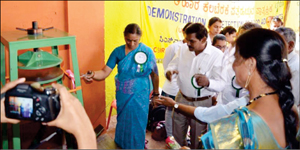
Training was arranged to two of the SHG members in the institute. A leg-operated papad- making machine (CFTRI design) and dough-mixing machine were bought from machinery suppliers.

The team conducted a survey of village and suitable place was identified for establishing the unit.

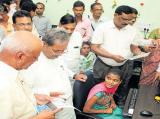
A brief function was arranged on Mar. 22, at Puttegowdanahundi, in which the machines were handed over to the SHGs by Prof. Ram Rajasekharan, Director of CSIR-CFTRI.

The entire village consisting of farmers, Members of SHG, Teachers, Caretaker of Anganwadi, students, and village representatives were present.

Also, water filtration units, developed by CSIR-Institute of Minerals and Materials Technology, Bhubaneswar, were handed over to representatives. The school was provided with laptops and an adulteration test kit to create awareness on food safety.

An Adulteration Test Kit was given to School for creating awareness in children on food safety. Later, CFTRI team gave a demonstration on how to use the kit to the students and teachers of the school.

source: http://www.starofmysore.com / Star of Mysore / Home> General News / April 07th, 2016

City architect only Indian at Swiss clock-making competition

Bengaluru:

Dilip Sivaraman, a Benglauru-based architect, believes everything has a soul and requires a human touch. For the same reason, he found love in watches that run mechanically.

“I have always loved the fact that a watch can be powered by you. Till today, I wear the HMT winding watch and it works beautifully,” he said. Little did he know that this passion for watches would make him the only Indian finalist on a global platform for watch-making apprentices.

For Dilip, 38, buying a 1980s clock over a year ago meant revisiting the heritage of clock-making. “I am a purist. So, whatever I buy or have currently in my house is a throwback in time,” said Sivaraman.

However, finding it tough to set the timepiece right, Dilip took to exploring the world of clocks himself. He searched the internet and scoured through online books on clock-making.

Recalling the experience of reading digitized versions of over 200-year-old books, Dilip said, “Most of these were written when technology didn’t exist. While questioning the need for complete traditional clock-making, I decided to integrate the use of technology into it as well.”

Although it took him 18 months, Dilip successfully designed and recreated from the scratch a mechanical regulator clock, which he named Gato.

Last September, while doing a regular follow up on the Academie Horlogere des Createurs Independants (AHCI) website, Dilip chanced upon the AHCI young talent competition for young clock/watch making apprentices. “I showed them the design of my clock while informing them that I’m not a formal student or apprentice. For something that I did out my love for it, they let me complete the project and send in my entry by January,” said Dilip.

Being the only Indian to enter the global competition and emerging among the top ten finalists, Dilip not only received huge support from the watch-making community at Switzerland but also got to meet his icon and renowned high-end watchmaker, FP Journe at the Baselworld watch exhibition in Switzerland this March.

A resident of Murugeshpalya, Dilip has plans to take his passion forward, “I wanted to make a clock that’d last for the next few hundred years and not just perish. At AHCI, I was encouraged to join their community of watchmakers. They have offered to review my work. But, for now, I’m hoping to wind up with Gato and, hopefully, start my next project soon,” he said.

Encouraging Experience

When I started the project I had no idea that it would enter the competition. The clock wasn’t complete and I had to seek an extension of deadline from the event organizers. But when I presented my work at the AHCI competition, watch-makers came up to me asking if I was willing to sell it. That was very encouraging. I hope to see my clock being sold someday and contribute to independent watch making.

source: http://www.timesofindia.indiatimes.com / The Times of India / News Home> City> Bangalore / by Deepika Burli, TNN / April 06th, 2016

Giving Voice to the Voiceless

Dr. Vishal Rao | Pushkar V

Losing one’s voice after an operation is very traumatic, and for patients with throat cancer, it becomes an added burden. India witnesses about 25,000-30,000 throat cancer cases each year, out of which at least 5,000 patients stand to lose their voice box due to the advanced stages of the disease.

Thanks to Dr. Vishal Rao, head and neck surgeon at Bengaluru-based HCG Hospital who has come up with a simple and affordable voice box prosthesis, patients can ‘speak’ again and swallow food.

According to Rao, one of the major disadvantages for throat cancer patients is the loss of their voice box when they undergo laryngectomy, the surgical removal of larynx. This is a hollow muscular organ forming an air passage to the lungs and holds the vocal cords.

Rao, a visiting scholar to the Pittsburgh School of Medicine in the US, says, “The larynx houses the vocal cords through which sound is produced. It also lets air travel from the lungs to the mouth. During laryngectomy, when the trachea (windpipe) and esophagus (food pipe) are separated from each other, an opening is created between them which is called the tracheo-esophageal puncture. The device is placed in this opening. Though the patients can eat through their mouths but they cannot speak due to the absence of the voice box.” Once he saw a villager who couldn’t speak for 16 years because he could not afford the imported device. Rao thought, speech and communication are not only the basic tenet to life force but a right to freedom, peace, dignity and justice. “These poor patients were bereft of this essential means of communication owing to costs only,” he says.

Rao realised there was a need for an improved device with a one-way valve enabling laryngectomy patients to speak. In 2013, he started researching on this problem. He and his industrialist friend Shashank Mahesh came up with a technical plan to develop such a device. After working for two years with engineers, physicists, biomedical and material experts, the voice box was built.

Explaining his innovation, the 37-year-old doctor adds, “Regaining one’s voice is much like a rebirth. We have named the artificial voice box as Aum device, because that sound first resonated across the universe. If air passes through the food pipe into the lungs, it will vibrate and create noise, which can be converted into intelligent speech, with coordination from the brain. As food or water should not fall into the lungs, it is a one-way valve device. It weighs about 25 grams and is 2.5 cm long.”

An imported prosthesis is available for Rs 20,000-45,000 and needs to be changed once in six months. “As 80 per cent of patients belong to the poor socio-economic strata, a majority of them are unable to afford the western prosthesis. Our innovation comes as a boon to them. We have priced it at Rs 50, which is less than a dollar at the moment. Presently, there is a clinical study going on at HCG, after which we will take it to other cities, especially to the regional cancer centres where there is a need for such device,” says Rao.

He has used the device on a few patients. Ramakrishna, a 55-year-old watchman from Bengaluru needed to change his imported prosthesis but could not afford it. “When my voice box was removed,  I was given an imported machine, which  I used for two years. I had trouble eating as the food leaked through the device. I am doing better after using the Indian device,” says Ramakrishna.

With more than 20 national and international publications to his credit, Rao has also received many global awards.

source: http://www.newindianexpress.com / The New Indian Express / Home> LifeStyle> Health / by Meera Bharadwaj / March 26th, 2016

‘Sneha Spandana ’ conferred with Youth Club Award

SnehaSpandanaBF28mar2016

Mysuru :

City’s Sneha Spandana Mahila Mandali, Kuvempunagar, was conferred with District Youth Club Award at the District Youth Convention jointly organised by Nehru Yuva Kendra, Department of Collegiate Education, Student Welfare Wing and NSS Unit, University of Mysore, (UoM) at Humanities auditorium, Manasagangotri here recently.

The award carries a cash prize of Rs. 25,000 and a citation.

Speaking on the occasion of award presentation, Mayor B.L. Bhyrappa said that Mysuru bagging the ‘Cleanest City in India’ tag for the second consecutive time, has brought enormous joy to him.

Pointing out that many Self Help Groups had joined hands with the MCC in keeping the city clean, Bhyrappa observed that relentless co-operation by Associations and Organisations, civic groups and members of the public, will go a long way in the city retaining the tag for a long time.

Maintaining that the MCC has launched several initiatives for making the city plastic-free, he called upon the co-operation of all stakeholders in this regard.

Noting that every individual has his/her own strengths, he opined that everyone should utilise their strengths for the betterment of society. He called upon Organisations to guide the youths in the right direction.

Joint Director of Collegiate Education Prof. Morabada Mallikarjuna, University of Mysore Dean Dr. M. Rudraiah, Administrative Officer Prof. C. Ramaswamy, Nehru Yuva Kendra’s M.N. Nataraj and others were present.

A total of 25 youth groups of the district were presented sports equipments on the occasion.

source: http://www.starofmysore.com / Star of Mysore / Home> General News / March 28th, 2016

‘Women should get Mental Independence ’

Mahila Vedike presents awards to achievers

MahilaVedikeBF28mar2016

Mysuru :

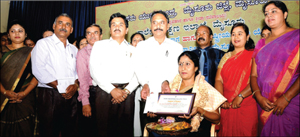
“By not fixing time for return of their wives, who go to their parents’ homes, men need to provide mental independence to women as even if they are at their parents’ house, they always think about the safety and well-being of their family,” observed Assistant Professor of Kuvempu Institute of Kannada Studies Dr. N. K. Lolakshi here yesterday.

Speaking after inaugurating a function organised by Karnataka Rajya Sarvajana Mahila Hitharakshana Vedike to present various awards to achievers as part of International Women’s Day celebrations at Rotary Centre on JLB Road in city, she said that laws should be formulated to make it binding on sons-in-law to take care of women who do not have sons.

Speaking after conferring Mysuru Rathna award on P. Supreeth, Chiguru Rathna and Sadhana Rathna awards on others, litterateur and former Sanskrit Professor Prof. K.R. Premaleela called upon the electronic media not to glorify events like child-marriages, sati, honour killing etc., which need to be shunned in the interest of safety of women, who have often been victimised for no fault of theirs.

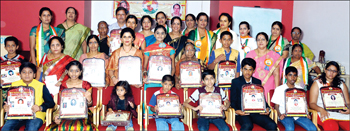
The other awardees are: C. Vani Raghavendra – Sahityashree award, Lalitha Sharma – Prathibha Rathna award, Chithra Nanjappa and Vidu. P.H.Vijayalakshmi – Shikshana Rathna awards.

C. Vikyath, S. Pratheek Gowda, K.S. Dhanush, S. Vidyadhar and H.S.Vinay – Chiguru Rathna awards; H.S. Vinayraj, N. Ranjini, B.S.Sahana Sharma, V. Ambika, N. Dhanushree, C. Kailash and Preethu Manjunath – Sadhana Rathna awards.

Vedike State President Yashodha Narayan presided. Vedike District President Amitha Subbaiah, General Secretary Latha Ranganath and others were present on the occasion.

source: http://www.starofmysore.com / Star of Mysore / Home> General News / March 28th, 2016

‘ Women Entrepreneurship ‘

DC Shikha & 10 women entrepreneurs feted during the seminar

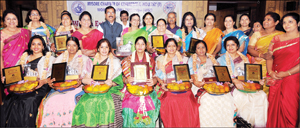
DC C. Shikha (seated centre) was felicitated by Women In Small Enterprise (WISE), the Women's Wing of Mysore Chamber of Commerce and Industry (MCCI) as part of International Women’s Day celebrations at the Quorum Hotel on Vinoba Road this morning. Also seen are ten women entrepreneurs who were felicitated by WISE and MCCI members.
DC C. Shikha (seated centre) was felicitated by Women In Small Enterprise (WISE), the Women’s Wing of Mysore Chamber of Commerce and Industry (MCCI) as part of International Women’s Day celebrations at the Quorum Hotel on Vinoba Road this morning. Also seen are ten women entrepreneurs who were felicitated by WISE and MCCI members.

Mysuru  :

‘Women should shun inhibition and become entrepreneurs to help solve unemployment in the country,’ suggested Sudhakar S. Shetty, Chairman, District Co-ordination Committee, FKCCI.

He was speaking as the chief guest at the seminar on ‘Women Entrepreneurship Development’ organised by Women In Small Enterprise (WISE), the Women’s Wing of Mysore Chamber of Commerce and Industry (MCCI), which commenced this morning at the Quorum Hotel on Vinoba Road here which was organised as part of International Women’s Day.

About 150 budding women entrepreneurs participated in the seminar where they were made aware on various topics pertaining to women entrepreneurs by several Resource Persons.

Deputy Commissioner C. Shikha inaugurated the seminar.

Addressing the gathering, Sudhakar Shetty pointed out that a soft loan at 4% interest was being offered upto Rs.50 lakh for women entrepreneurs and hence suggested women to make best use of the scheme.

Stating that the government too was providing good schemes for women entrepreneurs, he said that FKCCI too was offering good support for women to set up industries.

Shikha and ten women entrepreneurs — N.C. Chandana, Kavitha Sanjay, Jayashri Venkatesh, Kalpana Surendra, Smrithi, Veda Rai, Vyshali Hanumanthu, Lalitha S. Ramannanavar, Jayalakshmi Lingaraj and Shashikala Ashok — were felicitated on the occasion with shawl, garland and citation.

Mysore Chamber of Commerce and Industry (MCCI) President A.S. Satish, Vice-President N.H. Jayanth, Treasurer Srisaila Ramannanavar, Women In Small Enterprise (WISE) President Gayatri Keshava Rao, Vice-President Vasantha Kumari, Treasurer Malini Srinivasan, DIC Mysuru Joint Director Ramakrishna Gowda and others were present on the occasion.

source: http://www.starofmysore.com / Star of Mysore / Home> General News / March 28th, 2016

Old Student Gathers Forces, Restores 149-year-old School

GovtSchoolAnekalBF23mar2016

Bengaluru :

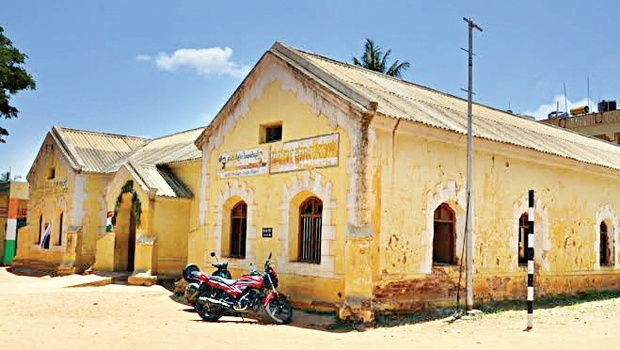
Government Model Primary Boys School, in Anekal, was started in 1867 by the British. It will turn 150 years next year and should’ve been preserved as a heritage building.

Instead, it was falling to pieces. The floors were cracked and the roof broken. The school lacked basic facilities like chairs and tables, and even toilets.

When Prem Kumari, who was a student here in the early 80s, came back as a teacher in 1994, she was disappointed with the way the school was being maintained.

“For the past 6 years, there had been a sharp fall in the strength of students because of the school’s condition. Since  I joined, I have been trying to convince people to save it. Elders of the community and panchayat members wanted to demolish it rather than restore it,” she says.

She approached the B R Sridhar, who was the president of Rotary Bangalore South, and spoke to the other members about the necessity to rennovate this heritage building.

It was adopted by the Club in 2014 and with the help of SABIC, a diversified chemical company, improved its structure and facilities. It has benefited over 218 students in Anekal Taluk, Sarjapura. This is the second school renovated by the club under the Rotary Mission to Teach programme, with SABIC as their CSR partner.

The chemical company’s CSR fund was channelled into the restoration of the school over the last 18 months — replacing the roof, keeping the old design intact; re-plastering the walls; replacing flooring with natural stone flooring; redesigning the courtyard; constructing a separate morning-assembly section; renovation of the kitchen; fixing new gates for the school compound; re-constructing toilets for boys and girls; installing an open-well water pump and purification system for providing drinking water and installation of CCTV security cameras. The refurbished school was inaugurated early this month.

Devendra, a Class 7 student of the school who has been studying there for the past 4 years, says “Earlier our classrooms were bad and there were no toilet facilities either. Now these are better and classes have become interesting with projectors and tablets.”

The student strength is now 200 and but the current infrastructure can serve up to 400 students.

source: http://www.newindianexpress.com / The New Indian Express / Home> Cities> Bengaluru / by Preeja Prasad / March 21st, 2016

Striking the golden mean

ProfSastryBF21mar2016

Prof. T.V. Venkatachala Sastry is an authority on ancient Kannada and Sanskrit classical texts. Speaking about the waning interest in this area of study, he tells DEEPA GANESH that we must be open to multiple interpretations of the text

It would well be a high pedestal if the acclaimed grammarian, lexicographer, Sanskrit and Halegannada scholar T.V. Venkatachala Sastry (TVV) sat on his achievements. But, on that cloudy morning in Mysore, the 83-year-old scholar was waiting at his gate. “You had to come all the way here, excuse me, I could not make it more convenient for you,” he said, with genuine concern. With over hundred books to his authorship, TVV is an authority on prosody, pre-modern classical texts, aesthetics, languages, literary criticism and more. He served the University of Mysore for several decades, and was later the director of Kuvempu Kannada Adhyayana Samsthe — the outcome of his erudition and vision has been huge. He has been guru to several generations of Indian students, and also to foreign scholars like Prof. Laurie Honke (who famously said to TVV: ‘You are Panini to me’), Prof. Showman, Prof. Karl Johanssen, and Prof. Stefan Anacker. Also teacher to the renowned Indologist, Prof. Sheldon Pollock, who attributes the idea of his book, “The Language of the Gods in the World of Men” to “the greatest living scholar in the field of old Kannada, T.V. Venkatachala Sastry”.

SastryStudyBF21mar2016

We settle down in his modest study, packed with books from all sides. On his bed by the window, are books that people have sent him, manuscripts, reading material etc. Lean that he is, TVV tucks in comfortably. The phone rings. It is a student who needs help with historical data. Yet again the phone rings, and this time in Telugu he tells the caller: “Of what use are these controversies? Chaduvukopora… Go to your studies, and I will also continues with mine.” In his home library of over 15,000 books, TVV knows exactly the location of each book. With undiminished energy after a conversation that ran into several hours, he explains his collection. “You must come again, I will keep some books for you,” he says with a rare generosity. The doors of his house constantly kept open for students, scholars, researchers and friends, TVV is so eager to give and share that 21st century ideas like “creative commons” seem outdated. For him, it is a way of life. Issues like intellectual property rights are hardly a matter of concern. Hence, if you discuss the global publishing industry, its politics and economics, you find that it lies outside his worldview. All that matters to him is the pursuit of knowledge.

Excerpts from the interview.

One often hears that soon there will be no one studying the classical texts in India, and the western world will be custodians of Indian classical studies. How do you react to this?

It is hard to give a yes or no answer. I don’t think that is expected of me either. Steadily, as someone who has been associated with the University, one see the dearth of students for Indian classical studies. About five decades ago, almost every Indian University had a department of Indian classical studies. We are hardly left with any now. With the advent of modern technology, it has become difficult even for departments of philosophy, science and literature to survive. Sanskrit and Halegannada became unpopular with students rather early.

We have had a continued relationship with Western scholars. They came from Germany, France, Finland, America… and worked extensively in India. For instance, Sir Monier Williams who studied, documented and taught Asian languages, wrote “An Elementary Grammar of the Sanskrit Language” (1846), compiled a Sanskrit-English dictionary (1899), A.B. Kieth wrote “The Sanskrit Drama” (1923), Weber’s “The Religion of India” (1916), F. Edgerton’s “Studies in the Veda” (1915), E.V. Arnold’s “Vedic metre in its historical development” (1905), Max Mueler’s “Sacred Books of the East” (1879-1910) and several others are early works by Westerners in the field of classical studies. There was rich literature available here and scholars have always been interested in studying it. Even back then, a lot was said about how they came with religious interest. It may be true, but it is not entirely true. They were genuinely attracted to languages, history and culture and worked assiduously. Karnataka has 25,000 to 30,000 inscriptions. Epigraphica Indica, the first volume of which was edited by James Burgess (1888) is the most competent. The later versions are just photographs of these inscriptions with no analysis whatsoever.

Their rigour was similar to that of our good old Pandits, who lived and breathed the subjects of their interest. The old school western scholars were also similar; however, you still find that this is a tradition continuing in their part of the world. Look how the outlook of our universities has changed so completely! They want to give you what is easy and what brings in many. The bulk of our literary, cultural-historical practises, has gone on reducing. Even if there is one single student, it is the responsibility of the University to keep the department functioning. You should be able to convince people to take it. However, ironically, now Universities ask, “What is the use of such a study?” Once you start asking questions of “usefulness” linked to material benefits, pursuit of knowledge simply moves to the background.

Do you think the Nehruvian imagination of State is also responsible for this?

Well… perhaps. It was a language of development, of course different from how we speak of it today. Also, these factions of Right and Left, have done more harm than good to classical studies. We must remember that the path of the King is flanked by a right and a left, but neither is complete in itself. Everyone wants to read their ideologies into these texts. Society is not just what constitutes our imagination. In this tussle for upholding one view, we have lost pride in what belongs to us. An anti-Sanskrit campaign started when ideologies began to take over.

Having said this, I think classical studies will survive. It will be sad that it may soon disappear from our formal educational processes, but it will live on, like it has all these years. I from my end, have started conducting workshops all over Karnataka for various interest groups.

Do you think the study of Halegannada and Sanskrit would help contemporary thinking, including the study of literature?

The classical way of learning is of no use to the “productive” outlook, to get jobs in this world. Let me tell you a story. A friend of mine, a solid pandit, was trained in the traditional way. Because he had not gone through formal schooling, he ended up as a middle school teacher. He took it as a challenge and did SSLC to MA from the Banaras University and became a lecturer. Isn’t this sad? The government must nurture this kind of scholarship.

The best of students go to other streams, and what we are left with is a disinterested bunch. My friend, a professor of philosophy, told me that he lectured on the philosophy of death for two hours, and at the end of it, students went out of the classroom laughing and whistling!

In your own personal interactions with several western scholars, were there moments when you felt “this far and no further”? Did you feel the “insider” was essentially different from the “outsider”? The outsider had an omniscient view, but a tad reductionist?

Hangal Virupaksha Shastrigalu, in the course of a conversation, had apparently mentioned to DVG that Westerners had done a lot of work. And DVG had remarked in a loaded statement: “Houdappa, they have. But with their mind.” (TVV laughs)

That’s exactly what they are saying about Sheldon Pollock too…

Is this great tradition of knowledge any single man’s property? It is for all. You have a problem with Pollock’s views? Let’s have an academic debate. Truth doesn’t change with somebody’s reading of it. I don’t understand this anxiety of representation!

Sheldon Pollock maybe alien to Indian culture and society. But the fact that he has spent four or more decades of his life studying all this, his readings will certainly not be grossly off the mark. Think of this – he could have chosen to study American literature which is closer to his culture. Why did he make this choice? He has been studying Sanskrit since he was 18. The respect he has, his passion, the depth and engagement, it is special. If you have to read old Kannada texts, you have to Shabdamani Darpana, which is no easy nut to crack. Pollock reads it. He comes back with doubts, and then when you give him an answer, he will tell you: “But this is what D.L. Narashimhachar has said…” Always thorough in his research.

Now listen to this. Kuvempu used to tell us in class that for us goddess Lakshmi comes with a whole emotional world of meanings, and therefore she means to us more than what she signifies. But for a Westerner, at best, she will be goddess of wealth. We recognise that difference. By virtue of being insider what is possible for you may not be exactly possible for them. But their research is also first hand. I personally feel that it is a great service that they have brought global attention to our ancient texts.

Having said this, let’s not even take away the merit of a discussion or of differences. Once, G.S. Shivarudrappa and I had a difference in a seminar about interpreting a verse from the Bhagavadgita. Should that take away our respect for each other? B.M. Shrikantaiah had once remarked that Halegannada poetry is kagga, old-fashioned and of little significance. Does that mean he had no respect for it? There are several instances to prove that he valued it immensely. I don’t understand this raising cudgel for everything.

I’m sure there have been discussions and disagreements between scholars in the past. Also inter-cultural. Can you recall some of those exchanges?

There have been famous exchanges, ones that have been documented. V. Sitaramaiah and R.V. Jagirdar (Sriranga), K. Krishnamurthy and Raganantha Sharma, Masti and Kuvempu, There are several others, academic and honest. That was the spirit of those times. The kind of teachers we had, and the writers of those times…. remarkable people who nurtured youngsters.

At the Shivagange Sahitya Sammelana for which Ram. Shri. Mugali was president, Masti had come. I had written a couple of essays for his journal Jeevana, so I went and introduced myself. He drew me into an embrace and said: “Chinnadanta baravanige. Golden writing…” There was nothing great in my writing, but it was their way of encouraging. Such generosity. Masti was so great a man that he apologized to Tirumalamba saying his observations on her writing were faulty. There was an intellectual atmosphere. Today, politics is dangerously ruling our cultural world.

Sediyapu Krishna Bhatta was an outstanding chandassu (metre) expert and a vedic scholar. S.D. Velankar had read all the Prakrit and Sanskrit texts. He had read so much more than Sediyapu. When he presented his views, Sediyapu didn’t take offence. Isn’t that a growth in pursuit of knowledge?

Let me tell you of A. Venkatasubbiah. He was a wonderful scholar. He was a master of vedic studies and Panchatantra. He had a doctorate from a German University in 1910. He wrote a 650-page book on the Veda. During the period even Western scholars were majorly into research. Venkatasubbaiah who had read all their works went on record to say – “Their estimate of several things are wrong because of cultural gap. I will revise the work of these German and French scholars.” In reply, one of them wrote, “Venkatasubbaiah is a great scholar but is not aware of recent research.” Isn’t this an ongoing process in the pursuit of knowledge?

I remember once Pollock asked me a question related to the works of Rice and Kittel. He had disagreements with their findings. He could have easily said, “What does this Venkatachala Sastry know? Kittel is the greatest afterall!” But that is anti-academic culture.

We have lost the tradition of Pandits. It has been replaced by professors. What is your reading of this situation?

The Pandits were unshakeable scholars. They had complete hold over the texts. They could extempore quote hundreds of poems, they could tell you the source of the words, their meaning, grammar… etc. University trained professors are aware of the modern tools of criticism, but their scholarship is limited. Also, the passion and commitment of the pandits cannot match that of professors. It is indeed a loss. In fact, DVG and Ti.Nam. Shrikantaiah have discussed this issue.

What is the difference between Indian and Western students?

It is very different, yet what I say are not generalisations. I have had fine students in the past who have become reputed scholars. Now, our students are not interested in the foundation. They are always trying to see how they can fit their ideologies into it. I always tell them to enjoy reading poetry for the sheer experience of finer feelings. Once that is done, you can start analysing and exploring other things. They are not prepared to enter the gateway of classical literature. They have lost patience, interest, engagement and the tools.

The West is interested in research, and wants to find new dimensions. They don’t get satisfied easily and work with perseverance and patience. Also, there is an academic system that is interested in the work of these scholars. They ask them questions, and engage with their work. There is a world that is watching them with interest. Here, even if I put out a great work, I am not sure if another scholar working in the same area as I do, will even read it. That makes a huge difference to your outlook.

You must understand one more thing, you get huge honours easily now. Social justice is fore-grounded and talent takes a backseat. Neralige sanmana madovaaga, akruti beke (when they felicitate shadows do you really need the real persona?)? Nevertheless, passion and interest needs no justification.

U.V. Swaminath Iyer, the Tamil scholar, writing about Malur Ranaganathachar who taught Sanskrit at the Presidency College says, “his head was constantly buried in some book or the other”. M.S. Puttanna writes about Triyambak Shastri: “He was always reading or writing. In case he felt drowsy in the afternoon, he would sleep over his book, wake up and start reading.” Ralapalli, our teacher, was an outstanding scholar. He would say, “I am slightly doubtful of this. I have asked D.L. Narasimhachar to help me with this.” Chidananda Murthy, at his age, calls me frequently to discuss something or the other. Learning is not easy. It is upasane. I feel thrilled when I read of such things. It is hard to find such people now. They all believed in the power of the text. Tell me, will Bhagavadgite get burnt if you burn it…?

You are quintessentially a traditional scholar who is not anxious about other readings of our texts…

Let me clarify this. I am a traditional scholar who has immense faith in the kind of learning that was imparted to me. We have a tradition and I believe in its values and respect it. I am also aware of its weaknesses. In a sense, I am also a moderner and in many ways I subscribe to some aspects of modernity. For instance, the liberal outlook that came with it. I stand in this new world, and would like to envision the ever expanding meanings of the old world order. I will not impose my beliefs on it. I adhere to the text, and am interested in its interpretation. No political ideology or country stamp will take me away from my commitment to the text. I will stand by what I find correct. If Pollock or whoever makes a mistake I will tell them my views. Since I respect scholarship, I respect Pollock’s dedication and good work too.

I want to quote Kavirajamarga. In a verse, Nrupatunga raises this question: “What is kasavara (gold)?” If you can accept another’s thoughts, another’s religion with antahkarana (feeling), that is gold. Else, he says, kasa (dirt) and kasavara (gold) are the same.

Corrections & Clarifications:

This report has been edited for factual errors.

source: http://www.thehindu.com / The Hindu / Home> Features> Friday Review / by Deepa Ganesh / Bengaluru – March 17th, 2016
Now, information on all govt services just a call away


PatilBF20mar2016

Minister for IT, BT and S&T S R Patil launched ‘Pratispandana Helpline 1800 208 1237’ to provide information and services to the public here on Wednesday’.

The department of IT, BT has set up the centre through its IT service wing KEONICS and it is the first-of-its-kind in Karnataka. It provides all information related to government schemes under one roof, (on toll free number). The centre will be functional from 10 am to 6 pm on all week days (government working days).

On the occasion, Minister Patil said that Chief Minister Siddaramaiah had announced the launch of a helpline in 2015-16 budget. If there is a good response to the people-friendly helpline, similar helplines would be launched in every district in the State. The helpline centre will also facilitate appointments with government officers of different departments in case of public demand. Public can also enquire about the APMC rates, he added.

Information about various hospitals, medical facilities, ration card, Aadhaar, RTI, permits and licences, students’ scholarships, soil cards, services related to education and RTE, will be a call away. The staffers for the service centre had been recruited from Vindhya E-Infomedia private limited, a Bengaluru-based BPO which recruits physically challenged candidates, who will run the helpline, the minister informed.

source: http://www.deccanherald.com / Deccan Herald / Home> State / Bagalkot – DHNS / March 17th, 2016

Bengaluru pals building India’s first driverless car

For Bengaluru techie Roshy John, it was a near-death experience brought about by a sleeply taxi driver that got him thinking.

Chennai:

A few years ago, Bengaluru-based techie Roshy John was one his way home from the airport in a taxi when the sleepy driver almost ran into another vehicle. John took the wheel and drove the driver and then himself home — but the near-death experience got him thinking. Five years later, he and his friends have developed India’s first driverless car — Tata Nano Autonomous.

John, who is practice head, robotics and cognitive systems at TCS, and his 29-member team worked on the software and algorithms in their free time and created a 3D model to test it. The car is yet to be tested on the road, and John is hoping to get permission from the traffic police soon.

In 2011, John purchased a Nano to test the software. “The Tata Nano is considered an engineering marvel. What better car to test Indian technology than on a car made in India?” says John. Across the world, Daimler, Nissan, General Motors, BMW, Google and Tesla are investing big bucks in developing driverless cars .

John used onboard diagnostics, a regular feature in most cars today, and a scanner to monitor the engine. “I had to get data from the car to make it accelerate or slow down based on the RPM,” explains John. Creating an algorithm using a custom cluster (multiple computers), John and his team were able to read all parameters of the engine.

Several other devices were used to extract vitals of the car and its surroundings — wheel encoders to measure the speed of the wheel, multiple lidars (a surveying technology that measures distance by illuminating a target with a laser light) to identify obstacles around the car, HDR cameras and GPS. The data was processed by the software to make the car ‘drive’ like a human.

He attached pedal robots to the accelerator, brake and clutch and connected them to the software. The ultimate test for the team was when the car halted by itself when John jumped in front of it. In May 2012, John’s autonomous car drove the roads of Bengaluru for the first time.

John’s journey wasn’t easy though. They were often interrogated by the police, who got suspicious about the cameras and many computers in the car. To import the scanners, John had to submit a three-page essay to the commissioner of customs before he was given his package. Amidst work responsibilities and project deadlines, John and his team have been at work on the autonomous Nano.

So what is the way ahead for John and his driverless car ? A demo event for people to experience the technology will be scheduled soon. Having invested more than Rs 1 crore on the research, he is testing the technology on other cars. While John has been approached by several auto companies, he has kept the offers at bay. “Right through my career, I have encouraged my team members to experiment with advanced technology. I built this car to satiate my hunger for innovation in robotics and inspire others,” he says.

(This story has not been edited by timesofindia.com and is auto–generated from a syndicated feed we subscribe to.)
source: http://www.timesofindia.indiatimes.com / The Times of India / News Home> Tech> Tech News / by Ranjani Ayyar / TNN / March 16th, 2016