Category Archives: Inspiration/ Positive News and Features

Mother for a Special Cause …..

SowmyaBF12mar2016


by Nandini Srinivasan

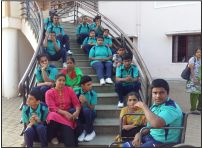
Opportunities to find deeper powers within ourselves come when life seems most challenging. Its one such challenge that pushed K.V. Sowmya to harness her innate powers into an opportunity to help the specially-abled. It’s with these inmates of her school Karunamayi Foundation in city that Sowmya finds solace and braces herself to face her tomorrows which still look challenging!

Life for Sowmya, a Journalism Post-graduate, was all pink and rosy, till her husband Rajesh, a journalist with a popular national daily, succumbed to depression, leaving her to fend two young kids and a family that made her go through the travails of widowhood! Driven to the brink of despair by the taboos of the society she was surrounded by, Sowmya could not pursue her studies in Mental Disorders, which she was very passionate about. On one of her visits to a school for special kids, which her nephew attended, her interest in dealing with people with special needs was rekindled when her nephew was treated successfully and joined the mainstream which further pushed her interest. It was then she decided to move from Mandya to Mysuru and started the Karunamayi Foundation, a day school for the specially-abled in a rented building in TK Layout. Despite offering free services, Sowmya had to run the school for a more than a year with just one kid!

Undeterred by the poor response, Sowmya with a meagre income to manage her life with a two-year-old daughter and an eight-year-old son, decided not to close down the school, as her passion was to work with people with mental disabilities.

When the neighbours of the only student of Sowmya’s school noticed a visible improvement in the way the child learnt to manage herself, curious parents of children with similar disorders visited the school and apprehensively sent their wards there. Today, the school has 35 inmates between the age group of 4 and 43 years, all with different levels of disabilities. No fee was collected all these years but now to bring in a little responsibility amongst the parents, the school charges a very nominal fee of Rs. 100 every month.

Depending on the level of disability, the inmates are given vocational training and three children have managed to pass their SSLC last year.

Those in vocational training are taught to make paper bags and woollen garlands. This year the school was given an opportunity to open a stall at My Build Expo where it managed to earn Rs. 12,500 by selling products.

Sowmya fondly recalls the help extended by Deputy Commissioner C. Shikha, who gave the special kids an opportunity to take part in the march past during last year’s Independence Day celebrations.

Managing an institution with meagre resources is a big challenge which Sowmya still faces. There are some good Samaritans who do come to help. One Mr. Balaji Srinivas, residing in Oman, has donated a Omni van and pays the salary of one teacher and also the monthly rent of the building. He is even prepared to construct a building for the school, if a site is allotted.

The journey of these seven years hasn’t been easy for Sowmya. “It isn’t about finances alone. It’s the taboos and the conflicts within and outside that arise when a woman loses her husband at a young age. In spite of all the progress that we speak of, our society still has ample doses of regressive thinking which can push women to the brink of total despair. It’s your determination and grit to go ahead and do what you passionately believe that gives you a purpose to live,” says Sowmya, who wants her daughter who is now in Class 5 and her son in Class 10 to pursue their education in the field of special education. The school organises a big cultural event every year with more than 300 children participating in dance competitions. Apart from giving a gift to each child, the first three winners are given cash prizes too. This year the school plans to hold a summer camp for specially disabled kids from April 15- 30, the venue of which is yet to be decided.

Though slow, the progress shown by those who enrol into her school is a big motivation for Sowmya and her staff. Sowmya proudly introduces Nethra a 17-year-old girl, who came in four years ago and needed help for everything, but not she not only manages herself well but manages others too! Sowmya also sadly speaks of Priyanka who had to suffer because of the carelessness of her father, who while trying to hit his wife hit the four-year-old on the neck resulting in a severe damage to a nerve rendering her speechless and mentally deranged! The father abandoned the mother and child! The mother who was finding it very difficult to manage her life, found a saviour in Sowmya! She admitted Priyanka ( who is now 17) to the school and earns a living by stitching clothes during her free time.

Sowmya has plans to expand the school which is presently located in TK Layout. The school runs from 10 am to 4 pm. If you do drop in, take with you your stocked old newspapers and magazines, as it will help them make paper bags and bins, which bring in some revenue to the school.

source: http://www.starofmysore.com / Star of Mysore / Home> Feature Articles / March 12th, 2016
Meet the Woman Forest Guard

An epitome of confidence and courage

netragowdaBF12mar2016

by M.T. Yogesh Kumar

Her confidence and fearlessness deserves to be commended. Her work in dense forest in close proximity of wild animals needs a special mention of her courage.

The woman in question is Netra Gowda, who is serving as a Guard in Forest Department posted at Bandipur Forest Range. A native of Honnavar in Uttara Kannada district, she is the daughter of Timmappa Gowda and Mahadevi. She is learnt to have landed as a Forest Guard not by choice but by chance and has been serving for the last six years.

About six years ago, Netra was an Arts student at SDM College in Honnavar. A friend of hers was learnt to have given her an application form for the post of Forest Guard. She then filled the form rather casually and submitted to the Forest Department. To her surprise, she got through the written test and was selected for the post of Forest Guard and was posted to Bandipur Forest Range.

On the first day of her posting she was taken by the Forest Department staff in a jeep into the forest for getting her familiar to the wild environment. By sheer coincidence, the jeep was attacked by a wild elephant and Netra was terribly upset and shaken to the core. She even confessed to her parents about her inability to get used to the harsh facts of working in the forest. However, Netra was encouraged by her sister Jaya and parents not to give up and was instilled courage to face the odds in her career.

Netra took up her job with confidence, girt and courage and there was no looking back since then.

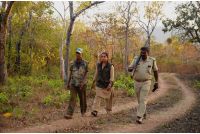
Now, Netra is a member of a team of four forest guards entrusted with patrolling an area of 12.75 sq.km of Kadamattur Katte belt near Maralahalla Camp in Bandipur Forest Range.

She has encountered ‘Prince’, the popular tiger, a couple of times during her patrolling duty. She has also recently seen Prince’s offspring Madesh with its mate and three cubs in the deep forest, not to mention leopards and wild elephants.

Speaking to Star of Mysore, Netra said “I was very afraid in the beginning to venture into the forest alone, but I received a lot of encouragement from my colleagues and parents. Now I am very confident and proud to be a forest guard. The initial reluctance is no more and now I am effectively managing the responsibility I am entrusted with by the Department and feel at home in the forest amid wildlife.”

Project Tiger Director Mallesh speaking to Star of Mysore said that all the staff serving in the Bandipur Forest Range were provided with all facilities

source: http://www.starofmysore.com / Star of Mysore / Home> Feature Articles / March 12th, 2016

Messenger on a Mofussil Mission

Khadri Achyuthan | Pushkar V

Khadri Achyuthan has a soft corner for rural India. First as a journalist with a Kannada newspaper and then as a communications officer with the government, he had to extensively travel to the rural areas of Karnataka and popularise new methods of agriculture and irrigation. Even after retirement, the 70-year-old has found it difficult to sever ties with the rural people.

He wants them to grow, and come on a par with the ones living in urban land. To ensure that, Achyuthan is now on a mission to take social media causes to the grassroots level. Realising the importance of social communication in the rural areas, a group of journalists has launched a media research studies institute in Bengaluru, and as a managing trustee, he is training village youngsters in skill development.

The institute, which started its journey in the beginning of the month, is trying to garner funds by holding monthly media workshops, seminars and publications. “Journalism has taken different shapes and has impacted the society over a period of time. But technology has overtaken the language of the media and young journalists have to be equipped with storytelling abilities for portraying an event in the right perspective,” he says, adding that media education scenario in the country is quite depressing. “Language is losing its importance. The academicians and journalists have to come together to give hands on training to print and broadcast journalists,” he says.

Before taking up the government job in 1966, Achyuthan worked as a journalist with Navakalyan, a weekly paper published from Gulbarga. As he speaks, the veteran admits that the travails have helped him dissolve into something complete and fulfilling. It was in 1965 that he came to Bengaluru in search of a job. “My mother was not well and we had no money to buy her medicines, but she was bent upon sending me to the city. I managed to get a job at a salary of `60 per month. My passion for Kannada did not allow me to join an English newspaper. I shunted from one paper to another,” he says.

During his stint with Navakalyan, he came closer to rural people. However, after the Indo-Pak war in 1965, the government of India was in need of information officers and he cleared the tests successfully in an emergency recruitment in Madras and joined service at Shimla in 1966.

He was also one of the first 24 candidates to be selected by the Union Public Service Commission (UPSC) and was posted as Field Publicity Officer, a position created by Jawaharlal Nehru to popularise the Five Year Plan at the grass-roots level.

In those days, when television was a distant dream, people flocked to see the news reels or any developmental films shown by the government. “Topics on agriculture, family planning and national integration were shown to the masses and the issues discussed threadbare. Most of the audience were illiterate and cinema itself was a new medium,” he says.

In his long tenure, he has come across instances when the government found it difficult to spread social issues among the rural people. He still remembers how the villagers would run away from the government officials thinking that they would be forced to follow family planning programmes.

Even as the influx of refugees from Bangladesh began in 1971, Achyuthan admits that rural communications in the country grew at that time. “Films Division was making and sending documentaries on the plight of Bangladeshis. We had to explain rural people about the creation of West Pakistan and the exploitation of East Pakistanis. To our surprise, people were eager to know and understand the refugee problem, while school children used to queue before information office to know the show timings,” he says.

Also a noted Kannada author, Achyuthan’s tryst with audio-visual communications began in 1981 when the first regional Kannada news on All India Radio Dharwar was launched. “Telecommunications had not improved and with the Dharwar services, both Press Trust of India and United News of India too started. Our bulletin almost became a mouthpiece for Gokak agitation in 1982-83,” he says.

The veteran journalist and a writer believes that those avenues helped rural communication grow. He has also written a book in Kannada on the Indian Space Research Organisation and its grassroots application. His other works include translation of Ashok Mehta’s studies in socialism, a German diary, Tenali Ram’s applications for modern business management.

source: http://www.newindianexpress.com / The New Indian Express / Home> Magazine / by Meera Bharadwaj / February 27th, 2016

Natl. Balashree Awardee’s journey’ from Mysuru to Dilli…

Ankitha with her parents.

by Ankitha Kishorchandra, National Balshree Awardee for Creative Writing

I still remember the day that found my mom and me shooting off to Jawahar Bal Bhavan right here in Mysuru. She was taking me to participate in the district-level Balashree Competition under the Creative Writing category. She had seen the circular in this very paper, Star of Mysore. I was initially hesitant and unwilling to participate in the competition for the prestigious Balashree Award which is a Presidential Award. I never knew the intensity and importance of the whole award then !

Finally, I groused, groaned, moaned about losing a whole afternoon [which would have been spent in reading books, nevertheless…], I sat behind my mom on her two-wheeler and found myself in Bal Bhavan.

There, I could see kids around my age and older, carrying things that totally matched the category they were participating in. I saw a few kids in colourful Bharatanatyam costumes and some carrying musical instruments. Others were holding bags overflowing with brushes, paint tubes, and pencils. Some were balancing science models precariously in their hands. The rest were like me; wielding nothing but an exam pad and a pen or two… All of us kids under the ‘Creative Writing’ category were made to sit in an auditorium in the campus itself. Parents were asked to move out, and my mom taking her cue, flashed me a ‘thumbs-up’ sign and requested me to take the whole thing seriously as taking things seriously was not something that I usually did for any competition.

The competition started. We were told that there would be three different sessions and were given sheets of paper. The first session was to write an essay on ‘India’s Heritage Sites.’ With a rather resolute sigh, I started penning down whatever I knew about our heritage sites, and almost coincidentally, just when I was finishing my essay with a flourish, a person came to take the sheet away and gave us new ones for another session.

This time, we had to write a story with mythological elements… This was my piece of cake ! I made my protagonists the avatars of Indian Gods [I know what you are thinking…But I had never even heard of the Kane Chronicles then!], and they saved their city from blood-thirsty demons.

The next hour was truly poetic… We had to write a poem on ‘Nature.’ We had to write only four stanzas… Nothing more, nothing less. I made it as beautiful as I could… and thus ended my saga here at Mysuru.

Two days later, the good news reached us! I got selected to compete in the Zonal-level between Andhra Pradesh [it included Telengana then] and Karnataka. I couldn’t have been more pleased! Heartened by this good happening, I started believing my own abilities better. So, the D-day arrived and we found ourselves in Hyderabad for the competition. There were arrangements for us to stay in a very nice hotel, which was quite spacious [and I do miss the food!]. On the first day, we did some sightseeing and did some shopping too. The sessions started on the second day. Forgive me, I only remember two sessions out of the four sessions that we had. One session was a poem that we had to write on ‘Superstitions’ and the other session was about writing a story on ‘Time Travelling.’ I made a few friends too — Pabitra, Ansar, Sathvika and Prathyusha.

Soon, we were heading back to Mysuru. I had done my best in Hyderabad. It was now up to the guiding light above me, to put me through to the National-level or not. The long wait ended with good news again. I was through to the National-level to be held in Delhi. But what was more exciting to me was all my friends from the Zonal-level had also made it to the Nationals! So, in August of 2014, we headed to Delhi [we first got down at Agra and paid a much needed visit to the Taj. Wah, Taj! My friends and I had a happy reunion in Delhi National Bal Bhavan, where only we kids and our escorts were supposed to stay. Our parents had to find other places for accommodation. It was a rather wild, ragged experience, staying away from my mom for five days.

For the National-level, we had seven sessions in all and I remember every session very vividly. But I don’t think I can give an elaborate writeup on every one of them, as unfortunately, my time is running short… It is a mysterious thing, time, always being fluid at the wrong hour. Anyway, that is not relevant. Back to square one.

The first session was a common session for all the four categories. We had to dish out different uses of a cotton cloth — that was quite brain-storming. The second session was to write a poem on ‘Mythological characters’ — this was a little tricky as we were given word and stanza limits. The third session was also a poem on ‘I remember.’ The fourth session was to write a story based on a picture that was given to us. The fifth session was again a story on ‘I lost my way’ [I gave it a tinge of terror]. The sixth session was to write ‘An autobiography of our School Gate’ [Yes, you read it right], and lastly, the seventh session was to come out with an advertisement to invite people to our home city for an event it was famous for [I proudly showcased our Dasara], but this had to be done in just 6 sentences!

The sessions were brain storming, but nice and different.

We all had an awesome time and it was then time to bid adieu to Bal Bhavan… another sad farewell to my friends and Delhi too.

And then, the eternal wait started… My mom anxiously scoured through the official website of National Bal Bhavan at least a gazillion times everyday. The number of times she went through the site everyday actually resulted in ‘National Bal Bhavan’ becoming a suggested site on the Home Page. I just kept silent, and when anyone asked me about my chances of winning the award, I gave an aloof ‘I don’t know’ and acted like I didn’t care. But I did. A lot. It would colossally crush me if I didn’t get it. And then one fine day, on March 17, 2015, to be precise, my mother was doing her routine check on the site [this time on her phone]. She saw a marquee ‘National Balashree Results 2013’ flashing past. She immediately swept away to the computer to check it on a ‘big screen,’ all in a state of great confusion and impasse, on whether I would get it or not. This was it. The sounding board. The judgement of my ability. The state of my ego. My entire life. I was totally freaking out and I tried my best not to hyperventilate. My mom clicked on that marquee with a shaking mouse, or rather, a shaking hand. The first category was Creative Performance, the second was Scientific Innovation, and the third was Creative Writing. As we went down the list of awardees, I felt my heart in my mouth. There was no trace of my name. Not yet… And there it appeared! Serial No. 41-ANKITHA KISHORCHANDRA, all in bold! My mom gave a resounding scream of delight and thereafter, she burst into volumes of tears. I admit, I teared up a little. It was a huge relief for me. Then there were the phone calls to our family and friends and the good news went around.

Life went on normally after that. Then the time came for us to send certain details about me to Bal Bhavan, Delhi, for the Award Ceremony and all this was done through e-mails and couriers, and my mom took great pleasure in sending all these herself.

The days, instead of slowly passing by, started whizzing past on full thrust… The day of the Award Ceremony dawned upon me like a bright star. But I had to taste this sweet with a huge pinch of salt. My father could not come to attend the Award Ceremony as someone had to stay behind to look after our pet dog, Bonia, and he chose to. I was of course, engulfed with sadness, and I knew that no pleading or compelling on my part would help.

So, again January 31, 2016 found us (my mom and me) in National Bal Bhavan, Delhi. None of my friends from the Zonal and National-level had made it, so I made other friends, though I missed my old friends very much. The stage rehearsals went on in full swing on February 1 and 2. We, the Creative Writing awardees had to write a poem and we decided on the topic ‘A clean India in the eyes of the youth.’ We didn’t focus only on the garbage littering the streets of our country but also on the social evils that have almost swallowed India. The Creative Performance kids had prepared a beautifully choreographed dance ready and the Creative Arts Awardees got busy with painting huge canvases. All these preparations along with rehearsals kept us busy for those two days.

And then the day arrived… February 3, it will be etched in the memory of all of us 62 Awardees forever in our lives. We were taken to the Vigyan Bhavan at 8.30 in the morning where we had another round of rehearsal.

The Plenary Hall, Vigyan Bhavan was the venue. Our parents followed us at 10.30. Time flew past in great dollops. The chief guest for the day was Hon. Minister for HRD, Smt. Smriti Zubin Irani. She arrived exactly on time, 12 noon. The ceremony started. Though every second passed by faster than the speed of light, I remember each second clearly… The Award Ceremony began with the Creative Performance awardees.

Soon, my name was called out to go and receive the award. I was not nervous, but I did feel trembly, happy, proud, confident and satisfied, all at once (and I do not know if there is a word that includes all those feelings). I received the award, spoke a few words with the Minister [everybody later told I spoke a lot…] and went back to my assigned seat. The ceremony got over just as quickly as it had started. I was extremely happy for myself and for my parents too and knew they felt the same. The next day, we were on our way back to Mysuru.

The whole experience was very nice, memorable and made me think and view things differently. The feeling and the Euphoria of winning a Presidential Award has not yet sunk in, and I do not want to think too much about it. I want to be the humble person that I am and keep reading more and more books always…

source: http://www.starofmysore.com / Star of Mysore / Home> Feature Articles / March 03rd, 2016

Where ideas for social enterprise take wing

Manas Nanda, founder of Harvest Wild which offers livelihood to people living in remote forest areas

Bengaluru :

A graduate from Oxford University, Manas Nanda’s dream was to make a social change. He found his way back to his roots by starting ‘Harvest Wild’, a social enterprise, with an aim to create livelihood opportunities for people living in remote forest areas in India. It was at IIM-Bangalore’s incubation cell, NS Raghavan Centre for Entrepreneurial Learning (NSRCEL), where his idea of bubble nut wash was mentored.

“I launched the pilot project at my hometown in Odisha in January 2015. I got sackful of soap nuts from nearby villages and did a few trials on how we can present them in a format to be used as laundry detergents. The product is now available in organic stores in Bengaluru. We are also taking online orders from across India and the UK,” Manas, 40, says.

His first task was to identify his role as a bridge between rural communities and health and environment-conscious urban consumers. “I was fascinated by the fact that we could make a dual impact—create livelihood in rural India and reduce use of toxic chemicals in modern detergents that affect people’s health and water bodies. I would travel to forest areas to see if some of the fruits and berries can be processed into marketable products that urban consumers would value,” he adds.

His proposal was chosen from hundreds of early pre-product entrepreneurial ideas that NSRCEL, one of the oldest incubation cells across all IIMs, receive every year. Such ideas go through several mentoring sessions by screening committees before emerging as market ready.

“Today, the scenario has changed from what it was some 15 years ago and the market is full of incubators. Our first challenge is to distinguish ourselves from the clutter. At NSRCEL, we are working with enterprises which have nothing more than a slide deck and a team. We help them acquire customers and build capital in 12 months. We look for impact-making ideas; the process starts after the entrepreneur presents his/her business plan to the committee. The possibility of incubation is informed to the entrepreneur in two days. During incubation, there are a number of review meetings with NSRCEL team to monitor the progress the company makes while incubating at the centre,” said NSRCEL chairperson Prof. G Sabarinathan.

According to him, the biggest strength of NSRCEL is its mentors who guide and mentor the incubates and play a major role in shaping up the new ideas.

Women top ideators

Annually, NSRCEL considers 80 ideas, promoted by teams comprising five members each. The maximum number of ideas are floated by women.

Chippersage, incubated at NSRCEL in 2012, was founded by Latha Srinivasan, a former software engineer. The software, which promotes English teaching in a fun way, is being used by schools in and around Bengaluru. Chippersage has developed a product to kickstart reading independence among children.

Alma Nourisher, a child nutrition and wellness firm, which aims to bridge nutrition gap in preschool/school segment with an analytic platform, is founded by Priyamvada Chandramouli. The wellness portal helps parents track their child’s nutrition levels and contribute to prevention of lifestyle diseases like obesity, cardiac ailments and diabetes.

The market winners

The past incubatees at NSRCEL include companies like JustBooks, Amagi, Milap, MeshLabs, Alma Nourisher, Brizz Tv that have made an impact or even redefined the markets they serve.

source: http://www.timesofindia.indiatimes.com / The Times of India / News Home> City> Bangalore / by Shilpa Baburaj, TNN / February 23rd, 2016

MCC greets Singapore-Bound Pournamika Leader

Mysuru :

MLA M.K. Somashekar, Mayor B.L. Bhyrappa and other officials yesterday felicitated Pourakarmika leader Mara who left for Singapore.

PournamikaBF20feb2016

Somashekar, speaking on the occasion, lauded the role of Pourakarmikas in Mysuru being named ‘Cleanest City in India’ for second time in a row and added that all efforts would be made to provide them with benefits. Corporators Sunil Kumar and J.S. Jagadish and others were present.

source: http://www.starofmysore.com / Star of Mysore / Home> General News / February 19th, 2016

From Child Artiste to Woman Activist …

Her journey towards ‘Swach’ Bharat had begun before Modi’s Mission

From Reel life to Real lIfe: Rekha during one of her lec-dems at an apartment in city.

Giving up was never an option for this ebullient woman, who was a child actor once and was known by the name of Baby Rekha. She has acted in more than 70 films in Kannada, Tamil and Telugu like Bhakta Siriyala, Tulasi Dalam, Madhura Sangama, Simhada Mari Sainya to name a few.

by Sujata Rajpal

Long before our Prime Minister Narendra Modi’s Swachh Bharat Mission was launched across India, a woman in Mysuru had already started working towards it slowly and steadily. Unaware of Modi’s plan, she had named her organisation SWACH (Segregation of Waste And Composting at Home).

Started in 2013 as a one-woman army, Rekha Rohit visits people’s houses, ladies clubs and apartment complexes (on invitation, of course) to educate residents on how to manage household wastes. Apart from organising awareness sessions on cleanliness, Rekha also trains people on how to segregate waste in various categories and disposing it off accordingly. Besides segregation of waste, she also teaches children and destitute women how to make paper bags.

“I got inclined towards this cause many years ago when I used to travel a lot by train taking my children for various table tennis tournaments across the country. The second class compartments were an eyesore. Dirty wash-rooms, trash strewn all over, passengers spitting anywhere — it was stink and filth all around on the platforms and stations. That instigated me to create awareness about the need for better civic sense,” says Rekha.

Why people in India can’t treat the public property just the way they regard their houses? Is it the lack of civic sense or plain disregard towards one’s surroundings? There is nothing wrong with people but obviously something is not right with the system. Indians lack civic sense only on their motherland. When they go abroad, like everyone else there, they dutifully throw trash in the trash bins and in the absence of a trash bin in the vicinity, they save the wrappers of chips and used paper napkins in the outside pocket of their bag until they can spot a dustbin for depositing the waste where it rightfully belongs. But the moment they land on Indian soil, there is total reversal of behaviour. The civic sense goes for a walk in the woods and these very people litter everywhere.

Come to think of it, each household adds 365 plastic bags to the total waste. Multiply 365 by the number of households in Mysuru and you will be shocked by the amount of waste that only one Tier-2 city is producing. Can such a huge quantity of waste be decomposed naturally?

How is the response to your campaign? I am curious to know.

“When I started, the response used to be very disappointing; women would come up with puerile reasons for not segregating the waste like there is no place in the house to keep two dustbins, the maid servant doesn’t know how to segregate the waste etc. There were days when I used to cry because people shrugged me off wherever I went.”

Despite the cold response, Rekha stayed steadfast in her mission. “The response is much better now, people are aware and understand how important it is to reduce the total amount of waste that we produce,” Rekha says with a glint of hope in her eyes.

She received a lot of encouragement from Dr. M.R. Ravi, former MCC Commissioner, who advised her to continue in her mission despite innumerable road-blocks.

“What I am doing is a very tiny step. If the government sees the waste management as a mammoth problem in future then there is only one solution. Make it mandatory to segregate trash into wet and dry categories, the way it is done in the developed countries. Don’t you see now two-wheeler riders are wearing helmets because it is either wear helmet or pay fine,” says the woman with a contagious smile.

Rekha is now ably supported by K. Sowmya (Gynaecologist and Assistant Professor at JSS Hospital) and K.P. Ganga (Vice-Principal at Queens Institute for Fashion Designing) and, loads of well-wishers from Rotary East who were her backbone in the initial stage of bringing SWACH into action. The organisation has a team of 15 volunteers but many more hands are required to spread the message.

Rekha believes in driving this mission through children. She regularly conducts awareness sessions on cleanliness and waste management for the students of Kalalavadi School in rural Mysuru. If the initiative is taken through children, it is always long lasting. Now children of Kalalavadi School ensure that their village is kept clean.

Giving up was never an option for this ebullient woman who was a child actor once and was known by the name of Baby Rekha. She has acted in more than 70 films in Kannada, Tamil and Telugu. To name a few Bhakta Siriyala, Tulasi Dalam, Madhura Sangama, Simhada Mari Sainya.

“I take it as my duty and contribution to the society. Even if people don’t respond, I feel satisfied that I am doing my tiny bit to make this world a better place for the coming generation,” says Rekha humbly.

“I am nothing without my family,” she says when asked about the family support. “The name SWACH was suggested by my husband,” she says shyly.

Rekha and R. Rohit couple, residents of Chamundipuram, is blessed with two lovely daughters — Ridhi Rohit, who is studying Physiotherapy at JSS Institute and Ruthu Rohit is in 9th at Vidyavardhaka school.

source: http://www.starofmysore.com / Star of Mysore / Home> Feature Articles / February 19th, 2016

Kamakshi Hospital …

Serving people with compassion

A Role Model for any Charitable Hospital

KamakshiHospitalBF14feb2016

by S.N. Venkatnag Sobers

One of the oldest charitable hospitals in Mysuru is Kamakshi Hospital, a multi-specialty hospital run by Bantwal Sulochana Madhava Shenoy (BSMS) Trust. Located in the heart of the city at Saraswathipuram, the hospital has been catering to the health needs of middle class, lower middle class and the poor.

Star of Mysore and Mysooru Mithra printing unit was close to this hospital, enjoying a cordial relationship with its genial, ever smiling, kind and compassionate Dr. K.R. Kamath as its administrator, till the unit was shifted to its present location in the year 1989.

Kamakshi Hospital is the brain child of philanthropists late Bantwal Madhava Shenoy and Sulochana Madhava Shenoy, the famous Ganesha Beedi Baron of Mysuru, who wanted to serve people by providing them quality health facilities at affordable rates.

The hospital was started on Apr. 23, 1973 with 16 beds and today, it has grown to a 220-bedded hospital, all because of the dedication put in by the Trustees and the members of the Trust.

The foundation stone for the hospital was laid during the 70th birthday celebrations of Madhava Shenoy. After the hospital became operational during April 1973, the first Operation Theatre was started on Nov. 19, 1973. Today, the hospital has nine state-of-the-art Operation Theatres (OT) with expert OT staff to assist the surgeons.

BSMS Trust, which has been managing the hospital, is constantly upgrading the hospital according to the advancements in the medical field. The popularity of the hospital is such that around 300 patients on an average come to get themselves checked at the OPD everyday.

The credit for developing the hospital goes to the previous Managing Trustee M. Vinod Rao, the fourth son of Madhava Shenoy, who served as the Managing Trustee for 10 years.

He is credited for his vision to bring more facilities to the hospital and provide quality health service to the patients. When he took over as the Managing Trustee, the hospital was 96-bedded but on the day he left, the hospital was developed into a 220-bedded multi-specialty hospital.

Vinod Rao’s younger brother Vishwanth Rao, who was the Managing Trustee for more than two decades, is also credited for safeguarding the Trust’s property before handing over the reins to Vinod Rao, who took over for the second time.

Speaking to Star of Mysore, BSMS Trust’s Managing Trustee, the young and dynamic, Mahesh Shenoy, son of Vinod Rao, said that it was because of his father’s vision that the hospital saw a lot of development and emerged as one of the finest hospitals in city.

Significantly, the Trust has never faced problems from the employees as there has always been a cordial relationship in the true spirit of running a charitable hospital.

Vinod Rao, who was an active partner of Mangalore Ganesh Beedi, chose to come out of the business and involve totally in charity and social service works. He has made sure that his children, his brothers and their children are also involved in social service through this hospital. More importantly, it is one of the spacious, airy and clean hospitals in the city. A model for a Swachh Hospital Abhiyan. Surely, Kamakshi Hospital is a role model for any hospital run as a charitable hospital.

The Trust, which is currently run by the grandchildren of Madhava Shenoy, on Founder’s Day every year, makes sure to honour doctors and staff for the service they have rendered to the hospital. Employees, who have completed 25 years of service, are felicitated during the event.

Talking about the future plans, Mahesh Shenoy, the Managing Trustee, said that the Trust has plans to expand the activities of blood bank by adding Blood Components Separation Unit.

“There is also a plan to install an MRI scanner to add to the present facilities. The OPD and the emergency unit will be renovated in the coming days. There is also a need for a bigger and better medical stores to provide medicines 24×7 to patients at the hospital as well as the general public,” he added.

The BSMS Trust will soon take up the construction of another hospital in J.P. Nagar which will provide similar services as the one in Saraswathipuram. The construction of the hospital is set to begin once the clearance is given from the government agencies. Once the hospital is functional, people living in the J.P. Nagar, surrounding areas and villages will be benefited.

Kamakshi Hospital, apart from being known for offering health services at an affordable price, is known for its cleanliness. Though the inflow of patients is more, the hospital authorities have made sure to provide a clean and serene atmosphere for the patients.

The hospital has a total of 400 employees who have been working in different shifts to take care of patients and their needs. A total of 40 consulting doctors visit hospital every day to attend the patients at the OPD from 9 am to 1 pm and 3.30 pm to 7.30 pm.

Dr. K.R. Kamath, the Administrator of the hospital, has been working at the hospital since day one. It has been almost 43 years since Dr. Kamath joined Kamakshi Hospital. Dr. C. Umesh Kamath, who is the Medical Superintendent, has been serving the hospital for more than 15 years now.

Kamakshi Hospital is also visited by many eminent surgeons like Dr. C.G. Narasimhan (General Surgeon), Dr. Ajay Hegde (Orthopaedic Surgeon), Dr. M.G. Anil Kumar and Dr. Kumar (Paediatric Surgeons), Dr. C.D. Sreenivasa Murthy (Physician), Dr. Shivakumar (General Surgeon), Dr. B.S. Jayaraj (Pulmonologist), Dr. Roopa Prakash (Gynaecologist) and Dr. M.S. Vishweshwara (Oncologist).

The BSMS Trust is offering free education at the Bruhaspathacharya School for children from poor background. This apart, the Trust has also plans to start orphanage and old age homes in the days to come. It has also helped around 200 children with various congenital anomalies to undergo procedures free of cost.

source: http://www.starofmysore.com / Star of Mysore / Home> Feature Articles / February 14th, 2016

2 billion meals for schoolkids, this IITian shows the way

Bengaluru :

Its 12 noon at the government school in DJ Halli, northeast Bengaluru. Hundreds of little faces are fixed on the van that has carried their lunch. For 15 years, every afternoon, the Bengaluru headquartered Akshaya Patra Foundation (APF) has been bringing smiles on faces of 1.4 million children.

And in a few weeks, it will serve its two billionth meal.

APF,founded by IITian Madhu Pandit Dasa, who was conferred the Padma Shri last month, is the world's largest school lunch programme
APF,founded by IITian Madhu Pandit Dasa, who was conferred the Padma Shri last month, is the world’s largest school lunch programme

APF, founded by IITian Madhu Pandit Dasa who was conferred the Padma Shri last month, is the world’s largest school lunch programme.

“I still remember the day when I took the first meal to a government school. The children loved it. I did not believe that we would go with the food the next day. But for 15 years now, we have been able to sustain,” Dasa said. From ensuring that no child in India shall be deprived of education because of hunger, the scheme has won many accolades for its transparency, hygiene and tech savvy delivery of cooked meals.

Says APF CEO Shridhar Venkat: “Growth has not been a challenge but sustainably growing is a challenge. Every time we start a kitchen, children come with a hope that they will get a good meal every day. Ensuring food safety especially at the school level which is the last mile and on a daily basis is a challenge. The road ahead is to implement innovative ideas in operations, fundraising and sourcing. We also would like to freely share our learnings with any organigation or an individual who wants to work on alleviating hunger amongst children.”

APF trustee T V Mohandas Pai told TOI: “I think the reason for our success has been how different competencies which are mutually inclusive and collectively exclusive have come together to fight hunger among children.”

PM Narendra Modi has congratulated the foundation for the milestone. “I am happy to learn that the foundation will complete 15 years of serving midday meal to schoolchildren and will serve its second billionth meal soon. These milestones and efforts inspire many to serve children,” he said.

source: http://www.timesofindia.indiatimes.com / The Times of India / News Home> India / by Seetha Lakshmi, TNN / February 10th, 2016

Down the memory lane : Late A. Ramanna of Vijaya Patrike , A Unique Personality ; My mentorship in his daily

RamannaBF07feb2016

by K. Vijaya Kumar, Former Jt. Director of Information & Publicity

He was indeed a unique personality in Mysore, known to people of all strata — be they vegetable vendors in Devaraja Market, traders in Santhepet, politicians, Chief Ministers, VIPs in all fields all over, Ramanna was fondly identified by them as their close friend. Nobody knows exactly why or how he migrated to Mysore from Mangalore at a very young age. He had little lame in one leg from child birth, but it never deterred him in his very active life.

I am told he started life here mingling with freedom fighters of thirties and showed his speaking talent in freedom movement by his early speeches in Subbarayanakere park. Thus he came in close contact with Gandhians H.C. Dasappa, Yashodharamma and other leaders of that time. Though he had no formal education, he ventured to start a small Kannada Daily ‘Vijaya’ on India’s Independence Aug.15, 1947.

He had contacts with our family as my grandfather was a freedom fighter. That is how I came under his influence in 1958-60 starting my career in his Daily as a graduate studying journalism for my degree. But it is a different story how he turned me to be more a Public Relations (PR) man than to be a journalist.

K.S. Bhagawan, known for his rational thinking and writing, who met me during his walk at Manasagangotri, accompanied by a security guard provided by Police, recalled his working in ‘Vijaya’ from 1963 to 1965 remembering A. Ramanna.

By then, Ramanna’s stature had grown so much he was sought by people for help, recommendation though he was not holding any office. But he was a member of Trade Union, member of Housing Board, Coffee Board etc. I had seen how even Ministers would visit him in his small ‘Vijaya’ office behind Dhanvantri Main Road. And they wanted the company of Ramanna during their visits to Mangalore. Chief Minister Kengal Hanumanthaiah was so close to him that he wanted Ramanna’s company during all his visits to Mysore.

It was Ramanna who made me to join the Information Department and I remember how he made my bachelor life comfortable in Mangalore when I was posted there in 1964 by visiting Mangalore and getting me accommodation in Bunts Hostel.

Though Ramanna was a bachelor, he had adopted a family from Mangalore and also established a house for them. He looked after their children growing — a son K.J. Kumar who became a film journalist and later edited ‘Vijaya’; daughter Pramila became a nominated member of Mysore City Corporation. I still remember how Ramanna celebrated her marriage at Nanjaraja Bahaddur Choultry inviting several thousands of people.

Ramanna had continuous contacts with Mangalore and Bunts community. So much so, he had even started a Bunts Hostel in Mysore in the name of A.B. Shetty, a stalwart figure of South Canara. He had also secured a site for the hostel building.

Pejawar Swamiji and Kengal at his 60th birthday: S. Krishna, a former Corporator (son of late A. Shivanna, Banana merchant, who was very close to Ramanna) informs me that his father had arranged Ramanna’s 60th birthday at Madhu Nivas in Gandhi Square, in co-operation with Ramadas Bhat of that Hotel which was attended by Sri Vishwesha Theertha Swamiji of Pejawar Mutt and Kengal Hanumanthaiah.

Close contact with Adichunchanagiri Mutt: Eighty-eight-year-old S. Bhyrappa, a very senior advocate, recalls his close association with Ramanna describing him as a fearless person, sincere, straightforward, loyal, helpful and never had enmity with others. He particularly remembered Ramanna’s interest in the growth of Adichunchanagiri Mutt since its beginning and his service to the Mutt till his death.

His contribution with T.S. Subbanna for Sarvajanika Hostel: R. Vasudeva Murthy (RV), 89, President of Mahajana Education Society, going back to his memory as a student of Central College, Bangalore, describes how he came in contact with Ramanna who knew some office-bearers of All India Student Congress and himself (RV) was the Treasurer of that Congress. From then on, his contacts with him continued when he came down to Mysore after his education. It was at that time, Ramanna introduced his close associate T.S. Subbanna to Vasudeva Murthy. Subbanna, a bachelor and a Gandhian to the core, was selfless, humble and dedicated his life for welfare of poor students.

Since then, the young Vasudeva Murthy supported them in their noble cause of providing food and shelter to poor students through Sarvajanika Hostel in Vidyaranyapuram which Subbanna had started in 1937 in a small structure.

G.H. Nayak, a known literary critique, who was a resident of the Hostel in later years, described, “it is difficult to believe that a person like Subbanna lived in their midst.” He also recalls that U.R. Anantha Murthy was also a boarder of the Hostel among many others who had come up in their life.

With the tireless efforts of Subbanna and Ramanna with Vasudeva Murthy and a host of others, the present building Sarvajanika Vidyarthi Nilaya was inaugurated on 18.4.1954 by no lesser person than Maharaja Jayachamaraja Wadiyar. The Foundation for the hostel building was laid by the then Mysore Government first Ministry Cabinet Minister H.C.Dasappa on 16.2.1951.

The photo above from Vasudeva Murthy’s album speaks of the dignitaries present on the occasion: To the left of Maharaja — H.M. Chennabasappa; young Vasudeva Murthy and A. Ramanna.

Behind Maharaja: Kengal Hanumanthaiah.

To the right of Maharaja: One Sakamma, who donated Rs. 25,000 for the hostel building.

Behind her: B.V. Banumaiah of Banumaiah Educational Institutions.

[G.H. Nayak recalls that T.S. Subbanna never wanted publicity nor his photo. Hence, there is no photo of his anywhere even with the Maharaja Jayachamaraja Wadiyar above.]

e-mail: kumarkv59@gmail.com

source: http://www.starofmysore.com / Star of Mysore / Home> Feature Articles / Sunday – February 07th, 2016