Category Archives: Inspiration/ Positive News and Features

This Hubballi bizman has been slacking thirst since ’83

Hubballi :

Summer has just started and temperature in North Karnataka is nearing 40 degree celsius. With untimely rain failing to provide any relief, 68-year-old businessman C N Desai has come to the rescue of citizens in Hubballi to beat the heat.

Since March 1, Desai has been providing mineral water in the stall he has set up outside his shop near the busy swimming pool complex. Desai claims that he has been serving drinking water during summer since 1983.

“Once I saw kids drinking water from a street tap. Water flow suddenly stopped and the kids returned thirsty. This incident inspired me to start the drinking water service. I used to serve tap water for some years. Now, I buy mineral water cans,” says Desai.

Chandrashekar Tegginamani, a teacher in Adargunchi village, said his Hubballi visit is incomplete without visiting the Desai’s water stall. “I have been drinking water here for the past 15 years,” he said.

“More than 200 people drink water here everyday. Now we buy 10 water cans daily. In April, it is 15. Though the MRP is Rs 50/bottle, suppliers take only Rs 40 from us. We never compromise on hygiene as glasses and tables in the stall are cleaned regularly,” says Kallappa, who works in Desai’s shop. He has also been sending money to PM and CM’s relief fund.

source: http://www.timesofindia.indiatimes.com / The Times of India / Home> City> Hubballi / by Sangamesh Menasinakai, TNN / March 21st, 2015

Arun Pudur: From Bengaluru to billions

ArunPudurBF17mar2015

Recently, Wealth-X listed Indian businessman Arun Pudur as the world’s 10th richest individual under 40; top on the list was Mark Zuckerberg of Facebook.
Arun Pudur, whose net worth is estimated at over four billion dollars, is the CEO of Celframe, which makes world’s second most popular word processor after Microsoft, among other things. Based in Kuala Lumpur, Arun Pudur has diversified into several sectors including mining and real estate.

In an exclusive interaction with Tarannum Khan of Deccan Herald, the reclusive billionaire, who says he does not give interviews as they intrude into his personal space, opens up.

He talks about his humble beginnings in Bengaluru, the milestones in his sensational success, the city which made him, his parents and the qualities that propelled him to the top.

A shorter version the interview appeared in the Panorama section of the Deccan Herald.

You were born in Chennai, when did you shift to Bengaluru?

When I was in my sixth standard, my family decided to move to Bengaluru as my father spent nearly seven to eight months in a year there. When we came to Bangalore, we stayed in Rajajinagar and then moved to Basaveshwarnagar before buying a place in HBR Layout. I stayed there till 2003, when I shifted overseas.

When I lived there, there was nothing in HBR Layout. Now I am told it’s a central part of the city.

When you were born, your family felt, you had a great destiny to fulfil…

My father always used to talk about us being Tirupathi Iyengars, one of the three families, who were the high priests at Tirumala. Though we never managed the temple, we always knew greatness was within us.

My mother always used to say that I was the lucky one in the family. After I was born, my father’s career skyrocketed. He passed away just three months ago. My mother always instilled in me that I was born for greatness.

Your parents wielded a considerable influence on your growth…

My father Sri Ranga, was a cinematographer, who was known for his work in the 16 mm movies, which typically tend to be artsy and low-budget movies. He had built quite a reputation in Kannada and Tulu industries and thanks to him I knew everyone in the industry – be it Vishnu uncle, Ambareesh uncle, even Dr Rajkumar and his sons.
I remember when Shivrajkumar stopped his car on a road and touched the feet of my father. I was shocked that my father, who was just a normal guy at home, commanded that kind of respect in the industry.

He did produce a few movies and television serials. But I asked him to retire early as the movie industry is a really tough business and every Friday fortunes are made and lost. I didn’t want him to be stressed out.

My mom was a housewife, who was my teacher as well. She was a disciplinarian, who made sure that we did our chores ourselves, including washing clothes and utensils.
But she was there 24×7 for me and now, I understand, the value she brought to my life. She taught me the way I should grow.
Now I have chefs, cleaners and a dozen people helping me run the house. But my mom used to do everything on her own.

I have a brother as well, who runs his own consulting business.

While stuyding in Bengaluru, you seemed to have stayed away from well-known schools…

When we moved to Bengalurufor my sixth standard, it was already August. So my father had to scramble to find a school.

Though I was supposed to go to National School in Rajajinagar, the cut off date to transfer had passed. So I joined St Anns Matriculation School. I had never been in a co-ed before, so it was a shock when I saw girls sitting in the classroom.

I had to learn Kannada as well. I think in my entire life it was the only time I failed in a subject.  I am very proud to say that in a matter of six to seven months, before the end of annual exams, I had mastered Kannada, and scored my usual, between 80 to 95 per cent.

The choice of college was also unconventional…
In SSLC, my results were fantastic, so I could have picked any course or college. Typically for Bangalore, everybody was pushing me to take science. But the entrepreneur bug had already bitten me and I wanted to do commerce instead of science.

While I was looking at St Joseph’s and other colleges, my mother wanted me to come home for lunch everyday as we were not allowed to eat outside.

So, I joined the Nijalingappa College in Rajajinagar, which was nearby. Though everyone said it was notorious, the year I joined, a new principal took over and he turned my college years into the strictest time of my life.

Literally, we were not allowed to do anything at all; only in the last year, that is when I was in the third year of B com, we could have a college day.

I was pretty studious and attendance was very important for me. I would sit right on the front bench everyday. College days are the best memories one has in a life and my longest-lasting friends are from this college.
You have been away from Bengaluru for a long time; what are your memories of the city…

It brings joy whenever I think of my days in Bangalore. The City was extremely cold until early 2000. Coming from Madras in the ’80s, where it was scorching hot, I took to wearing sweaters in Bangalore.

Whenever I travel overseas, and whenever I wear a sweater, the first thing that comes into my mind is Bangalore. If anyone asks me where I am from, my immediate answer is not Malaysia, not Chennai, but it’s Bangalore, India.

I remember the time with my friends when we used to ride in our kinetic Honda and drive down to Bannerghatta or the Tumkur road.

And of course, the one-by-two coffee or tea… Though I was not allowed to have tea or coffee at home, when I was out with my friends, we used to have by-two tea, and I think that’s a very Bengaluruthing to have.

There were some bad experiences as well; when we were staying at Rajajinagar, the Cauvery riots happened. We saw how the National School was looted.

I have not visited Bengalurufor a very long time. My parents went back to Chennai as that was where they were born and brought up. But I am in touch with few of my closest friends through Whats App and Viber.

What turned you into an entrepreneur?

I think curiosity, the zeal to solve problems and take on challenges. If you ask any of my school or college mates, they will tell you that I used to look forward to examinations, which may sound very funny, but that’s true.

I never wanted to work for anybody. In my entire life I have spent just one year working for a company in Jayanager. It was a training company. When I had joined the company they had a turnover of five to six lakhs a year. When I left after nine months, I had brought up the turnover to one crore a year.

I was working to open franchises for this training centre. That guy had promised to pay me for every few centres set up, but he did not keep his word.

I have seen top CEOs of multinational companies, who retired with very little to their name. They were running 120 and 130 billion dollar companies and now may have a personal fortune of 30 to 40 million dollars. And that was what I didn’t want to be.

You began your career at the age of 13 in a garage, fixing kinetic Hondas…

We opened the garage for a guy who was working for a shop near our house; he became a friend of us. He was from Tamil Nadu and could not speak Kannada. As we could speak Tamil, though we are Telugus, he became close to us.

He told me there was good money in garage. So we coaxed our mother and borrowed a few thousands to fund the garage at Rajajinagar, just a stone’s throw away from National school. But he disappeared after five or six months and we were stuck with the garage.

When I began my career in the garage, we had no training.  There was no Google at that time or any no manual. I had just had observed how this guy used to fix bikes and picked up from there.

But whenever a bike or a scooter used to come with a problem, I was on my own.

We used to solve problems on the fly and became good at that. I really loved it. I could open and fix back the engine, almost the entire vehicle, in about one hour and fifteen minutes, without any specialised tools.
Sai scooter garage became famous and even scientists from ISRO started coming to us. That is where I think I got the taste of business. That is where I learnt sales, marketing, customer handling, problem solving, managing human resources and financial management.

Running the garage was not a financial necessity to our upper middle class family. But I still ran it till my first year or second year PUC.

I would come back from school, finish homework and then open the garage. On Saturday and Sunday we were open full. It helped me not to get into wrong company, wasting my time, or you can say, chasing girls.

My priority was to show much business I could generate, how much money I could give my mother. My mother, who managed the finances of the house, would keep all the money. We would consider ourselves lucky to even get 10 rupees from her. But I loved the business. That’s why I went into it.
But we decided to close the garage because of my studies; my father wanted me to perform very well in college.

But you started breeding dogs after that…

From my aunt in Chennai, I found out about breeding dogs, and she gave me a Boxer to kick start my business. I started breeding boxers and Rottweilers. I have delivered hundreds of puppies, cut their umbilical cord and taken care of them. Though there was no formal training, I learnt how to manage them. Any dog lover would tell you that a dog will not allow anyone near the puppies unless she trusts you with her life.

Then I used my marketing skills to sell the puppies for up to Rs   20,000, which was good money in the mid ’90s. I was in this business till the end of my final degree.

You started Celframe after graduating; how difficult were the early days…

We opened the first office of Celframe at Lalbagh road. Prior to it, I had done one venture with my brother, which had failed.

Funding is a problem when you are not a big brand or don’t have a big family name behind you. Because of my age, I worked with wrong people, who took advantage of my naivety. I lost quite a bit of money – my own money and also the money of some of my initial backers. But I bounced back and it made me understand people better.
What were the major turning points in your career?

Everything was a turning point – opening the garage, breeding dogs, starting a technology company. But the biggest jump or spike in my revenue happened – if you consider money to be metric of success – when we released our first product called Celframe office.

It is now considered to be the Number 2 office suite in the world by way of sales. Not many people know that Microsoft office makes more than 60 billion dollars annually. When I launched my office suite, companies like Sun had failed in this product category. Even IBM’s Lotus notes had not made a big impact. Coral is still there but its sales are very small.

It is said you were one of the few people the Redmond giant could not smother…

It was more of a David and Goliath kind of situation. Being a monopoly Microsoft used every tool in its arsenal to bring us down. They made sure that no Original Equipment Manufacturer like Dell, HP or IBM would ever buy our products and pre-load them on their PCs.

I will not use the word bully but that is the word everybody uses when it comes to dealing with American tech firms. They use patent, money and media to bring down any small company that may look like a threat.

How did you survive that?

In this industry, partners and distributors get one or two per cent on every deal they make. I decided to give away 40 percent of my revenue and make them partners in success. We treat customers with respect and customise the way they want.

I focused my business more on the public sector as private companies cannot bully the government.  We managed to implement our product in several governments in Asian and African regions.

We made it a policy to promise a 50 per cent reduction in the tech cost of customers using our products. That is, if they are paying 100 million dollars to a competitor, we would deploy our software for just 50 million. We would increase the price over three to four years and by this time they would have realised that we were a fantastic company to work with. We also supported them very well.

That was the biggest hurdle I crossed in business. But now with the mobile ending the old monopolies, things are moving forward amazingly.
You have also made you mark as an investor…
I have diversified into gold mining, coal business, oil and gas, real estate, venturing with top companies. I am looking to build a casino and start an airlines in South Africa.

It’s said that my fortune is four billion dollars but with my diversification it has grown nearly five to six times in the last two to three years.

I am a very cautious investor. You want me in, you need to show me why should I invest money. I would like to know the entire story and the people before I do business. I turn away from a deal if the pressure is too much for me to invest money into it.

I invest only if I can get a majority control on that company. I don’t like to be a minority partner as I am very passionate about what I do. I get involved in minute details from the start to the end. The running of the company is done by CEOs whom I trust. But I get involved in major decisions. If a problem needs solving, I am there in the front. I don’t like to sit back and let my people take the hit.

You say your upbringing taught you the value of money

There was a time when I used to buy jets like buying candies. I had eight private jets of my own. I once tried to sell one of my jets and found that I had lost about 40 percent of what I had actually paid. Then I realised that these toys, homes or yachts, do not add much value to you.

I took the hit, got rid of jets and houses, and reinvested them back into my businesses. I also turned whatever jets and yachts I was left with, into a rental business.

This lesson, appreciating the value of money, was taught by my parents. The strongest reason for my success was the foundation I had when I was young.

What are your future plans?

I am excited about several ventures we are pursuing. We started a technology company called Browsify corporation a few months ago. We are setting up one of the largest mines in South Africa.
I am looking for partners to bring Celframe products to India. It’s ironical that most of the governments use my product, but the Indian government does not. India is still reliant on the investments coming from the US. China did a phenomenal job supporting local companies such as Alibaba.
Though I am known globally for my technology company, very few people know that I have a group company called Pudur group. We are going to make the information public sometime later this year.
You left Bengalurufor Kuala Lumpur, when the whole tech world was coming here…   
I was brought here in 2002 or 2003 by someone I knew in Bangalore. Though the business with him didn’t work out, and I lost quite a bit of money, I loved the way the government was moving over here.

The quality of people, though more expensive than India at the time, was very good. The access to banking was much better; if I needed money, I could always rely on my bank without having my father to co-sign as age was not a barrier.

As I grew, I was given tax exemptions. I have not paid tax in the past eight to nine years. I do pay income tax, though a small amount.
Government is straightforward; if you need an approval, it gets done on time. Malaysia compared to Singapore is a bit slow, corruption does exist here as well.

The support from the government is phenomenal. As it is a small country, they act pretty fast. They can change rules very fast in the interest of the nation.

source: http://www.deccanherald.com / Deccan Herald / Home> Panorama / by Tarannum Khan, Bengaluru / DHNS / March 07th, 2015

This IISc researcher makes books accessible to visually challenged

Bengaluru :

Sridhar S (22), a visually challenged degree student from Shivamogga, was good at academics. But he couldn’t study for his final-year BA or take the exam simply because no textbooks were available in Braille.
As books were part of old literature, they were not available in digital version either. His father Srinath would read out from the printed textbooks whenever he had time. But that didn’t help Sridhar much as he found it tough to memorize and recall the portions.

Now, an innovation by Shiva Kumar HR, a student at the Indian Institute of Science (IISc), has made life easier for the likes of Sridhar. Shiva’s innovation helps scan printed books and instantly makes them text compliant for the visually challenged.

Shiva has deservedly bagged the Gandhian Young Technological Innovation Award for 2015.

The young scientist, who is pursuing his PhD under the guidance of Prof AG Ramakrishnan at the Medical Intelligence and Language Engineering (MILE) Laboratory, department of electrical engineering, IISc, has developed high-accuracy optical character recognizers (OCR) for Kannada and Tamil languages. This converts scanned pages of a printed documentbook into e-text.

By using the OCR along with the Printto-Braille tool, it is easy to scan any printed bookdocument and convert it into Unicode text in a short span of time.The visually challenged person can listen to that e-text through any text to speech (TTS) synthesis software. The etext can also be converted into Braille codes and printed using a Braille embosser. Shiva said the study substance for English and European languages were available in digital and Braille versions for visually challenged. “But not so with Indic languages (classical literature, novels and even school and college books). Here, much of the printed material e-text is not available and hence inaccessible to visually challenged. Converting books into Unicode text by manual typing takes time and is costly,” he added.

It reduces time, cost

Shiva said the high-accuracy OCR cuts down on time and cost. “We have demonstrated it already and found it is possible to convert more books in a short span of time and make them accessible to the visually challenged. The Worth Trust in Chennai has opened a facility using our product.Family members or friends of visually challenged students come and get digitalized or Braille versions of printed textbooks in minutes. The number of the visually challenged in India is over 18 million and the product goes a long way in helping them,” he added.

Applications aplenty

Shiva and team have also developed an intuitive graphical user interface (GUI) called Print-to-Braille tool that enables even non technical people to quickly use their OCR and make corrections to the mistakes, if any, in the text output by the OCR. Hundreds of Tamil books, including textbooks, story and general books, have been converted into Braille format, and distributed to the needy.A Kannada version of the software has been given to some voluntary organizations and individuals in Karnataka associated with visually challenged students. Apart from pursuing PhD, Shiva is a software engineer at IBM Software Labs.

Awarded for its social relevance

The award to Shiva has been given by the Society for Research and Initiatives for Sustainable Technologies and Institutions (SRISTI) and aims to recognize student projects that have social relevance. Shiva’s work, Gift of New Abilities, was chosen for the award in the Computer Science, Information Technology and Related Fields category. The award was given at a function at Rashtrapati Bhavan in New Delhi on March 8.

source: http://www.timesofindia.indiatimes.com / The Times of India / Home> City> Bengaluru / TNN / March 12th, 2015

Mandya ZP CEO selected to train DCs in Delhi

Rohini Sindhuri has been chosen as a resource person following the impressive performance of Mandya district in implementing the Swachh Bharat Abhiyan.

Impressed by the performance of Mandya district in implementing the Swachh Bharat Abhiyan (SBA), the Union government has selected Mandya Zilla Panchayat Chief Executive Officer Rohini Sindhuri to train district collectors/deputy commissioners of various States in New Delhi.

The Mandya Zilla Panchayat launched a drive to provide individual toilets to 1.02 lakh households during 2014–15. And, since July last, it had constructed 75,000 individual toilets across the district.

The Ministry of Drinking Water and Sanitation has selected three officials as resource persons for the two-day orientation programme on the SBA, which will start in New Delhi on Friday. Two other resource persons are Deputy Commissioner of Bikaner district Aarti Dogra and Additional Collector of Harda district Ganesh Mishra.

These officials have performed extremely well in implementing the SBA and their inputs in the training will be valuable for the participants, Joint Director of the Ministry Sandhya Singh said in a communique dispatched to the Department of Rural Drinking Water Supply and Sanitation on Tuesday.

The Ministry has been organising such training programmes on the SBA for the district collectors/deputy commissioners regularly to achieve the goal of making country ‘Open defecation free’ by October 2, 2019, Ms. Singh said.

B.N. Krishnaiah, Commissioner for the Department for Rural Drinking Water Supply and Sanitation, has lauded the services of Ms. Sindhuri in motivating people to get toilets constructed.

source: http://www.thehindu.com / The Hindu / Home> News> National> Karnataka / by M.T. Shiva Kumar / Mandya – March 12th, 2015

Your old newspapers can fund a poor patient’s dialysis

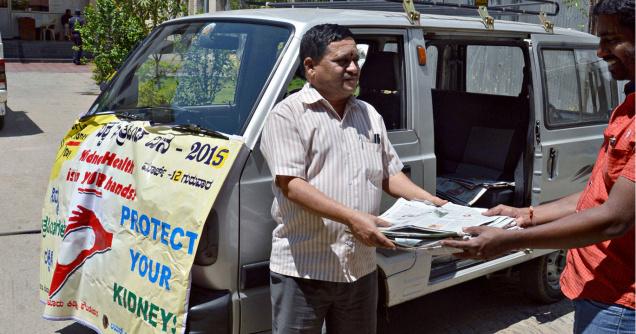
C.V. Sundaresh of Arpana Seva Samsthe collecting old newspapers in Bengaluru on Wednesday. The NGO sponsors 1,000 dialysis a year.— Photo: Bhagya Prakash K.

We were moved by the plight of patients: NGO

A bundle of old newspapers may mean a new lease of life for someone in dire need far away. A group of energetic volunteers are going to apartments, hotels and offices asking not for money, but for old newspapers to mobilise funds for dialysis for poor patients.

Businessman C.V. Sundresh, secretary of Arpana Seva Samsthe, an NGO started in 2008 by a group of philanthropists, said: “Over the years, we were moved by the plight of patients who had asked us for help for dialysis and realised that this was a recurring expenditure. People could not afford dialysis but still had to undergo it twice or thrice a week. So we decided to mobilise funds only to fund dialysis. End-stage renal failure patients have to spend at least Rs. 6,000 a month for dialysis apart from other medication.”

He said, “The money we get from newspaper drives may not be much, but we are spreading awareness on kidney health and the drive also helps us get commitment for individual cases.”

The organisation, which has 40 members and 60 volunteers and sponsors 1,000 dialysis a year, has tied up with Bangalore Kidney Foundation, which shortlists deserving patients.

T.N. Lakshmiprasad (39), who used to work in a private firm, travels five hours, twice a week, from Yagati village in Kadur taluk of Chikkamagaluru district to Bengaluru for his dialysis.

“Private hospitals are expensive and government hospitals are not always equipped with technicians and doctors, which is why I prefer coming to Bengaluru. The organisation, over the past seven years, has funded nearly 100 dialysis,” he said.

Those who want to donate newspapers can call 9845201563.

source: http://www.thehindu.com / The Hindu / Home> News> Cities> Bengaluru / by Tanu Kulkarni / Bengaluru – March 12th, 2015

MA in Sanskrit at 78

KrishnappaBF11mar2015

Mysuru :

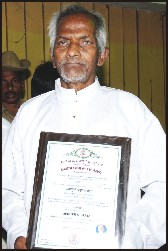
There was a special award waiting for Krishnappa at the 15th Annual Convocation of KSOU held here on Thursday. Seventy-eight-year-old Krishnappa, a resident of Kanavanaghatta in Channarayapatna taluk of Hassan district had appeared for MA Sanskrit examination and has passed with 57 per cent and also received a cash prize.

A relentless learner, Krishnappa says that his age never hindered him from appearing for the exam and added that he engaged himself in reading spiritual books after his retirement. Krishnappa also said that Sanskrit was an ocean of knowledge and this had inspired him to take up Master’s in the subject.

Krishnappa says that he wanted to attain spiritual knowledge and hence, read a number of books and added that he would continue to read and acquire knowledge till his last breath.

source: http://www.starofmysore.com / Star of Mysore / Home> General News / Thursday – March 05th, 2015

For the Love of Fabric

VanithaBF08mar2015

by Sujata Rajpal

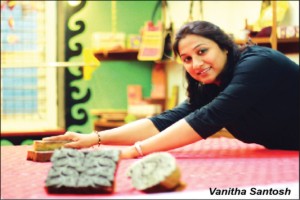
Those who believe that early marriage puts a spoke in the wheel of a woman’s professional growth and sounds a death-knell for her career should think again. The city-based designer and entrepreneur Vanitha Santosh is one such woman who not only started her career from scratch after marriage but also followed her heart by turning her passion into a full-fledged business.

She is one amongst 10,000 women entrepreneurs in the world who were selected to undergo Goldman Sachs 10,000 Women Entrepreneurs Certificate Programme. Conducted by Indian School of Business (ISB) in collaboration with Goldman Sachs, the 16-week programme provided world-class education to selected women entrepreneurs with 3 weeks of classroom sessions and 13 weeks of mentoring support on the job.

“This programme is an equivalent to MBA and I am considered as an alumnus of ISB,” Vanitha chuckles. The curriculum comprised structured way to do business, time management, prioritisation, focus, defining one’s targets in business and multitasking, which is so very important for women.

Vanitha was married off at the age of 18 immediately after her plus two exam. After marriage, she not only started her own venture but also studied B.Com through Open University. She recalls fondly how she was up on her feet visiting clients just two weeks after delivering a baby and would carry her eighteen-month-old son for meetings.

The seeds for entrepreneurship were sown in her when she was still in middle school. “I was the first grandchild in a big joint family. Though I was pampered, I had to run errands for everyone in the family, which taught me many life-skills required in a business and gave me an idea of pricing, negotiations and much more,” tells Vanitha.

Colours, designs and fabric fascinated Vanitha even as a child. She loved to give a new look to the fabric by mix and match. She got her first break at the age of 15 from a French Company to design kids’ summer collection for six seasons. It provided a great learning platform and the beginning of many more opportunities.

“I got married early but still I have managed to do what I had always wanted to. I don’t believe in complaining. Instead, I strongly believe in making the best use of the circumstances. I have always been a go-getter without being blatantly aggressive,” tells Vanitha with a constant smile playing on her lips.

Vanitha kick-started her venture with Mangalgiri Mix-and- Match kurtas which she exhibited at Rotary Needs in 1999. This was her first taste of success. The enterprising woman has come a long way since then. She has added various verticals in her business, which includes customised uniforms for hospitals, industry and hospitality sector, clothes for new borns, block printing, redoing old sarees, designer blouses. Out of all the verticals, redoing old sarees and giving a new look to the six yards is her favourite as there is a lot of sentimental value attached to old sarees.

Twelve years ago when Vanitha had just started her venture of customised uniforms, she met with an accident, which made her immobile for almost a year. She didn’t want to close the unit which had just taken off. At that time, her husband Santosh gave up his business of computer consumables and joined his better half. Since then the husband and wife have been working as a team.

“Though it is one business, we have our own independent clients and have divided our responsibilities,” says Vanitha candidly.

Aligning with her people’s person image, Vanitha prefers the front end jobs like marketing and designing whereas Santosh takes care of manufacturing and operations. The couple has an unwritten rule of not discussing work at home. The husband and wife take turns to ensure that one of the parents is always around when their two school-going boys, Aditya and Chaitanya, are at home. Vanitha resides at Sankalp Central Park, Yadavagiri and her store-cum-workshop Hidden Store is located on Kalidasa Road.

“Being a woman, I had to face many challenges. When I approached an organisation for soliciting orders for uniforms, they shooed me away thinking what can a woman do but when my husband approached the same organisation, they readily gave him the order. What saddens me the most is the attitude of people towards a woman entrepreneur,” tells Vanitha. “Mysuru is still not open to women entrepreneurs.”

There is more to Vanitha than a successful entrepreneur. She is a self-taught classical singer. A few years ago, she received an opportunity to perform at the Amba Vilas Palace during Dasara in front of a large audience. “One day I would want to find out time to learn classical singing,” she says dreamily.

e-mail: vanitha27santosh@gmail.com

source: http://www.starofmysore.com / Star of Mysore / Home> Features Articles / Monday – March 02nd, 2015

She goes the extra mile to help walkers

Bengaluru :

Shaila Prabhu (53), a software programmer turned social activist, is a known name in the bylanes of Vidyaranyapura. From battling threats to knocking on the court’s door, she’s done whatever it takes to reclaim pedestrian space in the area. Thanks to the crusader, the north Bengaluru locality today is home to wider footpaths, free of encroachments and hawkers.

About a year ago, pavements along Vidyaranyapura main road and others in the vicinity had no room for walkers. Commercial establishments, backed by the builder lobby, had encroached upon them. Children and senior citizens had no option but to walk amid speeding vehicles, putting their lives at grave risk. The number of accidents had also shot up.

It was then that a group of proactive citizens decided to take matters in its own hands, recalled Shaila. “In February 2014, we did an independent study to analyze the status of footpaths and other pedestrian infrastructure in the area. In some places, ramps and steps from buildings extended till the edge of the road, leaving no space for walkers,” she added.

Shaila and others then approached BBMP officials. “Some of them came forward to clear the mess but backed out soon. Some were hand in glove with groups having vested interests. It got so ugly that I I began to get threat calls asking to me to withdraw,” she added. That’s when residents chose to take the legal route.

Nirmala K, a resident of Vidyaranyapura, said she began to see a turnaround when the high court started issuing orders to BBMP to act on public complaints. “Officials have also become fearless now. They quote court orders whenever someone tries to put pressure on them. Encroachments are being cleared for sometime now. Several buildings are ensuring they redesign their structures, and walkers have more space to move around,” she added.

Legal route, social tools

We began to file affidavits furnished with details on encroachments, road by road. I was shocked to see that BBMP was providing wrong information to the court on footpath status. We took photographs of pavements and attached them to the affidavits. We kept the momentum going by conducting awareness drives and activities like cleaning and painting footpaths. We even made use of social media — the Facebook page of Vidyaranyapura residents and WhatsApp forums — to spread the message.
Shaila Prabhu, social activist

source: http://www.timesofindia.indiatimes.com / The Times of India / Home> City> Bengaluru / by Rohith B R, TNN / March 06th, 2015

Daughter of devadasi achieves doctorate degree fighting all odds

Belagavi :

Examples of children of devadasis qualified with higher education are seen very rare following poor social and financial background of these families. In such conditions, Suvarna Shanta Madar, 36 year old devadasi daughter from Kokatnur village in Athani taluk has achieved doctorate degree fighting all odds came in her way.

After completing B.Com from Karnataka University Dharwad with fifth rank in 2002, Suvarna completed her MA. She did not stop there by deciding to pursue PhD on devadasi system with which she suffered from. Karnataka State Women’s University, Vijayapur awarded her doctorate degree last year for doing PhD in the subject ‘An Economic Study of Rehabilitation Programme of Devadasis in Athani Taluk’.

She did research on five government schemes for the eradication of devadasi system and the welfare of devadasis including the schemes for providing housing, pension, rehabilitation and make them self reliant. Professor S S Peerzade in Economics department in women’s university guided her to pursue PhD.

“Pursuing the education was not a smooth task for me. I used to sell coconut, turmeric, oil, flowers and other things sitting in-front of goddess Renuka Yallamma temple in the village till the school time and after returning from school. It was the business providing us bread and butter. There are lot of hilarious experiences I have experienced in my childhood and adolescence being a daughter of devadasi. Poverty was our biggest enemy. As I had experienced the worries of devadasi system and being a daughter of devadasi I chose this subject”, Suvarna said speaking to the TOI.

In 1993-94 state government conducted the survey of devadasis and after that mother of Suvarna began getting Rs 500 monthly pension. The pension amount gave lot of solace to their day today financial problems for survival. Suvarna has two sisters and one brother. One sister is a police constable while another is a staff nurse on contract bases. Brother is daily wage worker. Suvarna works as a guest lecturer at the local 1 stgrade college.

Shanta Madar, mother of Suvarna is very happy with daughter’s achievement. Speaking to the TOI she said she wanted to look her daughter doing a permanent government job. Suvarna said “I have not married so far to achieve something. My first priority is getting a permanent job which is my mother’s dream too”, she said.

Considering the achievement of Suvarna Madar, district officer on devadasi rehabilitation programme M K Kulkarni has wrote letter to the Women’s Development Corporation fortnight ago to bring a book of Suvarna Madar’s thesis submitted for PhD and print at least 1,000 its copies. He has also appealed to honour both mother and daughter on state level platform on Women’s Day. “It’s not a small achievement for any devadasi daughter and it is encouragement for others too”, Kulkarni said.

source: http://www.timesofindia.indiatimes.com / The Times of India / Home> City> Hubballi / by Ravindra Uppar, TNN / February 13th, 2015

Netherlands beckons pioneering 9th grader

Ahalya Saraswathi Bhat

Ahalya Saraswathi Bhat J, a class nine student of Vittal Jaycees English Medium School, has developed a working model for preparing medicinal charcoals used in Ayurveda by slow pyrolysis using Masi Maker technology.

Speaking to Bangalore Mirror, she said medicinal charcoals known as Masi Kalpana in Ayurveda, is prepared by partial burning of medicinal herbs and has greater use in preparing medicinal oils, ointments and pastes. They exhibit wound-healing, anti-poison properties apart from working as adsorbents in clinical terms.

Ahalya developed a new working model named as “Masi Maker” using the principle of slow pyrolysis using stainless steel. Pyrolysis is a thermo-chemical decomposition of organic material at elevated temperatures in the absence of oxygen. It involves the simultaneous change of chemical composition and physical phase, and is irreversible. The working model “Masi Maker” consists of three chambers – the heating chamber for creating heat, charring chamber for charring medicinal herbs and the bio-oil outlet, to express any bio-oils produced.

Ahalya’s project that was demonstrated at the regional fair at Belagavi, secured the gold medal. The event was organised by the Science Society of India. At the national-level fair held at Chennai on January 10, 2015, the project secured the silver medal. Five students from the State have been selected to attend the International Environment & Sustainability Project Olympiad (INESPO) in the Netherlands from May 31 to June 4. Ahalya is the daughter of Dr Ganapathi Bhat Jeddu and Dr Manorama B Bhat who are both Ayurveda practitioners.

source: http://www.bangaloremirror.com / Bangalore Mirror / Home> News> State / by Deepthi Sanjiv, Bangalore Mirror Bureau / February 08th, 2015