Category Archives: Inspiration/ Positive News and Features

Farmer among five to get Rachana awards

Gabrial Stany Veigus lauded as agriculturist of the year

Farmer Gabrial Stany Veigus of Perar, a retired forest official who turned a 37-acre land into a model farm with innovative practices, is among five persons to receive the Rachana awards, instituted by Rachana, the Mangalore Catholic Chamber of Commerce and Industry, for 2014. Mr. Veigas has been recognised as Rachana agriculturist of the year for introducing sustainable farming practices.

He has planted 3,400 coconut saplings, mango, rambutan, cashew, grafted variety of jackfruit and breadfruit over the last 10 years and converted his land into a high-yielding agricultural plot. Jenette Pinto, a social activist from Mumbai and a professor of history who co-authored the book ‘Slavery in Portuguese India’ will receive the outstanding woman of the year award. Raphael Sequera has won the entrepreneur of the year award.

Anil Keith D’Cruz, a Mumbai-based Oncology surgeon, has won the professional of the year award and Ligoury D’Mello, chairman of the D’Mello group of companies, Oman has won the NRI entrepreneur of the year.

source: http://www.thehindu.com / The Hindu / Home> News> Cities> Mangalore / by Govind Belgaumkar / Mangalore – October 22nd, 2014

Food bank launched in Bangalore on World Food Day

Feeding America, a unique food bank initiative that has redefined food donation and feeding the underprivileged, has been replicated in Bangalore.

Bangalore Food Bank (BFB) was launched in the city on Thursday to coincide with the World Food Day. Supported by Griffith Laboratories Private Ltd and a handful of individuals, the initiative kicked off with Griffith Laboratories making the first donation of ready-to- cook ‘khichdhi’ packets to feed 5,000 people through its NGO feeding partners.

According to BFB director (operations) Meher S Dasondi, food banking is a system that moves food from donors to the needy and is a non-profit distribution enterprise that serves the community through institutional feeding programmes. A food bank acquires donated food in the form of food grains, pulses, oils spices etc, and works as a facilitator between those who have surplus and those who need food. Only dry food can be donated as cooked food has limited shelf life.

Nearly 28 NGOs have partnered with BFB including Auto Raja’s Home of Hope, Mitra Jyothi School for the Blind, and Vathsala Charitable Trust. Individuals and firms interested in food donation can contact Dasondi on 9538035252.

source: http://www.bangaloremirror.com / Bangalore Mirror / Home> Bangalore> Others / Bangalore Mirror Bureau / October 17th, 2014

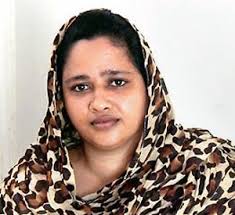
A Muslim, she looks after 14 Hindu HIV positive kids

TabassumMPOs15oct2014

by:Deepthi Sanjiv

​Tabassum faced tough opposition from family and society when she decided to work with the children

Breaking the HIV taboo is a challenging task. The moment a case is diagnosed, some families choose to distance themselves from the victims. About ten years ago, when a close friend of Tabassum died just two days after the doctors told her that she was suffering from HIV, Tabassum saw that none of her friend’s family even wanted to touch her. At this point, Tabassum was left alone to perform her last rites. That was when she decided to dedicate her life for the sake of HIV positive children. Until then, her job with an NGO was nothing more than a source of income.
Speaking to Bangalore Mirror, Tabassum said, “For the past 14 years, I have been working for HIV positive children and pregnant women. My outlook changed after this incident.” Recollecting her past, she said, “I hail from a very poor family. I secured a distinction in SSLC and wanted to study further, but my family could not afford to support my studies. I somehow managed to go up to PUC, but by then, my family got me married. After marriage, I did not want to stay at home and went on to do my degree, after which I took up a job with an NGO for the sake of a living. It is never easy for a Muslim woman to come forward and work, specially with an NGO where you deal all kinds of people. I somehow fought opposition from family and went ahead. I continue to work at the NGO even today, and at the same time since I enjoy working with kids, I took it up as a challenge and went ahead to set up my own protection care centre called ‘Snehadeep’ about two years ago,” she said.
“Strangely, I received lot of opposition; some even said it was not right for a Muslim lady to take up this responsibility. I can proudly say that at Snehadeep, I look after 14 girls in the 7-12 years age group and all of them are Hindus. There is no religion once these children fall sick. Often, their families prefers to distance themselves from the children. More than their physical health, these children suffer from psychological pain or want of company. The bigger children scan through newspapers everyday looking for any new medicine that can cure them. They know that they will die soon. At times, convincing them to study is also difficult. When these kids are at their last stage and are shifted to the hospital, nobody from their family wants to associate with the child. Often, they are left to die alone. I try my best to be there with them during their last stage though it is very painful and perform their last rites in the best way I can. With every death, I only pray and hope that this is last child dying before me. The initial days were a struggle. I used to go door-to-door on a Sunday asking people for help. Even a packet of biscuits for kids would make a difference. Getting funds for food is always a big task,” she said.
For Tabassum, spending time with the kids provides peace of mind. “Recently, I was very happy when a child received 92 percent in PUC. ”

source: http://www.bangaloremirror.com / Bangalore Mirror / Home> Bangalore> Others / by Deepthi Sanjiv / Bangalore Mirror Bureau / October 15th, 2014

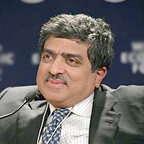
Nandan Nilekani Receives ‘Legend In Leadership’ Award

Infosys co-founder Nandan Nilekani is the first Indian to receive this prestigious award from Yale University.

Yale University felicitated the chairman of India’s Unique Identification Database Authority and Infosys’ co-founder Nandan Nilekani with the ‘Legend in Leadership Award’. Nilekani is the first Indian to receive this award.

NandanBF22sept2014

The ‘Legend in Leadership Award’ was created 20 years ago to honour current and former CEOs who serve as living legends to inspire chief executives across industries, sectors and nations.

The award was presented to Nilekani by Richard C. Levin, president, Yale University, at the Yale CEO Leadership Summit of The Chief Executive Leadership Institute. The summit convened 100 business leaders in New Delhi, to discuss the theme of ‘Navigating the Global Oceans of Opportunity for Indian Business’.

Nilekani, who co-founded Infosys in 1981 and served as CEO from 2002 to 2007, holds the rank of cabinet minister as the first chairman of the Indian government’s newly created ‘Unique Identification Database Authority’. The universal ID card is expected to help ensure that most of the billions of dollars India and other organisations spend on aid reach the people for whom it was intended.

In 2006, he was awarded the Padma Bhushan, one of the highest civilian honours awarded by the Government of India.

source: http://www.efytimes.com / EFY Times.com / Home> InfoTech> Awards and Recognition / Monday – November 09th, 2009

Nandan Nilekani to be given Legend in Leadership award by Yale

Washington :

IT Czar Nandan Nilekani  has been selected for the ‘Legend in Leadership Award’, becoming the first Indian to receive Yale University’s top honour.

Nilekani, 54, Chairman of India’s Unique Identification Database Authority will be presented with award given by the Yale University President Richard C Levin at the Yale CEO Leadership Summit of The Chief Executive Leadership Institute in New Delhi on November 6.

The summit will convene one hundred world-renowned business leaders in New Delhi on November 5 and 6 to discuss the theme of ‘Navigating the Global Oceans of Opportunity for Indian Business,’ a media release said.

The ‘Legend in Leadership Award’ was created 20 years ago to honor current and former CEOs who serve as living legends to inspire chief executives across industries, sectors, and nations.

Jamie Dimon of JPMorgan Chase; Robert Iger of The Walt Disney Company; Stephen Schwarzman of The Blackstone Group; Roger Enrico of PepsiCo; John Pepper of Proctor & Gamble and Don Keough of The Coca-Cola Co were some of the other people who received the prestigious honour.

Others who had earlier received the honour include were McKinsey founder Marvin Bower;Richard Teerlink of Harley-Davidson.; Holiday Inn founder Kemmons Wilson; financier Wilbur Ross; and Lou Gerstner of IBM.

source: http://www.timesofindia.indiatimes.com / The Times of India / Home> India / PTI / November 03rd, 2009

Pledges to make Mysore a Cleft-Free City

To donate Rs.400 for every 4s, 6s hit and wickets taken by the team to Deutsche Cleft Kinderhilfe Foundation

This campaign encourages cricket fans to share smiling selfies of themselves on the Facebook page of Mysore Warriors (https://www.facebook.com/MysoreWarriors). For each photo received, Cycle Pure Agarbathies and Mysore Warriors will donate generously towards the cause.

Bangalore / Mysore :

Strengthening Cycle Pure Agarbathies’ commitment towards the holistic empowerment of the underprivileged, Mysore Warriors, the KPL team owned by Mysore-based Cycle Pure Agarbathies recently annou- nced their association with Deutsche Cleft Kinderhilfe Foundation.

Deutsche Cleft Kinderhilfe is an international Non-Government Organisation that provides comprehensive treatment to children with cleft lip and palate across the world. Cleft lip is one of the most neglected body conditions. According to researchers every tenth cleft child in India dies before his or her first birthday calling for immediate attention.

Mysore Warriors will donate Rs. 400 for every 4s, 6s scored and wickets taken by the team through the KPL matches. Further, Mysore Warriors has initiated a campaign to create awareness on the condition and need for active participation.

The campaign encourages cricket fans to share smiling selfies of themselves on the Facebook page of Mysore Warriors (https://www.facebook.com/MysoreWarriors). For each photo received, Cycle Pure Agarbathies and Mysore Warriors will donate generously towards the cause.

Speaking about the initiative, Arjun Ranga, Managing Director, Cycle Pure Agarbathies said, “We at Cycle Pure Agarbathies have always had a legacy of working towards the upliftment of the society.

In fact, a significant part of the gains have been spent generously on socially relevant causes. Through this association, we are further extending our commitment towards bringing smile on the faces of people who are suffering from cleft and donating them a new lease of life.”

source: http://www.starofmysore.com / Star of Mysore / Home> General News  / September 08th,  2014

After eight years, Indiranagar road renamed after a legend

KareemKhanMPO08sept2014

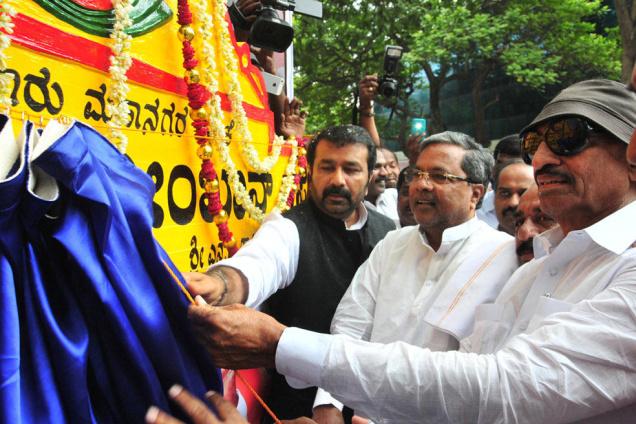
After a delay of eight years, the 100-foot Road in Indiranagar was renamed after folklore expert and freedom fighter S.K. Kareem Khan on Sunday.

Chief Minister Siddaramaiah, while recollecting the contribution of Kareem Khan, said he was a multifaceted personality who refused to take the government pension given to freedom fighters. “He was a towering personality who rose above caste, creed and religion.”

Posters

A large section of the road was dotted with huge banners and posters featuring the dignitaries invited for the renaming ceremony. At the 12th Main junction, posters and banners had covered every little space.

Bruhat Bangalore Mahanagara Palike (BBMP) officials conceded that permission was not granted to any person, organisation or political party to put up the hoardings.

The BBMP has been claiming for the past few weeks to have launched a drive to remove illegal publicity materials after the Upalokayukta lambasted the civic body over this. Till August 21 — the deadline fixed for the removal of flexes, banners, buntings and posters — the BBMP had removed 14,720 illegal publicity materials across the city.

However, with the BBMP citing pressure from politicians and shortage of personnel, the Upalokayukta has given the civic body three months to rid the city of all illegal publicity materials. Officials have been directed to submit an action-taken report every month.

‘Institute award’

Kannada Chaluvali Vatal Paksha leader Vatal Nagaraj urged the government to institute an award after Kareem Khan with a purse of Rs. 5 lakh. He also drew the attention of Mr. Siddaramaiah to the plight of Kannadigas in Talavadi, a border village, and urged him to speak to Tamil Nadu Chief Minister Jayalalithaa on the matter.

source: http://www.thehindu.com / The Hindu / Home> News> Cities> Banglaore / by Special Correspondent / Bangalore – September 01st, 2014

Voices from the grassroots : Measuring development …..

DrBalasubramaniamBF25aug2014

by Dr. R. Balasubramaniam

Being in the development sector, I have been fascinated by the evolving obsession of practitioners, donors, academia, and the community in measuring and evaluating. The tools, methodologies and the people involved in this activity are getting better and better. Everyone seems to be so preoccupied and engaged that many consider a programme a failure or bad, if some acceptable form of measurement is not undertaken. I have written numerous proposals and implemented many projects in different sectors of health, education, and community development that I have found myself questioning not just the validity but also some of the metrics and the fundamental premise that drives these measurements. I am not saying that measurements by themselves are wrong; all that I am trying to point out is that we need to understand the programme being measured, the competence of the people measuring, the tools deployed and the metrics of measurement and more importantly the context — before one indulges in this activity.

I would like to explain this a little more clearly with a personal example. I first came to the tribal area in the forests of Heggadadevanakote in Mysore district of South India in 1987 and began running a small dispensary. Obstetrics being one of my favourite subjects, it was only natural that my focus was on maternal health and mortality. Being concerned by the high maternal mortality in the area, I started exploring how one could bring it down. Public health knowledge and practice has established maternal mortality to be an important indicator of health of a community and one always believed that this indicator could measure health outcomes.

It was also the time when everyone including the WHO and the Government of India focused heavily on maternal health and safe motherhood initiatives. The whole health sector was being pushed towards Institutional deliveries and we also got caught up in this excitement. Over the next many years we campaigned for Institutional deliveries and ensured that we created adequate facilities for safe childbirth at our hospitals. We even had a World Bank funded project in 2001-02 to ensure improved maternal and child health outcomes amongst the tribals in the area.

Sometime ago, my wife Bindu, an obstetrician who has been long associated with the programme, was remarking how she was seeing a huge positive change amongst the health seeking behaviours of the tribal women. She told how challenging it was 20 years ago to motivate the tribal women to have Institutional deliveries but now the women sought the hospital on their own. Institutional deliveries, which were non-existent when I first came to the area, had grown to 40% by the end of the World Bank funded project in 2002.

Today, virtually every tribal woman in the area comes to our hospitals to deliver their babies. Our RCH programmes have been written about and studied; World Bank considers the RCH project that they funded us as one of their best; Public Health practitioners and academicians are impressed with the falling maternal mortality and improved health outcomes. It is indeed very reassuring when so many people and institutions with their sophisticated tools and methods call us a public health success.

In 2009-10, I had taken a year away from our projects and this gave me the space, the energy and the willingness to re-look critically at all that we had been doing. I was assessing what it was that I first came to the tribal areas to do and how I had been doing it. Using the metric of improved health outcomes and the falling maternal mortality and morbidity rates; we were definitely an unqualified success. But was this the right metric to measure our work and intent. Can this metric capture everything that exists in this ecosystem? How honest would it be if we did not try and engage ourselves in outcomes that unintentionally emerged because of our programmes, but were not given any attention, as they were not readily visible or worthy of measurement? Or is it that we were ignorant of the metrics that one needed to deploy?

In our intent to reduce the maternal mortality by increasing institutional deliveries, had we not unintentionally taken away the community’s ability to cope and manage this natural phenomenon without any dependence on people or a system outside their community and tradition? We today have a generation of young women who have mostly delivered their babies in our hospitals but who have neither the knowledge, nor the attitude or the skill-sets to ensure that they can continue their century-old tradition of delivering children at home. What if we changed the metric to building the capacity and competence of the community to have cost effective and rational health practices that did not need an expensive health care system that they could neither afford not sustain with their resources.

Isn’t building the capacity and competence of communities to ensure a workable health system that they can run and sustain with their own resources and abilities more important than running a sophisticated health care programme that needs doctors, nurses and managers to come from faraway cities. Well, the metric of measuring what is important for communities is what the development sector needs to focus on rather than what is easily measurable or merely the programmatic and managerial aspects. And the metric needs to be something that attempts to capture what is happening in the whole eco-system rather than just the piece that is the most evident.

[e-mail:drrbalu@gmail.com]

source: http://www.starofmysore.com / Star of Mysore / Home> Feature Articles / August 20th, 2014

State IAS topper interacts with students

HegdeBF17aug2014

Mysore :

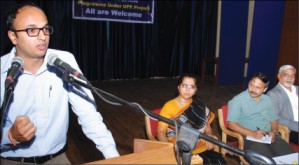
“Grasp what you read as reading should be qualitative and not just quantitative,” suggested Gurudath Hegde, State IAS topper with a national ranking of 25.

He was interacting with students at a programme organised jointly by Maharaja’s College, Yuvaraja’s College and Centre for Proficiency Development and Placement Services (CPDPS) of Mysore University at Maharaja’s College Centenary Hall here this morning.

About 1,500 students of various colleges participated in the programme and interacted with Hegde after listening to the valuable tips given by him.

Speaking on preparations for the competitive exams, the 2013 State IAS topper from Dharwad advised the students to cultivate the basic behaviour of reading books and newspapers and develop a passion for knowledge.

He asked the students to change their mindset first as nothing was impossible and inferiority complex should be shunned. He suggested them to be confident in their work as perseverance and hard work always ensured success.

When students asked whether coaching was essential for competitive examinations like IAS, Hegde answered in the affirmative saying that coaching at a right centre would put the students in the right groove to reach the goal.

He said that during coaching, a student could meet people, interact and exchange ideas and knowledge. However, he contended that a good coaching would involve a lot of money and time but should be utilised properly.

Maharaja’s College Principal Prof. B. Nagarajmurthy, Administrative Officer Vasanth, Yuvaraja’s College Placement Officer Swarnamala, CPDPS Director Dr. Niranjan Vanalli and others were present.

source: http://www.starofmysore.com / Star of Mysore / Home> General News / August 11th, 2014

In memory of freedom martyrs no one remembers

Bangalore :

It’s one thing to recall sacrifices of freedom fighters on the Independence Day, but another thing to remember martyrs on other days and maintain their memorials.

Standing testimony to such neglect is a martyrs’ memorial in the heart of the city. Worse, not much is known about the four martyrs named on the plaque.

The 10-foot-tall stone plaque has been relegated to the backyard of the Shani temple at Mysore Bank Circle – the area which witnessed several flashpoints between freedom fighters and police at the height of the Quit India Movement in August 1942.

Scores of people are suspected to have died in confrontations in the area where the Mysore Bank Circle stands now. The martyrs included Shamanna Bete Rangappa, G V Thirumalaiah, Prahlad Shetty and Gundappa, all said to be students of Central College.

Their memory remained buried till 1972, the silver jubilee of Independence, when the central government decided to build a memorial at the Mysore Bank Circle where the quartet breathed their last. A plaque with their names inscribed on it was installed.

As years went by, the memorial was neglected. Road and other infrastructure development in the area shrunk the space for the memorial. Slowly, it got lost in the backyard of the temple.

On the recent Martyrs’ Day, August 9, members of Rashtra Gaurava Samrakshana Parishat, a social service NGO which stumbled upon the memorial recently, cleared the weed and other waste materials from there.

On Friday, a few local youngsters washed the memorial, decorated the place with tricolour and celebrated the Independence Day there.

“It is said these four youths were students of nearby Central college and fell to police bullets within meters of where the memorial is now located,” said T N Ramakrishna, president of the Parishat.

“There is no effort whatsoever, either from the Central government or BBMP, to protect what they call is a national monument. We want the authorities to restore the memorial to its original status. The authorities should make the memorial visible from all sides and also make suitable lighting arrangements,” he added.

Another Parishat member alleged that the space around the memorial has shrunk by about 15 feet due to encroachment. “It was in good shape till 2006-07 with a compound wall around. Later, due to encroachment and weeds, the plaque virtually invisible,” he added.

The Parishat said it would wait till October 2 (Gandhi Jayanti) to see if any effort is made to restore the memorial. “If nothing comes out, we will approach the mayor and the Kannada and culture department. If nothing positive happens, we will have to approach the court,” said Ramakrishna.

Forgotten heroes

Not much is known about the four martyrs: who they were and when exactly they fell to British bullets.

SK Aruni, deputy director, Indian Council of Historical Research, said there were many points of conflagration in the Mysore Bank Circle area during the freedom struggle. Police action against freedom fighters was severe on August 16, 17 and 18 of 1942, he added.

On August 16, a youth named Thimmanna Dasa was killed. The next day, the situation worsened. A huge crowd of 2,000 people set on fire a post office at Aralipete, near Kengeri Gate. Nine people were killed in police firing, but only six were identified: Thippaiah, Appaiah, AR Srinivasan, Narasimhachar, Subash Singh Ram Singh and Ponnaswamy.

On August 18, two of the youths mentioned in the plaque – Shamanna Bete Rangappa and G V Thirumalaiah – were killed in police action, Aruni said.

“British rulers always gave lower numbers than the actual toll to downplay the scale of the struggle,” he pointed out.

Freedom fighter HS Doreswamy said the memorial, which is inside the compound of a temple, should be made an independent structure. “Of the four people mentioned in the plaque, Gundappa was gunned down by an IG called Hamilton during a demonstration. Prahlad Shetty had been incarcerated and died in Central Jail,” he added.

source: http://www.timesofindia.indiatimes.com / The Times of India / Home> City> Bangalore / TNN / August 16th, 2014