The birth centenary year of Noor Inayat Khan, the famous Indian-origin World War II spy, was observed in the UK this week.
Popular English novelist and political commentator Frederick Forsyth was among the key guests at a special memorial event in London to celebrate the life of Noor, the great-great-great-grand-daughter of Tipu Sultan, who became the first female radio operator to be sent from Britain into occupied France.
“What is so remarkable about Noor Inayat Khan is that she owed us nothing; she didn’t have to go,” said Forsyth, the well-known thriller writer behind books such as ‘The Day of the Jackal’ and ‘The Odessa File’ who compared her to the 18th century ruler, Tipu Sultan, known as the ‘Tiger of Mysore’.
“When it came to being recruited for the SOE (Special Operations Executive), she could have said ‘thank you but no’…but she volunteered. There must be something of the old tiger in her genes. It is recorded that she fought like a tigress…Noor absolutely did not die for nothing.
“She is an amazement, a remarkable and extraordinarily brave woman who did what she did for a country to which she owed nothing,” Forsyth said.
The memorial event was organised by the Noor Inayat Khan Memorial Trust set up by Shrabani Basu – author of the World War II heroine’s biography ‘Spy Princess’.
It coincided with the dates of June 16-17, 1943, when Noor – under her codename Madeleine – was flown to the landing ground in Northern France.
“She combined the rational side of her personality with her hatred of injustice and became one of our greatest heroines. My hope is that she would have gone back to that inner life that sustained her,” said Christine Crawley, a Labour party politician who has campaigned for the contribution of women agents in the war to be commemorated.
The SOE was an underground force established in Britain in 1940 by war-time Prime Minister Winston Churchill to “set Europe ablaze”.
It recruited men and women to launch a guerilla war against Hitler’s forces.
Noor, born in September 1914 to an Indian Muslim father and an American mother, grew up in Britain and France.
Despite her pacifist views, she decided to join the war effort to defeat the Nazis and was eventually captured.
In spite of being repeatedly tortured and interrogated, she revealed nothing and was executed by an SS officer on September 13, 1944, at Dachau concentration camp at the age of 30.
She was later awarded the George Cross, the highest civilian decoration in the UK, in recognition of her bravery.
A bust in Noor’s memory now stands at Gordon Square in central London, a stone’s throw from the home she briefly lived in.
source: http://www.ndtv.com / NDTV / Home> Diaspora / Press Trust of India / June 19th, 2014
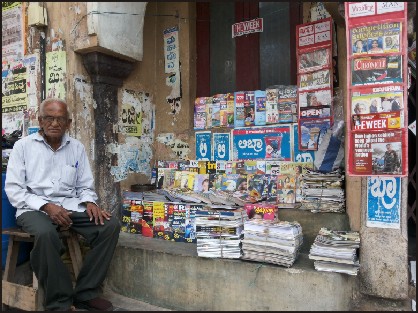
During the days when newspaper sellers are rarely recognised, here is an aging M.R. Subramanya, popularly called by his admirers as ‘Paper Subbanna,’ who is dedicated to journalism in his own kind by selling newspapers for the past five decades in the heritage city, thus justifying the title given to him.
Born in Mysore, Subbanna, who passed SSLC from Dalvoy School in city, took to distribution of newspapers and has been rendering a yeomen service to the field of journalism for the past 50 years.
His tryst with print: After unsuccessfully launching ‘Chitralaya,’ a tabloid devoted to film industry in Bangalore in 1963, Subbanna is now busy distributing newspapers, periodicals and books related to competitive examinations in all languages.
Later, lured by film journalism, Subbanna established an institution named Film Premier Association along with his friends and served as a reporter, critic, publisher and launched many programmes for the development of journalism.
After the collapse of the Lansdowne building, Subbanna now runs a shop opposite Merchants’ Co-operative Bank on Jaganmohan Palace road in city selling newspapers of all languages including Rajasthani, Hindi, Telugu, Tamil, Malayalam, etc.
Subbanna as a Publisher: After failing to achieve the desired results through his tabloid, Subbanna published many novels under the banner of ‘Sahitya Gangotri’ and created awareness on reading Kannada books and also achieved the distinction of publishing ‘Jenugudu’ scripted by celebrated Tamil writer Shantha through which he became a household name after being recognised by the Union Government.
Joined Kannada Chaluvali: Subbanna plunged into Kannada Chaluvali in his fight for propagation of Kannada and played a major role in the agitation against dubbing of Kannada films into other languages in the company of A.N. Krishna Rao, M. Rama Murthy, T.R. Subba Rao, Beechi, Sheshagiri Rao, Veerakesari, Seetharama Shastry among others.
Felicitations: Besides being felicitated for his contributions to Kannada language, Subbanna was honoured by the Dasara Exhibition Committee in 1992, Ambarish Award in 1995 by Ambarish Fans’ Association and also honoured in 2006 by a group of litterateurs from K.R. Nagar Taluk.
Paper Subbanna, who lost all his earnings after trying his luck in the film industry, is still well-known for his generosity towards visitors who come in search of him.
“I am happy with my profession and I am contented in life. The advent of TV has led a steep fall in newspaper readership which is regrettable but reading a newspaper over a cup of tea is itself a different and a wholesome experience,” says Subbanna.
Let us hope that the Government will take note of the contributions of Subbanna to the field of journalism and reward him appropriately.
After the demise of his wife Kamalamma six years ago, Subbanna is being looked after by daughter M.S. Nagashree and son M.S. Nagendra.
source: http://www.starofmysore.com / Star of Mysore / Home> Feature Articles / June 15th, 2014
You can always trust women to do things unique and differently as women and multi-tasking are two words that have always gone hand-in-hand. Their dynamic ability to juggle between altered roles at a time is one quality that helps them find themselves in great places.
Today, we will take you through the story of two such dynamic ladies who have been successfully juggling between three different interesting roles each of which hold a unique place in their lives.
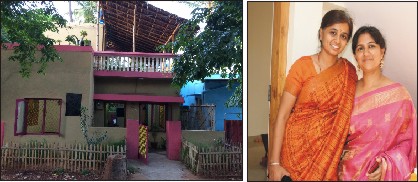
Meet Nandita Nagaraj and Deepha Chengapa. This energetic duo has chosen three different things do. One for passion, one for soul and another for living.
Their passion has given birth to a very uniquely functioning café called Chai Patthe; they teach English to little children at a government school to please their souls and for a living, the ladies are into setting up solar power plants which they have already done for several buildings across the country.
Let’s talk about Chai Patthe. A one-year-plus-old eatery with a very different touch to it for the way it functions. Chai Patthe is Nandita and Deepha’s dream-child, prepared and sold where are a whopping 70 different varieties of Tea along with some very interesting items to munch on. And all that’s available at the place is all the more special, for everything prepared there is made by no cooks but Nandita and Deepha themselves.
Walk into this cosy home with bean bags and cane seats within the rooms, relaxing upon which anyone can relish a simple Maggi to pasta and burgers or sandwich to cookies and brownies, in a very homely atmosphere. What’s more, top them up with some delicious varieties of tea which gets served to you in attractive earthen cutlery, and chances are, you’ll end up spending more than half a day at the place relaxing.
That’s not all. The place has much more than these to keep you at it. Book lovers visiting Chai Patthe can feast reading books from a mini library that’s maintained at the place, with a few but interesting books of varied genres. Those of who love playing games can enjoy playing uno, ludo, chess or crosswords with friends while their food and drink orders are being taken care of by the hosts.
“Our intention of starting Chai Patthe was not just for profit but to provide the visitors a nice and homely atmosphere where they could relax and enjoy a few simple and peaceful moments. Hence, we do not run it like a hotel. All things done and sold here are home-like,” explains Deepha, adding, “We also have a thatched roof seating where people are free to come over and celebrate their special days, read books, paint an art piece, write college records or even do school home works. We are glad we have such visitors too.”
The place which is open between 10.30 am and 7.30 pm daily, remains closed on the days when the ladies are busy with their power plant works for which they tend to travel outside the city. And before 10.30 am each day, Nandita and Deepha are in the Government School, where they teach the children.
“We do not bother if we have to close the cafe at times as our customers who are regular know the way we function. We are very happy working this way and have no plans to expand, as we are into it just out of passion,” says Nandita.
They so prove that they started Chai Patthe for just passion that they have never advertised about the cafe anywhere till date. All the popularity they have gained is by just word of mouth.
Chai Patthe is a non-smoking, wi-fi enabled zone and is one lovely place where any visitor can walk-in directly to the kitchen. “And as our customers, most of whom are acquaintances, know it is just the two of us who cook, they wait patiently until their orders are placed,” says Deepha. “And it is lovely when some of our friends who visit us even help us in the kitchen,” she gushes, who freshly makes the home-baked cakes served at Chai Patthe at her home daily. And all the health conscious ones will love the cooking here as the women use nothing but brown breads and buns and only olive oil to cook dishes and believe in keeping the place plastic-free. Everything here is served in earthen containers, porcelain and glassware. We indeed need to applaud the women for so successfully juggling between so many things at one time. Chai Patthe is located at Jayalakshmipuram [0821-4195033].— AN
source: http://www.starofmysore.com / Star of Mysore / Home> General News / June 14th, 2014
Rohini Sen, the Bangalorean artist whose first solo show in the city opens today, suffered a foot injury a couple of years ago. It left her in extreme, chronic pain. A Chitrakala Parishath graduate, she was teaching arts and running when the pain overtook her life, and marathon plans.
Her exhibition of drawings at Five Forty Five (from June 7 to 14), tells the story of her emotions as she grappled with the negativity surrounding her. She tells City Express how the pain changed her life and art:
You have titled your show ‘The Efficacy of Exquisite Pain’. Why do you describe pain as exquisite? And are you talking about its efficacy in making you see the world differently?
My drawing The Choice Between Freshness and Decay deals with how I began to look at pain as an exquisite gift when my injury posed an emotional dilemma—to look at myself as a person decaying from inside or to celebrate the discovery of a new lens with which to look at myself. And so, pain for me was exquisite in terms of the observations it facilitated. The efficacy of my injury perhaps culminates in these 20 drawings — which otherwise would have been stories I would have never known to tell.
Are you free from pain now? Does your show reflect ’emotion recollected in tranquillity’?
While I think I am free from physiological ‘real’ pain now, anyone who has had a chronic injury will tell you that one is never free from the peripherals that pain leaves in its wake. The fear of the injury relapsing comes back to me every time I am at the gym, training for a run or coming down a staircase. My doctor, Dr KMK Varma of Manipal Hospital, first introduced me to this idea of associations when he sat with me and some of my drawings, trying his best to understand what I was going through!
To reflect on any situation, perhaps quietude is paramount. At the beginning of my injury I was hell bent on looking for a quick fix. Several cortisone shots later (I would get a Cortico steroid shot and get back to training!), I came to realise that it was not about conquering my own body and proving to my injury, “Hey, see? I still finished a 25 km run, so you lost and I won”. Patience, a sense of calm and nurturing my dysfunctional foot really helped me reach a space of acceptance. The drawings Learning to Listen and The Acceptance Conference deal with this idea.
What artistic strategies helped you deal with the pain? Were you drawing and painting through the pain? Any particular works of art that you drew strength from?
I do not think I have ever looked at my drawings as a catharsis of any kind. I was drawing through the second half of my injury: the series started when I was admitted in an ayurvedic hospital. At I-iam Hospital (Yelahanka, Bangalore), between yoga and treatment sessions, I began to reflect on what this injury taught me. More than works of art, I drew great strength from the other patients admitted there. They had come with the determination to transform themselves and begin the process of healing. The 15 days I spent there taught me a certain meditative discipline with which I now approach my art practice, running and training.
What is the status of your marathon dreams?
While I am now ‘back’ on the running scene and successfully finished the TCS 10k in May with the help of my coach Mutie Mohammad and my extraordinarily supportive running team Jayanagar Jaguar, I do not think I nurture serious marathon dreams any more! I am now grateful for whatever little distance my body grants me.
Your paintings portray a wide range of animal characters, from parrots to emus to rats. What explains the absence of human characters?
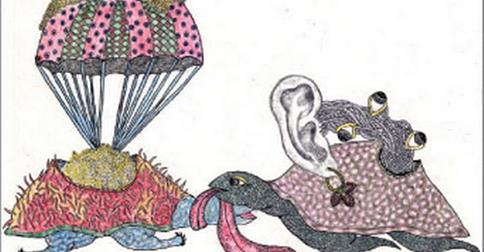
I made a conscious artistic decision not to make literal representations of situations, but to find visual metaphors. My animals allowed me to say it so much more beautifully because each animal stands for a certain characteristic. My rats talk about the plague that a painful association gives rise to, my emu and other ratites express the frustration I faced when people who did not run kept giving me ‘advice’, and my turtles represent being alive for long—their slowness allows them to absorb the experiential ambit of life in a profound way.
Tell us about your art training.
I was taught Madhubani art by national award-winning master craftsperson Sasikala Devi while I was at Rishi Valley School. I completed my Bachelor’s in visual art from Karnataka Chitrakala Parishath in 2010. I then went on to become an art and running teacher for middle school children at the Mallya Aditi International School. In 2012 I went to do my MA in Art Education at the Rhode Island School of Design, USA, which was a turning point in my artistic approach. Between 2012 and 2014, I have exhibited at quite a few internationally acclaimed galleries such as The Awagami Gallery, Japan, and the Drawing Box, Belgium. I am now represented by Cade Tompkins Projects in the US. This is my first solo show in India.
What advice would you offer people with chronic pain, and sufferers who want to use art as a way out of pain?
I personally do not subscribe to the idea that art is a way out of pain and injury!
My process of drawing allowed me to reflect and make observations.
What do you do when you aren’t drawing and painting?
I am currently adjunct faculty at Srishti School of Art, Design and Technology, where I offer courses on reflective praxis, drawing as a thinking tool, and narrative form and structure.
How did you deal with other people’s comments about your pain?
They were at times comforting and at others unkind, but most often not useful. Using birds that cannot fly, I wanted to say this kind of advice comes often from a feeling of not being able to help. When a person is injured like the way I was, it is really the whole family that suffers sleepless nights, so a lot of the advice was from my loved ones experiencing a sense of helplessness. I also faced a lot of unkind remarks about the weight gain as a result of my injury.
Anything else you would like to share?
More than anything else, I would like for the running fraternity of Bangalore to engage with my work and recognise that this was one runner’s way of reflecting about injury. As Haruki Murakami says in his book What I talk about when I talk about running, “Pain is inevitable, suffering is optional.” I wish to share this with every runner and fitness enthusiast who has faced the obstacle of a sports injury.
source: http://www.newindianexpress.com / The New Indian Express / Home> Cities> Bangalore / by S. R. Ramakrishna / June 07th, 2014
Trekking through snow is an unforgettable experience for the simple reason, there is no path or trail waiting for you; you have to create your own path, where even a small miscalculated step can be your last, says Aishwarya Sunaad, Trekker, International Academy of Mountaineering and Allied Sports, Mysore.
by Aishwarya Sunaad
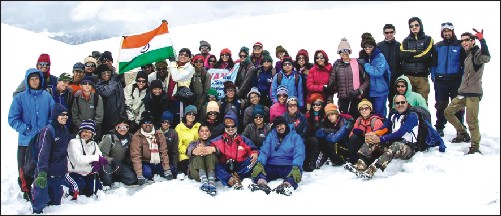
As the IAMAS (International Academy of Mountaineering and Allied Sports) team bid good bye to Mysore on the evening of 30th April, nobody could anticipate the adventure that awaited us 3000 kilometres away. We were 47 of us, of all ages and sizes, from 3 different States, making our way to conquer (as we would later learn) one of the toughest expeditions in the past 6 years.
Our journey took us backpacking through 5 States and several cities before we could officially start our endeavour up the mountains from Manali. There is a certain unexplored joy in visiting a new city everyday and as our team wound its way through each of these new places, it was like unravelling a different world. New people, new cultures, new experiences, new stories.
The star highlights of our backpacking being an exclusive visit to the Rashtrapati Bhavan in Delhi; reliving history in Agra and Mathura, experiencing sanctity at the Golden Temple in Amritsar, reliving the stories of partition at the Wagah Border with Pakistan at touching distance, 14 kilometres of White Water Rafting amidst class 6 rapids in the Ganga at Rishikesh and a VIP visit to the prestigious Indian Military Academy at Dehradun, to name a few.
After these indelible experiences, we arrived at our Base Camp in Manali on the 8th of May. Set in the Beas River Valley in the Kullu district of Himachal Pradesh, Manali is a treat to ardent trekkers and tourists alike. Our base camp, set amidst apple orchards with snowcapped mountains and pine forests on all sides marked the beginning of one of the greatest adventures we could experience. After acclimatising to the cold of Manali from the heat of the plains with some thrilling rappelling and river crossing, we started our trek officially on the 11th of May to Segli, our first camp.
The team descended down to a landmark point called ‘15 Mile’ before beginning the 12-kilometer ascend to Segli, at a height of 7,100 feet. The trail wound through small villages and dense vegetation, with the Dhauladhar mountain ranges surrounding us. Just as the team halted for lunch, we were greeted by the first spells of heavy showers. With raincoats and ponchos and an undying spirit, we trekked through the rain and reached the camp site by evening. Sipping some hot tea to combat the chill, we geared up for the next day.
The rain had subsided as we wound upwards towards the camp of Haura Thatch, at 10,700 feet on May 12; ‘Thatch’ means ‘plateau like land.’ Our camp site was actually on a Plateau up a Mountain! This goes to say, nature has her own mysterious ways. We trekked about 10 kilometres through dense green forests and gurgling streams with occasional glimpses of the mountains through the canopies. The sights that we saw and the scenes that we experienced are beyond description.
Trees, flowers, leaves, mosses, birds, insects and all other wonders of nature of all shapes and sizes ! It was paradise. As we were taking in the surroundings, we were greeted by rain, heavier than before. We couldn’t stop. With the rain and hail pounding, we continued upwards. It was getting cold and we were drenched to the bone. At one point, it seemed impossible to go any further when we reached a clearing that seemed suitable to camp. Tents were pitched and a fire was lit under a rock. After vain attempts to dry ourselves we retired to our tents. It rained the entire night and the next morning of 13th, the weather was so ruthless we couldn’t move camp. It was a truly chilling experience. By evening, on the 13th, the weather cleared and the sun peeped out. As we saw the first rays of sun in 2 days, the world seemed magical. We had set up camp near a small stream in an evergreen forest with pine trees on the fringes. There were colours even our cameras couldn’t capture!
But now, there was a crisis. Before starting the trek, we had already decided to forego our fourth camp at Dohra because of extreme snow conditions. Now we were lagging behind yet another day as we could not trek to Camp 3, Maylee, because of the rain. To make up the distance and keep the time schedule, a bold decision was taken. A decision of risk and daring. A decision that would test our courage and endurance, our mental strength and will power. A decision of ultimate adventure. A decision to cover the entire distance to Saurkundi Pass Summit in one day!
We started on the trail at 4 am in the morning on May 14. With torches in our hands and adventure in our hearts, we continued upwards. We encountered the first patches of snow and the first rays of light around 5.30 am. It was breathtaking. By 6.15 am, we had hit the snow.
[ Part 01…To be continued]
TRAVELOGUE…: SCALING SAURKUNDI PASS-2
Aishwarya Sunaad
Trekking through snow is an unforgettable experience for the simple reason, there is no path or trail waiting for you; you have to create your own path, where even a small miscalculated step can be your last. The temperature kept dropping to subzero values and the sun shone harsher. It was maddeningly white everywhere and without goggles one could go blind. The snow seemed never ending and the summit was nowhere in sight. It was getting colder and colder.
There was snow in our shoes and pants, our feet were going numb and we couldn’t feel our fingers. We had walked for nearly 6 hours up the mountain without stopping and still there was no sign of the Summit. Finally, at around 11.06 am, after a grueling walk, we reached the Saurkundi Pass. The snow was about 3 feet deep and it was snowing heavily.
Despite this, we crossed the Pass and summited, at a height of 13,500 feet. There is no greater feeling than having successfully summited an expedition. You are literally and figuratively on top of the world. We had the frozen Saurkundi Lake on one side and never ending ranges of mountains on all sides. We could almost touch the clouds.
By this time, our feet were frozen and our fingers non-existent. That was the day we realised that cold is the most unforgiving condition you can experience. But the joy of having summited one of the most difficult treks, however easy I may make it look, overshadowed everything else.
The 20 minutes we spent on the summit with the Indian flag and the IAMAS banner fluttering proudly in the wind, I can guarantee, will be the most important moments of our lives. But it did not end there. What we thought was difficult while climbing up was nothing compared to what we encountered while descending.
The snow was falling heavily and there was no route we could follow. We were numb and hungry but had to soldier on. We had no choice but to slide down the slopes ! Slide down with no equipment apart from a rope, which we used occasionally.
That was real adventure and the adrenaline rush was simply superb. With everything at stake, we made it down to the tree line by around 4 pm. We had trekked through the most extreme conditions for 12 hours. We finally reached our campsite at Longa Thatch by 6 pm after 14 hours of ascending and descending. We had done it with zero casualties! It was the most satisfying feeling one can feel.
After a good night’s sleep and merry making, we set off for base camp. The weather was sunny with the city of Manali, which looked like the Map of India from that height, sprawling beneath us. We descended down to Lekhni on May 15. The sights were like a poem. After staying at an authentic log hut that night, we finished our expedition on the 16th of May 2014 after successfully reaching Base Camp.
The next few days saw us exploring the city of Manali and seeking some more adventure while rafting in the Beas River. The team left for Delhi on the evening of 18th, where a privileged visit to the Parliament House added another feather to our caps. We caught the Duronto Express back home on the 19th with truckloads of memories and made it home on the 21st of May 2014, successfully.
Every expedition brings your best side to the forefront because it is the ultimate challenge one can face alone. And if you are an adventurous person and need the adrenaline, it is the call of the mountains you must answer. And finally, if you want to test your daring and mettle, it is the Saurkundi Pass you must conquer. For, if there is a paradise, it is this, it is this, it is this.
[Concluded]
Part 01:
source: http://www.starofmysore.com / Star of Mysore / Home> Feature Articles /by Aishwarya Sunaad / June 06th, 2014
Part 02:
source: http://www.starofmysore.com / Star of Mysore / Home> Feature Articles /by Aishwarya Sunaad / June 07th, 2014
Mysore Round Table-21 and Mysore Ladies Circle-9 will be felicitating deserving Police Constables in its 42nd annual event ‘Knights in Khaki’ today at 4.30 pm at Hotel Olive Garden.
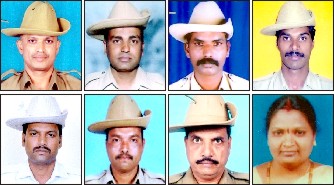
Eight Constables including one lady Constable from Mysore City and District from the categories of Crime, Traffic, Law and Order, Women’s Police Wing will be felicitated during the event.
Police Commissioner Dr. M. A. Saleem will be the chief guest. Tr. Anand Ramu, Chairman, Area 6, Cr. Namratha Shenoy, National Editor, Ladies Circle India, will be the guests of honour.
‘Knights in Khaki’ honours the unsung heroes — the Police Constables — who do the real legwork in the Police Force and receive very little in terms of recognition. The Police Constables selected for this year’s awards are: Mysore City Police- R. Manjunath, CPC34-Metagalli Police Station, M.P. Purushothama, CPC299-Udayagiri Police Station, N.M. Mallesh, CPC450 -KR Traffic Police Station, Gayathri, MPC91-Mahila Police Station. Mysore District Police: P. Ramesh, CPC 491, S. J. Manjunath, CPC 484, Nayeem Ahmed CPC 548 and T. Nagaraju, AHC80.
The awardees will be presented with a rolling shield, a memento, a certificate and gifts donated by the sponsors.
For details contact Convenor Tr.Manish Salian- 9845227249.
source: http://www.starofmysore.com / Star of Mysore / Home> General News / June 06th, 2014
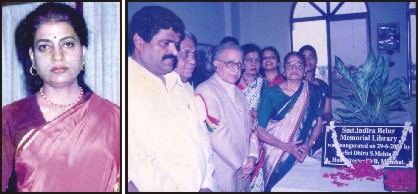
1) Late Indira Belur 2) A file photo of the inauguration of ‘Indira Belur Memorial Library’ at Bharatiya Vidya Bhavan, Mysore, which adorns the drawing room of Vinuthamma’s residence.
by Prof. A.V. Narasimha Murthy, former Head, Department of Ancient History & Archaeology, University of Mysore
A decade ago some of us were visiting houses of friends in Mysore to collect funds for the construction of a building for Bharatiya Vidya Bhavan, Mysore, under the leadership of Dr. Mathoor Krishnamurthy. K.B.Ganapathy was providing wide publicity by publishing the names of donors in his prestigious Star of Mysore and Mysooru Mithra. This enthused the donors. Dr. Mathoor had such a charming personality that he would speak in such a manner that people would not say ‘no’ and contribute donations for the Vidya Bhavan building.
The Mysore people are generally philanthropic and encouraged cultural activities to happen and the result is that we have an imposing building on the Hunsur Road and I do not think that there is anybody who has not seen this building. Thus Mysoreans and others have helped us to establish Vidya Bhavan which runs a school with 1500 students, an MBA (PGDM) College of Management, a school of Fine Arts, conducts monthly music programmes, discourses etc. All this has been possible because of the generous donations of the people of Mysore to whom we are grateful.
At that time, a lady called me on phone and said ‘I would like to contribute rupees three lakhs to Vidya Bhavan. Will it be possible for you to visit my house in Yadavagiri?’ She mentioned the road and said, ‘ask for Kogod House and anybody will show you.’ I jumped with joy. She was none other than Smt. Vinuthamma, a charming lady with a pleasant disposition. Before I could talk to her, she insisted on myself taking breakfast first. Before inviting me she must have told her plan to donate some money to her friends and relatives and the news spread. Many persons either visited her or talked to her on phone. Some others sent some feelers. All of them had an idea of getting an image of God or Goddess be made and consecrated in a temple so that she will get the religious merit (punya).
As she is an Iyengar lady, many offered the suggestion of making sculptures of either Alwars or Sri Ramanujacharya from her donation. But Vinuthamma had a different idea because the donor was her daughter Smt. Indira Belur and the latter had insisted that the money should be used to establish a library.
A highly laudable idea indeed! After hearing this many persons who had shown interest in taking donation suddenly vanished. However, some of them murmured. What is the use of a library? There are many libraries in Mysore and there are not enough readers in them. Most importantly, we have not heard of a crazy idea like this before and she will not get religious merit (punya) by this gift. But, Indira Belur was firm and her mother Vinuthamma was equally firm.
At that time, I had the good fortune of meeting Vinuthamma. When she offered the donation, I immediately accepted it and said a library will be established in Indira Belur’s name: absolutely no problem. She was taken aback by my acceptance and she repeated her library condition over and again. She also cautioned that I should not go back on my words. I re-affirmed and assured her that ‘as per the desire of your late daughter and your own wish to fulfil her desire, I will establish a library in Bharatiya Vidya Bhavan, Mysore and it will be inaugurated by a VIP, most probably our Governor, Dr. T. N. Chaturvedi.’
Before proceeding further, I would like to introduce Indira Belur. After graduating from Mysore University, she did her MBA specialising in marketing. She moved to Madras and became a management consultant and took assignments all over India. In the meantime, she became a consultant to State Bank of India, Bombay. She conducted many programmes in marketing management. Subsequently, she worked with a Japanese company and exported prawns to Japanese market. Subsequently, she became the General Manager for Trans Global Air, U.K. in-charge of South India. I saw this visiting card preserved by Vinuthamma as a memento of her dear daughter. When everything seemed well settled and she was at the top of her career, she became a victim of cancer and passed away in 1998. When she was in the BM Hospital, she celebrated her 50th birthday at the hospital itself. That is how she distinguished herself as a member of the illustrious Kogod Family.She had decided to donate her eyes.
As soon as I received the donation amount, I placed it before the Kendra Committee and apprised it of the details. N. Ramanuja, who was a relative of Vinuthamma, applauded the idea and insisted that the donation should be used for establishing a library in Mysore Vidya Bhavan. As soon as the building was completed, a place was identified for the library and a black granite name plate ‘Indira Belur Memorial Library’ was fixed on the wall. It was inaugurated by Sri Dhiru Mehta, the then Director General of Bharatiya Vidya Bhavan, Mumbai in the presence of Dr. T. N. Chaturvedi. This photograph adorns the drawing room of Vinuthamma’s residence and she proudly shows this to her visitors. Though the loss of a daughter before her own mother is unwelcome, Vinuthamma is proud of the achievements of her daughter and her final decision to establish a library.
This library is just ten feet from my chambers and I daily pass through the library and automatically my eyes go up and look at the name plate ‘Indira Belur Memorial Library.’ Incidentally, library is not just a place where books are stacked, but it is a repository of knowledge. Ancient India was famous for libraries and the Chinese have described the libraries of Nalanda. Chinese scholars used to visit this library for consulting original books (manuscripts) on Buddhism and allied subjects. In the modern period many good libraries have come up. I had the good fortune of visiting British Museum Library in London and Weidner Library (Harvard) which contain excellent and valuable collections. National Library at Calcutta is also a good library. I am a proud owner of a small library which has good books on ancient history and archaeology which I have been using all these days. Maintaining a library is a difficult job because books require daily cleaning and periodical check-up. But a personal library has its own pleasure and advantage.
But, I did not get any clue for the passion and love for library by Indira Belur. Perhaps she understood the secret that library is the source of knowledge and one has to go to that source. Though gifting a library is uncommon, it is welcome and Vinuthamma should take pride in that gesture of her daughter Indira Belur. I would like to say to Indira Belur ‘wherever you are, we remember you with pride and gratitude’ that is the best tribute according to our tradition.
source: http://www.starofmysore.com / Star of Mysore / Home> Feature Articles / May 31st, 2014
In today’s competitive world, students securing almost cent percent results in any exam is nothing new; thanks to the various resources available to them like internet, study materials and most essential, the tuitions. But, once in a while, there are exceptional students who achieve wonders without any aids except that of what they get at School.
And here’s one such girl, S. Monika, daughter of M.B. Siddaraju, an auto driver in city and a student of Good Shepherd High School, who secured 94.56% in the SSLC exams without any aids than that of her sheer determination and the drive to excel.
Hailing from a very poor family, Monika has managed to score 123 in Kannada; 96 in English; 98 in Hindi; 95 in Maths; 86 in Science and 93 in Social Studies. Her father’s wishes of seeing his daughter shine in academics has been fulfilled and all he aspires for his daughter in the future is to achieve greater success.
source: http://www.starofmysore.com / Star of Mysore / Home> General News / May 16th, 2014
Noorjan briefly quit studies to support her family. Thanks to the chemistry of dad’s backing and her passion for academics, she excelled in her masters
Her father never made it past class VII, her mom dropped out after class II, her five siblings have gone through education with a yawn. They are not to blame; their circumstances were such. But Noorjan A R rose above all that. On Tuesday, Noorjan will rewrite her family’s history when she picks up six gold medals as postgraduate topper in Chemistry at the 49th convocation of Bangalore University.
Noorjan’s has been a long and arduous journey, but not a solitary one. Hailing from a remote town — Bagepalli — about 90 km from Bangalore, Noorjan’s father is a butcher. Despite his meagre earnings from the mutton shop, he made sure Noorjan never lacked the resources to chase her dreams. But an even greater gift the head of the conservative family gave her was freedom to make her choices and his unstinting support.
Given her family’s circumstances, Noorjan didn’t start out dreaming big. She says she passed Class X with a first class and then took up II PU (Science). Instead of thinking of higher studies, she decided to take a short cut and do a D Ed (Diploma in Education) so that she could support her family. But luck eluded her as she couldn’t get a job of her choice. Keen to help out, she worked as a teacher for a few years but realised the calling of higher studies was too strong to ignore. So she went back to her parents to tell them she wanted to join a college and do a BSc in Chemistry.
“I was really scared to speak to my father as I didn’t know what his reaction would be. My father works in a mutton shop and my mother is a homemaker. I was surprised when my father told me he would even take loans, but I should pursue my academic goals,” says Noorjan.
Coming from someone with a conservative background, Noorjan says it motivated her. She enrolled for a BSc course in her town. “The three-year course redefined my attitude as I came second in the state in Chemistry. My dreams got wings. Now, I wanted to pursue a postgraduation,” she says. But this would mean travelling to Bangalore and she was once again besieged by fears about her parents’ reaction. However, they stood rock-solid behind her decision. This was also the time she decided to start paying for her education by giving tuitions.
“Every day, I would get up early to take the bus to reach Bangalore University and come back home late. The two-three hours’ journey was definitely tiring but my passion kept me going.” Seeing her struggle, her teachers suggested she take up accommodation at the hostel as it would save time. Apprehensions came flooding back as Noorjan wondered if her parents would ever agree to such an idea. “But they had full confidence in me and finally I joined the hostel. However, during study holidays, I would go back to my town where a school used to give me one month’s work.” The chemistry classes gave her a chance to infuse her love for the subject among students in her home town. “It was a refreshing experience,” she says. Noorjan’s years of hard work have finally paid off with summa cum laude results. “I worked really hard but never expected to score first,” she says.
Her lecturer Dr Mohammed Afzal Pasha, HoD, Chemistry department at the varsity, lauds her as a “really bright student.” “Despite travelling so much and coming from an underprivileged background, she managed to get good marks.”
Her father Abdul Rafiq said, “I could not study much and became a daily wage labourer, while my other kids did not fare well in studies either. I was glad Noorjan was very interested in studies. I have told her come what may, she should pursue her dream.” Noorjan’s mother Shakila takes special pride in her daughter. “I am very happy that my daughter has done her post-graduation and secured first place, which is the highest academic achievement in my family by a long distance.”
Noorjan now dreams of pursuing a PhD and hopes to continue her research in Chemistry.
source: http://www.bangaloremirror.com / Bangalore Mirror / Home> Bangalore> Cover Story / by Sridhar Vivan, Bangalore Mirror Bureau / May 20th, 2014
Dr. S.N. Mothi, Founder-Trustee and Chairman of Asha Kirana Hospital, Mysore, has been invited by the Department of Psychiatry, Harvard Medical School in US, to deliver a talk on the topic “Mental Health Morbidities in HIV/AIDS – The scope for interventions in resource limited settings.”
During his visit, he will also address at the Department of Infectious diseases, Boston University School of Medicine, on the topic of “Antiretroviral Therapy in Children and Adolescents — Indian scenario”.
Dr. Mothi will be away in the US from May 13 to May 25.
source: http://www.starofmysore.com / Star of Mysore / Home> General News / Mysore 12th, 2014