It is 5am and a biting cold wind sweeps through Kumbarhalla, a remote village located 10km from Jamakhandi, India’s Mecca of cycling. The sun is still a long way from topping the horizon, but 24-year-old Mahadev Kurani alias Madappa, a national-level cyclist, silently slips out of his dingy house with his Singapore-made Trek bicycle.
(Mahadev Kurani mortgaged…)
Racing against time, Kurani pumps the pedals hard as he zips on the Bijapur-Dharwad state highway on his way to Jamakhandi. He is joined by several other riders on the stretch, but while they head for the Jamkhandi stadium to hone their cycling skills, Kurani turns towards the Jamakhandi bus stand where he works as a security guard at one of the ATMs of anationalised bank.
Olympians would say that it’s the journey rather than the destination that makes the event so special. Kurani, though, wonders if he would ever arrive. A national cycling champion with four gold medals to his name, Kurani believes he has plenty more to give. But stuck in mounting debt, he had to give up cycling to help his family make ends meet. The daily sprint to work at the ATM serves as his only means of keeping in touch with the sport.
He draws a pittance — Rs 4,800 — in salary every month, much of it goes towards repaying the Rs 60,000 mortgage taken against his family’s acre of land. The money was borrowed six years ago from a local financier to fund his bike. The rest is given to his mother to take care of the family.
“What to do?” Kurani asks rhetorically. “If I do not work, we will lose the acre of dry farmland that was mortgaged to buy my bicycle. The land is the only hope for my family. Being the eldest, I have to look after my parents, brother and sister. The priority is to settle the loan as the interest piles up by the day. There was a time when I hoped the state government would recognise my achievements, but all I got was disappointment and insults. The creditors are not bothered with all these stories. I simply have to settle the debt or we will lose our land. So I had to join as a security guard.”
Kurani was drawn to the sport when he was in Std VIII. Success stories of several other cyclists from Jamakhandi spurred his dream of becoming an international athlete. He began by covering between 50 and 100km on an ordinary cycle. Soon he began to participate in state and national-level events. His dream began to take definite shape. The imported cycle was procured in 2007.
“I was initiated into the sport by my grandfather when I was in high school,” Kurani said. “He was a national-level cyclist and he motivated me to take up cycling. While in school, I took part in several national and state-level cycling competitions, either borrowing cycles from friends or using an ordinary bike. There are basically two types of events in cycling: Velodrome events and cross-country races. Both require different kinds of cycles. But I used to practise both events on the same bike. It was only when I was selected for the international race in Chennai that I had to buy an imported cycle to stay on par with the competition.”
Buying an imported cycle was no easy decision for Kurani, coming as he did from a family that struggled to make ends meet. His father, Manik, worked as a peon at an ITI college in Bagalkot and his earnings barely took care of his own needs in the city. The rest of the family relied heavily on the acre of land for a living.
“I did not want to miss out on an international race in Chennai, so I decided to buy an imported cycle by raising a loan,” Kurani said. “When none came forward to give me a loan, I mortgaged the land and bought this cycle from Singapore for Rs 60,000. Every year I had to pay an interest of Rs 18,000 failing which I would lose my land. Initially I began repaying the loan with whatever money I won at competitions. But it was not enough as considerable money was spent on my travel and maintenance of the cycle. In fact, to support the family, my younger brother gave up schooling and began working. We still fell short.”
Though he finished 14th at the race in Chennai, Kurani refused to be put off. The following year he finished 5th, but by then his bike, while still streets ahead of an ordinary bike, had become outdated for international competitions. He still continues to cover 150 to 200 kms in four to five hours with a maximum speed of 45 km per hour merely by pedalling to work. He hopes to get back into competitive cycling in a few months once the loan is repaid. He says he tried securing a constable post with the police and a job in the Railways under sports quota, but both moves didn’t work out.
“Meanwhile, I kept winning medals at both nationals and state level events in various states,” Kurani said. “So far I have won four gold, three silver and four bronze medals at the national level besides several state awards.”
source: http://www.articles.timesofindia.indiatimes.com / The Times of India / Home> City> Bangalore> Security Guard / Bangalore Mirror Bureau / August 03rd, 2013
Commuters, near City Railway Station, are at the receiving end of auto drivers ever ready to fleece them. But Monday morning was different.
If first impression is the last impression, then those who come to Bangalore, especially early mornings, and have to depend on autorickshaw for commuting, will have a poor opinion of the city.
On Monday, at 4.30 am, with the temperature hovering at 15 degrees in Majestic area, it was like any other winter day: Auto drivers waiting with relish for their prey. The difference on this nippy day was a sub-inspector from Upparpet Police station who took it up on himself to, well, make a difference.
The cop, Shivaswamy, took guard near City Railway Station and KSRTC bus stand, stopped every auto he found not metered down and ferrying passengers. His three-hour vigil fetched him 19 violators, as the word spread among auto drivers in the vicinity of his solo campaign in and around the City Railway Station/Majestic area.
Whenever he found an auto in the wrong, he would immediately call a constable over on the phone and seize the vehicle which the driver has to get possession of again after paying the penalty at the court. The surprise drive found bizarre rates being charged: In one case, an auto driver charged Rs 50 to ferry a businessman from Chennai from Anand Rao Circle to Bell Hotel, less than a kilometre.
Shivaswamy ensured the passengers of the autos were not left stranded, by finding alternative autos for them, and giving them his mobile number to call, to ensure they were not cheated again.
Unfortunately, even some passengers did not fully back the sub-inspector. A passenger told Bangalore Mirror, ”The auto drivers take us around the city and finally drop us to the place we have asked for. Instead of coughing up hefty sums and wasting time going round and round, it is better to talk to them about what they want and get into the autos.”
This passenger could be an aberration in a city where most commuters would only hope for many more Shivaswamys round the clock.
The charge against overcharge
Passengers blamed
Police caught an auto ferrying a single woman without turning on the meter. It was plying on the road between the BMTC and KSRTC bus stand. When stopped, the driver tried to blame the passenger. Shivaswamy switched on a digital camera and asked the customer to explain what happened. The lady, Shailaja, told the police that she is new to the city. The auto driver asked her to pay Rs 70 for taking her from Malleshwaram to the Railway Station. Finally, he agreed to ferry her for Rs 50. The police calculated the fare would be Rs 30 rather than Rs 50. She was directed to take the subway to the railway station. She said, “I was shocked when the police stopped me, but realised that they were actually helping me. If police everywhere help passengers, auto drivers will not harass us.”
Rs 70 for walkable distance
Another auto was stopped in which passenger Shivram, a 26-year-old businessman from Trichy, was travelling. He said, “I came to meet a vendor. The auto driver asked me to pay Rs 70 from Anand Rao circle to Bell Hotel.” The distance is walkable and at the most, the driver could have collected the minimum amount of Rs 25.
The auto driver Shivu was not carrying any documents. He was booked for overcharging and driving without valid documents. His auto was taken to Upparpet traffic police station. Shivram said, “I don’t know how much it would cost for the distance. This is the first time I am coming to Bangalore. I realised I am being cheated when police stopped the auto.”
Didn’t realise time
At Shanthala Circle, Shivaswamy found an autorickshaw without the meter turned on, carrying a passenger. The auto driver had charged Rs 220 to bring the passenger to Majestic from Hebbal. The passenger, Varun Kumar, said, “I work for a private firm in the city. I am from Puttur. When I asked the driver to take me to Majestic, he demanded Rs 250 and I agreed to pay him Rs 220.
Auto driver Jagadeesha said, “I did not realise that the time is 6am now, so I charged him one-and-half.” But his story did not convince the police. The auto was seized. The driver was even found driving without displaying his identity card in the auto.
Just across the road
Another auto driver, Arul Das, had charged Rs 50 to passengers who wanted to go to Shantala Circle from KSRTC bus stand. Once again, it was just across the road. The family said they were from Kolar. They had gone to Dharmastala and were on their way back to Kolar. Though Shantala circle is next to KSRTC bus stand, the driver took the family on a ride across Gandhinagar before dropping them at Shantala Circle.
Wrong direction
Sreeraj from UP works in a private firm in the city. He was travelling from Majestic to Koramangala and was asked to pay Rs 130 by the driver, who had refused to turn on the meter. When police caught him at Majestic, the driver was found to be taking the passenger in the wrong direction. He had kept his display card near the tools compartment rather than in front of the passenger seat. Sreeraj said, “I regularly take auto from Anand Rao circle to Koramangala. The auto drivers take us around the city if we prefer metered fare. So when the auto driver asked me for Rs 150, I brought it down to Rs 130.” The auto was seized by the police for excess fare and for not displaying the identity card. Police arranged another auto for Sreeraj.
Escape attempt
In another incident, when an autorickshaw driver was asked to stop by Shivaswamy at Gandhinagar, the driver managed to escape. Shivaswamy chased the driver Anand and caught the auto (KA02 AB4363) near Shantala Circle. Two passengers who were in the auto were put in another auto as they had to catch a train at the City Railway Station. The auto driver, a resident of KP Agrahara, was fined for reckless driving, driving without licence, demanding excess fare, driving without display card and without uniform.
WRITE TO US: If you face any issue with auto drivers, write to us with subject line as ‘Auto Problem’ at bmfeedback@gmail.com. We will take it up with the authorities.
source: http://www.bangaloremirror.com / Bangalore Mirror / Home> Bangalore> Cover Story / by Chaitanya Swamy HM , Bangalore Mirror Bureau / December 24th, 2013
Gita Gopinath is seen with first Indian Nobel Laureate Dr. Amartya Sen. Dr. Sen is seen reading a book written by Gita’s grandmother about their family.
To be listed as one of the ‘25 Smartest Indians to look out for’ is no mean achievement for a 41-year-old! The very mention of it makes this intellectual powerhouse blush, as she brushes it aside, wondering how these lists are made! But those who added her, know for sure why Gita Gopinath, deserves to be there.
A Mysorean and a Professor at the renowned Economics Department of Harvard University, she is the first Indian woman after Nobel Laureate Dr. Amartya Sen and the fourth woman in the Department’s history to be granted tenure. Sharing office space with Dr. Sen, Prof. Gita works in the area of international macroeconomics and finance and her field of expertise is regularly showcased on the global scene.
A mother of a 10-year-old, she strongly believes that a woman can successfully juggle home and work with the right kind of family support.
A BA in Economics from Delhi University (Lady Shriram College), MA from the Delhi School of Economics and University of Washington and a Ph.D from Princeton University, Prof. Gita was also chosen as one of the Young Global Leaders in 2011. But it all began in Mysore.
An economist who enjoys Bollywood films and gossip as much as she delves into the financial crisis in the world, Gita is married to former classmate Iqbal Dhaliwal, a Director of Policy at Abdul Latif Jameel Poverty Action Lab at Department of Economics, Massachusetts Institute of Technology. She is the daughter of T.V. Gopinath an Industrialist in city and Viji Gopinath who runs a play home in Kuvempunagar. Here, in the first in our series ‘Mysoreans making us Proud’ we feature this remarkable achiever, as she traces her journey from Mysore to Harvard. Excerpts…
Star of Mysore (SOM): You have so many firsts and prestigious assignments to your credits. How best do we introduce you?
Gita Gopinath (GG): A Professor at Harvard…That’s how I introduce myself!
SOM: You spent your formative years in Mysore, which is still considered as the ‘country cousin’ of the big metros. Did you also have the ‘small-town’ girl feeling when you moved to Delhi?
GG: Yes…. I did my Bachelors in Delhi University and when I went from Mysore to Delhi I certainly felt that way. Most of my classmates were from main brand schools in Delhi. They seem to have a lot more global exposure. They were very good at debating and other kinds of things…They seemed to have a lot of confidence. Coming from Mysore I did feel like I was a small fish in a big pond.
However, one thing I was always good at is, I was never apologetic about my background and I didn’t get intimidated by people coming from so-called better background.
For all the ‘small town’ folks out there, to succeed, I think it’s a combination of not being apologetic about your background and also learning from your environment. At no point should you be intimidated, always believe you are your own person and you have a lot to contribute. At the same time pick up all the good things that are available. If you engage in self-doubt, then you’ll never have the confidence to grow.
SOM: Economics has always been called a ‘dismal science?’
GG: Oh! That goes back a long way. The original kind of Adam Smith’s idea of Economics was that there was no real role for policy in initiating an economic outcome. In that sense it was called a ‘dismal science’…where you would have bad times and you would just have to live with it. But that changed a lot over Kaynes’ revolution and now we don’t think that way. We think there are ways of fixing problems with policy interventions.
SOM: In India, pursuing Economics as a career-building course is not considered a viable option?
GG: Yes and No actually…If you think of Delhi University, its one of the most sought after subjects. This notion that it is not an attractive option for a career is more true outside Delhi and Calcutta Universities. In terms of future careers, Economics is still very strong in places like Delhi.
SOM: You mean there’s a lot lacking in the colleges outside these cities?
GG: I just think that there is not enough depth in the Universities that teach Economics. Except for about 3-4 schools in India, Economics is not taught the way it should be. Say for instance, in the US, even if you studied in the 50th ranked US University, you would still get very good education in Economics.
Economics has changed a lot over time; we have had a lot of mini revolutions in Economics. If those tools are not being taught, then it’s not quite useful.
SOM: There is a lot of parental pressure not to pursue Arts…
GG: What people observe is, if you do Economics from one of the smaller Universities, you don’t really end up getting good jobs.
Also here students enroll in Economics as a last resort and so it’s not surprising that they don’t end up doing very well. It’s true that people should be less obsessed with professional courses but it’s also true that to make it more attractive, there should be good quality education in Economics.
SOM: You are the first Indian woman to be tenured at the Economics Department of Harvard University
GG: If you consider the history of the Harvard Economics Department ever, I would be the fourth woman and the first Indian woman.
Right now, we have 40 tenured faculty of which two are women. Circumstances have changed from when it used to be harder for women. What we have there is what we call a tenure clock. After your Ph.D, you start off as a Asst. Professor and you have about 7 years to prove yourself in terms of publications and your impact in the research field. After 7-8 years, you either get your tenure, which is permanent or you leave. It’s either up or out.
Most of us by the time we finish our Ph.Ds, we are 27-28 and for the next 7-8 years, till we are 36 or so, we can’t do anything but focus on writing papers and for women these are the child bearing ages. That becomes very difficult for women, as they have to make a very hard choice. But now what Universities do is, if you have a child, they stop your clock, that means if the typical clock is 7 years, if you have a child you get 8 years.
Universities these days are trying very hard to find good women candidates.
SOM: Clichéd but still… Does being one among the just the two women in a faculty of 40 men bother you?
GG: I don’t think at any point of time I felt any kind of conscious discrimination or any such thing. What’s true is that you go to take classes and you notice that 90% of your professors are men. You go to a conference and 90% of the people in the room are men. And you always wonder what’s this about !
SOM: Would you have preferred more women though?
GG: Oh! Yes. From my experience I do find that women students in Harvard in the Economics Dept. talk a lot more to me, because there is more affinity and they talk about how it is like to have a career, family, a child etc.
SOM: You have been listed among the 25 Smartest Indians to look out for.
GG: (blushes) I have no idea. I am very honoured to be on that list but honestly I have no idea how they come up with that. But nevertheless I was disappointed that there were only 3 women in that list. If I was to come up with 25 bright Indians, I would come up with 50-50. I guess they are trying to reflect the overall sample and probably there were more men who were successful. I don’t really know what it means to be there.
SOM: Okay, what do you think then that makes a woman smart?
GG: Someone who has found an area that they want to be in, work extremely hard to develop an expertise that sets you apart from others. The only reason why I know my Economics well is I spend 15 hours a day studying.
What distinguishes you is hard work and then you become a person who is less indispensable, because you have created this niche for yourself.
SOM: It’s said, a woman has to work twice as hard as a man to be considered at the same level?
GG: That depends on your family situation. If you are married to a person who expects you to work hard in the house and outside of it, it can be very difficult and almost impossible. In my case I have been very fortunate that I have been married to a person who is very supportive.
What’s true though is in professions where there are fewer women than men, you have to work harder in terms of collaboration and network. May be I feel this way because of the country in which I am working. I have not had any experience of working in India in a field dominated by men.
That said, in some ways India does better. Most of the Banking Heads are women, which is not true in the US.
SOM: You had a slightly different view from C. Rangarajan on Higher tax for the super rich?
GG: What I just said was that, in general raising tax creates distortion, in the sense it affects incentives. Most of the evidences, lots of evidences in fact, we see, suggests that it’s better to make tax system more effective, reduce wastage of government expenditure by improving the quality of deliverance of government schemes. You might be better off reducing on wastages in government expenditure rather than going about introducing new taxes. And in India, the tax base in terms of leakages in the tax system is still quite high. To make it more effective is better than introducing unnecessary tax.
SOM: Did you know that BJP plans to get rid of all taxes? It’s just going to tax on bank transactions?
GG: I haven’t heard of that! This is generally called financial tax but it’s not implemented in any country so far.
SOM: You have said that a State can be a welfare State and also business friendly. How do you rate Karnataka in this context?
GG: I must confess that I haven’t gone deeply into Karnataka’s state. In Karnataka, people recognise Bangalore as an outsourcing major. It’s done well on some business indicators. But what I know is that the political situation is quite messy and that’s problematic. In fact I have some figures for you. In a publication by the World Bank and the International Finance Corporation titled ‘Doing Business in India,’ that measures business regulations and their enforcements in India (the study involved 17 cities), Karnataka stands 13th among the 17 cities which come under cities easiest to do business in India. That’s not very encouraging! Ludhiana, Hyderabad and Bhubaneshwar take the 1st, 2nd and 3rd place respectively, while Chennai, Kochi, and Kolkata take the 15th, 16th and 17th places respectively.
SOM: The fall of the Indian Rupee has come in for a lot of flak?
GG: Among the many variables that affect the value of a rupee is inflation. If you look at the rupee with reference to the dollar and compare India and the US, look at in the last 7-8 years, then inflation in India has been higher.
The other variable is growth and in that dimension India’s growth rate is much higher than the US. It’s come down now, but it’s higher than the US. And by that matrix, India’s rupee should have strengthened. But the question is, which of these two forces were stronger in terms of affecting the value of the rupee.
And when the rupee fell specifically, at that time there was reason to think that the rupee needed to lose some value given the inflation channel was very strong.
But eventually there will be a correction in the rupee. Now that combined with what’s happening externally, besides inflation and besides growth, it matters what’s happening to the interest rate in the rest of the world. When in summer the US said that they would start tapering and the interest rate will go up in the year, for an investor the US becomes more attractive to bring money back in. And we saw withdrawal of money from India going to the US. A combination of all these factors led to the weakening of the rupee. It’s very very hard to predict what will happen to the rupee over a short period of time, better predicted over a longer period of time.
SOM: But the blame was squarely on the ruling government. How fair was that?
GG: I think in this case, the last 3 years there has been a problem with governance in India. There has been a problem with governance in general always. Look at the number of government projects that have been stalled, scams have gone up, bureaucracy has come to a standstill, nobody wants to move anything using scam as excuse. It’s not unfair to blame the ruling government !
SOM: For a layman, how does the future of India seem in terms of the economics?
GG: The layman needs to realise that India’s potential is high. To get the growth to go back up from the low level right now at 4.8% to 6.6 or 7% you don’t have to do very dramatic things say like reforms, get fantastic education for all, change labour laws et al. right away. You need to do all that in the long run.
Right now simpler things like making sure that the projects get going, the ones that have been stalled, put the infrastructure in place, put the investments in place. In that sense it is simpler to engineer growth in India than let’s say in China where it is a bit over invested in infrastructure
Today’s stand is that if there is a more decisive government in power next year, that should be sufficient to get a lot of people interested in India again. So these kind of small things are enough to instil growth again in the country.
SOM: So there’s no big reason for us to feel down and out?
GG: No, the main big uncertainty is what happens next year with the elections. My hope is that even if there’s a bigger coalition but still they will be able to function and be more accepted. My only concern is, if something really messy happens with the Centre and you are going to have another election.
SOM: A photo of your parents also finds a pride of place on your desk? (Industrialist T.V. Gopinath and Viji Gopinath, who runs a Play Home in Kuvempunagar, are her parents)
GG: They are in my heart! They believed I can accomplish much more than what I thought I could. In fact I was in Science stream in PU (Mahajana’s College) and I went to study in Delhi because I wanted to do my IAS. My father called me and told me that there’s something called a President’s Gold medal if you stand first in the Delhi University, after 3 years if you scored the highest, cumulatively … I did win that…He said it as if it was so easy and I never felt it was unattainable. Then he said you should study in Harvard. They kept raising the bar every time and it also helped that my personality is such that I like challenges.
SOM: Do you like to be a role model?
GG: Yes and No. I want people to kind of look at me and see that they too can do it. I want them to see that in international matters they can look like me, an Indian woman, in the sense that I want them to get a lot of confidence.
On the other hand I don’t want them to put me up there. I never did that. I never put anyone on a pedestal.
A lot of what you want to become should come internally. It’s what drives you. One can get inspired, but there shouldn’t be a fan following ! Your strength should come from within and not from anything outside you.
SOM: It’s said Mathematicians, Economists lead a boring life?
GG: I disagree! Of course I enjoy life! Someone who looks at me from outside may find that I’m leading a boring life. I enjoy my life to the hilt. In fact the mathematicians or physicists whom I meet in Harvard lead incredibly enjoyable lives ! It’s just about the definition of enjoyment! I get time to enjoy the smaller nuances of life. Yes I’m a workaholic and I get pleasure from working, but I have time for things I like. I know as much about Bollywood as I know about Economics! Pretty amazing actually and my friends always make fun of me about that.
SOM: Mysoreans are proud of you…How proud are you as a Mysorean?
GG: I spent most of my early years here. Some of my best friends are from Nirmala Convent and they are still my best friends. I liked that I grew up in a small town. You are more empathetic, there’s a little bit more innocence in you which is good and you grow up with some basic principles…like to achieve something you have to work hard for it. I tend to derive pleasure from doing simple things and keeping it simple. So, yes, I am happy I’m from Mysore .
source: http://www.starofmysore.com / Star of Mysore / Home> Feature Articles / December 28th, 2013
We know kids of the Gen-Next are super-fast and thoughtful. They’ll know their aims and plans for future way ahead of time and even start working towards achieving their goals well in advance. Shall we get introduced to one such thoughtful and brilliant kid from your city today?
Meet G. Nagashri, a child from Mysore who is all of ten, but knows what she wants to do once she grows up. “I want to be an IAS officer,” she adorably says when asked what her aim is for life, “I will study real hard to achieve this goal.”
But dreaming apart, what is the little girl doing to achieve her dreams? Nagashri, a V std. student of Avila Convent is an Abacus expert. Learning the same since 3 years now, she has been constantly winning first prizes and also Super first prizes in every Abacus competition that she competes in and is admired and looked up to by her Abacus tutors.
Talking of her expertise in the same, Vijayalakshmi Muralidhar, Chairperson of the Up Kidz Abacus Academy where Nagashri is training says, “Nagashri is a brilliant kid who is very good at Abacus. She joined us three years ago. We have about 20 centres of our own across Mysore for all of which we together conduct competitions frequently. And ever since Nagashri joined us, she has been constantly winning the first prize and super first prize in all the contests held. We are glad to have a student like her.”
The girl has won over 7 prizes and can easily solve 50 mathematics sums in three-five minutes, with or without the Abacus instrument which makes her a brilliant child, according to Vijayalakshmi.
What’s more is, the girl also excels in academics at her class and is a staunch lover of Mathematics according to her mother Geetha.“She joined abacus to sharpen her brain and to be able to learn and study better,” Geetha says, adding, “We enrolled her into abacus coaching as we wanted her to find the subject of Maths interesting. And once we did, she has been simply enjoying the subject all the more. And we are glad she is liking it as Maths is one subject which will help her sharpen her brain in all ways.”
Having started learning abacus at the age of 7, it has helped her lot in solving her school mathematics as well, the kid says and feels excited that she can answer complicated maths sums within minutes with ease. And her mother adds on to say that the course is also helping a lot in boosting her potential and aiding a positive augmentation of self confidence within. Let us wish Nagashri all the luck !
Nagashri is the daughter of Geetha and Guruprasad.
Abacus and it’s uses
• Abacus, also called a counting frame, is a calculating tool that was used centuries ago before the adoption of the written modern numeral system.
• Abacus method of calculations is believed to be one of the fastest methods of calculations and the Abacus device was invented in-order to aid counting of larger numbers.
• Abacus motivates kids, boasts their self-confidence, brilliance and attentiveness.
• Helps them love the subject of Maths and solve Mathematics sums with ease. — AN
source: http://www.starofmysore.com / Star of Mysore / Home> Feature Articles / December 27th, 2013
(Top) M.V. Santhosh and Akshatha S. Rao enroute their mission. (Below) Santhosh addressing a group of students during one of their expeditions.
Mysore :
With an aim to educate and create awareness among the young minds on how precious life is, a couple from Mysore is on a cycle expedition throughout the country on a modified tandem cycle. The couple who started their journey from Mysore on August 11 has toured Karnataka, Goa, Maharashtra and Gujarat till now with a message to prevent suicide and educating youngsters that suicide is not the only solution to solve problems.
M.V. Santhosh and Akshatha S. Rao, both Ballroom dance instructors & residents of Gokulam in city, have been visiting schools and colleges across the country with the message of suicide prevention among youngsters. They also hold interactive sessions with these youngsters and tell them about ways of combating suicidal tendencies if any.
Till the now the couple have visited 53 institutions and interacted with more than 9,000 students. Currently, they are in Bharuch, Gujarat and will be travelling towards Rajasthan after completing their mission in Gujarat. Speaking to Star of Mysore, Akshatha said that the so far the tour has been successful with lot of youngsters coming forward and sharing their experiences with them.
She said, in most of the cases the students were forced to take the extreme step due to the examination pressure and also pressure from their parents. “Some reasons also included molestation and rape not only among girls but also boys, addiction, betrayal from friends by not keeping their secrets, relationship issues.” We interact with the students and also stay at a place for a sometime to interact one-on-one with students if need be,” said Akshatha.
When asked about her inspiration to go on a cycle expedition with a social cause, Akshatha said that it was during a dance workshop in one of the colleges in Kollegal in Chamarajanagar district, they found out that four girls of the college had committed suicide in a single academic year unable to bear examination pressure. This inspired us to go on a expedition with a message to youngsters not to end their lives.
Akshatha also mentioned that during their interaction, on an average, around 4-5 students have the courage to tell them that they have had suicidal tendencies citing various reasons. “We interact with them and educate them regarding their precious lives. There have been many examples of students changing their minds not to take extreme steps and assuring us to not to end their lives through suicide,” added Akshatha.
The couple also conduct dance classes at the places they visit and collect funds to continue with their journey. During their recent visit to Maharashtra, Santhosh and Akshatha met Maharashtra CM Prithviraj Chauhan and actor, model Milind Soman and shared their message.
They have been visiting NGOs who have been working on distress helpline, share their experiences and also learn from them. COOJ (You Matter) in Goa, Connecting NGO, Pune, Samaritans, Mumbai are a few of the NGOs that the couple have visited so far.
The couple have not planned their date of return back to city. As of now, they are happy touring the entire nation.
source: http://www.starofmysore.com / Star of Mysore / Home> Feature Articles / December 25th, 2013
Leading retail chain Titan Industries opened its 1,000 store here, becoming the first Indian firm to have a thousand outlets across the country in seven formats.
“It has been a fascinating journey for us since 1988 when we opened our first watch store in this tech city. It was a bold step then when consumer products and retail market were unorganised and underserved,” Titan managing director Bhaskar Bhat told reporters on the occasion.
With a retail footprint in 177 cities across 26 states and a retail area of 13,95,712 sq ft, Titan has stores for watches under World of Titan, Helios and Fastrack, jewellery under retail brands Tanishq, Zoya and GoldPlus and Eye Plus for multi-brand eyewear.
“As our manufacturing expertise produced world-class products, we envisioned an elevating experience for customers when buying. This is where we saw an opportunity to start retailing through our stores, which worked well for us,” Bhat said.
In a retail journey spanning a quarter century, Titan has changed the retail fabric of the country, he said.
“For us, retail is beyond stores, which has become our company’s face to consumers across country and a commitment to deliver service and experience through human and technological intervention,” Bhat noted.
Noting that technology changed the rules of the game, Bhat said laser engraving service at watches store, Karatmeter at jewellery stores and visual map developer at eyewear stores had given the company a competitive edge in the retail space.
As a joint venture of the Tata group with the state-run Tamil Nadu Industrial Development Corporation (Tidco), Titan recently entered the fragrances segment with Skinn and forayed into making helmets under its Fastrack brand.
The company posted 15 percent growth in fiscal 2012-13 with net sales of 10,009 crore.
Wipro Ltd. (NYSE:WIT), a leading global Information Technology, Consulting and Outsourcing company today announced that it has been recognized as a role model organization by the Helen Keller awards. The National Centre for Promotion of Employment for Disabled People (NCPEDP) also conferred the 15th Hellen Keller Award to Wipro employee, Ankit Rajiv Jindal.
Instituted in 1999, every year the NCPEDP-Shell Helen Keller awards honors individuals or organizations who are working towards helping people with disabilities find positions of equality and dignity in the workplace.
Wipro has been hiring persons with disabilities and providing them with necessary support on an individual basis to help them realize their potential, for many years now. The company has also supported employees who may have sustained disability during the course of their employment and provided them with necessary support to enable them to continue their work adequately. Inspired by the UN/DPI theme “Nothing about us without us”, Wipro is now consciously involving persons with disabilities in reviewing, re-designing and sustaining the company’s “Persons with Disabilities” charter.
Ankit Rajiv Jindal is the first marketing manager with visual impairment at Wipro and was hired from Faculty of management Studies, Delhi University in 2011. Technology has been a great enabler and equalizer for Ankit who leverages it extensively to perform his work and personal tasks.
Isaac George, Vice-President and Human Resources Head, Wipro Infotech said, “It is a matter of immense pride that Wipro has won the NCPEDP-Shell Helen Keller Award under the Category: Role Model Companies/Organizations. Wipro currently employs over 450 persons with disabilities. Many functions have collaborated to create the opportunity for them to pursue mainstream careers through a supporting framework of accessible software applications, physical infrastructure, policies, training and culture building initiatives. This reflects the importance that Wipro accords inclusion, and this award recognizes the spirit of all Wiproites who joined hands to create a more inclusive workplace.”
source: http://www.indiaeducationdiary.in / India Education Diary.com / Home / Report by India Education Bureau, Bangalore / Saturday – December 14th, 2013
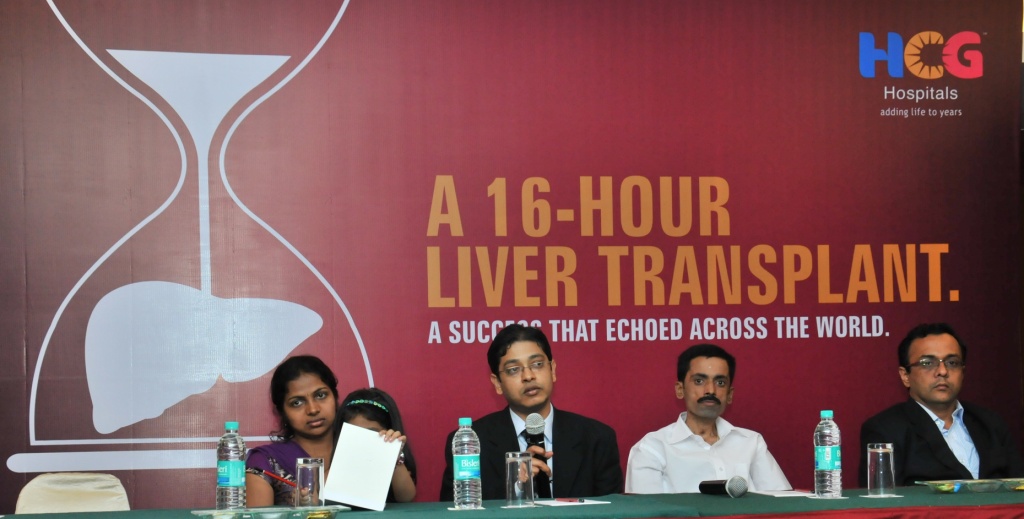
HCG Hospitals, organized a press conference on treating 36 year old Indian from USA, diagnosed with liver cirrhosis, underwent marathon 16 hour liver transplant surgery, with the organ donated from his wife.
A year ago, the patient had weakness and loss of appetite. During his routine health check-ups, he was diagnosed with liver cirrhosis, due to autoimmune hepatitis. After further investigations he was placed on the Liver Transplant waiting list in USA. With time running out, he did not get any organ offers and returned to India, for the liver transplant surgery.
Dr. Basant Mahadevappa, Consultant, Liver Transplant Surgeon, HCG Hospitals, said, “The patient was in a difficult situation, as he was decompensated with severe ascites (Liquid in the abdomen). His wife was worked up for donation. Anatomy of the donor was complicated, and was left with no other donor. With a multi-disciplinary team approach we took up the challenge and performed the transplantation. The patient & the donor are doing well and are on regular follow up.”
(From Left): Mrs. Shilpa Arun Kumar, Donor, Dr. Basant Mahadevappa, Mr. Arun Kumar, Recipient and Dr. Ganesh Bhat
Dr. Ganesh Bhat, Consultant, Gastroenterologist, HCG Hospitals, “The incidence of liver disease is on the rise and 2% to 3% of the people are living with Hepatitis B & Hepatitis C. People diagnosed with hepatitis B, are more likely to develop into liver cancer. Most of the times, its asymptomatic and when the patients start to see the see the symptoms, it’s in an advanced stage, which may require liver transplantation or a liver surgery. Early diagnosis of the disease helps in better medical outcomes.”
Mr. Arun Kumar, Recipient, said, “I was diagnosed with liver cirrhosis, and the only medical solution was Liver Transplant. With my condition worsening & surgery being an emergency I was lucky to find a donor in my wife. She came forward to donate her liver, though it was high risk surgery. I have recovered and got a new lease of life.”
source: http://www.moneylife.com / MoneyLife / Home / Bangalore, Karnataka, India / Business Wire India / November 27th, 2013
So far, 69-year-old Sudha Durg has helped more than 90 households also get Aadhar cards and senior citizen cards
Government authorities, including the MLA and corporator of Jeevan Kendra Layout in Ulsoor, know that a call from Sudha P Durg always means business. Neither diabetes nor age — she is 69 — deters this grandmother of three from doing what she loves to do: Lending a helping hand to the needy. From shuttling between houses in her locality collecting voter ID card, Aadhar card and senior citizen’s card forms to admitting impoverished children to school, Sudha does it all.
Homemaker Sudha was always restless as a young bride, but in a positive way. Although she loved mothering her children – a son and a daughter – the magnanimous side of hers was compelling. “From a very young age, I tried to do whatever I could for the people around me,” Sudha said with a smile. “We were more privileged than many other people around us, so I couldn’t sit back and do nothing.”
For the last 40 years, Sudha has been involved in social work such as educating the underprivileged — she got 25 children from families of construction workers admitted in government schools in Murphy Town — paying tuition fees for her maid’s children and attending to the needs of the backward classes. About four years ago though, she began championing the importance of voting.
“I would go from house to house, telling people to vote. That’s when I learnt that there were many people who did not have voter ID cards and didn’t even have a clue where to get it made. Many people did not have the time to run around government offices, so I decided to take it up for them,” she said.
Now, all the residents in her layout – 90 odd houses – and many others in neighbouring areas owe a debt of gratitude to her for getting their government documents made. “I started out by helping a few people here and there near my house, but soon, a lot of people came to know about me. They would come to my house seeking help. Since the government officials in my area such as the MLA and corporator know me well, it was never a trouble to get forms.”
Her immediate neighbour Jyothi Verma and her family of seven have Sudha to thank for getting their documents made. “Sudha herself got us the forms. All we had to do was fill those out and stick the photographs which she later came to collect. After a few weeks, our documents were delivered to our home. We did not have to go and collect even voter ID cards. Sudha received them herself and delivered them to us,” says Jyothi.
Sudha has also got residents in the area to contribute to appoint a security guard to watch over the area. Each house donates Rs 100. At the start of his duty every day, the security guard reports to Sudha and he knows better than to miss a single day on the job. Since 1996, beat police tick a register — now a card access system which they swipe — at her house, while pourakarmikas inform Sudha about their leave, and she accordingly informs everyone else.
While several other residential areas in the city suffer from parking problems, Sudha has streamlined parking in Jeevan Kendra Layout.
MH Naagthe, inspector, Ulsoor police station, lauds Sudha’s crime awareness initiative. “I always say prevention is better than detection. Sudha has been actively attending the workshops organised at the police station and is very knowledgeable about crime and the importance of being alert. She goes back and relays our messages to the residents, thus tutoring them on how to prevent crime.”
Backing Sudha in her noble cause is her husband Prabhakar Rao Durg as well as their son, daughter and their families. “She has been doing social service for the last 40 years and I know she loves everyday of her job. I help her out in any way I can like keeping a record of the amount collected from the society, payments, etc.,” says 77-year-old Durg.
source: http://www.bangaloremirror.com / Bangalore Mirror / Home> Bangalore> Others / by Tapasya Mitra Mazumdar, Bangalore Mirror Bureau / November 20th, 2013
Imran Khan, a resident of Tumkur, had been bedridden for the best part of 12 years after nearly 200 kg of steel fell on his back when he was visiting a construction site.
The 28-year-old lost all hope of walking again till he found out about Ilaj bit Tadbeer (regimental therapy), a little-known system of unani medicine involving massage, cupping and leeching using herbs. Imran underwent 14 months of continuous treatment at the National Institute of Unani Medicine (NIUM), which falls under the Ministry of Health and Family Welfare. Now, he has started walking with support.
The story of Tousif Ahmed from BTM Layout is similar to Imran’s. Tousif injured his spine in an accident in Andhra Pradesh in January 2012 in which his uncle died.
“I was told by a private hospital that I would not walk again and would be bedridden for the rest of my life. But with intervention from NIUM, I am moving in a wheelchair and also walking with crutches,” he said.
Tousif has been receiving treatment at the Institute for the past four months. He is currently shooting videos of recovering patients at NIUM in order to make a short film.
“I had wanted to set up a call-centre after getting my BCA, but the accident crippled my dream. But as I can move again, I have set a target of five months to walk out of this hospital,” he said.
Dr D A Muzzaffar Bhat, resident medical officer of NIUM, said the centre was focusing on neuro-rehabilitation. This included attending to patients who suffered from stroke, myopathy, epilepsy, motor-neuron disease, Parkinson’s disease, hemiplegia and paraplegia. He said NIUM takes up cases referred from other hospitals like NIMHANS.
He referred to the successful treatment of Mohammed Farooq, who was admitted to Victoria Hospital after meeting with an accident. He was bedridden for eight months with no sensation in his lower-back. Farooq started treatment at NIUM in January and is now walking with the help of crutches.
“No surgeries are done here and our approach is to develop cells and strengthen nerves and muscles,” Dr Bhat said .
Options for Cerebral Palsy Aditya Kholi greets you with a smile and offers a chair to those who approach him and only when he tries to walk, do people notice a problem.
Aditya is a child who was born with cerebral palsy and could hardly move his legs. His father Mahesh Kohli, an IT professional, had quit his job in Dubai to research treatment options for Aditya, when a friend told him about Ilaj bit Tadbeer.
After five months of treatment, Aditya can now sit comfortably and also fold his legs and walk.
source: http://www.newindianexpress.com / The New Indian Express / Home> Cities> Bangalore / by Mohammed Yacoob – Bangalore / November 18th, 2013


 10,009 crore.