There’s the Adam’s Family, the Jetsons, the Simpsons and The Flintstones and then there is Bangalore’s very own biker family —the Acharya family. This family of five — mother Jayashree, 56; father GV Acharya, 64; brother Srikanth, 31 and sister-in-law Namitha, 30 — led by daughter Shubra Acharya, holds the Limca Book Record of being the only family to have crossed the world’s highest motorable pass the Khardung La pass in Leh in 2011.
Riding through the 18,379 ft pass, Shubra, anardent biker, says, “We felt like we had conquered the world! My father owned a Bullet. Since then, we are familiar with the thump of the bike.”
It was during her MBA in 2010 that Shubra’s brother got her a Bullet Classic 500cc on her birthday. The brother-sister duo would set out on road trips around Bangalore with their dad; who would borrow a bike from friends and set out on a road trip. “I would write about the trips on my blog. Once my mother read the stories and wanted to be with us on a trip.”
It was during the Tonnur Kere ride on Mysore Road in December 2010 that they decided on a bike trip to Ladakh. “We just wanted to do it with mum. So we coaxed her to ride pillion with dad.”
It was a surreal experience for the Acharya family. “We stopped after the two and- a-half hour ride from Leh to the top of the pass and were drinking a lot of lemon tea because it was freezing,” says Shubra. They met other bikers who told them to send applications to the Limca Book of Records. They garnered two records: GV Acharya at 64 became the oldest man to have crossed the pass and the Acharya family became the “largest family” to have conquered Khardung La pass. For this family, no mountain is too high!
source: http://www.bangaloremirror.com / Bangalore Mirror / Home> Columns> Work / by Ayesha Tabussum, Bangalore Mirror Bureau / November 11th, 2013
(1-Top Left )Sabu, the elephant boy. (2-Top Right) Sabu with his father, a mahout (3- Middle) This is the rear of the building from where Kennedy was shot and killed. (4-Bottom) The memorial like a wall with vertical lines at the spot where Kennedy delivered his last speech. Dr. Sunder Raj is seen standing by the side of the information plaque.
A couple of days back, an old friend of mine from Bangalore had come to meet me and casually asked if Dr. J.K. Sunder Raj, a well-known family doctor of our city, had hung his stethoscope. Since I am in regular contact with him either in the Sports Club or Mysore Race Club or in connection with the Zoo (where he treats the gorillas), I answered in the negative.
“What makes you think Dr. Sunder Raj has called it a day and closed shop?” I asked.
It seems my friend had gone to see him at his clinic on Old Mysore Bank Road in city and found there was no clinic. That was news for me too. I called him on telephone to check. Yes, indeed he had closed his city clinic, but continues his service to the sick families from his house on Vivekananda Road in Yadavagiri. It was then that the good doctor said he was wanting to see me personally to hand over a unique newspaper that he had purchased in Dallas, Texas, where he had been recently to be with his daughter.
As promised, he came to my office with his special newspaper and more. The cover page of the newspaper is produced here… and the headline is self-speaking.
The daily newspaper ‘The Dallas Times Herald’, in its Friday evening Nov. 22, 1963 Final Edition, had carried world’s most shocking and tragic news of the day that happened in the city from where the paper was published. The assassination of US President John F. Kennedy. Looking at the paper that appeared as pulled out from the well-preserved archive, I wondered how our doctor managed to get the paper which will have huge antique value ! He asked me to take it easy. There is nothing like grabbing an old copy of that day of tragedy of Nov. 22, 1963. The credit for making available this copy of the newspaper to tourists should go to the Curator of Kennedy Museum at Dallas where Dr. Sunder Raj purchased it by paying $ 4.60. The cover price of the newspaper in 1963 was five cents.
The Museum authorities periodically print this historic newspaper as it was printed on that tragic day and sell them. What better souvenir one would want for visiting the Kennedy Museum ?
I took a copy of it before returning the original to the doctor and wondered if anything like this is being done at Gandhi Museum or Nehru Museum in our country. Readers with information on this may please write or e-mail to me.
Dr. Sunder Raj also gave me two photographs he had taken — one of the building from where Lee Oswald, the assassin, shot the President from the sixth floor which has now been converted into a Museum and another, the spot where President Kennedy delivered his last speech.
Dr. Sunder Raj also had two more surprise photographs with him which were of personal nature. One was a photograph he had clicked in the year 1951-52 at the elephant stables of the Maharaja, known famously as ‘Anekaroti.’ Now the new generation as also of the old generation may not know that the Anekaroti ever existed in Mysore, attracting huge number of tourists those days.
The stable was located where the JSS Hospital Complex is now. There used to be 20 to 25 elephants, well fed and healthy, says the doctor. The area of the Anekaroti used to be green and cool with plenty of trees, adds Dr. Sunder Raj.
The doctor recalls: Once a team of Hollywood film-makers visited Mysore in around 1950. They also visited the then famous Anekaroti. As they went around Anekaroti, they saw a young, bright and handsome boy playing with a huge elephant. His name was Sabu Dastagir who later became a famous Hollywood actor under the name Mysore Sabu (27.1.1924 – 2.12.1963). He was born in Karapore in H.D. Kote, the famous hunting forest of the Maharaja of Mysore. His father was a mahout (elephant attendant) and trainer of elephants. Sabu, his son, too was following his father’s profession where he was spotted by the Hollywood film-maker Robert J. Flaherty.
Dr. Sunder Raj says that Robert Flaherty persuaded Sabu’s father to let him take Sabu to Hollywood. Once in the US, Sabu was taught English and given training in acting.
Sabu acted in several English movies, specially connected to the jungles. His first movie was ‘Elephant Boy’ which was a great hit. Other movies were ‘Song of India,’ ‘The Jungle Book,’ ‘The Thief of Baghdad’ etc. It is sad that such a talented Mysore boy died young at the age of 39.
To those working to develop Mysore as a tourist destination, I may suggest that they revive the ‘Anekaroti’ which is sure to become a tourist attraction. Some lessons from the ‘elephant show’ of Bangkok’s ‘Rose Garden’ may be learnt and incorporated to this Anekaroti. Howzzat?
source: http://www.starofmysore.com / Star of Mysore / Home> Abracadabra….Abracadabra / by K.B. Ganapathy, Editor e-mail kbg@starofmysore.com / November 18th, 2013
As young Zaman was wheeled into the operation theatre, her head shaved, her mother Ninaya Khalil bent down to scoop up long locks of hair spread on the floor. Zaman had gone in for a complex surgery, and Ninaya wanted the hair for keepsake. Just in case. For Zaman had a ‘time bomb’ ticking inside her little head.
“I wanted to keep her hair, I didn’t know if she would come out alive,” says Ninaya, happy and relieved a week after her daughter’s surgery on November 1.
Zaman Adlaab, 9, from Iraq, was flown down to Bangalore, the left side of her body paralyzed. Zaman needed a surgery to remove a knot of arteries which was rupturing, leading to bleeding in her brain.
It began when Zaman was just six. She began complaining of severe bodyache that was followed by repeated convulsions. A few days later, she fell unconscious, white liquid oozing out of her mouth. Terrified, Ninaya took her daughter to a hospital in Iraq for an MRI, for a clear image of the brain.
“Doctors detected bleeding in Zaman’s brain. A surgery was performed and Zaman spent 15 days in the ICU. After the surgery, Zaman appeared healthy, apart from partial paralysis in the left side of her body,” recalls Ninaya.
The nightmare returned after two-and-a-half years. The bodyache and convulsions recurred, and she fell lifeless again. “A surgery was needed to get rid of the root cause. Although there was some risk involved, we had no other option. The doctors said a third fit could prove fatal,” says Adlaab Mehsin, Zaman’s father.
They came down for the surgery at Fortis Hospitals. “Bleeding in Zaman’s brain was due to Arteriovenous Malformation (AVM), a knot or ball-like structure formed by arteries which are “not fully developed”. Unless this knot was removed, chances of AVM rupturing the third time were high. Moreover, the AVM was sitting on the right side of the basal ganglia, a part of the brain that controls motor movement of the opposite side of the body. This made the surgery even more complex,” said Dr S Satish, consultant neurosurgeon, Fortis Hospitals.
The surgery, that went on for over nine hours, has given the girl a new life. “I feel no pain. I want to go home and start cycling with my brothers,” says a lively Zaman, waiting for the metal plates holding her scalp together, to be removed.
What is AVM?
* Arteriovenous Malformation is a condition that arises when immature blood vessels (arteries) in the brain form a ball-like structure. Often defined as a ‘time bomb’ by experts, AVM can rupture anytime without any symptoms, due to blood flow pressure and causes bleeding inside the brain.
* Brain AVMs occur in less than 1% of the population
* Cause unknown, are usually congenital but not hereditary
source: http://www.articles.timesofindia.indiatimes.com / The Times of India / Home> City> Bangalore> Time Bomb / by Garima Prasher, TNN / November 11th, 2013
Abhigya with his father Anand Ramasubramanian, mother Annu Anand and sister Abhidheya.
by Anagha Mahesh
This Children’s Day, we bring you a special feature on an 8-year-old boy, who can recite all the 700 shlokas of Bhagavad Gita with perfect pronunciation and spell out over 125 botanical names of various medicinal plants by just looking at their pictures.
Meet the wonder kid Abhigya Anand, a resident of city. Born to Anand Ramasubramanian and Annu Anand couple, residing at Emerald Enclave, behind Infosys, Mysore, Abhigya is just eight years. When he was just two-and-a-half years old, he could identify 40 flags of different countries and also about 50 car models. The virtue continued, with him learning to speak German in just a month when he was five years old and was residing at Stuttgart, Germany.
Abhigya’s father, an MBA graduate, has travelled extensively throughout the world along with family. Hence, Abhigya found it exciting to learn new languages. When he was seven years old, the family was based in Melbourne, Australia.
It is here that Abhigya drew inspiration to memorise and understand the Bhagavad Gita. He succeeded in learning 12 chapters out of 18. He chanted a few chapters at various temples in Melbourne, Mysore and Bangalore. Whatever he learnt was through You Tube videos as he didn’t have access to a teacher at Melbourne.
He was too keen on learning all the 18 chapters.
Once, Abhigya’s parents came to know that Sringeri Mutt would felicitate and honour anybody who can chant all the 18 chapters of Bhagavad Gita.
When they tried contacting them, the boy’s parents were told that all the 18 chapters should be recited at once. The parents were a little disheartened since Abhigya was confident of reciting only 12 chapters. This motivated the boy so much that he learnt the remaining six chapters and was thorough with all the 18 chapters within nine months with perfect intonation.
Abhigya will recite Bhagavad Gita at Sringeri during the end of this month.
His love for languages helped him learn how to speak and write Kannada within a month’s time. He is also fluent in Tamil and Sanskrit and has learnt and understood the meanings of over 200 Sanskrit shlokas.
The 8-year-old genius has also read over 500 Amar Chitra Kathas and can recollect most of the stories he has read. Apart from this, his other hobbies include playing cricket and football with his father and friends. He also plays mridanga.
Unlike most of the children, since there was a lot of globe-trotting involved, Abhigya has never been into a formal school. He is home-schooled by his mother Annu, a home-maker. He does attend a few classes here and there at MCS Govt. School, Belagola, for the sole purpose of socialisation with other children.
He has a four-year-old sister Abhidheya, whom he cured of dengue by suggesting a few ayurvedic medicines which he had learnt about by reading a book on Ayurveda.
Those who want to see it to believe it can watch Abhigya’s video on YouTube titled ‘7 year old Abhigya chanting Bhagavad Gita.’
Mother’s Message
Children should be encouraged to develop inclination towards spirituality as such an inclination at a tender age will help them maintain the same throughout their life. Thus, making them worthy citizens for the Nation, which claims to be a nation where spirituality occupies a vital place.
And it is also advised that children be given home food always and kept away from junk food with their future health in view.
source: http://www.starofmysore.com / Star of Mysore / Home> Feature Articles / November 14th, 2013
Hans-Gunter Loffler, Deputy Consul General of the Federal Republic of Germany, is seen cutting the tape to inaugurate the new cleft treatment centre at St. Joseph’s Hospital in city last evening as Bishop of Mysore Rt. Rev. Dr. Thomas Antony Vazhapilly; Alexander Gross, CEO, Deustche Cleft Kinderhilfe, Germany; Dr. Brigitte Winkler, Schweizer Hilfe fur Spaltkinder, Switzerland, Hospital Administrator Fr. Mari Raj and others look on.
Mysore :
Deutsche Cleft Kinderhilfe e.V., a first-of-its-kind super specialty cleft treatment centre was inaugurated at St. Joseph’s Hospital in city yesterday by Hans-Gunter Loffler, Deputy Consul General of the Federal Republic of Germany.
Bishop of Mysore Rt. Rev. Dr. Thomas A. Vazhapilly presided over the function held at St. Mathias School auditorium.
The guests of honour included prominent dignitaries like Alexander Gross, CEO, Deustche Cleft Kinderhilfe, Germany; Dr. Brigitte Winkler, Schweizer Hilfe fur Spaltkinder, Switzerland and Dr. Margrit Leuthold, Executive Director, Swissnex India.
Speaking at the occasion, Hans-Gunter Loffler said, “It is indeed a proud moment for us, as Germany is a good partner to India not just in the business and cultural domain but also in social and developmental activity.”
Addressing the gathering, Alexander Gross said, “Our aim is to make quality healthcare accessible to the underprivileged.”
Deutsche Cleft Kinderhilfe cleft centre at St. Joseph’s Hospital will offer comprehensive therapeutic, diagnostic and surgical facilities under one roof. In addition, the centre will be the first-of-its-kind exclusive facility in the Mysore region to provide free treatment to severe congenital facial deformities like NAM–Nasoalveolar Moulding therapy and orthodontic care under one roof coupled with the many complex and specialised surgeries including orthognathic surgery, rhinoplasty, pharyngoplasty, distraction osteogenesis and many secondary corrections which are quite complex in nature.
Apart from this the Centre will also provide orthodontics, speech and ENT-related treatment for cleft children.
The new cleft care facility is fully equipped with a dedicated high-tech operation theatre and ICU with state-of-the-art high-tech equipments/ technology including laminar air flow, epoxy flooring, high-end anaesthesia work station with ETCO2 and cardiac monitors, sevoflurane compatible anaesthesia machines along with a post operative rehabilitation facility for those who have undergone advanced cleft correction treatment/surgery.
The hospital has an exclusive blood bank having all the 4 components of blood 24/7 and facility of Apheresis which is a one-of-its-kind in Mysore.
Patients requiring cleft correction treatment can contact Dr. S. Manu Prasad, Project Director of the centre, on Mob: 09886701781
About Deutsche Cleft Kinderhilfe: In order to improve the living condition of the affected children and their families, Deutsche Cleft Kinderhilfe was founded in 2002. There are already ten cleft centres in India, in which operations are performed on over 2,000 children and teenagers each year. The comprehensive, free treatment also includes subsequent medical checkups, speech therapy, counselling and accommodation as well as transport costs for the children and their families, who are destitute in some cases.
In India, Deutsche Cleft Kinderhilfe has been actively setting up cleft centres in the past few years and at present successfully runs nine centres at Agra, Ahmedabad, Bhubaneswar, Coorg, Patna, Surat, Srinagar and Visakhapatnam. It also supports a cleft centre in Bangalore and Noida.
With over 10,000 free cleft lip and palate surgeries to its credit in India, the organisation is still midway on its long journey to provide high end comprehensive cleft care. Cleft in most cases, remains a childhood curse, as these otherwise completely normal children are socially ostracised coupled with health issues. If treated well and at a young age they are able to lead a completely normal and productive life.
source: http://www.starofmysore.com / Star of Mysore / Home> General News / November 06th, 2013
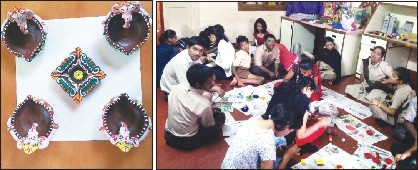
Come November, and your city starts gearing up to celebrate the vibrant festival of lights — Deepavali. While innumerable cracker stalls start mushrooming, several interesting exhibitions to purchase knick-knacks for the fest also start showing up all around. However, a few of the many fairs that come up are unique. One such is this expo and sale of the diwali diyas and candles made by the differently abled.
Starting tomorrow, city’s Mythri School, a school for specially abled kids run by the Mythri Charitable Trust will host a two-day exhibtion of Deepavali diyas and candles, made by the school’s children. This is the second edition of the expo where the items will be available for appreciation and sale.
Speaking about the fair, School’s Managing Trustee, Pruthvi explains, “we are hosting the Deepavali Diyas and candles sale made by our students for the second consecutive year. We conduct various fairs such as painting, candle and jewellery exhibitions, to ensure that the children of Mythri are self sufficient and also improve their skills in various areas.”
When asked if the sales did good last year, Pruthvi says, “yes, it did, for we use quality products in making the crafts and all items are made by the students under our supervision. However, unlike last year, we have several young volunteers from institutions such as Sri Jayachamarajendra College of Engineering (SJCE), National Institute of Engineering (NIE) and several other colleges, infusing that enthusiasm in kids and helping us organise this year’s fair in a much better way.”
The exhibition will include an array of crafted diyas, candles and decorative rangolis made on transparent plastic sheets which are prepared by those in the age group of five and forty, who are all eager and are looking forward to the event. “We are all very excited about the fair. We are doing the best of work we can with complete dedication. We can’t wait to see who will buy our creations,” say the artists Rakshita, Tabu and Srinivas.
Apart from the Diwali diyas and candles fair, the school also organises exhibitions of artificial jewellery, pottery and paintings made by the children every year.
The Diwali fair will be held at the school premises in Krishnamurthypuram opposite Ambedkar Park for two days starting Oct. 31 from 10 am to 5 pm.— AN
source: http://www.starofmysore.com / Star of Mysore / Home> Feature Articles / October 30th, 2013
In a first of its kind initiative in the state, here’s some good news for moms-to-be. Karnataka is gearing up to introduce the free pick-up-and-drop facility for pregnant women to reduce high infant and maternal mortality rates in the state. The scheme will be open to women who avail of services in government hospitals.
(Karnataka govt will provide…)
Though the Centre had launched this scheme a year ago on a cost-sharing basis with states under the National Rural Health Mission, the BJP government here failed to implement it for lack of funds and political reasons.
The Congress government, with an eye on the upcoming Lok Sabha elections, has decided to pursue this scheme on priority. “We have sought tenders for buying equipment, vehicles, among other things. Hopefully the scheme will be implemented in two months,” said M Madan Gopal, principal secretary of health and family welfare department.
Senior health officer M Raju said the scheme will help women from villages who find it difficult to reach hospitals on time due to factors like unavailability of vehicles and cash crunch.
WHAT’S THE SCHEME
As per the scheme, the health department will station its vehicles at strategic points. Based on a woman’s expected date of delivery, she will be taken to the nearest primary health centre or delivery point. She will be provided with food, medical and recreational facilities. Once she recuperates after delivery, the vehicle will drop her back home. The entire service, including the stay and food, is free of cost.
HOW IT WORKS
“All information about pregnant women, including their contact numbers, will be registered during their anti-natal period. The vehicle will be sent to their residence a day or two prior to the delivery date, depending on the woman’s condition. An SMS reminder will be sent to the family members before the day of pick-up, to help them prepare for the hospital stay,” Madan Gopal said.
The department will introduce the vehicles keeping in mind the area (terrain) and population.
MOBILITY MATTERS
On an average, at least 5 of 1,000 infant deaths (infant mortality rate) occur due to non-availability of transport to reach primary health centres. The Maternal Mortality Ratio (MMR) is also around 180 per lakh. Karnataka hopes the pick-up-and-drop facility will improve institutional delivery of babies from 55% in 2010, to more than 90%.
Chief minister Siddaramaiah, who recently reviewed the government’s health schemes, directed the health and family welfare department to make Karnataka’s IMR the lowest in the country within five years. The state currently ranks 10th on the national IMR index.
Times View
This is another social welfare scheme that seems high in intention but low in practicability. That it had been put in the cold storage for want of funds only underlines this. First, the government should ensure there are enough primary healthcare centres, especially in rural areas. Second, it should ensure these are manned and well-equipped. In a country where women deliver babies outside government hospitals due to lack of beds, it seems a little daunting and implausible that women will be accorded the time and space the scheme envisages.
source: http://www.articles.timesofindia.indiatimes.com / The Times of India / Home> City> Bangalore> Primary Health Centre / by Manu Aiyappa, TNN / October 09th, 2013
(Left): 1) Sri Suttur Swamiji, Dr. M.C. Modi, Ln. Nanjundaswamy and myself at the camp in Suttur. (Right- 2) Dr. Modi offering garland to Indira Gandhi during her visit to Mysore while he was conducting an eye camp.
by K. Vijaya Kumar, Former Jt. Director of Information & Publicity
October. 10 is World Sight Day, an annual day of awareness to focus global attention on blindness and vision impairment.
Having undergone cataract surgery for my right eye just a couple of weeks ago at the Sushrutha Eye Hospital in city by Dr. C.A.P. Prabhu, who runs it with his wife Dr. Pallavi Prabhu and as I turn 77 (on Oct. 14, Vijayadashami Day), it occurred to me to remember this day and offer my gratitude to all those ‘eye-care’ fraternity engaged in protecting our vision. The reason to mention the date is that after several years, Vijayadashami this year has occurred on Oct. 14 as per the Hindu calendar.
‘Cataract King’ Dr. Modi
When we speak of cataract surgery, the immediate name that occurs to our mind is that of Dr. M.C. Modi. A legend of his time, he had dedicated his full 90 years of life to provide vision to lakhs of people all over by conducting cataract surgeries and was rightly known as ‘Cataract King’.
Look at this description on himself — “Like a circus company I have toured all over India since 1943 to provide free eye relief service. In the process, I have examined over 10 million patients and performed a record nearly six lakh eye operations.” It is a fact, even when he was travelling by train, he would examine the eyes of the passengers moving from one bogie to another. While his wife accompanied him on a rail journey once, he was so engrossed in eye examination that he completely forgot about her and got off from the train at a wrong station leaving his wife in the train itself !
Gandhiji’s influence
The ‘human dynamo’ in Dr. Modi was triggered by Mahatma Gandhi (whose 145th Jayanthi was observed just last week) whose speech he had listened in 1942 at Beelagi near his own native place in Koppala district. Helen Keller had described him as a “light piercing in darkness in selfless service” at a felicitation in New York.
He was also decorated with Padma Bhushana award. “One man’s war,” a documentary on him, had been produced by our Information Department, directed by M.S. Satyu.
Eye camps in Mysore and Ln. M.S. Nanjundaswamy
I recall here Modi’s several mass eye camps held in Mysore in seventies and eighties when I was serving in Mysore. The person behind organising most of these camps was late Lion M.S. Nanjundaswamy.
An active member of Lions Club, who also became the Lions District Governor, having a motto ‘Gift of Eye-Sight to five persons every day,’ he had organised four major free eye camps in 1977-78 when Dr. Modi examined 34,320 eye patients and 1,342 eye operations were performed. Nanjundaswamy had become close to me because of the publicity support I was extending for this noble cause with charity undertaken by him and his wife Smt. Jagadishwari.
Their son Lion M.N. Jai Prakash, following the footprints of his parents, continued conducting free eye camps and serving as a Lion member becoming Governor twice.
A surprise visitor
I was greatly surprised one morning when Nanjundaswamy walked into my residence with Dr. Modi, who was such a modest person. My mother’s joy was beyond words. Even before she greeted him he made her to sit and started examining her eyes with his ready torch in his coat saying they are ‘perfect’.
After introducing me to the Doctor, both of them asked me to join them for the inauguration of eye camp by Suttur Seer. When I went there, they made me sit on the dais as a chief guest. A salute to them on the World Sight Day.
e-mail: kumarkv59@gmail.com
source: http://www.starofmysore.com / Star of Mysore / Home> Feature Articles / October 09th, 2013
The State government on Tuesday decided to implement ‘Universal Health Coverage’, a scheme which envisages bringing every citizen under a health scheme.
The decision was taken at a meeting of the State Health Mission Authority headed by Chief Minister Siddaramaiah. The scheme, which has been planned as per the recommendations of the High-Level Expert Group of the Union Planning Commission, will be launched on a pilot basis in Mysore and Raichur districts.
Health Minister U T Khader said the department will now begin preparations for implementing the scheme which is the first of its kind in the country. The Union government has agreed to fund the pilot project, he added.
source: http://www.deccanherald.com / Deccan Herald / Home> State / DHNS / Bangalore – October 01st, 2013
Waseem Pasha, a tailor near Brigade Road, has good reason to hold his head high. The 22-year-old returned Rs 12,000 that a customer forgot in the pocket of the shirt she gave him for alteration.
On Saturday afternoon, Imola Jamir walked into his small shop in Tibetan Plaza — the basement of Indo-Dubai Complex, on Rest House Road, off Brigade Road — and gave her husband’s new shirt for alteration.
Later, when Pasha picked up the shirt to work on it, Rs 12,000 fell out of its pocket. The sole breadwinner in his family, who earns Rs 15,000 a month altering clothes, decided then and there to return the money. But he didn’t have the contact info of his customer. He had to wait till Imola returned.
Meanwhile, Imola and her husband Ben Dang Aier, both aged 47, realised the money was missing only on Sunday evening. She said, “My husband didn’t like the shirt’s collar. So, I decided to give it for alteration and surprise him. But I had no clue he had left Rs 12,000 in that shirt’s pocket. That money was meant to pay the school fees for one our daughters.”
The couple from Nagaland, who run a paying-guest in their house in Koramangala, rushed to Pasha’s shop. When they asked him if he had found any money in the shirt’s pocket, Pasha took the receipt from them, confirmed the shirt was theirs and promptly returned the altered shirt along with Rs 12,000. Imola and Ben couldn’t believe they had got the money back. They thanked Pasha and offered him Rs 500 as a reward for his honesty.
source: http://www.bangaloremirror.com / Bangalore Mirror / Home> Bangalore / by Bellie Thomas / October 01st, 2013