Category Archives: Inspiration/ Positive News and Features

Transcending barriers for creativity

A Sharadhaa chances upon the success story of a spirited group of visually-impaired dancers | EPS

For the visually impaired, disabled and underprivileged youth, life is often a confrontation, with challenges coming in multitudes unlike an abled man or woman. It is often left to the individual alone to face these barriers and rise above his or her disability. There are many stories of such people who challenged life and overcame their incapability, either on their own or with a little support.

For a group of 14 people, being able to recognise the creative side in them, has taken them across the world; recognition coming in all forms.

Sunadha is a cultural group which was established in 1999 comprising visually impaired performers talented in dance, singing and mimicry. The group is an effort by Samarthanam Trust for the disabled. The group has performed classical and folk dances across India, US, UK, Malaysia and Thailand. Their popularity has increased by the year, so much so that they now embark on an annual two-month tour to the US and UK to showcase their talent.

The troupe has also won several awards including the first place at the All India Dance competition held in November 2010 in New Delhi. The troupe has nine dancers, four singers and a mimicry artist. The team is usually invited by corporates to perform as part of their corporate social responsibility initiative.“In 1999, Sunadha started its first cultural programme project outside India and our first programme was in the US for Veerashaiva Convention. Senior actor Shivaram accompanied us and made it a grand success,” said Vasanti Savanur, a 58-year-old volunteer and a trustee who has been travelling along with the troupe for the last 14 years.

“There is no fixed remuneration for the group. However, a minimum amount of `25,000 is charged for a performance of about an hour. The travelling and accommodation expenses are borne by the inviting party,” said Vasanti.

Recently, the troupe visited Malaysia where they performed for a month at every Sai Baba temple. “The main event was in Kuala Lumpur where they gave a two-hour performance in groups,” said Vasanti. For these students, performing at various shows has given plenty of exposure and for some, it has become their livelihood. “I have learnt a lot while I travel with them. This year, they have been invited by the Tamil Association in Dubai. We will be leaving in the month of September. I have almost attended 500 programmes with many groups and wherever we have gone till date, we never felt like outsiders. There are many challenges though. Sometimes their health dips but they don’t mess the programme. Their performances have left many people dumbfounded,” said Vasanti.

The group has also been trained to address another challenge – etiquette. “Since they participate in programmes that happen in India and abroad, they trained on how they should behave,” she said.

The spirited team

The troupe has Suma who is a visually impaired artist and has learnt the skills of Bharatanatyam, classical, folk, filmy, etc. She hails from Hiriyur, Chitradurga district. Suma has completed her degree in commerce from a reputed college in Bangalore and is a good dancer who has performed in Australia, Italy and the US as well as at prestigious events like the Hampi and Anegundi festivals.

“Initially we had a volunteer, Anumpama Jaisimha, who started teaching us Bharatnatyam. Then, we had Dr Raksha and, at present, it is Jai Lakshmi, who is handling the team. We have classes for three days in a week and we are taught only in the evening after our school and college hours,” said Suma who further added, “Public appreciation is our motivating factor. There were times when people have cried after our performance. We catch the enthusiasm when the audience appreciates. I never feel that I am blind when I participate in these shows.” For another special girl, Jayalakshmi, dancing was something that developed at a tender age. “I never had the opportunity back then, being disabled. But today I am glad to be part of the troupe,” she said. Lingaraju is the only male artiste in the dance troupe.

“He is visually impaired and hails from Tiptur. He started learning classical dance when he was only seven. Now, 22 years old, Lingaraju is an accomplished dancer. For more than seven years, he has been pursuing his passion for dance. In December 2010, he picked up the first prize for his performance at a national competition for the visually impaired,” said Vasanti.

The troupe is supported by a group of 12 singers and musicians, who are also disabled.

source: http://www.newindianexpress.com / The New Indian Express / Home> Cities> Bangalore/ by A Sharadhaaa— sharadhaa@newindianexpress.com – Bangalore / May 25th, 2013


Dharwad district tops State in utilising MGNREGS grants

The district tops Karnataka in utilisation of funds released by the Union government under Mahatma Gandhi National Rural Employment Guarantee Scheme (MGNREGS).

Several development projects have been implemented across the district, utilising all the money released for the financial year 2012-13, under the Scheme. Udupi is at the bottom of the list by making use of only 15.5 per cent of the funds – the least utilisation.

“The Centre releases grants according to the demands of the district. Dharwad Zilla Panchayat was the first one to prepare the action plan and  submit it to the implementing officers. Early release of grants ensured complete use of the money,” said Zilla Panchayat Chief Executive Officer, A P Meghannavar.

Last year, Rs 63 crore was allotted under the MGNREGS for the district. This time, a proposal for Rs 80.90 crore has been submitted, he said.

The Zilla Panchayat and Gummagola Gram Panchayat of the Navalagund taluk in the district have been bagging several awards from the Department of Panchayat Raj and Rural Development for successful implementation of the job scheme. This also played an important role in Union and State governments according priority to the district. Thus, Dharwad was among the seven districts selected for the pilot project of ‘e-FMS,’ an initiative for online payment of MGNREGS wages.

“Payments were delayed during the initial stages on account of the non co-operation from banks. However, the situation has improved now and wages are being deposited in the bank accounts online within 15 days as per rules,” Meghannavar said.

However, there have also been complaints of “improper” implementation of the scheme in some parts of the district. Social activist Sharada Dabade alleged that many with job cards had been denied job in Mukkal village of Kalghatagi taluk.

“Earthmovers are being used to desilt tanks while the rules stipulate that manual labour should be deployed for the purpose,”Dabade said.

source: http://www.deccanherald.com / Deccan Herald / DHNS – Dharwad, May 17th, 2013

Cash-Registers for hearts?

Charitable donations of wealthy Indian firms is only 0.6-1% of GDP, compared with 2.2% for American companies

Pic: Business Standard

Many believe that Indian businessmen have cash registers for hearts. Their philanthropic contributions are believed to be insignificant in comparison to their wealth. According to the 2012 Forbes list, the wealth of the 100 wealthiest Indians is around $250 billion—13.89 per cent of India’s GDP. But, according to the estimates of a 2010 report of Bain Company, the charitable donations of Indians is only 0.6 per cent to 1 per cent of the GDP, when the charitable contribution of Americans is around 2.2 per cent of the GDP.

But, before one jumps to a conclusion, there is the other side of the story as well. On a program aired on the CNN recently, Ratan Tata, former chairman of Tata Sons, said that of 60-65 per cent of the Industrial proceedings of Tata Sons goes  into programmes for education, medical, rural development or eradication of poverty. Only two per cent of the industrial proceedings go to the family.

Tata is the chairman of the Tata Trusts, which is among the largest private sector philanthropic trusts in India.

He is not alone. In February 2013, Azim Premji, the Chairman of Wipro became the first Indian to sign the giving pledge. Premji had also donated $ 2.3 billion to a trust to fund Azim Premji Foundation, an education-oriented non-profit. The giving pledge group was founded by Warren Buffett and Bill and Melinda Gates in 2010 to urge rich businessmen to donate a significant part of their wealth. With a net worth of $ 16 billion, Azim Premji is the 3rd richest Indian, and the 41st richest person in the world. Premji is also among the world’s top five givers. But, many think of them as an anomaly in a country where businessmen have billion dollar homes.

Gurcharan Das, author and former Procter and Gamble India CEO said philanthropy is a new idea in India when countries like the United States have a culture of philanthropy. “More and more people will donate to charitable causes in the future.” he said.

However, evidence suggests that philanthropy in India is often informal, and far more than  suggested by data. Bibek Debroy, an economist, and a research professor at Centre for Policy Research said though Indians do a lot of philanthropy, much of it is to religious institutions, is informal and does not appear in the official records.

Veena Jha’s recently published work, “India Emerging: The Reality Checks” sheds light on the long philanthropic tradition in India. Charitable donations have increased radically in the post-reform period. Studies of ‘The Society for Participatory Research in Asia’ between 2000 and 2002 shows that 53 per cent of the charity in India operates in rural areas and nearly half of it is unregistered.

Some studies suggest that nearly half of Indian households give charity. In India, non-profit activity, especially private nonprofit activity, is much higher than the global average. According to Bain and India’s annual philanthropy report, the private donation to charity had gone up by 50% from 2006 to 2011.

“A part of the philanthropic donations in India is to institutions abroad, like the universities and think-tanks. This is partly for visibility. But, many of them have studied abroad, and feel indebted to their alma mater.” Bibek Debroy said.

In 2010, Anand Mahindra had donated $ 10 million to the Harvard University, and Ratan Tata’s $ 50 million donation to the Harvard Business School in 2010 was the largest international donation in its history. In December 2012, a Delhi-based entrepreneur Sharik Currimbhoy had pledged $12.12 million to Columbia University, and businessman Siddharth Yog had gifted $11 million to the Harvard Business School.

Some economists have proposed an estate tax and corporate social responsibility (CSR) practices to increase the philanthropic contribution in India. While the former was not to the liking of the Finance Ministry, at least in the budget for 2013-14, the latter is there in the Companies Bill, 2012 which is yet to be passed by the Rajya Sabha.

Ajay Shah, a professor at National Institute of Public Finance and Policy (NIPFP), said an estate tax will help inter-generational class mobility and to reduce the concentration of wealth.

“Incentives do matter. But, I do not see this as a black-and-white issue. It is perfectly possible for a man at the bottom to rise to the top, and I admire people who come from a humble background, but in our country, it is very difficult to do so,” he said.

However, he voiced views against CSR. ” But, CSR is a bad idea because it puts managers in control of the purported charitable objectives of shareholders.” Ajay Shah said.

But, doing charity is intrinsically difficult. Steve Jobs had once said that he is not deeply engaged in philanthropy because there is no measurement system—-It is very hard to measure whether you have succeeded or not.

According to the Bain and India philanthropy report, 80 per cent of the individuals and 90 per cent of the NGOs are satisfied with the efficacy of their philanthropic activities. Many economists think that this is because people often donate for the “feel-good” factor, and prefer to believe that their money goes into the right causes.

Many, like Bill Gates had proposed solutions to this problem which is magnified in India, where philanthropy is informal, and the feedback mechanism weaker. Some proposed solutions include measuring the funding for social causes, the teacher absentee rate, and the extent of corruption.

Gurcharan Das opined that this is not severe problem. “The Gates’ foundation is known for their accountability and their work to counter AIDS in many poor countries, including India. Though it is hard for individuals to do philanthropy, they can pick a good NGO to donate their money to. It only takes a Google search to find out the NGOs that are more accountable.” he said.

But, Nitin Pai, the founder of The Takshashila Institution said because it is difficult to measure the outcome in philanthropy, people often measure the outputs. “Across the world, they tend to focus on impressing the donors, which is not always a good thing. Feedback mechanisms, if not properly designed, can skew the outcome. It is important to realize that this is intrinsically difficult.” he said.

And, charity will never be sufficient. Economist Jagdish Bhagwati once said that an outright redistribution of wealth would only increase the food consumption of the poor by one chapatti a day. Some economists have estimated that sharing the total wealth in developing countries would leave its citizens with a few dollars a day. It is clear that charity will not solve the problem of world poverty.

“Poverty is too big a problem to be solved by charity alone, but that does not undermine the case for charity.”, Ajay Shah said.

source: http://www.business-standard.com / Business Standard / Home> Companies> Features / by Shanu Athiparambath / New Delhi – April 20th, 2013

Teresian college golden jubilee celebrations to conclude tomorrow

Mysore :

The golden jubilee celebrations of Teresian College in Siddarthanagar here will end with a grand finale tomorrow (April 20).

A Thanksgiving Eucharistic Celebration will be held at 11 am to mark the beginning of the programme. Most Rev. Dr. Bernard Moras, Arch Bishop of Bangalore, will be the Chief Celebrant.

The main function will start at 5.30 pm, presided over by Most. Rev. Dr. Thomas A. Vazhapilly, Bishop of Mysore. Sudha Murty, Chairperson, Infosys Foundation, will be present as the chief guest.

Most Rev. Dr. Bernard Moras, Rev. Fr. Arul Raj, Parish Priest, St.Antony’s Church, Gayatripuram; Maria D’Costa, former Principal; Dr. Alexander, former Minister of Tourism; Dr. N. GopuKumar, Deputy Secretary, UGC, Southern Region and Dr. Sebastian Dasan, Chairman, Department of English, University of Mysore, will be the guests of honour.

Sr. Chris, Superior General, Congregation of the Carmelite Sisters of St.Teresa (CSST); Sr. Fridoline, Provincial Superior, Karnataka Province, CSST; Sr. Annette and Sr. Joyce, former Principals of Teresian College; Sr. Helena, Manager, Teresian institutions; Sr. Prafulla, Principal, Teresian PU College; Prof. V.K. Jose, Officiating Principal and Sr. Sajitha, Principal, Teresian Degree College, will be present.

The college started for girls with a modest strength of 60 students in the eastern outskirt of Mysore city at a time when women’s education was not encouraged. Today, it has expanded into a strong institution with more than 1,600 students.

The campus houses Pre-KG to PG programmes. Bearing testimony to the doyens who have walked through its portals, students from Teresian College have left their mark in the fields of Governance, Politics, Sports, Corporate sector and education.

Students: The college has produced outstanding personalities in every field. Dr. R. Indira (renowned academician and scholar), Prema Cariappa (former Bangalore Mayor), M.S. Archana (KAS), Sapna Dutta (Corporate trainer), Pavitra Chandra and Reshma Chengappa (international basket ball players), Supriya (international volleyball player), G. Nisha (Indian team captain in Junior Asian Volleyball Tournament), Poojashri Venkatesh (international tennis player), Chitra Mahimairaj (international billiards player) are a few among them. Reena George, Thippava Sannakki, Bibi Summayya, Shradha Rani, Afsana, Shahajahani are athletes of national repute.

TeresianBF25apr2013History: The history of Teresian College can be traced back to 1858 when Mary Grace D’ Lima was born in Chennai. She gave herself to the service of God and became Sister Teresa of St. Rose of Lima. With a desire for the service of humanity, she started a religious congregation known as Carmelite Sisters of St. Theresa (CSST), to spread lofty ideals and spirituality of St. Teresa of Avila, in a little house in 1887 at Ernakulam, Kerala. Her efforts have grown today into a large Teresian Family with 120 communities and around 100 educational institutions.

Mount Carmel College in Bangalore, Teresian College, Avila School, Christ The King, Nirmala Convent and Teresian School in Mysore, Carmel College and St. Joseph’s School in Mandya are a few institutions doing yeoman service in Karnataka.

The College: Teresian College is named after St. Teresa of Avila, a 16th century Mystic Saint who symbolises selfless dedication and devotion to the cause of the downtrodden and oppressed.

Manoranjan Mahal: Teresian College was born in the minds of a group of CSST Sisters headed by Sister Euprasia. The decisive journey of Teresian starts in ‘Manoranjan Mahal,’ an architectural and historical monument, presently the convent, where I PUC classes were started in Arts with a strength of 60 on 22nd July 1963. In 1964, the science section and the degree first year were added. In 1966 hostel facilities started in the campus.Courses in commerce started in 1976. Other new courses were added later.

PG Centre: The Post-Graduate Centre started functioning from 2008 and is offering M.Sc. in Bio-technology, M.Com and MA (English). Professional courses like MBA and MCA are offered through Twinning programme with Pondicherry University.

source: http://www.starofmysore.com / Star of Mysore /Home> General News / April 19th, 2013

Museum of love

AmulyaBF07apr2013

Amulya Shodha’, a museum in Shimoga, was built by a retired history lecturer, Khandobarao, in memory of his wife. The history lecturer now plans to expand the museum and make it the go-to  place for all students of history. Nrupathunga S K reports.

Inscriptions, coins, monuments, manuscripts, all stand as testimony to the many events in history. As we turn over the pages of history, we come across many kings, who took to the battlefield to either retain their kingdom or to expand it.

Speaking of love, though, only one king comes to the memory of most Indians — Mughal emperor Shah Jahan, who built the Taj Mahal in memory of his wife Mumtaz Mahal. This monument has been a source of inspiration for lovers across the globe for several centuries. It’s not surprising then that H Khandobarao, retired history lecturer, better known as ‘Shah Jahan of Shimoga’ was inspired by this emperor.

He has built his ‘Taj Mahal’, a museum named ‘Amulya Shodha’, on a one-acre farm near Lakkinakoppa circle on N R Pura road, 12 km from Shimoga in the fond memory of his wife, Yashodha, who was also history lecturer. She passed away in 2007 due to kidney failure.
‘Amulya Shodha’, as the name itself suggests, is an invaluable search for lost values and culture of the bygone days. It showcases rare paintings of Ravi Varma, coins, inscriptions, manuscripts, weapons, all used by popular kings. The history professor collected these artefacts from various parts of the country.

He wants to create awareness among youth about the significance of lost heritage, culture of the previous era through his museum and thus aspires to make youth more aware of our culture and heritage. Apart from this, it also spreads the fragrance of his deep love for beloved wife Yashodha.

Khandobarao did his schooling and college in Shimoga. Yashodha was his neighbour during his college days. Both of them studied at the Sahyadri College together. Acquaintance turned into friendship, and later, love. They got married in 1972. Khandobarao began his career as high school teacher in 1968.

After serving for nearly five years, he was promoted as a history lecturer for National Pre-University College in Shimoga.

His wife worked as a history lecturer at Kamala Nehru Women’s College. His wife would often say that the Taj Mahal was not only a symbol of true love, but also the soul of true lovers. Inspired by her thought, he made up his mind to build a museum on a one-acre farm after the death of his wife in 2007.

Khandobarao is seeking financial assistance for the development of this museum. He has appealed to people’s representatives, including former chief minister B S Yeddyurappa, in this regard. But, his efforts have failed to produce desired results. Khandobarao feels the museum is turning into a mere godown, owing to the presence of a large number of artefacts. He plans to expand it.

But he is short of funds to execute his plan. He has already submitted a proposal to the Centre along with his plan seeking Rs 3 crore for the development of this museum. He wants this museum to remain a symbol of true love and a school of history for future generations.

source: http://www.DeccanHerald.com / Home> Supplements> Spectrum / April 02nd, 2013

Lighting up lives of the underprivileged

Dharwad :

Karnataka Vikas Grameena Bank which covers nine districts of north and coastal Karnataka has come up with a scheme to attract students to school in association with Selco Solar Company, under a programme called “Light for Education”, which is being implemented in a few government schools.

According to a study, about ten percent of the children who go to government primary schools do not have electric lights in their homes. It is more so among the nomadic tribes, who go from place to place. It is their children who suffer the most as they are forced to read in the dim light of an oil or kerosene lamp. This nips most of their aspirations and creativity in the bud.

“Not only that, using kerosene lamps is dangerous as well, as we have heard of incidents of lamps falling on dozing children leading to fatal accidents. It is in this background that the bank has decided to help students with safe lights,” said KVGB chairman Sambasiva Reddy.

Under the programme, 50 students are identified and given solar lamps. The importance of this programme is that the batteries of these lamps can be charged only at the school where charging unit will be placed. The unit is a large one which can charge up to twenty five batteries at a time. Since the lamps can be charged at the school, children who use the lamps should necessarily come to school for charging. Lamps are made of good quality but since it cannot be charged independently, there can be no malpractice and it cannot be sold by unscrupulous persons and even by drunken parents. The lamps will be given to children studying in fourth standard and they can use it till they complete their seventh standard.

The Bank and Selco Solar Company have cast a responsibility on the school to maintain the solar charging panel and to keep track of the fifty solar lamps given to their students. The lamp and the solar panel will be serviced by Selco Solar Company.

The first beneficiary under the said scheme is the Government Kannada Primary School No.7, situated on Savadatti Road, Dharwad which has sheltered only students of poor background.

source: http://www.articles.timesofindia.indiatimes.com / Home> City> Hubli / by Gururaj Jamkhandi, TNN / March 31st, 2013

Grit and gumption help student achieve rare feat

Dharwad :

Coming from a poor agriculturist family in a parched village of Harlapur in Kundgoltaluk of Dharwad, ShridharBhandiwad could not have dreamt of having a lucrative job in a software company in Bangalore. But his determination to convert the challenges into opportunity has helped him achieve what was once considered impossible.

A fresh engineering graduate, Shridhar is now a software engineer working for BEL at Bangalore and earning a salary package of Rs 6.4 lakh per annum. What is more commendable is Shridhar bagging four gold medals for securing highest marks in the BE Computer science course.

Shridhar, son of Yallappa Bhandiwad and Sulochana did his schooling at Government Kannada Medium School in Harlapur and secured 91 per cent of marks in SSLC. He joined Karnatak Science College in Dharwad for PUC but money was a major constraint to pursue education further.

With an annual family income of Rs 15,000, Yallappa was unable to fund his son’s education. It was at this time that a friend Arvind Joshi informed Shridhar about NGO Vidyaposhak which is helping the deserving economically weak students to pursue education.

Shridhar’s efforts to contact Vidyaposhak clicked. Once in the ambit of Vidyaposhak, Shridhar had no worries over financial arrangement till he completed his BE. Vidyaposhak which studied his family background, economic status and academic performance ensured that he was helped with funds and study materials.

He got 72 per cent in PUC II year science and could get a seat at the University BDT College of Engineering in Davanagere for BE in computer science.

Shridhar did not disappoint those who helped him. Studying hard he managed to remain a topper during the course and secured highest aggregate marks (87.45 per cent) in B E final year and also highest marks in Computer Science subject and won four gold medals.

“But for the support from Vidyaposhak I could not have achieved anything. Right now I have some loans to be cleared and soon I want to start donating to Vidyaposhak,” Shridhar said.

Shridhar wants to do his MTech and help the needy.

source: http://www.articles.timesofindia.indiatimes.com / Home> City> Hubli / by Gururaj Jamkhandi, TNN / Dharwad, April 01st, 2013

City lad represents champion state cricket team for deaf

guruBF03apr2013

Mysore :

K. Guru, a student of 6th Sem. Diploma in Electronics and Communication Engineering, JSS Polytechnic for the Differently Abled played in the First National Deaf T-20 Cricket Championship held from Jan. 29 to Feb. 3 at Secunderabad representing the Karnataka State Cricket Team for Deaf.

The Karnataka team won the Championship. The Principal has congratulated Guru on behalf of the Polytechnic.

source: http://www.StarofMysore.com / Home> Sports News / March 29th, 2013

Encouraging aspiring entrepreneurs

EntrepreneursBF23mar2013

Every person aspires to become an entrepreneur, while some succeed others falter. The National Entrepreneurship Network (NEN), which is the leader in entrepreneurship education, has been encouraging engineering colleges to start E-Cells throughout the country to encourage students to grow as entrepreneurs.

One such Entrepreneurship Cell (E-Cell) is Aspera at the Vidya Vardhaka College of Engineering (VVCE), which was started in the year 2005 but was officially launched in 2007 with the name ‘Prerana.’ Later, the name was changed to ‘Aspera’ in 2009. Aspera has been actively taking part in activities conducted by NEN since its inception.

Speaking to Star of Mysore, Aspera Co-ordinator Prof. Manjula Murthy said that NEN had been guiding students in term of starting a new business, connecting the budding entrepreneurs from college to various industries and also to investors.

Aspera has been conducting activities throughout the year. This apart, regular meetings are conducted every Saturday where students come out with their idea of starting a new business. This is where seniors take the lead and guide their juniors to start their own business under the umbrella of Aspera, she said.

There are different concepts under which the meetings are conducted. There is a concept called ‘100 Rupees’ where the budding entrepreneur is given Rs. 100 which he/she has to invest and use the same money to purchase raw materials and come out with a product. They should also market their product and convince the consumers to purchase the product. This apart, members of Aspera also discuss about new business ideas and problems related to the college.

“The idea of starting a business is not to make profit, but to make students understand the functioning of the market and learn about the difficulties that they would have to face once they are out of the college,” said Prof. Manjula Murthy.

During the E-Week-2013, Aspera conducted workshops, seminars where opportunities available in the neighbourhood were discussed. Many of the students showed their interest to take up agro-based startups such as starting vermicompost enterprise and similar businesses. Aspera was also crowned Champion Runner-Up by NEN during E-Week-2013.

On-campus activities during E-Week included “Startup Mysore” in which students from different disciplines were selected for mentorship to start their own ventures. The crown of this success story has been rewarding. They were declared the Champion Runner-Up by NEN during the current E-Week after a thorough audit by the hosts of the championships, NEN, cutting across more than 600 institutions along the length and breadth of India.

Currently around six companies are being run under the umbrella of Aspera — a) Dil Ke Paas, b) Hidden Reflections, c) Go Tee, d) Tech Ambush, e) Reviewer’s Guild, f) Illusions — which have been guided by NEN, seniors and college.

Tech Ambush: Tech Ambush is a website which was started by Adithya, Saurabh and Nagarjun, all students of VVCE. The website was launched in March, 2013 and it gives information about the latest Android, Windows phones, Blackberry news. The website also provides information about apps, new gadgets, games and other development in the field of technology.

Interested can visit www.techambush.com.

Hidden Reflections: Founded in Nov. 2010, Hidden Reflections is a one-stop printing, designing and media solutions company based in Mysore. It specialises in all types of printing, designing, merchandising and media solutions for events, businesses, organisations, causes and individuals. It provides marketing solutions in all shapes and sizes like billboards, t-shirts, pamphlets, visiting cards, newspaper ads, etc. The company also designs and maintains websites and produce promotional videos.

Hidden Reflections is managed by the students who have the passion to innovate, achieve and explore new trends in media, marketing and advertising. Recently, the company also took up event management and music management assignments. It is being managed by Nikhil Furtado, III year, BE (Mech).

Go Tee Apparel: GoTee Apparel strives to create the perfect t-shirt, hoodie, or other apparel, specialising in both customised and bulk orders. It deals with t-shirts, sweatshirts, hoodies, jerseys, caps and other apparel. Every product is customisable according to the need of the customers and available in any range. The company has also released t-shirts with its own designs. It was founded by Nikhil Furtado, S. Impana and M. Ashwin, all engine- ering students.

Illuzions: Illuzions is a designing company which was started by Niranjan during Feb, 2012. Currently the company has been taking assignment related to web designing, graphic designing and interior designing.

Reviewers’ Guild: Reviewers’ Guild is a website which is being managed by Abhishek Bhat. It was launched a couple of years ago and has been getting good response from the public.

The website basically has reviews about gadgets, movies, books, games and new trends in the market.

Abhishek has also been managing V-Think, an e-newsletter about VVCE. Interested can visit www.reviewersguild.com to get to know about latest books, movies, gadgets and other products in the market.

Dil Ke Paas: Dil Ke Paas is a company started by M. Abhishek during his days in the college. He passed out of the college during 2011 and was working for a company till recently. Later, he quit his job and started his own business. Abhishek creates unique greeting cards which are a combination of his mechanical skills and art works.

Abhishek has also come out with a dehusking machine which works on both manual and electrical mode. He said that he had work on the machine before letting it into the market.

Apna Mess: Apna Mess is a canteen which is being run by Manish Kumar, a 6th semester Computer Science student. Manish Kumar started the mess to cater to the needs of North Indian students who find it difficult to adjust to the South Indian food.

The canteen has been serving around 60 students who visit the place every day to have their breakfast, lunch and dinner. The food is offered at reasonable price and it has been doing well since the day of its inception.

The students said the college had been supporting them in their endeavours. Prof. Manjula said that Aspera was looking out to come out with technology-based products. “We want to come out with technology-based products, materialise the product and also patent it. Further, we are looking forward to come out with software and environment-based products in our future endeavours,” she added.

With Vidya Vardhaka College lending its support to the students, one can expect more number of entrepreneurs emerging out of the institutions.

source: http://www.StarofMysore.com / Home> Feature Articles / by S.N. Venkatnag Sobers / March 17th, 2013

Honest laundry owner

Returns jewellery worth Rs. 1 lakh found in customer’s trousers

ShivaKumarBF12mar2013

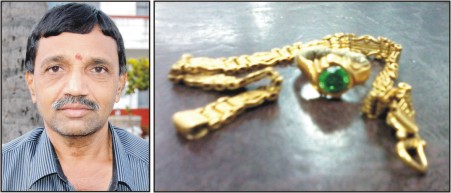
Caption: Laundry owner Shivakumar. The gold jewels found in the customer’s trouser.

Mysore, Mar. 6 :

In a rare display of honesty, Shivakumar, owner of SEL Dry Cleaners at K.R.Circle in city, promptly handed over a gold bracelet and a ring valued at about Rs. 1 lakh to a customer, who had reportedly left them in the pocket of his trouser which he had given for dry wash.

It is reported that one Ramesh, a resident of Nayakara Beedi in Chamundi Hill, had given a trouser and a shirt for dry wash at SEL Dry Cleaners on Feb. 26. On taking delivery of his clothes on Mar. 1, Ramesh discovered that a bracelet and a ring were missing. He recollected that he had left the jewellery in the pocket of his trouser (which he claimed was his practice).

On approaching Shivakumar at the laundry, Shivakumar reportedly told Ramesh that he had found the jewellery in one of the pockets of the trouser given for wash and promptly returned the same to Ramesh advising him to be careful in future. Meanwhile, Ramesh, speaking to SOM, lauded Shivakumar for his gesture.

Shivakumar, on his part, said, “I would have handed over the jewellery to an orphanage if Ramesh had not claimed it.” Stating that his family had been in the laundry business for over 55 years, Shivakumar said he believes in service rather than aspiring for wealth belonging to others as taught by his father.

Recalling the incident of Feb. 26, Shivakumar said that he found the bracelet and the ring falling from the trouser given for dry wash but could not identify whose jewellery it was as there were many customers. He thought that when the real loser would approach him, he would hand over the same.

“After taking delivery of the trouser and shirt, Ramesh came and complained of having lost his jewellery to which I responded and handed them over to him,” Shivakumar recalled.

source: http://www.StarofMysore.com / Home> General News / March 06th, 2013