Category Archives: Inspiration/ Positive News and Features

Aashayein makes a difference to learning

AashayeinBF11mar2013

Bengaluru:

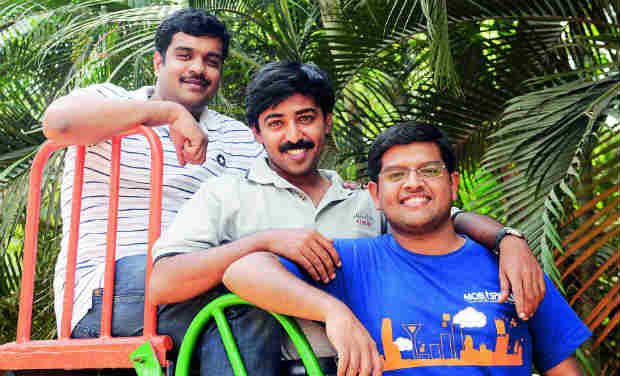
The Aashayein Foun­dation, a completely volu­nteer— run organisation has reached out to thousands of children since it was first formed in 2007. Chandan Raj, Ashwin B.M., Sunil Kumar, Somaiah M.P. and Ashish are software engineers brought together by an indomitable altruism. They bicker and laugh with each other as we talk in their ‘official’ meeting place, which doubles as a storage area, stacked with notebooks and whiteboards. With over 2000 volunteers in their network now, the Aashayein Foundation is a refreshingly low key, extremely driven organisation.

The foundation, which was registered as an NGO in mid 2007, runs four major programmes. Access to education is the primary focus, addressed by the Bachhe Mann ke Sachhe project. Pustaka Abhiyana creates an environment conducive for lea­r­ning by improving infrastructure in schools and providing children with basic needs like notebooks. The third programme, Shikshana Abhiyana has had the widest reach and focuses on the quality of education through spoken English classes and extra curricular activities.

Aashayein began with a New Year resolution made for 2007. “We were all just out of college, earning money for the first time and we thought we might as well be responsible about it,” said Chandan. So in the first week of January that year, they did what would become the first prong of the Aashayein Foundation — serve breakfast at the Karnataka Association for the Blind.
“Sunil’s uncle was serving breakfast on the street and we thought we’d go to an orphanage or blind school instead,” said Chandran. That Sunday morning proved so immensely satisfying that they decided to do it every week, roping in 150 volunteers in a little under two months.

A few weeks later, it was clear that serving breakfast wasn’t enough. “We wanted something that would have a greater impact,” said Sunil Kumar. The problems in India are many — health, sanitation, nutrition — that social workers are usually spoilt for choice.

Education, however, seemed the key to turning society around. “Even with education, there was plenty to deal with; we didn’t want to flounder in that ocean,” said Somaiah, who works at Cisco. Access to education was clearly the fundamental issue. “Our first project was bringing kids to schools,” he said. “It meant identifying kids who didn’t go to schools and enrolling them.”

The erstwhile Shivajina­gar slum, Jayanagar, Koramangala and later Whitefield became the haunts for the Aashayein Foundation where they encountered all sorts of issues. There are parents who can’t afford to send heir kids to school, but would like to. Sometimes the kids and the parents simply aren’t interested and “in these cases, we don’t force them,” interjected Chandan, “They are happy with the fifty rupees a day the children bring home.”

School fees are taken care of for the children who do enrol — the foundation has a budget of Rs 2,500 per child. “We pay 75% of the cost and ask the parents to contribute the rest, so that the whole family feels involved and committed,” said Somaiah.

This programme was limited to urban schools, but the scope was later widen­ed. Rural government-run schools became the new focus. “Logistics were a huge problem for us,” said Somaiah. That’s how the Gift your Village programme was born, to take advantage of the vast influx into Bengaluru from the rural parts of the state. “We ask people to conduct surveys in their own villages. Then we make them project coordinators for the work we do there.”

An official MoU is signed with the government and the foundation sets about providing the schools with infrastructure. There are currently 24 developmental programmes running in rural schools.
The pitiful state of so many government run schools runs far deeper than physical infrastructure. Teachers slack off, and many are not equipped with the skills to handle or teach a class of children. “This is where our volunteer programme took off,” said Sunil. Shikshana Abhiyana runs special classes on Saturdays — ranging from spoken English lessons to creating awareness on issues like cruelty to animals. This extends to summer camps, where the children get yoga, dance, music and even cooking lessons, all run by volunteers.

The Sunday breakfast serving programme, whi­ch started it all, remains the hallmark of the foundation. It is used as a way to initiate volunteers, so they see first hand the philosophy of the Aashayein Foun­dation. “We exist on commitment,” said Ashwin, one of the quieter members of the group. The volunteers are not paid and they don’t have to pay to volunteer, either.
Word-of-mouth has proved immensely successful for the organisation and an annual walkathon is their major fundraising event. Is that enough? “We get about 700 people who actually walk with us,” said Ashwin, “along with about 2000 ticket sales.” This is ample, they say.

A wonderfully simple method — an unshakeable faith in the innate goodness of humanity, has done wonders for the less privileged. Many, myself included, might raise a sceptical eyebrow at this very lofty notion, but the Aashayein Foundation seems to have hit upon something. “What has really changed is our perception of people,” said Somaiah. “We thought we would have to convince them to volunteer, but it turns out, we just had to give them a chance to do something they were only too happy to do!”

source:  http://www.DeccanChronicle.com / Home> News> Current Affairs / March 11th, 2013
Look around, talent is everywhere

KarthikBF09mar2013

  Karthik Muralidharan — R. Samuel

Bengaluru:

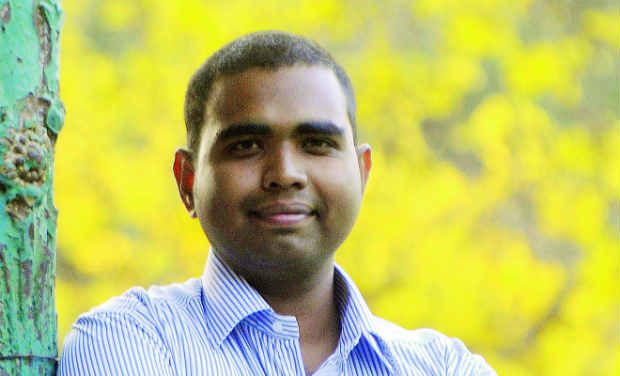
 “I have known failure, that’s why I do what I do”, said Karthik Muralidharan. At the age of 23, he conducts motivational sessions for students from the weaker sections of society. “The fact that I was unable to do as well as I should in school really crippled me at first, until one day, I realised I wasn’t the only one”, Karthik says. “All I wanted to do was quit.”

Now, he wants to tell people that failure isn’t the end of the world and that no matter how bad things get, they are not alone. The idea of social development, of bringing everybody on to a level playing field, where everybody has room to grow came to him. “None of this was part of the plan,” he said. “I had no idea I would work with financially deprived students and I didn’t see myself doing what I do today”.

In college, Karthik began giving motivational talks, which proved very lucrative. “I was making a lot of money and things seemed to be going well.” His work brought him to Magadi, where he met a young Muslim woman who would change the way he saw the world.

“The odds she faced were tremendous. Even so, she overcame them all and went on to make something of herself.”

The untapped potential in these areas, he realised, was huge. All they needed was an opportunity. “The boy who delivered the newspaper everyday was doing his MSc and it made me realise that there is so much talent out there going to waste.”

Corporate gigs haven’t reeled him in, “not yet”, he says honestly. “There is much money to be made there, but I don’t want to get carried away. There’s something I want to do and I don’t really aspire for a Mercedes”.

The young and impressionable are driven almost entirely by the opinions of their peers, most of the time, they don’t know why they do what they do, Karthik says. “Young people are very fond of the word ‘scope’,” he said laughing. “Placements and the prospect of financial gain are what drive them, usually down a path they are ill-suited to.”

This is when corporate sharks like to move in with promises and false hopes. “In the name of training, companies exploit,” he said. Creating a sense of inadequacy and promising to fill the void is a popular tactic, which corporations use ruthlessly to their own advantage. “The only aim is to make a little money and maybe fulfil the requirements of a few”.

“Companies have a 60% rule,” he said, “but if you really scrutinise it, you’ll find that even the person who made the rule has no idea why he did so. A memory game is all that stands between a student and his future.” Trapped now in a vicious cycle, where success is the only end game and there is only one way to get to it – to conform,  youngsters, most of whom are completely confused anyway, become easy prey. “People with good marks do science, because the humanities imply weakness,” he said. To be a doctor or an engineer is the only way to go, even today, when the world is open and information is available to all those who seek it.

“I met a girl once, a Commerce student, who told me she wanted to be a doctor,” Karthik recalls. “When I asked her how she intended to do that, she said her friends told her she could.”
Communication skills are a rarity, mainly because so many people fail to see how important they are.

A large section of the rural population doesn’t know what an IIT is, or an IIM, he reveals. When these students enter mainstream colleges, they find themselves completely out of place. Their peers seem miles ahead of them, an unpleasant reminder of how far they need to go and how alienated they have been from the world.

His methods are simple. “I might go to a college and tell my students there to organise a blood donation camp, or pledge their eyes. That makes them aware of how much they can do, it motivates them, makes them more confident.” In that way, everybody becomes a leader. There’s more to life, he says, than a namesake degree but no real education, placements without progress. “I want my students to be nourished physically, emotionally, mentally and spiritually.”

The greatest strength comes from within. It was Sheldon Kopp, psychotherapist and author of If you meet the Buddha on the road, kill him! who said, ‘The most significant battles are waged from within.’ When those are taken care of, the universe falls into place. One might even call it magic.

source: http://www.DeccanChronicle.com  / Home> News> Current Affairs / DC / by Darshana Ramdev / Monday 04th,  2013

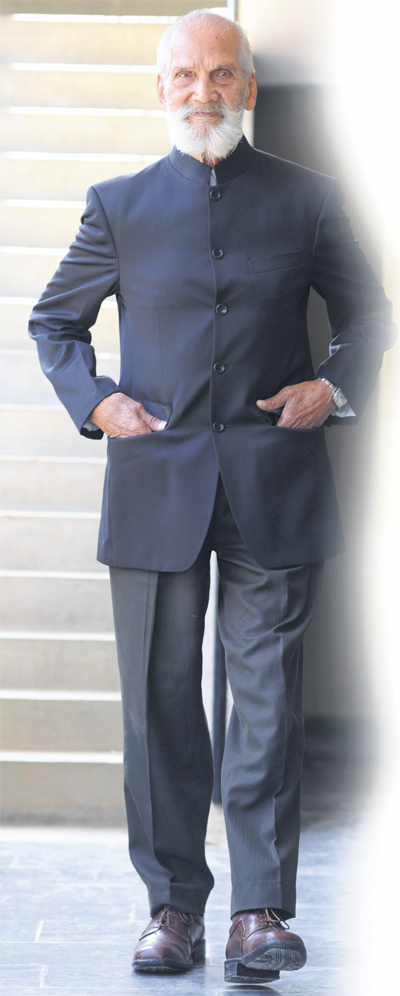
This 73-year-old man is a green warrior

Mallikarjun Shetty , a 73-year-old retired superintendent  engineer , is known as Anna Hazare  of Belgaum for his activism in protecting the environment. He was instrumental in getting the construction of Suvarna Vidhana Soudha shifted from Vaccine Depot to the present location at Halaga Bastwad.

Shetty, who worked with Maharashtra Electricity Supply Board, threatened to go on a hunger strike if Suvarna Vidhana Soudha was constructed at Vaccine Depot. The 200-acre land is full of trees and houses lot of animals and birds. He wrote many letters to the chief minister urging that Vaccine Depot be protected and came down heavily on the government for the proposed indoor stadium at the spot. He has also planted thousands of trees in Belgaum and also in Maharashtra. Shetty also creates awareness among people, especially the student community, about the importance of ecological balance. He has distributed nearly 200 eco-friendly bags to students and public. He is also credited with introducing door-to-door garbage collection in his area, which was the first in Belgaum city. The system was later followed across the city.

He also creates awareness on the judicious use of water and rainwater harvesting.

Every morning, armed with a broom, Shetty sweeps his locality and bus stand in Hanumanagar. Incidentally, Shetty joined hands with a philanthropist and helped construct the bus stand in Hanumanagar in 2003.

Sunil Basavaraj Nimbal, a businessperson, who was inspired by Shetty’s work, says: “He is a role model. Even at this age, he is very active. Inspired by his concern for the environment, I started using the bicycle instead of my bike or car.”

source: http://www.timesofindia.indiatimes.com / Home> City> Hubli / by R. Uday Kumar, TNN / February 24th, 2013

Azim Premji transfers Rs 12,300 crore to his not-for-profit foundation

Bangalore :

Azim Premji, chairman of the Azim Premji   Foundation, announced on Friday that he has transferred 295.5 million equity shares representing 12% of the total shares of Wipro Ltd , held by certain entities controlled by him, to an irrevocable trust. With this transfer (valued at about Rs 12,300 crore based on current market price), the trust’s shareholding in Wipro will go up to about 19.93%.

This trust will utilize the endowment to fund social, not-for-profit initiatives of the foundation, which are expected to scale significantly over the next few years.

The “Giving Pledge” campaign had recently announced that Premji was amongst the billionaires around the world to commit half their wealth to philanthropy. The campaign, led by billionaires  Warren Buffet, Bill Gates  and others, is a commitment by the world’s wealthiest individuals and families to dedicate the majority of their wealth to philanthropy.

Azim Premji Foundation  is a not-for-profit organization set up in 2001 with the goal to create and sustain initiatives to contribute to a just, equitable, humane and sustainable society. The foundation has worked largely in rural India, often in close partnership with various state governments, to help contribute to the improvement of quality and equity of school education.

Currently the foundation’s work is spread across Karnataka, Uttarakhand, Rajasthan, Chhattisgarh, Pondicherry, Andhra Pradesh, Bihar and Madhya Pradesh.

The foundation’s strategy focuses on creating and scaling up a network of institutions at various levels to contribute to improvement in the school education system and allied areas. As part of this strategy, over the last two years, the foundation has set up the Azim Premji University  at Bangalore, state level institutes in three states, district level institutes in seven districts and six demonstration schools associated with the district institutes. Seven more district level institutes are in various stages of formation.

The University has been established with the social purpose of developing outstanding professionals in the domains of education and development for the entire country. The University does this through offering various kinds of degree programmes, continuing education programmes and creation of knowledge in education and allied development areas. Currently, the university offers MA Education and MA Development programmes. It offers specializations in school leadership & management and curriculum & pedagogy under MA in education, and livelihood, public policy, health & nutrition and law & governance under MA in Development.

As part of scaling up of the institutional strategy, over the next 4 to 5 years, the number of district level institutions will expand to 50-60, state level institutions to 6-8 and the university will expand to have 3,500 students with 350 faculty members across multiple programs. The foundation will also have 50-100 demonstration schools associated with district level institutions. During this period, the team size is expected to grow from the current 800 people to about 4,000 people.

source: http://www.timesofindia.indiatimes.com / Home> Tech> Tech News> Software & Services / by Sujit John, TNN / February 22nd, 2013

Seminar on making of a nation at Bhandarkar’s College, Kundapur

Mangalore :

Bhandarkars’ Arts and Science College, Kundapur will organize a two day national level seminar on a subject “Locality, Region and Making of the Nation,” at RN Shetty Hall of the college from February 15.

The sub-themes of the seminar are: archaeological findings of South Canara and Coorg; Regional expressions in Temple Art and Architecture;) Agrarian relations in South Canara and Coorg districts; Port trade and commerce; Social dynamics of South Canara; Interaction with regional societies; Colonial experience; Nationalist expressions and Nationalist movement; Post- Colonial Developments and research prospects in South Canara and Coorg.

According to a release from the college, the main endeavour of the seminar is to look into the question of regions not only to examine but to understand the characteristics and the process of their formation. The seminar hopes to situate the regions of South Canara and Coorg in the context of Karnataka and India, while yet highlighting their uniqueness and dynamism, the release added.

source: http://www.m.timesofindia.indiatimes.com / Mobile / Home> Mangalore / TNN / by Stanley Pinto / February 12th, 2013

Aishwarya Rai Bachchan helps raise Rs 13.6 crore to fund schools at the NDTV SUPPORT MY SCHOOL INITIATIVE

The Coca Cola – NDTV ‘Support My School’, campaign raised pledges worth Rs 13.6 crore towards the revitalisation of 272 schools across India via a telethon led by cricket legend Sachin Tendulkar and Bollywood actress Aishwarya Rai Bachchan.

Campaign Ambassador, Aishwarya Rai Bachchan said, “Joining the Support My School Team on this platform today truly gives me great pleasure. I believe Education is immensely Invaluable, Essential and the most Empowering gift we can give the children of our Country.  Every child deserves the best of opportunities to grow and prosper… Every girl needs to recognise that she herself is a beacon of hope and has the potential to influence her future. And I understand and recognise, for this to be possible, these opportunities have to be made available to our children!!!  In a vast country like India, there are many and varied challenges one faces while working with diverse rural and semi-urban communities. Individually, we may not comprehend these challenges, but collectively we are much stronger! And the overwhelming response to this campaign this time has proven that! With 272 schools and counting, the second season of Coca-Cola NDTV Support My School is spreading the joy of learning amongst the children of our country… And this has only been possible All Thanks to Every support and encouragement from donors, viewers, campaign partners and all on board the collective effort today!!! God Bless everyone for their contribution and Thank you!!!”

The second edition of the ‘Support My School’ telethon, held at Yash Raj Studios in Mumbai was kicked off by Coca-Cola India & South West Asia president and CEO Atul Singh, NDTV India CEO Vikram Chandra, campaign ambassador Sachin Tendulkar and Aishwarya Rai Bachchan.

Besides being present at the telethon Aishwarya Rai Bachchan also pledged to adopt two schools through this initiative.

source: http://www.BollySpice.com / Bolly Spice / Home> News / by Stacey Yount / February 05th, 2013

Padma Bhushan for Rajesh Khanna, Rahul Dravid

Noted physicist Yash Pal and space scientist Roddam Narasimha were named for the Padma Vibhushan awards Friday, with 106 other Padma awardees, including actors Sharmila Tagore, Sridevi, the late Rajesh Khanna, late satirist Jaspal Bhatti and Olympic medallists Mary Kom, Yogeshwar Dutt and Vijay Kumar.

Sculptor Raghunath Mohapatra and painter S Haider Raza were among the four chosen for the second highest civilian award, the Padma Vibhushan. Nobody was named for the Bharat Ratna for this year too.

Cricketer Rahul Dravid made the 24-strong list for the Padma Bhushan . List of Padma Awardees

Joining him was Godrej group chairman Adi Godrej and missile scientist A Sivathanu Pillai. The awards will be presented in March and April.

Kom, silver medallist at the London Games, is the only Olympian in the Padma Bhushan list. India’s other two Olympic heroes, wrestler Yogeshwar Dutt and shooter Vijay Kumar, were named for the Padma Shri, along with actors Sridevi and Nana Patekar, filmmaker Ramesh Sippy and fashion designer Ritu Kumar.

Rajendra Achyut Badwe, director of Mumbai’s Tata Memorial Centre, oncologist Pramod Kumar Jhulka of AIIMS, homeopath Vishnu Kumar Gupta and sculptor Rajendra Tikku were named for the Padma Shri.

Four more sportspersons were named for the Padma Shri — mountaineer Premlata Agrawal, para athlete Hosanagara Nagarajegowda Girisha, boxer Ngangom Dingko Singh and rower Bajrang Lal Takhar.

source: http://www.HindustanTimes.com / Home> North India> New Delhi / by HT Correspondent, Hindustan Times / New Delhi, January 26th, 2013

City Doctor’s tryst with destiny

…from US Golf Open to Mysore’s Dolphin Cup

By Dr. Eskay Ghori

It was a wonderful morning at the JWGC Golf Club in Mysore reminding me of the day I set out to watch the US Golf Open in San Francisco on June 14, 2012. My son Zaid Ghori had bought me a ticket to the US Open as a Father’s Day surprise gift. Back here, the Dolphin Cup Golf Tourney was being played in Mysore when a lady golfer walked in with her daughter-in-law. I exchanged pleasantries and promised to catch up with them at Regaalis hotel in the evening where the prize distribution and a grand dinner party was organised by the Dolphin members.

For the first time since June 14 last year, I practiced a few shots and putted, the game and the swing was there and thought of future golf as a would-be 62-year-old man having played a handicap of 3 as a youngster and having won many a golf tournament in Nigeria, England and India.

It was 7.30 pm and all dressed formal for the evening, I stepped in accompanied by my wife Dr. Reshma Ghori to the poolside party at Regaalis. I saw Indira Venkatraman seated with her daughter-in-law Jennifer, who is an American lawyer living in San Francisco, California, USA, wearing a wonderful saree. I was told by Indira, the golfing lady member and a good socialite, that I have lost weight. I said, “Yes I am on weight control as advised by my doctor as I had a cardiac event, in simple terms a heart attack, at the US Open Golf Championship at the Olympic Club in Daly City near to San Francisco — a very challenging golf course by the Pacific Ocean, hilly with cold breeze blowing. I had forgotten to take my jacket in all the excitement to meet Vijay Singh whom I happened to know in Nigeria from his rookie days. Indira told me that her son Anand was a marshall at the US Open at Olympic Club and he was at the dinner at Regaalis.

As we were talking, her son Anand Venkatraman walked in and I asked him, “You marshalled at the Olympic Club in the US Open on the 14th of June 2012?” He said, “Yes, I did.” I asked him, “Do you remember a golfing spectator collapsed and was pronounced dead and the US Open came to a stand still for a few minutes, even Tiger Woods had to wait!” He said, “Yes, I was told he was an Indian.” I said, “Well Anand, it is me the dead man alive and fine, thanks to marshalls like you and the team of cardiologists who happened to be watching golf on the 14th tee box where Vijay Singh was teeing off. I collapsed and my heart, I was told, stopped for 3 minutes.” On hearing this, Anand was so overjoyed that he embraced me.

I was very lucky. They rushed me after giving me first aid and had me in a hospital in the nick of time and a life was saved like so many lives that are saved every minute in the United States with their state-of-art medical services — the emergency response team.

I felt like sharing this coincidence with my long-time friend and Editor-in-Chief of Star of Mysore K.B. Ganapathy who was enjoying the party with JWGC Captain P.M. Ganapathy, JWGC President Dr. P.A. Kushalappa and Dr. Joshi of the Dolphins who had invited us.

Is it not destiny that I had to meet Anand Venkatraman here in Mysore, a software marketing wizard who lives in San Francisco and a marshall. God, the supreme power, has many surprises for us in many ways — when it’s not your time to go up the seven skies, it’s not and when it is time to go, nothing can stop the order from God Almighty.

As a medical doctor who has spent all my career in the emergency rooms in India, Nigeria and Saudi Arabia, I have seen many a drama. But when it happened to me, I realised the value of a good emergency response. As lady luck would have it, I met a friend John Paul, an American golfing spectator whom I later called an angel who stayed by my side till the evening until my family arrived.

The excellent services at Seton Medical Center, a cardiac specialist hospital in San Francisco whose Medical Director Dr. Hasselherst was the one who gave me CPR with the help of an Aneasthetist Dr. Martin, who incidentally works at Loma Linda Hospital with Dr. Ramdas Pai, a Cardiologist who happens to be my friend and junior at Kasturba Medical College, Manipal, and told him that an Indian doctor had collapsed.

I did call Dr. Pai as soon as I was well enough to call from Seton Medical Center. He was also watching golf at the 14th tee of Loma Linda Hospital and the world-famous cardiac surgeon Interventionist Dr. Felix Milhouse and Dr. Gauhar Khan, a cardiologist at Modesto California, who took care of my follow-ups.

The time when one gets to the age of 60 is very crucial. One must get a heart check every year, a simple ECG, consult your family physician, eat a lot of vegetables and stick to a healthy diet, go for walks and keep stress at bay.

I cannot but less thank my wife Dr. Reshma Ghori, my son Zaid Ghori and would-be daughter-in-law Shanaz Ahamed for all the care and attention given for me to be back in Mysore with my friends and daughter Nisha Ghori, who travelled to the US to see me and brought me home. While I was getting well, I had an august visitor in Dr. Shivaram Malavalli who gave me much inspiration as his brother, urologist Dr. Sitaram Malavalli, also living in Modesto California where I lived.

The world is a small place and I always believed in the world as a place rather than a place as the world. Thank you God for this new life. Life is a very precious gift from God, take good care of it. I told my son Zaid Ghori that he not only bought me a gift of a ticket for Father’s Day but ended up giving me the gift of LIFE.

[Dr. Eskay Ghori runs Jubilee Clinic at Sareniza Villa in N.R. Mohalla, Mysore. Mob: 9945852340]

source: http://www.StarofMysore.com /Home>  Feature Articles / January 19th, 2013

I don’t have a special someone yet, says Pankaj Advani

Having won his eighth world title, ace cueist Pankaj Advani  opens up to Chennai Times on his sport, love and life.

You have won a record eight world titles now. How do you motivate yourself to better this achievement?
In each phase of a sportsperson’s life, the aims, goals and the purpose of playing the sport changes. For me, initially, when I started out, I just wanted to enjoy playing the sport and improve my rankings. Later, when I started winning the titles, the challenge was to retain my position. And, now, I want to push myself further and perform consistently and play as perfectly as possible.

With this title, you are already being talked about as a serious contender for the Greatest Of All Time tag. How do you view this?
Of course, being talked about in such a manner is definitely a huge morale booster. But such statistics and comparisons can wait till I retire or can rise towards the end of my career. Also, these talks can give you a false sense of confidence and I don’t want to be carried away.

Who is your inspiration?
It’s my coach Arvind Savur. He agreed to coach me without charging and penny and his knowledge of the game is incredible. But more than a coach, he is my friend, philosopher and guide. I also get inspired watching  Roger Federer  play. He is definitely the greatest sportsperson of all time. To play so gracefully and successfully all these years is just fantastic. I haven’t met him yet but I would like to. I would also love to watch him play live.

So what’s your idea of an ideal break?
I spend time with my friends and family. And, sometimes, I go to Goa and spend some time by the seaside. It is very relaxing. As a professional player, I get very few days to unwind and so, I try to get adequate sleep and rest. And, yes, I do like to walk the ramp, if only to relax. (Laughs)

What do you think of sportspersons taking an interest in films of late?
Well, people perceive a sportsperson in only one light. They don’t generally see you beyond your game. So, unless your priorities have changed, you should stick with your career. But once you have decided, you have to be yourself as you don’t want to make a fool of yourself in public. Even I got a couple of acting offers and a filmmaker was interested in my life story, but every time I decided to give it a thought, some important tournament would come up and I put it on the back burner.

You are considered one of the most eligible bachelors in India…
Actually, it feels great to be in this category. But I would like to stay an eligible bachelor for some more years. And, no, I don’t have a special someone yet. I have been traveling between India and England for the past six years and with the amount of travelling, it’s wise to stay out of a relationship. But, then, you don’t plan to fall or not to fall in love. If the moment and the person arrive, there’s nothing you can do.

Do sportspersons need to be socially active?
I think it is important that sportspersons involve themselves in social causes in any little way possible. There are so many issues that need to be addressed and each sportsperson or celebrity who has an appeal can go out there and do something for the society. Aamir Khan’s Satyameva Jayate was an excellent concept. Yes, it had a lot of drama and emotions but it brought out a lot of issues that need to be addressed today.

How has 2012 been for you and what plans for 2013?
2012 has been the best year in my career so far. Of course, it involved lots of struggle and was the toughest yet but it was also the most productive and fulfilling. I’ll be concentrating on my fitness in the coming year as health is very, very important when you play at the global level. I would also like to relax and stay mentally fresh.

source: http://www.articles.timesofindia.indiatimes.com / Home> Sports> More Sports / by M Suganth, TNN / December 31st,  2012

His 99th Xmas is coming

So you can understand when he finds the festival ‘stale’. Here he recalls the memorable ones to Khushali P Madhwani

Ashley Homes is an old age home situated on an isolated street in Horamavu. It is here that I met, Allan Arthur Wash, seated in the sunny verandah of the home, with an edition of Bangalore Mirror in hand. He was following the story of the “Chinese making a move on the Japanese” – it must’ve brought back old memories for he spent three years in a Japanese prison as a soldier.

Ramrod straight, an open smile and twinkling eyes match is suave self dressed in clothes as neat and crisp as rice paper. “I was always told to patch up your clothes, polish your shoes and dress your hair,” reminisces this retired army officer. And he’s been following it for the last several decades.
Wash was born in Madras on March 13, 1914. Yes, he has an elephantine memory and can rattle of time, date and year without any difficulty. He lost his father when he was a boy. His mother couldn’t support him and his sister, so he was sent to a “home in Madras called Civil Orphan Asylum” where he could “live and study too. I studied in this school till 1923.” Christmases were mostly spent in the hostel. “On Christmas day we would be served pulao, chicken, sweet, fruit custard and bread pudding.”
At 17, he began working as a telephone operator. “We had to plug the receiver and shout loudly and people would scream loudly to us. I couldn’t do it,” Wash recalls. Two years later, Wash joined the army. Today four medals – Campaign medal, star medal, victory medal and independent medal – keep him company, reminding of the bygone days.
After his stint in Bangalore, he was posted in Malay, Singapore. In 1924, he was captured by the Japanese and remained imprisoned for the next three years. “The Christmas I spent in captivity was a poor Christmas,” says Wash.”I remember eating maize and palm oil.” After three years of incarceration, he returned to India. “I lived in Hyderabad for sometime before moving to Bangalore. “The Bangalore today is not the same as I remember it. As I see it, it is the dirtiest city in the country,” he says. Wash today receives 30,000 as pension, which he passes on to his 62-year-old daughter who cares for him. “At this age what should I buy and what should I spend it on? The Lord has kept me free from wants,” he says.
While in the army, Wash married Pamela in Mysore. He had four girls and four boys. After retiring from the army, Wash worked at Central Food Technological Research Institute (CFTRI) in Mysore. “I didn’t like civil life. Today, the civil officers are highly corrupt,” he says. In 1962, the government gave Wash eight acres of land on which he built a house. His family stayed with him on this farmhouse till 1978. “Some of Pamela’s people, her brothers and sisters joined us in the farm in 1971 for a memorable Christmas. “They made sweets. We had all kinds of meat dishes…” recalls Wash. But, his all-time favourite Christmas meal, he says, will always be the custard and roast chicken prepared by his wife. Oh, yes and he also remembers what she wore on the Christmas of 1968, “She wore a gorgeous red and black checked plaited dress stitched by a good ladies tailor from Goa.” That Christmas, Wash’s eight children and grandchildren joined them in the celebrations. When the kids were little, they would set up a tree at home, decorate it and give their Rugrats gifts. “The girls got dolls and the boys got toy trains,” he says.
In 1975, Wash spent Christmas in Mysore with an Anglo Indian German gentleman and his brother, who threw a grand party for all friends. The hosts were dear friends of Jayachamaraja Wadiyar, who looked after them. “Srikantadatta Wadiyar was a little boy then. I got some novels and something to take home… I think it was a vase,” says Wash. In 1986, Wash and Pamela entered Little Sisters of the Poor in Mysore. After nine days his wife passed away. Like last year, even this year, Wash intends on going to his daughter’s house for Christmas to be with his children and grand children.
“Christmas has become stale because it is the same thing over and over again. It is the same meal, same recipe only the environment and company changes,” says Wash. Celebrating 99 Christmases will get to me too, I guess /
source: http://www.BangaloreMirror.com / Home> Sunday Read> Special> Story / by Khushali P Madhwani / December 23rd, 2012