Category Archives: Inspiration/ Positive News and Features

From vinyl neglect to virtual safety

Vikram Sampath with his prized collection

Vikram Sampath’s book My name is Gauhar Jaan recounts the dramatic life-story of celebrated courtesan Gauhar Jaan, who was also India’s first singer to record on the gramophone. It was during the research for this book that Vikram’s penchant and passion for gramophone recordings was stirred.

“Gauhar had cut close to 600 records in her lifetime and I ended up collecting over 150 records of hers alone from the grey markets in Kolkata, Delhi and Mumbai,” he says. “In the process, I also stumbled upon priceless recordings of several of her contemporaries in the north and south of India, all tucked away in unknown quarters of the country.”

In 2010, after the book was published, Vikram went to Berlin on a visiting fellowship and came upon a treasure of recordings by Indian artistes at sound archives across Europe. “The constant refrain everywhere was, ‘Why doesn’t India have a national sound archive?’” says Vikram, the BITS Pilani alumni, who is a banker.

In the course of a conversation with Congress president Sonia Gandhi, who invited him for a tete a tete, after reading the book, Vikram brought to her attention a need for an archive. “It was a revelation to see her speak so knowledgeably and passionately about classical music,” says Vikram. “I brought up the archive idea with her and she was excited about it and immediately made connections with several government agencies.”

With a recommendation from such a high level, one would have thought the project was a done deal. But Vikram sighs, and says, “The proposal just kept moving across departments and academies, which gave empty promises.”

But the archive project survived. Help came from T V Mohandas Pai, who was then with Infosys and is now chairman of the Manipal Global Education. “He readily and generously funded the project with seed capital that helped to import state-of-the-art equipment that meets international standards,” he says.

The Manipal University also came forward to host the archive at their premises in Bangalore. A grant from the India Foundation for the Arts (IFA) has also helped Vikram to put together important research material around this era. “The Archive of Indian Music (AIM), which I have set up, has several trustees from across the country,” he says.

A not-for-profit trust, AIM will seek to digitise, preserve and disseminate an important slice of the musical and cultural history of our land. “The range of recordings to be covered would not be restricted to Hindustani and Carnatic classical music alone, but also theatre, early cinema, folk music recordings in all languages as also voices and speeches of great personalities like Mahatma Gandhi, Rabindranath Tagore, Jawaharlal Nehru and others,” he says.

AIM now has 10,000 records—both 78 RPM shellacs and vinyls—already collected from several places; a few donations, and others purchased from the kabadiwalas! “The trustees would help us source these records from their region and send them to Bangalore where my technician Chethan Kumar digitises these records and catalogues them on a daily basis,” says Vikram. “But the archive is going to be a virtual one.”

The website, www.archiveofindianmusic.org, is in its final stage of development in association with Vikram’s partners, Gaurav Vaz, and his company ‘The Random Lines’. It is expected to go live by end October 2012 with about 1,000 clips in the first round. “All these clips will be uploaded there and made available to people on free registration, for listening through streaming audio alone and not for download,” he informs.

Vikram says it is a shame that in a nation where music is so ubiquitous there is no central repository for all kinds of music of our country. “What better way than the arts to achieve a sense of national integration in these troubled times?” he says. “But it’s an endemic problem because as a country we have very little regard for our history and for documentation. Just see the kind of preservation done for even houses of musicians like Beethoven or Mozart, while a Thyagaraja’s house in Tiruvayyaru is broken down to have a garish renovation! ”

Of course there are government bodies, academies and archives. “But they need to make a reality check about whether their holdings are reaching out to anyone, especially in today’s day of technology and the internet with everything being so accessible,” he says.

source: http://www.newindianexpress.com / The New Indian Express / Home> Magazine / by Sandhya Iyer / December 02nd, 2012
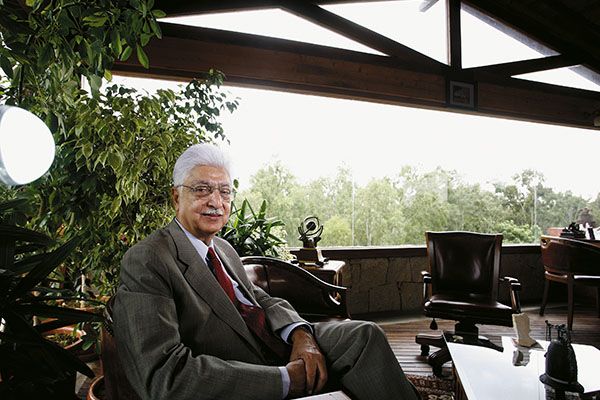
Azim Premji: Outstanding Philanthropist

For more than a decade, Azim Premji Foundation has been working to improve education. Just like at Wipro, Premji has left it to a professional team to run it

Image: Namas Bhojani for Forbes India

Azim Premji’s work to improve education is one of the largest such programmes backed by individual giving in India

Azim Premji
Award: Outstanding Philanthropist
Age: 67
Why He Won: For making India’s biggest philanthropic contribution for achieving universal quality education.
His Trigger: Was deeply disturbed by growing inequity between haves and have-nots; was afraid growing disparity would threaten society.
His Mission: Improving quality of education; which would improve social and economic conditions.
His Action Plan: Working with government schools, bringing change at the top, improving quality of teachers, increasing capacity of education officers.
His next move: Set up institutions like Azim Premji University, to
produce education professionals, focus on research, set up 200 rural schools to showcase good education.

So when exactly did Azim Hashim Premji, the third richest Indian and ‘Asia’s most generous man’ feel the first tug of philanthropy? Was it when, as a young man studying at Stanford University, he dreamt of joining an international development agency like the World Bank? Or maybe it was when his mother, a doctor, set up a philanthropic children’s hospital in the 1940s. Or was it in the 1950s and ’60s when he was soaking in the spirit of nation building growing up in Nehru’s India? Or did it come much later, when in the late ’90s he watched his millions grow into billions, thanks to the IT boom, all the while becoming aware of the distance between his wealth and the average Indian’s income?

No one knows the answer, not even Premji.

Dileep Ranjekar, who has worked with Premji for close to four decades and started the Azim Premji Foundation (APF), says Premji first started talking about working in the social sector in 1998-99. Ranjekar, who was then head of Wipro’s HR, and Premji were staying in the Wipro guesthouse at Brunton Road, Bangalore. Premji was shifting Wipro’s HQs from Mumbai to Bangalore.

Both of them would sit late in the evenings talking and it was on one such evening that Premji first broached the idea. He had spent the last 30 years building Wipro, which was successful and stable, and now at 54 he felt that he needed to do something more.

After a lot of deliberation he chose to work in education and told Ranjekar to come up with a plan, but with one clear instruction: Whatever area they picked in education, it must have widespread impact.

The conversation that started in that guesthouse has today resulted in one of the largest programmes backed by individual giving in India and perhaps Asia. Premji has pledged close to $2 billion from his personal wealth to APF, which is working to improve elementary education across government schools in India. APF today has 800 employees. Last year the Azim Premji University started three post graduate courses in education and development to beef up capacity in the education sector.

It may take several more years, if not decades, to truly feel the impact of Premji’s efforts, but the work has left a deep impression on him. “As a person I have become more hopeful and optimistic… When you see teachers, government officials, my own colleagues in the Foundation, working in the toughest circumstances possible… it reaffirms faith in the goodness of man,” he says.

Now at 67, he has only one regret. That he waited too long to embark on this journey. “I wish I had started earlier, maybe in 1990, not in 2000,” he told Forbes India in an email interview.

His role as chairman of Wipro takes up most of his time today, but that is set to change. “He is spending more and more time on this [philanthropy]; it will increase going forward,” says older son Rishad who is also on APF’s board. Premji has talked to people about giving away most of his wealth (estimated at about $12 billion) to philanthropy. Rishad says that everyone in his family understands that the wealth does not belong to them. “He’s always told us, ‘I am comfortable giving you something in life but if you want anything above that, you have to earn it for yourself. The rest is meant to be given away, it is an obligation to give it away’,” says Rishad.

Close friend and associate Narayanan Vaghul, former chairman of ICICI Bank who is on the board of both Wipro and APF, says, “Premji is one of those rare people who sincerely believe that philanthropy is not a hobby. Even 20 years ago he was a hardcore businessman, and he is not particularly religious. But this work has changed him spiritually, it has made him a better person.”

Unlike Wipro where he kept his family out for a very long time (Rishad joined in 2007), every member of his family is involved in APF. Wife Yasmeen and Rishad are board members, while younger son Tariq works in APF’s endowment office. Premji says that having the family’s support is crucial in this work. “Your immediate family must resonate with the ideas, the purpose and philosophy. Else, the impact will be much less than it could be,” he says.

After maintaining a laser like focus on education for most of the last decade, he is now thinking of expanding into other areas like health care and livelihoods. “He is deeply worried about the state of governance in the country today,” says Vaghul, and some of his close associates say that he may choose to work in that field next. In January last year he joined 13 eminent citizens in India, such as former RBI governor Bimal Jalan, HDFC Chairman Deepak Parekh, and Godrej & Boyce Chairman Jamshyd Godrej to write an open letter to national leaders on governance deficit and corruption in the country. On November 2, while announcing Wipro’s quarterly results, he exhorted Bangaloreans to protest against non-clearance of tonnes of garbage lying on the streets.

source: http://www.forbesindia.com / Forbes India / Home> Features> Philanthropy Awards 2012 /by Mitu Jayashankar / December 03rd, 2012

Indian team ready for T20 Blind World Cup

The first ever T20 Blind World Cup slated to begin from December 2 to 13 in Bengaluru will have nine teams, including host India. Having defeated Pakistan in March, India is among the favourites to win this Cup.

In India, cricket is passion. Be it Test cricket, one-day internationals or Twenty20, we never miss an opportunity to enjoy a cricket match. However, there is another version of cricket that deserves the same kind of attention.

Blind cricket, which is played through the length and breadth of India, requires more attention than what normal cricket gets. Not because they are played by visually impaired people, but because of their fighting spirit and a challenge to pursue a game which many able people only dream about. With above 200 teams, each state has 15-20 teams, and more than 10,000 players, cricket for the blind is no more an isolated game. It’s another thing that it has not got the deserved attention.

In a novel effort to make these visually impaired cricketers realise that they too are unique and not any way behind normal cricketers, Bengaluru-based NGO Samarthanam and Cricket Association for the Blind in India (Cabi) joined hands to organise the inaugural T20 Blind Cricket World Cup in Bengaluru from December 2 to December 13, with the SBI being the principal sponsor. Established in 1997, Samarthanam has always supported blind people in fulfilling their needs.

Mahantesh, a founder manager of Samarthanam and general secretary of Cabi, says: “Cricket in India is a mania, and visually challenged people are no exceptions. They follow the sport with the same passion and have the same urge as a normal cricketer has to play cricket.”

Deciding to hold this World Cup in May 2011 at the annual general meeting of the World Blind Cricket Council held in Dubai, there was a mammoth task before the organisers to keep everything in place. “It was a mammoth task to organise and coordinate with several individuals and institutions to get every approval ready for the event. Getting good grounds and adequate financial support were the two major challenges that we had to face,” says Kishore Joseph, media associate of Team India.

The rules set for the tournament are unlike the usual T20 cricket tournament. The ball to be played with in the tournament will have jingling bells in it so that the visually impaired can play on their hearing ability. The bowler has to deliver the ball underarm, and the ball must pitch twice before reaching the batsman, with the first pitch before halfway of the pitch. The stumps are made of steel to help the players differentiate between the ball hitting the bat and the batsman getting bowled.

The cricketers in the team are divided into three categories B1 (totally blind), B2 (partially blind) and B3 (partially fainted). The wicketkeeper — a partially sighted player — plays the role of a marshal, whose responsibility is to guide the bowlers and the fielders with his clapping and loud talk. He helps the bowlers locate where the stumps are, fielders to stop the ball and also to throw it back to him.

The players who will represent India have been selected from across the country on the basis of their performance in the selection trials tournaments held at Dharwad, Karnataka and Kochi. The Indian contingent of 17 players will be led by 24-year-old hard hitting opening batsman Shekar Naik from Karnataka. The Indian team, which had defeated Pakistan in March, is among the favourites going into the T20 World Cup.

The Indian blind cricket team has taken part in three World Cups, reaching the finals in the 2006 edition. To keep their prospects high in this inaugural cup and to keep at bay teams like Australia and Pakistan — whom they consider as tough opponents — the players are undergoing vigorous training under the guidance of their coach Patrick Rajkumar at the IIM grounds in Bengaluru. Skipper Naik says, “The condition camp is under progress and we practice from 6 am to 4 pm.” Not quite keen to disclose his strategy, Naik says he will be shuffling the teams according to the strength and weakness of the opponents.

Naik too had his difficulties in the past as he belonged to a very poor and backward family. However, Samarthanam Trust for the Disabled helped him make his dreams come true. “As both of my parents were blind, I did not know what my future would be. But when I got in touch with Samarthanam, it supported me in every form, be it education or sports. Today I have been to many countries representing the Indian blind cricket team. And I am a confident captain aspiring to win the T20 World Cup,” says Naik.

The inaugural ceremony will be held in Shree Kanteerva Stadium, Bengaluru, and a total of 39 matches will be played, with four matches every day. The organisers have booked three grounds viz Central College Grounds, Bengaluru; KSCA, Aloor Ground; Nellamangala & Aditya Global Sports Ground, Nellamanga, Bengaluru Rural, to conduct the matches.

source: http://www.asianage.com / Home> Sports> Cricket / by Abhishek Chakraborty, Age Correspondent / November 24th, 2012

Noor Inayat Khan: The Indian princess who spied for Britai

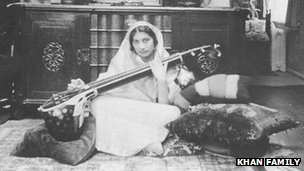
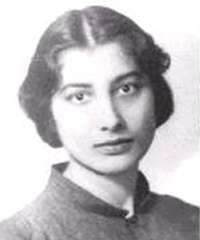
The Princess Royal is set to unveil a sculpture of Noor Inayat Khan, dubbed the “Spy Princess” by her biographer Shrabani Basu in London’s Gordon Square Gardens.

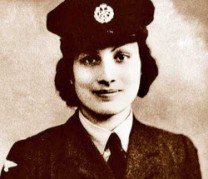
Raised in Britain and France and a descendant of Indian royalty, bilingual Noor Inayat Khan was recruited by the elite Special Operations Executive (SOE) in 1942 to work in Paris as a radio operator.

Records from the national archives show she was the first female wireless operator sent to Nazi-occupied France during World War II.

After evading capture for three months, the spy was imprisoned, tortured and eventually shot by the German Gestapo at Dachau concentration camp in 1944.

Her final word – uttered as the German firing squad raised their weapons – was simple. “Liberté”.

Liberty was a notion the pacificist-turned-war-heroine held deeply, according to Ms Basu.

For her bravery, she was posthumously awarded the George Cross. In France she was honoured with the Croix de Guerre, and later with two memorials and an annual ceremony marking her death.

Indian royalty

Brave, glamorous and both sensitive and formidable, it is said she acted not out of a love for Britain, but out of an aversion to fascism and dictatorial rule.

Her father was a musician and Sufi teacher, and Noor Inayat Khan was raised with strong principles and believed in religious tolerance and non-violence.

Ms Basu claims she “couldn’t bear to see an occupied country”, a notion that seems to run in her family.

Noor Inayat Khan’s great-great-great-grandfather was Tipu Sultan, an 18th century Muslim ruler of Mysore. He refused to submit to British rule and was killed in battle in 1799.

Born on 1 January 1914 in Russia to an Indian father and American mother, the agent’s infancy was spent in London.

The family moved to France when she was a child and lived in Paris, where she was educated and learnt fluent French.

A bronze sculpture of Khan has been erected in Gordon Square Gardens on land owned by the University of London

The national archives describe how the sensitive young woman studied both medicine and music.

In 1939 the Twenty Jataka Tales, a collection of traditional Indian children’s stories she had retold, were published in Le Figaro.

When war broke out in 1939, Noor Inayat Khan trained as a nurse with the French Red Cross.

She fled the country just before the government surrendered to Germany in November 1940, escaping by boat to England with her mother and sister.

‘Tigress’

Shortly after arriving in the UK, she joined the Women’s Auxiliary Air Force (WAAF) as a wireless operator and soon caught the attention of recruiters from the SOE.

Also known at the time as Nora Baker, Khan joined the elite spy squad in 1942.

She was deployed to France a short time later despite an SOE training report describing her as “not over-burdened with brains” and “unsuited to work in her field”.

Codenamed “Madeleine”, she joined others in the resistance network Prosper, famously tasked by then Prime Minister Winston Churchill to “set Europe ablaze”.

Despite suspicions that the network had been infiltrated by a Nazi spy, Khan refused to return to Britain, risking arrest by the Gestapo.

Ms Basu – who spent eight years researching her life – told the BBC: “She was this gentle writer of children’s stories, a musician, but she was transformed. She was a tigress in the field.”

Noor Inayat Khan was raised by her Sufi father to be tolerant of other religions and a pacifist

With her team gradually captured by the Gestapo, Noor Inayat Khan continued for as long as possible to send intercepted radio messages back to England.

Despite her commanders urging her to return to England, she single-handedly ran a cell of spies across Paris for three more months, frequently changing her appearance and alias.

Eventually, she was betrayed, arrested and imprisoned. She was sent to Pforzheim prison in Germany where she was kept shackled and in solitary confinement.

She refused to reveal any information, despite 10 months of repeated beatings, starvation and torture by her Nazi captors.

Her fortitude – and two escape attempts – led her captors to brand her “highly dangerous”, despite her pacifist upbringing.

‘Inner strength’

In September 1944, she and three other female SOE agents were transferred to Dachau concentration camp where on 13 September they were shot and killed.

Ms Basu has described her life as “inspirational”, and said the modern world can draw lessons from the story of Noor Inayat Khan.

She said: “For her to come into this world on the front line taking on the Gestapo, showed her inner strength and her courage, her immense courage and resilience.

“It’s very inspiring, especially given the the troubled times that we live in. It is important to remember these qualities and values.

“Two and a half million Indians volunteered for the war effort and it was the largest single volunteer army.

“I think we must not forget their contribution. Noor was part of this.”

source: http://www.bbc.co.uk / Home> UK / by Samantha Dalton, BBC News / November 08th, 2012

Indian-origin ‘spy princess’ Noor Inayat Khan to be honoured by England

A bronze bust of Indian-origin British ‘spy princess’ Noor Inayat Khan, who worked in France during World War II before being tortured and shot by the Germans, is being unveiled today in Gordon Square Gardens here, near the house where she lived as a child.

Noor Inayat Khan / DNA

It is said to be the first such memorial in Britain dedicated to a Muslim and the first in honour of an Asian woman.

Khan, posthumously awarded the George Cross for her work in France and for revealing nothing of use to her interrogators despite being tortured by the Gestapo for 10 months, is a direct descendant of Tipu Sultan, the renowned Tiger of erstwhile princely state of Mysore who refused to submit to British rule and who was killed in battle in 1799.

The event marks the end of several years of campaign by the Noor Inayat Khan Memorial Trust headed by her biographer Shrabani Basu, to revive the memory of the forgotten war heroine.

The campaign has received the support of British Prime Minister David Cameron and several MPs and Peers as well as from eminent women like film maker Gurinder Chadha, stage artist Nina Wadia and sitarist Anoushka Shankar.

Basu, founder of the Noor Memorial Trust and author of her biography – Spy Princess – said she became interested in Khan’s story from “pure curiosity” about how an Indian woman could have been involved in the theatre of war in Europe.

“As I started researching her life, I realised she was a Sufi who believed in non-violence and religious harmony and had yet volunteered to be in the frontline,” Basu, a journalist, said.

“Khan – code named Madeline and shot dead at Dachau concentration camp, was the proud descendant of a ruler who had died fighting the British, her own father was a strong nationalist, and Noor was a great admirer of Pandit Jawaharlal Nehru and Mahatma Gandhi.

“Though she believed firmly in Indian independence, she was focused and knew that it was important to fight the war against fascism”.

Khan was the last essential link with London after mass arrests by the Gestapo destroyed the Special Operations Executive (SOE)’s spy network in Paris.

As her spy circuit collapsed, her commanders urged her to return, but she refused to abandon her French comrades without communications.

For three months, she single-handedly ran a cell of spies across Paris, frequently changing her appearance and name until she was eventually captured.

The bust is being installed on land owned by the University of London, close to the Bloomsbury house where the spy princess lived as a child in 1914 and where she returned while training for the SOE during the World War II.

source: http://www.dnaindia.com / Daily News & Analysis / Home> India> Report / Place: London, Agency: PTI / Thursday, November 08th, 2012

Tippu Sultan’s Descendent Noor Inayat’s Bronze Bust at London

London, Nov. 5

A bronze bust of Noor Inayat Khan also known as ‘Spy Princess’ for her role in a dangerous secret mission against the Nazis, will be unveiled by Princess Anne in London on Nov. 8.

The bust is sculpted by Karen Newman, a London-based artist and will be installed in the north-east corner of Gordon Square, near the house where Noor lived and spent her off-days reading on a bench in the Square.

Basu, author of Spy Princess, The Life of Noor Inayat Khan and the founder of Noor Inayat Khan Memorial Trust, which raised 60,000 Pounds from the public for the memorial said that the memorial for Noor in Gordon Square would ensure that her story of bravery and sacrifice will not be forgotten by the future generations.

Noor Inayat Khan was born to an Indian father Hazrath Inayat Khan and an American mother Ora Ray Baker in the Soviet Union on 1st January 1914. Noor was a descendant of Tipu Sultan, the 18th century ruler of Mysore. Noor’s family lived in London and moved to Paris when Noor was just six years old. On the outbreak of the Second World War she trained as a nurse with the Red Cross.

In May 1940 France was invaded by the German Army. Just before the French government surrendered she escaped to London with her mother and sister.

Noor volunteered for the war effort and joined the Women’s Auxiliary Air Force (WAAF) and was eventually recruited by the Special Operations Executive (SOE).

Noor was the first woman operator to be infiltrated into occupied France and did crucial work for the allies. She was betrayed, captured and finally killed in the Dachau Concentration Camp.

Noor IUnayat Khan was posthumously awarded the George Cross by Britain and Croix de Guere award by France.

source:  http://www.StarofMysore.com / General News / November 06th, 2012

Kundapur: Hadibettu Residents Construct Road on Their Own

Kundpapur, Oct 23:

The long-cherished dream of 75 families of Uppinakudru was finally fulfilled when a newly-constructed road was inaugurated here on Monday October 22. What makes the occasion special is that the road has been built by the people themselves.

For the past 20 years, no road has been constructed in Hadibettu village. There was a ‘road’ where people could walk, but it was far from motorable. In rainy season the situation would worsen and even walking would be a harrowing task.

Poor roads are not uncommon, and neither are protests from people. Every now and then frustrated citizens march on streets demanding better roads, but here in Hadibettu, perhaps out of frustration or resourcefulness, the people themselves pooled in their money and built the road.

The initiative was taken by the locals which included president of Catholic Sabha Kundapur varodo Precilla Menezes, Flora Dias, Norbert D’Silva and team. They took the help of gram panchayat Tallur president Raghu Poojary who gave the no-objection certificate (NOC).

The people spent around Rs 1,60,000 on the work. Mani Sherigar helped with the mud. Looking at the zeal of the people, the gram panchayat assured some help toward road development in the future.

The newly-constructed the road was blessed by Fr Sunil Veigas, parish priest of Tallur Church. The road was inaugurated by president of gram panchayat Raghu Poojary Tallur.

Anant Mowadi, member of zilla panchayat said that road is a basic need of every citizen. He congratulated the people who took the initiative of constructing the road.

Member of gram panchayat Anand Billava, Girish Aithal, president of auto rickshaw drivers’ association Shekar Poojary, Stany Almeida, Urban Mendonsa, Tallur gram panchayat PDO Vivek and secretary Vasudev were present.

Precilla Menezes proposed the vote of thanks.

source: http://www.daijiworld.com / Home> News> Top Stories / by Silvester D’Souza / Daijiworld Media Network – Kundapur / Tuesday, October 13th, 2012

Austrian Co’s community service in N’GUD

Caption: AT&S Austria’s Chairman of Supervisory Board Honnes Androsch (extreme right) is seen with Mysore Unit’s Executive Secretary Roopa Rao and Managing Director Ric Rawlley.

Mysore, Oct. 7

An Austria-based company called AT&S India, having an electronic micro-chip industry in Nanjangud, has been providing community services in the areas of health and education for villages in the surroundings for the past several years.

AT&S Mysore Unit Managing Director Ric Rawlley, addressing a press meet in city yesterday, said that AT&S India has been providing regular medical services to the residents of Korehundi village located just behind the plant, in association with JSS Medical Institution.

“Physicians visit this village – which has a population of approximately 800 people — every week to attend to the patients and provide free consultation and medicines. AT&S India has constructed a medical examination centre and also a room for small children who attend the Anganwadi (special educational / health system for poor children),” said Rawlley.

AT&S has set up a new high capacity pump installed at Srikanteswara Water Works in Nanjangud, providing 100 liters of drinking water to Sujathapuram School everyday.

“The industry has been providing scholarships for employees’ children each year, along with free medical facility to nearby village people. Regular free medical checkup and distribution of medicine to Handuvinahalli villagers is being done,” he said.

Other community service works done by the industry are: Sponsoring three eye camps per year in association with Rotary Club of Nanjangud, distribution of uniforms, school bags and drinking water to Korehundi primary school and Anganawadi children, monetary rewards for toppers, computer literacy, sponsoring vocational training to villagers, etc.

AT&S unit is situated close to river Kabini. The company has a captive power generating station to meet operational requirements. The total land area is 42 acres, which is sufficient to take care of all future expansions. The present built up area is 39,300 sq mtrs.

AT&S Austria’s Chairman of Supervisory Board Honne

source: http://www.StarofMysore.com / Home> General News / October 07th, 2012

On a green day, veg had the edge

Punacha, Bantwal Taluk :

For the 300-odd people who flocked to Mallya Shankarnarayan Bhat’s home in this small village 50 km from Mangalore on Saturday, the visit was worth its while.

An overwhelming number of them were farmers, and they learnt during the visit things about their vocation they did not even know! They came to know, for instance, that vegetable growing is not seasonal as believed, that veggies can be grown 365 days in a year.

They also learnt that the range of vegetables was wider than generally believed to be. That the range is such that a grower can shift from one vegetable to another in order to avoid loss in times of glut in market, or to beat the pests and diseases. Bhat had organised the get-together to convey to his fellow farmers that vegetable growing was a profitable, round-the-year business, and that it need not be chemical-dependent.

A stunning range of over 200 varieties of vegetables and fruits, with shapes and shades no painter could reproduce, was displayed at Bhat’s house, to impress upon the gathering about the diversity of the greens that are so critical to health. There were a number of members from the gourd family (ridge, bottle, snake, ash, ivy and ‘kaadu peere’- a variety of bitter gourd that is anything but bitter), cowpea, spinach, pumpkin, regular beans, sword beans, bread fruit, passion fruit, jack fruit, star fruit, durian, banana stem, banana shoot, ginger mango, pomelo, elephant yam, ladies finger, gherkins, cucumber, tapioca, wild mosumbi, wild oranges, ‘kanchu huli,’ radish, anjoor, cherry tomatoes, a number of green leafy vegetables.

Some of them are so indigenous that the English names are not available, such as ‘Aane Mungu,’ ‘Maha Phala,’ etc, and many are not even sold in the market any longer. The programme was aptly titled “Varshavidi Tharakaari” (vegetables round the year), was jointly organised by Hopcoms (Dakshina Kannada and Udupi), Horticulture department (DK ZP), Varanasi Jackfruit Growers’ Association (Adyanadka) and Halasu Snehi Koota (Jackfruit Friends’ Forum).

Such was the excitement that the programme generated, that farmers came for as far away as Moodbidri, Madikeri and even Mysore. Many shared their knowledge on growing vegetables round the year, dispelling the widely-held notion that they can’t be grown during monsoon and growing them through organic farming is not profitable.

From door-to-door

Farmer A P Chandrashekar stressed the need to use more and more locally available vegetables like Colocasia (Kesu used in Pathrode), Amaranthus (Harive) and Lancy Crasta. A farmer from Taccode near Moodbidri, explained how he supplies vegetables from door-to-door. C R Shivakumar, a consulting engineer now into farming in Periyapatna, spoke of how he takes vegetables grown in his 18-acre land in Periyapatna to Madikeri every Saturday, but manages to sell it even before he reaches Madikeri!

The programme was inaugurated by cutting a cucumber and plucking ladies finger from a plant. While guests were given a sapling of colocasia, all the visitors were given seeds of a number of vegetables free of cost.

And veggie snacks too!

An added attraction in the day’s programme was the menu for breakfast, lunch and evening tea. Almost everyone was all praise for the host, Mallya Shankarnarayan Bhat. In fact, many had a rare opportunity to taste unique dishes made of unique vegetables.

While Colocasia was served as breakfast with tea/coffee, the lunch had a number of dishes. While the soup was made of ‘Maha Phala’ leaves, the pickle was prepared using ‘Aane Mungu’ and Avil was prepared with bittergourd, cowpea, elephant yam, cucumber, brinjal, ridgegourd. There were three varieties of salads. While the first one was prepared with papaya, pomelo, corn and green gram, the second salad comprised colocasia, ginger and coriander leaves and the third salad had cucumber, banana shoot and ginger. The palav had cowpea, elephant yam, gherkins and beans. The payasam was made of bottle gourd, cucumber and pumpkin and the ‘halva’ had tapioca and cashew nut. The ‘tapioca jamoon’ was a new invention added in the last minute.
For the evening tea, the host served ‘jackfruit bonda’ and fried ‘tapioca podi.’ Not ­surprisingly, most of the guests ate only vegetables and did not even touch rice!

source: htt://www.deccanherald.com / Sunday Herald / Home> State / by Ronald Anil  Fernandes / Sunday, October 07th, 2012

Aishwarya Rai-Bachchan becomes UN Goodwill Ambassador

Bollywood’s lovely Aishwarya Rai-Bachchan is now an International UN Goodwill Ambassador, specifically for the UNAIDS (United Nations programme on HIV/AIDS). Doing so, Ms. Rai-Bachchan is following the footsteps of friend and fellow star, Preity Zinta, as well as Hollywood actress and Oscar nominee, Naomi Watts, and many other influential celebrity activists.

Wondering what the beauty has to say about this new responsibility? At the press conference, she said, ““I will initially be like a student, holding the hand of the organization which will lead me to the real picture on the ground.”

Later, Aishwarya went on to say, “I don’t want to be just a poster girl, don’t want to be just part of a platform that will have my face and quotes and voice. By coming on board, I hope to give further impetus to the work that UNAIDS has done and further contribute to the help spread the message. This is a turning point in my life.”

What a fantastic story, right? Hearts are warmed at Aishwarya’s genuine concern for the UN and for making a difference.

By: Brittney Schering

source: http://www.desihits.com / Home> News / September 29th, 2012