Category Archives: Inspiration/ Positive News and Features

Silva Storai — only professional woman jockey in India

It was some kind of a karmic connection that lured 17-year-old Italian Silva Storai to India in 1978. Kodaikanal became her new home and there she found love and married Eddie Joseph, an artist based in the hill station.

Soon the teenager got her own horses and her love for speed encouraged her to pursue her passion of horse racing. And from there it was no looking back for Silva who has acquired the stature of being India’s only professional woman jockey and the only woman jockey in the world to have won two derbys.

“I decided to pursue horse racing and shifted my base to Bangalore,” said Silva. “My partnership with Irfan Ghatala, who was my trainer, lasted for 16 years.”

It has not been an easy journey for Silva but she considers herself lucky. She agrees with the stereotypical notion that it is difficult for a woman to walk into a man-dominated field.

“It is very tough for a woman jockey. I think it is more so in India. But I can definitely say with experience that women can compete alongside men,” said a confident Silva.

She gave an example. “When you win a race, the credit goes to the horse and if you lose, you are a bad rider.” A lose-lose situation is what she calls it. But that didn’t hamper her spirit and she continued to trot on the other side to prove herself.

Silva is in the city for the Raymond National and Junior National Equestrian Championship, the first such show being held at the Mahalakshmi Race course for youngsters. The event comprises horse jumping, show jumping, tent pegging, cross country and six bar jumping among other interesting equestrian activities.

Children raging between 10 and 21 can participate.

A popular name in the Bangalore Turf club, Silva has participated in thousands of races. She won the 2003 Hyderabad Derby with Brown Sugar and the Mysore Derby 2004 with Full Speed.“It’s a brilliant feeling to win a derby,” said Silva.

Silva explained the difference between equestrian and other sports. “In other sports, an individual’s merit matters the most. But in horse racing, obviously, the animal is an integral part but the rider is also important. Without one, the other cannot perform.”

Silva established the Embassy International Riding School in 1996. The school is run by experienced instructors from UK, personally selected by Silva. But a change in the designation does not mean that she has hung her boots up. She still heads to race course early in the morning to ride for a good three hours.

“My day does not begin if I don’t ride in the morning.”

Silva has also noticed a change in the horse racing circuit.
“Till 2004, all those parents who used to enrol their kids in the school were foreigners — expats living in Bangalore. There were hardly any Indian kids. “Come 2005, and there has been an amazing transformation. Now, a lot of Indian parents are registering their children. They have become aware of the sport and are ready to go that extra mile for their child,” said a beaming Silva.

source: http://www.dnaindia.com / Home>  Sport>  Report / Daily News & Analysis / by Namita Handa / Mumbai, Tuesday, December 20th, 2011

Ugandan children recieve heart surgery in India

Kampala, Uganda:

Six Ugandan children will receive life-saving heart surgeries at the Narayana hospital in Bangalore India last week.


Chairman of the Indian Association of Uganda (IAU) Shalendra Kundra said the operations will be conducted by Dr. Devi Shetty a cardiologist.
“The operation has been made possible by IAU through donations from the Indian community that totaled to Ushs 200 million as charity,” said Shalendra.
Before the first decision to take the children to India, there was a possibility for the surgery to be conducted in Uganda at a lower cost but experts discovered that the facilities were insufficient to carry out such a complicated operation.
The Indian High Commissioner to Uganda S.N Ray said that the move by the Indian society in Uganda is part of the commitment to help Uganda’s vulnerable children.
“Many parents cannot afford the high costs of medication and facilitation to India for the operation and so the association resolved to give a helping hand,” Ray said.
Ray referred to the 19 year old Arinaitwe Emily who had been struggling with the heart problem for such a long time since birth because the patients could not afford the high charges.
Arinaitwe had to forego UACE exams for the surgery because it was scheduled during the same time. Shalendra added that they have embarked on consultation with the heart consultants in India to extend the screening services to Uganda.
“Screening will ease selection of worst conditioned patients because there were over 400 applications which made selection costly,” Shalendra added.
Veronica Busingye a parent of Lukuba Jeremiah aged three is optimistic that the surgery will improve the health of her child that has been complicated over the years.
The association has helped over 20 heart patients undergo heart surgery since the initiation of the project in 2008.
The surgeries that are expected to run for a month will see the patients accompanied by their guardians.

source: http://www.busiweek.com / East African Business Week / Home> Science & Technology> Health / by Eriosi Nantaba / Sunday, December 04th, 2011

Women who sow innovation

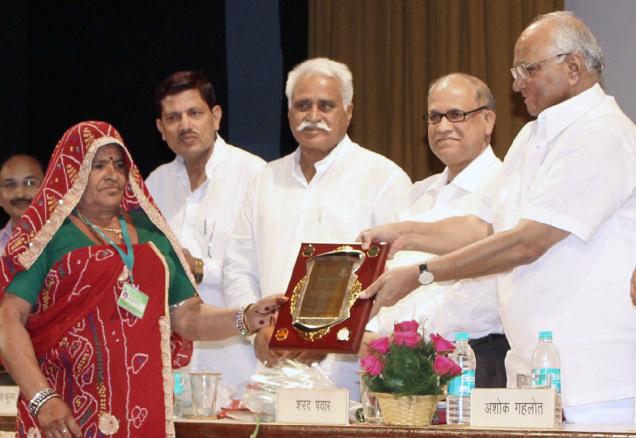
Women farmers shine: Bhagwati Devi, honoured for innovative farming by Union Agriculture Minister Sharad Pawar and Rajasthan Chief Minister Ashok Gehlot. WFS

Laxmi Lokur

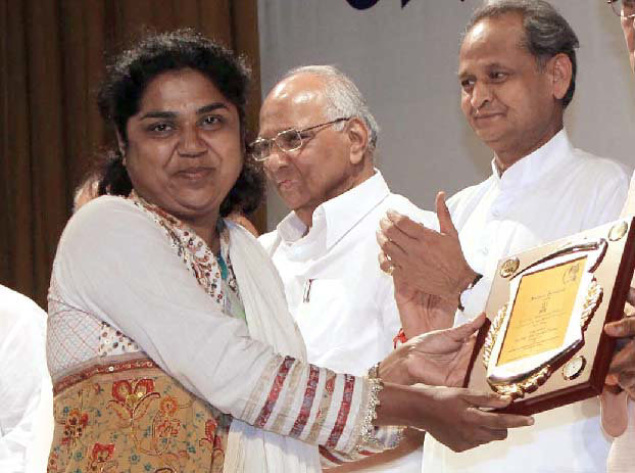
Three women farmers were recently felicitated for their scientific approach and acumen.

Laxmi Lokur is 38 and single. “I have no time for marriage,” she says, before moving on to her favourite subject, agriculture, and all the projects she has undertaken to attract youngsters to the field, quite literally.

Laxmi is from Karnataka’s Belgaum district and lives on her 22-acre farm. With her team of eight, which includes three women, she grows organic vegetables and fruits. Her focus is more on sowing, planning marketing networks and utilisation of the by-products of vegetables. She also runs a dairy.

Like Laxmi, Teilang Rani, 30, is also passionate about the land. Although a teacher by profession, she spends about four hours a day in the fields. Her family owns 11 acres in the village of Umden Arka, in Meghalaya’s Ri Bhoi district, on which she and her grandparents grow vegetables and paddy. The family cultivates bamboo on an additional acre. About a decade ago, Teilang began fermenting tender bamboo shoots to make curries, soup, pickles and chutneys, and has now developed this as a business model.

Bhagwati Devi from Sikar, in Rajasthan, has invented a way to protect crops from termites by planting a variety of wood, locally known as safedi ki lakdi.

Their love for agriculture and acumen for innovation recently fetched Laxmi, Teilang and Bhagwati national recognition. They were the only women felicitated alongside 28 other “farmer scientists” from 18 States by the Centre for International Trade in Agriculture and Agro-based Industries (CITA) and the Department of Agriculture, Rajasthan. The Union Agriculture Minister and Rajasthan’s Chief Minister were also present at the function held in Jaipur, where the women were honoured for their innovative practices and scientific research to enhance crop yields, improve seed varieties and scale up soil productivity.

For Teilang, this was only the second time she had ever ventured out of Meghalaya. She lives with her grandparents, husband, sister and an uncle. “Ours is a matrilineal society. I got married in January and my husband came to live with me. He works in a church 80 km from my village and visits me only twice a month,” she says. Teilang teaches English to students from Std V to X, but before going to school, she works for an hour in the fields.

Elaborating on her award-winning business model, she says, “We select 45-60-cm-long tender bamboo shoots for fermentation. These are stunted shoots, which are not likely to produce good quality bamboo for use in construction. The shoots are sliced and immersed in large jugs of water after their sheaths have been removed. They are kept like this for about a month when they ferment. We use this bamboo as pickle, add it to fish or pork curry and even soups.” Teilang has taken her bamboo shoot pickle to village exhibitions and other marketplaces, and makes about Rs 10,000 a year from her produce.

Laxmi, on the other hand, gave up a flourishing bag manufacturing business in Mumbai to return to farming in her native village of Udikeri, nine years ago. “I have two older sisters and a younger brother. In 2002, my father, a health inspector, fell ill. My sisters were married and my brother was busy studying. So I returned home to take care of my ailing father. But even after my father recovered, I decided to stay on. I had lived on our farm with my father since I was three, so I was naturally drawn to agriculture although I had no formal training. Since I wasn’t a particularly good student, I did not complete my graduation, but later explored the possibility of a short-term course in agriculture,” she says.

Laxmi’s family owned about seven acres when she first put her hands to the plough. “For one year, my father came to the fields with me to guide me. I started with a nursery, but we were unable to meet our day-to-day expenses. Then I bought a buffalo to sell milk. The next year, I bought four more. In 2005, I took a loan of Rs 6.4 lakh from the State Bank of India to procure 18 Murrah buffaloes from Haryana for dairy production. Simultaneously we worked on developing vermicompost. By 2006, we were selling vermicompost. Today we grow vegetables, which we supply to Bangalore and neighbouring districts. I have now developed my own marketing network.”

When she realised that seeds were getting too expensive, she started collecting local seeds. Three years on, she has been able to collect 22 varieties of local vegetable seeds. She now owns 19 acres, and has taken another three acres on lease.

She also conducts spoken English classes on weekends. “These are school-going children who come to me for vocational training. I have six boys and five girls as students. Once a month, I even train farmers in innovative farming, in making vermicompost the natural way and on using organic hybrids to increase harvests,” Laxmi says.

She now plans to register a non-governmental organisation and has already decided on the name: Prerna (inspiration). Apt indeed, seeing how she has inspired at least 20 young people over the last nine years to give up business activities and take up agriculture.

Laxmi, Teilang and Bhagwati are women with their hands on the plough and an instinct for the land. In a predominantly agrarian country like India, they can help transform the landscape.

© Women’s Feature Service

source: http://www.thehindubusinessline.com / by Renu Rakesh

To the zone and back

They stood facing each other, shuffling from side to side like prize fighters sizing up what lay ahead. The younger man, shorter and of a slighter frame, Olympic gold medallist Abhinav Bindra, sparing with words, and Indian cricket’s stickiest commuter Rahul Dravid, who listened more than he smiled, waited rather than waded, held court on the strikes and strokes that make up the sporting universe.

Bindra, 29, who made history in the 2008 Beijing Olympic Games, recounted his obsessive journey to greatness in a book ‘A Shot At History’, which Dravid launched before a glittering audience that included bowling great Anil Kumble, sprint queen Ashwini Nachappa, basketballers Nandini Basappa and Jayawanthi Shyam and swim star Nisha Millet. Dravid, slow batsman, sharp with words, said of Bindra’s historic effort, “He gave us one of those I-was-there, it-happened-during-my-lifetime moments.”

The evening, an education on the pursuit of sporting excellence, saw the iconic stars attempt to define that moment in time athletes like to call ‘the zone’. A smiling Bindra called it ‘fantasy’. “For me,” he said, “it is all about being in the present. When you are able to sustain that focus over a period of time.”

Dravid said, “Whenever great athletes meet, this (the zone) topic always comes up for discussion, you want to know if the other guy has been there, experienced it, you feed off each other. When Abhinav and I met earlier, we discussed it. Like he said, it is about being in the present, when you don’t have one eye on the score or the pitch or what’s coming at you. I’ve been fortunate to have glimpsed and tasted it in my career.”

For Bindra, whose sport is about attaining a stillness of state and spirit, said that while perfection was the goal, it’s also about what you are able to sum up on an imperfect day. “You have to have a Plan B and then it’s about how you make it work.”

Dravid said, “It’s not about how you do on a good day because you will do well, but how you come through when you are struggling. When things are not going your way and you’re wondering what you’re doing out there embarrassing yourself, but you stick around and make a 100. There’s great satisfaction in that.”

Bindra’s ‘A Shot At History’ is a stirring narration of the journey of an Olympic athlete. The autobiography written with sportswriter Rohit Brijnath, grabs the attention of the reader as much with the voice as with the words that make up the 200-odd pages of the book which takes on the tone of a conversation. It’s as if the champion shooter is narrating his story to you at a neighbourhood cafe. From the moment he wakes up, battling his mind on a winter morning in Chandigarh, to the final pages of the book, where he tells you that he’s ‘learning to suffer again’, readying himself for the 2012 test, you’ve probably downed many mugs of coffee, run through several tissues and finally thumped the table in triumph.

source: http://www.timesofindia.indiatimes.com / by Prajwal Hegde / TNN / Home> City> Bangalore / November 01st, 2011

Azim Premji: The bare-bones billionaire

True to form, Azim Premji has an austere meal in front of him.

It’s not for lack of choice. His company, Wipro Ltd., has laid out an array of decadent pastries, hot drinks and a rainbow platter of fruit for our interview at his new Canadian office. Mr. Premji, India’s third-richest man, has selected seven strawberries and a cup of tea.

Mr. Premji is not like other billionaires. He built his father’s vegetable oil company into a global software empire with operations in dozens of countries, yet he still flies economy class. He walks to work. He does not own a yacht. And in December, he was responsible for the largest lump-sum donation in his country’s history, pledging $2-billion (U.S.) to support rural schools in India.

That generosity is one of the reasons Western media have dubbed him India’s Bill Gates, the Microsoft founder who shares a technological bent and who, like Mr. Premji, dropped out of school. But Mr. Premji is different. For one, he returned to finish his degree in electrical engineering at Stanford University three decades later, a feat he’s quite proud of. For another, his vibe is more professorial than tech nerd.

Mr. Premji has long focused his attention on the developing world, seeing huge potential in major growth markets such as India, China and the Middle East. On this day, dressed in a dapper grey suit and burgundy tie, he is sitting in an office in an industrial area of Mississauga, talking about why Canada now plays such a key role in his company’s growth plans.

Sales here more than doubled in the past year, even before the company ramped up plans and decided to set up the Mississauga headquarters. Wipro aims to double revenue again in the next year. “It’s a reasonably large market. It’s English-speaking. We think it is a country which is economically very stable, growing, and it produces oil, which helps today in terms of having solid growth. And we have underinvested in it,” he says. “We’re taking it seriously now.”

Wipro now has 2,100 workers supporting its Canadian operations in business services, of which 300 are in Canada. It will add at least 100 more jobs in the country this year with its eco-energy division, which aims to manage energy reductions and cut companies’ carbon footprints. It will also branch out into servicing financial, retail and telecom firms in areas such as billings.

Mr. Premji is a journalist’s dream interview: his answers are succinct. He does not stray alarmingly off-topic. He remembers meeting you the year before. He doesn’t pepper his language with jargon.

His business background began with a lurch. At age 21, while studying at Stanford, he got a phone call informing him that his 51-year-old father had died of a heart attack. Azim would have to take over the family’s business – then called Western India Vegetable Products – with annual sales of about $2-million.

At his first shareholders’ meeting, he remembers someone telling him to sell his shares to an older colleague because he couldn’t run such a complex company. Instead, he bought business textbooks and studied them at night. He turned the cooking fat firm into a consumer products company that produced laundry soap and light bulbs. He diversified into information technology – printers and personal computers – and then into global outsourcing.

Today, Bangalore-based Wipro is India’s third-largest information technology exporter. It operates in 55 countries with more than 108,000 employees and sales of about $6-billion. Its businesses range from software and green energy services to consulting and outsourcing. Mr. Premji has a net worth of $16.8-billion, Forbes said this week.

The growth hasn’t come without setbacks. “Many things have failed,” he says. In the mid-1990s, he branched into financial services. “We didn’t understand the depth or the intricacy of the business. And we finally backed off. And we paid an expensive price for that.” What did he learn? “You cannot get into business for the fashion of it,” he says. You need a commitment which is long term and a commitment to leadership, because that’s the only way you build excellence.”

In a country plagued with corruption problems, he has made a public point of never paying bribes. “You can do clean business in India,” he says. “We have found we get better employees because of it, with more pride and more character. We get better partners, because they trust us. And we get more trusting customers because of it.”

Global challenges remain. Inflation is a broad concern – while he doesn’t see hyper-inflation, he is worried about rising prices in emerging markets.

“Messy consequences” from unrest in the Middle East is another worry. Everyone aspires to democracy, to a degree of control over their lives, he says. But in the process, there will be “uncertainty and major stumbling.

“And major frustrations expressed by people over what they’ve inherited.”

Economic clout is tilting towards emerging markets and away from advanced economies, he said in a recent speech at the Davos World Economic Forum. In the next decade, he expects emerging countries will have a $20-trillion economy – much larger than the $15-trillion U.S. economy. That means multinational companies will have to develop affordable products to suit local needs, he believes.

Much of his own attention is shifting. On Dec. 1, Mr. Premji said he plans to transfer $1.95-billion worth of shares to a trust that will fund social initiatives, particularly elementary education in rural India. He now spends 10 per cent of his time on the foundation, and he expects that will grow to a quarter of his time in the next few years.

Mr. Premji won’t say whether he plans to give away all his money, à la Warren Buffett. But he has said the trust is expected to expand “significantly” in the coming years. He sees this as the single best way of improving his country.

Much of Mr. Premji’s efforts are focused on girls – keep them in school, give them a basic education, ensure teachers show up for work, empower female leaders at the village level and you will see better health outcomes and smaller families. “How can you contribute towards building the Indian society and the Indian nation? No better way than to upgrade the quality of young people in school, particularly the schools which are run by the state government in the villages.”

Then, there is the matter of Mr. Premji’s frugality. He has made some concessions in recent years – he now flies business class on long-haul flights, and economy domestically. He used to drive a Ford Escort, then a Toyota Corolla. These days it’s a Volkswagen Skoda Laura. He is still arrives at the office at 6 a.m., works until almost 7 p.m. and toils after dinner and on weekends. He treks in the countryside, alone or with companions, on the weekends to clear his head.

His sister lives in Halifax with her children. Mr. Premji appears to genuinely like Canada – and is impressed with the Indo-Canadian community, which numbers close to a million people and has potential to help strengthen trade ties between the two countries.

“The Indian community in Canada has integrated much better than the Indian community in United States. They’ve become really Canadian at the same time as keeping all their Indian characters and customs and social groups. It’s a very unique blend, I’ve not seen it in this intensity anywhere else. And they’re doing well.”

source: http://www.theglobeandmail.com / by Tavia Grant / for Saturday Globe and Mail / Mar 11th, 2011
Visiting Card that Sows


A visiting card that grows into a plant. That’s what an NGO founder hands her clients and expects them to sow and grow them into plants. In what is perhaps one of the most eco-friendly visiting cards, Janet, the founder of city-based NGO, ‘treesforfree’, hopes to drive the green message.
Pongemia (Honge) seeds are used as visiting cards. It contains Janet’s name and telephone number on one side and a message advocating planting of trees on the other. “Thank you in advance for planting this seed and healing the earth,” reads the message. 

FIRST TIME IN INDIA
N Ramesh, the executive creative director of Meridian Communications, came up with this seed-cum-card concept. “The idea was conceptualised and executed in one day. It is the first time in the country that a seed is being used as a visiting card.”

He said treesforfree had so far been carrying out a paper-less campaign for its programmes and it did not want to use paper. That’s how this idea was born.

SURVIVES ON SUNLIGHT
A water-proof CD marker is used to inscribe on the card. “Even if recipient throws the card somewhere, the seed will start growing. All it needs is some sunlight,” said Ramesh.

“When I was young, there were honge trees all around MG Road and OMBR Road. But there are none of these now. I hope this campaign helps bring more trees in the city. This is not a copyrighted idea. Anyone who wants to avoid the use of paper or ordinary visiting cards can embrace the idea,” he said.

Janet said when she handed her first card to the CEO of Harley Davidson, he was taken aback, but he appreciated the idea.

http://www.bangaloremirror.com / Environment / by M K Ashoka / Wednesday Dec 16th, 2009

ISRO Dy Director Cycles to Work

Top space scientist Murthy Remilla cycles to office every day and cajoles others to do the same. We owe it our children, he says

While 163 nations slug it out in Copenhagen about how much carbon each of them won’t emit, closer home, a scientist at ISRO is doing his own mite not to add to the greenhouse effect. Murthy L N Remilla, who is currently the deputy director of business development at ISRO, has been using a bicycle to commute to work for the last 18 months.
STARTING TROUBLE 

Murthy is entitled to an official car and owns a Swift Dzire. At first, he faced ridicule from his own children when he started using a bicycle. For six months, starting March 31, 2008, Murthy travelled between home and office, a distance of five kilometres, on his son’s bicycle “to test myself.”

“My family members were surprised and did not like the idea. My two children thought it was undignified and found it odd, but I persisted. Six months later, I gave back the bicycle to my son when a friend of mine sent me a new one from USA,” Murthy said.

Murthy Remilla on his cycle

GREEN LANE

The tree-covered New BEL Road was the trigger for Murthy to start cycling. After spending three years in Sriharikota and nine years in National Remote Sensing Agency, Hyderabad, Murthy shifted to Bangalore in 2000.

“The road from Sadashivanagar police station to our office is tree covered. It looks like the Nehru Tunnel in Jammu and Kashmir. I had spent time doing my PhD in the IISc campus and it was common for people to use bicycles there. One fine day, I started to use the bicycle and have not stopped since,” the 44-year-old says.

INSPIRING OTHERS

Murthy has inspired other staff in ISRO to follow his lead. Whenever he has a break from marketing ISRO’s remote sensing data across the world, he can be found persuading his colleagues and subordinates to do their bit for the environment. His subordinate Ravindra HS has taken to cycling and so has A S Sudarshan, personal assistant to the ISRO director.

“We used to talk about environmental issues. But when we actually saw the senior scientist doing his bit, we knew our time has come to contribute,” Sudarshan said.

Murthy’s environmental concern does not stop at the office parking lot. He makes sure that printing paper used in the office are printed on both sides and lights are switched off when not needed. “The printing cartridge and electric waste are not bio-degradable. I am rude with people who waste paper, power and petrol. As individuals, we can do what is possible at our level to protect whatever is left of the environment,” said the Electronics and Communications engineer.

ROOTING FOR METRO RAIL

The scientist is often tempted to take his car to office. “It takes me 20 minutes to cycle the five kilometres from home to office. It takes more in a car most of the times. But sometimes, I am tempted to take the car. But in those few seconds, I steel myself and shut the garage door. We cannot have the kind of roads we have in China or Japan and we cannot do the job for BBMP. But bicycles are good for our health and wealth, even if we don’t think about the country or the world,” Sudarshan said.

“For me, it is the condition I leave behind for my daughter and son that concerns me,” he added. Hoping that the Metro would be a boon, he said, “The Vajra bus system has inspired many to take to public transport. Earlier, travelling by bus was like purchasing tickets to a new movie on Friday. The Metro should also boost public transport,” Sudarshan hopes.

source: http://www.bangaloremirror.com / Environment / by S Shyam Prasad / Wednesday Dec 16th, 2009

Surgery Pumps New Life Into Her

Wockhart doctors perform rare operation that helps 13-year-old girl’s left ventricle pump more blood to the body


Looking at her sitting with quiet dignity, facing the glare of harsh lights, you would never guess what her tiny heart has been through.

Indira, 13, a farmer’s daughter from Kodagu, was born with her heart on the right side of her body, while the heart’s pumping chambers and arteries had got inter-changed.

She got a ‘new life’ after Dr Devananda from Wockhardt Hospital and his team performed three surgeries her – all within a year which has worked miracles for the child.

Ever since she was a year old, Indira used to fall sick frequently. She made trips to many hospitals, where she was prescribed medicines for for ailment. When she grew older, she had difficulty in breathing and used to turn blue after even after a little work.

Options open

Fortunately, Dr Devananda met her and explained to her family that surgery was the only chance for her survival.
Indira’s heart was unable to pump blood to the entire body as her ventricles had got interchanged. The right ventricle pumps blood to the lungs and the left ventricle to the rest of the body. As her left ventricle wasn’t strong enough to pump blood at required pressure, doctors had to train her heart by creating obstructions in the blood flow to increase blood pressure.

There have been only a handful of cases in the world where the ventricle has been trained to pump blood after the age of 12. As her parents could not afford the surgery, the Needy Heart Foundation stepped in along with Wockhardt Hospitals to facilitate the same. The final step, the ‘double switch’, was completed successfully. The girl was on artificial ventilation for two weeks as she had developed pneumonia after her surgery, on May 26 this year. Before the final surgery, doctors had given her a 25-50 per cent chance of survival. But Indira insisted she wanted the surgery and her parents relented.

Dr Prakash Vemgal, who monitored her after surgery till her discharge, spoke about how, after the tubes were removed from Indira’s mouth and she could speak, she told doctors that her birthday was on June 16.  A surprise party was arranged for her and she cut the cake.

After speaking to the press, she quietly left with her mother in an autorickshaw.

source: http://www.bangaloremirror.com / Bangalore Mirror Bureau / Monday, Sept 22nd, 2008


A Prestigious Fellowship for her Skills

A photo of an Asian Open-bill Stork by Nikitha. 

A photo of an Asian Open-bill Stork by Nikitha.

The Royal Photographic Society (RPS) of London has picked N.V. Nikitha from Mysore for a fellowship for her skills in the nature category.

The honour is doubly special for Nikitha because her father, N.T. Vijayakumar, a forest official, who is the Deputy Director of the Chamarajendra Zoological Garden (Mysore zoo), got an RPS fellowship a year ago.

“I would never have become a photographer, but for my father’s encouragement,” Nikitha, who has finished her final B.Com examination, told The Hindu.

More than 15 pictures of birds shot by her were sent to the RPS by an agency of the RPS in Bangalore in January 2011. And, on March 23, 2011, she was informed that she had been chosen for the honour.

The distinction that young Nikitha has got is laudable also because only 11 persons in the world are chosen by RPS for it.

This year, of the 11, four from Karnataka have got the RPS honour, and Nikitha is one of them. The other three are Siddarth Malik, Ramu Mastaiah and Hanumantha Ramakrishnaiah.

Mr. Vijayakumar said that Nikitha was only the third woman photographer from the country in the nature category to have won the RPS honour. The others were Devi in the late 1970s and Asha Jaykumar in 2000.

Nikitha attributes her passion for nature photography to her father. When Mr. Vijayakumar was the Assistant Conservator of Forests at Dandeli Wildlife Sanctuary in 2003, Nikitha started watching birds.

Then in 2005, she followed it up with bird photography.

There was no stopping her afterwards as she went on a photography spree from 2005 to 2010 touring Hesaraghatta in Bangalore, Attiveri Bird Sanctuary in Haveri district, Ranganathittu Bird Sanctuary near here, various parts of Kodagu and the Karanja Nature Park here.

About the international recognition for her photography skills, she says, “It is again my father who coaxed me to apply for the international recognition.”

Nikitha has taken the pictures of Asian Open-bill Stork, Black Kite, Common Moorhen, Eurasian Spoonbill, Great Cormorant, Kestrel, Great Thick-knee, Little Egret, Paddyfield Pipit, Little Grebe, Pied Kingfisher, Purple Swamphen, River Tern, Spot-billed Duck and Spot-billed Pelican.

Nikitha, besides pursuing her passion for photography, also wants to take up MBA.

Her father got the Royal Photographic Society fellowship a year ago

source: http://thehindu.com / by Jeevan Chinnappa /National / Karnataka / Mysore / Jun 08th,2011

Postal Van that Runs on Power

BANGALORE:

Campuses across the country could run electric postal vans  if the department of science and technology (DST) makes IISc’s innovative electric postal van a model. Researchers at IISc’s Centre for Product Design and Manufacturing are excited by the idea of approaching DST while already having approached a few private companies to commercialize their in-house product.
To keep IISc campus green and clean and save energy, which can be the case with all campuses in the country, researchers led by Prof Anindya Deb have designed an electric postal van that will begin operations in two months time.

Deb explains the van is special for two reasons. “The van has been made based on the unique space frame body design. In simple terms, it is a lightweight van made out of aluminium tubes integrated through innovative engineering. The aluminium tubular frame keeps the van very light. There is no use of steel, a feature of conventional vehicles. The van is also special because it runs on battery __ an electric motor powers the van which makes it an eco-friendly product too.”

The van, named Vidyut, is 4 metres long and weighs around 800 kg. The batteries weigh 300 kg. “To offset weight of the batteries, we have used lightweight aluminium to design the van. An 800 kg vehicle spread over 4 metres makes it light,” Deb explains. For every battery charge, the van runs 60-70 km and can be charged once in three-four days if used within campus. The van approximately costs Rs 5-6 lakh.

The van is a boon to IISc as the existing van has postal boxes which are at a height of almost 6-6.5 feet making it very difficult to reach out. The new van is at the height of a car __ around 4 feet __ and has 100 mail boxes inside it ensuring easy reach.

Funded by IISc, the design of the van, which took five years, is a dream come true. “We made this van with less than 10 people. We have a workable product with virtually no manpower. We are not a company and we don’t have the privilege of having hundreds of engineers. We’re researchers primarily and not product manufacturers,” Deb explains.

Can the van be used in the city and can it be commercialized? “The van is a real product. It can be modified to run in the city, which requires certification from the automotive institute in Pune and the regional transport office concerned. Technically speaking it can be run on the roads.

“We have in fact driven the van in the city when we needed to get the paint job and maintenance work done. It performed like any other conventional vehicle. We have also run it inside the campus. The vehicle is primarily meant to be run inside campuses and can be replicated in campuses around the country.

“We have approached some companies on commercialization. In fact Ratan Tata  had evinced interest and I even drove him around campus. But what we need is support to market and commercialize it as I and my team are primarily academics,” Deb says.

The team is securing insurance for the van to offset damage. This being an experimental, research van, it has a permit from RTO to be run without registration within campus. It will need to pass certification tests and registration to run outside. The van has successfully run simulation tests for crash worthiness.

QUOTE CORNER

“A literature survey we did indicates the design of this van is special. It is not seen everywhere in the world. To that extent we have attempted a product different from existing ones.”

__ Anindya Deb

MAIL BOX

Innovation: Lightweight aluminium electric postal van

How it works: Battery-driven, runs 60 to 70 km

Utility: Can be used as postal van in all campuses

Cost: Around Rs 5-6 lakh

The Team: Anindya Deb conceptualised and designed the van, technician Eaganathan did mounting works, Sigbathullah fabricated mail boxes, S K Sinha looked into electricals, N D Shivakumar took care of fabrication and a host of students helped

OTHER FACTS

* Van will make two rounds __ morning and evening __ deliver and collect mail from and to a central point in the campus

* Mail boxes have numbers indicating the departments/centres to which mail is delivered and collected

* Van will deliver and collect internal mail between departments and external mails

* Van has been derived from the original plan and concept of a small car project undertaken by two students, funded by IISc, private company Hydro Aluminium and Norwegian University of Science and Technology.

* Patent filed for design and technology used in it


source: http://www.timesofindia.indiatimes.com / by Prashanth G M / TNN / Jun 14th, 2011