Category Archives: Inspiration/ Positive News and Features

They are on a mission to rebuild schools, one at a time

Bengaluru :

Teachers taking lessons out in the open, owing to dilapidated conditions of government school buildings, coupled with the constant fear of the fragile roof collapsing over their head, was a common sight across Karnataka and Maharashtra for a bunch of IT and other professionals, based in the US, seeking to improve the education system in India.

One School At A Time (OSAAT), set out on a mission to improve schools in the country, where infrastructure translates to decaying walls, absent toilets, crumbling celing and lack of basic amenities. The organisation has been spearheading projects in the two states for more than a decade.

OSAAT-USA was established in 2003 in San Jose bay area, when a group of like-minded IT professionals seeking to build a safe and healthy learning environment in India came together. Its India arm, OSAAT-India was incorporated in 2012, and is headquartered out of Bengaluru. The venture began when OSAAT’s management trustee, Vadiraj Bhatt visited his hometown, Bajagoli village in Karkala, Udupi on a vacation from the USA, around the same time when he and other IT professionals were looking for a specific area to invest their efforts.

“My teacher informed me about a school where students were being taught under a tree. After that, we realised that there are many schools without a proper building. The idea was to embark on something that few or no one had touched in education,” said Bhatt.

Upon returning to Bengaluru for good in 2005, he formed a team of nine equally passionate volunteers of mostly IT and retired professionals. In the space of a decade, OSAAT has rebuilt or completely renovated fifteen schools in Karnataka and rural Maharashtra.

Bhatt pointed out that funds raised by OSAAT-USA account for nearly 90% of the finances for the project. “In India, we have partnered with organisations such as Rotary in Bengaluru, Mysuru and Bhadravathi and POWER in Bijapur, who have helped us get manpower and intelligent engineers, who ensure that the reconstruction of schools is achieved without loopholes,” he added.

Monika Venkateshmurthy, who is championing the cause in the US, said that fund-raising for OSAAT projects in India had turned into an inclusive effort. A hardware engineer by profession, Monika said, “There are people in the city who want to donate but don’t have enough knowledge on how to go about it. When they asked, ‘Why should I spend money for a school 10,000 miles away,’ I explained the value of a single dollar in India.”

Vadiraj’s elder brother, GK Bhatt, who retired as an assistant general manager at Vijaya Bank three years ago, joined his brother and is putting his experience as a banker to use as OSAAT-India’s treasurer, although he also enjoys working with volunteers in the field.

“We have no clue about so many things, unless we see it for ourselves. In one of the schools we worked on recently in Yeshwanthpur, Malur, there was a cow shed adjacent to the school building. The children were exposed to the filth and mosquitoes, due to the poor maintenance of the cow shed,” GK Bhatt said.

Speaking on the road ahead for OSAAT, he added, “We want to take it to the next level by partnering with corporates, who would want to take up such projects under their CSR initiatives. They could donate funds for the purpose and also participate actively in the process, while we rebuild a school.”

‘We want to create a template for the future’
“We want to propose a model – the concept of working on a cluster of schools, like we did in Malur taluk with three schools – to the government. We are aiming at creating a template of work, based on our association with the revenue department, block education officers and panchayat, showing the authorities that this is how work must be taken up in the future. We want to create a blueprint for quality education by emphasising on the need for proper infrastructure.”
– Vadiraj Bhatt | Management Trustee, OSAAT-India

source: http://www.timeofindia.indiatimes.com / The Times of India / News Home> City> Bangalore / Deepika Burli / TNN / August 07th, 2016
Raichur boy’s idea of tree transplantation wins award

Udupi:

A boy from Raichur was declared young scientist of the district for 2015-16 by the Karnataka Rajya Vijnana Parishat. Pampana Gowda, 17, bagged the title for his idea of a machine for shifting trees and also devising fuel-saving technology.

Pampana studies at the SVST High School, Kidiyoor, and represented Udupi district in the contest. Pamoana said people are aware of damage to the environment while cutting a tree for development. They also want to protect trees, but they don’t have the means to shift them.

“This inspired me to come up with a model of a tree-shifting machine,” Pampana said. The teenager is sure his model will be an asset to protect the environment. “The project needs a crane and a blade. Depending on the size of the tree, a suitable blade will be used. The machine will lift not only the tree roots but also the mud surrounding the tree. The project cost will be around Rs 2 lakh,” he said.

He also devised fuel-saving technology using two metal cylinders, one filled with petrol and the other with water. It’s a better option than a gas cylinder and environmentally-friendly too. “I’m working on an improved model. I want to be an engineer,” he added.

source: http://www.timesofindia.indiatimes.com / The Times of India / News Home> City> Mangalore / August 06th, 2016

‘This is my school and I am proud of it’

GovtModelSchoolGuluruBF05aug2016

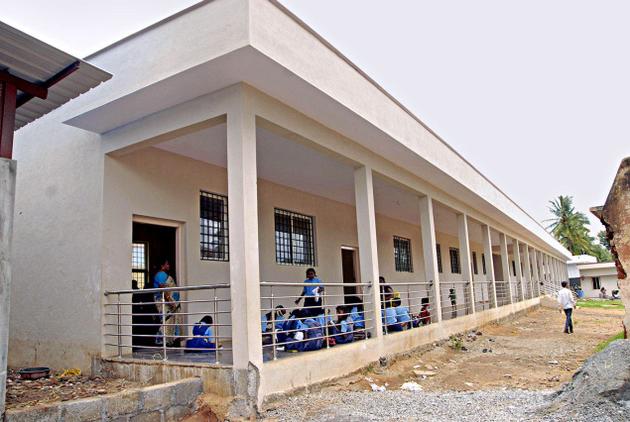
But just two years ago, the Government Model Higher Primary School in Guluru was a crumbling edifice lacking basic infrastructure

A 108-year-old government school at Guluru in Tumakuru taluk has embraced modernity gracefully and has become a model for others. Just two years ago, the Government Model Higher Primary School was a crumbling edifice lacking basic infrastructure. However, today it boasts of computer labs, airy classrooms, a library, science labs, separate toilets for boys and girls, and all other amenities offered by private schools that charge hefty tuition fees.

“We proudly tell our friends who go to private schools that we work on computers,” says Nethravathi. V. G, an eighth standard student. Like his friends, he can’t get over the fact that till recently, their school was in a dilapidated state with broken tiles, leaky roofs and cracks in walls.

Worried about the safety of their children, villagers approached MLA Suresh Gowda seeking a new school building. Mr. Gowda sanctioned Rs. 80 lakh from the MLA LAD (Local Area Development) funds.

MLC Lehar Singh offered Rs. 10 lakh and former minister V. Somanna contributed Rs. 5 lakh towards construction of a new building. L&T, an Indian MNC, offered Rs. 10 lakh as part of its corporate social responsibility initiative, which is being used to pay the salaries of LKG and UKG teachers, the computer teacher and a sweeper.

“Earlier, our friends used to make fun and tease us, as we were studying in an old building. But now, we are happy to show them our new school,” said Vinutha N., a seventh standard student.

The co-ed school, which has LKG, UKG and classes from I to VIII, has a total strength of 282. The pride of the school is the computer laboratory, which has 20 computers and Wi-Fi connection.

Another student Akbar Khan adds, “Seeing us in such a nice building, now my friends want to join our school.”

Headmistress N. Hemavathi says, “After the revamp, we have been getting applications from students of private schools nearby.”

The school will be celebrating its 108th anniversary on Friday.

source: http://www.thehindu.com / The Hindu / Home> News> Cities> Bengaluru / by S. B huvaneshwari / Bengaluru – August 05th, 2016

Oral health without tears

Dr Srivats Bharadwaj talks to children and teachers of Brindavan School in JP Nagar

Bengaluru :

A public-spirited dentist is taking oral health care to the doorsteps of people. Dr Srivats Bharadwaj and his team of 15 doctors are also on a mission to make people aware of the importance of paying attention to oral health.

At Vatsalya – Centre for Oral Health, experts have been providing care to individuals with no access or awareness about the same. Over the years, the team has conducted campaigns, workshops and camps in the villages, towns and cities of Karnataka. Vatsalya focuses on three areas — home care, clinical care and community health.

“We are on a mission to give world class treatment on a par with the West or even better,” explains Dr Srivats.

Recently, the team treated 450 children at government schools in Bengaluru. Its community initiatives began at Chittadhama near Kabini in H D Kote, at a centre for the mentally ill, where patients needed urgent help in oral health care.

. A girl at Government School in Manjunathnagar receives treatment | Express

The team carried a portable dental unit that fits into a suitcase and can do everything, including scanning and drilling. Similar camps took the team to Chikkamagaluru and Tumakuru, besides old age homes and orphanages in Bengaluru.

In 2013, the team adopted Kudur village in Tumakuru district to run a regular oral health care programme. Socare, an organisation that looks after indigent children of convicts, roped the team for a camp.

Dr Srivats has been treating children with cardiac problems for the past 5 years who need dental care, and the initiative is supported by ENR Foundation, Germany. The 41st group of children visited Vatsalya this month and over 25 children were treated before their heart surgery. More than 500 under privileged children have got a new lease of life under this initiative.

“Oral health is a window to one’s overall health, and my idea is to drive home this point. Our focus is on prevention as tooth decay and other problems can lead to multiple organ failure and 120 other health conditions,” he explains.

Drilling, filling and billing is what dentists do today, Dr Srivats says. “Dentists are seen in a poor light when they advocate procedures that are unnecessary and expensive. They don’t advise sealant medicine for children below 18 for the prevention of tooth decay. I am launching a Seal India prevention and interventional programme as it can keep the problem at bay for 20 years,” he adds.

Vatsalya has two centres in Bengaluru and is opening the third in Rajajinagar. In the coming days, the team hopes to spread its activities to Nepal, Bhutan, Bangladesh and Pakistan.

“We are not aligning with venture funds but are definitely looking at contributors with a social commitment,” says Dr Srivats.

The aim is to set up community health centres not funded by the government “We hope to make a huge difference in the coming years,” he says.

source: http://www.newindianexpress.com / The New Indian Express / Home> Cities> Bengaluru / by Meera Bharadwaj / July 31st, 2016

Re 1 initiative helps the poor build dreams, brick by brick

The house of gardener Sampangi, which was built using the funds collected under the Rupee

Bengaluru:

For over 30 years, 44-year-old Sampangi and his wife and three daughters lived under a leaky roof which they called their home. “The roof would leak every time it rained and we’d have to shift clothes and electronic items to one corner of the house. The house would shake whenever there’s heavy wind,” the gardener recalled.

Today, Sampangi lives in a two-bedroom home with a garden and three dogs that he found abandoned on streets. His eldest daughter is now married, while his two younger daughters are school students. A photograph of Japanese volunteers from NGO Habitat for Humanity, who constructed the house, is displayed on top of the TV shelf, and his eyes light up whenever he sees the people who made this possible.

“As my children got older, my wife and I would talk about building a better home. We had even begun saving some money from the meagre amount we earned. But four years later, we were left with only about Rs 1 lakh,” he said.

Things changed for the better when he met a person from the Habitat for Humanity, through whom he learned about interest-free loan. The rest, is history.
Rupee for change

What can you do with Re 1 is a question that everyone asks. Apparently, you can build houses.

Habitat for Humanity has tied up with 20 schools in Bengaluru. Students, parents and teachers contribute Re 1 per day towards funds to construct houses for people from low-income group. In the past two years, the NGO has raised Rs 10 lakh which has gone into constructing 14 houses in Nagenhalli, Byrathi, Bagalur, Yerapanahalli and other parts of the city. Students, through the volunteer build programme, are also assisting in renovation activities.

India faces a shortage of about 6 crore housing units, said Rajan Samuel, managing director, Habitat for Humanity India.
12 lakh in need of houses

“In Karnataka alone, over 12 lakh people don’t have a decent home while 49% of the population does not have access to a toilet. The Centre has introduced policies like ‘Housing for All’ to provide adequate shelter to each and every family by 2022. The state government too has undertaken measures to provide affordable homes to the poor and to redevelop slums. About 70% per cent of the urban housing need is in the affordable segment and this is where Habitat for Humanity is working,” he said.

In Karnataka, the NGO is building 74 homes and 123 toilets for the low income, marginalized people, he added.

According to him, in most cases, women bear the brunt of lack of housing or toilets.
Learning experience for students

While lives of people like Sampangi or Kaliyamma, who recently moved into her newly constructed two-bedroom home are being transformed, student volunteers are learning as well.

“Recently, our students painted a government school as part of the volunteer build programme and they were surprised to see a blackboard. Most of them have seen white boards in classrooms, but never a blackboard on which chalk is used,” said Asha Samuel, faculty incharge of CAS at Canadian International School.

“These activities help them grow. They come back realizing that there are so many things that they take for granted and so many things they should be grateful for,” she said.

Poor women bear the brunt

Women and girls from the lower income families live in highly unsafe and substandard conditions without access to basic sanitation. Majority of them suffer from poor health since they do not have the liberty to relieve themselves when required and have to wait till dusk to go out and defecate. Owning a house with proper sanitation facilities is a deep desire of all poor women across the country. By providing access to decent housing and sanitation facilities, Habitat for Humanity India intends to improve health and provide security for the whole family

– Rajan Samuel, managing director, Habitat for Humanity India

source: http://www.timesofindia.indiatimes.com / The Times of India / News Home> City> Bangalore / Merlin Francis / TNN / July 31st, 2016

For him, the battle continues

Bezwada Wilson.
Bezwada Wilson.

The Magsaysay Award winner says India still has over two lakh manual scavengers

Fifty-year-old Bezwada Wilson, national convenor of the Safai Karmachari Andolan (SKA), was declared one of the six recipients of the 2016 Ramon Magsaysay Award by the Philippines-based award foundation, in Manila on Wednesday. Recognised for his efforts to eradicate manual scavenging, Mr. Wilson told The Hindu that India still has over two lakh manual scavengers who needed to be rescued, according to a nationwide survey by the SKA.

The award citation recognises Mr. Wilson’s work in “asserting the inalienable right to a life of human dignity”. Of the estimated 600,000 scavengers in India, SKA has liberated around 300,000, the citation notes.

Hailing from a Dalit family in Kolar, Karnataka, Mr. Wilson said his first brush with the local authorities over the abominable practice was in 1986-87, when he saw poor Dalit women cleaning human waste in the public latrines of Kolar Gold Fields. His own family members had been manual scavengers for generations.

“It was a big town, and in those days KGF was known to be the most electrified town after Tokyo,” he said. Yet, the town lacked public toilets with running water. Moved by the plight of the women who had to clean them every day, Mr. Wilson decided to petition the local town municipality to improve facilities. In 1986, he sent a complaint about dry latrines to the authorities and, when it was ignored, he sent the complaint to the Prime Minister, threatening legal action, the award citation notes. As a result, the town’s dry latrines were converted into water-seal latrines and the scavengers transferred to non-scavenging jobs.

Despite his 32 years of activism, Mr. Wilson says challenges remain in putting an end to the practice. “No thorough survey has been conducted as yet to enumerate manual scavengers though State governments have been promising one since 2010,” he said. Expressing scepticism over the implementation of the government’s flagship Swachh Bharat Abhiyan, he said the scheme did little to address the plight of manual scavengers and only sought to build more and more toilets.

Mr. Wilson formed the SKA as a network of activists in 1993. A PIL he filed in the Supreme Court, naming all the States, Union Territories, and relevant government departments as violators of the 1993 Manual Scavenging Prohibition Act, produced positive results. In 2014, the SC ruled in his favour demanding that all States ban manual scavenging and even fixed a compensation of Rs. 10 lakh for families of scavengers who had died on the job.

“In 2014, we gave the Centre a list of 1,073 people who had died while cleaning sewers, but the families of the dead are yet to be compensated fully. Only 36 people from the families of dead sewer cleaners have been compensated, but they did not get the full amount prescribed by the court,” he said.

Our Special Correspondent from Bangalore adds:

Practice still rampant in Kolar

In the hometown of Bezawada Wilson, who has been honoured with the Ramon Magsaysay award for 2016, manual scavengers are not hard to find.

The century-old mining set-up at the Kolar Gold Fields (KGF) saw thousands of people — primarily from Dalit communities — being brought in to deal with night waste. Mr. Wilson’s father was among those brought from Andhra Pradesh to KGF.

Though mining operations ended in 2001, the prohibited practice continues in the town where dry latrines are abundant.

The government claims that there are only 82 manual scavengers in KGF. This is disputed by activists and government officials who peg the figure at 800 families — making it the highest density of manual scavengers in Karnataka.

“While more than 12 criminal cases have been filed across the State for manual scavenging, there is little clarity on the prevalence of the banned practice. A 2007 survey threw up a figure of 15,375 manual scavengers. This is clearly under reporting, says Narayana, Chairman of Karnataka State Commission for Safai Karmacharis.

“The number is higher than 25,000,” he alleged. “We have sought a re-survey, but government officials are looking at their list and claiming that the number has reduced.”

The announcement of the Magsaysay award for Mr. Wilson did not trigger celebrations in KGF. Much of his activities have been in Andhra Pradesh or at the national level.

source: http://www.thehindu.com / The Hindu / Home> News / Vidya Venkat / Chennai – July 27th, 2016

Release of Book on JC Wadiyar’s compositions marks Vaggeyakaras’ Day

Pramoda Devi Wadiyar (fourth from left), who inaugurated the Vaggeyakaras’ Day celebrations organised by Karnataka Sangeetha Nritya Academy at Jaganmohan Palace in city on Monday, is seen releasing a book titled ‘Jayachamarajendra Wadiyar’s Compositions’ authored by Musicologist Karnataka Kalasri Vid. V. Nanjundaswamy (third from right). Others seen are Academy Member-Convenor Dr. Sukanya Prabhakar, KSGH Music and Performing Arts University VC Dr. Sarvamangala Shankar, Academy Chairperson Gangamma Keshavamurthy, Registrar Banashakari V. Angadi and author’s wife Prof. H.S. Umadevi Nanjundaswamy.

Mysuru :

“Jayachamarajendra Wadiyar’s contribution to music as a composer and critic will always be cherished by musicians,” opined Dr. Sarvamangala Shankar, Vice-Chancellor, KSGH Music and Performing Arts University.

She was speaking at a function organised by Karnataka Sangeetha Nritya Academy, Bengaluru, at Jaganmohan Palace in city on Monday to mark Vaggeyakaras’ Day.

Dr. Sarvamangala said that thousands of composers like Patnam Subramania Iyer, Bidaram Krishnappa and Mysore Vasudevacharya laid a strong foundation for music with rich literature. She added that music and literature were both soothing elements for mind but not just that as a music should have a good literature for real value.

Pramoda Devi Wadiyar, who inaugurated the programme, also released the book ‘Jayachamarajendra Wadiyar’s Compositions,’ authored by Musicologist Karnataka Kalasri Vid. V. Nanjundaswamy, on the occasion. The day also witnessed Dr. Veena and troupe rendering compositions of Mysore Vasudevacharya and Jayachamarajendra Wadiyar, lecture by the author, veena recital by Vidu. Rajalakshmi and troupe and violin duet by Tejas Manjunath and Pranav Manjunath.

Academy Chairperson Gangamma Keshavamurthy, Registrar Banashakari V. Angadi and others were present.

source: http://www.starofmysore.com / Star of Mysore / Home> General News / July 20th, 2016

In her shoes

Special Arrangement / The Hindu

The fascinating story of Anu Vaidyanathan, the first Asian woman to compete in Ultraman Canada.

As someone who goes to bed praying the morning papers will publish findings that pizza is good for weight loss, two questions popped up when I read Anywhere but Home: Adventures in Endurance, written by Anu Vaidyanathan, “the first Asian female to have competed in Ultraman Canada”. It sounds suspiciously like auditioning for a superhero movie set in Nova Scotia, but what is it really? The answer is easy enough, as it exists in the finite and definable realms of sport and mathematics: a 10-km swim, a 420-km bike ride, and an 84.4 km run. (Four weeks later, again in Canada, Vaidyanathan switched her allegiance to a different superhero: Ironman. This time, a 3.8 km swim, a 180-km bike ride, a 42.2 km run.) I then asked the tougher question, the answer to which lies in the diffuse dimensions of metaphysics: Why?

I get why people climb the Everest. It sounds like something you’d want on your obituary note, or at least your Facebook post. But what glories can swimming, running and biking bring? As it turns out, Vaidyanathan is searching for a “why” too.

Despite the broad motivational-poster nature of the narrative (sample quote: “If it were easy, it wouldn’t be worth doing”), Anywhere but Homeis also an intimate portrait of a single woman in India — “a quintessential Tamilian Brahmin — five times a year at least, during Pongal, Nombu, Ganapathi Chaturthi, Krishna Jayanti and Deepavali” — brushing off the “when are you going to settle down?” question, training on bad roads, without much money for equipment, putting her body through unimaginable stress, all because… Because… The answer, finally, comes from writer and Holocaust survivor Victor Frankl. What athletes do with their goal-setting “frees them up from commerce or the meaningless pursuit of goals that depend on other people’s validation.” The other reason: “the grand challenges of survival were absent because we were children of luxury.” Hence the transformation of life into a hurdle race with a series of self-imposed challenges.

Vaidyanathan writes like a runner — breathlessly, without getting sidetracked. The pages seem to pant. The prose is observant (“watching dark grey clouds tease the distance between them and my rear-view mirror”), if sometimes too cute (a chapter is titled “An Inheritance O’Floss”). And often very funny, in the way everything circles back to running, even romance. About an early boyfriend, she writes, “I think I was in love. You would have to be, with a boy who took you on a 13-km run through the woods on a first date.” Later, she writes about dating a tall, soft-spoken German boy who did not understand why a ride was so much more exciting than a movie. “Miffed with his lack of understanding, I took off on a long run.”

I must say I saw the German boyfriend’s point. Vaidyanathan is quite a character, someone whose idea of a memorable Thursday includes a 3.5-km swim, a two-hour run, an hour of commuting on the bike, and 30 minutes of upper-body weights. (One can only imagine what her idea of a perfect Valentine’s Day is.) She never seems to rest. If she’s not working towards a PhD in Electrical Engineering, she is at home in Bangalore plunging into a start-up.

Anywhere but Home is mostly the story of a solitary pursuit but filled with family and friends. We meet the people Vaidyanathan leaves behind when she goes off on her runs and bikes and swims, the people she yearns to be with while living out of suitcases. We get to know her roommates and boyfriends (though we never seem to know when the relationships ended). We meet members of the running community, people who seem to think nothing of scrounging up enough money to fly off to exotic locations (Brazil! China!) for endurance events. And everyone is so giving. During a run, when Vaidyanathan was suffering from dehydration, sleeplessness and worries about an unsupportive crew, “Lena held my hand for nearly two kilometres, running alongside me, reminding me to never give up.”

The last chapter deals with another sort of hand-holder, finding “someone crazy enough to marry me”. And we sense a calming down, especially after the birth of Vaidyanathan’s son. “Giving birth brought with it a moment of great clarity. There was magic beyond what any class in engineering, science or objective observation had taught me. However, to sustain that magic past the endorphin rush of birth would involve a great deal of humility… Overnight, I went from being someone’s daughter to being someone’s mother.”

The epiphany lasted about six weeks. Soon, Vaidyanathan was back on the road, participating in a 10 km race. It wasn’t easy, but she finished, “just for the pleasure of having my son know that his mother embraced life’s challenges.”

Anywhere But Home: Adventures in Endurance; Anu Vaidyanathan, Harper Sport, Rs. 350.

source: http://www.thehindu.com / The Hindu / Home> Books> Literary Review / by Baradwaj Ranjan / July 23rd, 2016

Bengaluru students develop gloves for speech impaired

The team of engineers with their mentor H R Nandi Vardhan

Bengaluru :

A team of engineering students has developed a glove that converts sign language into voice, helping people with speech impairment communicate better.

The smart glove, named Mudra ,converts gestures recognised under Indian sign language into spoken English.

The prototype that can convert gestures into speech

The prototype was developed by the students of Amrita School of Engineering — Abhijith Bhaskaran, Anoop G Nair, Deepak Ram and Krishnan Ananthanarayanan — as part of their final year project.

“In Sanskrit, mudra means gesture,” says Krishnan.

The idea for the project was born when the students were discussing the problems faced by the differently-abled. “As engineers, we wanted to give back to society. That is how we came up with this idea,” says Anoop.

Explaining how the device works, he says, “The flex sensor in the glove predicts the orientation of the fingers. The gyrometer, accelerometer and magnometer predict the movements of the hand in a 3D space. The sensor processes this data and produces audio output through the speaker.”

“We will start developing the device in two to three weeks,” he adds.

The team took 16 weeks to build the prototype and spent Rs 7,500. The glove can currently recognise numbers 1 to 10, and gestures corresponding to words such as morning, night, goodbye and thank you.

It can detect four different positions of each finger, and as many as 70 gestures can be configured. “We have begun validating its social feasibility. The preliminary results are very encouraging,” says Abhijith.

A lot of research went into the project, chips in Deepak. “We didn’t know how to go about it at first. We then studied about various sensors, their uses and the materials that can be used.”

The team claims that there are no side effects of using this glove and it is as comfortable as a riding glove.

H R Nandi Vardhan, assistant professor, Department of Electronics and Communication Engineering, mentored the team. “Initially, we thought of using a camera. But we realised that the cameras would be expensive and non-portable.”

While the gloves are only in the prototype stage, the team is looking for people to invest in the product. Once the cost is minimised, it can hit the markets.

source: http://www.newindianexpress.com / The New Indian Express / Home> Cities> Bengaluru / by Akhila Damodaran / July 23rd, 2016

Mysuru Warriors and Kalisu Foundation establish library in Govt. School

LibraryBF13jul2016

Mysuru :

Mysuru Warriors, the city’s cricket team and Kalisu Foundation today handed over a library to Sharada Vilas Government Higher Primary School on Sewage Farm Road in Kanakagiri here.

Speaking after inaugurating the Library, R. Guru, Chairman, NR Group, makers of Cycle Pure Agarbathies and Owners of Mysuru Warriors, said that public participation was vital for development of Government schools and a library is of great value to the overall development of a child.

He also observed that the Sharada Vilas Government Higher Primary School was so good that parents around the school were taking their children out of private schools and admitting them to this school .

Vikram Muthanna, Managing Editor, Star of Mysore, who was one of the chief guests, appreciated the efforts of Mysuru Warriors and Kalisu Foundation in establishing a well-stocked library and added that the teachers must encourage students to not only use the library but also maintain the library and increase the number of books.

The Library has more than 2,000 books, which include pictorial books on Science, Math and General Knowledge.

This is the fourth library established by Kalisu Foundation in Government schools. Earlier this year, Mysuru Warriors in association with Kalisu Foundation had established a library in Kuvempunagar Government school.

Balachandar, Convenor, KSCA, Mysore Zone; South Zone BEO B.N. Shivaramegowda, School Principal Ravish, Mysore Round Table Chairman Mayur Shah, Kalisu Foundation’s Nikhilesh, SDMC President Narayana and others were present at the inaugural function.

source: http://www.starofmysore.com / Star of Mysore / Home> General News / July 13th, 2016