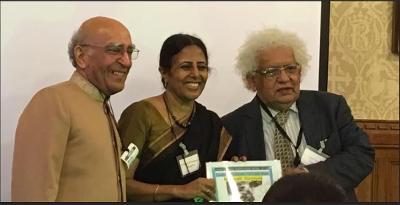
Dr Ratnavalli Ellajosyula and Nidhi Dev get the prestigious Gandhi International Fellowship Award.
The CNC has been working on research projects in the fields of dementia.
The Gandhi Fellowship Award was set up by a UK based neuropsychologist Dr Narinder Kapur
________________________________________
Bengaluru :
Two researchers from Bengaluru have been awarded with the prestigious Gandhi International Fellowship Award by Lord Meghnad Desai in the House of Lords, London, recently.
Dr Ratnavalli Ellajosyula, founder, Cognitive Neurology Clinic (CNC), and Nidhi Dev, Neuropsychologist, CNC, were among the ten doctors and researchers who were honoured. The team was awarded this fellowship for their outstanding research in the fields of dementia.
The CNC has been working on research projects in the fields of dementia that was presented at the mid-year Meeting of the International Neuropsychological Society in London.
Dr Ratnavalli Ellajosyula, a senior consultant neurologist, did her medical and neurological training in New Delhi. She was faculty, Department of Neurology at the National Institute of Mental Health & Neurosciences (NIMHANS), Bangalore for a decade. She started the behavioural neurology clinic there. She has a fellowship in Cognitive Neurology from the University of Cambridge, UK. She was also a research fellow at the University of North Carolina, Chapel hill. Currently, she heads the Memory Clinic at Manipal hospital.
She has more than a decade’s worth experience in cognitive neurology and neuropsychology. Her clinical interests are stroke, neuroinfections and dementia. Her research interests are multilingualism and dementia, breakdown of memory and mechanisms and neural substrates of language. She has several research projects and has published in the area of stroke and cognitive neurology.
Nidhi Dev is a Consultant Neuropsychologist at CNC with her areas of interest being epilepsy, dementia and children with neurological disorders. Her core research emphasis has been on epilepsy in children and in adults.
Dr Ratnavalli and her team study patients with stroke, dementia, head injuries, and encephalitis as well as healthy adults. Their research focuses on the neural underpinnings and mechanisms of cognitive functions like memory, language, and executive functions. Their work primarily involves doing detailed clinical and neuropsychological assessments that aid in accurate diagnosis of neurological conditions, treatment and designing of rehabilitation plans.
The Gandhi Fellowship Award was set up by a UK based neuropsychologist Dr Narinder Kapur in the memory and spirit of Mahatma Gandhi, to promote neuropsychology in India. Dr Kapur is currently visiting Professor of Neuropsychology at University College London.
source: http://www.timesofindia.indiatimes.com / The Times of India / News Home> City> Bangalore / by Sunitha Rao R / TNN / July 08th, 2016
Exposing your face and forearms to 30 minutes of sunlight between 11 am and 4 pm will get you sufficient Vitamin D for a day, says Dr C V Harinarayan of Sakra World Hospital, Bengaluru.
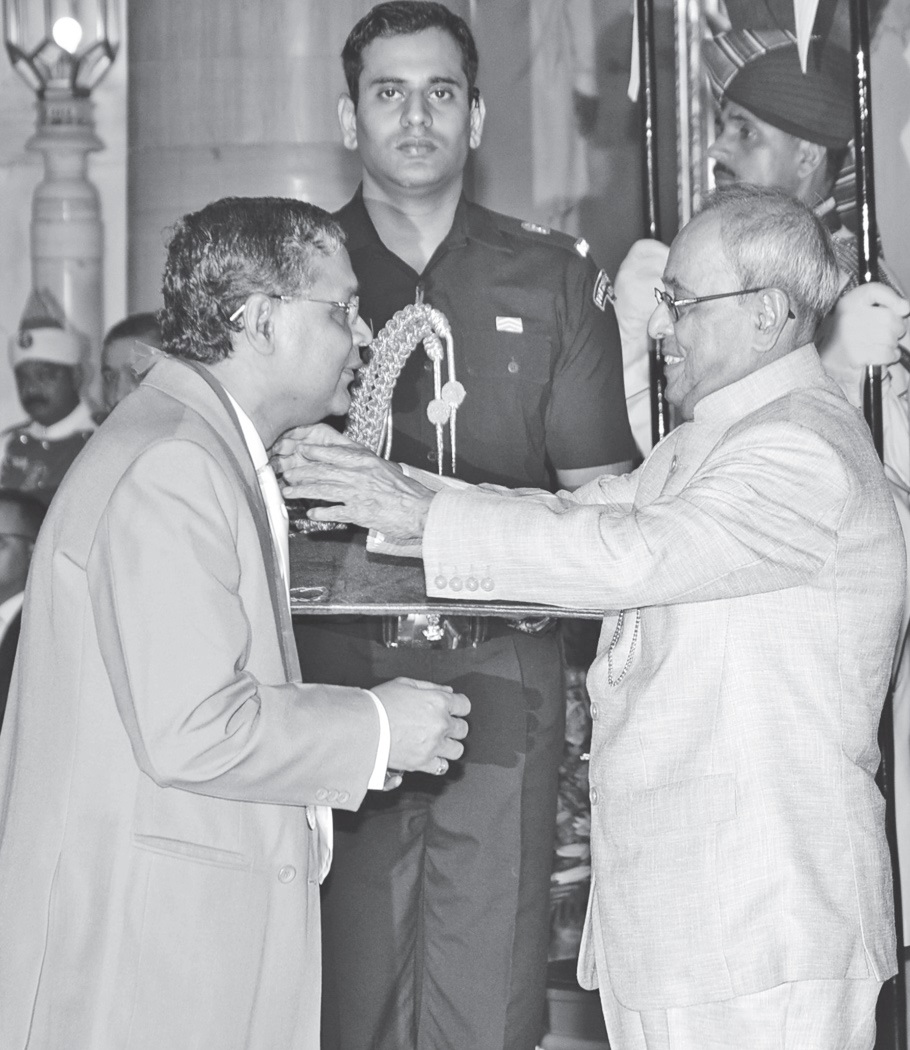
The Medical Council of India recently conferred him with the BC Roy Award for his work in the field of endocrinology and metabolic bone diseases.
Twenty-five other doctors of various fields also received the honour from President Pranab Mukherjee on World Doctors’ Day.
Despite India being a hot country, most of the population is affected by Vitamin D deficiency.
In 1990, a team led by Harinarayan conducted a study among the people of villages surrounding Tirupati in Andhra Pradhesh. The doctor was working with Sri Venkateswara Institute of Medical Sciences then.
“We found that the agricultural labourers of the region, despite exposing 80 per cent of their bodies to the hot sun for over eight hours a day, suffered from a deficiency of Vitamin D. The reason, research revealed, is that they don’t include sufficient calcium in their diet, which prevents the Vitamin D from being synthesised,” he explains.
The human body requires 1,000 mg of calcium a day. The labourers of the villages were found to consume only 260 mg, the study showed.
The urban population, on the other hand, consumes 600 mg a day. Vitamin D deficiency and bone diseases were found to be common among them too.
“People in metropolitan cities work in air-conditioned offices all day. Lack of exposure to sun makes them vulnerable to bone ailments,” Harinarayan says.
The doctor explains, “When the body faces a calcium deficiency, the parathyroid hormone – which makes the bones release more calcium into the blood – is released. Patients with hyperparathyroidism and calcium deficiency are prone to bone diseases as excess secretion of the hormone weakens the bones.”
He advises the urban youth to take a half-hour walk post lunch. “Besides speeding up your metabolism, it will expose you to sunlight and get you your daily dose of Vitamin D,” he says.
Children too should be allowed to play in the sun for an hour every day, he adds. “Milk and dairy products can be natural sources of calcium. Supplements are also advisable.”
While at SVIMS, Harinarayan and his team of doctors developed a IRMA radioimmunoassay with financial aid from Baba Atomic Research Centre, Mumbai.
“It is a kit that is used to deduce the parathyroid hormone levels in the blood. Earlier, we used imported kits. Under Prime Minister Modi’s Make in India intiative, we’re trying to develop the technology here,” he says.
The imported technology that costs Rs 35,000 will be available for Rs 3,500 once the indigenous kits gain popularity, he adds.
Currently the director of the Institute of Endocrinology, Diabetes, Thyroid and Osteoporosis Disorders at Sakra World Hospital, Harinarayan is working on a research project on Vitamin D deficiency in children.
source: http://www.newindianexpress.com / The New Indian Express / Home> Cities> Bengaluru / by Express Features / July 07th, 2016
Major-General H.H. Maharaja Sri Sir Jayachamarajendra Wadiyar Bahadur, Maharaja of Mysuru – 18 July 1919 to 23 Sept., 1974
1) The portrait of Jayachamarajendra Wadiyar that was used to sculpt the statue. 2) The life-size Italian marble statue of Sri Jayachamarajendra Wadiyar, sculpted by Arun Yogiraj & team of city, was installed at Hardinge Circle after a 10-hour-long process in the wee hours of June 20, 2016.
by R.G. Singh Secretary, Ramsons Kala Pratishtana
Very soon, Hardinge Circle will be known as Jayachamarajendra Circle as the city finally honours the last ruler of the erstwhile Mysuru State with the installation of a full-body portrait statue of the last Maharaja of Mysuru.
Hardinge Circle was named in commemoration of the visit of Viceroy Lord Hardinge to Mysuru. There used to be a flowery hedged circle with a high post with five domed lights in the middle of the crossroads. The circular garden vanished without a trace yet the name remained, ‘Hardinge Circle’, called raucously by bus conductors, ‘Aardinsurkel.’
The location of the Jayachamarajendra Circle at the culmination of the Albert Victor Road is meaningful as we already have the statues of two other iconic rulers of Mysuru in a row. KR Circle, as it is known, is a commemorative statue to His Highness Nalwadi Krishnaraja Wadiyar whose achievements for the well-being and development of Mysuru has been well-documented, likewise the majestic commemorative statue of Chamarajendra Wadiyar in front of the Jayarama and Balarama gate of the Palace.
History seems to have ‘overlooked’ the reign, brief though it was, of Jayachamarajendra Wadiyar. Major-General H.H. Maharaja Sri Sir Jayachamarajendra Wadiyar Bahadur, Maharaja of Mysuru. He was born on 18 July 1919 at the Chamundi Vihar Palace to Yuvarani Kempu Cheluvajammanni Avaru and H.H. Yuvaraja Kanthirava Narasimharaja Wadiyar Bahadur.
Jayachamarajendra Wadiyar had his early schooling at the Lokaranjan Mahal Royal School followed by graduate studies at Maharaja’s College of Mysore University and awarded a BA in 1938.
The death of his father on 11 March 1940 led to the title, ‘Yuvaraja Bahadur’ being conferred on him. The death of his uncle, the Maharaja on 3 August 1940, led to Jayachamarajendra ascending the throne on 29 August 1940 and anointed and installed as the Maharaja of Mysuru on 8 September 1940.
Jayachamarajendra Wadiyar was installed as the ruler of Mysuru at a time when the winds of freedom were blowing across the country. The nascent freedom fighters had already made inroads in various parts of the State. Mysuru was not an exception. Maharaja Jayachamarajendra Wadiyar signed the ‘Instrument of Accession’ on 9 August 1947 and Mysuru became a part of the Dominion of India on 15 August 1947. With an agreement merging Mysuru with Indian Union on 26 January 1950, he ceased to be sovereign.
Later he was installed as ‘Rajapramukh’ of the State of Mysuru and held this post till 31 October 1956. He was made the Governor of Mysuru on 1 November 1956 and continued till 3 May 1964, further he was made the Governor of Madras and he served till 25 June 1966.
The then Maharaja had made certain conditions to the accession of Mysuru to the Republic of India and this assurance made by the then party in power was rudely given a jolt when an Amendment to the Constitution was passed in 28 December 1971 by which the position of countless rulers were deprived of their rights as ‘rulers’ and the privy purse guaranteed under the accession agreement was abolished. Overnight, kings became ‘commoners.’
This betrayal led to an anguished Maharaja forsake the grand Dasara celebrations; placing the royal sword on the throne he retreated to a private forest reserve near Bandipur.
H.H. Jayachamarajendra Wadiyar married twice. The first marriage which took place at the Kalyana Mantapa of the Palace on 15 May 1938 was to Satya Premakumari Devi-ammanni avaru, the daughter of Pratap Singh Deo Bahadur of Jigni. The couple had no children. The Maharaja’s second marriage was to Maharani Tripurasundari Devi Ammanni Avaru, daughter of Balananja Raje Urs, an officer in the Mysuru State Forces. Both Maharanis died at Mysuru in 1983 within a span of fifteen days.
Jayachamarajendra Wadiyar died on 23 September 1974 at the Bangalore Palace leaving behind one son and four daughters (the eldest daughter had predeceased him).
Jayachamarajendra Wadiyar was an accomplished musician in both Karnatak and Western Classical music. He was an excellent pianist and there was a time when he expressed the desire to be a concert pianist and play with the great orchestras of Europe. In 1948, he was elected President of the London Philharmonic Orchestra Society. He was also an Honorary Fellow of Trinity College of Music, London (1946) and a Licentiate of the famed Guildhall School of Music.
Blessed with an ear for music, Jayachamarajendra Wadiyar discovered Russian composer Nikolai Karlovich Medtner. A contemporary of Rachmaninoff and Scriabin, he wrote several compositions, all of which include the piano. Jayachamarajendra Wadiyar discovered Medtner when the latter was living in London and in failing health. The Maharaja founded the Medtner Society with the objective of recording all Medtner’s works and managed to record several concertos with the London Philharmonic Orchestra whose first president was the Maharaja. In gratitude to his patron, Medtner dedicated his Third Piano Concerto to the Maharaja of Mysuru.
The Maharaja was also equally at home in the realm of Karnatak music, both as an instrumentalist and a composer. There are 74 Karnatak compositions by him.
He was also the Vice-Chancellor of Mysore, Madras, Annamalai Universities as well as the Benares Hindu University. Like his forefathers he was a Patron & Chief Scout of Mysuru State between 1940-1956, Chairman of the Wildlife Board of India. He was conferred a Hon LL.D by the Banaras Hindu University (1942), a D.Lit. by the Annamalai University in 1955 and a Hon. D.Lit. from the University of Queensland, Australia.
That he was deeply spiritual can be gauged by his scholarly books: “An Aspect of Indian Aesthetics” (1956), “Dattatreya-the Way and the Goal” (1957), “The Quest for Peace: An Indian Approach” (1959), “The Gita and Indian Culture” (1963) and “Religion and Man” (1965).
It is said that he had visited the ashram of the sage, Ramana Maharishi, in Tiruvannamalai, Tamil Nadu. No Palace diarist has recorded this meeting but what is available is a book published by the ashram, ‘Day by day with Bhagavan’ by one Devaraja Mudaliar. In an entry dated 1945, there is Devaraja Mudaliar and others talking to Ramana Maharishi. Asks Mudaliar: ‘It is said that the Mysuru Maharaja had come to see you.’ Nodding in agreement, the Sage replies: ‘He just sat quietly. He did not ask any questions. After sometime he bowed and took his leave saying that he would like to live here but the call of his people was too strong.’
Maharaja was also a good equestrian and fond of dogs. Regular visitors to the Palace in the late 50s would normally be shocked when they were in the Amba Vilas waiting to see the Maharaja, they would instead be forced into immobility as a pair of giant hounds wandered in and sat flanking the hapless visitor. The Maharaja would arrive, apologise on behalf of the dogs. “They will not hurt a fly” the Maharaja is said to have remarked leading one of the visitors to comment later on, “but I am not a fly.’ The Maharaja was quite accessible to his subjects and visitors.
Those fortunate enough to have met him would unanimously say, ‘A gentleman and a scholar.’
source: http://www.starofmysore.com / Star of Mysore / Home> Feature Articles / by R.G. Singh, Secretary, Ramsons Kala Pratishtana / July 02nd, 2016
Smart Cradle’ developed by students of NIE College placed at Bapuji Children’s Home in Mysuru | Express
Mysuru :
Though many orphanages have cradles for ‘unwanted babies,’ there is no guarantee that the babies will be safe if they are not picked up within a short time.
To overcome this, students of Industrial Automation & Robotics at the Department of Mechanical Engineering of the National Institute of Engineering (NIE) have developed a ‘Smart Cradle.’
The cradle was donated to Bapuji Children’s Home at Gokulam here on Saturday.
When a newborn is placed in this cradle, the system senses the presence of the baby and sends alarms through wireless technology. It also sends an SMS to the authorities concerned to take immediate action.
The completely automated system has a smart baby bed designed to detect the presence of a baby on it. It has a spring supported moving platform, which goes down when a baby is placed and comes up when the baby is taken back. Below the platform is a switch system and battery- powered electronic hardware.
The hardware is housed inside an ingress protected box making it weather proof. The alarm system placed in the orphanage office, which can be at the distance of around 50-60 metres from the cradle, gets an alarm through wireless technology. The alarm goes on until action is taken. An SMS module is placed which sends an SMS to the authorities within a few minutes.
Ajit N N, Rakesh K M and Keshava Prakash V who have developed the cradle under the supervision of K S Lakshmikanth and Dr K R Prakash, said there is always a risk of even stray dogs eating the baby.
This smart baby bed is designed to protect the infant from the environment and animals. This indigenously designed product can be placed in front of government hospitals and privately run orphanages to help save infants from any probable harm from animals, insects and the weather.
source: http://www.newindianexpress.com / The New Indian Express / Home> States> Karnataka / by Express News Service / June 27th, 2016
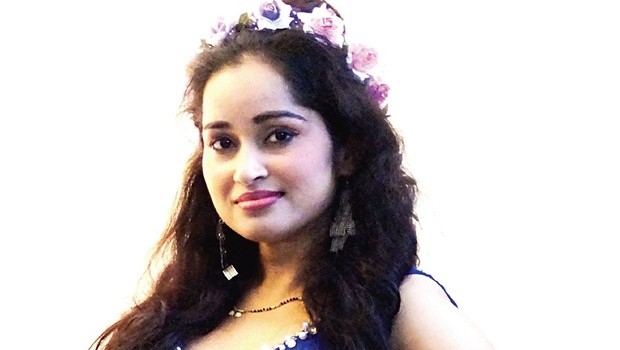
Bengaluru mom Laxmipriya Srivastav bagged the first runner-up and the Mrs Beautiful Smile at Mrs India International contest held in Chennai recently.
The contest saw 40 finalists from across the country. It comprised six rounds and workshops for self-assessment, time management, innovative ways of draping sarees, hair care and styling, followed by yoga and meditation to overcome anxiety and stress before the finale.
Laxmipriya, native of a village near Allahabad, has always admired Sushmitha Sen, former Miss Universe, a single mother, and an independent woman.
Laxmipriya lives in the city with her husband Tanmai and their three-year-old son Vivaan.
She works in Pharmed Limited as Senior Product Manager. Her professional career has been progressive in the past eight years. She has also the title of ‘Junior scientist’ from The National Academy of Sciences India to her credit.
As a teenager, she won a painting competition organised by the Indian Oil Corporation, and represented Allahabad in a play during Natya Mahotsav, a cultural event organised by North Central Zone Cultural Centre (NCZCC).
Writing, painting and acting are among her passions.
She cherishes two years of working with Doordarshan as a 12-13-year-old. Currently, she is editor of her company’s in-house magazine Supermom.
She is also associated with NGOs like Aasra and Global Headstart Mission to address medical needs and contribute to the education of the underprivileged.
source: http://www.newindianexpress.com / The New Indian Express / Home> Cities> Bengaluru / by Express Features / June 22nd, 2016
About 20 volunteers turned up at the hackathon on Sunday
Bengaluru :
An app that would help the visually impaired catch buses on their own was the highlight of a hackathon held in the city this weekend.
This was one of three hacks that 20 members of Random Hacks of Kindness (RoHK), a Bengaluru-based community, started working on Saturday. The team designing it hopes to help the visually impaired find bus stops, and identify buses that take them to their destination.
“Google Maps is only accurate up to 100 metres,” says 22-year-old engineer Yashaswi Bharadwaj, who is part of the team. “We are working on a code to help them find the exact location using a Bluetooth beacon. It should also have a text-to-voice and voice-to-text interface.”
The hack that he and his teammates come up with can be integrated with an existing source code. “We will also need data about the number of buses to a particular destination, the route numbers, and their expected time of arrival,” he said.
The second phase of the project would involve working on an image recognition system to inform users of the arrival of buses at their destination.
The theme of this edition of the hackathon — perhaps the 14th in the city and 20th in the country, according to RoHK managing trustee Chinmayi S K — was disability.
While the community gets together twice a year for two-day hackathons to work on tech-based solutions to various civic problems — including disaster management and gender-related issues — accessibility and disability have been recurring themes.
“Muthuraj, who works with the NGO Enable India, is here for most of our events,” says Chinmayi. “And we often partner with the organisation that works towards empowering the disabled.”
Yashaswi’s team is counting on the NGO’s cooperation to take the bus stop project forward. “We can’t integrate our hack with the BMTC app because we don’t have their source code,” he says. “But if Enable pitches it as one of their projects, the data will be made available.”
source: http://www.newindianexpress.com / The New Indian Express / Home> Cities> Bengaluru / by Express News Service / June 20th, 2016
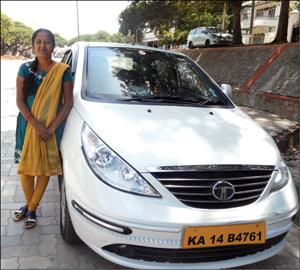
This is the tale of 35-year-old Neetha, a resident of Hebbal in city, who did her Master’s in Sociology from the Open University in 2006, passed Bank services exams and got a job in a Nationalised bank but became a cab driver in the running. She is now working as a cab driver at OlaCabs, a transport company, for the past one year.
Neetha, who says that circumstances forced her to reject the bank job as it was opposed by her family members, is the daughter of retd. KPTCL employee Madaiah and a native of Malavalli in Mandya district, married to one Raju, an employee at KPTCL and a native of Kundapura.
Neetha, who undertakes about 20 trips a day from 6 am to 7 pm in the TATA Vista (KA-14 B-4761) to take tourists to various tourist spots in and around Mysuru like Chamundi Hill, KRS, Nanjangud, Hunsur, K.R. Nagar, Srirangapatna and T. Narasipur, also enjoys her job as the lone woman cab driver in the city.
Speaking to Star of Mysore, Neetha said that she took to cab driving as she felt that it was better to take up a job which helps her earn some money instead of idling at home, which, she claimed, ensured that she was self-sufficient which should serve as a model for other women who waste their time by just sitting at home.
source: http://www.starofmysore.com / Star of Mysore / Home> General News / June 23rd, 2016
From begging to bagging medals, this athlete has sprinted a long way
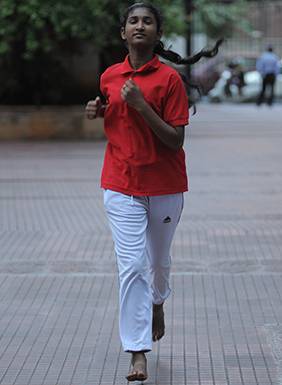
No fancy shoes, no newfangled techniques, and no formal training whatsoever — just plain old-fashioned grit, passion for the sport, and feet that fly off the ground. Meet 14-year-old Chandramma K, the student who has bagged several gold medals in athletics at various inter-school competitions over the last few years, including the first place in 100-metre and 200-metre sprints at the taluk-level in 2015-16.
Defying all odds and ousting competitors from all over Bengaluru who had had proper coaching, she also came in first at the 100-m dash at ‘Gail – The Fastest Indian’ event in 2014. But life was hardly a bed of roses for the little girl.
Chandramma was all of seven years old when she and her younger brother, Narasimha, were rescued from the streets in 2010 — the cops had picked them up for beggary. Taken in by the Child Welfare Committee (CWC), the siblings’ parents said they would come back for them, but never did.
The duo was then sent to the care of Annapoorna Charitable Trust in Jnana Ganga Nagar where they were nurtured and educated. But little did the staff know that Chandramma would turn out to be a gifted athlete. Now in class 7 at Balya Vidya Mandir, run by the NGO, she is able to read and write in English and Kannada, and has learnt the basics of operating a computer.
While running is her forte, Chandramma has also won laurels in high-jump and long-jump events, and is a strong team player in kabaddi as well as kho-kho. Though she does not train on a daily basis, she practises intensively a month or so before any major competition is due.
At the end of the day though, Chandramma is like any other growing girl. Her favourite food is chapatti with potato curry, and loves chocolate so much that she has often been caught red-handed stealing it from the fridge!
HIGHLIGHTS
14-year-old Chandramma K, has bagged several gold medals in athletics at various inter-school competitions over the last few years
She also came in first at the 100-m dash at ‘Gail – The Fastest Indian’ event in 2014
Chandramma was rescued from the streets in 2010, after which she was sent to the care of Annapoorna Charitable Trust
ABOUT THE TRUST
Annapoorna Charitable Trust currently houses 70 boys and girls with separate living quarters, and looks after their education, food, clothing, medical needs, and vocational expenses. It costs Rs 4,500 to fund one child for an entire month. Those interested in donating can contact the NGO at 080-23399359 or walk into their office at #13, MICO Layout, Attiguppe, Vijayanagar, Bengaluru.
source: http://www.timesofindia.indiatimes.com / The Times of India / News Home> City> Bangalore / Prakruti PK, Bangalore Mirror Bureau / June 16th, 2016
Gen. K.S. Thimmaiah Lodge and The Cauvery Lodges of Mark and RAM
Seen in the picture are Worshipful Brother C. Muthanna (Master for Gen. K.S. Thimmaiah Lodge); Worshipful Brother Ujjval Joshi, Grand Master Most Worshipful Brother Harcharan Singh Ranauta O.S.M.; Organising Committee Chairman Right Worshipful Brother G.K. Balakrishna and Bro. B.N. Pramodh, during the inauguration of the new lodges.
Mysuru :
Freemasons Grand Lodge of India opened three new Masonic Lodges in city on Friday last.
Grand Master of the Grand Lodge of India Most Worshipful Brother Harcharan Singh Ranauta, who visited Mysuru for the first time after assuming as Grand Master, consecrated the new Lodges — Gen. K.S. Thimmaiah Lodge and The Cauvery Lodges of Mark and RAM. At present there are two Lodges in Mysuru — Lodge Mysore No. 34 and Lodge Jayachamaraja No.308.
On the occasion, five top Army officers were honoured. Also, the Organising Committee Chairman Right Worshipful Brother G.K. Balakrishna was installed as Master for the Cauvery Lodges in the morning meeting and Worshipful Brother C. Muthanna was installed as Master for Gen. K.S. Thimmaiah lodge, by Right Worshipful Brother A.P. Chitra, the Regional Grand Master of Southern India.
Speaking on the occasion, W. Bro. Ranauta said the first Lodge in India was established in Kolkata in 1729 and has been active in spreading Universal Brotherhood, Faith and Charity.
“It is the world’s oldest secular organisation and aims at making good men better. It is an all-men organisation, but the spouses of the members are part of its events. Its principle is secrecy in charity and follows ‘the left hand should not know what the right hand gives’ rule,” he added.
According to him, some of the initiatives of Freemasons in India are: Open schools in prisons for children of inmates with world class facilities; Helping victims of disasters; Providing solar lights to students in villages, where there is no electricity etc.
Freemasons, which has several properties across the country, plans to open Polyclinics and offer medical care at almost 25% of the market cost.
A worldwide charity organisation, Freemasons, which will celebrate its Tri-Centenary Year in 2017, is of late expanding its activities by establishing new Lodges. It presently has 425 Lodges in India and 25,000 members across the nation.
The Grand Master said, the Grand Lodge of India will host a world summit in New Delhi on Nov. 20.
He was accompanied by Regional Grand Master of South India Right Worshipful Brother A. P. Chitra.
C. Muthanna Aiyappa (Chandler), who will head the new Lodge in Gonikoppa, Kodagu district, said, “We are launching a ‘go green’ project and each member will adopt 10 acres of land and plant saplings in Kodagu, Dakshina Kannada districts and in Kerala.”
source: http://www.starofmysore.com / Star of Mysore / Home> General News / June 05th, 2016
Chief Minister Siddharamaiah is seen presenting the ‘Environment Award’ to Dr. Chandra, Ayurveda Doctor from T. Narasipur taluk in Mysuru district. Others seen are Ministers Ramanath Rai, Ramalinga Reddy and Roshan Baig.
Bengaluru :
“Protecting environment is the responsibility of everyone,” opined Chief Minister Siddharamaiah.
He was speaking after inaugurating a function at Kanteerava Indoor Stadium here yesterday to mark ‘World Environment Day-2016’ organised jointly by the Department of Forests and Environment and Karnataka State Pollution Control Board (KSPCB).
Siddharamaiah said that the forest area had diminished by 13 percent and hence the government in its budget had approved planting of 8 crore saplings in the State. He observed that air pollution was responsible for many diseases and advised people to bring it down.
Speaking on the occasion Minister for Forests and Environment B. Ramanath Rai said that environment protection should be eternal and should not be restricted to a particular day.
‘Environment Award’ for the year 2015-16 was presented to Dr. Chandra, an Ayurvedic doctor from Kyamballi village of T. Narasipur taluk in Mysuru district, Anand Kumar from Gudibande taluk in Chikkaballapur district and Lingaraj from Hubballi.
The award was also presented to three organisations, Hasiru Dala Waste Management, Kali Tiger Protection Area Dandeli and Hulagi Gram Panchayat, Koppala.
An environmental awareness cycle rally and essay competition was organised on the occasion.
KSPCB Chairman Lakshman delivered the keynote address.
Information and Infrastructure Development Minister R. Roshan Baig, Transport Minister Ramalinga Reddy, former Minister P.G.R. Sindhya, MLC Ugrappa, Forest Department Principal Secretary Ramachandra, Additional Secretary T.M. Vijay Bhaskar, Deputy Commissioner Shankar and others were present.
source: http://www.starofmysore.com / Star of Mysore / Home> General News /June 06th, 2016