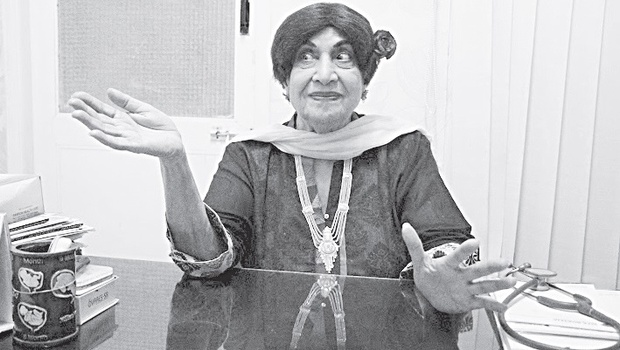
Sita Bhateja may be one of a kind in the obstetrics-gynecology world. She has been an active practitioner for the last 67 years, and at the age of 88, she shows no signs of slowing down. “I love my job… I wouldn’t have survived 67 years if I didn’t enjoy it,” Bhateja says laughing.
Her passion for her job is exhibited by the fact that she has worked free of cost at the CSI hospital for eight years, and has even funded the setting up of the maternity ward at St Martha’s Hospital.
She goes to the gym thrice a week, is very strict about her diet and is a voracious stamp collector. In fact, she is world famous for her philatelic activities. In her younger days, she was a horse-rider. However, none of these hobbies came in the way of her one passion — gynaecology. In fact, she quips that she used to go on horseback to attend to expectant mothers if the need arose! She also had to witnessed the horrors of the partition, but went on to Bombay to pursue her higher studies.
She has engaged in several philanthropic activities-some of them including establishing an orphanage called the ‘Child Foundation Karnataka’, and engaging in polio eradication activities.
She set up the Sita Bhateja Hospital in 1965. It originally started out as an obstetric hospital, but became a multi-speciality hospital in 1969. Owing to her long years of practice, it should come as no surprise when she reveals that she has helped deliver three generations of the same family.
Her delivery count exceeds an astounding one lakh babies. On being asked whether mothers opt for normal or C-section delivery these days, she says, “Most prefer C-section, as this prevents further complications like prolapse and urinary infections. They see no reason to persist with difficult vaginal deliveries. Further, women these days are not engaged in physical activity, so the body is not cut out for normal delivery.”
source: http://www.newindianexpress.com / The New Indian Express / Home> Cities> Bengaluru / by Namrata Menon / April 28th, 2016
Mysore District Athletics Association (MDAA) will present Nandi Awards-2016 during a programme organised at Lions Hall, next to Oval Ground, University of Mysore, tomorrow (Apr. 29) at 6.30 pm.
The awards will be presented to Mayor Bhyrappa (Sports Promotion), M. Bheeresh of Vijaya Karnataka (Sports Journalist) and M.N. Lakshminarayana Yadav of Star of Mysore (Sports Photographer).
The association will also honour ‘Best Athletes of Mysuru District 2015-16’ during tomorrow’s event.
Boys’ category: B. Munush (U-16) and C. Druva (U-18).
UoM DPE Director (in-charge) Dr. P. Krishnaiah and former Director of DPE Dr. C. Krishna will be the chief guests.
MDAA Chairman and MLA Vasu will preside.
MDAA President and former International Athlete S. Somashekar, MDAA Sr. Vice-President B.L. Jagadish and MDAA Vice-Presidents Mahesh Ballal & Abhilash Nair will be present on the occasion.
source: http://www.starofmysore.com / Star of Mysore / Home> Sports News / Thursday – April 28th, 2016
Chandrahasa Charmadi after receiving the Padyana Gopalakrishna Memorial Award 2015 in Mangaluru on Tuesday.— Photo: By Special Arrangement
Dakshina Kannada Superintendent of Police Sharanappa S. Dhage on Tuesday said that journalists in the district work in the interest of society with progressive and reformative outlook. That is the reason they excel all over, he said. He was speaking after presenting Padyana Gopalakrishna Award, instituted by the Dakshina Kannada Working Journalists Union, to journalist Chandrahasa Charmadi, here. Mr. Sharanappa said that the police and the media persons work alike and are almost like a family because of their nature of work.
He appreciated the efforts of the union in instituting the award and presenting it to a reporter from rural area.
Responding to the felicitation, Mr. Charmadi, who works for the monthly magazine of Sri Kshetra Dharmasthala Rural Development Project, said that he was thankful to the Dharmadhikari [Veerendra Heggade] for allowing him to contribute articles to other publications too. The award-winning article, appearing in a Kannada daily, Prajavani, was on the miserable living conditions of tribal people in a haadi in Chamarajanagar district, he said.
He said that he was happy that the government and other associations initiated reform measures after his article was published. Mr. Charmadi also declared that the purse of Rs. 10,000 coming with the award would be spent on the betterment of people living in the tribal haadi.
Senior journalist Manohar Prasad spoke about his association with late Gopalakrishna. The biography of late Gopalakrishna, being written by senior journalist Chidambara Baikampady, would be released in Bengaluru on April 30 and at Mangaluru on May 3, Mr. Prasad said. Office-bearers of the union were present.
source: http://www.thehindu.com / The Hindu / Home> Cities> Mangaluru / by Special Correspondent / Mangaluru – April 27th, 2016
Performing at the prestigious Carnegie Hall, New York, is a dream for any musician. And a 12-year-old Bengaluru girl is all set to live this dream.
Nilanjanaa Jayant will join a handful of musicians like Pandit Shivkumar Sharma and Ustad Zakir Hussain when she performs at the hall in October. The honour follows her victory at the Golden Voices of America competition.
In March, Nilanjanaa’s mother asked her to send an entry for the event. The girl sent a clipping of her performing Frank Sinatra’s popular jazz number Fly me to the Moon.
Declared a winner in the Musical Theater/Disney/Broadway/Jazz category a month later, Nilanjanaa will perform live the same song at Carnegie Hall this October. Winners in other categories will also perform with her.
Music and Nilanjanaa go a long way, recalls her mother, Sangeeta Ananth. “Even as a young girl, she’d hum the tunes of songs really well. When she turned six, we made her join Carnatic music classes. Though she was left-handed, she was expected to put the tala only with the right hand. This she couldn’t digest and refused to attend the classes.”
“I didn’t understand why I had to use my right hand,” says Nilanjanaa, who was later introduced to Bengaluru-based music school Taaqademy, founded by musicians Rajeev Rajagopal and Bruce Lee Mani.
“It was so much more fun learning music at Taaqademy. They encourage you to do what you want to rather than what you are expected to do,” said the 12-year-old.
The only child of JP Nagar residents Jayant Ananthkrishnan and Sangeeta Ananth, Nilanjanaa studies in class VIII at The Samhita Academy, Bannerghatta Road.
Not just Nilanjanaa, even her teacher Ragini Ramanathan will get a certificate of recognition from the Golden Voices of America for having trained her. “When she came to Taaqademy, she showed a lot of potential. Her voice was loud and clear and her pitch would hit the right notes. She is so determined to learn and so hard working that she wouldn’t give up even if she didn’t get it right after trying 3-4 times,” said Ragini, 25, faculty at Taaqademy.
For IT professional Jayant Ananthakrishnan, Taaqademy was the best thing that happened to his daughter.
“The experience with the music school has been very fulfilling. This success is the result of the training she has been getting there. Coming from a south Indian background, people kept advising us against western music, telling us that she will get used to using the right hand to put her talas. But we know we weren’t wrong in choosing Taaqademy,” he said.
“I have a bit of stage-fright. I’m just going to try and calm myself down before I get on the stage there,” said Nilanjanaa, gearing up for an experience of a lifetime.
Golden Voices of America
Golden Voices of America is an international competition, open to all countries for vocalists of different age groups. It began in 2009 under the American Fine Arts Festival.
Vocalists compete on this global platform and the winners get to perform at the Weill Recital Hall in Carnegie Hall and at Bruno Walter Auditorium in Lincoln Center.
source: http://www.timesofindia.indiatimes.com / The Times of India / News Home> City> Bangalore / Deepika Burli, TNN / April 27th, 2016
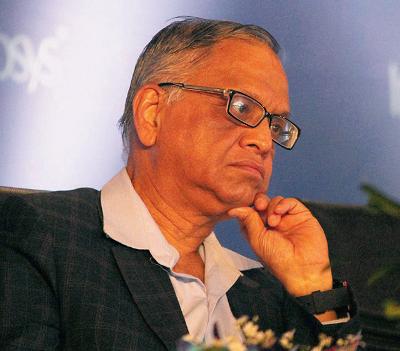
While a trip to the United States may not be unusual for Infosys founder NR Narayana Murthy , the one starting this week promises to be different.
Kick-starting one of the biggest alumni hunts, Narayana Murthy and his team will be travelling coast to coast in the US to find and reconnect with the ‘missing’ alumni of the Mysuru-based National Institute of Engineering (NIE).
It is estimated that around 8,000 graduates from the institute who moved to the US – especially in the 1960s and 1970s – had lost touch with their alma mater and their colleagues over the years.
Given the prevalence of social media and various other channels of communication, it is now time to reconnect.
According to NIE principal Gowri L Shekar, NIE had been planning an expansion and had recently inducted Narayana Murthy as a board member. “It was Murthy’s idea to reach out and reconnect with the institute’s global alumni.
It is a fact that thriving institutes across the globe maintain a good relationship and are in contact with their alumni. So, we too are attempting to do this. Murthy, who is on the board of some top institutes in the world, including Princeton, suggested that we take a global tour to connect.
So, as per the plan, our team along with Narayana Murthy will begin our alumni connect in Austin on April 30 and conclude their trip in New York on May 7.
In a span of eight days, they will organize events in six US cities and meet with our alumni,” added Shekar.
Shekar said that Narayana Murthy is deeply involved in their efforts to reconnect with the institute’s alumni. “Narayana Murthy has asked us to concentrate on the San Francisco Bay Area and talk to the alumni there and build a connection. He said doing so will make us a healthier institution and will add immense value to the university.
“His knowledge of higher education is very significant as he is well aware of the industry. His mantra was that well-known universities in the West focus on their alumni and Indian colleges should follow suit. He spoke of adapting good practices of universities and the US alumni connect tour is part of it,” said Shekar.
Narayana Murthy passed out of NIE in 1967 with a degree in electrical engineering and was the highest ranking student from his branch. “One thing I remember was his punctuality, he would not miss a single class even on days when there was a strike or a bandh in Mysuru.
Narayana Murthy would often recall his mother’s words that he was studying in an aided college which was funded by the state government and hence bunking a single day would amount to doing injustice to tax payer’s money. So, Murthy religiously followed his mother’s words and never missed a class,” added Shekar.
source: http://www.timesofindia.indiatimes.com / The Times of India / News Home> Tech> Tech News / Sridhar Vivan, Bangalore Mirror Bureau / April 26th, 2016
The PU student dug a 55-ft-deep well to reduce hardship of his mother, at Settisara village in Sagar taluk of Shivamogga district. Photo: Special Arrangement
PU student digs a 55-ft-deep well in his backyard to provide water for his family.
While Dashrath Manjhi in Bihar carved out a 360 foot road along a hillock in memory of his wife, Phalguni Devi, this 17-year-old boy from Settisara village in Sagar taluk has dug a 55-ft-deep open well on his own to reduce the hardship of his mother, who had to make repeated trips to the public well to get water for the family every night after returning home from work.
In the Malnad region, every household with a decent income will have an open well in its backyard.
However, due to poverty, Pavan Kumar’s family could not have such an open well.
His father, Vinayak Hegde, works as a cook and his mother, Nethravathi, works at a printing unit in Sagar.
Pavan’s mother, after returning from work late in the evening, used to make several trips to the local well, about half a kilometre away, to fetch water for the family.
Pavan Kumar, a PU student, said: “I decided to find a permanent solution for the problem by digging a well at the backyard of my house.”
Following advice from Kannappa, a local hydrology expert, Pavan identified the right location for the well and began digging on February 26. As his family could not afford to hire labourers, he worked single-handedly. He took a break of 10 days in March for writing the first PU exam.
After completing the exam, he resumed work and finished digging the well on April 20, working nearly 45 days on the project. “It was really hard to dig the rocky ground under the scorching sun. Finally, at the depth of 53 ft, when water oozed out, I was filled with a sense of fulfilment. After digging two more feet, I completed the work. I am happy that my mother now has respite from having to rush to the public well after coming home from work,” said Pavan.
source: http://www.thehindu.com / The Hindu / Home> National> Karnataka / by Veerendra P M / Shivamogga – April 25th, 2016
This article refers to the ‘Health Capsule’ published in Star of Mysore dated April 14, 2016 under the caption: ‘Who is the oldest person who ever lived?’ The name of the oldest verified person was stated to be a French woman Jeanne Calment, who lived to be 122 years and 164 days old and died on Aug. 4, 1997.
In this connection, I would like to mention about Pandit Sudhakar Chaturvedi, who is presently staying in Jayanagar 5th Block, Bengaluru, and celebrated his 124th birthday on Ramanavami Day (April 15, 2016). This reminded me of Babasaheb Ambedkar whose 125th birth anniversary was celebrated on Apr.14, 2016. Charlie Chaplin was also his contemporary for he would have been 127 years old on Apr. 16, 2016.
I personally spoke to the Pandit and wished him on his birthday. An article has appeared in the Kannada Magazine ‘Taranga’ (dated Apr. 21, 2016) giving a brief account of his life. My wife and I met him about two years ago when he was invited to a function and stayed at the Mysore University Guest House and presented a book on my father. A bachelor, the Pandit has witnessed three centuries during his lifetime and yet his vigour never runs short. Even now, on every Saturday between 5.30 and 6.30 in the evening, he meets people in his house for Satsang to disseminate Vedic knowledge.
His ancestors hailed from Moghul Sarai near Kashi and settled down in Kyathasandra in Tumakuru district. Here are some excerpts from the aforementioned article:
Pandit Sudhakar Chaturvedi is a master of the four Vedas and has published the same in 20 volumes. He was drawn by Mahatma Gandhi’s credo and had a very intimate association with him. Gandhiji, recognising his keen intellect, invited Pandit to work with him and that is how he stayed in Gandhiji’s Sabarmathi Ashram.
He was a person of independent mind and would quote the authority of Veda for everything. In fact, he made it clear to Gandhiji that his first calling was spreading Vedic knowledge and that he would work without compromising his focus on it.
Pandit has participated in the freedom struggle, served the cause of Dalits, helped remove caste discrimination, overseen thousands of inter-caste marriages (under the aegis of Arya Samaj) and has spread Vedic knowledge in Kannada, Sanskrit, Hindi and English. In short, he is a multi-dimensional personality with knowledge of Veda, Upanishad, grammar, ganitha, astrology, yoga etc. Though he has slowed down due to advanced age but while reciting Veda he will not stumble. He can recall facts with encyclopedic memory. The Pandit, who has spent 13 years in jail, is a very simple person and follows a simple life-style. Whoever comes to meet him he talks to them with a smiling face and will not fail to impress them with his humorous quotes.
It is hard to tell that this man, convivial in every sense of the word, has suffered from a heart problem twice and has only one working kidney. During the freedom struggle he also had to suffer Police brutalities which only compounded over his jail term.
During his association with Gandhiji he met many eminent personalities. There are many interesting incidents connected with his life and the following few facts would serve to highlight a measure of his personality.
1. He was the sole person who performed the last rites of all those who were massacred during Jallianwala Bagh firing in 1919. At that time, he was just 24-years-old.
2. In Sabarmathi Ashram, Khan Abdul Gaffar Khan and his son Wali Khan were staying for a week as his guests. On the fourth day of their stay, Gandhiji was in a dilemma and called Pandit Chaturvedi and said, ‘Poor chaps without non-vegetarian food their meals might not be satisfying, shall I call a butcher and arrange for non-vegetarian food?’ In reply, Chaturvedi said, ‘I will bring them what they want, just ask them.’ The guests, however, said that they would abide by the rules of the Ashram.
3. What Chaturvedi says on dharma is noteworthy: It is believed that in Krutha Yuga there was respect for dharma and it is getting reduced gradually in other Yugas and in Kali Yuga there is no dharma. Chaturvedi says this is sheer bunkum. Adharma existed in all Yugas.
4. Pointing out certain contradictions, he says that Bhagavad Gita has changed to suit the times but the original version was not like this. How it has changed only the scientists can unravel.
source: http://www.starofmysore.com / Star of Mysore / Home> Feature Artices / April 22nd, 2016
Mandd Sobhann, promoters of Konkani Museum, dubbed Konkani’s most ambitious project, have set themselves 3-year time frame to complete the project. CM Siddaramaiah laying the foundation stone for museum at Kalaangann, Shaktinagar on April 21 will mark another step towards realizing the project, cost of which is estimated at Rs 30 crore. The first step incidentally was laid on June 15, 2013 with a unique move of asking donors to donate a cent of land.
With the museum coming up on one-acre land abutting Kalaangann, the task before the cultural organization is now to raise required funds. Giving this dream project a small fillip is a budgetary grant of Rs 2.5 crore that Siddaramaiah announced in the budget this year. With a similar amount assured in next year’s budget, the organization is left with the task of raising a further Rs 25 crore and try and tap newer sources of funding rather than go to their usual donors.
Eric Ozario, gurkar of Mandd Sobhann told reporters that the Central government, governments of Goa and Kerala, and even UNESCO is on his organisations radar for funds. “We have spread our tentacles far and wide in our effort to raise funds for this project and even deputed people to liaison with authorities concerned to meet our objective,” he said, adding the plans for the museum are big and will require concerted efforts to realize the same with equal determination.
Describing the project as world-class anthropological museum in the making, Eric said it is largely inspired by the Don Bosco Centre for Indigenous Cultures, Mawlai in Shillong. “It is our endeavor to document, promote and preserve Konkani cultures of Konkani speaking communities wherever they exist for the future,” and not limit it to a mere collection of artefacts. “There will be digital documentation of all facets of Konkani cultures, traditions across communities,” he said.
The museum also has the potential to become a place of tourist importance in the future and even this will be kept in mind as the project takes shape and is completed, he said. “It will showcase the unique and rare, rich and diverse Konkani culture of Konkani’s belonging to all religions, regions, communities and dialects,” he said adding research will drive the museum’s endeavours.
source: http://www.timesofindia.indiatimes.com / The Times of India / News Home> City> Mangalore / by Jaideep Shenoy / TNN / April 18th, 2016
The Indian Institute of Science (IISc) which has recently been ranked the best university in the country has been buzzing with research innovations for years. In the latest, TOI looks into four innovations that are taking shape at, or, come out recently from the 107-year-old institute.
Solar water purifier & saltwater lamp
An IISc start-up, SuryaGen, has come out with a low-cost solar water purifier and a salt water lamp.
Professor Vasant Natarajan, from the Department of Physics in IISc, whose brainchild SuryaGen is, said: “The solar water purifier can transform water from any source – be it from sea, river, pond, wells, or even water collected from rain – into potable water.”
Impure water is evaporated using solar energy and the vapours are condensed to pure water on a cold surface. This leaves behind bacteria, heavy metals, arsenic, fluoride and other impurities. It can produce 1.5 litres of potable water from 3 litres of impure water.
The saltwater lamp, he said can power 12 LEDs with just half a litre of water and 2 tablespoons of salt. It is suitable for remote areas where grid facility is not available.
Novel sensor to check on heart & lungs
A team of researchers have developed a novel sensor they claim can simultaneously measure both cardiac and respiratory activities. The new device is non invasive, and can be wrapped around a person’s chest. It can help in early clinical diagnosis of many conditions associated with lung and cardiac health. The device is robust, portable, shock-proof, non-electric.
Called the Fibre Bragg Grating Heart Beat Device, it is based on an optical fibre sensor known as a Fibre Bragg Grating. S Asokan, Professor at Department of Instrumentation and Applied Physics led the team. They’ve also developed sensors for various healthcare applications including measuring blood pressure, cardiac markers, blood glucose levels.
“The simultaneous detection of cardiac and respiratory activities with a single device helps in decoding the abnormalities connected to lungs and heart dysfunction. One of the most desirable advantages of this instrument is that it can be used for the detection of original heartbeat shape (Nascent Morphology),” says K Chethana, a member of the team.
Bacteria-free water
With deaths due to water related diseases on the rise globally, high efficient water filtration that is affordable is gaining importance. A research team at IISc claims to have a solution. It has designed a membrane which can almost eliminate bacterial contamination from water.
The newly designed membrane is made of polyethylene, which has several advantages like low cost, strength, durability and stability. It also prevents biofouling – accumulation of micro-organisms on the membrane, which blocks the membrane and increases the overall time, cost and energy required for water purification.
To make the three dimensional porous membrane, the scientists mixed the polyethylene oxide (PEO) with polyethylene during the manufacturing process, and later created tiny pores. Biocidal agents are chemical or biological agents used to kill unwanted organisms.
A large portion of the porous membrane is covered with graphene oxide sheets which are efficient and safe biocidal agents with potential to kill bacterial contaminants. Unlike other biocidal agents like silver, graphene sheets are non-leaching and non-depleting and thus are safe for use in filtration procedure.
source: http://www.timesofindia.indiatimes.com / The Times of India / News Home> City> Bangalore / Chethan Kumar / April 11th, 2016
Sandeep Boniface, a city-based musician, has been shortlisted for the coveted John Lennon Songwriting Contest.
His composition Moments of Bliss has been selected as one of the three entering the final round for the award. He is a music composer, singer, keyboardist and music teacher at Canadian International School, Bengaluru.
The contest, named after the former Beatles singer, was started by Lennon’s wife Yoko Ono in 1997. It is a platform for amateur and professional musicians across the globe.
Over the years, Sandeep got many offers to sing for Bollywood films, thanks to his association with musicians from around the country. However, he did not go down that road. “I did not want to cater to a particular market. I wanted freedom to make my own music,” he says.
Being nominated for an international prize has been a dream come true, says Sandeep.
“It is also a privilege to rub shoulders with fellow finalist and Grammy Award winner Ricky Kej,” he says.
Sandeep started learning piano at a very young age and performed for the first time at the local church when he was 10. “One of my earliest influences was the band Bee Gees. I was fascinated by their compositions and the harmony in their music,” he says.
Subsequently, works of French composer Eric Serra created an impact on him.
As a singer, Sandeep learnt a lot from Rab Halford, lead vocalist of the heavy metal band Judas Priest, and Pakistani singer Nusrat Fateh Ali Khan.
He has sung and composed music for numerous radio jingles, TV commercials, documentaries, films and plays. He has also worked with organisations like Nimhans as a music consultant. A couple of months ago, he set up his own recording studio named DJ Nitro Production.
“Winning the award will help me reach out to a global audience,” he says.
source: http://www.newindianexpress.com / The New Indian Express / Home> Cities> Bengaluru / Express News Service/ April 07th, 2016



![Pandit Sudhakar Chaturvedi [Pic. courtesy : Taranga]](http://www.bangalorefirst.in/wp-content/uploads/2016/04/PanditSudhakarBF23apr2016.jpg)
