Monthly Archives: March 2013

Not just for carpenters

WoodmuseumBF11mar2013

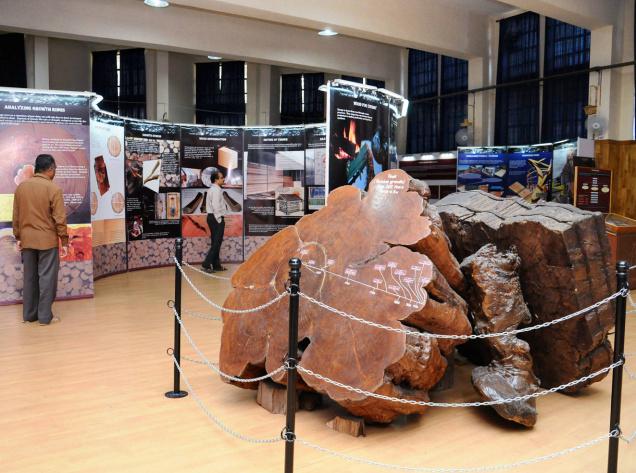
Valuable material: Malleswaram’s Wood Museum and Interpretation Centre is a repository of knowledge about wood./  Photo: S. Mohan Prasad / The Hindu

Malleswaram’s Wood Museum offers a 360-degree view of the humble material

If the signboards are tree-shaped, and the buildings bear slogans like “wood is good”, you’re likely to be at the Institute for Wood Science and Technology, an establishment dedicated to researching all things wood.

Located near Malleswaram 18th Cross, the Institute for Wood Science and Technology (IWST) also houses a Wood Museum and Interpretation Centre, a repository of knowledge about the material.

Walking through a museum devoted to wood might not sound like your idea of a fun afternoon, but this museum has something for everybody.

The first thing that strikes you as you enter the museum is a section of a giant tree trunk. This enormous exhibit is detailed enough to allow you to view — and count — the growth rings that indicate the age of a tree; its age is estimated to be 780 years.

You then notice that the museum has detailed posters that trace the centrality of wood to civilisations. Heat was obtained from wood fires; fields were ploughed with wooden tools; structures were built with wood.

The museum was set up in January 2012, primarily to renew public attention to wood as a material, and to remedy the perception that there’s little to wood beyond being a ‘carpenter’s material’. “We do not value it since it is nature’s gift, but there’s a lot to be learnt about wood,” says Shakti Singh Chauhan, scientist at the IWST.

Trivia and oddities

Plenty of curiosities are on offer, perhaps too many, for the easily distracted: for instance, one particularly alluring section exhibits a visually fascinating variety of seeds of trees. Another section invites you to pick up slabs of wood from different trees — they’re all of the same size, but vary dramatically in weight. (If only I had been taught high school science with such hands-on exercises.)

There are also many stray facts to collect, did-you-know style, should you be so inclined. Take, for instance, the fact that trees can get as short as one to six centimetres, as in the world’s shortest tree species, the dwarf willow.

At the same time, with posters and exhibits that describe the chemistry and biology of wood, there’s enough detailed, specific knowledge for the scientifically inclined.

source: http://www.TheHindu.com / Home> News> Cities> Bangalore / by Neha Mujumdar / March 06th, 2013
Indelible ink to make the mark once again

Mysore. Mar. 5 :

It is election time and as usual, the Mysore Paints and Varnish Limited (popularly known by its old name as MYLAC) is in the news again for its indelible ink — the industry that produces the ink that is marked on the fingers of voters across the country, wherever election is being held — may it be the Lok Sabha or the Assembly or even the election for civic bodies.

“For the Mysore City Corporation (MCC) election to be held on Thursday, the 7th of March, the MYLAC industry has supplied 24,000 vials of the indelible ink. The ink which appears purple in colour when being applied, turns black after drying,” said MYLAC Managing Director Hemanth Kumar and added that a 10 ml vial costs Rs. 142. The industry has also supplied 250 pieces of wax for sealing the Electronic Voting Machines.

Hemanth Kumar said that the industry is well prepared to supply the indelible ink and wax seals for the Assembly election scheduled to take place during May 2013.

MYLAC will be supplying 18,500 vials of indelible ink to Tripura, Meghalaya and Nagaland States for their Assembly elections and another 64,000 vials for the urban local bodies election in Punjab.

MYLAC, an industry which is a pride for Mysore, has been making profits ever since its inception. According to the latest statistics available, MYLAC is making an average profit of Rs. 2 crore per annum and the total profit earned in the past years is Rs. 12 crore, according to Hemanth Kumar.

MYLAC also supplies the indelible ink to countries like Cambodia, Ghana, Malaysia and South Africa.

MYLAC is also credited with supplying the glossy paint for Airavata buses of the KSRTC.

source: http://www.StarofMysore.com / Home> General News / March 05th, 2013

Aashayein makes a difference to learning

AashayeinBF11mar2013

Bengaluru:

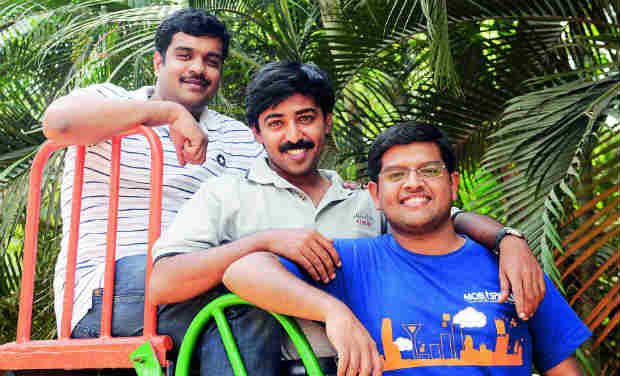
The Aashayein Foun­dation, a completely volu­nteer— run organisation has reached out to thousands of children since it was first formed in 2007. Chandan Raj, Ashwin B.M., Sunil Kumar, Somaiah M.P. and Ashish are software engineers brought together by an indomitable altruism. They bicker and laugh with each other as we talk in their ‘official’ meeting place, which doubles as a storage area, stacked with notebooks and whiteboards. With over 2000 volunteers in their network now, the Aashayein Foundation is a refreshingly low key, extremely driven organisation.

The foundation, which was registered as an NGO in mid 2007, runs four major programmes. Access to education is the primary focus, addressed by the Bachhe Mann ke Sachhe project. Pustaka Abhiyana creates an environment conducive for lea­r­ning by improving infrastructure in schools and providing children with basic needs like notebooks. The third programme, Shikshana Abhiyana has had the widest reach and focuses on the quality of education through spoken English classes and extra curricular activities.

Aashayein began with a New Year resolution made for 2007. “We were all just out of college, earning money for the first time and we thought we might as well be responsible about it,” said Chandan. So in the first week of January that year, they did what would become the first prong of the Aashayein Foundation — serve breakfast at the Karnataka Association for the Blind.
“Sunil’s uncle was serving breakfast on the street and we thought we’d go to an orphanage or blind school instead,” said Chandran. That Sunday morning proved so immensely satisfying that they decided to do it every week, roping in 150 volunteers in a little under two months.

A few weeks later, it was clear that serving breakfast wasn’t enough. “We wanted something that would have a greater impact,” said Sunil Kumar. The problems in India are many — health, sanitation, nutrition — that social workers are usually spoilt for choice.

Education, however, seemed the key to turning society around. “Even with education, there was plenty to deal with; we didn’t want to flounder in that ocean,” said Somaiah, who works at Cisco. Access to education was clearly the fundamental issue. “Our first project was bringing kids to schools,” he said. “It meant identifying kids who didn’t go to schools and enrolling them.”

The erstwhile Shivajina­gar slum, Jayanagar, Koramangala and later Whitefield became the haunts for the Aashayein Foundation where they encountered all sorts of issues. There are parents who can’t afford to send heir kids to school, but would like to. Sometimes the kids and the parents simply aren’t interested and “in these cases, we don’t force them,” interjected Chandan, “They are happy with the fifty rupees a day the children bring home.”

School fees are taken care of for the children who do enrol — the foundation has a budget of Rs 2,500 per child. “We pay 75% of the cost and ask the parents to contribute the rest, so that the whole family feels involved and committed,” said Somaiah.

This programme was limited to urban schools, but the scope was later widen­ed. Rural government-run schools became the new focus. “Logistics were a huge problem for us,” said Somaiah. That’s how the Gift your Village programme was born, to take advantage of the vast influx into Bengaluru from the rural parts of the state. “We ask people to conduct surveys in their own villages. Then we make them project coordinators for the work we do there.”

An official MoU is signed with the government and the foundation sets about providing the schools with infrastructure. There are currently 24 developmental programmes running in rural schools.
The pitiful state of so many government run schools runs far deeper than physical infrastructure. Teachers slack off, and many are not equipped with the skills to handle or teach a class of children. “This is where our volunteer programme took off,” said Sunil. Shikshana Abhiyana runs special classes on Saturdays — ranging from spoken English lessons to creating awareness on issues like cruelty to animals. This extends to summer camps, where the children get yoga, dance, music and even cooking lessons, all run by volunteers.

The Sunday breakfast serving programme, whi­ch started it all, remains the hallmark of the foundation. It is used as a way to initiate volunteers, so they see first hand the philosophy of the Aashayein Foun­dation. “We exist on commitment,” said Ashwin, one of the quieter members of the group. The volunteers are not paid and they don’t have to pay to volunteer, either.
Word-of-mouth has proved immensely successful for the organisation and an annual walkathon is their major fundraising event. Is that enough? “We get about 700 people who actually walk with us,” said Ashwin, “along with about 2000 ticket sales.” This is ample, they say.

A wonderfully simple method — an unshakeable faith in the innate goodness of humanity, has done wonders for the less privileged. Many, myself included, might raise a sceptical eyebrow at this very lofty notion, but the Aashayein Foundation seems to have hit upon something. “What has really changed is our perception of people,” said Somaiah. “We thought we would have to convince them to volunteer, but it turns out, we just had to give them a chance to do something they were only too happy to do!”

source:  http://www.DeccanChronicle.com / Home> News> Current Affairs / March 11th, 2013

‘Music is the contribution of India’s eternal culture’

MusicBF10mar2013

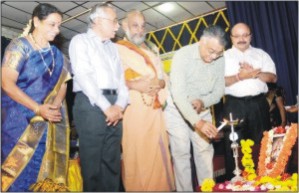
Star of Mysore Editor-in-Chief K.B. Ganapathy is seen lighting the lamp to inaugurate the valedictory of Surabhi Ganakalamandira Charitable Trust’s silver jubilee celebrations in city yesterday. Others seen are (from left) Vidushi Dr. Sukanya Prabhakar, Surabhi Sambrahma celebration President K.V. Murthy, Dr. Bhashyam Swamiji and Industrialist Jagannath Shenoy.

Mysore, Mar. 4 :

Music is the contribution of India’s eternal culture, opined Dr. Bhashyam Swamiji.

He was speaking at the valedictory function of Surabhi Ganakalamandira Charitable Trust’s silver jubilee celebration ‘Surabhi Sambhrama’ at Mysore Vasudevacharya Bhavan on JLB Road in city yesterday.

Music and veda have an unbreakable connection. Music is equal to nectar. It is helps a person fight sadness and depression and revives him. Music helps maintain mental balance, he said.

Speaking after inaugurating the programme, Star of Mysore Editor-in-Chief K.B. Ganapathy said, art and culture is necessary for a civilised society. In olden days, kings and rulers encouraged music, art and literature. In the same way, now they are being promoted by organisations and associations. Only dedicated people like K.V. Murthy can become art patrons, he said. On the occasion, he released the souvenir ‘Rajata Sambhrama Sinchana.’

Industrialist Jagannath Shenoy, who also spoke said, knowledge does not mean just reading and writing. It includes music and dance too. There is no fixed time to learn it. It is a continuous process. Only then can music and art grow.

Surabhi Sambrahma celebration President and art patron K.V. Murthy was present.

Prior to this, Vid. Krishnamurthy & troupe presented a Mangaladhwani Nadaswara programme followed by Karnatak music vocal recital by Vidu. Dr. Sukanya Prabhakar.

source: http://www.StarofMysore.com / Home> General News / March 04th, 2013

Look around, talent is everywhere

KarthikBF09mar2013

  Karthik Muralidharan — R. Samuel

Bengaluru:

 “I have known failure, that’s why I do what I do”, said Karthik Muralidharan. At the age of 23, he conducts motivational sessions for students from the weaker sections of society. “The fact that I was unable to do as well as I should in school really crippled me at first, until one day, I realised I wasn’t the only one”, Karthik says. “All I wanted to do was quit.”

Now, he wants to tell people that failure isn’t the end of the world and that no matter how bad things get, they are not alone. The idea of social development, of bringing everybody on to a level playing field, where everybody has room to grow came to him. “None of this was part of the plan,” he said. “I had no idea I would work with financially deprived students and I didn’t see myself doing what I do today”.

In college, Karthik began giving motivational talks, which proved very lucrative. “I was making a lot of money and things seemed to be going well.” His work brought him to Magadi, where he met a young Muslim woman who would change the way he saw the world.

“The odds she faced were tremendous. Even so, she overcame them all and went on to make something of herself.”

The untapped potential in these areas, he realised, was huge. All they needed was an opportunity. “The boy who delivered the newspaper everyday was doing his MSc and it made me realise that there is so much talent out there going to waste.”

Corporate gigs haven’t reeled him in, “not yet”, he says honestly. “There is much money to be made there, but I don’t want to get carried away. There’s something I want to do and I don’t really aspire for a Mercedes”.

The young and impressionable are driven almost entirely by the opinions of their peers, most of the time, they don’t know why they do what they do, Karthik says. “Young people are very fond of the word ‘scope’,” he said laughing. “Placements and the prospect of financial gain are what drive them, usually down a path they are ill-suited to.”

This is when corporate sharks like to move in with promises and false hopes. “In the name of training, companies exploit,” he said. Creating a sense of inadequacy and promising to fill the void is a popular tactic, which corporations use ruthlessly to their own advantage. “The only aim is to make a little money and maybe fulfil the requirements of a few”.

“Companies have a 60% rule,” he said, “but if you really scrutinise it, you’ll find that even the person who made the rule has no idea why he did so. A memory game is all that stands between a student and his future.” Trapped now in a vicious cycle, where success is the only end game and there is only one way to get to it – to conform,  youngsters, most of whom are completely confused anyway, become easy prey. “People with good marks do science, because the humanities imply weakness,” he said. To be a doctor or an engineer is the only way to go, even today, when the world is open and information is available to all those who seek it.

“I met a girl once, a Commerce student, who told me she wanted to be a doctor,” Karthik recalls. “When I asked her how she intended to do that, she said her friends told her she could.”
Communication skills are a rarity, mainly because so many people fail to see how important they are.

A large section of the rural population doesn’t know what an IIT is, or an IIM, he reveals. When these students enter mainstream colleges, they find themselves completely out of place. Their peers seem miles ahead of them, an unpleasant reminder of how far they need to go and how alienated they have been from the world.

His methods are simple. “I might go to a college and tell my students there to organise a blood donation camp, or pledge their eyes. That makes them aware of how much they can do, it motivates them, makes them more confident.” In that way, everybody becomes a leader. There’s more to life, he says, than a namesake degree but no real education, placements without progress. “I want my students to be nourished physically, emotionally, mentally and spiritually.”

The greatest strength comes from within. It was Sheldon Kopp, psychotherapist and author of If you meet the Buddha on the road, kill him! who said, ‘The most significant battles are waged from within.’ When those are taken care of, the universe falls into place. One might even call it magic.

source: http://www.DeccanChronicle.com  / Home> News> Current Affairs / DC / by Darshana Ramdev / Monday 04th,  2013

RCB launches RCB Diva

Bangalore :

Indian Premier League outfit Royal Challengers Bangalore  (RCB) on Thursday announced the launch of RCB Diva, a special digital initiative on the occasion of International Women’s Day.

RCB Diva will be a regular feature on the official website of RCB, will be handled by women and for women.

RCB’s Diva page will not only recognize the female fans of the team and their contribution but will also have content designed specifically for them. The page will showcase women cricketers as well as videos and blogs. That’s not all. It also gives a sneak peek into the women behind a player.

Russell Adams, Vice President- Commerical Operations & Cricket Academy, Royal Challengers Sports Pvt. Ltd. said, “I am delighted to kick-start this unique initiative dedicated to the female fans of RCB and I have no doubt  that 2013 will go down in history as the year RCB made a significant difference in the game of cricket for its female fan base in India. I would like to wish a very happy Women’s Day to our wonderful female fans and welcome them to the RCB lifestyle.”

A delighted Disha Shetty, winner of Fanatic Fans Challenge 2, said, “Many female fans have been following the IPL very closely and this welcome initiative by RCB will just add to our excitement as I am sure that now, everyone will aspire to be an RCB Diva.

source: http://www.articles.timesofindia.indiatimes.com  /Home> Sports> Cricket / by Sunil Subbaiah, TNN / March 08th, 2013

Steven Spi­elberg compliments Bengaluru student on animation film

StephenBF08mar2013

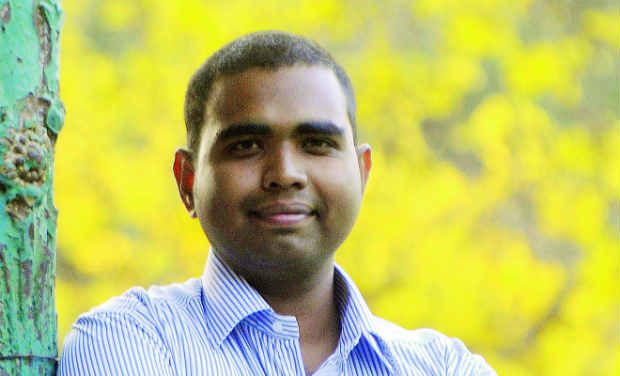
Steven Spielberg has been my favourite filmmaker for the last decade. He has a way of inspiring emotions in the audience in ways that not many filmmakers can. I love the way he he combines images and sound to have the maximum impact— Krishna Bala Shenoi

Bengaluru:

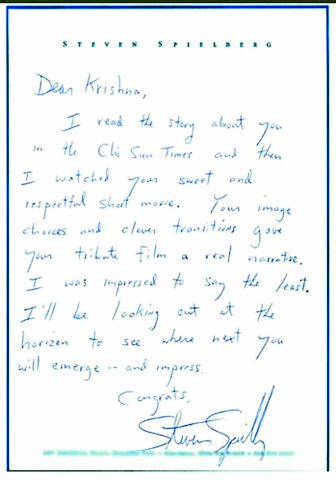
 A 19-year-old Bengaluru student was paid the ultimate compliment on Wednesday when his hero Steven Spi­elberg wrote him a letter of appreciation after his own animated tribute caught the legendary film maker’s eye.

The handwritten letter of appreciation from Spiel­berg sees him use the word ‘im­press’ not once, but twice.

“Getting this letter from my childhood hero was such a shock,” said an ecs­tatic Krishna Bala Shenoi, second year student at Sri­shti School of Art, Design and Technology, who couldn’t contain his excitement.

“Getting this letter from my hero was such a shock, I was shivering. My knees were wobbly. I am so thankful to Steven Spielberg for being gracious enough to have taken the time to write me such a kind letter. I am convinced that his goodness isn’t restricted to just his films,” says Krishna Bala Shenoi, Second Year of Foundation Studies Programme at Srishti School of Art, Design and Technology.

LetterBG08mar2013

Steven Spielberg’s hand-written letter addressed to Krishna Bala Shenoi

He has admired filmmaker Steven Spielberg since he was a child and now he has received a handwritten letter of appreciation from the man himself.

The 19-year-old, who compelled Spielberg to use the word “impress” twice in his letter in appreciation of his animation film, does not want to stop at animation. He wants to be a filmmaker like his hero.

“I haven’t been able to capture my awe for him. And therefore, I decided to create this animated tribute to him. It took me four months to make the video. I worked on it whenever I was free from college work. I have used a technique called rotoscoping, which involved drawing over the original video, which was, in this case, my favourite images from Spielberg’s movies. But this was only for my hero. In the long run, I want to make films,” says Krishna.

“I’ve been interested in filmmaking ever since I began watching films, when I was around eight years old. My mother introduced me to great movies like Superman, ET, Close Encounters of the Third Kind, etc.

“I started making short movies with an old Sony camcorder, building blocks, clay models, and whatever I could find, employing very rough stop-motion animation techniques,” Krishna adds.
He is also the youngest Far-Flung Correspondent on film critic Roger Ebert’s blog. “In 2010, the world’s most read film critic, Roger Ebert, contacted me via e-mail after seeing my films and writing on the internet, and Invited me to the Foreign Correspondents’ blog on his website.

The Foreign Correspondents blog is a feature of Roger Ebert’s Journal in which film commentators from all over the world contribute their video reviews, observations, musings, philosophies and pronouncements. Another foreign correspondent for Ebert’s blog, Anath White, sent my video to Lois Burwell, a make-up artist who has worked with Spielberg on films like Lincoln, and Saving Private Ryan, who passed it on to Spielberg.

source: http://www.DeccanChronicle.com / Home> Entertainment> Hollywood  /DC / March 08th, 2013

Indo-Canadian workshop on training health professionals in suicide prevention held

CanadianBF07mar2013

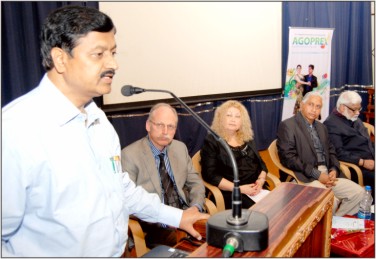
Caption: Dr.G.M. Vamadeva is seen addressing the gathering yesterday.

Mysore, Mar. 1 :

The Department of Psychiatry, JSS Medical College, in association with Schullich University of Medicine & Dentistry, Canada conducted a one-day workshop on Training Health Professionals in Suicide Prevention at Sri Rajendra Auditorium in JSS Hospital premises here yesterday.

The workshop was attended by nearly 200 health professionals including Psychiatrists, Physicians, Family Physicians, General Practitioners, Auyrveda Practitioners, Psychologist, Social Workers & Nursing staff from JSS Medical College, JSS Nursing School and College, Mysore Medical College, Mandya Institute of Medical Sciences and Mysore University. It was inaugurated by dignitaries — JSS Medical College Principal Dr.H. Basavannagowdappa, Senior Journalist Niranjan Nikam, Mysore District Surgeon Dr.G.M.Vamadeva, JSS Hospital Medical Superintendent Dr. M. Guruswamy, JSS Mahavidyapeeta Medical Education Director R.Mahesh, Head of the Department of Psychiatry Prof.T.S.S.Rao and Dr. Amresh Srivastava, Dr.Paul Links and Dr.Rahel Eynan from Canada.

The dignitaries emphasised the need for such workshop as suicide is one of the leading causes of preventable death. They also noted the importance of personal narratives in fighting the stigma associated with seeking help, initiatives from the government to tackle the issue, the greater role of public & media in creating awareness and relevance of sharing the experiences for effective strategies in prevention of suicide.

The first session was on the role of family physicians and other health professionals in suicide prevention by Prof. T.S.S. Rao, who said that south India was noted across the world as suicide prone region and it was crucial that family physicians should be aware of the risk factors and protective factors.

The second session was by Dr.Paul Links on Clinical Manifestations and Causes of Suicide Behaviour. He emphasised the need to recognise suicidal behaviour at early stages and relevance of psychiatric disorders which increases the risk of suicide. The third session was by Consultant Psychiatrist at JSS, Dr.M. Kishor on Psychosocial Factors, in which he appealed for individualising risk assessment based on psychosocial factors. He also highlighted the need for health professionals’ awareness about culture and socio-economic conditions.

The session was followed by role play, coordinated by Dr.Sam Manickam on effective ways of communication by health professionals during interaction with patients. Interactive session with audience coordinated by Dr. Amaresh, Dr. Paul Links and Dr.Rahel Eynan.

source: http://www.StarofMysore.com / Home> General News / March 01st, 2013

VVIET students secure 2nd place in state-level project contest

Studentsaward

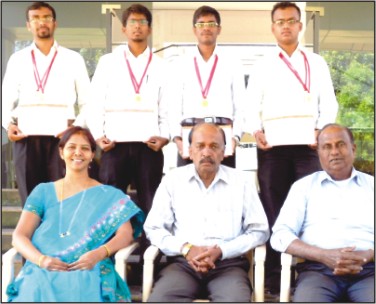
Caption:   The prize winning students of Vidya Vikas Institute of Engineering & Technology (standing from left) E. Dilip Kumar, Ravichandra, Sheikh Mohammed Subhan and V. Nandan are seen with (sitting from left) Surekha Manoj, Head of E&E Dept, Dr. B. Chandrashekar, Principal of VVIET and Prof. B. S. Nagabhushana, Department of E&E.

Mysore, Feb. 28 :

The budding Electrical Engineers E. Dilip Kumar, Ravichandra, Sheikh Mohammed Subhan and V. Nandan of Vidya Vikas Institute of Engineering & Technology (VVIET) have brought laurels to the E&E Department and also to the institution by winning the State-level Project competition-2013 organised by ‘Anveshana’ on Feb. 22 and 23 at Shikshara Sadhana in Bangalore.

‘Anveshana’ is an initiative to bridge the gap between schools and engineering colleges to develop innovation and creativity in young minds through mentoring of engineering technology.

Priority is given to government high school students for mentoring. During the competition, students display their research projects, working model and present their findings orally.

The competition comprised two rounds where, in the first round out of 200 teams, 44 teams were shortlisted for the final round from the entire State.

In the final round, the students of E&E Dept., VVIET, who secured the second place, were awarded Rs. 25,000.They have also got majority of votes (61%) by the visitors and high school students and were awarded Rs. 10000 as “Most Popular Project”.

Kaveesh V. Gowda, Secretary of VVET; Dr. B. Chandrashekar, Principal of VVIET; Surekha Manoj, Head of E&E Dept, VVIET have congratulated the students for their achievement.

source: http://www.StarofMysore.com / Home> General News / February 28th, 2013

Megalithic burial site at MM Hills

MegalithicBF06mar2013

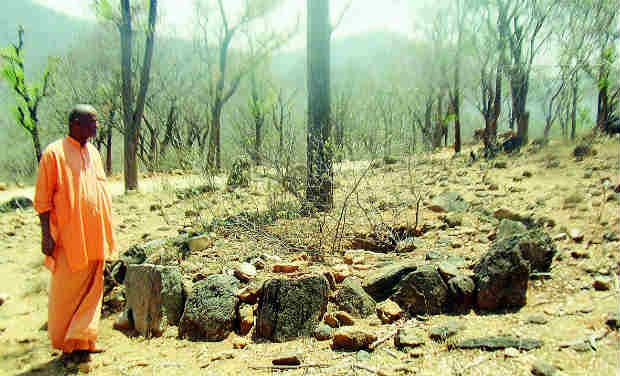
The Megalithic burial site was discovered on the slopes of MM hills in Kollegal Taluk. /  Deccan Chronicle

Mangalore:

 A team of historians recently chanced upon a Megalithic site used for burials at Mari Kote, on the slopes of the MM hills in Kollegal taluk of Chamarajnagar district, very near the Hogenakkal Falls.

Prof T. Murugeshi of MSRS College, Shirva and state archaeology department director, Dr R Gopal, were on their way back after doing a survey near the MM hills, along with Mahadeva Swamiji of Sri Saluru Bruhan Mutt when they spotted a number of Megalithic burial sites known as Stone Circles, and Cairns on the right side of the famous falls.

Stone Circle is a type of Megalithic burial in which the graves are covered and stones placed around them in circles. Cairns are another kind of burial common to those times.

“We accidentally stumbled upon these Stone Circles and Cairns last week. Usually these graves are covered. But here we could study some of them as they were already damaged and dug up by treasure hunters,” said Prof. Murugeshi.

“In one of the exposed graves we found four orthostats (arranged like a square box). Based on the preliminary study we feel they are Stone Circles consisting of Dolmenoid Cists. More than 20 graves were found at the spot,” he added.

source: http://www.DeccanChronicle.com / Home> News> Current Affairs / DC / by Gururaj A. Paniyadi / March 05th, 2013