Monthly Archives: September 2013

ENTERPISE: AYURVAID – The Best Of Both Worlds

At affordable prices, AyurVaid is treating those below the poverty line with its blend of ayurveda and allopathy practices

“Earlier, my impression of ayurveda was that it is full of grandma’s remedies and not scientific" —Rajiv Vasudevan, Founder / Photo. RA Chandroo
“Earlier, my impression of ayurveda was that it is full of grandma’s remedies and not scientific” —Rajiv Vasudevan, Founder / Photo. RA Chandroo
  • Started 2006
  • Location Bengaluru and Kochi
  • Initial investment Rs 55 lakh
  • Social impact Provides quality ayurvedic healthcare to the poor at subsidised rates

***

A frail looking Mini Shaji sits on a bed in the corner of the general ward of AyurVaid’s hospital in Bengaluru. Wearing a brick red nightgown, Shaji’s painfully thin frame looks devoid of all energy, but there is a glimmer of hope in her eyes. Six months back, the 36-year-old Shaji, who suffers from rheumatoid arthritis, could not move without the help of a walking stick. A friend directed her to the AyurVaid centre at Ramamurthy Nagar. After 10 days of in-patient treatment, Shaji can now walk slowly without a stick. Though still weak, she’s now hopeful that the weight she lost because of her ailment will be regained too. Her doctor, Rashmi Johnson, says she suffers from rheumatoid arthritis, joint pain, swelling and deformity of joints. The doctors at AyurVaid have treated Shaji in the traditional ayurvedic way and she has discontinued her allopathic treatment of two years. The good news is that the pain has gone. Johnson says Shaji will need to repeat this treatment for 15 days every six months till she is cured. “She has started walking but we cannot cure the deformity once it is formed,” she says.

AyurVaid uses traditional methods of ayurveda, which translates into “life-knowledge”, to treat patients at its three hospitals in South India. It’s the first Ayurvedic hospital to get the National Accreditation Board for Hospitals & Healthcare Providers (NABH) certification, usually given to allopathic hospitals for conforming to prescribed standards of hygiene and operating processes. Interestingly, AyurVaid’s treatment methodology is a blend of ayurveda and allopathy. While it relies on classical ayurveda for treatment, its hospitals also use modern tools such as lab tests and scans, and sometimes refer cases to allopathy doctors, whenever required.

Its founder Rajiv Vasudevan, 50, stumbled onto ayurveda by chance. A BTech in mechanical engineering from NIT Calicut, he began his career with ISRO, before proceeding to do an MBA from IIM Calcutta. Vasudevan worked in the corporate sector briefly before joining the Kerala government as CEO of Technopark, Thiruvananthapuram, where he was responsible for the formulation of Kerala’s IT policy. In 2003, Vasudevan was appointed special officer with the Government of Kerala with a mandate to devise a road map for development of biotechnology in the state. This put him in charge of authenticating and validating ayurveda drugs. “Earlier, my impression of ayurveda was that it is full of grandma’s remedies and not scientific,” says Vasudevan, who began to realise the holistic healing potential of this ancient stream of medicine.

Ayurveda has more relevance now than ever before, says Vasudevan, pointing out that the healthcare market today is dominated by acute tertiary and emergency care, with no concept of prevention. At most, there is primary prevention in the form of health check-ups. But, he says, the main requirement is secondary and tertiary prevention. “Say, somebody has the beginning of arthritis or asthma. How do I prevent it from becoming a full blown acute condition? This is where ayurveda can play a role.”

Under the same facilities, the treatment cost at AyurSeva is 60% of what it is at AyurVaid

Taking centrestage

Vasudevan started AyurVaid with Rs 55 lakh, pooled from his own savings, along with friends and family. The first hospital opened in Kochi, in 2006, followed by two more in Bengaluru, one in Mumbai’s Dharavi, Asia’s largest slum, and one in Chennai. Dharavi was an attempt to develop an independent ultra low-cost yet viable model that would serve the healthcare needs of bottom-of-the-pyramid patients, but the 18-bed hospital closed in June last year after three years of operation. “The problem was we could not get enough patients because the poor usually go to a doctor only for emergency treatment, which ayurveda does not provide,” says Vasudevan. Its day-care centre in Chennai, too, closed down due to issues faced by its local partner.

Ayurvaid now has three hospitals, two in Bengaluru and one in Kochi, with total 51 beds, 17 doctors, 24 nurses and a patient base of over 35,000. These cover all major specialities including orthopaedics, neurology, dermatology, gynaecology, ophthalmology, auto-immune disorders and gynaecology. Treatment is segmented into two groups — AyurVaid and AyurSeva — both offered in the same facility. While the former is intended for middle and upper-middle class patients, AyurSeva is aimed at being affordable to the poor. “We follow a cross-subsidisation model,” says Vasudevan. An AyurVaid patient pays Rs 300 per consultation, while an AyurSeva patient pays Rs 100. The treatment cost for AyurSeva patients is 60% of what an AyurVaid patient will pay. AyurSeva patients are identified as those with a BPL card, or those who can prove that they can’t afford treatment.

While AyurSeva patients are admitted in the general ward, AyurVaid patients have the option of either opting for a general ward or private rooms. Nursing and doctors charges too are subsidised, although there is no change in method of treatment.

For now, there are more AyurVaid patients walking in, helping offset the hit on margins due to AyurSeva. The average price of treatment for an outpatient is currently about Rs 1,500 per day.

Due to low capital involved, AyurVaid broke even in just three years

Making a case

While lifestyle diseases is commonly associated with those living in urban pockets, Vasudevan believes the poor are equally susceptible to such chronic diseases. “The moment the poor get some money in their hands, that goes into food. They end up having rich oily food from the street, which leads to ‘lifestyle disease’. When they fall ill, they are unable to work, leading to poorer food choices,” he says, adding that this is a vicious cycle and it is important to extend ayurveda treatment to the poor.

Though government-run hospitals have made their presence felt, Vasudevan points to the generally poor conditions in such hospitals as a reason why healthcare needs better models like his. “What is really free is a question in government hospitals. For the money you pay unofficially to people, you don’t get quality treatment. There is no reliability and accountability,” he says.

However, the absence of medical insurance has been a deterrent. Though IRDA formally notified that insurance companies may cover ayurveda care provided in government or NABH accredited ayurveda hospitals, Rashtriya Swasthya Bima Yojna (RSBY), a government-run health insurance scheme for the poor, which provides for cashless insurance for hospitalisation in public and private hospitals, does not include ayurveda treatment. Vasudevan feels that RSBY is critical to help ayurvedic treatments reach the poor, given that over 35 million BPL citizens are already covered under the scheme and the poor will have a very good option to consider for their chronic diseases. “Take sciatica or osteoarthritis for example. Without ayurveda coverage, a person may be compelled to go in for surgery [IVDP surgery or TKR] by an allopathy specialist. Surgery can be obviated in such cases through ayurveda, at a significantly cheaper cost, faster recovery and superior medium to long term outcomes,” he says.

Though challenges abound, for now there seem to be takers for Vasudevan’s business model. Acumen Fund, a non-profit venture philanthropy fund that invests in social enterprises in South Asia and Africa, has invested Rs 6 crore in AyurVaid in phases since 2008. According to Sachindra Rudra, director, Acumen Fund India, the investment was to help the firm expand its cross-subsidy model for treatment of chronic medical conditions using an appropriate integration of ayurveda and allopathy in a patient-centric, quality conscious and process-oriented approach.

As of FY13, revenues were Rs 3 crore, with pharmacy sales accounting for 20-25%, consultation income for 10% and the rest coming from in-patient and out-patient service fees. In the healthcare industry, where break even typically happens in six-seven years, AyurVaid broke even in three years. Vasudevan attributes this to the low capital investments needed in ayurvedic hospitals. In a regular allopathic hospital, each bed costs Rs 75 lakh to Rs 1.5 crore, while an ayurveda hospital bed costs Rs 3-8 lakh. “We hope to be profitable as a company in four or five months,” adds Vasudevan.

Vasudevan plans to use the hub-and-spoke model to expand — one hospital with in-patient facilities in the city, supported by four day-care hospitals. “We want to start with the Bengaluru cluster and set up four more in-patient hospitals and 12-16 satellite day-care centres,” he says. The idea is to have hospitals everywhere, instead of having one large hospital in one part of the city. Though with 14.2 million people living below the poverty line, Karnataka itself is a huge market, over the next 18-24 months AyurVaid plans to replicate the Bengaluru model across Mumbai, Delhi and Chennai, and is looking to raise around $5-10 million in a second round of funding.

Yet another opportunity that AyurVaid is looking to tap into is to become a ‘diabetes specialist’ with focus on prevention, reversal and management of diabetes and diabetic complications. “With India emerging as the diabetes capital of the world, with over 70 million diabetics, and many undiagnosed/emerging diabetics, AyurVaid with its root cause management approach has clear advantages to offer,” says Vasudevan. But he will need a proactive government on his side to achieve what he has set out to. Whether that happens or not remains the million-dollar question.

source: http://www.business.outlookindia.com / Outlook Business / Home> Entrepreneurs> Health-Medicine-Fitness / Section: Enterprise / by Shabana Hussain / August 31st, 2013
Ekalavya Award for city skaters

Sanjana, Varsha
Sanjana, Varsha

Mysore :

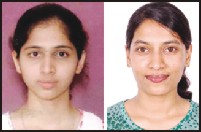
City Skaters Varsha S. Puranik and Sanjana Srinivas have been selected for the prestigious Ekalavya Award to be presented by the Government of Karnataka in Bangalore tomorrow.

Varsha S. Puranik, a 2nd year MD student at the JSS Medical College, is coached by Srikanth Rao, who himself is an accomplished roller skater.

Speaking to Star of Mysore, Varsha expressed her happiness on being selected for the prestigious Ekalavya award.

Varsha is the daughter of Sriramkrishna, a retired Manager of Indian Overseas Bank and Tara.

Sanjana Srinivas, another roller skater from city, who is selected for Ekalavya award, is currently pursuing her engineering in Electronic and Communication (E&C) at PESIT, Bangalore.

Sanjana was part of the team which won the bronze medal at the Asian Ice Skating championship.

She has represented India at the world championships. She has also won national individual championship twice. She is the daughter of city-based businessman Srinivas and Savitha.

The Department of Youth Services and Sports (DYSS) is expected to make an official announcement of 17 names of sports personalities who have been selected for the Ekalavya award this evening.

The award carries Rs. 2 lakh cash prize and a citation. The award is presented every year to commemorate the National Sports Day (Aug. 29) which is observed to mark Hockey legend Major Dhyanchand’s birth anniversary.

source: http://www.starofmysore.com / Star of Mysore / Home> General News / August 28th, 2013

NISTTARKYA: City designer’s concept electric bike

The designer also holds 3 Limca Book of Records, one each in India Book of Record and Asia Book of Record for his innovations.

BikeBF03sept2013

It is said that necessity is the mother of inventions, but here is an innovator from city who says that he invents for passion and not for awards.

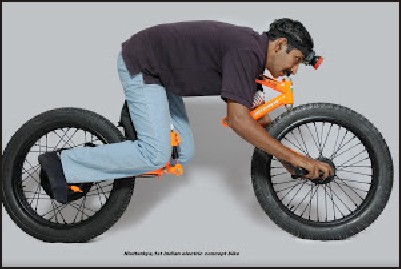
Santosh, a motor bike design enthusiast, who lives in Saraswathipuram, has come up with an electric-concept bike.

Santosh completed his ITI in Electronics from NIE in city and works at Reckitt Benckiser, a pharmaceutical company, as a technician but his real love is motor cycles.

Santosh has named his electric-concept bike as ‘Nisttarkya,’ which means ‘Unimaginable’ in Sanskrit.

The bike weighs 40 kgs with both wheels size at 3.00×18″ drives on 36 V, 350w hub motor and is powered by three 36 V rechargeable batteries.

The most noticeable feature of ‘Nisttarkya’ is its riding position. It has two shock absorbers, one for the front, one for the back and headlight mounted on the rider’s head.

The riding position is so peculiar that it makes one wonder as to how it is possible to ride it at all. But Santosh says, that is why it is a ‘concept’ bike. It will have to be further refined and fine tuned before it can reach marketable potential.

Santosh, speaking to Star of Mysore, said: “all the parts of the bike were made at home for which I have been working for the past 18 months. Though the design looks simple to naked eyes, there is a lot of technology involved in it and my friends have helped me a lot.”

This shy natured innovator said that he was not behind any records but simply loves motor cycles. Incidentally, his father Jeevandhar is also an ardent bike enthusiast.

Santosh, in order to pursue his passion, used to participate in rallies, where he learnt technology and design. “You learn a lot when you get your hands dirty in mechanics,” he says.

Speaking of viability, Santosh says he spent Rs. 60,000 to built Nisttarkya and is thankful for all the assistance he got from his friends.

For now, Nisttarkya runs for 30 kms with an hour of charging but one has to keep a watch for the potholes and take a few breaks during the ride.

Santosh can be contacted on e-mail: santhosh.bikes@gmail.com.

source: http://www.starofmysore.com / Star of Mysore / Home> Feature Articles / by S. Kenneth Shishir / August 28th, 2013

New plants to take root in Lalbagh

The largest lung space in Bangalore, covering a sprawling 400 acres, Lalbagh is now home to 1,916 species./  Photo: Murali Kumar K. / The Hindu
The largest lung space in Bangalore, covering a sprawling 400 acres, Lalbagh is now home to 1,916 species./ Photo: Murali Kumar K. / The Hindu

Around 25 species of ornamental and fruit-bearing plants will be introduced

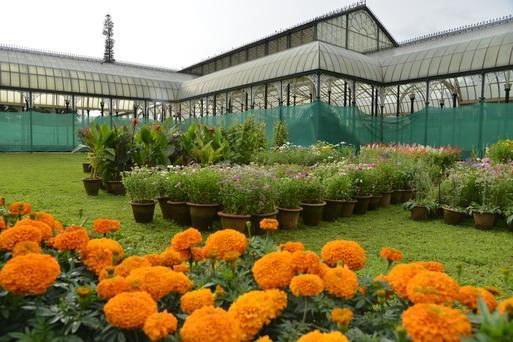
New species of ornamental, medicinal, commercial and fruit-bearing trees are to welcome you on your next visit to Lalbagh Botanical Gardens here.

The over 200-year-old garden is to get around 25 new species from the National Botanical Garden, Kolkata.

“We have brought species…that could suit Bangalore’s climate,” deputy director of the gardens J. Gunavanth told presspersons here on Monday. “We are identifying space across the gardens to plant them, as there is a space crunch,” he said.

Among those being introduced are palm varieties such as thatch, gingerbread, cabbage, feather, feather duster, desert fan, Nicobar and ruffled fan palms. Some other plant species are velvet apple, star apple, Hanuman phal, brush cherry, as well as poon, empress, olive bark and locust trees. Most of these species are natives of South America, tropical Asian countries, the U.S., Australia, New Zealand and Africa.

REPLACEMENT

This comes even as around 50 to 60 species are planned to be replaced. Some of these trees are more than 100 years old. “An old tree fell last week and many others are old,” Mr. Gunavanth added.

DIRECTORY

The largest lung space in Bangalore, covering a sprawling 400 acres, Lalbagh is now home to 1,916 species.

The Horticulture Department plans to come out with a handbook or directory of plants in the gardens for the benefit of visitors. “Endangered species that are over 100 years old will be featured in the handbook,” Horticulture Department Director D.L. Maheswar said.

source:  http://www.thehindu.com / The Hindu / Home> News> Cities> Bangalore / by Staff Reporter / Bangalore – August 06th, 2013

Crowds swell at Lalbagh flower show

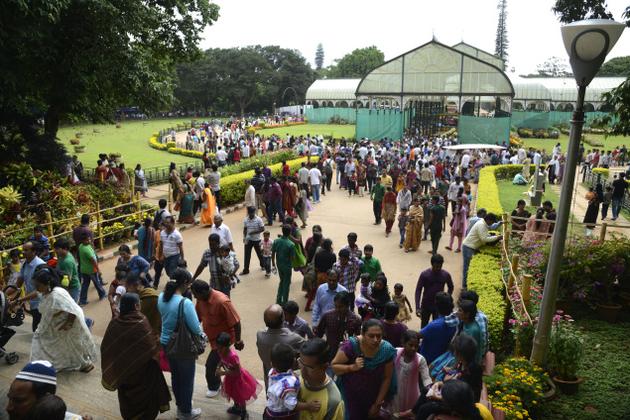
A massive crowd turned up at the Lalbagh Botanical Gardens to enjoy the biannual flower show - Photo: V Sreenivasa Murthy / The Hindu
A massive crowd turned up at the Lalbagh Botanical Gardens to enjoy the biannual flower show – Photo: V Sreenivasa Murthy / The Hindu

Over 50,000 people thronged Lalbagh on Saturday, resulting in windfall collections

Like butterflies, thousands fluttered into Lalbagh on Saturday for the annual Independence Day flower show. According to official figures, over 50,000 people thronged the venue, resulting in windfall collections at the gate.

The show, which was opened to the public on Wednesday, took wing on Friday with nearly 60,000 footfalls thanks to the public holiday for Ramzan. With one more day to go before this long weekend ends, the Horticulture Department expects the total figure to touch two lakh. “We are expecting one lakh people at the very least on Sunday,” said Deputy Director of Horticulture J. Gunavaantha.

The Ikebana display and the flower-laden houseboat appeared to be the biggest draws. Almost every second visitor could be seen walking out with Ikebana showpieces. George and Christina Butcher from England bought such a large display that they had to carry it together with the taxi driver, who brought them to the venue. “We don’t know how we will take this back with us. But we couldn’t not buy them,” said Mr. Butcher. “I have never seen something so beautiful,” gushed his wife.

TRAUMA OF TRAFFIC

However, the city’s meagre infrastructure once again played the party pooper. The roads leading to Lalbagh were clearly in no shape to bear the extra load. Negotiating traffic on Lalbagh Double Road, J.C. Road and Hosur Road is a tortuous experience even on a normal day. But on Saturday, these roads were practically impenetrable.

The jam on K.H. Road extended all the way to Richmond Circle Flyover. The situation was not too different at Dairy Circle, Lalbagh West Gate and Main Gate junctions as well as the R.V. Road Junction. Special arrangements were made at the multistorey parking lot at the Shanti Nagar KSRTC bus depot as well as the BBMP multistorey parking lot on J.C. Road.

Yet, hundreds could be seen stalling on the road waiting for a parking spot and blocking traffic. Policemen were at their wits end trying to wave these vehicles forward but they stuck to their ground. Commuters arguing with each other and with overworked traffic constables was a common sight throughout the day.

The crowd displayed their lack of civic sense by littering the venue. It was a sad contrast: lily and chrysanthemum blooms on one side; chocolate wrappers, ice-cream sticks and corn cobs on the other.

source: http://www.thehindu.com / The Hindu / Home> News> Cities> Bangalore / by Staff Reporter / Bangalore – August 11th, 2013

‘SILK INDIA-2013’: Expo-cum-sale of pure silk sarees and silk products

SilkBF02sept2013

Mysore :

“Abhivridhi”, an Association assisting Artisans and Weavers, established in Mysore, which has successfully exhibited Pure Silk, Silk Cotton and Silk products throughout South India, has organised a six-day exhibition- cum-sale ‘Silk India – 2013’ for the second time in city from Aug. 29 to Sept. 3 at Hotel Regaalis.

The aim of the organisation is to provide access to products directly to the customers from the weavers and artisans. Various Silk Saree Weavers, Handloom Clusters and Silk Cooperative Societies will exhibit their products at more than 40 stalls.

Tassar silk sarees and suit, Kanchi Silk, designer fancy Sarees, Darmavaram silk sarees, handloom silk cotton Sarees, silk blends sarees & stole, silk shawls, silk blends fabrics and furnishing,Bomkai Sarees, hand block print sarees, silk bed covers, Assam Muga fabrics, Apoorva silk sarees, Baluchuri Sarees, Bhagalpur suits and Butti sarees, Karnataka silk sarees, Chanderi silk sarees and suit, Kota silk, Mulberry silk with temple border, Banaras Jamdani etc., will be on display.

The exhibition will be open daily from 10.30 am to 8.30 pm.

source: http://www.starofmysore.com / Star of Mysore / Home> General News / August 27th, 2013

The entrepreneurial spirit that doesn’t deter these two women from selling food on the streets

I was strolling down the lanes of an upcoming Bangalore suburb when I came across a stall run by two women selling food items. They were very well dressed and if they stood in a crowd, no one could pick them apart from the regular IT crowd in Bangalore. And the surprising part is that they are IT Professionals. Well, atleast one of them still is while the other quit her job 3 years ago.

(L to R) Divya Anne Joseph, Cheryl George, Anto Roy

The two women in question are Cheryl George and Divya Anne Joseph who both were in their typical IT jobs when they felt this pang to do something more. Acting on their gut, they decided to work to their strength which was cooking and setup a stall outside their building in February 2013. Their friend Anto Roy also joined them with the endeavor. They tried the mobile stall concept to begin with but half of their day went in just explaining what they were doing and they weren’t seeing many returns. Hence they decided to stick to one place and setup the stall outside their building.

They have a Facebook Page where they update the menu (usually snacks and light dinner items) and stand on the streets, alongside the coconut vendor and others to sell their items. And it’s not something they did for a few weeks. The team of three have persisted and it’s been more than 6 months now where they stand out (in all weathers) and take in the joy of serving. “We’re not doing this for money or to build a grand business, we’re doing it for the joy we get out of it,” says Cheryl.

The ladies cook at their home and the three of them then bring the items to the stall in their cars. Anto Roy handles the other stall and the two stall together are serving around 80-90 customers every day. They call themselves ‘Street Eats’ and their average ticket size is around INR 50.

Divya is into this fulltime while Cheryl still holds her job. They don’t have immediate plans to scale and formalize but are taking it as it comes. “We’re really enjoying what we are doing and the kind of people we’re meeting everyday is just phenomenal!” says the team in chorus.

This is the kind of spirit that thrills us here at YourStory and gives us the motivation to go out there discover more such interesting people. Follow StreetXEats on Facebook.

source: http://www.yourstory.in / Your Story / Home / by Jubin Mehta / August 10th, 2013

Taste and feel of Uttara Karnataka

A Food stall at the 'Uttara Karnataka Utsava' organised by the Uttara Karnataka Nagareekara Abhivruddhi Vedike at Palace grounds in Bangalore./  Photo : K . Bhagya Prakash / The Hindu
A Food stall at the ‘Uttara Karnataka Utsava’ organised by the Uttara Karnataka Nagareekara Abhivruddhi Vedike at Palace grounds in Bangalore./ Photo : K . Bhagya Prakash / The Hindu

If you want to experience the art, culture and distinct cuisine of north Karnataka, head to Palace Grounds over the weekend to witness the Uttara Karnataka Utsava 2013.

When you enter, you’re greeted by loud percussion and the sight of men and women performing the ‘dollu kunita’. On display are stalls selling paintings, traditional clothes and handicraft — Ilkal saris from Bagalkot, cotton towels, the Gandhi cap, a traditional north Karnataka accessory for men — but food remains the star attraction.

Businessman Ranganath said, “I tasted the mandakki and it was a change compared to the food we eat regularly. I will try the jolada rotiand brinjal curry next.”

Virupaksha B.T., whose stall, Jolaa, had a large number of visitors, said, “Our food has a lot of variety and our USP is the spiciness. It is special, yet it is like homemade food.” Of course, a wide variety of pickles and chutney powders are also a big draw.

After all that spice, you may need some sugar andkaradantu, a sweet made of dryfruits, would be ideal. Mahantesh Savaligeppa Aiholli of Pooja Sweets said he was the third generation of a family that has been selling the sweet from Aminagad, Bagalkot, since 1907. He explained to a perplexed customer, “This sweet is made of cashew, badam, pista, raisins, dried coconut and jaggery procured from Belgaum.”

The Dharwad pedakunda and peanut laddus are also there to add to your sugar rush.

However, there were some visitors who were disappointed. Kasturi Devandrakumar, an artist said, “The food stalls have hogged all the limelight. It could have been better if there was more emphasis on the art and culture of the region.”

The fair is on till August 11.

WELFARE

Earlier, speaking at the inauguration, Chief Minister Siddaramaiah said the government was keen to work for the welfare of the people of the north Karnataka region. They had accepted all recommendations made by the Cabinet sub-committee on the implementation of Article 371(J) of the Constitution, providing special status to the Hyderabad Karnataka region.

source: http://www.thehindu.com / The Hindu / Home> News> Cities> Bangalore / by Staff Reporter / Bangalore – August 10th, 2013