Yearly Archives: 2015

Two friends join hands to spread Bicycle culture in city

Vikas Hosahalli & Mahesh Siddegowda

Mysuru :

‘If passion can take you places, then Mysuru is the place to polish your passions till perfection.’ This seems to be the collective conscience among the young in city who are leaving behind fat-pay cheques from multi-national corporate companies to follow their hearts.

Like Rohan Abijith and Dhruva Rao, who gave up their lucrative jobs to start the ‘Science Ashram’ at Jayalakshmipuram, there is a rising trend among the young in the city to innovate, collaborate and start ventures that are benefiting the society on the whole.

Now two friends have joined hands to inculcate bicycle culture among Mysureans that can not only save the environment from pollution but can also keep individuals fit!

Nowadays in the fast paced modern world, man is totally dependent on petroleum products to keep moving about in his two and four-wheelers. The gasoline-run vehicles not only pollute the environment, but have also been cause for numerous accidents and deaths in the world. People suffer from breathing problems after inhaling the air polluted by the carbon dioxide emission from these vehicles.

Before it is too late, human beings must realise the importance of clean air and environment and in this context, several environmentalists and naturalists have come forward to work for a people-friendly environment.

The city is not lagging behind on such environmentally conscious matters and is fortunate to have two young men namely Vikas Hosahalli, a resident of Kuvempunagar and Mahesh Siddegowda, residing at Kesare, the founders of ‘Green Wheel Ride’ who have been trying to instill ‘Cycling Culture’ among Mysureans. In the first phase of cycling promotion, the duo have opened centres near State Bank of Mysore in Chamundipuram, near Gnanaganga School in Kuvempunagar, near Vikram Nursing School in Gokulam and near Corporation Bank branch in V. V. Mohalla.

Green Wheel Ride has plans to open 75 to 100 franchise points at various locations in city. The unique feature of this ‘Cycling Concept’ is that one may hire a bicycle from one centre and hand over the bicycle at the nearest destination centre.

Speaking to SOM, Vikas said that the duo was looking for places to set up their franchisees and are happy to engage in partnerships with institutions and environmentally conscious corporate houses.

“There are lots of un-used spaces in government office buildings and they are perfect to have these e-bikes installed there. The officials can use these bikes for their transport, but we are not getting any positive response from them,” says Vikas.

After having relinquished their plum positions in MNCs, Mahesh, a mechanical engineer by profession, has been engaged in altering the bicycles and Vikas is into the maintenance work of these bicycles.

Battery operated bicycles: We may be wondering how to pedal on these bicycles especially during summer, relax; these bicycles operate on eco-friendly batteries. ‘Lithium Ion’ technology is used for these bicycles and once the battery is charged, the bicycle runs for 70 kms at 20 km per hour. The cost for 3-hour charge will be less than a Rupee.

Triple mechanism on bicycle: An individual can ride the bicycle by pedalling if he or she wants to exercise; the bicycle can also be operated with pedals and accelerator on battery. The bicycle has the option of being operated only on accelerator.

The spare parts for these bicycles are manufactured by Green Wheel Ride at their Hootagalli unit in city. Bicycles are assembled at the Vidyaranyapuram unit, here, and the brand name for these bicycles is ‘Made in Mysuru.’

These bicycles may be hired at 50 paise per minute for members and Re. 1 per minute for non-members. Bicycles are available for hire between 8 am and 6 pm at the designated bicycle centres in city.

Riders who wish to avail these bicycles on hire should submit a passport sized photograph, identity card, address proof and give their thumb impression on biometric machine. The firm has its own App for registration of members and to identify the path travelled by the bicycle rider.

E-Bike: The battery-operated bicycle was launched only 18 days ago in Mysuru and has been christened ‘E-Bike’ for its eco-friendly mechanism. Our aim is to save the environment from pollution and reduce the dependency on petrol, diesel operated vehicles. Even if 10 percent of our population uses these bicycles, the country would save lakhs of rupees on petroleum products import. Ten bicycles have been made available at the Karanji Kere premises for the convenience of the public. A fee of Rs. 25 will be charged for 30 minutes use. About 3,500 people have used 10 bicycles which were operational at Karanji Lake during the last 10 months covering a distance of 15,000kms.

Green Wheel Ride has plans to open such Bicycle Centres in other cities too and those interested to join the organisation may contact: 95358 50001 or visit the website: www.ecobike.rentals

source: http://www.starofmysore.com / Star of Mysore / Home> Feature Articles / Sunday – June 14th, 2015
‘Sita Ashoka’, The sacred tree with medicinal values

SitaAshokaBF20jun2015

by Dr. Mahadeswara Swamy, Scientist, Mob: 97429-91057, e-mail: swamy_clri@hotmail.com

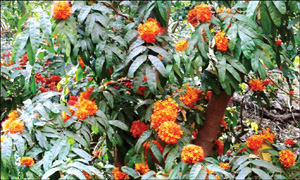
Ashoka’ or ‘Sita Ashoka,’ one of the most beautiful indigenous trees, looks marvellous when fragrant, pale apricot (scarlet) Ixora like blooms are fashioned amidst the deep green shiny foliage. It is a sacred tree for Hindus and Buddhists. Therefore, it is widely grown in gardens adjoining temples and monasteries. According to one belief, Lord Buddha was born under an ‘Ashoka tree.’ According to Ramayana, it is associated with chastity. Sita, after being abducted by Ravana, spent her days grieving for Rama in Ashoka Vana. A quaint Hindu belief is that the tree will flower only in places trodden upon by a woman’s foot!

In West Bengal, women eat the flower buds on ‘Ashoka Shanthi’ day. The scientific name is ‘Saraca asoca’ belonging to Fabaceae (pea family). ‘Saraca’ is derived from Western Indian vernacular name for the tree; ‘asoca’ means ‘sorrow – less’ in Sanskrit. It is native to India, Sri Lanka, Burma and Malaysia. It is found wild in forests of Khasia Hills in Assam and Western Ghats and grown all over India.

It is a medium-sized, evergreen, hardy tree with erect trunk, rounded crown and drooping foliage. The bark is distinguished by the presence of warty protuberances on its outer surface. The compound leaves are arranged alternately on the stem; leaflets, 3-6 pairs, opposite, deep green, elliptic oblong in shape with wavy edges; surface is glabrous and shiny.

Young leaves are coppery red and flaccid — the distinguishing feature. Large clusters of golden yellow fragrant flowers appear on trunks and old branches, 4-6” across. The flowers have no petals and the sepals form a tube at the base and open up into 4-6 petal like lobes, first orange and later turn to scarlet. The stamens are orange near the base and scarlet upwards.

The fruit is a dehiscent pod with 4 to 8 seeds. They are fleshy and red when young and closely resemble the young tamarind pods.

Uses: The tree has immense medicinal value. The bark is astringent and used in uterine infections, menorrhagia (scant menses), dysmenorrheal (painful menses, menstrual cramps), leucorrhoea, as a uterine sedative and tonic. The bark powder is also used for improving skin complexion. The flowers are used in diabetes and dysentery. Seeds are chewed as a substitute for betel-nuts. Ayurvedic medicines ‘Ashokarishtam’, ‘Ashoka Ghrita’ and ‘Chandranadi Thailam’ contain ingredients from this tree. The timber is used for house building in Sri Lanka.

Other related species: S. cauliflora: Yellow and orange flowers (yellow turning red) on thin woody branches, but not on trunks; S.declinata (red asoca): Large clusters of red flowers on old branches and twigs; S.thaipingensis (yellow saraca): Large clusters of golden yellow flowers on trunks and old branches.

Note: Polyalthia longifolia is often planted in many places in the name of ‘Ashoka’ tree. This is a misnomer. At best, it can be labeled as ‘Madras Ashoka’ or ‘False Ashoka.’

Useful tips: Suitable for small avenues, parks, big gardens as well as home gardens.

Prefers shady situation and a porous, moist soil.

Needs shelter from dry wind in hot places.

Easily propagated from seeds.

Looks beautiful when planted in the corner of a lawn.

Peak flowering season: February to June.

This beautiful tree can be seen in Curzon Park, park adjacent to B.M. Hospital on Hunsur Road and many other places.

source: http://www.starofmysore.com / Star of Mysore / Home> Feature Articles / Sunday – June 14th, 2015

DC Office to move out of 120-year old Monument

DCMysoreBF20jun2015

by S.N. Venkatnag Sobers

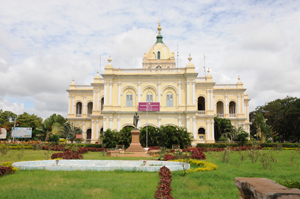
One of the heritage structures in Mysuru is the Deputy Commissioner’s office. Though, there are no authentic documentation regarding the building, it is said that the foundation for the building was laid on June 20, 1887 and the construction was completed in 1895.

The building constructed at a cost of Rs. 1.75 lakh, had two halls and 27 rooms which served as the offices and chambers. It was also the place where the Mysore Representative Assembly was held during the Wadiyars rule in early 1900s. Built in European style, the building has octagonal dome with an unusual double-bulb final resting on an elaborately composed square drum, ardhes of different shapes, with corinthian pilasters, open verandahs leading into high ceilings.

The area where DC office is located was called as ‘Gordon Park’ named after Sir James Davidson Gordon, the British Administrator, who was the guardian of Maharaja Chamaraja Wadiyar.

The building which is spread over 30,000 sq ft was surrounded by 92 acre open space. The building was dedicated to Sir Gordon as a gratitude for his services extended to Mysore Kingdom till Chamaraja Wadiyar became an adult and took over the administration. Chamaraja Wadiyar was coronated at the age of five.

Some of the important offices which were housed at Deputy Commissioner’s office were the District Treasury, District Excise Office, Judicial Records Room, Revenue Records Room, Office of the Superintendent of Police, the District Forest Office on the ground floor and District Health Office, Mysore Sub-Divisional Office on the first floor.

The present DC office building which is 120-year-old heritage building houses the offices of Additional Deputy Commissioner, Assistant Commissioner (Mysuru Taluk), District Treasury, Department of Food and Civil Supplies, Deputy Director of Land Records and District Urban Development Cell (DUDC). Offices belonging to Department of Social Welfare, and Department of Backward Communities and Minorities (BCM) which were at the DC’s office have been shifted owing to space constraint.

Attara Kacheri: The Deputy Commissioner’s office in Mysuru was earlier known as ‘Attara Kacheri’ as it housed offices of 18 different departments. It is believed that the then King Chikkadevaraja Wadiyar (1673 to 1704) had divided the administration of Mysore State to 18 departments for smooth functioning of the kingdom. Chikkadevaraja Wadiyar was influenced by Mughal Emperor Aurangazeb who had also divided the administration into 18 departments. After the British left the Kingdom, the Deputy Commissioner’s Office was converted into Dewan’s Office which housed the offices of 18 departments.

Sir James Davidson Gordon: Right in front of the Deputy Commissioner’s Office, there is a bronze statue of Sir James Davidson Gordon, who served as the Chief Commissioner of Mysuru from 1878-81. He was also the guardian to the then King Chamaraja Wadiyar from 1871-1873.

Sir Gordon was born to Evelyn Meadows during 1835. After joining the Civil Service in 1854, he worked as the Private Secretary to Governor General Lord Lawrence from 1866-73. Later, he became the Judicial Commissioner of Mysore, Chief Commissioner in 1878 and a Resident of Mysore in 1882. Sir Gordon retired in 1883 and died on June 27, 1889.

When Sir Gordon was serving as the Chief Commissioner, Chamaraja Wadiyar was the heir to the throne. Since Chamaraja Wadiyar was a minor, Sir Gordon took care of his education and guided him with the administration. After he became the King, Gordon continued to guide him and resided in the building in Mysuru.

New DC office: The construction of the new Deputy Commissioner’s Office will be taken up on a 15 acre land located in German Press premises in Siddharthanagar. Around 100 acre of land belonging to State Government was leased to Central Government for a period of 99 years for Re.1 annual rent agreement. Now, the Central Government has handed over 15 acre land to the State Government following its request to accommodate the new DC’s office. The matter was also pursued by Mysuru-Kodagu MP Prathap Simha.

Though, the lease period of the land was valid till 2061, the Central Government handed over the land back to the State Government to go ahead with the project. Previously, the State Government had earmarked Rs. 35 crore for the construction of new DC Office complex and had instructed the District Administration to identify the land.

Speaking to Star of Mysore, DC C. Shikha said that the new building with a basement and two floors will have offices of 25 departments including those which are functioning in rented premises.

The built up area will be around 17,000 sq mts and will be designed by the State Public Works Department keeping in mind the heritage and cultural values of the Mysuru district, said Shikha.

She also mentioned that new building will be public, disabled and senior citizen friendly with ample parking space and lung space around the building.

When asked about the new DC office being too far from the city, DC Shikha mentioned that it would not be difficult for people to reach the new DC office as it was well connected with transport facilities and was near to the sub-urban bus stand.

Adding that the land identified for the new DC office was ideal, Shikha mentioned that it would have been difficult for the District Administration to find a suitable land in city limits.

Now the question arises as to what would happen to the old DC office building after completion of the new building. Reacting to this, DC Shikha said that the old office building will be retained by the Revenue Department and the State Government would decide on the measures to be taken to preserve and conserve the heritage structure.

source: http://www.starofmysore.com / Star of Mysore / Home> Feature Articles / Sunday – June 14th, 2015

Satyanarayana Nadig passes away

Satyanarayana S. Nadig

Mysuru :

City’s prominent industrialist and builder Satyanarayana S. Nadig passed away early this morning at a hospital in Bengaluru after a brief illness. He was 70.

He leaves behind his wife Jayalakshmi Satyanarayana, sons Vikram S. Nadig and Raghav S. Nadig, a host of relatives and friends.

The body of Nadig, which is expected to be brought to city this afternoon, will be kept at his residence on 4th Main, Jayalakshmipuram. Last rites will be performed tomorrow (June 15) at 10 am at Chirashanthi Dhama in Gokulam.

Profile: Born on Feb. 3, 1945, Satyanarayana S. Nadig, a civil engineer by profession, was the Managing Director of Nadig Promoters and Developers Pvt. Ltd., and Nadisons Resorts Pvt. Ltd. He was the Past Chairman of the Builders Association of India (BAI), Mysore Centre.

A cricket enthusiast, Nadig was the KSCA Mysore Zone Convener from 2007-2010 and was representing the National Cricket Club (NCC). He was instrumental in reviving several cricket grounds in city.

Apart from being the Founder-Member of Sarawathipuram Recreation Club, Nadig was the member of JWGC, Vonti- koppal Club and Babbur Kamme Sangha.

source: http://www.starofmysore.com / Star of Mysore / Home> General News / Sunday – June 14th, 2015

Roundle Table India and Ladies Circle India Felicitates 12 ‘true legends’ from Karnataka in Bangalore

Seagram’s 100 Pipers Music CDs in association with Pride of Karnataka, an initiative of Round Table India and Ladies Circle India felicitated 12 ‘true legends’ from the state.

Ashwini Nachappa and Pramoda Devi

Among those felicitated were Priya Mani, Ricky Kej, RK Misra, Prasad Bidpa, Manoviraj Khosla, Shukla Bose, Ashwini Nachappa and Robin Uthappa. Kartik Mohindra, Business Head, International Brands, Pernod Ricard India, said, “True legends are successful people who lead a positive change on society. The True Legends awards recognizes and felicitates successful personalities who have risen above the material pursuits of success, and believe in giving back to humanity. Each True Legend story is very inspiring and will forever be remembered for good.”

source: http://www.timesofindia.indiatimes.com / The Times of India / Home> City> Bengaluru / TNN / June 19th, 2015

Bengaluru misses Charles Correa too

CharlesTELAN19jun2015

The Hyderabad-born architect had strong links with Bengaluru too.

“One has to open up to the skies… only then will your buildings look up to light and ventilation in a scientific way,” renowned architect Charles Correa, who passed away at 84 in Mumbai yesterday, had said during one of his visits to Bengaluru.

He had many ideas on art and architecture and their role in shaping the building environment and urban landscape at large, particularly public spaces of Bengaluru. He passionately combined old-world charm and new age design philosophies that spoke of his strength to retain green values. His book, “A Place in the Shade” strongly exhort habitats to “respond to the overriding parameters of climate, culture and financial resources”.

He was known for his forthright comments on changing Mumabai’s landscape and bringing in local sensibilities into its architectural make-up. The Hyderabad-born architect had strong links with Bengaluru too.

Some of Correa’s buildings well-known in Bengaluru are the Jawaharlal Nehru Science Centre, off Jakkur, his own house that he built for his daughter at Koramangala where Fab India presently operates from, and the renowned LIC Tower or the Vishweshwaraya Centre where his exposed concrete work comes into reference even after 40 years of its historic handling for architects today.

He had strong views on the laying of Metro on M.G. Road. “The track on M.G. Road should have gone underground; or at least the elevated part should have been in steel instead of the ugly concrete expressions with gigantic pillars running all along,” Mr. Correa had said in an interview with The Hindu.

He, however, wanted the metro running elevated especially on the Vidhana Soudha Road. “Although I haven’t studied the buildings and the flow pattern near the Vidhana Soudha, it could have proved a heavenly addition to be above-ground. I can visualise the rail running 20-feet above the ground in steel, this gossamer being a typical contemporary narrative adding to the drama amidst the traditional looking State Assembly and the Karnataka High Court,” he had said.

Architects mourn death

Well-known architect Nagaraj Vastarey says about Correa: “There would never be a masterly figure as him in architecture anymore. Correa, apart from Balakrishna Doshi, was a point of reference to most of us growing up as architects.” Mr. Vastarey explained that in those days studying architecture was different as there wasn’t much of theory, but practical buildings from Correa meant lessons to all of us for references.”

Says architect Sandeep J. of Architecture Paradigm, “Correa rode the architectural world like a colossus, leaving behind a trail of master-pieces that are hard to match. The very aura around the man indicated that you were in the presence of a master architect, making you think twice before you decided to start a conversation.”

We have many architects who create wonderful forms and also those who create great spaces. “Charles Correa stands tall in Indian architecture as a creator of both form and space, as could be seen in Bharath Bhavan, Bhopal,” says Architect Sathya Prakash Varanashi. “His sense of scale, colour and visual aesthetics compliment the overall design, which together resulted in projects like Jawahar Kala Kendra in Jaipur, adding a new dimension to the history of modern architecture in India.”

Mr. Varanashi explained that Correa did not experiment with innovative structures or international styles, which possibly helped him to perfect his ideas across varied building locations and types. Alternately, he explored each project without getting stuck to the earlier projects, to the extent where one building appears totally different from the other. The Bengaluru projects Vishweshwaraya Tower opposite Vidhana Soudha and Jawaharlal Nehru Center for Advanced Studies may not even appear as designed by same architect. Correa had a mind that never got stuck, letting him explore designs like very few world architects could.

Those who have frequented the earlier Fab India showroom in Koramangala, Bengaluru have walked into the house which Correa designed for his stay in Bengaluru! “The fact that a house gets the new avatar as a shop, without losing its spirits, shows the flexibility with which the house has been conceived,” said Mr. Varanashi.

The early buildings of Correa, including the famous Gandhi Smarak Sangrahalay at Sabarmati Ashram, synthesized his international exposure with the local contexts, charted a new road map for architecture in India. His fluency in dealing with residential houses – from LIC Colony in Bengaluru to Kanchanganga Apartments in Mumbai – shows a variety very few architects have been able to even think of.

source: http://www.thehindu.com / The Hindu / Home> News> Cities> Bengaluru / by Ranjani Govind / Bengaluru – June 17th, 2015

Organic Food Delivered at Your Doorstep

Queen’s Road :

A group of passionate foodies have come together to launch a website (www.homemadeonline.in) that brings women entrepreneurs and cottage industries into one domain to manufacture and distribute food products to consumers.

Through the platform, one can buy and sell homemade food products, which will be delivered fresh at the customer’s doorstep.

AjantaBF17jun2015

Ajanta Chandan, managing partner of Homemadeonline, says, “There are a lot of talented entrepreneurs amongst us who don’t know how to reach the masses. Our website gives them an opportunity to meet the demands of the people who are looking for non-commercial and organic food products online.”

Started two months ago, the website aims at bringing back the forgotten local food items and encouraging vendors to sell good quality products. Health-oriented people who could be working professionals, young students and diabetic patients are the company’s target group.

“We currently have around 1,000 regional food products on offer being supplied by over 200 registered vendors. Besides food, we are also promoting many entrepreneurs who are into handicrafts,” she adds.

OrganicBF17jun2015

Homemadeonline has on display a wide range of products including organic spices, masala powders, pickles, papad, homemade chocolate, herbal products, millet products, health and nutritional products, regional delicacies and healthy breakfast options.

Chandan says, “Within six months, we plan to expand our business in South India and in the years to come, we hope to spread all over India.”

source: http://www.newindianexpress.com / The New Indian Express / Home> Cities> Bengaluru / by Express News Service / June 17th, 2015

A new world, in photos

Youngsters in the mahout community look at the camera. Photo courtesy: CLIC Abroad Foundation

CLIC Abroad is an initiative for American students to immerse themselves in India and take back an understanding of our similarities and differences.

The best way to learn about a country and its culture is to live in the community and follow their daily life, and even better, photograph them to take stories back to friends at home. Students from American high schools have had several such experiences in India, living in States as diverse as Assam to Karnataka, through CLIC Abroad or ‘Children Learning International Cultures’, an organisation founded by travel writer and photographer Bhaskar Krishnamurthy from Karnataka.

Bhaskar Krishnamurthy. Photo courtesy: CLIC Abroad Foundation

Bhaskar has lived through many photography experiences, including, he says, an ULFA militant kidnapping in 1999 before he moved to the U.S.A.! “Photography is often seen as an elitist thing. I didn’t want it to stay that way,” says Bhaskar, explaining how he involved the local communities of Augusta, Georgia, where he lives, in photography festivals. Based on the success of those projects, the engineer felt it was a great idea to do something like this in India. So in 2009, he, along with friends set up CLIC Abroad, with the idea that children from America and people from India mingle at photography workshops held within communities here and together build and narrate stories. Most visits last about 12 days.

“The first camp we had was in Bodoland; after initial hiccups, over 5,000 rural people participated in the rural photo exhibition. My focus is on education through visual representation and empowerment through participation,” he reiterates. A product of SIT Tumkur, Bhaskar studied mostly in various parts of rural Karnataka and then moved to Bengaluru.

“Till date we have brought down over 100 American children studying in classes nine to 12. Just last month was our latest venture where a group of students from the Abraham Baldwin Agricultural College lived with elephant mahout communities in Karnataka in Dubare, Sakrebylu, and Aane Chowku (Nagarhole), talking, among other things about the gaps between conservation and the man-animal conflict,” says Bhaskar. CLIC Abroad currently has a tie up with about eight high schools and colleges in America.

“The idea is to understand the dynamics of the community, and figure out how best to participate or help,” adds Bhaskar, giving examples of how sometimes students donate something as simple as shoes and socks which children in remote India don’t have to wear to school. On the other hand, they helped light up an entire village that didn’t have electricity, using solar lamps. The students raise their own funds or save up to pay for their trip.

Shelby Evans, a 20-year-old communication student, says of her recent trip to Karnataka: “Rural, where I’m from, and ‘rural’ in India were very different. Farms were smaller, crops were unusual, and the farm equipment was handcrafted. However, while I found the landscape and the culture to be incredibly different, the people were kind and hospitable. The kindness here is not unlike the kindness of the Southern (American) hospitality, I find at home. It was comforting for me to see that kindness across the world.” Her classmate Austin Morris got to straddle two worlds – riding elephants, coming across King Cobras, and then visiting schools and interacting with children across age groups and seeing how they learn.

Thomas Grant, assistant professor of journalism at Abraham Baldwin Agricultural College, in an email response, says: “My students and I couldn’t begin to understand India until we had travelled there. In CLIC Abroad, what students get is a chance to touch and feel India in a way that no movie or book ever can. It allows young people from both nations to embrace their similarities and understand their differences in a personal way. I could never teach this. In Coorg, we came to understand India’s relationship with nature. In America, nature is often something to be dominated. If a wolf eats a sheep, the farmer is allowed to shoot it. But in Coorg, we saw wild elephants trampling through coffee estates, yet the farmer was not angry with the elephant. He wanted it to leave, but he wouldn’t harm it. We talked to two girls whose mother had been killed by an elephant, yet they wished no harm on the elephant.

They merely wished that that the elephant would be moved far away. This respect for nature was one of our most incredible takeaways from India. Indians have learned to live with nature, and Americans could learn much from that.”

For details look up www.clicabroad.org

source: http://www.thehindu.com / The Hindu / Home> Features> MetroPlus> Society / by Bhumika  K / June 17th, 2015

‘I always dreamt of owning the best cars’

CarBF16jun2015

Personal diaries have always been around. Confidential and distinctive, personal diaries capture some memorable moments, in the life of an individual. However, VP Manohar. a passionate hoarder of machines of all ages, has a list of cars written down in his diary! 
It all started when he was a kid. Manohar would write down the names of the cars that he liked and the ones he saw on the roads. Not only did he know the names of the best cars that roared on the streets of old Bangalore, but would also write down the information about the owners of these cars. “I always dreamt of owning the best cars,” says Manohar, currently the managing partner of Southam and Company. He says, “I remember that my father owned just one car. I made sure I washed it regularly.” However, it was in 1967 that Manohar was gifted his first car — the Triumph Herald. He later owned a few more beauties, including a Ford and a Contessa, after which his love shifted to vintage and classic machines.His first classic car was a 1966 Mercedes Benz, a royal blue queen, which ruled the automobile markets for eleven years. “These cars are called classic for the obvious reasons. They were strong and weighed over two tons,” he explains. The second entrant into his collection was the very stylish 1984 Jaguar XJ6 Sovereign. A rare car with twin fuel tanks, it has the glass headlight cover, which is not to be seen in the present-day models.“The old models of Jaguar are better built than the newer ones. This car has twin fuel tank with a button that can switch from one tank to the other. The 1984 model is premium when compared to the recent models,” he opines. After the ‘panthera’ beauty came the beastly wagon — 1946 Chevrolet Fleetmaster. A synonym for luxury, it has a fastback styling, comfortable upholstery and white-walled tyres. A roar of the car is enough to know its majesty. “I have the original keys for this car. I have the bill from 1946 with me too,” he quips.

A love for these classic beauties has turned his house into a workshop of sorts. “The Benz was in a pretty good condition. But the other two needed complete restoration. I would never leave my cars at the workshop. Instead, I would get the mechanics home and my house was altered into a workshop,” he informs.

His Mercedes Benz has driven one lakh miles. He says, “The Germans built this machine ahead of technology and hence it has remained intact, without any rust or wear and tear.” While most of the parts of Jaguar were imported from the US, the Chevy’s parts were available in the country. “I even have the original petrol cap for my Chevy,” he says.

A member of Karnataka Vintage and Classic Car Club, he takes out his cars every Sunday and says he likes the attention he gets while driving these old cars. He has been a part of rallies for many years now. Drawing a parallel to the rallies of the old times, he says, “The rallies of the olden times were tougher. Now it is just a 600 to 800 km rally. But I have taken part in 2,000 km rallies and one had to be a strong driver to take part in them.”

It is his passion that has brought him thus far and inspired him to learn a great deal about cars, from assembling to reassembling. He concludes saying, “I want to own a vintage Rolls Royce in future.”

source: http://www.deccanherald.com / Deccan Herald / Home> Supplements> MetroLife / by Pragna GR – DHNS / June 16th, 2015

The Fête de la Musique is Back

Thimmaiah Road :

Musicians will be jamming it out in various venues around the city on June 20 and June 21 to celebrate the International Music Day.

FeteDeLaMusicBF16jun2015

Since its inception in France in the year 1982, The Fête de la Musique has ramified into other countries. The Fête de la Musique was hosted in 700 cities in over 100 countries not including the country of origin in 2014. In India,  Bengaluru, Chennai, Delhi,  Kolkata, Pune and Puducherry organize the event on a very large scale. In accordance with each country’s cultural specificities, The Fête de la Musique – International Music Day is celebrated on June 21 around the world. Bengaluru’s first Fête de la Musique took place in 1984 in collaboration with the Bangalore School of Music.

The Fête  is free to all and open for all to participate across genres. This year, some venues have chosen to represent certain genres. For example: Church Street Social is going all out to celebrate Electronica and Toit Brewpub has Acoustic Rock acts, whereas SAIACS CEO Centre is focusing on Jazz and Bangalore School of Music is more  focussed on Western Classical. This is also the year where a lot of professional acts will be sharing the stage with amateurs – Galeej Gurus, Perfect Strangers, Peepal Tree, to name a few.

Another noteworthy performance to lookout for from  a group of young girls from The Baale Mane Trust who will be the first ever female troupe to play the Dollu Kunitha, a Kannada percussion always played by men.

In most of Europe, public spaces host the Fête de la Musique. People step out at cross roads, footpaths, city squares for one big jam session. In Bengaluru, such an idea may not work given our unpredictable weather. This year though, BMRCL official U V Vasanth Rao himself opened up the Rangoli Metro Art Centre (Rangasthala and Hoovina Haadi) as well as select Metro stations for the event. Venues include the Bangalore School of Music, The Humming Tree, Octavium, Big Pitcher, Toit, Church Street Social, SAIACS CEO Centre, Goobe’s Book Republic, Guruskool, The Warehouse, Blistering Barnacles and Alliance de Française.

source: http://www.timesofindia.indiatimes.com / The Times of India / Home> Cities> Bengaluru / by Shalini Raman / June 16th, 2015