Yearly Archives: 2015

Achievers tie the knot

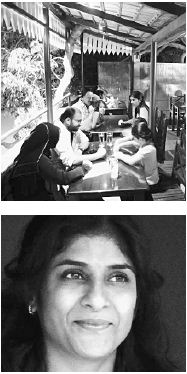
Dinaker Kenjur and Sabita Gundmi got married in Udupi on Tuesday.

Both – Dinaker Kenjur (32) and Sabita Gundmi (29) – have firsts to their credit in the most backward Koraga community, a Scheduled Tribe, and both entered the wedlock in a simple ceremony on the Ambedkar Jayanti here on Tuesday.

The main occupation of the community is basket weaving and collection of minor forest produce. The population of this community in Udupi and Dakshina Kannada, and Kasaragod district of Kerala taken together is about 17,000.

While Ms. Gundmi is Assistant Professor at the Department of Sociology in Mangalore University for last one-and-a-half years, Mr. Kenjur is guest lecturer in the Department of Commerce in the same university since 2009.

Both Ms. Gundmi and Mr. Kenjur overcame heavy odds to make a mark in their community. While Ms. Gundmi is the first person from the community to pass National Entrance Test (NET) for lectureship conducted by the University Grants Commission in 2010, Mr. Kenjur is the first in the community to have done M.Com.

Ms. Gundmi lost her father, when she was five while her mother died in an accident when she was studying SSLC. She had to discontinue her studies for two years after SSLC due to financial problems.

But she persevered and completed M.A. in Sociology standing second in Mangalore University in 2010. She cleared the NET in the first attempt.

She also cleared the State-level Eligibility Test (SLET) for lectureship conducted by the University of Mysore. She is pursuing Ph.D. for the last two years.

Mr. Kenjur too was born in a poor family. He suffered a polio attack when he was young and it affected his leg. He too had to struggle to complete his education. He has also completed third semester in MBA course from Karnataka State Open University. He is trying to clear the NET.

Both are childhood friends. They had both decided to marry nine years ago. Both have no superstition and decided to marry on Ambedkar Jayanti here.

“I told my well-wishers that I was born on a Tuesday. I joined work on a Tuesday. It would make no difference to me to marry on a Tuesday [which is considered inauspicious]. I have been deeply influenced by Dr. Ambedkar’s philosophy. Hence I and Dinaker decided to get married on Ambedkar Jayanti,” he said.

source: http://www.thehindu.com / The Hindu / Home> News> National> Karnataka / by Ganesh Prabhu / Udupi – April 15th, 2015
Heralding a new beginning

Family time

The New Year is a special day for everyone and the City has been bustling with activities as different communities celebrated festivities with their families this week. Bengalureans are prepared to bring in the New Year on ‘Vishu’ and ‘Bihu’, which fall today, with both communities excited about the year ahead.

NewYearBF15apr2015
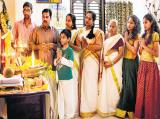
While the young are excited about the family gatherings and shopping, the adults are excited about the festivities. On ‘Vishu’, the ‘Vishukanni’ plays a major role, says Sindhu Padmakumar. She details, “The ‘Vishukanni’ comprises different elements like fruits, cucumber, pulses, cereals, gold, coins and the ‘kannikonna’ flower. A ‘vaalkanadi’ inside a ‘kindi’ is also placed along with ‘mundu’ as a part of the ‘kanni’.” Sindhu says that all these items are placed around Lord Krishna’s idol, which is the first thing one sees on the day.

“The woman of the family prepares the ‘kanni’ the night before, and brings the other family members one by one to see this sight, early next morning. This sight is believed to bring blessings in all the fields throughout the year,” says Sindhu.

Anjali, an engineering student, says that she awaits the day with excitement. “And at the end of the day, I wish that it wouldn’t end. A grand feast and loads of family time is what Vishu is all about,” she says. She says that new clothes and ‘kaineetam’ are the most exciting parts of the day. “Also, the ‘kanni’ itself is something we wait for. Even if I’m awake, I wait patiently for my mother to come and take me to it. There is also the anxiety of seeing whether the ‘kanni’ is better than the last time,” she says with a smile.

Giving ‘kaineetam’ is another big part of Vishu. Hemalatha Prakash says that it is an essential part of the day and symbolically means that one’s life will be blessed with wealth and prosperity. “The elders of the family give ‘kaineetam’ (which means giving money) to the younger lot, so as to give them monetary blessings. Words like ‘kai nirachu kittate’ (meaning may you blessed with more) are uttered during this. Usually my grandmother, who stays with us, gives everyone the ‘kaineetam’,” she says. Hemalatha adds that earlier silver coins used to be given away but nowadays it has advanced to rupee notes.

The festivities remain the same and a grand feast is cooked for the day. “Traditionally, the ‘Vishu Kanji’ is made on this day. The festivities include an elaborate ‘Vishu sadya’ like Onam, where different dishes are prepared like rice, ‘sambhar’, ‘achar’, ‘injipulli’, ‘avial’, ‘thoran’, ‘erusheri’ and ‘pacchadi’. Nowadays, it is more about what can be made, so anything that can be prepared becomes a part of the feast,” says Sangeetha Vipin. She adds that the festival also includes bursting fireworks traditionally, but many don’t do that in Bengaluru.

Celebrated by the Assamese diaspora, ‘Bihu’, which falls on the same day has its own festivities to it. This ‘Bihu’ is called ‘Rongali Bihu’, which comprises colours, dance and festivities. “The festivities include ‘Goru Bihu’ on April 14, where cows are washed and fed properly in the villages. ‘Manuh Bihu’ will be celebrated on April 15, where we wear new clothes and also gift new clothes to our relatives. It can be the ‘gamocha’, which is a valued gift, and also the ‘chadar’,” says Manjula Gogoi, a young professional.

She adds that the day is about unlimited food. “Of the mouth-watering food cooked for the day, the specialities includes ‘fish fry’ and ‘duck curry’ and an authentic drink made from rice,” she says. Priyam Bortamuli, brand manager with Fortis Hospitals, says, “The final day of the Bihu celebrations is today. We celebrate it in grand style with meeting families and gatherings. Back home, there are lots of public events which are held on the day. My in-laws are in town, and thus it will be a fun family affair.”

source: http://www.deccanherald.com / Deccan Herald / Home> Supplements> MetroLife / by Tini Sara Anien / DHNS – April 15th, 2015

Bengaluru boy to head Indian team at G200 youth forum

Bengaluru :

A 19-year-old Bengaluru boy is all set to take part in the G200 youth forum 2015 in Germany. Shailesh Singhal, studying in St Joseph’s College of Arts and Science, has been chosen as the India head in the summit. Shailesh, a first-year BSc (Economics) student, will represent India as its Head of State at the G20 Youth Summit beginning on April 29. He will lead the Indian delegation and share his and his country’s views on global issues during the summit. Shailesh will join the Global Market Challenges Committee of the forum.

After a detailed application was sent, he was shortlisted for an interview through Skype and chosen. He received a confirmation letter in February from G8 and G20 alumni association headquartered in Geneva.

G200 Youth Forum will be the largest international event organized for young leaders in 2015, and about 500 young leaders, parliamentarians, students and academicians, representatives of the business world, governments and international organizations will be participating in it. The forum will take place in Garmisch-Partenkirchen, Bavaria, Germany from April 29-May 3. The youth forum serves as a unique opportunity for participants to gather together in an exchange of ideas and best practices and encourage stronger persona and professional relationships.

Speaking to TOI, Dr Fr Praveen Martis, principal of St Joseph’s College, said that the initiative was completely Shailesh’s and the college was supportive. “It is a matter of pride to have our student take part in an international summit. I wish him all the best. He is a bright student,” he said.

However, Shailesh is all excited that he will be able to spend his summer holidays differently. “All I wanted was to make good use of my two months’ vacation. I searched about taking part in international summits and got to know about G200 youth forum. I applied and got through. Currently I am reading more about global market and international relationships,” says Shailesh who wants to pursue higher studies in Economics. Though he’s from a business family, Shailesh is certain he won’t join it.

source: http://www.timesofindia.indiatimes.com / The Times of India / Home> City> Bengaluru / TNN / April 15th, 2015

A Cafe that Serves Food, a Heritage Tree and Art

An informal seating around a lychee tree and a gallery creates an atmosphere where art meets conversation, says Leena

 Basavanagudi  :

Art has been a passion for Leena Chethan for as far back as she can remember and over the years, it has solidified in two projects that offer artists, collectors and curious collectors, an opportunity to grow closer.

The portal Tangerine Art Space (tangerineartspace.com) promotes Indian contemporary art in the virtual realm and  Leanin’  Tree Art Café, serves European and Tex-Mex treats and the works of  young artists in a physical space designed around, yes, a tree!

LeenaBf15apr2015

Laughs Leena, “Yes, the café is built around a 100 year old fruit bearing lychee tree and that was the primary reason why I chose this space. The seating is on the tree deck and gives you a feeling of being seated on a machaan. Of course there are attendant problems. The tree is home to a wide range of birds, squirrels, ants etc and I’d like to keep it intact for them and not go trigger happy with a disinfectant or disturb the delicate ecological balance. Also, to keep the feel of the tree deck, we have to let go of any type of roofing.”

So if it is warm or noisy in the street outside or if it rains, you have to grin and bear it. Leena says, “This place is not for those who seek air-conditioned luxury. Those who understand the spirit of the space have become regulars.”

For the longest time though, it was convenient to only run a virtual business. Leena says, “Our art-buyer base is mostly in Mumbai, Delhi and overseas and it suited me perfectly to function from a virtual space all these years. Basically, that meant MAKING MONEY without the overheads! I was a one-woman army handling sales, PR, logistics, packaging, client relations, exhibitions, enquiries, artist communication, curation and them some.”

A certain pragmatism has always accompanied her creative decisions and she says, ‘‘I come from a management background. My decision to work with the contemporary art field stems from my understanding of art’s value in the present market and its potential for growth in future. Art market prices today are only the tip of the iceberg and I am convinced that Indian art will grow in leaps and bounds in the near future and the biggest beneficiaries of this bull run will be those who have invested in the right artists at the right time and at the right price.” She is astute enough to understand that,“In our times, art is not separated from commerce. Art has grown beyond the definitions of aesthetics.” It has, she says, now become an integral part of the economic structure of our society. “Those who INVEST in contemporary art with a clear judgment are going to be benefited in the long run. Art is not temporal, hence its value lives beyond ages,” she opines.

To take art into the physical dimension of an art cafe was natural for her. Leena  explains, “I’ve been married to a coffee planter for a little less than 20 years and have lived on a plantation for a good decade, before moving to Bengaluru. I consider myself a coffee and an art evangelist and Leanin’ Tree Art Café is a coming together of these two things. I am passionate about what I do and this is my true calling. The objective is to provide a regular café goer with an experience beyond eating and drinking. Its primary aim is to promote art by providing a gallery experience in an environment that is more accessible and less intimidating than a regular art gallery.”

Taking up a physical space was long overdue but the fact that galleries today are near empty throughout the day, bothered her. “With an art café, however, we’re able to bring in the footfalls and get to unleash the art on the unsuspecting guests! I consider my job done when I’m able to familiarise at least a fraction of our visitors with the names and works of a few artists,” she smiles.

She would also like to host poetry/book reading sessions, art discussions, creative training and workshop sessions at the cafe. The space is slowly but surely acquiring a cult reputation with young couples, students, techies, architects and art lovers. Leena recalls, “A lady celebrated her seventieth birthday with her family here!”

However to all those who come to her looking for investment ideas, she says, “Buy art that you love and can live with. While art can produce significant returns financially, the best returns are made when you buy with a passion for the art itself and not merely with the aim to INVEST.’’

And what guides her own choices when she showcases artists? She answers, “Aesthetically speaking, all the artists presented in our exhibitions demonstrate original thoughts and styles. They are either young fledgling artists poised for fame or those who have already established themselves.” Art she says is not just for the aesthetes but those who enjoy looking at something that engages their eye, provokes a thought over a cup of a coffee with a fruit laden tree swishing in the breeze.

For more details, please visit www.tangerineartspace.com or mail leena@tangerineartspace.com, or call +91-98862-18518.

source: http://www.newindianexpress.com / The New Indian Express / Home> Cities> Bengaluru / by Reema Moudgil / April 15th, 2015

Bike ambulances launched; air ambulances by year end

View of Bike Ambulance First Response Unit (FRU) inaugurated by the Health Minister U.T. Khader in Bangalore on Tuesday. Photo: Sampath Kumar G.P. / The Hindu

Two companies had evinced interest in taking up the air ambulance project in the State, the Minister said.

The much-awaited two-wheeler ambulances will hit the streets in the State from Wednesday. Health Minister U.T. Khader, who launched 30 first responder bike ambulances in the city on Tuesday, said his department was working at introducing air ambulances in the State by this year end.

Two companies had evinced interest in taking up the air ambulance project in the State, the Minister said.

Terming the bike ambulance project as a “platinum ten minutes” trauma care initiative, Mr Khader said the bikes will be flagged off by Chief Minister Siddaramaiah on Wednesday.

Aimed at reducing deaths due to road accidents, the platinum trauma care initiative is useful for negotiating heavy traffic in urban areas where it will be difficult for four-wheeler ambulances to reach the accident spot at the earliest.

Of the 30, 21 will be stationed at strategic locations in the city and one each in the districts of Mysore, Mangaluru, Kalaburgi, Belagavi, Hubballi-Dharwad, Davangere, Tumkuru, Vijayapura and Shivamogga.

The initiative will be implemented through GVK-EMRI, the organisation that is running the 108 Arogya Kavacha ambulance service. The bike ambulance rider will be a trained paramedic who has a driving licence. “The paramedic will reach the spot in ten minutes and give first aid and start resuscitation measures to save the victim till the four-wheeler ambulance arrives,” he said.

Each bike ambulance will carry 40 medical items including stethoscope, pulse oxymeter, bandages and IV normal saline apart from 53 basic drugs. The government has spent nearly Rs 2 lakh on each of the bike ambulances.

source: http://www.thehindu.com / The Hindu / Home> News> Cities> Bengaluru / by Afshan Yasmeen /Bengaluru – April 14th, 2015

In the company of writers

NisarAhmedMPOs13apr2015

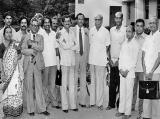
This photograph was taken in 1984 when the renowned Kannada poet, Prof KS Nisar Ahmed, was the president of  Karnataka Sahitya Academy. A felicitation function had been arranged for Masthi Venkatesha Iyengar, the  Kannada writer who had bagged the prestigious ‘Jnanapeetha Award’ for that year. 

It was a memorable  function in which many prominent writers  had participated. After the function, some of the close friends of Nisar Ahmed, including myself, gathered to congratulate him on arranging the function in a fitting manner. It was then that this photograph was taken.

Nisar Ahmed had started writing poetry in Kannada when he was studying MSc in Geology at the Central College  in the fifties. His poetry had caught the attention of his teacher and Kannada scholar GP Rajarathnam. He happened to read and correct his poetry and got it printed in the magazine of the Kannada Sangha of Central College. Later, poetry became his forte and he brought out one poetry collection after another.

He wrote prose too and translated two of Shakespeare’s plays. But he is recognised as a poet mainly as he has been writing poetry through all the literary movements of Kannada.Though his mother tongue is not Kannada, he has been writing in Kannada only.

Nisar Ahmed had also told the literary critics that he does not need any concession just because his mother tongue is not Kannada. He is also known as ‘Nithyostava Poet because his lyrics appeared in the first cassette of modern Kannada poetry under the same title. Since then, Nisar Ahmed has been a household name as one of the most popular among contemporary Kannada poets.

He was the president of the Karnataka Sahitya Academy between 1984 and 1987 and launched several programmes to take literature to the common people. In order to encourage young writers, many workshops were organised and lectures by eminent writers were arranged. He also organised a literary programme in every district and taluk head quarters and involved the local writers and the people  in creating awareness about the current literary trends. He started the English edition of the Academy’s quarterly journal ‘Aniketana’.

It was devoted to the English translation of Kannada literary pieces. Thus, it enabled the non-Kannada readers also to get an understanding of Kannada literature through translations. I remember that he had organised a seminar as the president of the Academy in Kanakapura of Bangalore Rural District in 1986 on the last quarter century of modern Kannada poetry in which stalwarts of Kannada literary world including Prof M Gopala Krishna Adiga, Prof  LS Seshagiri Rao, Dr Ramachandra Sharma, Dr Kamala Hampana had participated.

In the evening, there was a poets’ meet under the chairmanship of poet Dr Pu Thi Narasimhachar. It is worth mentioning that the seminar was attended by the people of Kanakapura in large numbers and actively participated in the interaction with the speakers of the seminar.

This photograph assumes importance for another reason. Two writers of yesteryears, namely the late Prof VM Inamdar and Prof Venugopala Soraba, are present in it.

source: http://www.deccanherald.com / Deccan Herald / Home> Supplements> MetroLife / by Prof. M S Raghunath / DHNS – April 06th, 2015

As darkness looms, weavers spin success story

Hubballi :

At Vishwanath Kenchi’s handloom unit at Gajendragad in Gadag district, the steady clacks of the looms belie all expectations. At a time when the handloom sector appears to be losing the fight to power looms, the 43-year-old has taken 75 weavers under his wing to ensure that their livelihood isn’t affected by the winds of change.
Kenchi’s organization – Adishakti Kaimagga Nekarara Sahakari Sangh Niyamita – which boasts of a flat structure, has been receiving a steady stream of orders since its inception as a self-help group in 2007. In the cooperative society’s success story lies a potential model for the handloom sector’s revival.

The climb to self-sustenance, though, wasn’t smooth. Kenchi found himself without work in 2007 when a cash-strapped Karnataka Handloom Development Corporation (KHDC) stopped giving him assignments. Hundreds of weavers were left in the lurch and were forced to migrate at the time.
But even in the face of such hardship, Kenchi decided to stick to his ‘family profession’. Work orders were few and far between, but he drew courage and solace from his handloom. Soon, a few others joined his self-help group.

During a visit to Heggodu in January 2008, Kenchi was inspired by theatre director and activist Prasanna, who has, time and again, taken up the cudgels for handloom weavers. Prasanna helped him and other weavers land more orders.

Things soon began to look up. “To meeting the growing demand, we had to buy another loom,” says Kenchi, who had to drop out of school after Class 3.

The Gajendragad resident was also egged on by the Deshpande Foundation in Hubballi. The NGO conferred on him the Navodyami Award in 2011. “Apart from the cash prize of Rs 1 lakh, it helped him get a bank loan of Rs 5 lakh.”

The loan was used to buy 3,634 sqft of land in Gajendragad to help the weavers expand their business.

Shrikant Chuncha, an employee of the sangh, credits the flat structure of the organization for the success of its business model. “As all employees are also members of the sangh, we get profit dividends, besides our wages, at the end of a year,” he explains.

Shadimbi Shantagiri, another employee, says members are paid Rs 17 per metre. “We weave about 10 m per day. Some of us manage to go up to 20 m.”
Another worker, Drakshayani Ashapur, 50, says flexible working hours between 6am and 6pm help a number of women find part-time JOBS.

Gururaj, Kenchi’s son, says the sangh has 251 members and 75 members-cum-employees. “We plan to create about 1,000 JOBS here by 2020. We produce saris, and clothes for shirts and coats.”

Orders come from Charaka, a women’s cooperative society specializing in natural dyes and handloom weaving founded by Prasanna, KHDC and other organizations from across the state, he says.

The sangh has prepared a proposal, seeking 6-7 acres of land from the department of handloom and textile. “We provide insurance cover to weavers and scholarships to their children with the help of government schemes,” says Gururaj.

source: http://www.timesofindia.indiatimes.com / The Times of India / Home> City> Hubballi / by Sangamesh Mena Sinakai, TNN / April 10th, 2015

Performance Institute Crosses Milestone

From In Such A State, adapted from U R Ananthamurthy's Avasthe. The centre, founded by actor-director Prakash Belawadi, is presenting six plays
From In Such A State, adapted from U R Ananthamurthy’s Avasthe. The centre, founded by actor-director Prakash Belawadi, is presenting six plays

Banashankari /JP Nagar :

Centre for Film and Drama (CFD), which turned 10 last August, will stage six plays, Tuesday onwards, as part of a milieu of events spread across this landmark year.

“We wanted an institute for training in integrated media and production,” says co-founder Prakash Belawadi. Now, he says, this has become so commonplace that even the term ‘convergence’ has gone out of use.

When CFD took off, its facility on Millers Road had, in addition to a performance space, an art gallery. But in 2010, it was mandated as a trust under Suchitra Cinema and Cultural Academy, and the school building coming up in its premises in Banashankari Stage II will be ready by the end of this year, the actor-director estimates.

Since its opening production, Brian Friel’s Translations directed by Mallika Prasad, in 2004, the group has averaged about four productions a year. And the selection of plays, on the whole, Belawadi says, are concerned with identity and identity crises.

“All our actors and directors are people who are interested in theatre as well as literature and other arts, and work with other groups in Bengaluru as well. So most of our plays are not only Indian, they are also very Kannadiga,” he says.

Like many of his peers, he rubbishes the notion that the technology that has led to this media integration has robbed theatre of this audience and artistes.

“I’ve been in theatre for about 30 years and every year, someone asks me about this. If anything, mainstream Kannada cinema is at risk because you can’t experiment in film and serials the way you can in theatre and get away with it,” he says.

But the journey so far for CFD, as it is for anyone in the field of theatre, hasn’t been free of hardship, nor is it likely to be. “One of the main challenges is that you’re constantly borrowing, trying to make things work in the box office because there is hardly any sponsorship in theatre,” he says, adding that this ensures that those who stick to theatre, usually, are the ones who love it most.

But while this passion for theatre remains in the artistes, Belawadi has observed that it has rather fizzled out in those who write about it.

“Earlier, staging a play was a risk, and reviewing it was equally risky,” he recalls, adding that critics were also people who were part of the theatre community, like himself.

“They deeply cared about it, and would get hated for the kind of reviews they wrote. This kind of engagement with the writer is something I miss,” he says. And this, he notes, is a problem common to cinema and music as well.

Even at the institute, he says, though he and the other faculty would like to train students in the art of theatre criticism, few are interested. “Most come to learn editing or acting,” he says.

So what does he feel is the solution to this? Conferences that facilitate interaction between members of the theatre community and those who write about them, and discussions of fresh scripts, he replies.

Plays next week

Tuesday – Michael Frayn’s Copenhagen

Wednesday –  Aatankavaadiya Aakasmika Saavu (Kannada)

Thursday – The Other Side Of History, a translation of Baaki Itihas by Badal Sircar

Friday – Badal Sircar’s Bogola Charit Manas (Bengali)

Saturday – In Such A State, based on U R Ananthamurthy’s Avasthe

Sunday – U R Ananthamurthy’s Avasthe (Kannada)

About the centre

Centre for Film and Drama offers year-long courses and works from Suchitra Film Society, Banashankari. Phone: 99868 63615

source: http://www.newindianexpress.com / The New Indian Express / Home> Cities> Bengaluru / by Chetana Divya Vasudev / April 11th, 2015

Fellowship award for Chauhan

O.P. Chauhan, scientist, Defence Food Research Laboratory, has secured the ‘Bioved Fellowship award 2015’ for his contribution in the field of food technology from Bioved Research Institute of Agriculture and Technology.

Mr. Chauhan’s research areas include post-harvest handling of fruits and vegetables, high pressure processing, pulsed electric field processing, microwave dehydration, vacuum frying and modified/controlled atmosphere packaging/storage of fruits and vegetables.

His research findings have appeared in over 60 international and national peer-reviewed journals and conference proceedings.

He has authored five international and six national book chapters.

Apart from this he has seven patents to his credit. — Staff Correspondent

source: http://www.thehindu.com / The Hindu / Home> News> National> Karnataka / Mysuru – April 12th, 2015

Mangaluru beauty to promote breast cancer awareness

Mangaluru :

When she was 12, she knew she would do something big. Thirteen years down the line, Aafreen Rachel Vaz, the first runner-up at fbb Femina Miss India 2015, has done it.

She will launch her own institute – Early Detection for a Better Future (EDBF) – which will work towards spreading awareness about breast cancer among Indian women. The institute, which will be launched on Tuesday, will concentrate on breast cancer. It will, later, bring under its umbrella other diseases which can be detected early.

“I do have a reason (for taking up breast cancer) – but that reason just served as a trigger. I lost a loved one at a very young age in Mumbai simply because it was misdiagnosed. I don’t think misdiagnosis on cancer should lead to someone’s death,” Aafreen, a third-year medical student at AJ Institute of medical science, Mangaluru, told TOI.

Aafreen’s resolve was strengthened when she won a scholarship from the Royal Society of Breast Cancer, New Zealand, and worked in the field for a year. She completed her Bachelor in Science with a major in physiology from the University of Otago, New Zealand, apart from doing a one-year course in radiation therapy from the same university.

Miss India was not even on cards; it happened by chance. Aafreen had directed a 45-minute film, ‘The Untrodden Path’, to enter a competition at Jipmer, Puducherry. Just then, Campus Princess, a pageant of the Times Group, was held. Aafreen was chosen winner, giving her automatic entry into Femina Miss India.

“I knew it was a one-month thing and studies would lag. But what better platform to launch many things which I dreamt of early, and why would not I go for it?” said Aafreen.

“It’s selfish to promote an NGO for a cause from which I will get a lot of satisfaction,” she quipped.

How will she balance her studies and handle the new responsibility? “The stress factor will be governed by my plan of action and how well my college is going to work with me. If I feel the stress is taking me to a point where I can’t handle it — I doubt it will happen — I will take a break from studies. But I will complete it (medicine). I have not thought about specialization, but oncology or psychiatry would be the choice,” Aafreen said.

Her Mangaluru roots are “too complicated to explain”. But her father would love a good chat in Konkani, she said, adding her parents were very happy to hear about her success. “I came to know that my mother had a shrill voice when she screamed with joy over the phone from New Zealand,” said Aafreen.

Getting into medicine was made easier by her parents, who asked her to go for what she is naturally good at, what she would enjoy doing and be successful at. “I’m good at human body systems. I’m lucky that my cause and my chosen career path go hand in hand.”

She will not refuse offers from Bollywood, Aafreen said. “I have been given offers, but my present commitment will not allow. Acting is natural to me as it has helped me get out of many a situation.”

She plans to hold a women’s marathon in Mangaluru soon to promote EDBF and raise awareness on breast cancer. “This will happen in a couple of months as I will away with Miss World commitments.”

source: http://www.timesofindia.indiatimes.com / The Times of India / Home> City> Mangaluru / TNN / April 07th, 2015