Yearly Archives: 2015

MIT solar flair will provide impetus to rural Karnataka

The Massachusetts Institute of Technology has roped in city-based Selco Foundation to run pilot project to ultimately benefit Karnataka

The MIT software will help minimise cost of installing solar micro-grids fo 10-50 kW to ensure uninterrupted power supply

​US-based Massachusetts Institute of Technology (MIT) and Selco Foundation in Bengaluru are sowing the seeds for large-scale rural solar electrification in Karnataka and Tamil Nadu. The aim is to pepper rural landscapes with well-placed 10-50 kW solar power micro-grids to directly supply uninterrupted power supply at minimal cost to small clusters of houses in villages.

The idea is to install solar power micro-grids in villages so that larger electric supply grids using conventional thermal/hydel power could more easily meet the growing urban demand for power in future.
Selco Foundation, a non-profit organisation focusing on enhancing quality of life and wealth creation in rural India through sustainable energy applications, is scheduled to run a pilot project in Munger district in Bihar to test an MIT-developed software tool that automatically analyses ideal locations for installing micro-grids.
According to MIT, a team of its graduate students and data scientists developed a software tool that identifies houses from readily-available satellite imagery and automatically analyses precise locations for setting up solar micro-grids in villages.
An MIT News Office release on the project said once the locations of houses are determined the computer runs thousands of combinations on where solar panels, battery packs, and distribution wires could be located.

This allows the team to pick configurations that provide power to the greatest number of houses with the least wiring to minimise costs.
Niraj Marathe, project lead, Selco Foundation, told Bangalore Mirror, “If proven accurate and effective, it can be used by project developers as an affordable planning tool as it will consider optimum costing as basis for planning and design of a (solar power) micro-grid system.”
In a pre-pilot trial run conducted by MIT in an unnamed Indian village, it was found that the process indeed saved considerable time and money otherwise spent in sending teams from village to village to identify locations.
The MIT findings have been published in the journal Big Data.
After the pre-pilot trial, MIT roped in Selco Foundation to conduct the pilot project in Munger.
Marathe said following the successful completion of the pilot in Munger, Selco plans to scout for villages in Karnataka and Tamil Nadu to install solar power-grids using the MIT software.
“We will work on two micro-grids simultaneously (in Munger). One will be planned and designed using the MIT tool, while the other will follow conventional planning and design methodology of Selco,” Marathe explained. “This will help us evaluate the effectiveness of the tool. Following the execution and detailed monitoring, we will evaluate the tool, incorporate necessary changes and use the tool again on planning different sets of micro-grids.”
MIT will select four more Indian villages for the next phase of testing: Two will have solar micro-grids installed using existing methods, and two installed by using patterns selected by the MIT software. These villages will then be compared for the actual costs and performance of the systems to determine the benefits.
This is the right time for installing micro-grids. In keeping with the state’s new solar power policy, the Karnataka State Pollution Control Board (KSPCB) earlier in April decided to keep only solar power units of more than 5 MW under the concerned acts for issuing licences. KSPCB chairman, Vaman Acharya, said this meant that public who installed solar power plants of capacity less than 5 MW need not get ‘No Objection Certificates’. Solar power comes under green category in the industry categorisation of Pollution Control Act.
“We’re hoping that public agencies eventually see the wisdom of mapping 100 million rural households…,” MIT News Office quoted Stewart Craine, chair of UN Foundation’s mapping group and head of DevelopmentMaps.org, a company offering satellite-based mapping services.

source: http://www.bangaloremirror.com / Bangalore Mirror / Home> Bangalore> Others / by Nirad Mudur, Bangalore Mirror Bureau / April 13th, 2015

Sci-fi writer Rajshekhar passes away

Dharwad :

Science fiction writer and physics professor Rajshekhar Bhusnurmath, 77, died at his Dharwad residence in the early hours of Sunday.

From Nidagundi in Ron taluk, Rajshekhar earned Master’s in physics and taught at Karnatak Science College in Dharwad. Son of noted writer SS Bhusnurmath, Rajshekhar was a popular sci-fi writer in Kannada and has produced several programmes for All India Radio.

Many of his novels were serialized in newspapers and magazines. Post retirement, he was guiding youngsters in astronomy. He is survived by his wife, two sons and two daughters.

source: http://www.timesofindia.indiatimes.com / The Times of India / Home> City> Bengaluru / TNN  / April 13th, 2015

Online Database of City Launched

Bengaluru :
An online database on Bengaluru, Justadz.com, has been launched recently by Naveen, a city-based entrepreneur.

Justadz is a comprehensive search platform developed and carefully assessed over a period of two years.

“We are mainly engaged in providing specific answers to the queries we receive. What counts most is a specific accessible answer to one’s requirements. Simply put, we strive to connect every single person searching for a solution with the apt service provider in his locality,” Justadz told Express.

“With numerous facilities such as online and offline search, classified listings, lead generations, promotions and discount offers along with several value-added services, Justadz.com aims to become Bengaluru’s best local search engine,” said Khussaal Jain, Naveen’s technical guide and mentor.

Naveen said the website will be updated bi-annually so that all the content on it is up-to-date and relevant for users.

source: http://www.newindianexpress.com / The New Indian Express / Home> Cities> Bengaluru / by Express News Service / April 13th, 2015

The Indian-American dream – At 17, Indian-origin girl gets into all Ivy League schools

Pooja, the only daughter of two engineers who immigrated to the US from Bangalore, got a SAT score of 2390 out of 2400, a 4.57 grade point average and aced all 13 of her Advanced Placement exams.

At just 17, an Indian-origin girl has earned admission to 14 top US universities, including all eight Ivy League schools that are considered the most prestigious varsities worldwide.

Virginia-born Pooja Chandrashekar decided to apply to all eight colleges hoping to get into just one of them. But now she has the choice to get into Harvard, Yale, Princeton, Cornell, Dartmouth, Columbia, Brown, and the University of Pennsylvania besides six other elite universities in the US, including Stanford and MIT.

Pooja, the only daughter of two engineers who immigrated to the US from Bangalore, got a SAT score of 2390 out of 2400, a 4.57 grade point average and aced all 13 of her Advanced Placement exams.

The brainy teenager, who graduated from Thomas Jefferson High School for Science and Technology, a top-ranked magnet school in Virginia, has developed a mobile app that analyses speech patterns and predicts with 96 per cent accuracy if a person has Parkinson’s disease. She has also founded a organisation that encourages middle-school American girls to participate in science, technology, engineering and math (STEM) programmes. Pooja said that she decided to apply to all eight ivies hoping to get into just one of them, “because college admissions are really unpredictable.”

“They are all fantastic schools, so I couldn’t discount any of them…I wanted to make sure I could get into a really good school and have more choices,” she told The Washington Post.

She has narrowed her list to Harvard, Stanford and Brown, where she got into a programme that guarantees her admission to the university’s medical school. Pooja said that what sets her apart is her passion for promoting STEM among young girls. Her non-profit ProjectCSGirls, hosts nationwide computer science competitions, “dedicated to closing the tech gender gap.”

She wrote one of her college application essays about being a woman interested in a career in computer science, a field long dominated by men. She said she was often one of just a handful of girls in her high school technology classes. “I want to encourage diversity in the field,” she told the daily.

source: http://www.thehindu.com / The Hindu / Home> News> International / by PTI / April 12th, 2015

Biotech Forum Office-bearers Elected

Bengaluru :

The executive council of the Association of Biotechnology Led Enterprises (ABLE) has elected Kiran Mazumdar-Shaw, chairman and managing director, Biocon, as its first non-executive chairman in an honorary capacity.

Dr P M Murali, managing director and CEO, Evolva Biotech, has been re-elected president of ABLE for a second term. Shrikumar Suryanarayan, chairman of Sea6 Energy, has been elected vice-president, while Dr Goutam Das, Chief Operating Officer of ABLE, has been elected as secretary and will also hold the treasury portfolio. The term of the new office-bearers is from 2015 to 2018.

source: http://www.newindianexpress.com / The New Indian Express / Home> Cities> Bengaluru / by Express News Service / April 09th, 2015

83-year-old woman gets her house back


Stella D’Souza was cheated by her relative.

Ravindranath Shanbhag, president of Human Rights Protection Foundation (HRPF), said on Tuesday that the foundation had helped one more senior citizen get back her house that was fraudulently taken from her by a relative in Mangaluru.

Addressing presspersons here, Mr. Shanbhag said that Stella D’Souza (83), who was a spinster and retired teacher, had a house at Vamanjur in Mangaluru.

Ms. D’Souza had not adopted any children. Her relative, a woman, used to visit her house under the pretext of enquiring about her welfare. During these visits, she used to persuade Ms. D’Souza to keep the land documents safe, preferably in the Sub-Registrar’s Office.

Trusting her relative, Ms. D’Souza agreed to her suggestion. Her relative took Ms. D’Souza to the Sub Registrar’s Office in Mangaluru on August 30, 2011, where the latter signed some papers, which she believed was for safe-keeping the land records. But Ms. D’Souza signed a sale deed selling the house to the relative for Rs. 3.31 lakh. “The motive appeared to be to grab the property after Ms. D’Souza’s death,” Mr. Shanbhag said.

A year later, Ms. D’Souza came to know that she had been tricked by her relative and she filed a case in the JMFC court in Mangaluru in 2013. Then she approached the HRPF here.

The HRPF took her case under the Maintenance and Welfare of Parents and Senior Citizens Act 2007 to the court of the Sub Divisional Magistrate of Mangaluru.

The Sub Divisional Magistrate (Assistant Commissioner) ordered cancellation of the sale deed on March 9, 2015 and Ms. D’Souza got back her house, Mr. Shanbhag said.

Relook at the Act

He said that as per the Act, a case should be disposed in 90 days. But in this case, it took six months as Assistant Commissioner was busy. Besides, the Assistant Commissioner gave every opportunity to the relative to explain her position.

“It will be better if the government amended the Act and made a provision for interim order by the Sub Divisional Magistrate. There is no provision for an interim order in the Act,” he said.

Not many people knew about the Act. The government should create awareness about the Act among the public and also officials, Mr. Shanbhag said.

Ms. D’Souza, who was present at the press meet, said that she had been tense for the last four years. “Now I am delighted at getting back my house,” she said.

Mr. Shanbhag said that the HRPF had received 392 cases of fraud performed on senior citizens either by their children or relatives from different parts of the State. Of these, 12 cases had been disposed and 45 cases had been settled out of court, he said.

source: http://www.thehindu.com / The Hindu / Home> News> National> Karnataka / by Ganesh Prabhu / Udupi – April 10th, 2015

Centenary celebrations Rosario Cathedral on Sunday

Mangaluru :

The centenary celebrations of Rosario Cathedral, the first church of Mangalore diocese, will be held on Sunday.

However, the 100-year celebration merely spotlights the milestone of the present building built in 1915; the church is much older than that. Its rich history dates back to 1568.

In 1784, the edifice suffered much wear and tear when Tipu Sultan engaged in attack against churches, as he presumed the Coastal Christians were in favour of the British rule. As a result, the church suffered massive damage.

In 1799, Canara Christians returned to Mangalore. However, due to the new rules and regulations imposed by the British, Rosario Church of Bolar failed to establish its importance. Fortunately, in 1813, the devotees succeeded in building a small church.

In 1915, under the guidance of Father Henry Buzzoni and Brother Divo, the present church was constructed. Paul Perrini, the then Bishop, blessed the church.

This huge church is not only the Centre of the Diocese of Mangalore but also the Bishop’s official seat of exercising his authority. Bishops’ consecration, annual blessing of oils and all other important religious ceremonies are held here. The deceased Bishops’ burial ceremonies also held here and their tombs are found inside the church.

From the entrance of the church to the sanctuary on either side there are huge pillars on which stand the massive arches exhibiting awe and reverence. The huge pulpit (preaching place), the statue of Our Lady of Holy Rosary in the Sanctuary and baptistery enhance the beauty of the church.

The Kannada Karavali Catholics refer to the patroness of the church as Ruzar Mai, who, in their life, literature, culture, and faith, has become an inseparable part.

The bells of Rosario Cathedral have gained popularity. Each year, on the first Sunday during the Eucharistic procession from Milagres church to Rosario cathedral these bells are tolled for more than an hour. The bells announce the different hours and different events.

source: http://www.timesofindia.indiatimes.com / The Times of India / Home> City> Mangaluru / Stanley Pinto, TNN / April 08th, 2015

Rajagopalan Award for IISc Scientists

Bengaluru :

IISc Alumni Association celebrated the birth centenary of eminent scientist Dr Srinivasa Rajagopalan here on Thursday. Dr Rajagopalan’s family has instituted a biennial cash award of `1 lakh to be given to an outstanding young Indian scientist. The first award ceremony was was shared between Dr Santanu Mukherjee of the Department of Organic Chemistry, IISc and Dr Govardhan Reddy of the Solid State Chemistry Unit, IISc. The award was given away by IISc Director Anurag Kumar.

Dr Shantanu Mukherjee is a young faculty at IISc. He works on chiral molecules that are mirror images of each other, their preparation and analysis. Dr Govardhan Reddy works on protein molecules, their folding and aggregation.

Dr Rajagopalan made a mark for himself in organic chemistry especially in the field of tropical medicine and early research on steroids. He began his scientific career as a research scholar at IISc in 1938.

source: http://www.newindianexpress.com / The New Indian Express / Home> Cities> Bengaluru / by Express News Service  / April 10th, 2015

When Gandhi came to Badanavalu …

The village in Mysuru district will host National Convention for Sustainable Living on April 19.

The first “star” to arrive at Badanavalu village in Mysuru district, once a prominent centre for khadi and village industries, was Mahatma Gandhi, back in 1932.

Theatre personality Prasanna and people from various walks of life have joined hands to revive Badanavalu Khadi and Gramodyog Centre which is in a shambles, and (right) Mahatma Gandhi during his visit to the village in 1932.

He was pleasantly surprised by the success of the khadi centre here run on a 7.5-acre campus. Badanavalu Khadi and Gramodyog Centre was established in 1927 with only four Dalit women, with the intention to uplift the economy of Dalits. Their number increased gradually and the centre introduced other trades. More than 300 women were working during its heydays.

Over a period of time, however, the place saw a decline, with work sheds falling into disuse.

Theatre personality Prasanna and people from various walks of life have joined hands to revive Badanavalu Khadi and Gramodyog Centre which is in a shambles, and (right) Mahatma Gandhi during his visit to the village in 1932.

Now, led by theatre personality Prasanna, a group of volunteers have been living in the village and rebuilding the sheds besides holding meetings, workshops, street performances, and visual art campaigns since March 21.

Six padayatras will begin on April 12 from various parts of the State and culminate at Badanavalu for the National Convention for Sustainable Living on April 19. According to Mr. Prasanna, panchayats will be held on different aspects of sustainability throughout that day and there will be exhibitions, sale, demonstrations and prayer meetings at the convention.

Artistes, activists and leaders of various people’s movements are now camping with Mr. Prasanna and joining their hands in temporarily resurrecting the centre which is in a shambles.

“We don’t demand anything from the government, as successive governments have failed in sustainable development. Equally blaming the people for the situation, we want to create awareness among them on the need for sustainable development,” Mr. Prasanna said.

The plan is to expand the movement across the country, using Badanavalu as a symbol. Redesigning Badanavalu, without harming the original design of the existing structure, and making the village a “pilgrimage place” for people who believe in sustainable living were all part of the plan, he explained.

source: http://www.thehindu.com / The Hindu / Home> News> National> Karnataka / by Muralidhara Khajane / Bengaluru – April 10th, 2015

From Single Screen to Multiplex…

VaishaliBF09apr2015

Vaishali has it first for our city 

by Sujata Rajpal

Call it destiny or seizing the opportunity but all big things in life are the result of taking the right decision at the right time.

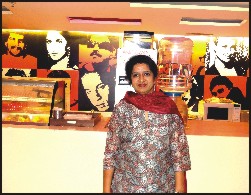
Vaishali Hanumanth, the Managing Partner of DRC Cinemas in Mysuru, is a perfect testimony to the above sentiment. Not only this, such once-in-a-lifetime situations always come disguised in the most innocuous forms such as the driver taking off on that particular day. The golden opportunity to set up the first multiplex in Mysuru knocked at Vaishali’s door when one day she had to drive her father to the office of Dr. C.B. Murthy of B.M. Hospital. The proposal to build and operate a multiplex was offered initially to Vaishali’s father, who runs a Finance company but he had his hands already full. Turning down such an offer on the phone would have been discourteous.

Vaishali sat in Dr. Murthy’s office flipping the pages of a random magazine as the duo got engrossed in the business talk. Dr. Murthy asked her father, “If you can’t do it let your daughter take it.” And the gutsy woman signed the deal without blinking an eyelid and the rest as they say is history which was made on Oct. 1, 2011 when the royal city got its first multiplex located at B.M. Habitat Mall in Jayalakshmipuram.

“Sometimes ignorance is bliss. If I had known about the challenges involved in this high risk industry, perhaps I wouldn’t have taken this project,” says Vaishali, who admits being an intuitive person.

“The challenges have been aplenty right from the construction stage to dealings with distributors to operations. Since the cost of construction was huge, I decided to procure the material and personally supervise the construction which enabled me to bring down the cost of construction drastically. Even though well-wishers warned me about making such a huge Investment in a laid-back city, the response has been encouraging right from the beginning. I never had an iota of doubt about its success. Though laid-back, Mysureans indulge if they get value for money,” believes Vaishali, who is an unadulterated Mysurean.

An alumna of CKC School and Marimallappa College, Vaishali graduated in Commerce from JSS College of Commerce. At the age of three-and-half years, Vaishali had her Aksharabhyasam at the Shanthala theatre jointly owned by her grandfather.

“It is interesting that today I am running a multiplex,” Vaishali says dreamily.

DRC changed the definition of entertainment for the residents of Mysuru. When visitors enter the premises, they are awed by the alluring ambience, spic-and-span floor, sparkling clean restrooms and the courteous staff as if everything functions on auto mode. The drive behind the auto mode is the managing partner herself who spends around ten hours every day at her office-cum-second home. “Actually my family calls DRC my first home. This theatre is my passion. I enjoy my work thoroughly,” laughs the doe-eyed woman.

“How do you manage to maintain it so well?” I ask.

“Don’t we take pride in maintaining our house?” she counter questions me. Vaishali fondly recalls the incident when N.R. Narayana Murthy, who had come to watch a movie, complimented her on the impeccable maintenance of the multiplex.

Not the kind to sit back and bask in the glory, Vaishali is constantly scaling up the theatre. When the theatre was started, only one screen was 3D compatible. Now all four screens are 3D compatible.

The spunky woman is up and running everywhere in the theatre premises personally supervising if all is fine in the projector room, ticket counters, snack counters, with the house-keeping and even catching up with the visitors who stop by to say hello.

“I couldn’t have managed this multiplex without the support of my family. I am fortunate to get tremendous family support. My husband and my father are my backbones,” admits the lady with the contagious smile. Her daughter Manasa, is studying Law at Symbiosis Law School, Pune and son Krishna, is a class 12 student at NPS International School.

Fact file on

DRC was started on Oct. 1, 2011

All the four screens are 3D compatible

Average 20 shows are screened daily

Four movies – Force (Hindi), Dookudu (Telugu), Kung Fu Panda (English) and Lifeu Ishtene (Kannada) were screened on the first day

Life of Pi ran for 200 days (the maximum number of days at DRC until now)

The theatre has a total seating capacity of 958

5.6 lakh visitors visited DRC in the first year

In the first eleven months of 2014, 5.86 lakh people visited this multiplex

DRC is built on a total area of 30,625 sqft

Each projector lamp required to screen a film costs Rs. 80,000

Each lamp has a life of 1000 hours

The most delectable Samosas in Mysuru are sold at DRC [I take the liberty to add the last fact as I make my way to the Samosa counter].

source: http://www.starofmysore.com / Star of Mysore / Home> Feature Articles / Friday – April 03rd, 2015