Yearly Archives: 2015

Musings on awards and years past …

A reason to go down memory lane

AwardsBF09apr2015

The year 2015 seems to have begun well for me considering the way it went so far. To begin with, I was on a North India tour on Royal Rajasthan on Wheels (RROW) about which I have been writing in this column quite for some time now and still to write the concluding part; then I went to Dubai and, of course, a thanksgiving visit to Tirupati!

And then came the Award from the Government of Karnataka with the Journalism Awards Selection Committee headed by Justice Arali Nagaraj (retired) selecting me for the prestigious Mohare Hanamantharaya Award, carrying rupees one lakh reward, for Excellence in Journalism for the year 2013. This was given at a function held at Bengaluru by Chief Minister Siddharamaiah on 27th March, 2015. There were eight recipients of awards under four categories and all these awards were given away at the function. Siddharamaiah was the third Chief Minister to give me an award, instituted by the government; the other two earlier ones were given by S.M. Krishna and B.S. Yeddyurappa.

The then Chief Minister S.M. Krishna gave me the Karnataka State Press Academy Award at the Ravindra Kalakshetra on Thursday, 5th April, 2002. On that occasion, Krishna also gave away a Special Award of the Press Academy to H.Y. Sharada Prasad, the legendary Press Advisor to Indira Gandhi and other Prime Ministers. Veteran journalist, Prajavani, Arjun Deva was the Chairman of the Press Academy then. I was extremely delighted this time to find Arjun Deva being a recipient of TSR Memorial Journalism Award for 2012 (Lifetime Achievement Award) which was also presented by Siddharamaiah on 27th March, 2015 at Sulochana Hall, Bengaluru.

The second time I was honoured by the Karnataka Government was on 1st November, 2008 when the then Chief Minister B.S. Yeddyurappa presented the Rajyotsava Award at Sri Kanteerava Indoor Stadium, Bengaluru. The other three distinguished persons in the area of their specialisation were former Dean and Founder of CAVA (Chamarajendra Academy of Visual Arts) Prof. V.M. Sholapurkar, Dr. Ambalike Hiriyanna (folk) and Dr. Vijaya Dabbe (literature). Inlay artist Puttaraju was also bestowed the Rajyotsava award that year apart from two others.

Now, in the Year of Our Lord 2015, for the third time I received another award, as mentioned earlier, from the present Chief Minister Siddharamaiah. Hat-trick of a sort. Be that as it may, I must recall here another occasion many years ago, 16.2.1998, when I had Siddharamaiah to preside over the 20th anniversary of Star of Mysore along with M.C. Nanaiah and Dr. U.R. Ananthamurthy at Kalamandira. It was the Janata Government, Siddharamaiah was the Deputy Chief Minister and M.C. Nanaiah was the Law Minister. Siddharamaiah was notorious for not keeping the time; not known for punctuality. Since I knew M.C. Nanaiah well from our college days, I entrusted him the job of getting this man to the function on time. It was a great victory for M.C. Nanaiah. However, Siddharamaiah spoiled the post-function programmes of a dance-drama by a renowned troupe from Bengaluru and also the dinner at Regaalis (then Quality Inn Southern Star) by speaking for fifty minutes in a dull-drab drawl of a speech unconnected to the subject of the function.

Surprisingly this time at the Sulochana Hall in Bengaluru though he came late by one hour at 7.30 pm, he acquitted himself like an experienced professional on the stage and also in delivering his speech. He spoke for 15 minutes to the point. It was short enough to be interesting and long enough to cover the subject. Just like a lady’s skirt. A good speech delivered with aplomb in his booming voice befitting a Chief Minister. All of us felt proud of him. Indeed, he has come a long way from 1998 to 2015 and has learnt his trade well. His Kannada was chaste, grammatically accurate, used apt words and more importantly, did not deviate from the theme of the function. He even indulged in a couple of light- hearted banter bringing smile on the faces of the audience and he himself breaking his lips to a smile of his special brand – smirk. Thank you Sir.

You will make a good Chief Minister in public and may even last full five years’ term if you break away from the present venal coterie of advisors. Make yourself a “People’s Chief Minister” (like Princess Diana who was called “People’s Princess”). You are not the Chief Minister only for Ahinda or a certain section of the people. Other sections of people too have their own problems. Address them openly. Otherwise you will get into many snares and traps like the one created following the death of D.K. Ravi, IAS Officer, in which you lost your face.

And finally, I am also reminded of the great disappointment I suffered as a result of trusting the then Minister H. Vishwanath in the year 2003. I wanted to conduct the Silver Jubilee of Star of Mysore in a grand manner. S.M. Krishna was the Chief Minister. I wanted him to preside over the function. Vishwanath being from Mysore, whom I knew personally well, had assured me (100%) to get the Chief Minister on 16.2.2003, for the Silver Jubilee function. Till the last moment, Vishwanath’s assurance remained typical of a politician’s promise. If only he had told me his inability at least in advance…that’s history’s one more If.

Star of Mysore News Editor M.R. Shivanna was the one who made me trust Vishwanath for getting S.M. Krishna. I trusted Shivanna being our own man and who knew Vishwanath better than me. We even had a few dinner meetings to review the arrangements with Vishwanath. Well, some live and never learn. I am one such dullard.

M.R. Shivanna was my ‘right hand’ man in the matter of news gathering and news writing for Star of Mysore. He had been with Star of Mysore for 30 years till he breathed his last on 21.5.2011. When S. Bangarappa was the Chief Minister, 17.10.1990 – 19.11.1992, Govindaraju was the Chairman of MUDA and was too close to Bangarappa. Shivanna too was close to Govindaraju who was given huge news coverage in Star of Mysore and Mysooru Mithra by Shivanna taking advantage of my long absence of over 40 days. The papers, Star of Mysore and Mysooru Mithra, drew flak from the readers. Later, when November approached Shivanna was tipped for the Rajyotsava Award that year which seemed like a quid pro quo.

One evening, he came to me and sheepishly disclosed the news. “Sir, I asked Govindaraju to recommend your name. But he refused…,” explained Shivanna. I smiled. “How can I receive the award when you are here…,” lamented Shivanna. I said, “Don’t you worry. Tell me what comes with the Award?”

Shivanna: “Rs. 10,000 and I think a house site at MUDA rate.”

“Okay,” I said. “Look here Shivanna, I do not need that Rs. 10,000 nor that site. You can sell the site later and MAKE SOME MONEY. Don’t feel bad that you are superseding me… Go ahead and receive the award,” I told him without mincing words. A man of few words, he quietly withdrew. I don’t think he ever got the site. But Shivanna was very happy when I too got the Rajyotsava Award in 2008. For the first time the reward money was raised to Rs. one lakh and told Shivanna it was good I got the award so late after you !

At the awards function on 27th March 2015, I could not see Chief Minister’s Media Advisor Dinesh Amin Mattu but I was told by my Editor Govinde Gowda that he was there.

Here I would like to contemplate on Amin Mattu’s connection to this 27th March Awards function. Wonder, if this function would have ever happened at all on this date but for Amin Mattu’s intervention, if there was. However, I guess, there was his intervention and he must have been prompted by my remark at a function held at Mysuru District Journalists Association (MDJA) Hall where Amin Mattu was the chief guest. This function was held on 9th March 2015 to felicitate me for getting the Journalism Award and also Amshi Prasanna Kumar for getting the Award for ‘Development Journalism’ apart from awarding others under an endowment.

When I was asked to speak I said I was reluctant to be felicitated for fear that the award, not yet given to me though announced nearly eight months ago, might as well be withdrawn as a mistake or for some other reason. So saying I drew the attention of our Chief Minister’s Media Advisor Amin Mattu to the apparent incompetence of the government in a simple matter of organising a function to give the award announced nearly a year ago. As a sting in the tail, I had said that since a couple of awardees were past 75 years, the government should not find itself giving the award posthumously! Amin Mattu must have got the message and lo and behold, on the 18th day after I said this, the awards were given away by CM Siddharamaiah himself.

Thank you Amin Mattu.

e-mail: kbg@starofmysore.com

source: http://www.starofmysore.com / Star of Mysore / Home> Abracadabra…Abracadabra / Friday – April 03rd, 2015
Dr. Chandrashekar conferred Sri Mahaveer Ahimsa award

DrChandrasekharBF09apr2015

Mysuru :

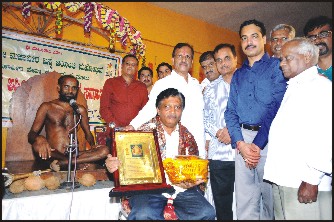
Medical Practitioner and Social Worker Dr. Chandrashekar was conferred ‘Sri Mahaveer Ahimsa’ award at the Bhagawan Mahaveer Jayanti celebrations organised under the aegis of Sri Mahaveer Seva Samsthan at M.L. Jain Boarding Home on Chandragupta road in city yesterday.

Speaking on the occasion, Srirangapatna Court Judge Sushat Mahaveer Chowgule, who was the chief guest, said that he had previously listened to a discourse presented by Munimaharaj Swamiji, when the Swamiji had explained on how we had deviated from Jain religion’s philosophies and principles to suit out selfish ends. He stressed on the need for making a pledge on following Jain religion philosophies in our daily life. Digambar Jain Samaj President S.N. Prakash Babu presided.

Mahaveer Bhavan working President M.A. Sudhir Kumar, M.L. Jain Boarding Home Secretary Madan Kumar and others were present.

source: http://www.starofmysore.com / Star of Mysore / Home> General News / Friday – April 03rd, 2015

City Doctor chairs ‘Hip Session’ at US

Dr. B.R. Prashanth (right) and Dr. J. Marsh, Chairpersons for the ‘Hip Session,’ seen at the AAOS meet in Las Vegas recently.

Mysuru :

Dr. B.R. Prashanth, Orthopaedic Surgeon attached to Columbia Asia Hospital, Mysuru and Committee Member representing India, chaired a ‘Hip Session’ along with Dr. John Marsh from USA at the American Academy of Orthopaedic Surgeons (AAOS) 85th Annual Meeting that concluded on Mar. 28 at the Venetian Sands expo, Las Vegas, USA.

Scientific papers from US, Canada, Europe and Asia pacific were presented. The consensus on hip fracture treatment was that these patients should be operated upon with in forty eight hours to reduce the mortality and morbidity in these elderly, osteoporotic individuals. Also, the role of hip replacement surgery in these patients was also presented.

Dr. Prashanth also critically evaluated five Instructional Course Lectures (ICL) ranging from Knee replacement Surgery to knee sporting injuries. The ‘Metal free Replacement’ for patients with metal allergies, ‘Fast track’ knee replacements for faster recovery and the new generation computer-assisted knee replacements besides ‘Gel one,’ a non-operative treatment for knee arthritis, were the latest developments which were presented and will be introduced in India shortly, says Dr. Prashanth.

China was the guest nation at AAOS and the advancements in Orthopaedic Surgery from China were highlighted. Dr. Mihalko, Chair of Committee Members, appreciated the efforts of the International Committee Members contributing to the development of the prestigious AAOS at the inaugural event.

A total of over twenty thousand orthopaedic surgeons from around the globe attended this annual event.

source: http://www.starofmysore.com / Star of Mysore / Home> General News / Friday – April 03rd, 2015

The pioneer of electronic tambura

“Can you not manufacture a pocket-sized electronic tambura,” the doyen M. Balamuralikrishna had asked G. Raj Narayan of Radel Electronics, the pioneer of electronic tambura, and a flautist, in the 1980s.

“Miniatures don’t serve the purpose as the size of the speaker determines the needed tonal throw and quality,” explains Mr. Raj Narayan, who first brought out electronic tamburas in 1979 and bagged several awards for his innovation.

Tambura apps are linked to fashion and the mindset of people now, Mr. Raj Narayan says, and adds that such apps cannot go beyond a point as “an external amplifier and speaker have to be connected for use on stage, which makes it cumbersome.”

There are seven variants in Radel’s electronic tamburas, catering to both the Carnatic and Hindustani genres. The price ranges from Rs. 3,000 to Rs. 6,500 and “some are even shaped like a tambura,” he says

Honour for tambura artistes

Despite not many artistes using tamburas, all concerts at the Sree Ramaseva Mandali, Chamarajpet, feature the instrument. For the first time, three well-known tambura artistes V. Jagannatha Rao, Sripada Rao and Hulikal Prasad will be honoured by the mandali.

Family members of the tambura artistes cherish the days when artistes such as T. Chowdiah, Honnappa Bhagavathar, Doreswamy Iyengar, T.R. Mahalingam, Bhimsen Joshi and M.S. Subbulakshmi used to send inland letters requesting them for their tambura accompaniment. All India Radio, until the late 1970s, used to appoint tambura artistes with an underlying rule that they possess good vocal knowledge.

source: http://www.thehindu.com / The Hindu / Home> News> Cities> Bengaluru / by Ranjani Govind / Bengaluru – April 06th, 2015

India and US share a common vision of peaceful and stable world : Richard Verma

US Ambassador to India inaugurates renovated ORI building

US Ambassador to India Richard Verma being felicitated by University of Mysore Vice-Chancellor Prof. K.S. Rangappa with a Mysuru Peta, silk shawl, sandal garland and a memento (wood-inlay of the Crawford Hall) during the inauguration of the renovated building of Oriental Research Institute (ORI) in city last evening. Also seen are Director of ORI Dr. H.P. Devaki (extreme left) and Registrar of UoM Prof. C. Basavaraju.


Mysuru :

US Ambassador to India, Richard Verma inaugurated the renovated building of the Oriental Research Institute (ORI) here yesterday. The renovation was funded by the US Consulate, which had donated $50,000 in the year 2012.

Speaking on the occasion, Verma said that both India and the United States have entered into a ‘strategic plus’ phase in their relationship, sharing a common vision of a peaceful, prosperous and stable world. He further stated that the partnership is bolstered by people-to-people ties between the two nations and said, “How we work together to achieve a common vision defines our strategic plus partnership, be it with regard to economic and trade relations, energy, space, climate change, science and technology etc.”

The US Ambassador referred to the ancient Indian treatise of Arthashastra by Chanakya and said that Chanakya had told that a ‘true friend’ in international affairs was someone who shared common objectives and added that India and the US share democratic values and can be called ‘true friends,’ if they accept the wisdom of Chanakya.

Speaking at the programme, Vice-Chancellor of University of Mysore (UoM), Prof. K.S. Rangappa requested Verma to contribute $2,00,000 dollars for the restoration of various heritage buildings of the University.

The ORI now houses more than 30,000 paper and palm-leaf manuscripts and over 45,000 rare books. The items were put on display for the Ambassador including a rare manuscript of Chanakya’s Arthashastra, transliterated versions of the religious work commissioned by the then Maharaja of Mysuru, Nalwadi Krishnaraja Wadiyar and rare palm-leaf manuscripts with treatise on astronomy, medicine and mythology.

Looking at the manuscripts, Verma said that he was thrilled to see the only copy of the Arthashastra in Mysuru.

Registrar of UoM Prof. C. Basavaraju and Director of ORI Dr. H.P. Devaki were present during the VIP’s visit.

Richard’s Mysuru Connection

It might be surprising to know that the US Ambassador to India, Richard Verma has a closer connection with Mysuru than we had thought.

Richard’s sister Roma Murthy is married to Bala Murthy from Mysuru. Bala Murthy’s father late N. Narasimha Murthy was the former Principal of National Institute of Engineering (NIE).

Speaking after the inauguration of the renovated ORI building, Verma said that it was a great honour to be in the city where he was able to meet some of his family members. He recalled that his father, who went to the US to pursue a Master’s degree in English Literature, had a close interaction with scholars of the Department of English, UoM.

source: http://www.starofmysore.com / Star of Mysore / Home> General News / Wednesday – April 01st, 2015

US Envoy awestruck by Palace

PalaceBF07apr2015

Mysuru :

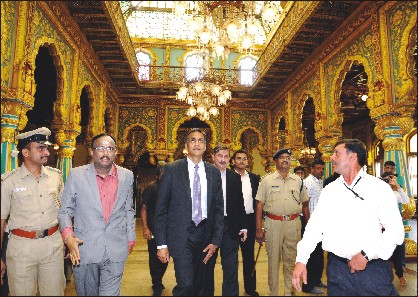
US Ambassador to India Richard Verma, who arrived in city yesterday to inaugurate the renovated building of Oriental Research Institute (ORI), visited the Amba Vilas Palace, popularly known as Mysore Palace, in city this morning.

On his arrival, he visited the residence of late Srikanta Datta Narasimharaja Wadiyar to meet Pramoda Devi Wadiyar and had a brief chat over a cup of tea.

Later, Richard Verma visited the Private Durbar Hall, ornate Kalyana Mantap and other prominent sections inside the Mysore Palace.

He expressed his happiness over the maintenance of the Mysore Palace, the gold leafing works and the recently introduced Braille book facility.

Verma told the Palace Board officials accompanying him that he would spend more time at the Palace during his next visit to Mysuru.

Earlier, Mysore Palace Board Deputy Director T.S. Subramanya welcomed Richard Verma with the traditional Mysuru Peta and a shawl.

During his Palace visit, Richard was accompanied by his brother-in-law Bala Murthy, President, i4 Now Solutions, USA and Co-ordinator Ariel H. Pollock.

source: http://www.starofmysore.com / Star of Mysore / Home> General News / Wednesday – April 01st, 2015

A self-sustaining art village in Haveri

Artists busy at work at the Utsav Rock Garden in Gotagodi of Haveri district.

With the government not keen on recruiting Fine Arts teachers, Yallappa Uppar, with his ‘Art Master Course’ certificate, would have ended up opting for a job that had nothing to do with his passion. But, a chance to work with a different media saved him.

Ten years after he made the choice, Yallappa is a happy man doing what he loves, making sculptures and getting paid for them.

Like Yallappa, there are 100 more sculptors and Fine Arts graduates, who are now able to make a living in an art village in Haveri district.

Located off the Pune-Bengaluru National Highway (No. 4), 37 km from Hubballi, the Utsav Rock Garden at Gotagodi in Shiggaon taluk of Haveri district, is a prime example of the transformation of an art village concept into a revenue-generating model.

The Utsav Rock Garden has already become a picnic hotspot for the people of the northern districts of Karnataka, where people love to spend the day experiencing ‘village life’ recreated by artisans.

The enjoy the art works, which are a mix of both contemporary and traditional art forms, fashioned out of cement.

What is unusual is that the ‘art village’ keeps on expanding, adding new creations while providing work to the artisans and the sculptors. The brainchild of senior artist, art teacher and folklore scholar, T.B. Solabakkanavar, and given shape by his son, Harsha Solabakkanavar, the rock garden, is an attempt at preserving Kannada culture and traditions.

“The set-up is in the form of a company now, but will soon get converted into a trust,” says Managing Director of the garden, Prakash Dasanur.

The art village is a training ground too.

“We provide training along with food and accommodation, and remuneration for the artists work. Over 2,000 artists have been trained here and they are taking up individual and group art assignments,” said Vedarani P. Dasanur, curator of the rock garden.

“There are around 80 Fine Arts schools in Karnataka, and not many who pass out are able to eke out a decent living. We experimented and recreated a revenue-generating model. The government could facilitate creation of such art villages in other places or involve artists in beautification projects and in preserving art and culture,” said Mr. Solabakkanavar.

“If the artists team up, there are various opportunities for them, especially in the wake of a growing demand for cement sculptures,” said Harsha.

source: http://www.thehindu.com / The Hindu / Home> News> National / by Girish Pattanashetti / Hubballi – April 06th, 2015

Southern Comfort Moves Up North

U S Mahendar (fifth from left) with his team members | JITHENDRA M

The engaging logo of the pot-bellied coffee maker juggling his classic steel tumblers is all set to invade tea drinking bastions in north of the Vindhyas under the brand Hatti Kaapi. Rooted in Bengaluru, the affordable and well-researched over-the-counter format is the brainchild of U S Mahendar, a small town coffee powder maker, hailing from Hassan district. Catering to office goers, tourists, shoppers and passersby, the distinctive little outlets dish up seemingly endless South Indian style cups of filter coffee. They almost serve 70,000 cups  of coffee on a daily basis along with a small range of teas, milkshakes and snacks.

The Hatti Kaapi growth chart is impressive. It began as one tiny outlet in 2009 operating out of Bengaluru’s bustling Gandhi Bazar area and located under a stuffy staircase. Now 40 units are spread across street corners, tech-parks and more recently airports in Bengaluru and Hyderabad. At Rs 12, one can get a cup of hot filter coffee and khara bhath, while a cup of hot coffee costs Rs 5.

Mahendar himself sounds a tad bemused by their success and the several awards and recognitions they have won. “It was at 5.30 am on November 27, 2009, that we served our first cup of traditional filter coffee from our 40 sq ft counter in Gandhi Bazaar. We sold 3,000 cups at Rs 5 each the next day and haven’t looked back since,” he says, adding, “I came to Bengaluru with my mother, friend M L Gowda who is now a partner in Hatti Kaapi and with just Rs 2,000 in hand. My mission was to market our coffee powder to some of the big Udupi restaurant chains specialising in South Indian filter coffee. One particular brand insisted that we come in at 4 am each day , brew the coffee, serve it to customers and collect feedback on the quality.”

After three exhausting months of doing this, they were told that they were not good. In retrospect, that rejection turned out to be in their favour. Mahendar took it as a challenge and decided to start his own brand.

He attributes his success to his core team which includes a mix of Starbucks baristas, industry veterans like S Lakshmana Swamy  from Hindustan Unilever, his head of operations Balaji A R and several others who have been around since its inception. “We are now taking on tea drinking areas up north—Delhi, Mumbai and Kolkata. My dream is to have a Hatti Kaapi presence in major international cities like New York and Paris,” says he. This does not seem impossible as word has it that they are developing ties with international super market chains like Carrefour although they currently have no plans to raise money externally or to dilute their stake.

“You cannot beat our price or our packaging. We serve you coffee in earthen pots, takeaway cups or old-fashioned steel tumblers,” says he. And to satisfy those hunger pangs they also have a no-fuss menu of samosas, rolls, South Indian rice- and lentil-based staples like idlis or Bisibele Bhath (hot rice-dal mixture), stuffed buns and bags of savoury dips. “Our biggest challenge is keeping our price low without compromising on quality. Since we started, we have only increased our prices by Rs 3 per cup in corporate campuses and Rs 5 elsewhere. Yet the quality of our coffee powder and milk is not compromised on. We want to be the quintessential neighborhood adda that everyone must want on their street corner,” he signs off.

source: http://www.newindianexpress.com / The New Indian Express / Home> LifeStyle> Food / by Jackie Pinto / April 04th, 2015

A ride of a lifetime

Suresh Kumar (in yellow suit) during the zero-gravity flight. Photo: Special Arrangement

On April 2, T.N. Suresh Kumar achieved what some of us can only dream of.

The senior scientist of ISRO’s Master Control Facility in Hassan, took a ride in a zero-gravity flight from the Yuri Gagarin Cosmonaut Training Centre in Moscow. This was a fulfilment of his long-cherished dream, a step up for his last year’s feat, when he became the first Indian to visit the stratosphere — the second layer of the Earth’s atmosphere.

Then, he had made it to an altitude of 17,100 metres from the Sokol Airbase near Nizhny Novgorod in Russia.

This time, he spent $ 5,400 for the flight, covering an altitude of around 8,500 m.

Mr. Suresh Kumar, who has travelled to 114 countries, told The Hindu over the phone: “I took the Indian flag and my mother’s photo for the flight as it was a memorable event in my life. I was one among 15 members from different countries.

We took the flight after completing medical fitness tests.

Only those who are fit physically and understand the instructions given at the training centre can take the flight.”

He lived with the passion to take the flight after he missed a chance to be part of ISRO’s team to visit space in 1986.

The visit was cancelled following the explosion of space shuttle Challenger.

He will return to India on April 18.

Mr. Suresh Kumar’s wife, Geetha, is also a scientist at the MCF.

They save a major portion of their salary for travel.

Geetha has also visited more than 90 countries.

Their daughter, Raksha, has visited more than 45 countries.

His family had accompanied him to Moscow.

While Geetha and Raksha have returned to India, Mr. Suresh Kumar continued on his visit to central Asia.

“We are budget-travellers. We book tickets in advance and carry ready-to-eat food to reduce expenditure,” he said.

source: http://www.thehindu.com / The Hindu / Home> News> National> Karnataka / by Satish G. T / Hassan – April 05th, 2015

Bangalore Rose Onion gets GI tag

The ‘Bangalore Rose Onion,’ which is almost exclusively grown for the export market, has managed to get the coveted Geographical Indication tag. It is the 217th product in India to get the tag. The GI tag is an intellectual property right that not only indicates the geographical origin of that product but also conveys an assurance of quality and distinctiveness of the product. The Bangalore Rose Onion tag means that this onion is grown in one of the 16 taluks of Bengaluru rural, Kolar and Doddaballapur. The GI tag was announced late last week.

Bangalore Rose Onion growing areas

Bangalore Rose Onion is the only product from Karnataka to get the tag this year (2014-15) out of the 20 given products across the country. This is only the second item to have ‘Bangalore’ in its name. Out of the 235 products that now have the GI tag in India, 29 are from Karnataka. Out of these, edible products include the Coorg Orange, Mysore Betel Leaf, Nanjangud Banana, Monsooned Malabar Arabica Coffee, Coorg Green Cardomom and the Bangalore Blue Grapes.
The effort to get the GI tag for BRO started with the Bangalore Rose Onion Growers’ Association facilitated by the horticulture department of the state government. In their detailed application before the Geographical Indications Registry, they pointed out the uniqueness of the onion.

What makes it Special
What is unique about the BRO is that the bulbs have a flat base. The shape is spherical with deep scarlet red colour, anthocyanin, phenols and high pungency. The high pungency makes it preferable in making pickles. It also has higher levels of protein, phosphorus, iron and carotene. “Bangalore Rose Onion is grown only in and around Bengaluru, that is Bengaluru urban, Bengaluru rural, Kolar and Chikkaballapur districts. The climate and soil conditions of the area are ideally suited for this variety of onion. Deep fertile mekklu soil and sand mix of red soil of the area with good infiltration, soil pH ranging between 6.5 to 7, atmospheric humidity of 70 to 75% and average temperature of 25 to 350 C is most suitable. BRO is not consumed locally and the tag could only be a status symbol. TN Prakash Kammardi, Chairman of the State Agriculture Prices Commission, said, “You can find them in super markets these days, usually in pickled form. What the GI tag will do to the product and how far it will benefit farmers has to be seen.”

source: http://www.bangaloremirror.com / Bangalore Mirror / Home> Bangalore> Others / by Shyam Prasad S, Bangalore Mirror Bureau / April 06th, 2015