Yearly Archives: 2015

The keys to happiness

Unique hobbies

KeyChainCollectorBF06apr2015

Sabhyata’s souvenirs stand proudly at the entrance to her house, welcoming visitors with jingling stories from different corners of the country.    A collector of keychains for over a decade now, her collection is vast and varied. Each one is testament to her travels and the different stories she has to share. She even fondly calls the collection the ‘Hanging Keychain Garden’! 

Sabhyata started collecting keychains when she was doing her bachelors in engineering, way back in 2000.    “I used to live in Mysuru and was doing an engineering course in Mandya. I was fascinated by the sheer number of keychain vendors and the variety that they used to sell. This spurred me to collect keychains.” She hasn’t stopped since.  She has about 118 keychains in her collection – from bare metal ones to those that have unique shapes and intricate designs.

Her collection includes keychains from metros like Delhi, Hyderabad and Mumbai, tourist spots like Goa and Kullu Manali, temple towns like Madurai and Udupi and from hole-in-the-wall shops around the City. She makes sure that she buys at least four keychains whenever she travels to a new place.  She has found star attractions for her collection outside temples such as Dodda Ganeshana Gudi in Basavanagudi and Muddu Udupi Sri Krishna  along with a metal keychain of Manjunatha from Dharmasthala, one of Radha and Krishna from ISKCON and another in the form of Hanuman Gade from the Doddanjaneya Temple in Mahalaxmi Layout.

Her treasured assets also include keychains in the form of toys and handmade dolls bought from exhibitions.     At the Dasara exhibition, she had bought keychains with cloth dolls and jute boys. There are keychains with Channapatna toys picked up from ‘khadi’ exhibitions. She also has a keychain with two girls from the Kalakruthi exhibition.

Although handmade keychains are the ones she treasures the most, she says, “I have many favourites. I have a beaded keychain which I bought from Akshardham in Delhi for Rs 80. It happens to be the costliest and one of my favourites. I also have a keychain which is in the form of a cycle made from unused wires.

A few other pretty ones come from handloom exhibitions in Chickpet and Channapatna.” She also has ‘multipurpose keychains’ in her bouquet of collection.     They are in the form of torches, screw-drivers, Pepsi bottles with pens, nail-cutters, measuring tapes and a weighing instrument that she carries around with her.     Roadside vendors have also contributed to her collection with intelligently-shaped designs. From simple keychains in the form of gambling dices, cigarette-shaped ones, girls and money to gory ones like skeletons and fish-bones, her collection is unique.

Sabhyata says, “Designs of keychains have changed a lot ever since I started collecting. I used to have bare metal keychains. Soon, handmade, jute and wooden keychains were an intimate part of my collection. Now, the keychains of cartoons and caricatures are in vogue. My daughter keeps me updated on keychains from shows like ‘Chhota Bheem’, ‘Jaggu’, ‘Bal Hanuman’ and about Barbie dolls and ‘Angry Birds’.”

She adds that her daughter picks up keychains for her when she visits old shops. Her family, too, has generously contributed to her hobby. “My aunt gave me a keychain from a Nepal trip.” But she says she finds the best keychains during train journeys, especially the ones from Bengaluru to Mysuru. From Delhi,  she has bought at least six keychains.   She would like to pursue this hobby as collecting keychains comes in handy.

“It’s a cost-effective hobby. Keychains are reasonably priced with beautiful colours and patterns.” Although, many a time, her child has not received return gifts from tours, Sabhyata makes sure she brings back her treasured keychains, which fully clink of stories.

source: http://www.deccanherald.com / Deccan Herald / Home> Supplements> MetroLife / by Anushka Sivakurma / DHNS – April 06th, 2015

New Tech in City Station to Help Seniors Climb Stairs

Bengaluru :

The City Railway Station is likely to become the first station in the country to get a stairlift, a mechanical device to carry people up and down stairs.

Essentially a chair mounted on rails, the stairlift helps the elderly, differently abled and those with knee problems. It is new in India, but has been around in the United States since the 1930s, helping victims of polio negotiate stairs.

Picture for representation

In Bengaluru, product testing is under way on Platform 1 since Thursday, and so far, no problems have been reported. A woman passenger, weighing 120 kg, was among those who volunteered to test the stairlift.

Dr Arun Kumar Manocha, chairman and managing director, Indian Railway Catering and Tourism Corporation (IRCTC), Delhi, is in town to demonstrate the technology to Railway Minister Suresh Prabhu.

“The stairlift is imported from the Netherlands from a reputed company with a long innings in manufacturing safety products. It meets European passenger safety standards,” Manocha said.

The company’s Indian franchisee is in Bengaluru and so the City Station emerged as a natural choice to test the technology.

IRCTC is only looking at Platform 4 as it is the only one that lacks a pedestrian subway, Manocha added. The staircase is ‘Z’-shaped with a flight of stairs followed by a landing and another flight of stairs.

“We are looking at introducing two stairlifts, one for each flight of stairs. The passenger will have to walk the one or two metres between the two,” he told Express.

The cost of the two stairlifts and the 15 metres of railing it needs will work out to around Rs 6 lakh, he said. “We initially planned installing a railing on the flat surface also so that the passenger need not disembark and all steps leading to Platform 4 could be covered in one go. But it worked out very expensive (Rs 16 lakh),” he said.

New Tech in Station to Help Seniors Climb Stairs

The equipment and the railings can be installed in just two hours. If trials succeed in Bengaluru, many stations across the country will have it.

It works out much cheaper than an escalator or a lift, which require more time and space for installation, Manocha said.

Simple Apparatus

The stairlift, which can carry a passenger load of 140 kg, runs on mains, but will also have a chargeable battery so that it does not stop midway in case of a power disruption.

Initially, an attendant will man the operations, but gradually, the public will be allowed to handle it, Manocha said, describing the procedure as simple. To ensure safety, it will have a seatbelt.

After being approved by Suresh, the stairlift has to be okayed by the directors of IRCTC.

The operation is likely to begin in three months. IRCTC is installing the stairlift as part of a corporate social responsibility initiative.

“The Delhi passport office introduced a stairlift recently, but it was not working when I checked it out a few days ago,” Manocha said.

At the City Station, the IRCTC has also donated flashlights and horns for golf carts, four sophisticated wheelchairs (Rs 12,000 each) and a superior filtration system that can purify 200 litres of water an hour.

source: http://www.newindianexpress.com / The New Indian Express / Home> Cities> Bengaluru / by S. Lalitha / April 04th, 2015

Industrialist turned kite flyer organizes summer camp on kite building and kite flying

Sandesh Kaddi, industrialist turned international level kite flyer, is going to conduct a camp in ‘kite building and kite flying’ in this summer.

Belagavi :

Sandesh Kaddi, industrialist turned international level kite flyer, is going to conduct a camp in ‘kite building and kite flying’ in this summer. It’s a first time such activity will be taking place in Belagavi city.

Sandesh is a habitual kite flyer since his childhood and taken this hobby seriously since past 5-6 years. He is a regular participant at the international kite festival held at Gujarat annually while took part in kite flying events at abroad including China and Dubai. According to Sandesh, kite flying is an inherited hobby to him as his father, paediatrician Dr M S Kaddi has great craze of kites.

Since the former MLA Abhay Patil is hosting international kite festival in Belagavi since past four years annually, it has created hundreds of kite enthusiasts in city and providing huge platform to budding talents. “I have conducted several workshops in schools and colleges on kites but it’s a first time I am embarking to hold summer camp during vacations”, Sandesh Kaddi said to the TOI. Camp will be in two groups- one is for 7-15 age group children and second group will be the age group of 15 onwards.

Prime idea behind holding this camp is bringing out kids from TV and video game culture and encouraging them to exhibit their kite flying art in nature, and get fun along with friends and family. Kite flying is also being considered as a best therapy to release the stress. “I have conducted workshops on kite flying for the kids of orphanage, HIV positives and disable kids organized by Rotary Club and other social organizations”, he said.

During the camp, kids will build their own kites and fly them out. They will be given guidance on every stage of kite building and taught the art of kite flying.

source: http://www.timesofindia.indiatimes.com / The Times of India / Home> City> Hubballi / by Ravindra Uppar, TNN / March 23rd, 2015

Kalaburagi student is champion

Spoorthi S. Kamaradgi has been adjudged the State champion in the Handwriting Olympiad, conducted by the Madhya Pradesh-based Master Mind Tutorials.

Ms. Spoorthi, a Class 10 student of Sharanabasaveshwar Residential Public School in Kalaburagi, with her prowess in legible cursive writing skills, beat the stiff challenge of other students drawn from different schools throughout the State.

Skills

The contestants were judged on legibility, size, spacing and slant of their handwriting skills.

Greeted

President of the Sharanabasaveshwar Vidyavardak Sangha Poojya Sharanabasvappa Appa and principal of the school N.S. Devarkal congratulated her for her achievement.

source: http://www.thehindu.com / The Hindu / Home> News> National> Karnataka / by Special Correspondent / Kalaburagi – April 06th, 2015

5-day Intl. Herbal Medicine Conference inaugurated

Dr. V. Prakash, Scientist of CSIR - India and Director of Research, Innovation & Development at JSS Mahavidyapeetha, is seen lighting the lamp to inaugurate the five-day international conference on Herbal Medicine organised by NAM S&T Centre and JSS University at Sri Rajendra Auditorium, JSS Medical College, Mysuru, this morning. Also seen in the picture are (from left) Principal of JSS Medical College Dr. H. Basavana Gowdappa; JSS University Director-Academic Dr. P.A. Kushalappa; Director General of NAM S&T Centre (New Delhi) Dr. Arun. P. Kulshreshtha; Vice-Chancellor of JSS University Dr. B. Suresh and Professor-Emeritus of Department of Phytopharmacy & Phytomedicine K. Chinnaswamy.
Dr. V. Prakash, Scientist of CSIR – India and Director of Research, Innovation & Development at JSS Mahavidyapeetha, is seen lighting the lamp to inaugurate the five-day international conference on Herbal Medicine organised by NAM S&T Centre and JSS University at Sri Rajendra Auditorium, JSS Medical College, Mysuru, this morning. Also seen in the picture are (from left) Principal of JSS Medical College Dr. H. Basavana Gowdappa; JSS University Director-Academic Dr. P.A. Kushalappa; Director General of NAM S&T Centre (New Delhi) Dr. Arun. P. Kulshreshtha; Vice-Chancellor of JSS University Dr. B. Suresh and Professor-Emeritus of Department of Phytopharmacy & Phytomedicine K. Chinnaswamy.

Mysuru :

Appealing for a marriage between traditional knowledge and modern science, distinguished scientist of CSIR – India and Director of Research, Innovation and Development at JSS Mahavidyapeetha, Dr. V. Prakash, said that India should innovate new herbal medicinal practices and products by digesting its immense historical-knowledge of herbal medicine. He was delivering the keynote address after inaugurating the five-day international conference on herbal medicine at Sri Rajendra Auditorium, JSS Medical College in city today.

The conference is jointly organised by the Centre for Science and Technology of the Non-Aligned and other Developing Countries (NAM S&T Centre), New Delhi and JSS University, Mysuru. After the first two days (Mar. 30 and 31), the venue of the conference will be shifted to the JSS Campus in Ooty, Tamil Nadu.

Addressing a gathering that had delegates from around 30 countries, Dr. Prakash lauded Mysuru as the ‘Ayur-Valley of the world’ and called for a conjunction of pharmaceuticals with herbal medicines.

He dismissed the speculation of a ‘complete collapse’ of the Asian economy by the year 2020 due to over-population and said that it is not a threat but an opportunity to use the human resource to its best and develop a new herbal supply chain right from pre-harvest till consumption. He also recommended every herb available in the country to be grown like a tea-gardens and make India a ‘healthy nation.’

Speaking about the contemptuous attitude of the world community towards Ayurveda, he said, “In the recent past, there has been an uneasy silence regarding the uses of ayurveda in curing diseases and slowly it is now seen as the best mode of treatment. India and other Asian countries can use this opportunity, research further and develop new products that can help humanity in general. All we have to do is give the herbal medicines a Grandmother’s touch.”

Director General – NAM S&T Centre (New Delhi) Dr. Arun. P. Kulshreshtha and JSS University VC Dr. B. Suresh were the chief guests. JSS University Registrar Dr. B. Manjunatha, Director-Academics and Chairman Dr. P.A. Kushalappa, JSS Medical College Principal Dr. H. Basavana Gowdappa and Professor Emeritus of Department of Phytopharmacy and Phytomedicine K. Chinnaswamy were present.

The third volume of the Compendium on Medicinal Plants was also released on this occasion.

source: http://www.starofmysore.com / Star of Mysore / Home> General News / March 30th, 2015

Gudidi Baba , A Miracle Man

Pages from History :

by Prof. A.V. Narasimha Murthy

I was recently reading ‘Rosary of Saints’ by Meera S. Sashital and published by BVB, Mumbai. It is an interesting book and acquaints the readers with many saints who are normally not known to most of us. The life-sketch of a saint, Gudidi Baba of the 19th century, appealed to me the most and I thought of sharing it here.

The word Gudidi means a thin light cotton blanket stuffed with cotton. It is stitched by joining small pieces of cloth of different colours. It is generally known to us kaudi or datta. It is also called comforter. This saint always used to carry this kaudi or gudidi and people began to call him by that name as Gudidi Baba as they did not know his original name. This Baba used to wear a loin cloth even during winter. He always carried a small brass vessel and a bamboo shell to eat food and drink milk or water. The bamboo shell was also used as a musical instrument whenever he went on singing in praise of the divine. He would normally sing songs written by Kabir, Nanak, Tulsidas, Dadubaba and others which were quite popular. He had a rich and melodious voice to attract people. He used to get into ecstasy that would turn into trance. All these qualities endeared him to the crowd in the town Pilkhuva.

People liked him, his songs and talked to him with respect and affection. But nobody knew his name, caste, age and personal details. Slowly he became a mystic saint. People would throng to see him and get blessed. Even non-believers used to visit him out of curiosity and most of them became his devotees. Some admired his yogic powers. He used to bring people to the divine path. This became well-known and made him famous as a miracle man.

All these attracted more number of people to his fold. Pilkhuva was a great centre of the movement of Arya Samaj and they criticised him for his teaching which would bring religious chaos. They insisted that religion should function within the purview of social and religious traditions of the society.

Though Gudidi Baba differed from them, he never went into any arguments with them. He always said people should have religious freedom. At times he preached devotion to Krishna (Krishnabhakti), Vedanta which meant advaita or non-dual philosophy. He would declare “I’m alone there and there is no second or other person.” This is closer to the philosophy of ‘I am Brahman’ (Aham Brahmasmi) the traditional saying of ancient India. He knew that this concept was very difficult to comprehend and hence avoided such topics.

Baba chose to perform miracles to drive home his philosophy because common people believed and understood miracles. Once Baba called some children, removed some threads from his kaudi, gave each of them a thread and asked them to keep them in their fist. After sometime he asked them to open their fist and to their utter pleasant surprise, they found grapes, almonds and dry fruits and this made great news in the town. Children began to follow him and their parents would also come behind to see this miracle. Thus, more people began to walk around him making him more popular.

People, who did not like the Baba, called him a black magician and accused him of cheating the simple-minded devotees. Once they poured milk into his bamboo vessel and asked him to turn it to grapes. Baba closed his eyes for a minute and took out grapes from the vessel and distributed it to the people assembled there. On many occasions he drew grapes from the vessel and distributed to devotees. On another occasion, a non-believer came to test him. Baba asked him to shake the empty glass and people heard some sound and on examination, it was found to be a one-rupee coin. Then Baba asked him to shake it five more times and five more coins were seen in it.

Atmaram Maharaj came to stay in his ashram. He was an atheist. He wanted to test the Baba. Baba understood this and asked him what he wanted. Atmaram, who wanted to test him, asked for pomegranate grown in Kandahar. Baba smiled at him and closed his eyes and raised his hands and got the pomegranate fruit. Atmaram was surprised and became a devotee of the Baba. A person by name Lala Jagannath was going go Ghaziabad. Baba, who saw him, put his hand into the well and got a bottle of oil and a piece of soap and gave them to Jagannath. On another occasion, a devotee came to him and lamented that he was not blessed with a son. Baba gave him gold ash (Suvarna Bhasma) and asked him to take it. After some time, he came to Baba, prostrated before him and showed him his son and requested for his blessings. Baba was happy to do that.

Gudidi Baba had a good knowledge of medicine. He was capable of extracting oil from sulphur. Others also tried but failed. Baba said that it requires a combination of mantra, tantra and devotion. Thus Baba had cured many patients in whose cases the local doctors had failed. He used to say that God is the healer and he was only an instrument. Baba was familiar with leaves and herbs and he himself would bring them from the forest and give it to patients. Thus he became a Siddha Purusha.

Baba was active serving the people in various ways. He used to visit Pilkhuva often for almost thirty years. Whenever he went to any place, he was helping the people. In 1951, he came to Pilkhuva and understood that this was his last visit as God wanted him to leave this old body and change to a new one. He called his devotees and told them about this and asked them not to weep but to be happy as he is going to adorn a new body. He told them the date and time of his departure. He cast-off his body on his way to Meerut at the (6.3.1951) exact time. His body was then consigned to mother Ganga at Garmuktesvar where his Samadhi can be seen even now.

Thus Gudidi Baba led a life of activity which included mainly serving the people and showing them the right path of ethical principles. This he did living in the midst of the people and transformed the people who came in contact with him. This was the greatness of Gudidi Baba, a good example of simple living and high thinking.

source: http://www.starofmysore.com / Star of Mysore / Home> Feature Articles / Saturday – March 28th, 2015

Prof. Chandrashekaraiah conferred with ‘Sri Shivarathreeshwara Award’

Eight books released

Prof. Chandrashekaraiah, retd. English Professor, Mysuru, who was conferred with ‘Sri Shivarathreeshwara Award,’ is seen with Suttur Seer Sri Shivarathri Deshikendra Swamiji, National Institute of Advance Studies (Bengaluru) Visiting Professor Dr. S. Shettar, Prasaranga Director Prof. C. Naganna, JSS Mahavidyapeetha Executive Secretary B.N. Betkerur and others.

Mysuru :

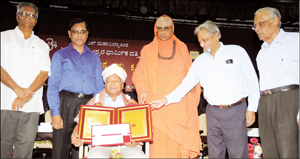
Prof. Chandrashekaraiah, retd. English Professor, Mysuru, was conferred with ‘Sri Shivarathreeshwara Award’ at a programme organised by Sri Shivarathreeshwara Religious Endowment, JSS Mahavidyapeetha, at Navajyothi auditorium in JSS Women’s College here on Wednesday.

Suttur Seer Sri Shivarathri Deshikendra Swamiji presented the award to Prof. Chandrashekaraiah for his book ‘A Survey of Veerashaiva Religion and Literature.’

National Institute of Advance Studies (Bengaluru) Visiting Professor Dr. S. Shettar released eight books on the occasion — Vid. Dr. Sri Immadi Shivabasava Swamiji’s Allamaprabhudevara Teekina Vachanagalu (2nd edition), Dr. H. Thipperudra Swamy’s The Virasaiva Saints – A Study (2nd edition), Sri Siddeshwara Swamiji’s Devotional Sayings of Basaveshwara (3rd edition), Prof. B. Somashekarappa’s Divya Chethana, Prof. Chandrashekaraiah’s Ghanalinga Shivayogi – Vicharasankeerna, Dr. Sangamesha Biradara’s Vachanagalalli Bhakti, Dr. B.V. Vasanthakumar’s Vachanagalalli Sthavara – Jangama and Dr. Rajashekara Jamadandi’s Vachanagalalli Drushtantagalu.

Prasaranga Director Prof. C. Naganna and Shivamogga litterateur Jayadevappa Jainakeri  spoke about the books.

Prof. S. Nanjundaiah delivered the felicitation address on the occasion.

JSS Mahavidyapeetha Executive Secretary B.N. Betkerur presided over the programme.

source: http://www.starofmysore.com / Star of Mysore / Home> General News / Saturday – March 28th, 2015

CM presents awards to eight distinguished Journalists

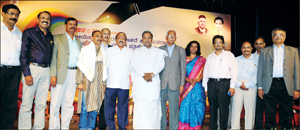
Chief Minister Siddharamaiah presented TSR Memorial, Mohare Hanamantharaya, Development Journalism and Environmental Journalism awards to senior journalists at a function held at Sulochana Auditorium of Vartha Soudha in Bengaluru yesterday. Seen are (from left) Journalists Dr. Narendra Rai Derla, Dr. Sadananda Perla, Amshi Prasanna Kumar and Deepak Sagar, Media Academy Chairman M.A. Ponnappa, Information Minister R. Roshan Baig, Senior Journalist N. Arjun Deva, Information & Public Relations Department Principal Secretary Dr. Nagalambika Devi, Senior Journalists P.S. Eshwar Bhat and Raghavendra Aravindrao Joshi, Information Department Director N.R. Vishu Kumar and Star of Mysore Editor-in-Chief K.B. Ganapathy.

Bengaluru :

Chief Minister Siddharamaiah presented the prestigious TSR Memorial, Mohare Hanamantharaya, Development Journalism and Environmental Journalism awards to eight journalists at a colourful function organised by the Department of Information and Public Relations at Sulochana Auditorium, Vartha Soudha on Bhagavan Mahaveer Jain Road here last evening.

The TSR Memorial Journalism award- 2012 was presented to veteran Journalist N. Arjun Deva, who is presently the Editor of ‘Jaana,’ a publication dedicated to Science articles and the TSR award for 2013 was given to senior Journalist P.S. Eshwar Bhat (Eshwar Daitota), who has served in Print Media, Radio, Television and Internet Journalism for over three-and-a half decades.

The Mohare Hanamantharaya award for 2012 was presented to Belagavi-based senior journalist Raghavendra Aravindrao Joshi, who started ‘Nadoja,’ a Kannada weekly, which later became a daily newspaper while Mohare Hanamantharaya award for 2013 was presented to K.B. Ganapathy, Editor-in-Chief, Star of Mysore, an English eveninger and Mysooru Mithra, a regional Kannada morninger.

Mysuru-based Journalist Amshi Prasanna Kumar, who has been serving in Kannada Prabha daily since 1995, was presented Development Journalism award for the year 2012 and the year 2013 award was conferred on Dr. Sadananda Perla, currently serving in the programmes section of Akashavani.

Dr. Narendra Rai Derla, a lecturer by profession and who had worked as a Sub-Editor of Taranga weekly magazine, was presented Environmental Journalism award for 2012 and journalist Deepak Sagar, who is working as a reporter of Vijayavani at Sagara in Shivamogga district, was presented the award for the year 2013.

Both TSR Memorial and Hanamantharaya awards comprised a cash prize of Rs. 1 lakh each and a citation while the Development Journalism and Environmental Journalism awards carried a cash prize of Rs. 50,000 each and a citation.

Veteran Journalist Arjun Deva, who spoke on behalf of the awardees, observed that the print media has not lost its sheen despite the advent of electronic media.

Stressing on the need for brining the electronic media under the ambit of the Press Council of India, he said that with the media becoming highly powerful, shedding light on all issues, politicians are making a beeline to enter the media field.

Maintaining that politicians with different backgrounds and conflicting views were confusing the people, Arjun Deva regretted that the present situation was conducive only for the wealthy to start news- papers.

Shedding light on the growth of media over the years, he referred to a recent incident where it was reported that the High Court was haunted by spirits and questioned whether the reported missing of certain documents from the High Court can be attributed to the spirits, which remark sent the entire audience into peels of laughter.

Information and Infrastructure Development Minister Roshan Baig presided.

Information and Public Relations Department Principal Secretary Dr. Nagalambika Devi, Awards Selection Panel head former Justice Arali Nagaraj, Information Department Director N.R. Vishu Kumar, Karnataka Media Academy Chairman M.A. Ponnappa and others were present at the function.

source: http://www.starofmysore.com / Star of Mysore / Home> General News / Saturday – March 28th, 2015

Visit Varanasi through B’lurean’s lens

Bengaluru:

The Ganga never ceases to evoke awe despite all the clamour about its cleanliness or lack of it. Veeral Parekh, a photographer from Bengaluru, visited Varanasi to capture the vignettes of life and death which blend seamlessly on the river’s 100-odd ghats. Life on the Ghats is an exhibition of Parekh’s photographs, frames captured from a faraway land. A former student of Karnataka Chitrakala Parishath, he is known to aesthetically capture quotidian existence in his works which primarily revolve around travel. “I visited Varanasi in 2013. I was there for two days and moved around the 100-odd ghats from morning to evening, capturing the lives of middle-class people there. It was a touching experience,” he recalls.

Parekh was taken in by the uniqueness of Varanasi in Uttar Pradesh. “As you walk in the city, you will see that buildings and streets over 100 years old throbbing with life. It’s exciting to see and experience something like this. The city has more than 100 ghats (a series of steps leading down to a water body). They are used to perform ceremonies, and a lot of them are also used as cremation sites. People take bath in the holy river; it’s an amazing feeling to witness life and death in this incredible city, especially when you share the experience with others and not keep the moments to yourself.” Parekh’s photographic ensemble of Varanasi comes in colour as well as black and white. From flower sellers to people burning bodies on the ghats or throwing them into the river, to elderly people regurgitating memories in solitude, the photographs reflect the essence of Varanasi’s way of life. What: Life on the Ghats, an exhibition of Veeral Parekh’s photographs Place: Shades of Art Gallery, Koramangala Timing: 11 am to 6.30pm (till April 20)

source: http://www.timesofindia.indiatimes.com / The Times of India / Home> City> Bengaluru / by G S Kumar, TNN / April 02nd, 2015

The hand that creates…

ToysBF02apr2015

Preethy Vijay, the mother of a four-year-old, decided to start a home venture out of sheer boredom. Little did she know that her home venture, ‘Pretty Creations’, would one day become her passion. ‘Pretty Creations’ was started in 2013 and is a place where one can find exquisite and unique handmade crafts and paintings with a fun twist and a dash of creativity.

She hand paints on products like mugs, and also makes birthday candles, photo frames, magnets, keychains, gift tags, accessories and much more, as per the theme of the party. Crafts like miniature dolls, bikes and name boards can also be found as part of her designs. She also makes quilled jewellery and self-designs and paints them. Lately, she is also trying her hand at dress design to create something of her own. She constantly posts her designs on Facebook and receives feedback. “I feel very happy when my customers like my work. Their feedback really matters to me and motivates me to do better,” says Preethy.

Her inspiration stems from her surroundings. “One can learn a lot from the little things that we see around us,” she says.

Her products are colourful and she makes each of them using air-dry clay. For example, if it’s a miniature bike, she takes pictures of them and designs the creations accordingly.

Balancing time between her venture and her four-year-old son is a hard task. “I usually work on my craft when my son is sleeping or away at school. But I also feel that if you are passionate about something, no matter what, you will make time for it,” she adds.

With the growing need for customised items  and unique birthday party themes, ‘Pretty Creations’ offers customisation of all products. “It sometimes brings out the best in me. When I take the customised order I’m a little skeptical at the beginning, but slowly I draft out a graph and work towards it.”

source: http://www.deccanherald.com / Deccan Herald / Home> Supplements> MetroLife / by Preethi Ravi / March 05th, 2015