Noted Kannada film director Siddalingaiah’s life story could well have been a movie considering the twists and turns it had.
Born to a humble farmer couple Linganna-Gangamma at Taruru village of Kallambella hobli in Sira taluk, Siddalingaiah wanted to achieve something big in life. He left behind the parched land and ran away from home. His parents too had no clue of his whereabouts and presumed him to be dead.
It was after he gave a phenomenal hit Bangarada Manushya (starring Raj Kumar and Bharathi) that the people of the village realised that the successful director was none other their Siddalingaiah. By then, his father too had died. He visited the village and interestingly, got a huge open well dug for his younger brother Basavaraju in his barren land and wished him to become a bangarada manushya (man with a golden heart). Indeed, his brother grew coconut and plantain and settled down there.
Siddalaingaiah had his primary education at the village’s 100-year-old school. The village wanted Siddalaingaiah to grace the school’s centenary celebrations a couple of years ago. But he couldn’t oblige them as he was unwell at the time.
Today, the entire village sat glued to the TV after hearing the news of Siddalingaiah’s demise.
source: http://www.newindianexpress.com / The New Indian Express / Home> States> Karnataka /by Devaraj B. Hirehalli / March 13th, 2015
T. Anbu Pauline, a student of VGK Music Academy in Mysuru, was recently conferred the Level 1 Award in Graded Examination in Music Performance – Grade 1 Drum Kit with Distinction – by the Trinity College, London.
Nine-year-old Pauline, who is studying in Class IV at Kendriya Vidyalaya, had been awarded six credits at Level 1, according to a press release. She has been learning drum kit for the past one-and-a-half years under Venugopal Krishna at the academy.
Anbu Pauline was conferred Level 1 Award by Trinity College, London
source: http://www.thehindu.com / The Hindu / Home> News> National / by Special Correspondent / Mysuru – March 12th, 2015
Sridhar S (22), a visually challenged degree student from Shivamogga, was good at academics. But he couldn’t study for his final-year BA or take the exam simply because no textbooks were available in Braille.
As books were part of old literature, they were not available in digital version either. His father Srinath would read out from the printed textbooks whenever he had time. But that didn’t help Sridhar much as he found it tough to memorize and recall the portions.
Now, an innovation by Shiva Kumar HR, a student at the Indian Institute of Science (IISc), has made life easier for the likes of Sridhar. Shiva’s innovation helps scan printed books and instantly makes them text compliant for the visually challenged.
Shiva has deservedly bagged the Gandhian Young Technological Innovation Award for 2015.
The young scientist, who is pursuing his PhD under the guidance of Prof AG Ramakrishnan at the Medical Intelligence and Language Engineering (MILE) Laboratory, department of electrical engineering, IISc, has developed high-accuracy optical character recognizers (OCR) for Kannada and Tamil languages. This converts scanned pages of a printed documentbook into e-text.
By using the OCR along with the Printto-Braille tool, it is easy to scan any printed bookdocument and convert it into Unicode text in a short span of time.The visually challenged person can listen to that e-text through any text to speech (TTS) synthesis software. The etext can also be converted into Braille codes and printed using a Braille embosser. Shiva said the study substance for English and European languages were available in digital and Braille versions for visually challenged. “But not so with Indic languages (classical literature, novels and even school and college books). Here, much of the printed material e-text is not available and hence inaccessible to visually challenged. Converting books into Unicode text by manual typing takes time and is costly,” he added.
It reduces time, cost
Shiva said the high-accuracy OCR cuts down on time and cost. “We have demonstrated it already and found it is possible to convert more books in a short span of time and make them accessible to the visually challenged. The Worth Trust in Chennai has opened a facility using our product.Family members or friends of visually challenged students come and get digitalized or Braille versions of printed textbooks in minutes. The number of the visually challenged in India is over 18 million and the product goes a long way in helping them,” he added.
Applications aplenty
Shiva and team have also developed an intuitive graphical user interface (GUI) called Print-to-Braille tool that enables even non technical people to quickly use their OCR and make corrections to the mistakes, if any, in the text output by the OCR. Hundreds of Tamil books, including textbooks, story and general books, have been converted into Braille format, and distributed to the needy.A Kannada version of the software has been given to some voluntary organizations and individuals in Karnataka associated with visually challenged students. Apart from pursuing PhD, Shiva is a software engineer at IBM Software Labs.
Awarded for its social relevance
The award to Shiva has been given by the Society for Research and Initiatives for Sustainable Technologies and Institutions (SRISTI) and aims to recognize student projects that have social relevance. Shiva’s work, Gift of New Abilities, was chosen for the award in the Computer Science, Information Technology and Related Fields category. The award was given at a function at Rashtrapati Bhavan in New Delhi on March 8.
source: http://www.timesofindia.indiatimes.com / The Times of India / Home> City> Bengaluru / TNN / March 12th, 2015
Rohini Sindhuri has been chosen as a resource person following the impressive performance of Mandya district in implementing the Swachh Bharat Abhiyan.
Impressed by the performance of Mandya district in implementing the Swachh Bharat Abhiyan (SBA), the Union government has selected Mandya Zilla Panchayat Chief Executive Officer Rohini Sindhuri to train district collectors/deputy commissioners of various States in New Delhi.
The Mandya Zilla Panchayat launched a drive to provide individual toilets to 1.02 lakh households during 2014–15. And, since July last, it had constructed 75,000 individual toilets across the district.
The Ministry of Drinking Water and Sanitation has selected three officials as resource persons for the two-day orientation programme on the SBA, which will start in New Delhi on Friday. Two other resource persons are Deputy Commissioner of Bikaner district Aarti Dogra and Additional Collector of Harda district Ganesh Mishra.
These officials have performed extremely well in implementing the SBA and their inputs in the training will be valuable for the participants, Joint Director of the Ministry Sandhya Singh said in a communique dispatched to the Department of Rural Drinking Water Supply and Sanitation on Tuesday.
The Ministry has been organising such training programmes on the SBA for the district collectors/deputy commissioners regularly to achieve the goal of making country ‘Open defecation free’ by October 2, 2019, Ms. Singh said.
B.N. Krishnaiah, Commissioner for the Department for Rural Drinking Water Supply and Sanitation, has lauded the services of Ms. Sindhuri in motivating people to get toilets constructed.
source: http://www.thehindu.com / The Hindu / Home> News> National> Karnataka / by M.T. Shiva Kumar / Mandya – March 12th, 2015
Here’s a chance for Bengalureans to pick the best of the old structures in the city. The Indian National Trust for Culture and Heritage (Intach), Bengaluru, is out to crown two heritage buildings – one governmentowned and the other private.It has invited Bengalureans to nominate two buildings of their choice for the Intach Bangalore Heritage Awards. C Aravind, Intach co-coo r d i n a t o r, said this seeks to recognize and bring at and bring attention to Bengaluru’s heritage buildings.
The buildings chosen can be residential, official or religious or even a market. The only condition: it should have been built before Independence. The best preserved structures, judged by a panel of experts, will receive an award and a citation. For details, visit http:www.intachblr.org.The last date for sending nominations is March 15, 2015.
My choice
Naresh V Narasimhan |
Architect: Though there are a number of beautiful heritage buildings in Bengaluru like Town Hall and St Mark’s Cathedral, my choice for the best structures among them would be the Bangalore Club and Seshadri Iyer Memorial Library.Bangalore Club, which belongs to the British period, is very well preserved.It was built as a club. The Seshadri Iyer Memorial Library is an honour to the great man. It is architecturally excellent and the colour (terracotta red) excellently complements the greenery of Cubbon Park where it is located
Mansoor Ali |
Architect I would nominate the Attara Kacheri or the high court building as it is a very good example of colonial architecture. The other point to note is how wonderfully the contractor has executed the work as the building still stands like a monument even after over 100 years. The other great heritage building is the house of Diwan Sir MN Krishna Rao in Basavanagudi. This house is said to be the third oldest in the area. It has many antiques like a 143-year-old Ansonia clock from the US and a Scott’s Radiogram
Poornima Dasharathi |
Founder, unhurried heritage walks: Bangalore was known to be a manufacturing hub during the Maharaja’s rule. I would say it is a good idea to preserve at least one factory and turn it into a museum dedicated to showcasing this heritage and technology, instead of a mall.One of the examples that come to my mind is the Mysore Lamps Factory in Malleswaram. There are many privately owned bungalows still standing today simply because of their owners’ love and their resistance to selling. I want the government to set up a proper local heritage preservation policy and save bungalows
CN Kumar |
Founder, Bygone Bangalore, a group on Facebook: I prefer the high court building, which is more than 100 years old, as my choice for the best. It is very well maintained and designed well. Of course, when it comes to private buildings, there are many, but I feel Bangalore Club is the best of the lot because of its structure
source: http://www.timesofindia.indiatimes.com / The Times of India / Home> City> Bengaluru / TNN / March 12th, 2015
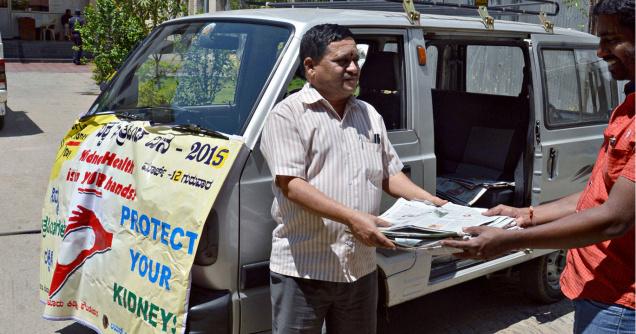
C.V. Sundaresh of Arpana Seva Samsthe collecting old newspapers in Bengaluru on Wednesday. The NGO sponsors 1,000 dialysis a year.— Photo: Bhagya Prakash K.
We were moved by the plight of patients: NGO
A bundle of old newspapers may mean a new lease of life for someone in dire need far away. A group of energetic volunteers are going to apartments, hotels and offices asking not for money, but for old newspapers to mobilise funds for dialysis for poor patients.
Businessman C.V. Sundresh, secretary of Arpana Seva Samsthe, an NGO started in 2008 by a group of philanthropists, said: “Over the years, we were moved by the plight of patients who had asked us for help for dialysis and realised that this was a recurring expenditure. People could not afford dialysis but still had to undergo it twice or thrice a week. So we decided to mobilise funds only to fund dialysis. End-stage renal failure patients have to spend at least Rs. 6,000 a month for dialysis apart from other medication.”
He said, “The money we get from newspaper drives may not be much, but we are spreading awareness on kidney health and the drive also helps us get commitment for individual cases.”
The organisation, which has 40 members and 60 volunteers and sponsors 1,000 dialysis a year, has tied up with Bangalore Kidney Foundation, which shortlists deserving patients.
T.N. Lakshmiprasad (39), who used to work in a private firm, travels five hours, twice a week, from Yagati village in Kadur taluk of Chikkamagaluru district to Bengaluru for his dialysis.
“Private hospitals are expensive and government hospitals are not always equipped with technicians and doctors, which is why I prefer coming to Bengaluru. The organisation, over the past seven years, has funded nearly 100 dialysis,” he said.
Those who want to donate newspapers can call 9845201563.
source: http://www.thehindu.com / The Hindu / Home> News> Cities> Bengaluru / by Tanu Kulkarni / Bengaluru – March 12th, 2015
Created at Sri Kanteerava Narasimharaja Wadiyar Sports Club, Mysuru
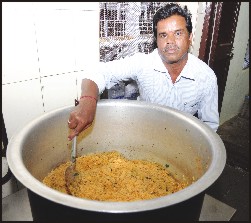
Narayan is seen preparing the famous mutton Biryani at Mysore Sports Club
by S.N. Venkatnag Sobers
In his recent interview to The Sunday Times, Yaduveer Krishnadatta Chamaraja Wadiyar, who has been adopted to the Mysore Royal Family of Wadiyars, when asked about his favourite food said, ‘‘I cannot say I have a favourite. But, if cornered, I would probably have to go with the famous Biryani from the Mysore Sports Club.”
In fact, he is not alone. Thousands of Mysoreans have been relishing the famous mouth-watering mutton biryani at the Mysore Sports Club over the past few decades.
The man behind the famous mutton biryani is Narayan, who has been working at the Mysore Sports Club for the past 32 years. Wanting to discover the man who created a Biryani that satiated the royal palate, Star of Mysore went to Sports Club to talk to this master chef. He is Narayan.
Speaking to Star of Mysore, Narayan said that members of the Royal Family including late Srikanta Datta Narasimharaja Wadiyar, Chaduranga Kantharaj Urs, Gayathri Devi, Yaduveer Krishnadatta Chamaraja Wadiyar and others were fond of the biryani cooked by him.
Mysore Sports Club introduced Mutton Biryani to its guests in 1989 and since then, it has been relished by many. Earlier to this, cooks from outside were invited to prepare biryani during events organised at the club.
Narayan said that he learnt the art cooking biryani through his guru Abdul Sattar, who lived in Mandi Mohalla.
“When I joined the Sports Club as a kitchen assistant, the then Secretaries B.A. Nanaiah and Dr. N.M. Srinivas encouraged me to learn the art of cooking biryani and since then, I have been cooking the delicacy,” he said.
Speaking about his cooking style, Narayan said that he starts preparing for biryani at around 12 noon by marinating mutton and adding necessary masala. Once the mutton is cooked, the half cooked basmati rice is added to mutton and is kept for blending for about one-and-a-half hours. Later, the hot biryani is served to the guests at the Club from 7.15 pm.
Everyday around 15-20 kg mutton biryani is prepared at Mysore Sports Club and not bit of it remains in the end. In fact, the biryani is so famous that even the non-members of Mysore Sports Club do not miss out a chance tickling their taste buds whenever they get an opportunity to visit the club. In fact most of the non-members demand the club members not to book them rooms at the Club but for a parcel of mutton biryani.
Given an opportunity, one must visit the Mysore Sports Club to savour this gastronomic delight.
source:http://www.starofmysore.com / Star of Mysore / Home> Feature Articles / Thursday – March 05th, 2015
There was a special award waiting for Krishnappa at the 15th Annual Convocation of KSOU held here on Thursday. Seventy-eight-year-old Krishnappa, a resident of Kanavanaghatta in Channarayapatna taluk of Hassan district had appeared for MA Sanskrit examination and has passed with 57 per cent and also received a cash prize.
A relentless learner, Krishnappa says that his age never hindered him from appearing for the exam and added that he engaged himself in reading spiritual books after his retirement. Krishnappa also said that Sanskrit was an ocean of knowledge and this had inspired him to take up Master’s in the subject.
Krishnappa says that he wanted to attain spiritual knowledge and hence, read a number of books and added that he would continue to read and acquire knowledge till his last breath.
source: http://www.starofmysore.com / Star of Mysore / Home> General News / Thursday – March 05th, 2015
You may have heard of women playing the mridangam, but have seen one making it?
Over the last 45 years, 72-year-old Ashwathamma has made nearly 3,000 tablas and mridangams. She has repaired thousands more. So much so, she is referred to as ‘tabla taayi’.
Her workspace, Shanta Tabla Works on the busy OTC Road near Balepete Circle, is stacked with tabla, mridangam, dholak, dholki, damaruga, nagaari, thamte, khanjari and other percussion instruments.
“Every year, I make more than 50 instruments. Percussion stalwarts like M.L. Veerabhadraiah, A.V. Anand and T.A.S. Mani have vouched for its quality,” she says.
There was a time when everyone advised her to roll incense sticks, rather than make mridangams, which requires “manly strength”. She argues that making percussion instruments is more of skill than strength. “It takes a week to make a pair of tablas and 10 days for a mridangam.”
Ms. Ashwathamma was married at 15 to Anantharamaiah, who played tabla at the Anjaneya Swamy temple in Rajaghatta near Doddaballapur. They moved to Bengaluru in 1965 seeking jobs as makers and repairers of instruments. Ashwathamma began assisting her husband and then made it her own vocation. “My passion to learn is my accomplishment. Now I want my son to take forward the family profession,” she says.
source: http://www.thehindu.com / The Hindu / Home> News> Cities> Bengaluru / by Ranjani Govind / Bengaluru – March 10th, 2015
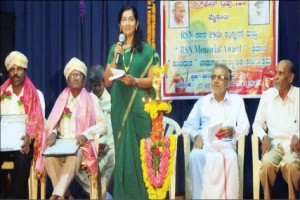
Zoo Authority of Karnataka (ZAK) Chairperson Rehana Banu is seen delivering inaugural address during the award function organised by R.S. Naidu Art and Cultural Welfare Trust in memory of Freedom Fighter R.S. Naidu at Nadabrahma Sangeetha Sabha in city recently as Sanjhi Artist S.F. Huseni, Freedom Fighter M.R. Ramashesh, Brahmana Association Chairman Raghuram and R.S. Naidu Trust President P.Y. Venkatadri look on.
Mysuru :
Freedom fighter M.R. Ramashesh and Sanjhi Artist S.F. Huseni were conferred with ‘RSN Memorial Award’ at a programme organised by R.S. Naidu Art and Cultural Welfare Trust in memory of freedom fighter R.S. Naidu at Nadabrahma Sangeetha Sabha in city recently.
Speaking after inaugurating the programme, Zoo Authority of Karnataka (ZAK) Chairperson Rehana Banu said, “Many artists across the country have contributed in their respective fields despite lack of encouragement and recognition. They should be lauded for their commitment and passion. We should encourage the artists through felicitation programmes.”
After the award function, Indu Shekhar and Troupe presented a musical programme.
Renowned artists of Mysuru and Bengaluru sang the old film songs sung by P.B. Sreenivas, S.P. Balasubramanyam, P. Susheela, S. Janaki and others. They even sang the songs from the movies of Dr. Rajkumar, Dr. Vishnuvardhan and Puttanna Kanagal.
The following songs were sung on the occasion: ‘Hindusthanu endu mareyada…’ from the movie Amrutha Ghalige, ‘Snehada kadalalli…’, ‘Aseya bhava olavina jeeva’, ‘Karunada thayi’, ‘Haadu haleyadaadarenu’, ‘Jeeva veene needu midithada sangeetha’, which made the audience to travel down the memory lane.
Mike Chandru compered the musical programme.
Singers including Indrani Anantharam, CFTRI Krishnamurthy, KEB Gangadhar, Srinivas Hemanth, Vijayanand, Joyce Peters, Anantharam, Kiran Kumar, Geethalakshmi Keni, Vijay Manasa and others took part in the function.
R.S. Naidu Art and Cultural Welfare Trust President P.Y. Venkatadri and Trustee M.K. Ramesh; K. Raghuram, Chairman, Brahmana Association; Mysuru Anand and Parthasarathy were present on the occasion.
source: http://www.starofmysore.com / Star of Mysore / Home> General News / Wednesday – March 04th, 2015