Yearly Archives: 2015

Indian Science Congress returns to State after 13 years

The country’s largest science event — The Indian Science Congress (ISC) — which is in its 103rd edition, returns to the State after a gap of nearly 13 years.

The five-day event, comprising seminars, exhibitions and award ceremonies, will be held at the University of Mysuru from January 3, and Prime Minister Narendra Modi is expected to inaugurate it. The prestigious event comes to Mysuru after nearly 34 years.

This year’s event is being run on the theme, ‘Science & Technology for Indigenous Development in India’. Over 500 scientists, including five Nobel Laureates, are expected to talk at the congress. The event is being touted as the biggest ever, with 15,000 delegates scheduled to attend.

However, the focus will be on the ‘Science Exhibition – Pride of India Expo’, where a hall is being dedicated to former President A.P.J. Abdul Kalam and noted engineer and administrator M. Visvesvaraya.

source: http://www.thehindu.com / The Hindu / Home> News> Cities> Bengaluru / by Staff Reporter / Bengaluru – November 06th, 2015

4-day conference brings global experts in Bengaluru to share health innovations

Bengaluru  :

Hematocon 2015, the 56th four day conference organized by the Karnataka Chapter of Indian Society of Haematology and Blood Transfusion began on November 5 in Bengaluru.

It brought together global professionals from fields of Haematology, Haemato-oncology, laboratory medicine and blood banking to share their innovations, research and latest findings on to an inter-disciplinary platform.

The conference will witness the latest developments in the fields of Haematology, Haemato-oncology, blood disorders, blood cancer and bone marrow transfusion. The teaching faculties, experts and distinguished speakers from leading institution will share their insights and experiences during the conference.

“We are pleased to welcome eminent medical professionals at this forum to share inter-disciplinary knowledge and the latest developments in the fields of Haematology and Haemato-oncology. The conference will help further educate and enable healthcare professionals to adopt best practices that will in turn enhance the quality of healthcare,” said Dr Sharat Damodar, Head of Heomatology & Bone Marrow Transplant, Mazumdar Shaw Cancer Center, Narayana Health City and Organizing Secretary of Karnataka Chapter of Indian Society of Hematology & Transfusion Medicine.

Dr Cecil Ross, Professor and Head of Hematology at St. John’s Medical College & Chairman of Karnataka Chapter of Indian Society of Hematology & Transfusion Medicine said, “Multiple scientific workshops will focus on sharing innovations in field target therapies (immune therapy that is more effective with less side effects managing blood related infections), bone marrow transplants, blood cancer and other blood related disorders. More than 1000 delegates and 25-30 faculties nationally and internationally will offer a series of diverse continuing education as part of the event”.

Researchers, faculty and academicians are expected to create an avenue towards robust exchange of information on technological advances and new scientific achievements for issues like platelet disorders, acute Leukemia (paediatric and adult), lymphomas cancer (cancer of the lymph system), RBC & WBC issues, blood transplants and other relevant topics.

source: http://www.timesofindia.indiatimes.com / The Times of India / News Home> City> Bengaluru / by Sreemoyee Chatterjee, TNN / November 05th, 2015

MITE engineering students design all-terrain vehicle for auto show

Mangaluru :

Mangalore Institute of Technology & Engineering (MITE) students have designed and developed an all-terrain vehicle (ATV) for BAJA SAE, a prestigious national-level sporting vehicle building event organized by Society of Automotive Engineers (SAE).

SAE is an engineering and scientific society dedicated to the advancement of the automobile sector. The ATV will be participating in BAJA SAE India-2016, a national-level competition to be held in Indore in February 2016. Also, the developed ATV will be participating in BAJA Student India-2016 in January 2016 at Buddh International Circuit, Utter Pradesh.
Chairman of Rajalaxmi Education Trust Rajesh Chouta unveiled the ATV on November 2. Successful field testing was done by the Team Mite Racing (TMR) comprising of 30 students of MITE.

“The TMR comprising students of the mechanical engineering department have designed and fabricated a lightweight ATV as per the rules and specifications of BAJA SAE India-2016 in the MITE campus. TMR is one among the three colleges in the zone along with NITK Surathkal and MIT, Manipal to qualify for the event in which every team asked to design and build an all-terrain sports vehicle. The institution has encouraged the students to work independently in the campus after their regular academic work,” said Ashwin Balaram, one of the team leaders.

“The team has innovatively applied the new concepts for its suspension and load-bearing capacity in the vehicle. The team investigated and applied new methodology of continuously variable transmission (CVT) for improved acceleration and to reduce driver fatigue,” said another team leader Ashrith S. Ashwin and Ashrith are seventh semester mechanical engineering students of MITE.

The ATV is developed by the TMR under the sponsorship of the management of the institution led by the chairman of Rajalaxmi Education Trust Rajesh Chouta. G L Easwara Prasad, principal and C R Rajashekar, head of the department of the mechanical engineering department supported the team for the project, students said.

source: http://www.timesofindia.indiatimes.com / The Times of India / News Home> Cities> Mangaluru / by Shobha K T, TNN / November 05th, 2015

Vijayapura cyclists bring home laurels

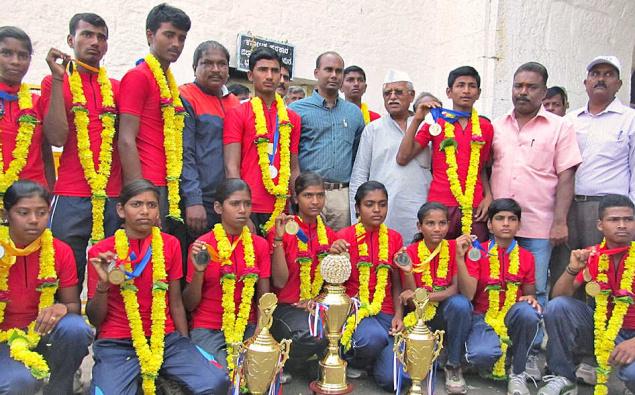
The cyclists, who won 25 medals at the national-level championship, being honoured by Deputy Commissioner D. Randeep in Vijayapura on Tuesday.— PHOTO : RAJENDRA SING HAJERI

Cyclists of the district have brought glory to the district by winning 25 medals and emerging as all-round winners in the recently concluded national-level mountain cycling championship in Pune, Maharashtra. Some 28 cyclists from the district participated in the three-day championship that concluded on Monday at Pune.

Speaking to presspersons, R.B. Upase, District Sports Officer, said that of the 25 medals, they clinched nine gold, ten silver and six bronze medals.

He said that all the cyclists had secured the position in national-level championship after winning the State-level competition held last month in Vijayapura.

“This is certainly a matter of great pride for all of us that the cyclists of the district have been continuing their winning streak at the State and national level championships,” Mr. Upase said.

Sandesh Uppar and Sahana Kodignur, who won medals in the tournament, said they were elated to win medals for the district.

“Our next aim is to participate in international championships and bring glory for the district and the nation by winning medals,” Ms. Kudignur said.

She thanked their coach for preparing them in the best manner for winning the medals.

Velodrome project

Deputy Commissioner D. Randeep has expressed unhappiness over the slow pace of work of the Velodrome project for cyclists here.

Addressing presspersons after honouring district cyclists who won medals in national championship, he said that despite calling the agency twice for a review meeting of the project, no representative turned up.

“Soon, we will call the third meeting. If still nobody represents the agency, then we will take a decision to cancel the contract,” he said.

Deputy Commissioner D. Randeep has expressed unhappiness over the slow pace of work of the Velodrome project for cyclists here.

Addressing presspersons after honouring the district cyclists who have won medals in national championship, he said that despite calling the agency twice for a review meeting of the project, no representative turned up.

“Soon, we will call the third meeting. If still nobody represents the agency, then we will take a decision to cancel the contract,” he said and added that it was an ambitious and long-pending project, which should be completed within the stipulated time of 18 months.

source: http://www.thehindu.com / The Hindu / Home> National> Karnataka / by Firoz Rozindar / Vijayapura – November 04th, 2015

Services at the doorstep

Owning a home always comes with the huge responsibility of managing it. This involves fixing different problems that occur and at times, these issues seem never-ending. But with technological evolution, all these secondary services can be availed with just a click of a button.

There are a number of start-ups mushrooming in the City that provide Bengalureans the necessary secondary services online.

Electrical repairs, plumbing, carpentry, laundry…the anguish of not getting a serviceman at the required time can be put to rest now, as they are all just a click away.

‘Handy Fix’, an online venture that started in 2014, has become a trusted name in home repairs and offers electrical, plumbing and carpentry solutions.

The founder of the firm, Arvind Kumar, says, “I am from a hotel management background and have seen how hotels are maintained. Any complaints from the guest, a technician is called for and the problem is fixed within minutes. This gave me the idea to provide fast services at one’s doorstep.”

‘Handy Fix’ now has a team of professional and committed servicemen who are available at one’s convenience. “They are all trained professionals and the customers are happy with their services,” he explains. However, the service is provided within 10 km radius of Indiranagar as he points out, “We need more investors and once we get the funds, we will cover all parts of the City.”

The ever-piling laundry is yet another painful task. Providing a solution to this is ‘MyWash’. Launched in 2014, the firm picks up the laundry from one’s doorstep, dry cleans and irons it and drops it back to the customer’s house.

Says Raghu Bharat, the CEO and founder of the firm, “‘MyWash’ is a result of my personal experience. I could not get my dry cleaned clothes on time for a wedding. The laundry sector was inefficiently run and unorganised. I analysed the market and conceptualised the plan to help all those who face laundry troubles.”

One can download the Android app on their phone and with a large industrial set-up in the outskirts of the City, one can get their clean laundry within four days of time at an affordable price.

And it is not just these household services that are taking the online route. The parlours too are going mobile and offering the best of home services.

‘Bangalore Mobile Spa’, started in 2008, has many satisfied customers who are enjoying the services at home.

RubinaBF04nov2015

The proprietor of the firm Rubina Guleria moved from London and found it hard to enjoy the after-effects of a spa due to the chaotic commute back home.

“The commute to and from the spa salons took away the pleasure of a spa. I wanted to change this and the result is a mobile spa,” she says.

It offers speciality treatment massages at the comfort of the client’s house without dirtying their furniture.

She explains, “Initially, the clients had a problem with our service as we had to use their beds for a massage. They would worry that their beds would get dirty and we had to fight this out. So now, we carry our own cots and beds. We are on par with all the good spas here and we cover all the areas in Bengaluru.”  With chaotic traffic in the City, these start-ups are a boon and provide efficient services at the comfort your cosy home.

source: http://www.deccanherald.com / Deccan Herald / Home> Supplements> MetroLife / by Prajna GR / DHNS – November 04th, 2015

Inventor With Eyes on the Sky

Dayananda Sirigere, a hobbyist inventor who fashions camera lenses and telescopes made from PVC pipes and discarded electronic equipment, has been getting inquiries from unlikely corners. “In September, a businessman called from California,” says the 53-year-old. “He said he will be coming to Bengaluru to meet me as he was fascinated by what I do.”

While most of his equipment costs Rs 5,000 to Rs 10,000 to make, his talents have remained largely undiscovered by shutterbugs. “Until a neighbour came and admired his work, I kept telling him to throw all this rubbish out,” says his wife Ratna Rao.

Dayananda Sirigere and the telescopes/JITHENDRA M

The “rubbish” is about 35 cartons of telescope lenses stacked up in their house in Bengaluru’s Chandra Layout. Sirigere seems completely uninterested in the possibilities of using his skills to pursue a commercial end. He is fired by passion for the “practical” aspect of science.

“In school, I used to wonder what the planets we drew looked like,” he says. “Much later, when I was going through some bad times in the 90s, people attributed it to an unfavourable influence of Saturn.”

This rekindled his curiosity in astral bodies, and he got to work on trying to make a telescope. Years of trial and error followed till 2003 when his efforts came to fruition and his first telescope was ready. “I assembled an optical lens, a mirror lens and a PVC pipe using calculations based on the focal length of the lenses,” Sirigere explains.

When he looked through it, he was overjoyed. He then began working on how to attach a powerful lens to a camera to photograph planets. For this, he used a teleconvertor to enlarge the image.

He finished his first telephoto lens in 2005. “I made a wide-angle lens that covers 180 degrees and another that covers 230 degrees,” he says. The macro lens in his collection has enabled him to photograph the pores in the eye of an ant and air bubbles and droplets of water in a leaf against light. “If you attach it to a video camera, you can see the water movement in leaves,” he says.

His lenses and telescopes have kept him up nights in the open, gazing at the galaxy. “Some parts of the moon reflect more light due to its undulated surface,” he says. “The craters are best visible on the fourth day after the new moon because that side is facing Earth.”

As novel as his hobby is, he is also aware of its amateur nature. “The lenses are too bulky for some people, unlike the professional ones. There’s no way I can build in auto-focus,” he says. Procuring a camera and xerox lenses collecting dust in homes or shops takes time. “Whenever I’m visiting someone or passing by someplace and I notice parts I could use, I ask the owners if I could buy them,” he says.

Once when Sirigere wanted to photograph cricketers in Chinnaswamy Stadium, the security stopped him and asked what he was carrying in his bag. They refused to believe they were lenses. They said, “These look more like AK-47s,” he says with a hearty laugh.

Before he moved to Bengaluru eight years ago, he often let children look at the stars through his telescopes in his native Sirigere, a village in Chitradurga district. “In rural areas, children don’t have any exposure to the practical aspect of science,” he says. With them, he has observed eclipses, the rings of Saturn and four of Jupiter’s moons.

The people and the clear skies of the pastoral countryside beckon, but it might take him a couple of years to shift base. “Ideally, I would like a village not yet penetrated by electricity,” he says.

source: http://www.newindianexpress.com / The New Indian Express / Home> Magazine / by Chetana Divya Vasudev / October 31st, 2015

Pages from history : Magic word Karnataka

by Prof. A.V. Narasimha Murthy, former Head, Department of Ancient History & Archaeology, University of Mysore

November first each year heralds a new enthusiasm and jubilation among Kannada speaking people. Old Mysore State ruled by the benevolent Maharajas became the State of Karnataka. The magic word Karnataka has a hoary antiquity going back to the times of epic Mahabharata. Sabha Parva has the word Karnata while the Bhishma Parva has the form Karnataka. Varahamihira’s Brihatsamhite (sixth century AD) also mentions this word. The land of Kannada had become so famous as to attract attention of the Tamilagam. An ancient Tamil work (2-3 century AD) called Silappadikaram refers to the people called Karunadar who obviously inhabited the Kannada land.

Truncated Karnataka

Various ancient and modern writers have interpreted this magic word in a variety of ways. The famous work Kavirajamarga defines Kannada land as a geographical entity between Cauvery and Godavari. This is significant indeed. But what we have today is truncated Karnataka and have to be contented with Cauvery only. On the basis of this and other evidences, Pattadakallu, Dharwad (Lakshmesvara), Belgaum and parts of Nizam’s dominions, Salem, Nilgiri, Coimbatore etc., were considered parts of Karnataka. Unfortunately, due to political reasons, the wide boundaries of Karnataka are being truncated and the British also played their own part in this respect as they did not like to have a strong, powerful and wide area as a province in their empire.

Though northern parts of Karnataka were the kernel of the land of this area, it was not a milking cow for the British as against the Maharajas of Mysore and hence they neglected that area. Fortunately, in spite of this handicap, the northern parts of Karnataka have stood up by hard work and political will and have occupied a prominent place in today’s socio-politico-economic and cultural fields. It only shows that innate strength is more important for cultural growth rather than political patronage. There are many scholars who feel that northern parts of Karnataka have been responsible for providing leadership qualities for the development of Karnataka. But this does not undermine the part played by old Mysore or Maharajas’ Mysore.

Some of the etymological explanations of the word Karnataka may be referred to here briefly. First of all, the very form itself is a matter of controversy among the scholars. The question is whether it is Karn(£Áð) taka or Karn (uÁð)taka and if both are correct which one should be used without confusing the common man. Some scholars feel that it should be written as Karn (uÁð)taka because the word has been derived from the mellifluous and soft sound which touches your ears and then your heart. Hence the ear organ (Karna) plays a significant role here and naturally any word or language is closer to the ear first and then it touches other parts including heart. From this point of view, our State should have been named as KauÁðtaka. But it is officially named and spelt as Ka£Áðtaka which may not be to the liking of the scholars on etymology.

A pure Sanskrit word

Many scholars have argued that Karna(tð)taka is a pure Sanskrit word and it satisfies the rules of grammar and hence that form should be used. Even if it is accepted as na (£À) and because of its combination with ra, it automatically becomes na (t). Perhaps, realising the seriousness of the etymology of the word, the Sahitya Parishat has opted for its name as Kannada Sahitya Parishat. Though all these etymological complications were taking place, the State of Kannada language accepted and adopted the term Karnataka (£À) in 1973 in the Legislatures. This put all the controversies at rest.

Another set of scholars have propounded a different view of the etymology of the word. They divide the word as Karu+nadu. The word karu has been taken to mean black soil. Of course, this land is famous for black cotton soil also and this etymology has been justified. But others point out that red soil is also available in plenty and hence this explanation is not appropriate. However, others give a different meaning to this word: Kar means higher altitude and this is satisfied by the position of Karnataka. Still others give a different meaning to it. It is explained as Kammitunadu, meaning the land of sweet fragrance. Perhaps the sandal wood and fine smelling flowers that grow here might have been responsible for this explanation.

Not satisfied by these explanations, other scholars have propounded another theory. This land was inhabited by some ancient tribes of which two tribes Kara and Nata were more civilised than the others. Because of the superior culture of these two tribes Kara and Nata, the people of the surrounding areas looked upon them with great respect and admiration and called this as the land of Karnata and the name continued in historical times also.

Aryan connections

Father Heras, a great historian of yesteryears has explained the contemporaneity and connection of Kannada speaking people with Indus Valley Civilisation of 2500-3000 BC. One of the seals of the Indus Valley has been explained by him as Kanneer and he takes it to be a Dravidian word and consequently, the Indus civilisation also to be a Dravidian contribution and thus has paved the way for the Dravidian origin of Kannada land. This shows that we are the sons of the soil. The followers of Dravidian movement argued that the word Karnataka denotes Aryan connections with our Dravidian land and forces on us the so-called alien Aryan culture in which Sri Rama is perhaps the most distinguished person. Hence, we should fight for a province called Dravidasthan to which we belong to. Fortunately, better sense of the nationhood prevailed on the population of that time and this idea was rejected by one and all.

Long back our anthropologists have told us that there is nothing like a pure race and an exclusive race. Consequently, there is nothing like pure Dravidian and pure Aryan in our culture. This also applies to racial features. Thus Karnataka is purely neither Dravidian nor Aryan. Actually it is a wonderful synthesis of Aryan and Dravidian culture at their best. Culturally, we have adopted a lot of Dravidian and Aryan cultural traits in our socio-religious life. This has been going on for almost over five thousand years of Indian life and this is found to continue for ever. Thus Karnataka has been a good meeting ground for both the cultures.

Royal dynasties

A large number of invasions took place in India and they have not changed our way of thinking or culture. Karnataka saw a series of royal dynasties which ruled here and they worked for the development of the land and the people. Thus Karnataka became famous in the entire country for the co-existence of people of different faiths and cultures. Of course, some minor skirmishes were always there. Kannadigas are known all over the world as good and affectionate people, always ready to help. This has been considered as their weakness; but actually it is their strength also. It is our duty to come up to this expectation and work hard in building the nation.

Four years ago, I had the good fortune of receiving Kannada Rajyotsava award. I know many persons are lobbying for this coveted award by holding on to the politicians. In fact this has lowered the prestige of the award itself. However, I congratulate the awardees in advance.

Finally, I salute Goddess Bhuvaneshwari and pray to her to shower her blessings on the population of Karnataka. All these can happen only if there is a strong and purposeful Kannada speaking people. After all, Kannada should be supreme in Karnataka. That is our prayer right now.

Jai Karnataka Mate

source: http://www.starofmysore.com / Star of Mysore / Home> Feature Articles / Saturday – October 31st, 2015
Padma Shri Samuel Paul: He worked for clean public governance

By KRS Murthy

In the passing away of Padma Shri Samuel Paul, India has lost a quiet and unassuming leader and builder of institutions. Throughout his professional career as a teacher, researcher and institution builder, he searched for ways to make the world socially and economically more just, and worked actively for a better and cleaner public life.

My wife Nirmala and I first met Paul, then director of IIM-Ahmedabad, in 1973, when he was visiting Harvard Business School in Harvard University , where we were both doing our doctoral studies. Paul had come to recruit faculty . After we joined IIMA, we had an opportunity to see Paul in action.Although some considered him quiet and reserved, we could see beneath the exterior a caring and affectionate person. His style was one of informing and involving all stakeholders -students, faculty, industry, board and society.

Paul later went to the US where he worked with Kennedy School of Government in Harvard University and the World Bank. He continued to focus on disparities in social and economic development and the role of public policy and governance in bridging them. It might have been during that period that he began to recognize the need for active involvement of citizens in governance and delivery of public services.

I moved to Bengaluru as director, IIMBangalore, in 1991. Paul’s decision, around that time, to settle in Bengaluru, gave us another opportunity to work closely with him. Paul, I think, felt as sured involving colleagues and alumni of IIMA in his missionary work. I think he expected IIMA competence and profes sional and decent behavior in any role. In addition to others, he involved me, and PP Madappa, another distinguished alumnus of IIMA, in his early experiment with the idea of a Citizen’s Report Card (CRC) on public services. The idea was to get a sys tematic feedback of citizens on the quality of public services such as water and electricity , into policy-making and imple mentation of decisions at higher levels.

The experiment was a great success and senior civil ser vants involved Paul in finding out how CRC could help. The ex periment brought national and international attention to Ben galuru, with the Indian govern ment, World Bank and the Asian Development Bank tak ing note of it as a useful innovation in pub lic governance. Paul proceeded to set up the Public Affairs Centre, a non-profit society committed to improving public account ability and good governance. One of the earliest to recognize the impact that the cancer of corruption would have on public life, he held a seminar with leading think ers to find ways in which it can be curbed.

He published several books on corruption and on holding the state to account.

Paul continued his professional com mitment till the very end of his life. He is no more with us, but his concern for better public governance, which he lived through his quiet and exemplary profes sional life, will continue to inspire us.

(The writer was a close associate of Samuel Paul and also former chairman of ISEC, Bengaluru)

source: http://www.timesofindia.indiatimes.com / The Times of India / News Home> City> Bengaluru / TNN / October 29th, 2015

Preventing privatisation of water

KshihjitUrsBF310ct2015

Kshitij Urs has spent the past two decades reminding society and the government that water belongs to the people

With rivers dying and lakes becoming bowls of sewage, water is being prophesised as the centre of the next great power struggle.

Amidst grave concerns, Kshitij Urs has spent the past two decades reminding society and the government that water belongs to the people. “Water, to me, has historically been a source of power. Because of this, it is also a source of discrimination. If one were to look at urban deprivation, lack of access to water is as important as food or education,” he said.

Privatisation

The battle for water started in 2004 when he accessed a government agreement with an NGO to “manufacture consent” among the people on water privatisation.

“We realised that this was a new era of public participation where consensus was going to be manufactured. We needed a State-level mobilisation of opinion on the actual impact of the move,” said Mr. Urs who then co-founded the Campaign against Water Privatisation.

Through a sustained campaign that focussed on the commoditisation of water over three years, the State government backed off from the reform. However, the ‘war’ is far from won. “They have tried their hand at Hubbali and Mysuru where opposition to the move resulted in water coming back to the municipality…In Bengaluru, we are seeing privatisation in other forms, such as Unaccounted Flow of Water project, where operations of water supply is being given to private companies,” said Mr. Urs.

Since 2007, the organisation has transformed into People’s Campaign for Right to Water (PCRW), which strives for the protection of water bodies. Their legal action has seen encroachments on Sarakki lake being removed – a development that set off anti-encroachment drives on lakes across the city.

The advocacy by PCRW was also crucial for drafting of the Karnataka Lake Conservation and Development Authority Act, which will see all lakes coming under one body, he said.

Trained as a medical doctor, Mr. Urs’ interest in social justice and deprivation started in 1993 when he met two sisters — one 10 and another 12-year-old — while volunteering at an NGO. “They were diagnosed with HIV. Deprivation had pushed them from a slum in Banashankari to prostitution in Bombay…Nothing in my upbringing had prepared me for this,” he said.

The ‘awakening’ saw him delve into the social sector with a masters in development studies from London followed by a Ph.D from National Law School of India University in the water sector.

Projects working on

Democratisation of water sources

Empowering local communities to raise issues relating to lakes

Following up implementation of Karnataka Lake Conservation and Development Authority Act

Suggestions to government

Understand social conservation of water

Involve local communities in managing water sources

Suggestions to citizens

Understand the importance of traditional wisdom to secure inter-generational rights of water

Demand protection of lakes, tanks

Get involved in policy making

source: http://www.thehindu.com / The Hindu / Home> News> Cities> Bengaluru / by Mohit M. Rao / Bengaluru – October 27th, 2015

KMC, Manipal launches Karnataka’s first chest pain clinics in Udupi district

Manipal  :

With an aim to save lives from cardiovascular diseases, Manipal Hospital launched Karnataka’s first ‘Chest Pain Clinics’ (CPC) in the Udpui district, on Wednesday.

To be operated under the ‘hub and spoke’ model, this initiative will include five ‘spoke’ hospitals (Chest Pain Clinics), one ‘hub’ hospital (KMC Manipal) and will reach out to thousands of people in the district, said Dr Ranjan Shetty, Head of the Department for Cardiology at KMC-Manipal at press conference.

Explaining how CPC are difficult from current health care services related to cardiovascular diseases, Ranjan said these clinics will enable small hospitals and nursing homes in and around Manipal to provide timely and quality emergency cardiac care to citizens and save more lives. Each Clinic will be a small healthcare facility equipped with Philips EfficiaECG-100 systems to wirelessly transmit ECG reports of patients in real time from the ‘spokes’ to the ‘hub’.

The report is transmitted to expert doctors in hub swiftly and team immediately analyzes condition of the patient and suggest further treatment if needed. “Once a patient is confirmed as suffering from a Myocardial Infarction, known as a Heart Attack, he/she is immediately transported via an ambulance from Clinic to hub, for primary Percutaneous Coronary Intervention (PCI) within the golden hour. While doctors at the hub keep everything ready for treatment and it saves times as well patient,” he pointed out.

He said that usually when a person has heart complications, he/she has to go a clinic equipped with electrocardiogram (ECG), after the reports consult doctor and undergo treatment. While new system will save all such procedure and aim to provide quick and timely health care service.

Philips Healthcare will support KMC with exhaustive training for the staff, recording and storing all ECG related data, developing protocols and periodic review of data, said Srinivas Prasad, CEO, Philips Innovation Campus.

source: http://www.timesofindia.indiatimes.com / The Times  of India / News Home> City> Mangaluru / by Kevin Mendonsa, TNN / October 28th, 2015