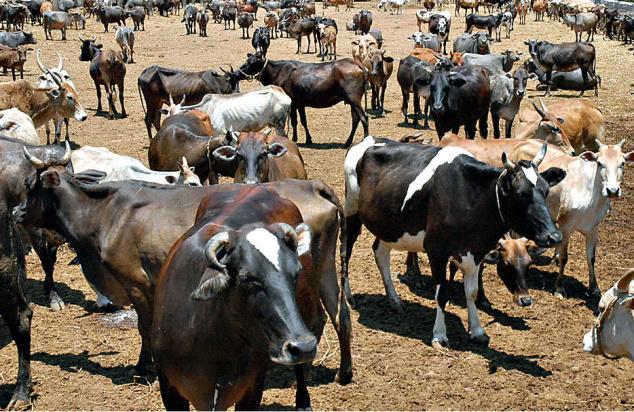
Veterinary diseases cause a huge impact on economy as the country suffered a loss ofRs. 23,000 crore owing to foot and mouth diseasealone in 2013–14.— File Photo M.A. Sriram
In a bid to prevent thousands of crores of losses being suffered due to veterinary diseases, the country is set to strengthen and modernise its veterinary disease surveillance and forecasting system with expertise from the United States of America, which has one of the best veterinary disease surveillance systems in the world.
Under this initiative, the U.S.-based Centre for Disease Control and Prevention (CDC) will train Indian veterinarians as well as medical doctors, according to H. Rahman, Director of Bengaluru-based National Institute of Veterinary Epidemiology and Disease Informatics, which is coordinating such efforts to strengthen and modernise the system.
Though a formal memorandum of understanding in this regard is expected to be signed in September, the preliminary rounds of training have already begun by the CDC. “The CDC has given preliminary training here to two batches of veterinarians and medicos from different States,” Dr. Rahman said. In all, the CDC will impart four rounds of trainings at different levels. This will cover a range of issues such as disease surveillance, collection of disease samples, validation, case studies, and epidemiology (the study of disease pattern and its health impact on population in certain geographical area), he said. Those who undergo the training would be used as trainers for imparting skills to others.
The training is being imparted to medical doctors also as some of the veterinary diseases impact the health of human beings too, he said.
The modernisation will help forecast the incidence of major diseases well in advance besides contributing to development of a strong infrastructure support for preventive measures, he said.
Veterinary diseases cause a huge impact on economy as the country suffered a loss of Rs. 23,000 crore owing to foot and mouth disease alone in 2013–14.
Center for Disease Control and Prevention to train veterinarians as well as medical doctors
source: http://www.thehindu.com / The Hindu / Home> News> Cities> Bengaluru / by B. S. Sathish Kumar / Bengaluru – February 15th, 2015
Having come from a typical rural background, this person had no idea about his journey in life. After working hard for 14 long years, today he has become one of the most sought-after sound effects engineers in the country.
We are talking about Vijaykumar, a boy belonging to a poor family of Santhemarahalli in Chamarajanagar district, who braved all odds to become a successful sound engineer.
His journey began with him taking to distribute newspapers to households in his village. After suffering a loss in business, he headed to Mumbai and entered the film industry.
His latest movie ‘Roar: Tigers of the Sundarbans,’ directed by Kamal Sadanah, has been nominated for the prestigious 62nd Gold Reel Awards instituted by Motion Pictures Sound Editors.
Vijaykumar shared his experience in a brief teate-e-tete with Star of Mysore. Excerpts…
Star of Mysore (SOM): Your journey so far has been fascinating. Tell us something about your childhood?
Vijaykumar: I belong to Santhemarahalli in Chamarajanagar District but my native is Malavalli in Mandya district. Since my father worked in a silk yarn manufacturing company, we had to settle in Santhemarahalli and even today my parents are residing in the same village. I am the second son to my parents. After completing my primary education in Malavalli we shifted to Chamarajanagar. I attended high school and PU at Govt. PU College in Yelandur. I have completed B.Com from JSS College and later studied Diploma in Computer Science. Unfortunately, I did not get a suitable job for my qualification.
SOM: How did you enter into film industry?
Vijaykumar: After completing my education, I started a newspaper agency to help my family. Unfortunately, I had to suffer a huge loss and was unemployed for few months. Suddenly, I remembered one of my friends who had settled in Mumbai. I explained to him about the problems I was facing. Without much delay, he asked me to come to Mumbai and join ‘Aradhana Sounds Service’ studio.
After joining the studio as an office boy for a salary of Rs. 900, I used to attend to the students who visited the studio. While, the students were being explained about the sound engineering, I used to listen to the experts. This is when the diploma I has studied came handy. With things being explained in an unknown language (Hindi) I could only catch a few words. But, slowly I developed Hindi knowledge which helped in learning sound engineering.
SOM: Tell something about your journey from an office boy to a sound engineer?
Vijaykumar: While, I was working in the studio, Oscar winner Resul Pookutty who observed my eagerness to learn, took me as his technical assistant. Initially, my work was to arrange the computer system for him to work. While, he worked I stood behind him and observed his work. After his work was done I used to ask him questions to clear my doubts. It is because of his guidance and my hard work that I reached this level.
SOM: Share something about your relationship with Resul Pookutty
Vijaykumar: Resul Pookutty had a lot of affection for me. While he quit Aradhana Studio to setup his own, Resul sir took me along with him. I have worked in many Hollywood projects along with him as an assistant. He also received the Oscar award for ‘Slum Dog Millionaire.’ Now, ‘Roar: Tigers of the Sundarban’ has been nominated for Golden Reel Award.
SOM: For how many movies have you worked with Resul Pookutty?
Vijaykumar: I have worked for most of his movies. Slum Dog Millionaire, Ghajini, Kochadaiyaan, Robot are some of the movies that I have worked with Resul sir. I have worked in Sound Effects Department for the movie ‘Roar: Tigers of the Sunderban.’
SOM: Which are the other films vying for Gold Reel Awards?
Vijaykumar: There are four other films of foreign countries nominated for the award that is for technical excellence and the award will be presented at a function to be held in Los Angels in America on Feb. 14 and I am eagerly awaiting for the outcome.
source: http://www.starofmysore.com / Star of Mysore / Home> Feature Articles / February 08th, 2015
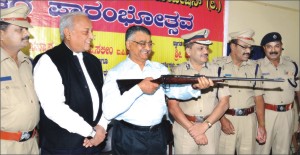
K.B. Ganapathy, Editor-in-Chief, Star of Mysore, is seen posing with a rifle during the inaugural function of Mysuru City Civilian Rifle Association at CAR grounds here this morning. Others seen (from left) CAR Deputy Commissioner of Police (Mysuru) B. Shivanna, Prof. Shivaram Malavalli, City Police Commissioner Dr. M.A. Saleem, DCPs A.N. Rajanna and M.M. Mahadevaiah.
Mysuru :
“One bullet is equal to one life,” said City Police Commissioner Dr. M.A. Saleem.
He was delivering his presidential address during the inaugural function of Mysuru City Civilian Rifle Association, a unit of Mysuru City Police, at City Armed Reserve Grounds premises here this morning.
Dr. Saleem said that one should know the proper usage and maintenance of rifles as in the past many people had lost their lives because of accidental firing while cleaning their rifles.
He said that one bullet is equal to one life as it can take the life of a person instantly.
Dr. Saleem, recalling his rifle training practice while undergoing Anti-terrorism training in America, said that in America, they first teach about the proper usage of Rifle and the safety of the person using the rifle and the people with him. Only when a person knows the right usage thoroughly, he is allowed to practice Rifle shooting there.
Earlier, K.B. Ganapathy, Editor-in-Chief, Star of Mysore, inaugurated the function by lighting the lamp.
In his inaugural address, he noted that many people had lost their lives due to firing of the Rifles accidentally.
He suggested the participants to never keep the rifles loaded at their homes as children may think that it is a toy and may accidentally trigger it.
Appreciating Dr. Saleem for his efforts in reducing the crime rates in city and for enforcing strict traffic rules, Ganapathy said, “Many Police Commissioners have served in Mysuru. However, four among them have made a difference to the city and one among them is Dr. Saleem.”
B. Shivanna, Deputy Commissioner of Police, CAR, Mysuru, who welcomed, noted that civilian rifle training was first started during II World War as there was a necessity of soldiers then. During II World War, civilians were trained in rifle shooting and were appointed into army those days, he added.
Shivanna said that more than 150 people from Mysuru have enrolled for the Rifle shooting training programme which will begin from tomorrow. In each batch, 40 members will be trained for one week.
Commandant of KARP Mounted Police Janardhan, DCPs Mahadevaiah and Rajanna, Mysuru City Civilian Rifle Association’s Joint Trustee Shivakumaraiah, Assistant Police Commissioner, City Armed Reserve, Mysuru and the Association’s Executive Committee Members Dr. Javeed Nayeem, Shreehari, Jainsingh Raj Purohit, Nabeel Mohammed, Den Thimmaiah, Prof. Shivaram Malavalli, Dr. Latha Muthanna, Rifle Training participants and others were present.
Mallikarjunappa, CAR ACP, proposed a vote of thanks.
source: http://www.starofmysore.com / Star of Mysore / Home> General News / Monday, February 09th, 2015
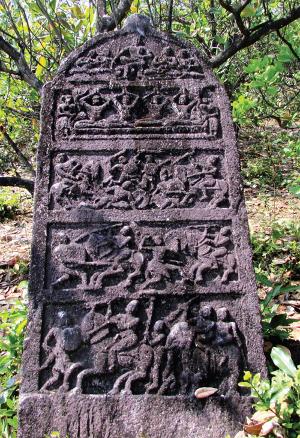
A typical hero stone has been discovered 5 km from Kollur Mookambika Temple by Murlidhar Hegde, a junior engineer of the temple. This discovery is significant for the cultural history and antiquity of Kollur, said professor T Murugeshi, an archaeologist and associate professor in Ancient History and Archaeology, M S R S College, Shirva in Udupi district. Kollur Mookambika temple, 135 kms from Mangaluru, is an important pilgrim centre. Goddess Mookambika is in the form of Jyotir Linga here, incorporating both Shiva and Shakthi.
Murugeshi says erecting memorial stones in honour of the deceased was an ancient practice in India. Menhirs were erected in the megalithic period in honour of the dead and different types of memorial stones such as hero stones and sati stones were raised in different forms and styles. It was also introduced in coastal Karnataka where it is found in different styles and forms. The hero stone is divided into five strips with bottom three depicting war scenes. The fourth shows four dead warriors sitting with palms joined over their heads in salutation. The fifth has carved figures of four dead persons seated on either side of a royal figure, seated in a heroic posture. This is a distinct feature of this hero stone. In medieval hero stones the deceased are generally depicted sitting near god.
“The hero stone under study was prepared in the style and form of medieval ones. It is datable to the 13th-14th century AD. The temple’s history dates back to 17th century to the Keladi kings. But there is a belief that Shankaracharya established the temple in the 8th century. There is no historical evidence of the period between 8th and 17th centuries, and hence, this Hoysala-style discovery is crucial,” said Murugeshi.
source: http://www.bangaloremirror.com / BangaloreMirror / Home> News> State / by Deepthi Sanjiv, Bangalore Mirror Bureau / February 11th, 2015
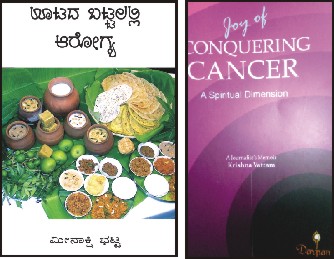
The city-based public-spirited duo Dr. Anil Sangli (Consultant Neuro and Spine Surgeon) and Sripad Sangli (Certified Financial Planner and Music Therapist), founders of Scientific Research Innovations in Advanced Neurosciences (SRIAN) have organised an event “Neuroscience and Art” at Veene Seshanna Bhavan, Kuvempunagar) here on Feb. 6 from 5.30 pm comprising release of two books — ‘Ootada Battalalli Aarogya’ by Meenakshi Bhat and ‘Joy of Conquering Cancer: A spiritual dimension – A Journalist’s Memoir’ authored by veteran journalist Krishna Vattam.
The first book in Kannada presents in simple language the regimen of diet based on traditional food and food habits for healthy living. The second book is the English version of the Kannada publication by Vattam presenting his years of battling with cancer and the delight of overcoming the scourge with a positive mindset and prompt treatment, with the message that cancer survivors owe a duty to educate and involve themselves in cancer awareness campaigns.
Dr. B.S. Ajay Kumar, Founder-Chairman, Healthcare Global Enterprises Ltd., will be the chief guest. Dr. Vasundhara Bhupathi, Secretary, Karnataka Rajya Vijnana Parishat and President, Karnataka Lekhakiyara Sangha, will be the guest of honour. Ravindra Bhat, Special Correspondent, Prajavani and Bharathi Hegde, Chief Sub-Editor, Vijayavani will be the special invitees. Dr. Anil Sangli and Sripad Sangli will speak on the theme ‘Neuroscience and Art’ based on their research in the field.
The programme will begin with an invocation by renowned playback singer Veena S. Pandit followed by musical delight by Shreyas Sai, Mansi Pai and Shilpa Srinath. The event will be compered by Vidu. Rajalakshmi G. Sridhar while snippets will be presented by Niranjan Nikam and Bharathi Hegde.
SRIAN Envisions, an organisation that works with the theme ‘Harmonising Health-Wealth-Wellness,’ has been offering inter-disciplinary professional complementary services. SRIAN Envisions highlights the benefits of Neuroscience by bringing the essenc eof mind-body interaction and the art of attaining youthfulness.
source: http://www.starofmysore.com / Star of Mysore / Home> General News / Thursday – February 05th, 2015
The Karnataka Chamber of Commerce and Industry (KCCI), in collaboration with Dharwad Horticulture Department and Karnataka State Spice Products Development Board, will organize a three day “Chilli Mela” at Murusavir mutt from February 7.
Speaking to reporters here on Thursday, Vasantha Ladawa, president of KCCI, Hubballi, said that the main objective of the event is to provide chilli at reasonable prices and provide a platform to farmers sell their items directly to consumers.
He said that farmers from Dharwad, Gadag, and other districts of North Karnataka would participate in the mela. About 150 shops, displaying different varieties of chilli, would be set up at the mela. Ladawa said that about 150 tonnes of chilli is expected to be sold at the event.
I K Doddamani, deputy director of Dharwad Horticulture Department, said that all measures have been taken to end the menace of middlemen who harass farmers. “Farmers can register by producing their land records or identity cards,” he said.
Horticulture minister Shamanuru Shivashankrappa will inaugurate the mela. Former chief minister Jagadish Shettar, district in-charge minister Dinesh Gundurao and MP Pralhad Joshi will be present at the inaugural ceremony.
source: http://www.thehindu.com / The Hindu / Home> City> Hubballi / TNN / February 06th, 2015
The Fort High School at Chamarajpet in Bengaluru was built in 1907. File Photo: V. Sreenivasa Murthy
INTACH has taken up the structure for preliminary assessment to suggest areas that need restoration
The 108-year-old Fort High School building in Chamarajpet has braved the vagaries of time. The school that was built in 1907 has also witnessed several students graduate from its portals, right from freedom fighter H.S. Doreswamy and political statesman V.S. Krishna Iyer to the former cricketer G.R. Vishwanath.
However, the old building is crying for attention. The clay-tiled roof needs urgent replacement, while the walls are damp due to leakages. The steel and wooden trusses in the building need to be treated, the walls need plastering, and flooring and wooden staircase need work. Even the stucco work on the walls look damaged.
The structure has now been taken up for preliminary assessment by Indian National Trust for Art and Cultural Heritage (INTACH), which will suggest areas that need restoration so as to bring back its colonial grandeur. “We will share our study with the Department of Public Instruction and anyone who is interested in taking up the restoration,” said Meera Iyer, co-convener of INTACH.
There are thousands of such old buildings in the city that can be preserved for value of antiquity. “As per INTACH’s listing, Ulsoor alone has nearly 90 heritage buildings,” she said.
The buildings in INTACH listing are grouped into various categories and grades, as per international standards. This helps identify the heritage potential of the buildings. Some of the buildings that have a public connect are assessed in depth by restoration experts and conservation architects to establish their social relevance.
“Recently, INTACH took up a study in Lalbagh to advice the Department of Horticulture for the restoration of three buildings — Library Building, Krumbigal Hall and Old Aquarium,” Ms. Iyer said.
It is the cost-factor that plays the spoilsport in the restoration of heritage structures, she said, and added that to bring back the bygone glory of a building, one requires not just “a feel for the old”, but also flair to identify the techniques required for restoration.
source: http://www.thehindu.com / The Hindu / Home> News> Cities> Bengaluru / by Ranjani Govind / Bengaluru – February 09th, 2015
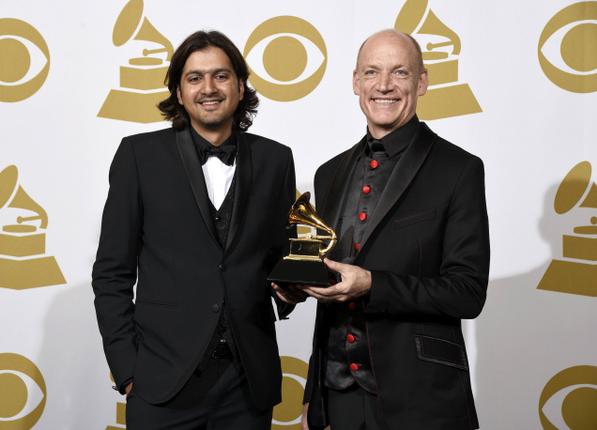
Ricky Kej (L) and Wouter Kellerman of Winds of Samsara pose with their trophy that they won in the new age album category at the 57th annual Grammy Awards in Los Angeles on Sunday. / AP
India-based Ricky Kej’s collaborated album Winds Of Samsara won the Best New Age Album trophy at the 57th Annual Grammy Awards here.
Ricky teamed up with South African musician Wouter Kellerman for the album, which symbolises peace and harmony.
The website of the album describes the project as a “truly global effort”, which draws inspiration from two cultures. The music of the album blends in the creative influences of the cultures to generate a sound of calmness and positivity.
Other albums nominated in the category were Bhakti by Paul Avgerinos, Ritual by Peter Kater and R. Carlos Nakai, Symphony Live In Istanbul by Kitaro and In Love And Longing by Silvia Nakkach and David Darling.
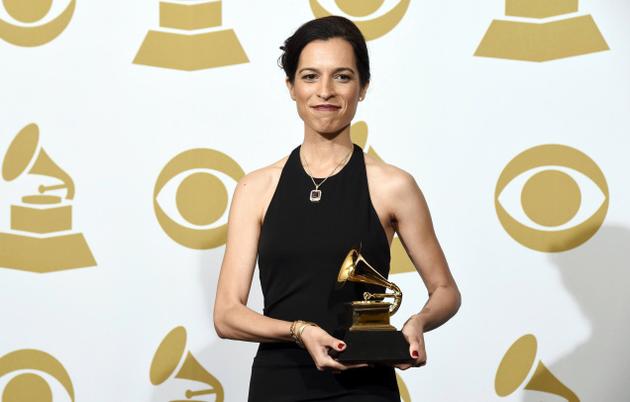
Neela Vaswani poses with the award for best children’s album for “I Am Malala: How One Girl Stood Up For Education And Changed The World” at the 57th annual Grammy Awards, in Los Angeles on Sunday. / AP
Another Indian artist to make it big at the awards this year was Neela Vaswani. She won the trophy in the Best Children’s Album category for I Am Malala: How One Girl Stood Up For Education And Changed The World (Malala Yousafzai). Vaswani narrated the audio version of the book.
However, sitarist and daughter of the late sitar maestro Ravi Shankar, Anoushka, who was nominated for her album Traces of You in the Best World Music Album category lost out to Angelique Kidjo’s album Eve.
source: http://www.thehindu.com / The Hindu / Home> News> International / IANS / Los Angeles, February 09th, 2015
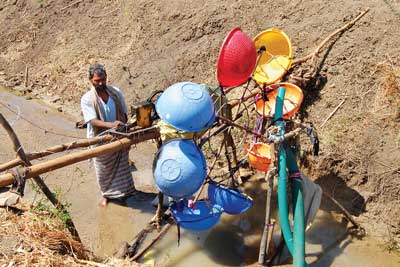
Siddappa, an illiterate farmer from Somapur village in Gadag district of Karnataka, has designed a water mill to generate electricity. Right from conceptualizing to materialisation, the farmer has done everything on his own. He operates the water mill in the canal near his house.
Using timbers, Siddappa prepared a giant wheel that joined at a central hub. There are eight arms, five feet each, extending from the central hub. A plastic bucket is dangled at the tip of each arm. When the water from two pipes gushes into one of the buckets, it generates the pressure that turns the 10-feet wheel in an anti-clockwise motion. The bucket could also be spun in the horizontal plane using a central steering wheel, similar to a teacup ride. As one after another bucket is driven by the flowing water, the first arm declines back to the ground while the other rises in the air. This process spins the black wheel attached to this giant wheel. The spinning black wheel rotates another wheel connected to a dynamo.
A converter converts the Direct Current from the dynamo into Alternating Current. Siddappa claims to have spent a mere Rs 5000 on building the entire apparatus. This is his second attempt to show the villagers that anybody can produce electricity for self-consumption using the resources at hand. “Many people who have canals flowing near their villages don’t know how to use that natural gift. I want to show them all practically that electricity problems can be solved by being creative. There is no need to beg to the government for everything,” he says.
He gets 150 watts of power from this water mill when water flows in the canal. Siddappa claims he can create electricity for the entire village through his machine. But the problem is that the canal in his village flows only for three months a year!
source: http://www.thebetterindia.com / The Better India / Home> Innovation / by N K Suprabha / April 08th, 2011
This article originally appeared in The Sunday Indian (TSI) magazine and has been reproduced here as part of an arrangement between The Better India and TSI. The author, Suprabha Naik is a correspondent with the Kannada Bureau of TSI. Read previous article of this author here.
When was the last time you went to a museum? If you can’t recall, this NGO’s project will help refresh your memory and revitalise the idea in your head
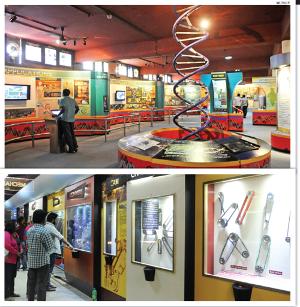
The Visvesvaraya Industrial and Technological Museum attracts 10 lakh visitors per year. (Top right) The National Gallery of Modern Art where they’re are organising new exhibitions, workshops, family quizzes, gallery walks and auditorium programmes to attract visitors
Swords, guns, king’s outfits, utensils, palanquins, artefacts, lamps, artworks… and life itself. Museums are much more than storerooms of strange and fascinating objects from a bygone era, preserved and labelled in glass cases with ‘Do Not Touch’ signs on them. They’re repositories of a way of life, showcasing a history and continuum that has brought us where we are today — whether sociologically or culturally. So why is that most of us rush to visit museums in other countries, but haven’t gone to one in our immediate vicinity since our school days, or without our children and grandchildren? Bengaluru NGO ReReeti, which hopes to transform Indian museums into spaces of learning, delight and meaningful engagement for Indian and overseas visitors, is attempting to answer that very question with a project called ‘Object of my Affection’.
In an effort to contemporarise the museum experience and re-introduce its value to a young audience, ‘Object of my Affection’ invites people to contemplate the value of objects in their home and imagine them in a museum 60 years from now. After all, “citizens get a sense of their ethnological ancestry, their nation’s cultural, scientific, historical, and technological progress through the materials on display at museums,” says Tejshvi Jain, Founding-Director of ReReeti. If you admire an object for its design, functionality or aesthetic appeal, and think it is precious today and may not be in use say 60 years from now, take a picture and upload it to Twitter or email them. Tell them when was the last time you visited a museum and why this object is museum-worthy or valuable to you. Through the exercise, which commences today and will go on for a month, ReReeti hopes to spark a thought process about the purpose of museums and help people look at them anew — as spaces that tell a narrative of a way of life.
More than objects
SK Aruni, City Director of Indian Council of Historical Research Bangalore, believes the time is ripe for such an initiative. Ruing that the revival of museums is not taken seriously, he says, “Each object has its own history, its own growth. But a museum needs to go beyond just labelling and displaying these items,” he believes. That could be done via cultural entertainment, “to show how life was lived at the time” and interactive displays or stories of the way art developed from ancient to modern times, “in art galleries”, he believes.
Great ideas, but not always successfully implemented. DK Chowda, General Secretary, Chitrakala Parishat says, “We have some of the best collections in the world including works by Bengal artistes and folk artistes, leather puppets and Mysore traditional paintings, among others.” He admits there is a need to attract newer audiences by making this a more lively space — by way of storytelling sessions around paintings, audio and visual aids, and a focus on promoting art and culture. “But we need funding and space,” is his refrain. Simple changes — like making the third floor “easier to reach”, and employing guides who can take people through the rich tapestries of the Mysore paintings (“Where did this style start? How did it emerge? What are the myths?”) are his suggestions, and hopes for the art school and museum.
Jain agrees. “Museums are perceived as dull, boring spaces,” she says. But that can be changed, if they work to fulfil people’s needs. She cites the examples of sleepovers in some US museums.
And in the UK, museums such as Tate and Victor and Albert Museum are, every so often kept open till late in the evening, and the look is changed, complete with disco lights and bars. “That attracts youngsters. Architecture students create theme-based activities — like games related to the architecture of the museum.” In Scotland, she recalls a Christmas-themed day at a museum when adults stood in a huge line, excited to make small badges with selfies on it. “In that process, they end up visiting the museum,” she says.
Have activities
It’s a philosophy KG Kumar, Director, Visvesvaraya Industrial and Technological Museum, has been trying to further ever since his return to the institution two years ago. Proudly citing a figure of 10 lakh visitors per year “highest in the science council of museums”, he talks about the various initiatives he has undertaken to make the museum a more interactive space. These include storytelling around exhibits like the spinosaurus, attended by 700 children over two days, multimedia projections, the use of miniature props that add to the storytelling sessions, and the Wright Brothers Flight Simulator that replicated the first flight in 1903, complete with controls.
“Next, I’ll have an exhibition on natural disasters and how to prevent them, a science show using dry ice, an interactive exhibit around the meaning of DNA…” The list is long.
Outreach programmes, he stresses, are necessary to attract audiences. From activity corners to demonstrate small processes in the biotechnology lab to an innovation festival where the public is invited to demonstrate their ingenious daily innovations, Kumar is making an effort to generate interest in museums. “You’ll see a king’s or a Nizam’s outfit on display, with a boring label next to it. Why not create a story around it? When did he wear it and why?” he asks. At the National Gallery of Modern Art, where he is the “borrowed” Director, he is making similar attempts with new exhibitions, summer workshops, family quizzes, gallery walks and auditorium programmes. “There are original paintings, which immediately relate to history, and contain stories of the times they were created — say Partition. We need to tell those stories in a more engaging fashion.”
We can almost see Jain nod. “Museums are holders of tradition and history. Once you make them personal enough, make a connection and make it contemporary, people will see that.” With Object of my Affection, she hopes people start with themselves. “What would you want to preserve for your next generation,” she asks. How can you be proud of your city, your time and your history? “People take selfies every now and then. So we’re connecting it to what is around them with this project,” she says. All of which will finally culminate in an exhibition of things that are important to Bengaluru. There you have it — your very own museum of memories. Not so boring anymore, right?
Object of my Affection: Choose any object from your home: spoon, hair brush, cushion cover, cooking utensil, graphic novel, lamp, whatever strikes your fancy you would want to preserve for the next generation. Click a photo, upload the photo and type ‘Object of my Affection: xyz, tag @ReReeti, use the hashtags #ReReeti #museumworthy and post your tweet. Or email: ReReeti13@gmail.com. All photo submissions will be added to their Flickr account.
source: http://www.bangaloremirror.com / Bangalore Mirror / Home> Columns> Sunday-Read / by Sowmya Rajaram, Bangalore Mirror Bureau / February 08th, 2015