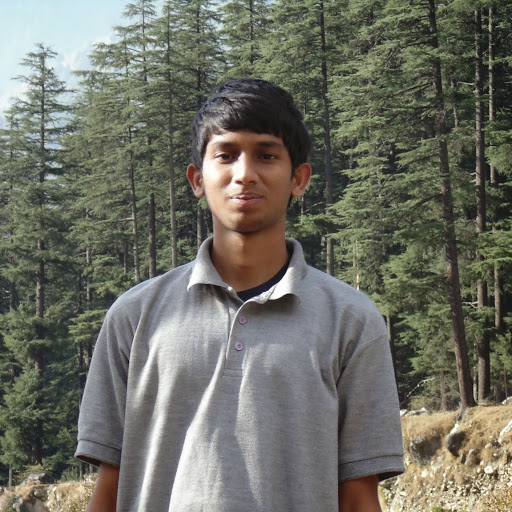
Mysore University Vice-Chancellor Prof. K.S. Rangappa is seen greeting Hokkaido University President Prof. Keizo Yamaguchi after exchanging the MoU at a press meet held at Crawford Hall here this morning.
Mysuru :
The University of Mysore has tied up with Hokkaido University of Japan for exchange of faculty, students and research fellows, academic materials, publications and to conduct joint research projects to include symposiums, conferences and workshops. This was disclosed by Vice-Chancellor Prof. K.S. Rangappa at a press meet held at Crawford Hall here this morning after signing an MoU with representatives of Japanese University.
Elaborating on the subject, Prof. Rangappa said the agreement was valid for five years which could be extended and the alliance would boost research and academic works.
The VC said that Mysore University, Hokkaido University and a South African University had already taken up a joint research work on early detection of cancer. He further said that the State government with approval of Union Ministry of Human Resource Development was contemplating to establish an Exclusive Research University and Mysore University was vying to get that honour.
Hokkaido University President Prof. Keizo Yamaguchi, Professors Makoto Demura, Shinichiro Nishimura, Kenju Monde and Mysore University Registrar Prof. C. Basavaraj were present.
source: http://www.starofmysore.com / Star of Mysore / Home> General News / Thursday, January 29th, 2015
Sanjay will present a paper with a set of plans to explore the outer solar system and beyond
Sanjay Lakshminarayana
A 20-year-old Bengaluru boy is on his way to Texas to present a paper at the prestigious National Aeronautics and Space Administration (NASA). Sanjay Lakshminarayana, a mechanical engineering student, has been selected to present his ideas and attend conventions. These will study important observations made by recent planetary missions and emerging nuclear technologies for space exploration and travel.
The youngster, who has been interested in space since childhood, will present a set of plans to explore the outer solar system and beyond. The ideas will have a significant focus on nuclear systems as enabling technologies.
Sanjay said he would use this opportunity to discuss the knowledge gaps in exploration of extra-terrestrial environments and the most recent discoveries in this area.
The youngster, who also has an interest in car designing, told BM that his background in mechanical engineering provided a base for his interest in space exploration and his consistent research in the area.
Unexpected invite
The meetings on Sanjay’s agenda have been sponsored by NASA and the American Nuclear Society. Speaking on the unexpected invite, Sanjay said, “It was at a meeting in Russia, that a professor from NASA noticed my interest and sent me an invite for this year”.
Commenting on what this opportunity meant for him, he said, “I want to learn a lot about the latest developments and share my ideas with scientists from across the world. I am looking to gain immense knowledge, a sense of direction and meet people who will be able to help me in my research. ”
The meetings are scheduled between February 3 and March 16. These will be held at various locations including the Lunar Planetary Institute in Houston. Sanjay has also been invited to present his paper titled “The Magneto-Confined Fusion Ion Thruster” at the 2015 Nuclear and Emerging Technologies for Space (NETS-2015) conference to be held in Albuquerque. Sanjay’s schedule
1. 2015 Nuclear and Emerging Technologies for Space (NETS-2015) conference, March 23rd-26th, Albuquerque
2.Workshop on Early Solar System Impact Bombardment III, February 4th-6th, Lunar and Planetary Institute in Houston.
source: http://www.bangaloremirror.com / Bangalore Mirror / Home> Bangalore> Others / by Apurva Venkat, Bangalore Mirror Bureau / February 03rd, 2015
The city was subsumed by a riot of colours. The much-touted Konkani Holi, or Okkuli, as it is popularly called here, drew vast numbers of people to paint the town red, blue, green and more.
The Monday’s devout ‘Kodial Theru’ crowd on Car Street was replaced by colour-splashing youth on Tuesday.
The SVT Mat Friends dished out filmy numbers on a makeshift stage on the left of Sri Venkataramana Temple, and another band of motley crew struck all the right chords, making the crowd sway to their music.
Friends sneaking on friends with their hands full of bright, fluorescent colours, and the latter trying to flee only added to the festive fun. This year, for a change, girls were not reticent when it came to dishing it back to boys for daubing them in colours.
Doting mothers watched their children, when they were running about playing with everyone on the street. Tankers spraying water on the revelers saw Car Street awash with multiple colours. Youth made a dash for sachets of wafers and other snacks which were thrown around from the tankers.
Both young and old merrily participated in the colour-splashing battle. Even the jolly old men in their sixties broke a leg when they dance to the hit number ‘Premanathe Pass Aathe,’ which featured Bollywood’s comedy king Johnny Lever from the Tulu movie Rang.
The countless moments of joy and laughter were visibly evident as the residents took part in the festive fun and frolic.
source: http://www.timesofindia.indiatimes.com / The Times of India / Home> City> Mangaluru / TNN / January 28th, 2015
SHARING DIVERSE EXPERIENCES The core team of the India Theatre Forum.
The first phase of SMART, India’s first theatre management programme, was held at Fireflies, near Bengaluru. The residential course had some of the best theatre groups gather to learn the nuts and bolts of purposeful planning
Passion alone sustains theatre practitioners in India. Despite lack of government funding and inadequate infrastructure, there is plenty of theatre happening all around us, in big cities and small towns, alike. In an endeavour to propel the art form forward, India Theatre Forum, a theatre network run by and for people in theatre, conceptualised and implemented, with support from Mumbai-based Junoon and India Foundation for the Arts (IFA), India’s first theatre management programme.
The initiative, Strategic Management in the Art of Theatre (SMART) is divided into three phases, which takes theatre groups from across the country through a practical roadmap or a strategic plan to make them more sustainable, effective and financially viable. The first phase of SMART was held at Fireflies near Bengaluru, where 17 theatre groups from across the country, participated in a 10-day residential workshop. Sanjna Kapoor and Sameera Iyengar of Junoon, Sudhanva Deshpande of Jana Natya Mancha and Studio Safdar, Delhi and Arundhati Ghosh, executive director, IFA, at a press conference held in the city, spoke of their experiences at Fireflies and of the road ahead for SMART.
Sanjna said the time for capacity building within the theatre community had finally arrived. “It seemed necessary to try and cultivate theatre management,” Sanjna said. Sameera added: “Theatre is an informal sector. In India, theatre survives and thrives despite everything. Theatre practitioners are often the managers. We felt we needed to look at what it means in the Indian context. We put together a fairly detailed survey. We sent it out to our database. We got 72 responses. We were very clear that SMART would be for theatre groups. We wanted theatre groups to send two people who are key decision makers in the group.” Sudhanva said the quality of groups who responded were outstanding. “It wasn’t just new groups that had responded, but older, more well-established groups who have been in the field for 20 to 30 years. Each one of the groups is first rate theatre groups, who do different kinds of theatre.”
Sanjna added, “We got participants not just from the metros, like Delhi, Mumbai and Bengaluru, but also from small towns such as Allahabad, Nasik, Pondicherry.”
Professor Milena Dragicevic Sesic, UNESCO chair in Cultural Policy and Management and professor at the University of the Arts, Belgrade, Serbia was the course mentor. She said the conclusion of the first phase signalled the “end of one process and the beginning of another process— a long journey of theatre development.”
The residency at Fireflies, Arundhati said, was magical. “We had something in the evening which we called adda. We had researchers and practitioners from the international community, including Ruth Bereson, an arts manager and teacher, Alessandra Gariboldi, Milena and the Freedom Theatre group that have worked in Palestine, share their diverse experiences.”
Apart from Sanjna, Sameera, Sudhanva and Arundhati, the other facilitators were Sunil Shanbag, theatre director, Arpana, Mumbai, and Swati Apte, director, Junoon.
Every group has been given one mentor, and in the next phase, theywill work with them over their respective mentors over six months.
“Among the mentors are Pravin K.P., Rajiv Krishnan and Menaka Rodriguez. They will be facilitators and will act as a bridge. The groups will come back this year again to discuss a strategic plan for the next three years,” said Arundhati. She added that they will announce SMART’s next year’s programme, in August.
source: http://www.thehindu.com / The Hindu / Home> Features> MetroPlus / by Sravasti Datta / February 01st, 2015
Winners of the spelling bee contest: (from left) Bindu Shree (3rd place), Sandhya (2nd place), Archana N.S. (1st place), Syed Arbaz (4th place), and Vishwanath R. (5th place). / The Hindu
The air is thick with tension as students from 23 schools across the city struggle to get their words right.
“How do you spell Gemini?” a judge asks Preethy of Madivala Government High School. She hesitates and asks for a Kannada translation, then proceeds to answer correctly, amid loud claps and cheers.
It was the sixth year that Sahasra Deepika International for Education (SDIE) was holding a spelling bee competition for Class 9 students of Kannada-medium government high schools across the city.
It is unique in many ways: the students do not come from top private schools and many cannot speak English beyond constructing basic sentences. As many as 92 students were drawn from 23 schools as part of a programme to impart English grammar and vocabulary skills among Kannada-medium students. They performed admirably, tackling words from ‘celebration’ and ‘vague’ to ‘heliocentric’ and ‘echinodermata’. The winning word was ‘chorus’.
“We want to give these children an opportunity to be on stage, and to gain confidence through such competitions,” says Vijayalakshmi Ramakrishnan, founder and treasurer of the SDIE. “Some of these kids have never celebrated a birthday. Some do not get English textbooks until the end of the school year.”
The goal is to try to ensure that these children do not feel left out, she says, pointing out that without a working knowledge of English, the children have little chance of getting jobs in the future.
The winners of the event are: Archana, Krishna Iyer School; Sandhya, Honnagonahatti Government High School; Bindu Shree, Honnagonahatti High School; Syed Arbaz, Fort High School, and Vishwanath Doddagolarahatti Government High School.
source: http://www.thehindu.com / The Hindu / Home> News> National> Karnataka / by Cinthya Anand /Bengaluru – February 01st, 2015
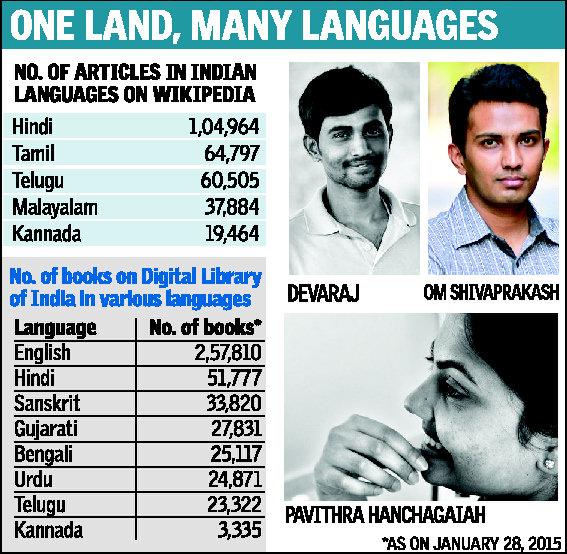
They will also create 5,000 Kannada Wiki pages based on these books
Hyderabad-based Osmania University Digital Library has 2,133 digitised Kannada books, but they are not easy to access because their titles are not listed in the Kannada script.
Three young techies from Karnataka — Om Shivaprakash H.L., Pavithra Hanchagaiah and Devaraj K. — are now setting right this anomaly by not only transliterating the titles and names of authors and publishers into the Kannada script, but also embarking on creating 5,000 Kannada Wiki pages related to these books. The trio has created a crowd-sourcing platform called ‘Samooha Sanchaya’ (http://samooha.sanchaya.net) to get help from people to transliterate, so that the work can be completed faster.
In the next phase, the team is planning to take up a similar project with 3,335 Kannada books in the Digital Library of India, a total of 7,19,327 pages.
“We hope to enhance the reachability of digitised books and also add value to Kannada Wikipedia by contributing Wiki pages,” says Mr. Shivaprakash, who heads the team. Along with this, the team is also launching its own book site ‘Pustaka Sanchaya’ (http://pustaka.sanchaya.net) in a few days which hopes to provide exhaustive bibliographic information.
Mr. Shivaprakash says that access is a problem across languages in digitised libraries. “In all existing digitised projects, they have not taken care of the accessibility of regional language books. They should have got the book names indexed in the respective languages,” he says. “We can help people do the same exercise in other languages if they need help in making books easier to search and find.”
The same team has put together Vachana literature of the 12th Century and Dasa literature on an online platform designed to help researchers.
source: http://www.thehindu.com / The Hindu / Home> News> National> Karnataka / by Bageshree S / Bengaluru – February 01st, 2015