It was a marvelous sight as nearly 70,000 students in educational institutions across Dakshina Kannada and Udupi districts simultaneously performed yoga in an attempt to enter the Guinness Book of World Records.
More than 2000 students of Sharada Vidyalaya gathered in their school ground to attempt the record.
‘Yoga for Future 2013’ has been organized by Sri Kshetra Dharmasthala Shantivana Trust in association with Sri Dharmasthala Manjunatheshwara Yoga and Ethical Education, Dakshina Kannada zilla panchayat and department of public instructions.
The students made an attempt to beat the present Guinness Book of World Record created when 29,973 students from 362 schools performed Suryanamaskar for 18 minutes at Vivekanand Kendra in Jiwaji University.
The demonstrations included Suryanamaskar, chanting of Surya mantras, Thrikonasana, Parshwakonasana, Shashankasana, Pavana Mukthasana, Sarvangasana, Vajrasana, Makarasana, Bhujangasana and Dhanurasana.
There was one yoga instructor for every 50 students, and the entire event was videographed.
Health Minister U T Khadar who was present on the occasion said, “I love yoga. I do yoga whenever I have time, which is not very often. I congratulate everyone for being part of this attempt for Guinness World Record.”
Additional deputy commissioner Dayanand and others were also present.
Udupi/Beltangady/Kundapur :
As many as 2,960 students of SDM Institutions, Ujire gathered at Ratnavarma Heggade stadium alone and performed Yoga. The historic moment was watched by Dharmasthala’s Harshendra Heggade and Hemavati Heggade.
In Kundapur, students attempted the record at Gandhi maidan and other places. As many as 3,625 students gathered at MGM grounds at Udupi and performed yoga. Altogether, 44,117 students from across the district were part of the event. District incharge minister Vinay Kumar Sorake, Sri Sugunendratirtha Swamiji of Puttige Math, Sri Laxmivaratirtha Swamiji of Shiroor Math and others witnessed the event in Udupi. Youngest film director Kishan Shrikanth is the brand ambassador for ‘Yoga for Future 2013,’ which is being held at 50 centres under the guidance of Dharmasthala Dharmadhikar Dr D Veerendra Heggade.
The event has been organized by Dharmasthala Shantivana Trust. As the yoga is being held in various centres, the success of the attempt will be known only later.
source: http://www.daijiworld.com / Daijiworld.com / Home> Top Stories / by Daijiworld Media Network – Mangalore (MD) / Friday – December 13th, 2013
by Prof. A.V. Narasimha Murthy, former Head, Department of Ancient History & Archaeology, University of Mysore
A religious spectacle referred to as Panchalinga Darshana at Talkad has been receiving maximum attention from print and electronic media. The religious rituals have already been started and will continue for a week. The whole atmosphere is soaked in mythology and the devotees are pouring into Talkad to get the religious merit by worshipping the five Siva lingas in a particular order. In fact the historical aspects are equally glorious as supported by inscriptions.
The archaeological excavations conducted at Talkad have taken the antiquity of this place to the stone age (megalithic) period corresponding to pre-Christian era. Later it exhibited Satavahana or early historic culture datable to 2nd century AD. A very interesting find of this period was the equipment used for manufacturing counterfeit Roman gold coins, may be used for pendants, as evidenced by terracotta mould showing the reverse of the coin of Roman emperor Augustus or Tiberius. Subsequently the western Gangas migrated to this place. Actually the original home of the Gangas was Kolar and they migrated to Talkad around 4100 AD and made it as their capital and ruled till the end of the tenth century AD.
The Gangas of Talkad have contributed two Siva lingas for the ritual of Panchalinga Darshana. The first one is the Patalesvara temple. It is a small stone temple with a sanctum, vestibule and a mandapa, opening to the east. The sanctum has a small Siva linga which is reddish in colour. It is said that it changes its colour as the day advances.
The Maralesvara temple is slightly bigger with a sanctum and two mandapas. The large number of loose sculptures kept in the temple are evidences of Ganga art. The sanctum has a Siva linga. This temple was built around eleventh century AD.
Sometime later, the Gangas were defeated by the Cholas and Talkad became a part of the Chola kingdom. It became a prominent town during the rule of Chola Rajaraja and it was named as Rajarajapura. The Cholas built many Siva and Vishnu temples at Talkad. It became a provincial capital under the Cholas with a governor placed here. The Cholas renamed Malingi as Jananathapura and built Chola temples here also. The Cholas have contributed Arkesvara temple actually situated 3 miles away from Talkad at a place called Vijayapura. It has undergone many renovations and has lost its original Chola features. This is a temple for surya aspect of Siva and has to be visited by the devotees undertaking Panchalinga Darshana.
The next phase is the Hoysala rule. Hoysala king Vishnuvardhana invaded Talkad, defeated the cholas and drove them out of Karnataka for ever. This was a great political event and Vishnuvardhana assumed the title Talakadugonda (Conqueror of Talkad) and minted gold coins to commemorate this great event. Not satisfied by this, he built a Vishnu temple at Talkad itself and named it as Kirtinarayana. This temple was partly buried under the sands and the Archaeological Department partly exposed it. About a decade back, Archaeological Survey of India began complete conservation of this temple by dismantling every part of it and the work is in progress.
This is a Hoysala temple built of granite. Soapstone is used only for pillars. The temple has a sanctum, vestibule and a navaranga which has three entrances. The main image of Kirtinarayana is about ten feet in height. Actually it is an image of standing Vishnu holding conch, lotus, club and discus. The halo has ten incarnations carved minutely. Thus this temple stands as a witness to the heroism of Hoysala Vishnuvardhana. No visitor can afford to miss this temple.
After the decline of the Hoysalas, Vijayanagara empire came into existence with the main object of preserving and nurturing Indian tradition and culture. Talkad became a Vijayanagara capital and Minister Madhava built a dam in 1342 across Cauvery which helped agriculture in this area. Srirangaraya was appointed as the governor and Talkad also came under his administration. He and his wife Alamelamma have become famous by giving a curse to Raja Wadiyar. The place of this incident is the Vaidyesvara temple at Talkad.
This temple was built in the early Vijayanagara period by about 1360 AD under the direction of Minister Madhava who was a native of Talkad. It is a large granite temple consisting of a sanctum, vestibule and a square navaranga. It stands on a star shaped low platform. It has a dravidian tower. Another mandapa was added in 1633 AD. The outer walls have a large number of sculptures such as Mahishamardini, Lakshmi, Surya, Brahma, Virabhadra etc. The eastern entrance has two dvarapala sculptures which are over ten feet in height and are considered tallest sculptures of that category in Karnataka. There are two rare sculptures here. The first one represents Bedara Kannappa and the other is Shankaracharya being tormented by a crocodile. The consort of Vaidyesvara is goddess Manonmani and a separate shrine has been built for her.
With the decline of Vijayanagara empire, Talkad became a part of Mysore Wadiyar kingdom as evidenced by inscriptions of Chamaraja (1633), Devaraja (1663) and Chikka Devaraja (1679). It remained under the Wadiyars of Mysore till the formation of Karnataka and continues to be a religious town till date. Thus Talkad has a long unbroken history of over 2500 years.
Though situated outside the town of Talkad, Mallikarjuna temple at Mudukuthore, four kms away, forms a part of the Panchalinga Darshana ritual. It is to the north of Talkad on a hill called Somagiri. The hill temple has to be reached through steep steps. The temple has a mandapa. Siva here is referred to as Mallikarjuna. The temple has a small Dravidian tower.
The village goddess of Talkad is called Bandarasamma and a small temple houses this goddess. The annual fair or jatre attracts a large number of devotees from nearby villages. In addition to the temples mentioned above there are more than 25 temples which are in ruins. Out of these cluster of temples, only five were selected for the special honour and ritual of Panchalinga Darshana which takes place on a special day of significant Hindu astrological and astronomical phenomenon. It should be the month of Karthika with five Mondays and the fifth Monday should coincide with new moon day (amavasye) with Visakha, Jyesta or Anuradha Nakshatras and Kuhu yoga. It is a strange combination and this year it took place on 2nd December. Because of this, all roads led to Talkad. That is the strength of our tradition and culture where history and mythology merge harmoniously.
source:http://www.starofmysore.com / Star of Mysore / Home> Feature Articles / December 08th, 2013
One can burn 330 calories per hour through this beautiful dance.
For pregnant women, this dance works wondrously during the birthing process. It facilitates natural childbirth and is a perfect post-natal exercise that helps one tone the abdomen to perfection.
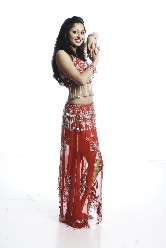
She is an expert in the very graceful Middle Eastern dance form which is not just popular in the Middle Eastern countries but is equally loved by those in Western countries too. And what makes Anusha Nutoh special is the fact that she enjoys the distinction of having been the first one to start belly dance training classes in Mysore.
Twenty-five-year old Anusha’s tryst with belly dancing began almost over a decade ago. Inspired by pop singer Shakira’s belly dance in one of her music videos Anusha decided to learn the dance.
When asked about the acceptability of belly dance in a conservative Indian society, she says “Yes, India has a long way to go and accept this dance form as a prestigious one. There is a myth that belly dancing is like cabaret because of which many hesitate to learn this dance form in India. Also, many think, belly dance is all about showing the belly and wearing revealing costumes which is absolutely not true.”
This myth she says in perpetuated by old hindi movies and other regional movies where the vamp is always seen exposing her belly and prancing around.
Anusha’s aim is to rid people’s minds of such thoughts. “Initially, I learnt belly dancing to be a performer. But the non-acceptance of the dance form by people made me decide otherwise”. She says and adds saying five years ago she decided to set up her own belly dance classes in Mysore to teach and rid people of the perception of ‘sleaze’ they associated with it. “In fact it is a fantastic ab exercise”, she adds. A bachelor’s degree holder in Food Science, Nutrition and Dietetics, Anusha, who is married to city based businessman Pramood Shandilya, takes classes at city’s Jayalakshmipuram, Nazarbad and Vijayanagar for which the demand has been increasing off late, according to her.
Having gained expertise in the same by attending various workshops by expert trainers at Bangalore, Delhi, Mumbai, Dubai, Europe and Italy, she has been successful in mesmerising the audience with her belly dawdles to the absorbing Arabian music at shows like Yuva Dasara-2007, the International Salsa Congress festival at Bangalore-2008 and twice at the Raqs Sharqi show at Dubai.
For now she says more than being a well-know belly dancer she is more intrested in increasing the acceptablity of the dance form. “I do not perform anywhere and everywhere just for the sake of money as I believe in performing only before a classy crowd with a capability to accept and love belly dance as a form of art,” she says, adding, “I also design my clothes according to the crowd before which I will be performing. There is no rule that one has to show the belly while performing belly dance.”
So those of you willing to burn those extra kilos in the body, boost of possessing the perfect figure and staying as fit as a fiddle now know what’s best for you? — AN
source: http://www.starofmysore.com / Star of Mysore / Home> Feature Articles / December 08th, 2013
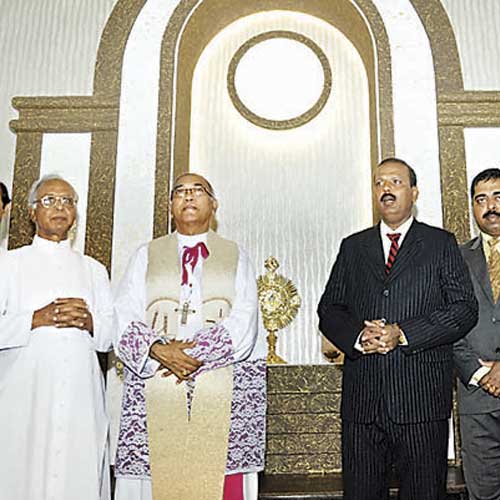
Bishop Aloysius Paul D’Souza and the Church committee with the relic of the Holy Cross in the background. – DNA
Till now this port city was called ‘Rome of the East’ for its true Catholic outlook, but now it has one more reason to sustain that name, as a relic of the Holy Cross on which Jesus Christ was crucified by Romans 2000 years ago arrived in Mangalore and has been consecrated in the Holy Cross Church in Kulashekar in the city.
Catholics in Mangalore were trying to get the relic for over seven years, and the Vatican administration finally found that the city deserved to house a relic from the biblical times, senior parishioners of the newly built Holy Cross church felt.
According to the church administrators, housing the relic of the Holy Cross will be a rare distinction for Mangalore. The relic will be open to the lay people for adoration and prayers.
In 312 AD, after his victory in one of the many battles he waged, Roman King Constantine attributed his triumph to the grace of the holy cross. In 326 AD, he sent his mother St Helen to find the Cross of Jesus in the city of Jerusalem where Jesus was crucified. The cross was installed in the Church of Sepulchre in Rome later.
Towards the end of 7th century AD, Persians tried to destroy it and took it to Persia, but in 629, King Heraclius regained the Cross and had it re-installed in the same Church in Rome.
source: http://www.dnaindia.com / DNA / Home> Bangalore> Report / Place: Mangalore, Agency:DNA / Monday – September 16th, 2013
A S N Hebbar, the city’s veteran lawyer of 50 years was felicitated by his interns and social welfare organizations at Government Pre-University College, here on Saturday November 30 evening.
The former Rotary governor Dr H Shantaram presided the function.
The former MLA A G Kodgi delivered the felicitation address.
The additional district and sessions judge G S Revankar, Udupi district journalists’ Assocition president Kiran Manjabail and others were present.
The journalist Chakravarti Soolibele delivered lecture on professional ethics and India.
The prizes were distributed to the winners of inter-district badminton and tennis tourney on the same occasion.
An exhibition of rare birds was held on the occasion.
Sugam Sangeet musical extravaganza and Yakshagana play was staged as part of entertainment programme.
About Hebbar
Seventy-three-year-old Airody Shankaranarayana Hebbar, popularly known as A S N Hebbar is active lawyer who attends court proceedings in Bhatkal, Honnavar and Udupi by driving his own car even now. His father the late Airody Venkatanarayana Hebbar was also a lawyer who mentored his son Shankaranarayana in professional ethics, in-depth study, humorous advocacy etc. The budding interns practiced with Sankaranarayan who has a great number of followers.
Besides, being busy at legal practice, Shankaranarayana was engaged in contributing his articles, poetry, humorous columns etc. He was the chairman of Udupi district seventh Kannada Sahitya Sammelan. He was the founder chairman of Jaycees Club International – Kundapur. He served as chairman of local school governing council and also bagged several awards for his philanthropic contributions.
He had participated in Akka Sammelan held in Chicago, USA. He was the founder president of Kundapur taluk journalists’ Association and founder vice president of Udupi district journalists’ Association. He has married to Sudha, daughter of Kasargod’s popular lawyer B S Kakkillaya. They have three children and many grand children.
source: http://www.bellevison.com / Belle Vision.com / Home> News / by Bernard J D’Costa, Bellevision Media Network / Kundapur – December 01st, 2013
H. Yoganarasimham (1897-1971) was one of the scholarly musicians of yesteryears. This retired District Education Officer and retired Principal of Maharaja Sanskrit Pathashala had initially learnt music from his mother and later became the disciple of the legendary Mysore Vasudevacharya from 1928 to 1935.
He was a musician, a musicologist, a composer, a critic and an author. He has composed about thirty-eight Krutis, including Swara Jatis, Varnas, Krutis, Padas, Javalis and Tillanas. His Krutis are composed with strict musical grammar and lyrical value. They are acclaimed by the musicians of that era and even M.S. Subbulakshmi has made some of his Krutis popular.
His sons (including H.Y. Sharada Prasad, former advisor to many Prime Ministers of India) and daughter Neeraja Achuta Rao took it upon themselves to popularise his Krutis.
Yoganarasimham has used ‘Deva’ as his signature in his Krutis. Therefore, an organisation by the name ‘Devagitam’ was founded in 2011. During the inaugural function, a twin CD pack containing 18 Krutis of Yoganarasimham was released.
Devagitam celebrated its second anniversary on Nov. 20, this year. The programme was planned in a unique way with a Bharatanatya recital by young danseuse M.S. Archana Rao, dancing to the composition of Yoganarasimham. Her husband, a well-known vocalist of the city, Manasa Nayana was asked to sing for the dance.
Another well-known Danseuse Nayana Shivaram took care of the Nattuvanga, G.T. Swamy provided the mridanga support and flautist C.N. Tyagarajan gave musical support. The dance was choreographed by the dancer herself and Chetana Radhakrishna, another dance Guru of the city.
Archana is a sprightly young dancer. The agility of this fragile danseuse on stage was something to watch. Dancing in a ‘Marga’ way or with a theme is something different. To dance to some Krutis, without creating monotony is altogether a different proposition. In this aspect, Archana is to be appreciated.
She began with a Pushpanjali, a short Jati composition in Adi Tala, saluting the deity, Guru and the audience. Apart from this, all other Krutis figured in this recital were the compositions of Yoganarasimham. Lord Ganesha was worshipped with Ekadantam Upasmahe, in Begade set to Adi Tala. Her innovation in the choreography was evident in the Sanchari, depicting the birth of Ganesha, and how he acquired the elephant head.
The next item was another fine Swarajati composition Bhajare Vrajabalam in Maya Malava Gowla, set to Chaturashra Rupaka Tala. There were three Sancharis ingeniously incorporated in this number. The first was the slaying of the seven out of the eight children to Devaki in Kamsa’s prison and the escape of the eighth child, Krishna. Transporting that child to Dwaraka, Adi Shesha giving protection from the rain to the child enroute, etc. were well depicted.
The second Sanchari was the Raasa Leela at Brundavana and the third one was protecting the cattle and the cowherds from the torrential rain, by lifting the Govardhana Mountain.
There was one more Sanchari Daksha Yajna in the next composition Sada Saranga Nayane (Ranjani-Adi), made famous by M.S. Subbulakshmi. Dakshayani, the consort of Shiva and daughter of Daksha learns that her father is conducting a Yajna. She wonders why she and Shiva were not invited. She wanted to go to that Yajna. Shiva refuses to go there as he was not invited and admonishes Dakshayani also not to go. If she ever go there, she will be ill treated, he says. With all this Dakshayani goes to the Yajna and the prediction of Shiva comes true. As she could not bear the insult, she jumps in to the ritual fire. Here, the danseuse used different Charis, the elements of Karana. Especially her use of Akashiki Chari many times was noteworthy. Karana (Adavu, as it is known now) being the part of a whole single Abhinaya. The use of many Karanas was also equally good.
Navavidha Bhakti was depicted in the next piece Kolalelli Kalakondeyo in Raga Malike (Bilahari, Manirangu and Arabhi), here Yashoda was enjoying the child pranks of Krishna. The next one was a Javali Panchaanga Nodi Bandiha in Khamach. Basically, a Javali is predominantly exploits the Shrungara Bhava. Here, the Nayike is eager to welcome her lover. She gets up in the morning, does the house hold chores like sweeping and watering the front yard, especially this day as her lover is coming, drawing the rangoli, plucking the flower & tying it in a garland, decorating the house with the flower garlands, make-up herself etc. Here the poet has made a little pun also. The lover is coming to her house, of course stealthily. But she questions if he has seen the almanac (Panchanga) and coming in an auspicious time!
Jatis and Nrutta had to be purposefully included into all the above Krutis. Therefore, they were brief. But the Abhinaya in all the Sancharis were excellent and Archana earns full marks.
Especially in Raasa Leela, the way she occupied the entire stage was noteworthy. As Dakshayani, the depiction of anxiety, disappointment, pathos, remorse and other Bhavas were wonderful. The Abhinaya as Yashoda, enjoying the pranks of Krishna, must have brought many sweet memories to many mothers present in the auditorium. The Nayike in the Javali, doing all the morning chores on stage, appeared as though she was actually performing it live. Her involvement was so intense.
Archana concluded her dance recital with a Tillana in Abhogi set to Khanda Triputa Tala. A Tillana is a real test for a dancer, which is the Nrutta part of a recital. When all other compositions figured in the recital were predominantly Abhinaya oriented, this perhaps was the only full-fledged Nrutta oriented composition.
Attempting to utilise his talent for dance for the first time, Manasa Nayana succeeded in getting the feel of it. The other accompanying artistes contributed immensely for the success of this programme.
source: http://www.starofmysore.com / Star of Mysore / Home> Feature Articles / December 04th, 2013
A cursory look at the Bangalore office of Amar Chitra Katha (ACK) — a house nestled in the heart of a bustling residential lane in Indiranagar — will probably not impress you much. But behind the ordinary door is a world of mythology, colour and fiction. Sanjana Kapur, who has been working for five years at ACK, says:
“A purple dragon adorns the wall of the home converted into an office. Stained glass paintings double up as storage shelves near the reception area, and depict excerpts from the Mahabharata.
“Every wall has a painting relevant to the work we do, and it makes the place come alive. Each team — editorial, art and digital, has put in some creative element into the walls. The art team works in a room whose walls have a scene from Kurukshetra. A vibrant painting of Arjuna riding with Krishna in a ratha spreads from end to end.
“Another highlight of the office is a huge wall, a divider between a conference area and a passage to the kitchen, featuring artwork by one of our own designers. There is a bookshelf on one side and the other side has a gorgeous yellow painting of a woman. This breaks the monotony of the passage and provides continuity of colour. Our work is often converted into posters and pin ups which we liberally use on pinboards and walls.
“The terrace is a favourite hangout where we take chatais and spread them on the floor. Here, we write stories on our notepads. We also take breaks in the balcony. Music is an important part of this office — there are two speakers, one on each floor. We play Hindi, regional or English music. Sometimes, our editor deliberately turns off the music so she can concentrate while writing.”
source: http://www.bangaloremirror.com / Bangalore Mirror / Home> Columns> Work / by Sindhuja Balaji, Bangalore Mirror Bureau / December 01st, 2013
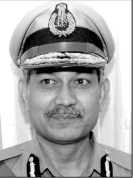
Dr. Ajai Kumar Singh has been selected as President of the 11th Akhila Bharatha Sharana Sahitya Sammelan to be held at Dharwad from Dec. 27 to 29.
Dr. Singh, the retired State Director General of Police (DGP), has obtained Post-graduate degree in Hindi from Bangalore University and a doctorate from Bangalore University for his thesis ‘Studies on 12th century spiritual leader Allamaprabhu and Saint Kabir of 16th century.’
Apart from two poetry collections, many of his short stories, poems and articles on tour experiences have been published in English and other language newspapers.
Even though Dr. Singh has professionally served the Police department, he has interest in different fields including literature, spirituality, yoga, expedition etc. Dr. Singh, who has special interest in Vachana sahitya is originally from Uttar Pradesh.
Dr. Singh is the second non-Kannadiga, who has been selected as President of Akhila Bharatha Sharana Sahitya Sammelan.
Earlier, Dr. Bhagwan Das Tiwari of Madhya Pradesh was selected as the President of the Akhila Bharatha Sharana Sahitya Sammelan held in Raichur.
source: http://www.starofmysore.com / Star of Mysore / Home> General News / December 02nd, 2013
A file photo of Mysore Grahakara Parishat [MGP] holding its first meeting which was attended by (from left) Chiranjiv Singh, IAS, Dr. Bhamy V. Shenoy (Working President), V.P. Baligar, IAS, Dr. H.A.B. Parpia (President) and A.K. Ranganathan (Secretary).It was a cold winter night. Dr. Bhamy Shenoy and his wife were returning from Vontikoppal after making some purchases to their house on Vivekananda Road in Yadavagiri at about 8 pm. As they were nearing the house, walking, Dr. Bhamy Shenoy got a bit curious to find a person standing at his gate with a bicycle. On enquiry, about the reason for his being there at that odd hour, the answer surprised Bhamy. The man was wanting to complain to the Mysore Grahakara Parishat [MGP] against the Principal of the Regional College of Education [RCE] where he himself was employed as a Group D employee. His name was K. Madhu.
Madhu had two children, M. Tara and M. Bhaskara. After they completed their CBSE X, he admitted them to vocational courses at DMS in 1989. He had seen an advertisement in Star of Mysore by Demonstration Multipurpose School (DMS) that these courses were recognised by the government of India.
However, when his children completed their studies and got their certificates, he found that because of the failure on the part of RCE to get them recognised by the State government, they could not get jobs. It was then that he decided to approach MGP seeking help.
Usually MGP does not help individual cases. Since Madhu was illiterate and did not have one to help, MGP took his cause. He used to come to office by bike from RCE campus in the night and wait patiently for MGP members, says Dr. Bhamy Shenoy. “Even today I remember how he used to wait when MGP was closed. Some times he might have returned without meeting anyone. I do not know how many times he must have travelled to MGP office,” says Dr. Bhamy Shenoy trying to recollect the past.
“We first wrote to RCE and DMS officials. When it did not produce any results, we complained to Consumer Court in Mysore in 1993. They gave a judgement in favour of Madhu’s children in 1997. They gave an award of Rs 10,000 in each case finding fault with RCE. RCE went on appeal to State Consumer Court which again ruled in favour of Madhu in 2001. They then went on appeal to the National Commission,” recalls Dr. Bhamy Shenoy.
As Dr. Shenoy could recall, Madhu won the case at the National level also and RCE appealed to the Supreme Court.
In the mean time, as the case was going through, Madhu died. His children contacted MGP and it continued to help them. However, MGP did not think they got any compensation despite all our efforts. Bhaskara, despite his qualification, ended up as a day labourer and Thara worked as a seamstress. This is our justice system.
Though this was not the biggest achievement of MGP, which over the past 25 years has fought many battles for the consumers and the citizens of Mysore City, the case is suggestive of the sincerity of purpose with which MGP takes up any common cause or a complaint that comes before it.
Mysoreans are familiar with the city’s renowned-NGO Mysore Grahakara Parishat which was set up on March 15, 1989. It will be celebrating its silver jubilee in March 2014 and plans are underway.
MGP, like all well-intentioned organisations for common cause, had its own birth pangs. The first impediment came from the Government itself. Instead of playing the role of a facilitator in a Democratic Welfare State like ours, the Sub-Registrar’s office where the founders of MGP went to register the organisation as a society, found the officer their first road block. Dr. Bhamy, Dr. Parpia and others of the first seven members of MGP registered their first protest, in their long 25 years journey, in the Sub- Registrar’s Office !
Dr. Bhamy called the District Registrar to complain with no result except the assurance that he would look into it. When this was mentioned to the then Congress MLA D. Jayadevaraja Urs, the politician, as if by habit, said he would get it done. Dr. Bhamy refused the offer saying no such influence should be used.
The Deputy Commissioner was approached. The DC was requested to tell the Sub-Registrar not to make them visit his office again and again to give one document or the other; instead, ask the Sub-Registrar to give a checklist of documents he required so that they would furnish the same to him in one visit. They also said no bribe would be paid as a matter of principle. This worked and then came into existence the MGP.
Interestingly, the same group of good Samaritans of MGP had also formed an organisation called Mysore Lokswaraj Andolan to fight for civic rights, environment etc. However, this was ruined when certain persons with vested interest came to occupy the office of President and Secretary. The organisation died a natural death; of course, not without a Court battle.
According to Dr. Bhamy Shenoy whom this writer met, there are 687 members in MGP. Out of this, 676 members are life members and there are 11 annual members as on March 31, 2013. The members meet regularly once in a month at Dr. Bhamy Shenoy’s residence. Though there are 687 members, about 25 members who are active attend the meeting.
Over the years, MGP has fought many battles. Some may be mentioned here: The greening of the barren land around the Lakshmikanth Temple in Hebbal Industrial Area; the court battle fought against City Corporation to prevent it from constructing buildings inside the Cheluvamba Park; preventing the unholy barter deal the City Corporation and the Government of Karnataka had entered into in the matter of constructing a Public Library in the People’s Park with a land developer in exchange for leasing out a huge area of the park by the side of the main road free of cost for constructing a shopping complex and helped to conserve Kukkarahalli, Lingambudi, Hebbal, Bogadi and Karanji lakes.
Similarly, MGP had taken up steps to control air pollution in certain industrial areas. It was primarily responsible for closing down a lead battery factory which was polluting the air causing health hazard to the people living in the surrounding areas. It was the time when the unscrupulous elements in the society were selling petrol by adding lead into it to improve the petrol octane rating which enables the vehicle to run faster. It is a worst pollutant of the atmosphere. Happily these days lead-free petrol is also available.
At present MGP is pre-occupied with the Mysore Master Plan 2031 and also the issues related to JNNURM and JUSCO.
Asked about the nature of calls MGP receives, Dr. Bhamy Shenoy says there is a variety ranging from a complaint against dry cleaners, telephone exchange, electricity, water supply, MRP issue to such major issues like garbage accumulation and disposal and the Master Plan.
To run an NGO of this kind, it is imperative to have advocates to take matters to Court where it is unavoidable and inevitable. When asked if MGP has a panel of advocates, Dr. Bhamy says yes. It has right now four advocates on their panel and their service is free because MGP is an NGO. However, MGP gives them out-of-pocket expenses.
The MGP has for all its 25 years in the service of the tax payers of Mysore city has about Rs. 15 lakh, raised from the membership fee, put in Fixed Deposit. The interest derived from this is used for filing PIL, buying stationeries, to meet travel expenses and more importantly to publish its monthly newspaper called ‘Grahaka Pathrike’ in Kannada.
At present MGP has an Executive Committee of nine members. The new Executive Committee of Mysore Grahakara Parishat (MGP) was installed at its 24th annual general body meeting held recently.
The nine-member Committee, which will serve for the period 2013-2016, consists of Prof. R. Chandra Prakash, President; Ashok Kacker, Working-President; Vishwas Krishna, Secretary; K.R. Seshadri, Treasurer; Maj. Gen. (Rtd.) S.G. Vombatkere, B.V. Shenoy, Uma Shenoi, Prof. S. Sobana and Prof. S. Sekhar, are Executive Committee Members.
When MGP was registered on March 15, 1989 the Founder-Members were Dr. H.A.B. Parpia, who recently passed away, President; Dr. Bhamy V. Shenoy, Working-President, who has offered the cellar of his house free for running the office of MGP; D.K. Ranganathan, a retired Railway employee, Treasurer and A.K. Ranganathan, Secretary.
It may be interesting to mention here how politicians pursue their personal agenda, well reinforced with a big ego, that often affect the developmental works, discourage those who want to take up social service and sometimes even embarrass the lesser mortals.
It appears the Treasurer and Founder-Member of MGP D.K. Ranganathan was also a social activist at Metagalli, where he lived. The simple folks of the area with a sense of gratitude named a park in that area after Ranganathan. However, the politician changed the name of the park to his own name. No comments.
May the MGP, a torch-bearer for Mysore city as an NGO when there was none, grow from strength to strength.
source: http://www.starofmysore.com / Star of Mysore / Home> Feature Articles / December 01st, 2013
So far, 69-year-old Sudha Durg has helped more than 90 households also get Aadhar cards and senior citizen cards
Government authorities, including the MLA and corporator of Jeevan Kendra Layout in Ulsoor, know that a call from Sudha P Durg always means business. Neither diabetes nor age — she is 69 — deters this grandmother of three from doing what she loves to do: Lending a helping hand to the needy. From shuttling between houses in her locality collecting voter ID card, Aadhar card and senior citizen’s card forms to admitting impoverished children to school, Sudha does it all.
Homemaker Sudha was always restless as a young bride, but in a positive way. Although she loved mothering her children – a son and a daughter – the magnanimous side of hers was compelling. “From a very young age, I tried to do whatever I could for the people around me,” Sudha said with a smile. “We were more privileged than many other people around us, so I couldn’t sit back and do nothing.”
For the last 40 years, Sudha has been involved in social work such as educating the underprivileged — she got 25 children from families of construction workers admitted in government schools in Murphy Town — paying tuition fees for her maid’s children and attending to the needs of the backward classes. About four years ago though, she began championing the importance of voting.
“I would go from house to house, telling people to vote. That’s when I learnt that there were many people who did not have voter ID cards and didn’t even have a clue where to get it made. Many people did not have the time to run around government offices, so I decided to take it up for them,” she said.
Now, all the residents in her layout – 90 odd houses – and many others in neighbouring areas owe a debt of gratitude to her for getting their government documents made. “I started out by helping a few people here and there near my house, but soon, a lot of people came to know about me. They would come to my house seeking help. Since the government officials in my area such as the MLA and corporator know me well, it was never a trouble to get forms.”
Her immediate neighbour Jyothi Verma and her family of seven have Sudha to thank for getting their documents made. “Sudha herself got us the forms. All we had to do was fill those out and stick the photographs which she later came to collect. After a few weeks, our documents were delivered to our home. We did not have to go and collect even voter ID cards. Sudha received them herself and delivered them to us,” says Jyothi.
Sudha has also got residents in the area to contribute to appoint a security guard to watch over the area. Each house donates Rs 100. At the start of his duty every day, the security guard reports to Sudha and he knows better than to miss a single day on the job. Since 1996, beat police tick a register — now a card access system which they swipe — at her house, while pourakarmikas inform Sudha about their leave, and she accordingly informs everyone else.
While several other residential areas in the city suffer from parking problems, Sudha has streamlined parking in Jeevan Kendra Layout.
MH Naagthe, inspector, Ulsoor police station, lauds Sudha’s crime awareness initiative. “I always say prevention is better than detection. Sudha has been actively attending the workshops organised at the police station and is very knowledgeable about crime and the importance of being alert. She goes back and relays our messages to the residents, thus tutoring them on how to prevent crime.”
Backing Sudha in her noble cause is her husband Prabhakar Rao Durg as well as their son, daughter and their families. “She has been doing social service for the last 40 years and I know she loves everyday of her job. I help her out in any way I can like keeping a record of the amount collected from the society, payments, etc.,” says 77-year-old Durg.
source: http://www.bangaloremirror.com / Bangalore Mirror / Home> Bangalore> Others / by Tapasya Mitra Mazumdar, Bangalore Mirror Bureau / November 20th, 2013
![A file photo of Mysore Grahakara Parishat [MGP] holding its first meeting which was attended by (from left) Chiranjiv Singh, IAS, Dr. Bhamy V. Shenoy (Working President), V.P. Baligar, IAS, Dr. H.A.B. Parpia (President) and A.K. Ranganathan (Secretary).](http://www.bangalorefirst.in/wp-content/uploads/2013/12/MGPbf07dec2013.jpg)