The works of 20 artists are on display at a calligraphy exhibition organised at the Barid Shahi Palace Hall in Bidar. / The Hindu
Mohammad Azmathulla goes around old monuments in Hyderabad collecting pigeon feathers lying on the ground. He comes home to clean them and fix artificial pearls at one end.
His real work starts now. He picks up his calligraphy pen to inscribe letters, names of friends and lines from Holy scriptures. “As far as I know, I am the only one who does feather calligraphy,” says the retired railway employee. He is among the 20 artists whose works are featured in the calligraphy exhibition organised in the Barid Shahi Palace function hall in Bidar.
The exhibition is organised by the Shaheen group of institutions and Siasat, the Hyderabad-based Urdu daily.
“It is very difficult to write on feathers as they are slippery. The pen gets stuck in the feathers and the letters can be distorted. That is why no one else seems to do this,” he said.
The artist has painted hundreds of names and sayings from Holy scriptures in English, Hindi and Urdu. He usually uses a single colour. But some times, he coats the feathers in a light shade of colour and uses multiple colours for the writing.
So does spot painter Abdul Lateef Farooqui. He creates stunning portraits in less than five minutes. Interestingly, he does not ask them to sit before him, but keeps observing and drawing sketches while they are doing something else. “I keep a bunch of sheets ready always, as I would be attracted to a face and feel like producing a caricature anytime,” he said. He has perfected the art of using geometrical designs in calligraphy. He also draws lines and letters on paintings of events described in the Holy Quran and other scriptures.
However, the master of the group is the 86-year-old Abdul Nayeem Saberi. He not only produces great works of calligraphy, but also trains young people in the art. He has trained more than 2,000 young people in the last 12-15 years.
Mr. Saberi also teaches young people how to make pens from bamboo shoots. He also helps women’s groups who recreate the calligraphic designs in embroidery and other craft forms.
The exhibition also displays wood work art where pieces of discarded wood pieces are joined to produce replicas of buildings or monuments.
Artists have produced copies of the original images of the house of Prophet Mohammad, the Kabah and the holy well at Makkah.
Some artists use a style that includes English letters, numbers and geometric designs. Some rearrange letters to create images of birds, animals and nature.
The Siasat trust was promoting the art of calligraphy among youth, Editor of the daily Zahid Ali Khan told The Hindu. He said their art works were showcased in exhibitions in New Delhi, Bangalore and Hyderabad. “We are training more than 300 women in various types of handicrafts and home industries. The trust also offers a total of Rs. 1 crore in scholarships to students per year,” he said.
“We are working at providing an online platform for artists to sell their wares,” said Managing Editor of the daily Zaheer Ali Khan.
Shaheen education society secretary Abdul Quadeer, spoke of plans to organise calligraphy classes for youth. The exhibition concludes today.
source: http://www.thehindu.com / The Hindu / Home> News> National> Karnataka / by Special Correspondent / Bidar – November 05th, 2013
The government has sanctioned Rs. 5 lakh for the construction of Kannada Bhavana in city.
This was disclosed by MP H. Vishwanath while speaking after presenting Kannada Ratna awards to 35 Kannada activists at a programme organised as part of Kannada Rajyotsava by the Dasara Exhibition Cultural Sub-Committee at P. Kalinga Rao Gana Mantapa at Exhibition Grounds here recently.
Vishwanath said that the government has envisaged several schemes for the promotion of Kannada in the State. He lauded the services of the Kannada activists who vociferously spear- headed Kannada movements unlike the senior litterateurs with a lot of intellectual finesse.
The Kannada Ratna awardees were felicitated on the occasion. MLA M.K. Somashekar presided. Sub-Committee President Biligiri Ranganath, Vice-President Latha Siddaranga Shetty, District KSP President M. Chandrashekar and others were present.
List of awardees: H. Vishwanath, A.T. Ranganath, S.L. Nagaraj, G. Hanumantha Shetty, Chandrashekaraiah, M.B. Doddegowda, Thayur Vitthal Muthy, Mugur Nanjundaswamy, S.S. Shastri, C. Sampath, M.B. Vishwanath, M.P. Anandakumar, N. Vanaraju, H.K. Ananth Palahalli Ramakrishna, Dr. T. Bharadwajan, K. Raghuram, M.N. Gopalkrishna, R. Ranganath, S. Murali, C. Srinivasa Gowda, M. Jayaprakash, G. Balasubramanya, G.S. Bhoganandish, Gubbigoodu Ramesh, B.A. Shivashankar, M.P. Jnanamurthy, K. Satyappa, H. Rajneesh, Abdul Ghani, K. Madesh, Nataraj, Mohankumar Gowda, Balakrishna and Nalabeedi Ravi.
source: http://www.starofmysore.com / Star of Mysore / Home> General News / November 08th, 2013
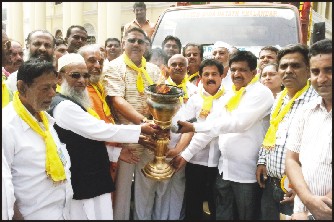
Marking the birth anniversary of Tipu Sultan (Nov. 10), a Sadbhavana Yatra from Mysore to Bangalore began here this morning.
The yatra was launched from the Town Hall premises by MP A.H. Vishwanath in the presence of Sir Khazi of Mysore Moulana Mohammed Usman Shariff, Prof. Bhashyam Swamiji of Sri Yoganarasimha Swamy temple, Tipu Sultan Sadbhavana Yatra Committee President Mohammed Ali and others. The yatra will pass through the thoroughfares of city before proceeding to the tomb of Tipu Sultan at Gumbaz in Srirangapatna, where special prayers would be offered to the tomb.
Later the yatra would proceed through Mandya, Channapatna, Ramanagar to Bangalore and reach Ravindra Kalakshetra on J.C. Road where Chief Minister Siddharamaiah would receive the Yatra Jyothi.
MLAs Tanveer Sait and M.K. Somashekar, former Corporator M.Shivanna, Showkath Ali Khan and others took part in the yatra function.
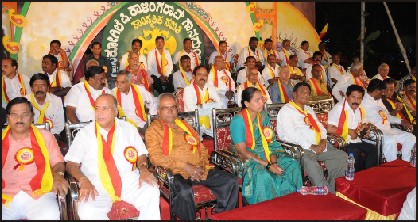
Seen are (from right) Rajyotsava awardees Dr. Vasanthkumar Thimakapura, Bannur Kempamma, Dr. N. Rathna, Dr. V. Lakshminarayan and My.Na. Gopalakrishna with City Congress President C. Dasegowda, MDCC Bank President C. Basavegowda, MP Vishwanath, MLA Tanveer Sait, ZP President Mahadevu, Mysore District Kannada Sahitya Parishat President M. Chandrashekar and others during the felicitation ceremony at the MP’s office at Govt. Guest House in city this morning.
Mysore :
Rajyotsava awardees from the city and district — Dr. V. Lakshminarayan, Dr. N. Ratna, My. Na. Gopalakrishna, Dr. Vasanthkumar Thimakapura and Bannur Kempamma — were felicitated at a function organised at Mysore-Kodagu MP’s office at Government Guest House in Nazarbad here this morning.
MP H. Vishwanath, speaking on the occasion, said it is a matter of delight that the Government has identified and awarded the achievers who have excelled in their own fields.
Pointing out that the State Government had chosen the Rajyotsava awardees purely on merit, without giving way for the interference of political or external forces, Vishwanath said the government’s action had only enhanced the value of Rajyotsava award.
NR constituency MLA Tanveer Sait, who presided, said the Government’s action of selecting the awardees based on merit, was a sign of better prospects for the State.
Tanveer Sait called for more developmental works in the city so as to make it a model one for the entire country.
He also stressed the need for making Mysore a bigger educational hub, with the city already known for providing quality education besides making rapid strides in the educational field .
Mysore District Kannada Sahitya Parishat President M. Chandrasekhar was the chief guest.
source: http://www.starofmysore.com / Star of Mysore / Home> General News / November 07th, 2013
Some people may think collecting old, rusted and unfashionable gadgets is a waste of time. However, it has been a hobby and a passion for Sohanraj Pipada, a resident of Okalipuram.
His collection boasts of gadgets, which are as old as seventy, and have been carefully tended and maintained by Sohanraj. “It was my father who started collecting these gadgets when he was young and I started developing an interest in them when I was very young. When I was seven, I made a radio and soon started collecting gadgets and adding to the collection,” he informs.
Maintaining them is not an easy job, Sohanraj makes sure that the gadgets are cleaned and preserved properly. “All these gadgets have been kept in a separate room in my house, I clean everything on my own.
They have to be maintained well or else they might stop working. It is very difficult to find a mechanic who can mend these gadgets as they are quite old. I play and use these gadgets twice a week as they might not function if they are not used. I also clean them once in seven days. It is time consuming but not as difficult as it might appear,” he adds.
The oldest gadget in his possession is a 75-year-old HMV gramophone and though tough to maintain, he feels it steals the show. “Many neighbours and relatives ask me to show them my collection and the first thing I show them is the gramophone.
My father had purchased it from someone and he made sure that it is maintained well. I have tried my best to preserve it. I also have a 40-year-old spool recorder, I bought it from someone who was discarding it,” he notes.
Currently, he has more than 20 such gadgets and all of them have interesting anecdotes attached to them. While some of them have been gifted by friends who know of his passion for antique gadgets, many others have been bought from people.
“A while back, I had booked an old telephone, which was almost 45-years-old. Soon after, I was informed that one of my friends was selling an old telephone. I bought the other one and now, I have two such telephones and it has been a challenge to not only maintain them but also keep them functional,” he adds.
Ask him how he makes time to collect these gadgets and he explains that it is his passion that drives him to get some time off from his day-to-day work. “I am a businessman and hence there is no ten-to-five routine that I adhere to. There have been days when I have been extremely busy, but I have never failed to take sometime out from my schedule,” he adds.
Along with some antique phones, he also has a couple of radios, a forty-year-old record, a seventy-year-old Kenwood gramophone and an old camera.
His penchant for collecting old gadgets has also extended to the car that he drives. His 53-year-old Ambassador is one of his prized possessions and he adds that it can give any new car a run for the money. Some of the gadgets that he owns are quite magnificent to look at and reflect the craftsmanship and designs of the past. The room housing these gadgets makes one quite nostalgic and is like a glimpse into the past.
“There is something in these old gadgets that has attracted me and I feel that the kind of workmanship and technical genius involved in making these gadgets is great. That is one of the reasons why they are functional even after so many years. This has always intrigued me and it was this curiosity to know the technique used in these gadgets that mademe want to collect and own more and more of them. Most gadgets made now become useless after a couple of years,” he says.
“My family has been living in Bangalore for many years now and hence I have a big circle of friends. They have often helped me and given me contacts of people, who own old gadgets, and want to sell these off to someone. My family has been very co-operative and has supported me in pursuing my hobby. Though people often laugh at my hobby and call it madness, it does not deter me from pursuing it. I have stopped collecting now and devote time to maintaining and preserving these gadgets,” he sums up.
source: http://www.deccanherald.com / Deccan Herald / Home> Supplements> Metrolife / by Treena Mukherjee, DHNS / November 11th, 2013
For these youngsters, owning a vintage bike is a matter of great pride as they travel the length and breadth of the country to scour these beauties
Yezdi lovers’ says a patch of graffiti on a lamppost outside Vikram Kumar’s house at Dairy Circle. “It’s been there almost 10 years,” he says, laughing. Clearly, like his 10-month-old daughter Lakshita, who sleeps soundly through everything except the hum of her father’s Yezdi, Kumar’s neighbourhood is well aware of his love of vintage bikes.
Parked at the entrance of the 33-year-old software engineer’s house are two shiny Jawas — one green and the other red. Next to them stands a Yezdi Roadking. “The red and green Jawas have shin covers, which protect you from snow. These bikes are originally from Czechoslovakia and are designed to protect riders from extreme weather conditions,” he says, with pride.
Dressed in a casual pair of jeans, a T-shirt with a bike print and a Jawa cap, Kumar’s passion took root when he saw his father ride a Jawa at the age of 10. “I fell in love with the sound of the engine,” he recalls. He began collecting bikes in 1999 and today boasts Lambrettas, a Vespa, Enfield Mofa and a couple of mopeds in his 35-strong collection. He even has a 1957 Fiat 1100 —”as old as my father”. They are stored in his garage in Kalasipalayam.
Kumar isn’t the only one. Owning a vintage bike (least over 30 years old) is a matter of pride for young Bangaloreans who are splurging on restoring and maintaining them.
Twenty-four-year-old gym owner Bhuvan Narayan first bought a Yezdi Classic for Rs 4,500 three years ago and decided to restore it. “Ever since, I began collecting bikes. Today, I own a 1979 Classic Yezdi, a 1976 Standard Bullet which is a 350 cc twin engine, a 1964 Bullet, a 1962 Jawa, and 1990 Yezdi Deluxe. I just purchased four Yezdi Roadkings in bulk,” he says. Narayan even owns rare bikes like the France-made Suvega- a moped that he picked up in Tirupati; a Czech imported 1952 Jawa Parack and a Lambretta scooter.
Tracing the classics Sourcing the bikes is a task. Mudasir Ahmed, (33) who works for a construction company, owns three vintage bikes and says, “Networking is the best way. Social media has made it easier to find bike owners, who may want to sell since they fetch a good price.”
A host of Facebook pages such as Royal Knights Motorcycle Club, Bangalore Jawa Yezdi Motorcycle Club and Bangalore Vintage Group provide useful information about where to find these vehicles, cost, availability of spare parts and more. “I have made friends through these clubs, and we network online to service our bikes and find spare parts too, which is otherwise very tough,” says Kumar.
Some good leads are also found when they set off on weekly rides to nearby districts such as Kolar, Mysore, Ramanagaram, Shimoga and Ooty. They track down old mechanics who supply them with information about bikes and the whereabouts. Twenty-eight-year-old Alwin Lawrence found his 1955 AJ Stevens just like that. “My uncle is a vintage motorcycle mechanic in Coimbatore and when I enquired about a British bike, he tracked one down in Kanyakumari for me. I went to Kanyakumari to pick up the bike and brought it back in a bus to Bangalore,” he says.
Maintenance Looking after these beauties is a tall order too. “I used to own around 12 bikes but sold most of them because finding a good mechanic and getting spare parts is a challenge. Since most of them are not of Indian origin, it’s not easy to understand the mechanism,” admits Ahmed.
Trial and error Kumar and his father say they are fairly aware of how these bikes function, as they have spent years tinkering away on these classic beauties; their learning has been largely trial-and-error. “My father can put together a bike with ease, and I’m slowly getting there. I have all the spares in my factory for most of my bikes,” he says. Narayan and Lawrence are learning too. “I get manuals online or from showrooms. Unless they need serious repair, it’s not impossible to fix the bikes. Jawas and Yezdis usually don’t need much maintenance, but the older ones need to be taken care of,” explains Kumar.
Money matters At Rs 50,000 for a Jawa and almost 2 lakh for older bikes like Paracks, it’s an expensive hobby. Lawrence has spent close to Rs 5 lakhs on his bikes, some of which were given to him by parents and the rest were paid for from his savings. Vikram approximated his collection to be priced at about Rs 20 lakh.
Passion play While these biker boys are the object of envy for many collectors, their hobby is perceived differently by their family. Nitu, Kumar’s wife says, “The entrance to our house looks incomplete without these bikes. My son has to take a ride on his father’s bike every weekend or he won’t eat, and my daughter gets excited when she hears the sound of a Yezdi. These bikes are a part of my life now.” Alwin Lawrence’s mother Julie says, “At first, the sight of the bikes would annoy me and I always find my son cleaning the bikes in his spare time. But I also think its these bikes that have given my husband and son a chance to bond. It’s great to see that, and I cannot put a price on it.”
The envious glances, curious questions and approving stares from the onlookers make all the trouble worthwhile. Kumar cannots even dream of selling any of his prized possessions, and says, “The joy of taking a bike out and riding it around town is unparallelled. My grandfather rode a 1941 Triumph which is one of the most special bikes we own. It’s a way of honouring the style and poise of the men of that age,” concludes Kumar.
source: http://www.bangaloremirror.com / Bangalore Mirror / Home> Columns> Sunday Read / by Sindhuja Balaji, Bangalore Mirror Bureau / November 10th, 2013
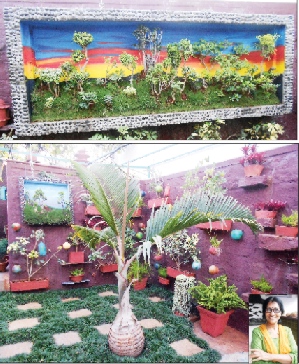
Plants at home can add an unique touch to the decor, and miniature horticultural masterpieces like Bonsai plants, beyond doubt give a diverse look. Enhancing these further by growing them within a frame with a scenic backdrop is something all the more vivacious. Creating such beautiful ‘live sceneries’ in different sizes within varied beautiful decorative frames is this dexterous lady’s favourite hobby.
Sharada Gupta, a Bonsai expert from city is also a connoisseur in making these beautiful mural bonsais. She has created several such murals at home, each of which is a masterpiece in its own way. While watching these mini wonders with a bunch of little healthy trees marvellously growing within a set frontier is awe-inspiring. Growing them not just requires proficiency but also a lot of patience, the lady says.
“I have about five of them and I have remade one of the oldest among them recently. It is about 18 years old with almost 50 trees within,” Sharada explains.
“Making these murals requires a lot of patience and personal attention. You cannot simply bring them from the nursery and plant them within a frame. They need to be first grown in a separate space the right way, cut and pruned to rightly grow within the frame size we prefer and then transfer into the mural frame. Further, they need to be taken care of like children if not for which they fail to survive. All this is a lengthy process. Thus, growing these bonsais and turning them into live murals takes about two years time.”
While a bonsai plant is not much suitable for indoors and cannot be kept inside for more than 3-4 days, as it requires a lot of sunlight and fresh air. The advantage of these murals is that they can be hung indoors as well. “As these live murals are created within a frame, they can be hung anywhere including indoors, which beautifully add to the look of home interiors,” suggests Sharada, “however, they too need to be frequently placed outdoors, so that the plants are showered with sunlight and fresh air often.” The artist is currently making a fixed mural in her garden with several bonsais which will also be decked up with a water fall within. “I am waiting to complete it for I know it will look wonderful and lively,” she says, who makes all the bonsais on her own, while the frames and sceneries of her murals are created by professional artists.
“Decorating your home with bonsai plants adds a soothing touch to the space. If placed attractively at the right places, it greatly enhances the beauty of our nest and lures many visitors. I have been doing it for almost 40 years now and I must say it’s a great feeling,” gushes Sharada, who has created hundreds of bonsais in several different varieties, has conducted demonstration classes on Bonsai making both in India and abroad and has even written books on the subject years ago.
Sharada Gupta is a resident of Yadavagiri In city.
source: http://www.starofmysore.com / Star of Mysore / Home> Feature Articles / by AN / November 05th, 2013
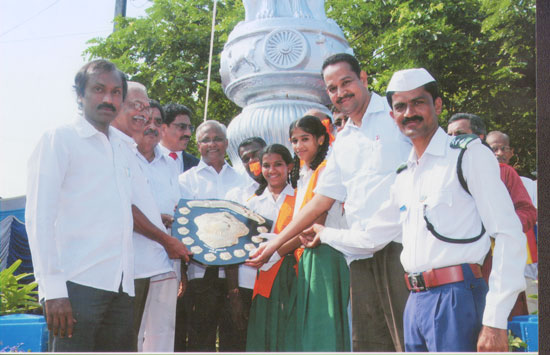
Bharath Seva Dal (girl’s wing) of B M High School was awarded first prize in the Rajyotsava Day parade held in Nehru maidan under the aegis of Dakshina Kannada district administration on November 1.
The rolling shield was awarded by B Ramanath Rai, district in charge minister.
MLAs J R Lobo, Mohiudin Bava, commissioner N Prakash, district president of Bharath Sevadal, Basheer Baikampady, secretary T K Sudheer, Karnataka Sahitya parishat district president Pradeep Kalkura, Taluk president of Seva dal, Prabhakar Sriyan, District panchayat president Koragappa Naika and district convener of Bharath Sevadal T S Manjegowda, teachers of B M High school and other leaders were present.
source: http://www.daijiworld.com / DaijiWorld.com / Home> Media Release / Mangalore – Saturday, November 02nd, 2013
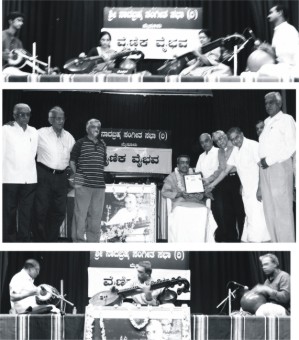
(Top) Vani Yadunanadan and Majula Surendra, accompanied by A. Radhesh (mridanga) and S. Manjunath (ghata), is seen presenting a Veena duet concert at the Vainika Vaibhava programme (Bottom) D. Balakrishna, accompanied by T.A.S. Mani (mridanga) and Ranganath Chakravarthi (ghata), presenting Veena recital at Vainika Sambhrama programme recently. (Middle)/Vainika D. Balakrishna is seen being felicitated at the Vainika Sambhrama programme in city.
by S.R. Krishna Murthy
Sangeetha Kalanidhi, Padma Bhushan V. Doreswamy Iyengar (1920-1997) was a well-known Vainika, who nurtured Mysore School of Veena Playing, known as Mysore Bani. He was initiated to music by his father Asthana Vidwan Venkatesha Iyengar. He later became a disciple of Mysore Venkata Giriyappa, who is believed to be the originator of Mysore Bani.
Doreswamy Iyengar was known for his chaste style of presentation. He had extensively travelled throughout the country and performed in most of the prestigious platforms. He had also participated in the International Music Festival at Shiraz, Iran (1969).
Many accolades have come to him in his musical journey. To cite only a few are — The Sangeeth Nataka Academy Award (1970), Padma Bhushana (1983), Sangeetha Kalanidhi (1984) etc. He was very simple in appearance, gentle in his behavior, but carried the great treasure of Music in his head.
With all the popularity, name and fame Doreswamy Iyengar had acquired, he had almost faded into obscurity from the memory of the public, but for the efforts of Nadabrahma Sangeetha Sabha. The Sabha under the leadership of Sangeetha Seva Ratna K.V. Murthy initiated a commemorative Veena concerts annually, on the doyen’s birthday. S. Rama Prasad, (former Editor of Encyclopedia, published by Prasaranga of UoM), donated substantially, with a sizable amount as a corpus fund.
The commemorative programme aptly named as ‘Vainika Vaibhava,’ started as an evening programme, has now become a day-long one. The morning session consists of the inaugural function and a veena concert, followed by lunch to all who attend the programme. There will be another Veena concert in the evening session, and bestowing a Title ‘Vainika Brahma’ to one of the prominent Vainika, who has made a significant contribution in the field of Music.
The fifth in the series of ’Vainika Vaibhava’ programmes, was held at Vasudevacharya Bhavana of Nadabrahma Sangeetha Sabha on Oct. 27. During the morning session, Sangeetha Vidya Nidhi Dr. Sampathkumaracharya was felicitated, as he has been honoured with ‘State Sangeetha Vidwan’ award, during the just concluded Dasara celebrations.
Vani Yadunanadan and Majula Surendra presented a Veena duet concert. Their concert consisted of an incredible selection of Mysore composers (except one of Purandara Dasa), some in very rare Ragas and some rare krutis. The duo was accompanied by A. Radhesh (mridanga) & S. Manjunath (ghata).
Synchronised rendering
The concert began with a Kedara Varna Sarasijakshi Vinave of Veene Sheshanna, in Atta Tala. A brief alapane by Manjula in Chakravaka led to Palinchina of Mysore Karigiri Rao. A very rare Raga Bhuvana Gandhari was the next with the Kruti Lalitambe Shri of Venkata Giriyappa. After a brief alapane by Manjula, Sri Jalandhara of Jayachamaraja Wadiyar was taken up. Incidentally, this Audhava Audhava Raga is a Janya of 36 Gambhira Nata. The same Swaras can be obtained from 29 Shankarabharana also. It is interesting to note that, Venkata Giriyappa (one Varna and one Kruti) and Karigiri Rao (one Kruti) have composed in this Raga and called it as Vedanda Gamana and attributed it to Shankarabharana.
The ever pleasing Raga Simhendra Madhyama was the next with alapane by Vani. Ninne Nammitinayya of Tyagaraja in Mishra Chapu was the Kruti. The Swara at Pannagendra Shayana was imaginative. Another rare raga Sharada Priya, a creation of Venkata Giriyappa was taken up before the main Raga and the Kruti was Sharade Shubha Shubhrahaare of Venkatagiriyappa.
The main raga was Saveri and the delineation in alapane was shared between the two efficiently. The Tana was a Raga Malika affair with the Ghana Panchaka Ragas, Nata, Gowla, Arabhi, Varali and Shree. Shri Kamakoti Peetha Sthite of Mysore Sadashiva Rao was rendered without any flaw, doing justice to both the Raga and the kruti. The duo concluded the concert with another three Kruthis, Bhuvaneshwariya (Mohana Kalyani-Adi-Muthaiah Bhagavathar), Jagadoddhaarana (Hindustani Kaapi-Adi-Purandara Dasa) and Salaga Bhairavi Tillana by Doreswamy Iyengar.
The duo have done good home work, right from selection of rare Kruthis to the fine tuned and synchronised practice.
Carrying on the torch further
D. Balakrishna, son and disciple of Veena Doreswamy Iyengar, an accomplished Vainika, gave a scintillating Veena recital in the evening session of Vainika Sambhrama programme. With his deft fingers and fingering techniques, he is one of the few Vainikas, carrying on the torch of Mysore Bani. His veena playing has an austere approach to ragas and Kruthis, which are rendered in Gayaki style. Balakrishna was accompanied by a formidable team consisting of Guru T.A.S. Mani, a mrudangist par excellece from Bangalore & Ranganath Chakravarthi on ghata.
Balakrishna laid a firm foundation to his concert with the Verna Era Napai (Thodi-Adi-Patnam Subramanya Iyer). He built up further with Marubalka (Sriranjini-Adi-Tyagaraja), prefixing it with a short alapane and suffixing with a Neraval at Daari Nerugi Santasilli, and a brief Swara. Though Veene Sheshanna was a great Vainika of his time and also a composer, his Kruthis are seldom used in concerts. Balakrishna took up one of his Kruthis Emani Delapudura Ee Mahilo in the melodious Raga Vachaspati (64), with a brief alapane and Swara. A slow and serene rendering of Nannu Brovu Lalitha (Lalitha-Mishra Chapu-Shama Shastri), bringing out the Bhakti Bhava of the composition. Whenever a musician opts to take up an alapane in Khamach, the first rection of a listener would that thekruti would be either Brochevarevarura (Mysore Vasudevacharya) or Seetapathe (Tyagaraja). But Balakrishna played a rare Kruti Upendram Ashrayami (Mysore Vasudevacharya-Adi).
The concert was interrupted here to felicitate Balakrishna and to bestow the title of Vainika Brahma. Balakrishna became very emotional after receiving the title.
Continuing the concert, Balakrishna, took up a very rare Kruti Samukhana Nilva Galguna (Kokila Varali-Adi-Tyagaraja), made famous in the yesteryears by Musuri. With a not so brief Alapane, Bhajare Manasa of Mysore Vasudevacharya in Abheri was a good choice.
The main raga of the evening ws Shankarabharana, the alapane of which was delineated with all the delicate, but ‘Bhava’ laden Swara contours. The fingers of Balakrishna appeared to be dancing on the frets of Veena, when executing some Gamakas. Tana, is an integral part of a Veena concert and this was no different. The Tana was so rhythmic, I tried to call the attention of Mani, the mrudangist to request him to join in. But, I could not draw his attention, as he too was enjoying the rhythmic beauty of the Tana. After a wonderful Tana, one of the beautiful compositions of Tyagaraja, Swara Raga Sudha was rendered with all its grace. It was noticeable both by the lucidity and uniform tonal quality. The sensitivity contained in the structure of the Kirtane could be felt. The Swara was interpreted with scholarship. The Guru Shishya duo, presented an excellent Tani Avartana after the Swara.
The concert ended with another three tail pieces, Kaliyugadali Hari Naamava Nenedare (Janjhuti-Adi-Purandara Dasa), Gayati Vanamala (Piloo-Adi-Sadashiva Bramhendra) and Krishna Nee Begane (Yaman-Khanda Chapu-Vyasa Rayaru).
source: http://www.starofmysore.com / Star of Mysore / Home> Feature Articles / November 03rd, 2013
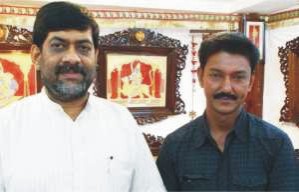
In conversation with artist Anand who makes the city proudR.G. Singh (RGS): First, congratulations. The fact that Mysore Style paintings will adorn the Bangalore International Airport is itself a signal honour for the School of Mysore style and for the city… but how did all this come about?
M.S. Anand (MSA): The two paintings which measure 13 feet by 8 feet may be two of the largest of Mysore style of paintings. But how it came about is quite ordinary. The team that had been tasked for executing art installations at several airports in the country wanted to encourage local artists first and I was part of some 20 odd artists from Karnataka and other States to show our portfolio of works. Quite unprepared, I had taken only one sample and that was of a traditional Mysore style painting. This seems to have made an impression and I was given the commission to execute the work.
At this point I was asked to come to Delhi where the Design firm, which had landed the contract, was located and I spent a month there and showed more than 50 sketches and rough cuts before two were chosen.
RGS: It is generally understood that the classical Mysore or Tanjore style centre around religious motifs. That’s the classical form. But you seem to have taken artistic licence a step further… Is there a symbolism here?
MSA: No! There is no intention of showing religious sentiments in this artwork as the art installation at the airport is secular in nature. The central form of the male figure in my artwork is not meant to be religious in character. It should not be seen as a deity but as a celestial being. Similar is the form of winged beings; the viewer is not expected to read religious insights into it. I have used this iconography only as an aid to creativity. For instance the influence of Ajanta and Ellora murals can be seen in my paintings… Besides even techniques used are different… Both paintings are oil and acrylic paint based since they should last for at least a few decades with proper maintenance.
RGS: The classical Mysore or Tanjore style uses figures of deities like Rama, Krishna and others. What made you choose the ones who look like, for me, Vishnu and the Garuda, to serve as the creative launch pad as it were?
MSA: The original association of the deities is with wind and flying just as aeroplanes and we wanted the paintings at the airport to be associated with that theme. Again, I must emphasise that religious leanings were avoided since an airport per se is a secular place…
RGS: Creating and executing paintings of this size… was it a one-man-effort? Did you paint both of them by yourself ?
MSA: No. I had a team of 10 assistants to help me. Not all of them were experienced in executing Mysore style of paintings and they had to be taught. Look, the figures in both the Mysore and the Tanjore style are done in different styles. My assistants had to unlearn their academic style technique and learn the technique of Mysore style.
RGS: And are your assistants local artists?
MSA: Yes, I had hand-picked them from last year’s Dasara Chitra Santhe. I looked for signs of originality and technique in them. I was lucky and the ten of them worked very well.
RGS: How long did it take for you and your team to execute these paintings?
MSA: Six months and at regular intervals the team of Delhi supervised what we were doing, made suggestions and more importantly listened to our suggestions. In the end it gave us a lot of satisfaction…
RGS: Anand, you do not hail from a traditional artist’s (Chitragar) family and hence many conservatives may consider you not to be cut in the classical mould of an artist. But then times have changed, or better still, they are instrumental in changing the time! How did this fascination for traditional Mysore Style of Paintings come about in you?
MSA: Well, yes! I do not come from a traditional artist’s family. My first encounter with traditional classical paintings, as a young boy, was with Tanjore paintings at Salem in Tamil Nadu. I was drawn towards it like iron to magnet and made up my mind to learn to paint that way. My father was in the Railway Postal service or RMS as it was called and we moved from place to place; he was often transferred to various stations of Tamil Nadu before we came to Mysore. Here, I discovered Mysore School of Painting and was equally fascinated. I joined Chamarajendra Academy of Visual Arts (CAVA) at Mysore and at that time Prof. V.M. Sholapurkar was the head of the institution. He and my teachers encouraged me a lot.
RGS: Was it after your studies at CAVA that you established your own studio?
MSA: After my studies at CAVA, I made several Mysore style paintings which I sold for Rs. 1,000 each to buyers in Chennai. At this point I joined Chettinad Vidhyashram in Chennai where I learnt the traditional skills involved in painting Tanjore and Mysore style. I made it a point to attend various artist-camps where I learnt further and displayed my works. The going was often difficult. The earnings were meagre and periodic. Of course, I must not forget to mention late artist C. Kuppachar of the Archaeology Department here in Mysore who constantly encouraged me!
RGS: Anand, what is it being an artist in Mysore?
MSA (smiles wryly): Very difficult… I have to admit… local artists live in their own world and there is no fraternal bonding, discussions or… or… it is a strange life. An artist in Mysore does not relate to other artists… Each to himself… Maybe I am being too cynical (his voice trails off…)
RGS: What do you mean by that?
MSA: Look at Cholamandalam established by Panicker in Chennai. That is an artists’ collective, a meeting place for artists… Mysore in spite of having a rich tradition of art that was patronised by the Mysore Maharajas, today does not have a meeting place for artists to gather, debate and discus each other’s work…
RGS: Let us have another cup of this exquisite tea, an Indianised version of Zen and the tea ceremony. May be there will soon be a silver lining on the horizon… Anand, one last question and it is the tea that is responsible… What next?
MSA: Well, I will be creating another pair of paintings for the Mumbai International Airport and hope to start work soon. This will be double the size of the paintings that I have done for the Bangalore International Airport. Yes, they too will be in the Mysore style… Then let’s see…
source: http://www.starofmysore.com / Star of Mysore / Feature Articles / November 03rd, 2013