Category Archives: Arts, Culture & Entertainment

Akashvani : National Integration through music

(From left) Akashavani Mysore Asst. Station Director Dr. Anand V. Patil, Asst. Director Programmes G. Raja Lakshmi, Head of Office V. Srinivasan, Nada Brahma Sangeetha Sabha President K.V. Murthy and Programme Executive M.Raghavendra.

by S.R. Krishna Murthy

The Akashvani Sangeeth Sammelana is an annual musical event, organised by Akashvani, since 1954. In earlier days, it was a two-day festival on the second Saturday and Sunday of October, in major stations and a one-day event on the second saturday of October in other stations. Since some years, it has become a one day event conducted throughout the country on the same day, sometime during the end of September or during the middle of October. A happy note of this music festival is that the artistes from different parts of the country will be performing in other parts of the country, which is an effort in creating National integration. The artistes selected to perform not only feature regular and famous artistes, but even the upcoming artistes who are given equal prominence. This gesture definitely lends a supporting hand, in encouraging these youngsters.

Major stations will conduct the event every year and other stations will be holding the event turn by turn. This year, the programmes will be broadcasted from the National hook-up of Akashvani, for nearly forty-four days, from Oct. 19 to Dec. 11, at 9.30 pm on some days and 10 pm on other days, depending on that day’s schedule.

The Mysore edition of the Akashvani Sangeeth Sammelana 2013 was organised at Vasudevacharya Bhavana of Nada Brahma Sangeetha Sabha, on Sept. 29. It had two concerts, a Hindustani flute recital by Nityananda Haldipur, Mumbai, accompanied by Ravindra Yavagal on Tabla and the other, a Karnatak vocal recital by A.S. Murali of Chennai, accompanied by T.K. Padmanabha (violin), Tanjore Subramanyam (mridanga) and A.S. Shankar (ghata).

Akashvani Sangeeth Sammelana always evokes sufficient interest among the music fraternity and the auditorium was full with music enthusiasts.

About Nityananda Haldipur He is an ‘A’ Grade artiste of AIR and Doordarshan. He took to music at an early age and had the fortune of being taught by stalwarts like his father Niranjan Haldipur and Devendra Murudeshwar, both disciples of Pt. Pannalal Ghosh, Annapurna Devi (daughter of Ustad Aladdin Khan). Nityanand has participated in all the major events in India. In 2010, Nityanand Haldipur was given the highest award for his contribution to Indian classical music by Sangeeth Natak Academy, New Delhi. 

He began serenely the Alap of Raag Puriya. The Gat in Vilambit was in Rupaka Taal. His methodical presentation, smoothly breathed life into each note of the raga. The intermittent usage of phrases like RSNSR, SNDNS, added sweetness to the melody. Druth Gat was set to Teen Taal. Totally the delineation of Raag Puriya testified the flautist’s penchant for exploring a raga to its fullest. The next thirty minutes was Raag Jhanjooti, in Madhya Laya and Druth, both in Teen Taal. He concluded the concert with a Dhun in Mishra Pahadi.

The second programme was the Karnatak vocal recital by A.S. Murali of Chennai. The first rendering Ganapathi Enna Paliso (Nata-Adi-Prasanna Venkata Dasa) was for balancing the sound system. The broadcasting part began with Smaraneyonde Saalade (Malaya Marutha-Adi-Purandara Dasa). Two ragas were taken for delineation. First was Dharmavathi with an enthusiastic alapane, followed by the Kruti Bhajana Seyarada of Mysore Vasudevacharya. He did a Neraval at Niravadhi Sukhadaayakuni, with a short Swara. The second was Shankarabharana, with another good Alapane, leading to the Kruti Enduku Peddula of Thyagaraja with a Neraval at Veda Shastra Tatvarthamulu, followed by another set of good Swara. In between he sang Kamalaambaa Samrakshatumaam (Ananda Bhairavi-Mishra Chapu-Muthuswamy Dikshitar), the first of the Navaavarana Kruti. He concluded the concert with Paalaya Shree Mantraalaya Nilaya (Yaman Kalyani-Adi-Ananda Dasa). It may be a fact that the singer is accustomed to singing in Akashavani. Therefore, there was no rapport with the audience. It looked as though he was singing to the mike.

At this juncture, I would like to point out one odd phenomenon. The auditorium was full when the programme began. But, as soon as the Hindustani recital was over, nearly forty percent of the audience, mostly Hindustani connoisseurs, just walked out en-mass, just like our opposition members in the Assembly, walking out of the hall, if the ruling party does not agree to their point of view. Nobody can force someone to listen to something, which th ey do not relish. The audience could have sat for some more time, at least as a mark of respect to the next artiste.

source: http://www.starofmysore.com / Star of Mysore / Home> Feature Articles / by S. R. Krishna Murthy / October 15th, 2013

Dasara with unique flavour

The invocation ceremony or "Bodhon" of Goddess Durga being performed on Maha Shashthhi in Bangalore on Thursday. (Suryarshi Mitra/EPS)
The invocation ceremony or “Bodhon” of Goddess Durga being performed on Maha Shashthhi in Bangalore on Thursday. (Suryarshi Mitra/EPS)

With just three days left for the Dasara festivities to conclude, any celebration that is held in the city, is usually in the shadow of the world famous Mysore Dasara festival and the procession on the Vijayadashami day. With most people flocking to Mysore, Mangalore and their hometowns, festivities are either being held at homes in a localised manner depending on the state to which they belong.

Over the years, Bangalore has changed a lot and the Dasara festival too is celebrated with a distinctive regional flavour, be it from Gujarat, Bengal, Rajasthan, Punjab, Tamil Nadu and Uttarakhand. With each community celebrating in its traditional way, the citizens too partake in this festivities which is so diverse from the local culture. If it is Durga Puja, people flock to the pandals set up by the local Bengali associations in Malleswaram, Banaswadi and other areas while, if it is the Navaratra of the Gujaratis, the locals love taking part in the Garba and Dandiya that is held at the Bangalore Palace grounds as well as various residential areas. Joint celebrations are very popular in gated communities and huge apartment complexes be it in Domlur, JP Nagar or Marathahalli.

However, in some areas of Bangalore, one can still see Dasara festivities in the old areas like Chickpet, Cubbonpet, Munnireddy Palya when people throng the pandals and enjoy the nine-day festival.

The famous JC Nagar Dasara is nothing but a nada habba with people from all communities taking part which culminates with a grand procession on the Vijayadashmi day.

According to the organisers, this time, the festivities are on a large scale with more than 80 chariots taking part in the procession.

Any festival brings with it special menus and lip smacking sweets and savories. And Dasara in Bangalore means getting a chance to taste the unique flavours from different states and communities. We bring you some flavours from Bengal and the north.

Blessed be the bhog

There is no disputing a Bengali’s love for food. Durga Puja is no time to make an exception for it.

That food stalls at the various community puja pandals make brisk business and have people thronging for the varied delights of Bengali cuisine, shockingly so to others since it includes non-vegetarian fare, is well documented. What fewer know is the draw of the pujo-er bhog.

Partaking in what has been served as a meal to the goddess during her stay in her maiden home – it is believed that Durga is visiting her baaper badi (father’s home) with her four children Lakshmi. Saraswati, Kartik and Ganesh – is the highlight of Durga Puja.

source: http://www.newindianexpress.com / The New Indian Express / Home> Cities> Bangalore / by Express Features – Bangalore / October 12th, 2013

Kite-flying competition in Mysore

The ring kite, one of the highlights of the kite-flying festival held during Dasara in Mysore on Friday./  Photo: M.A Sriram / The Hindu
The ring kite, one of the highlights of the kite-flying festival held during Dasara in Mysore on Friday./ Photo: M.A Sriram / The Hindu

Total of Rs. 75,000 in cash awards awaiting winners

Kites of different colours and shapes soared high and took to the clear blue skies in the backdrop of Chamundi Hills and Lalitha Mahal Palace during the Dasara kite festival held on Friday.

The two-day event – being held on the Lalitha Mahal Palace helipad grounds – will also include a kite-flying competition on Saturday. It was introduced as part of the festival to revive the practice of kite-flying, which is reckoned to be going out of vogue among the modern generation.

The cynosure of all eyes at the festival was the ring kite while the inauguration saw a kite depicting the colours of Karnataka Flag with an image of Chief Minister Siddaramaiah inserted in the middle.

Highlights

Gopal, a renowned kite flyer from Gujarat is one of the special invitees. The festival will also see a kite fitted with 360 LED lights that will soar come dusk. Participants in the kite-flying contest will be classified under different categories depending on their age. A total of Rs. 75,000 in cash awards is waiting for the winners. The highest amount – Rs. 10,000 – will be given to winners in the group category.

Free kites will be provided.

source: http://www.thehindu.com / The Hindu / Home> News> National> Karnataka / by Special Correspondent / Mysore – October 12th, 2013

Pages from history : The magic spell of Dasara

by Prof. A.V. Narasimha Murthy, former Head, Department of Ancient History & Archaeology, University of Mysore

All roads lead to Mysore, the royal city, because it is the time of Navaratri also called Dasara and Mysore is glittering with electric lights. Infact ancient Dasara of Vijaynagara times was glittering with gold and gold but our Dasara has substituted electric bulbs in place of gold. Even this is a luxury and a symbol of pomp. Actually it is called Sharannavaratri or Navaratri during the autumn season as different from Vasantha Navaratri which is celebrated during spring. In the former, nature also plays a role with good climate and the season of flowers and hence flower show is also held during this period. Navaratri is basically the celebration in honour of the mother Goddess, called by different names according to the role assumed by her in destroying the wicked demons who were tormenting the good people. It has been so arranged by our ancient people that the pre-navaratri fortnight is called Pitrupaksha or the fortnight of the ancestors culminating in the Mahalaya Amavasya on which day even the poorest of the poor offer prayers to their ancestors. Thus the ancestors are worshipped first and then comes the Navaratri, the worship of the mother goddess.

According to mythologies, the goddess amalgamated the power and prowess from gods Vishnu, Shiva, Brahma and Agni so that she could destroy the powerful demons. These demons had obtained boons from the same gods that they should not be killed by ordinary methods and persons. Hence the goddess had to assume special forms by ingenious combinations which could not have been imagined by the demons while requesting the boons. Thus the arrangement was such that the validity of the boons was not disturbed and vanquishing of the wicked demons also took place. The work Devimahatme describes in details the various forms of supreme goddess like Mahishamardini (demon Mahishasura), Kali (Madu and Kaitabha), Chamundeshwari (Chanda and Munda), Raktadanti (Demon Danti), Durgi (demon Durga), Bhramani (demon Aruna) etc. Of all these goddesses, Mahishamardhini, Durgi and Chamundeshwari are more popular. In fact as it is well known, our city Mysore got the name from Goddess Mahishasuramardhini, the vanquisher of the demon Mahishasura. Its ancient name was Mahishapura or Mahishuru which got corrupted by the British as Mysore. In fact southern Karnataka was referred to as Mahishamandala and this name found mentioned during the period of Ashoka almost 2,200 years ago.

Another significant feature of Navaratri, is the exalted position given to Kannike or unmarried girls. They are supposed to be personifications of the Goddess of Navaratri. They are to be worshipped as Kumari, Trimati Kalyani, Rohini, Chandike, Shambhavi, Durgi, Subhadra and Kali. Each one of these forms was worshipped and presents given to them and it is believed that the great Goddess would be pleased by the worship of the unmarried girls.

It is of interest to note that the Goddess of Navaratri was worshipped by epic heroes also. It is said that Sri Rama worshipped the goddess before going to fight Ravana and achieved success. Mahabharata heroes also worshipped the goddess and took out their weapons of war which they had hidden under a Shami (banni) tree and started their victorious march. Our kings of historical dynasties were not slow to imitate Sri Rama and the Pandavas in this respect. Unfortunately the history of Navaratri festival celebrated by the pre-Vijayanagar dynasties is not known to us as it has not been recorded. But we are fortunate that many foreign travellers like Nikitin, Barbosa, Abdul Razzak, Domingo Paes, Nuniz etc. who had the good fortune of participating in the Dasara festival as special invitees of various Vijayanagara kings have described in glorious terms even the minutest details of Dasara held during the period.

The most luxurious Dasara of the Vijaynagara period was held during the reign of Krishnadevaraya, the most distinguished emperor of this dynasty. The foreign traveller Domingo Paes was an eye witness to the Dasara of Krishnadevaraya which was celebrated for nine days from Sept. 13 to 21, 1529 AD. Its luxury and pomp can be estimated by the presence of gold images of gods and goddess and the rich gold ornaments worn by royalty and common women who attended the celebration. The speciality was that celebrations took palace both in the day time as well as during nights. One the tenth day called Vijayadashami, Krishnaradevaraya held a review of the army of the State. It was an occasion for Krishnadevaraya to exhibit his military strength in public.

The Wadiyars of Mysore are the cultural successors of Vijayanagara and hence celebrated Dasara on the pattern of Vijayanagara. Raja Wadiyar (1578-1617) celebrated Dasara at Srirangapatna and codified the rules and regulations in this regard. He even ordered that Dasara should not be stopped even if there was a death in the royal family. During the days of Kanteerava Narasaraja Wadiyar, Dasara became more glorious. Dasara became a grand affair during the period of Krishnaraja Wadiyar III in Mysore.

During the period of Krishnaraja Wadiyar IV Dasara became a great spectacle and attained fame even abroad and it became world famous. Then came Jayachamarajendra Wadiyar who continued the traditional Dasara in a glorious manner. The last Dasara of this type was held in the year 1969.

The Vijayadashami procession held on 10th day popularly known as Jambo Savari was the greatest attraction. Govinda Vaidya (1648) refers to it as Jambi Savari, meaning a procession to Banni tree. It is said that there was an elephant in London Zoo and it was called Jambo and hence British called it Jumbo Savari and in course of time it became Jumbo Savari.

This is all history and at present Dasara is celebrated as Naada Habba with the procession of the idol of Chamundeshwari.

The government is trying to make it more attractive by innovative additions. But is lacks religious fervour and traditional glory of the days of the Wadiyars. In spite of all these changes, Mysore Dasara is attracting people in large numbers. That is the magic of the word Dasara.

source: http://www.starofmysore.com / Star of Mysore / Home> Feature Articles / by Prof. A.V. Narasimha Murthy, former Head, Dept. of Ancient History & Archaeology, University of Mysore / October 12th, 2013

Sufi music by Mukhtiyar Ali mesmerises audience at Amba Vilas Palace

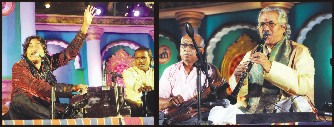
Sufi singer Mir Mukhtiyar Ali performing at the sprawling Palace premises. 2) Pandit Narasimhalu Vadavati of Raichur presenting clarinet recital at Amba Vilas Palace.

Mysore :

The Sufi music rendered by Pandit Mukhtiyar Ali from Rajasthan stole the show at the cultural programme organised by the Dasara Cultural Sub-Committee at Palace premises here yesterday.

The Sufi music and hindi songs rendered by Ali literally mesmerised the crowd to an ecstatic level that the full gathering stayed back for the whole programme even after one hour of the Palace illumination was switched off. The added attraction was Ali explaining the meaning of the songs during the programme.

Previous to that Pandit Narasimhalu Vadivati presented a delectable clarinet recital in Hindustani style.

Also included were a presentation of Veeragase dance by Basaveshwara Yuvaka Sangha of Shimoga and Bhangra dance by artistes from Punjab.

District in-Charge Minister V. Sreenivasa Prasad, MLAs Vasu and M.K. Somashekar, AICC member Motamma and others were among the audience enjoying the programme.

source: http://www.starofmysore.com / Star of Mysore / Home> General News / October 12th, 2013

Uusung heroes of Jumboo Savari

Mysore :

Although lakhs of visitors flock the Royal Route of Jumboo Savari from the Palace to the Bannimantap grounds to have a glimpse of the 5,535 kg howdah elephant Arjuna majestically carrying the 750 kg golden howdah with the idol of Goddess Chamundeshwari placed in it and seek the blessings of the presiding deity, the real heroes of the event go unnoticed.

Akram Pasha, an employee of the Forest Department, who is specialised in tying the howdah to the Ambari elephant, is on the job for the past 20 years. He along with 68-year-old Zakhaulla, a resident of Ghousianagar, is busy preparing the Gaddi on which the Ambari will be placed atop Arjuna besides tailoring flaps of clothes to be placed on either sides of the 14 Dasara elephants.

Pasha claims that he learnt the art of tying the Ambari to the elephant from Mahouts after joining the Forest Department and adds that with the help of his father he learnt the art of stitching decorative flaps used in decorating the elephants for the occasion.

Claiming that he had prepared Gaddis for Dasara elephants like Biligiriranga, Rajendra and later Drona, Pasha adds that lot of gunny and grass are required to prepare the Gaddi.

To prevent any inconvenience from citizens, Mahouts and Kavadis of the 14 Dasara elephants and those preparing these costumes are provided security by 24 Police personnel at 14 specially erected sheds.

The district administration had spent more than Rs.12 lakh for purchase of necessary decorative items to be used for decorating these elephants for the grand finale of the Dasara festivities.

However, this year, it is said that approximately Rs. 15 to 16 lakh is required for purchase of decorative items to be used on these elephants on the Jumboo Savari day itself and the State Bank of Mysore which is celebrating its centenary year has come forward to donate Rs.15 lakh for this purpose, said Palace Board Deputy Director T.S. Subramanya.

Whether those taking part in decorating the Dasara elephants get their due recognition or not, the Jumboo Savari leaves an indelible mark in the hearts of those who witness the spectacle.

source: http://www.starofmysore.com / Star of Mysore / Home> General News / October 11th, 2013

8 young directors to interpret Karnad’s plays

Bangalore :

Eight plays of Jnanpith awardee Girish Karnad will be seen in a new light. Eight young theatre directors from across India will interpret and analyze the plays at Samprathi — a theatre festival to be hosted by Ranga Shankara from October 18 to 27.

The directors are Samkutty Pattomkari (Thiruvananthapuram), Sam George (Thiruvananthapuram), Abanti Chakraborty (Kolkata), Koumarane Valvane (Puducherry), V Balakrishnan (Chennai), Mohit Takalkar (Pune), Aditee Biswas (New Delhi) and Ashish D’abero (Karnataka), They’ll be staged in English, says Surendra Nath, artistic director, Ranga Shankara.

Abanti, who is directing her favourite play, Nagamandala, says: “It has multiple layers and it’ll be interesting to deal with such complexities on stage. And, I have all the freedom to interpret it in my own theatrical language. The play, with deals with the issue of gender, is relevant even today.”

According to Balakrishnan, Karnad’s writings have an influence which is not time-bound. “His woman characters are strongly presented. Their conflicts are powerful and stir the soul,” says Balakrishnan, who is directing The Fire and the Rain (Agni Mathu Male).

For Ashish, Karnad’s Yayati explores a range of interesting themes and ideas, relevant even in this day and age. “Through our production of the play, titled Desperately Seeking Sanjeevani (Yayati), we have decided to explore the idea of immortality and what it means in today’s context. The modern-day quest for immortality is alive and kicking, fuelled by a multi-billion-dollar advertising and marketing plan. Based on the discovery of the ageing gene, Sanjeevani could be just around the corner. Well, almost,” he quips.

Aditee feels Karnad’s plays revisit Indian history and bring to life complex characters, issues and situations, reflecting societal changes. “He paints a vivid picture of present-day India. He is one of the few Indian playwrights, whose works build bridges between the ancient, mythic and the contemporary, and connect India’s historical and social past with its present”, she says.

Treat to watch

The festival celebrates over five decades of Girish Karnad’s playwriting genius. We have invited the best of young directors from across the country to interpret the master’s work. The event will feature eight plays, a seminar, a talk by Karnad himself and a film with him as an actor. What more can Bangaloreans ask for?

Arundhati Nag, artistic advisor, Ranga Shankara

source: http://www.articles.timesofindia.indiatimes.com / The Times of India / Home> City> Bangalore> Directors / by G S Kumar, TNN / October 04th, 2013

Dharwad teen to speak at UN meet

It is not every day that you come across a 16-year-old child rights activist. And it would be even more uncommon that you will see one who took up such a cause when she was in Class 4. But Manjula, a first-year PUC student from a remote village in Dharwad, knows where her priorities and passion lie.

This child rights activist will be among the select few representing India at the 66th United Nations Convention on the Rights of the Child (UNCRC) that will be held in Geneva on October 10.

Manjula was in the city on Thursday to be felicitated by the Karnataka State Commission for Protection of Child Rights (KSCPCR). “When I was in Class 4, I started working with KIDS (an NGO) where I learned a lot about our rights. I am really happy because I got a chance to represent the children of my country at the convention,” said Manjula about her journey as an activist.

Manjula was clear about the purpose of her trip. She said that she would prepare a report on issues assigned to her and declared that she would not hesitate to highlight the problems of India’s children.

Though she was given particular areas to talk about, Manjula has decided to look at local problems. “I need to concentrate on civil rights and freedom, family environment and alternative care and special protection measures. These are issues from the report we prepared at the national-level meeting held at Mumbai,” said Manjula.

When asked about her opinion on issues faced by Indian children, she said the government should address rising incidents of sexual harassment cases reported against minors. The Centre must ensure effective implementation of the National Policy for Children and there should be proper representation for children in the Constitution, she felt.

“Being a girl, I have seen many cases of improper alternate care for children. There is a rise in the number of orphaned children, but there is no proper care for them,” she added.

source: http://www.newindianexpress.com / The New Indian Express / Home> States> Karnataka / by Express News Service – Bangalore / October 04th, 2013

Mothers-to-be to get free pickup and drop in Karnataka

Bangalore :

In a first of its kind initiative in the state, here’s some good news for moms-to-be. Karnataka is gearing up to introduce the free pick-up-and-drop facility for pregnant women to reduce high infant and maternal mortality rates in the state. The scheme will be open to women who avail of services in government hospitals.

(Karnataka govt will provide…)

Though the Centre had launched this scheme a year ago on a cost-sharing basis with states under the National Rural Health Mission, the BJP government here failed to implement it for lack of funds and political reasons.

The Congress government, with an eye on the upcoming Lok Sabha  elections, has decided to pursue this scheme on priority. “We have sought tenders for buying equipment, vehicles, among other things. Hopefully the scheme will be implemented in two months,” said M Madan Gopal, principal secretary of health and family welfare department.

Senior health officer M Raju said the scheme will help women from villages who find it difficult to reach hospitals on time due to factors like unavailability of vehicles and cash crunch.

WHAT’S THE SCHEME

As per the scheme, the health department will station its vehicles at strategic points. Based on a woman’s expected date of delivery, she will be taken to the nearest primary health centre or delivery point. She will be provided with food, medical and recreational facilities. Once she recuperates after delivery, the vehicle will drop her back home. The entire service, including the stay and food, is free of cost.

HOW IT WORKS

“All information about pregnant women, including their contact numbers, will be registered during their anti-natal period. The vehicle will be sent to their residence a day or two prior to the delivery date, depending on the woman’s condition. An SMS reminder will be sent to the family members before the day of pick-up, to help them prepare for the hospital stay,” Madan Gopal said.

The department will introduce the vehicles keeping in mind the area (terrain) and population.

MOBILITY MATTERS

On an average, at least 5 of 1,000 infant deaths (infant mortality rate) occur due to non-availability of transport to reach primary health centres. The Maternal Mortality Ratio (MMR) is also around 180 per lakh. Karnataka hopes the pick-up-and-drop facility will improve institutional delivery of babies from 55% in 2010, to more than 90%.

Chief minister Siddaramaiah, who recently reviewed the government’s health schemes, directed the health and family welfare department to make Karnataka’s IMR the lowest in the country within five years. The state currently ranks 10th on the national IMR index.

Times View

This is another social welfare scheme that seems high in intention but low in practicability. That it had been put in the cold storage for want of funds only underlines this. First, the government should ensure there are enough primary healthcare centres, especially in rural areas. Second, it should ensure these are manned and well-equipped. In a country where women deliver babies outside government hospitals due to lack of beds, it seems a little daunting and implausible that women will be accorded the time and space the scheme envisages.

source: http://www.articles.timesofindia.indiatimes.com / The Times of India / Home> City> Bangalore> Primary Health Centre / by Manu Aiyappa, TNN / October 09th, 2013

Mangalore: Exhibition of old Konkani books, antiques inaugurated at Jeppu

Mangalore :

An exhibition of old secular and religious Konkani books was inaugurated at Maria Jayanthi Mandir, Jeppu church premises here on Wednesday May 1 by Sahitya Akademi awardee Melvyn Rodrigues.

To the beat of the Gumott instrument, people gathered during the inaugural, sang an old folk song and thus the exhibition was inaugurated.

“The habit of reading good books is going into oblivion. As per the survey conducted in Delhi, out of 5000 lecturers belonging to 66 colleges of two universities in Delhi, 95% dont read any books other than those they want for teaching.  Another 3% read crime, detective stories and literature on sex. Only 2% read real worthy books. This shows where exactly our country is heading to,” said Melvyn in his speech, “Our young generation is living in a fantasy world which is far from reality. Let these books enlighten them about the realities of life,” he said, and requested people to devote a minimum of half hour every day for reading.

Fr Nelson D’Almeida, parish priest of Jeppu church welcomed the gathering.

The exhibition also includes a display of antiques.

The exhibition is arranged to coincide with the parish feast of Jeppu church. There will be festive mass at 5 pm, fancy fete and cultural programme at the open grounds later in the day.

source: http://www.daijiworld.com / DaijiWorld.com / Home> Top Stories / by DaijiWorld Media Network – Mangalore / Wednesday – May 01st, 2013