Category Archives: Arts, Culture & Entertainment

Transcending barriers for creativity

A Sharadhaa chances upon the success story of a spirited group of visually-impaired dancers | EPS

For the visually impaired, disabled and underprivileged youth, life is often a confrontation, with challenges coming in multitudes unlike an abled man or woman. It is often left to the individual alone to face these barriers and rise above his or her disability. There are many stories of such people who challenged life and overcame their incapability, either on their own or with a little support.

For a group of 14 people, being able to recognise the creative side in them, has taken them across the world; recognition coming in all forms.

Sunadha is a cultural group which was established in 1999 comprising visually impaired performers talented in dance, singing and mimicry. The group is an effort by Samarthanam Trust for the disabled. The group has performed classical and folk dances across India, US, UK, Malaysia and Thailand. Their popularity has increased by the year, so much so that they now embark on an annual two-month tour to the US and UK to showcase their talent.

The troupe has also won several awards including the first place at the All India Dance competition held in November 2010 in New Delhi. The troupe has nine dancers, four singers and a mimicry artist. The team is usually invited by corporates to perform as part of their corporate social responsibility initiative.“In 1999, Sunadha started its first cultural programme project outside India and our first programme was in the US for Veerashaiva Convention. Senior actor Shivaram accompanied us and made it a grand success,” said Vasanti Savanur, a 58-year-old volunteer and a trustee who has been travelling along with the troupe for the last 14 years.

“There is no fixed remuneration for the group. However, a minimum amount of `25,000 is charged for a performance of about an hour. The travelling and accommodation expenses are borne by the inviting party,” said Vasanti.

Recently, the troupe visited Malaysia where they performed for a month at every Sai Baba temple. “The main event was in Kuala Lumpur where they gave a two-hour performance in groups,” said Vasanti. For these students, performing at various shows has given plenty of exposure and for some, it has become their livelihood. “I have learnt a lot while I travel with them. This year, they have been invited by the Tamil Association in Dubai. We will be leaving in the month of September. I have almost attended 500 programmes with many groups and wherever we have gone till date, we never felt like outsiders. There are many challenges though. Sometimes their health dips but they don’t mess the programme. Their performances have left many people dumbfounded,” said Vasanti.

The group has also been trained to address another challenge – etiquette. “Since they participate in programmes that happen in India and abroad, they trained on how they should behave,” she said.

The spirited team

The troupe has Suma who is a visually impaired artist and has learnt the skills of Bharatanatyam, classical, folk, filmy, etc. She hails from Hiriyur, Chitradurga district. Suma has completed her degree in commerce from a reputed college in Bangalore and is a good dancer who has performed in Australia, Italy and the US as well as at prestigious events like the Hampi and Anegundi festivals.

“Initially we had a volunteer, Anumpama Jaisimha, who started teaching us Bharatnatyam. Then, we had Dr Raksha and, at present, it is Jai Lakshmi, who is handling the team. We have classes for three days in a week and we are taught only in the evening after our school and college hours,” said Suma who further added, “Public appreciation is our motivating factor. There were times when people have cried after our performance. We catch the enthusiasm when the audience appreciates. I never feel that I am blind when I participate in these shows.” For another special girl, Jayalakshmi, dancing was something that developed at a tender age. “I never had the opportunity back then, being disabled. But today I am glad to be part of the troupe,” she said. Lingaraju is the only male artiste in the dance troupe.

“He is visually impaired and hails from Tiptur. He started learning classical dance when he was only seven. Now, 22 years old, Lingaraju is an accomplished dancer. For more than seven years, he has been pursuing his passion for dance. In December 2010, he picked up the first prize for his performance at a national competition for the visually impaired,” said Vasanti.

The troupe is supported by a group of 12 singers and musicians, who are also disabled.

source: http://www.newindianexpress.com / The New Indian Express / Home> Cities> Bangalore/ by A Sharadhaaa— sharadhaa@newindianexpress.com – Bangalore / May 25th, 2013

Karnataka’s popular Mavalli Tiffin Rooms to open first restaurant in Singapore

Bangalore, (ANI) :

Decades ago, elderly Bangaloreans used to take their morning walk around the Lal Bagh Fort, and at the end of it, visit the Mavalli Tiffin Room, known more popularly as MTR, for their breakfast. On some days, the Tiffin Room used to be full and one had to wait in a queue.

One could see persons belonging to the rich, middle and lower middle class waiting in the queue, waiting for their turn. There were no reserved tables. Till the end of the last century, Bangalore used to be a ‘fanless’ city, leave alone air-conditioning.

A good breakfast, for a Bangalorean, cost hardly a couple of rupees. It used to be rounded off with a warm glass of coffee.

The demand for MTR cuisine became so pressing that it had to prepare packed ingredients at their ‘factory’ near Bangalore. The packed food became a major attraction following the ‘research’ done by the Defence Research Laboratory in Bangalore in the sixties to ensure that the Indian soldier serving in far-flung posts along the northern border could have healthy food.

When MTR could prepare more food that was demanded by the armed forces, it decided to market the same in retail across India. Today, you can buy from the shelf, the ingredients for ‘Idli, Upma, Sambhar, Vada, Gulab Jamun and Kheer, to name only a few.

While other Tiffin chains, like the Woodlands, Dasaprakash, Udupi Hotels, the Sagar Ratna, Naivedyam, Ananda Bhavan and Sarvana Bhavan, to name a few, opened their branches all over India and abroad, the MTR did not. It is news now that the chain is opening a branch of the MTR Tiffin room in Singapore of all places.

Indian food consists of a wide variety of regional cuisines native to India, and given the range of diversity in soil type, climate and occupations, these cuisines vary significantly from each other and use locally available spices, herbs, vegetables and fruits.

Indian food is heavily influenced by religious and cultural choices, and the cuisine is popular not only among the large Indian diaspora, but also among the mainstream population of North America and Europe.

Apart from Europe and North America, Indian cuisine is also popular in South East Asia, because of its strong historical influence on the region’s local cuisines.

Indian cuisine has had considerable influence on Malaysian cooking styles and also enjoys strong popularity in Singapore.

It, therefore, comes as no surprise that Karnataka-based Mavalli Tiffin Rooms, known more popularly as MTR, which has been serving authentic South Indian food, is opening its first restaurant in Singapore on May 26.

India’s High Commissioner to Singapore, T.C. A.Raghavan, will be the chief guest at the opening ceremony of the restaurant  that is located at 438, Serangoon Road, opposite the Sri Sininivasaperumal Temple.

Mavalli Tiffin Rooms (MTR) was started in 1924. It was set up near Lalbagh Fort, Bangalore, by two brothers-Yajnanarayana Maiya and Ganappaya Maiya, who came down from from a place called Parampalli, near Udupi, Karnataka.

In 1936, Ganappaya Maiya decided to go back to Parampalli and Yajnanarayana Maiya assumed full charge of the restaurant .

It was originally called ‘Brahmin’s Coffee House’, but the name was changed when it was shifted to a bigger premises in 1960.

In 1950, Yajnanarayana undertook a European tour to see for himself how restaurants in other parts of the world functioned.

The cleanliness and hygiene there opened his eyes. He resolved that MTR would adhere to the same standard of cleanliness.

He distributed small booklets on health, proper eating habits and recipes. He introduced the system of opening up of the kitchen to the scrutiny of any customer who was interested.

In 1968, Yajnanarayana Maiya passed away and the restaurant was taken over by his nephew, Harishchandra Maiya.

1n 1976, at the height of the Emergency in India, the government called five of the most well known restaurants in Bangalore, including MTR, and told them that they had to reduce the prices of food at their restaurants according to government approved rates, to bring it within the reach of the common man.

The prices of the items were to be the same in all restaurants. Some restaurants paid up, others started compromising on the quality, but MTR did neither.

It kept the quality of the food as high as ever and put up a board stating the losses for the day outside the restaurant.

This practice continued for 16 days, and on the 16th day, MTR downed its shutters, and opened a small departmental store next to the hotel, from where it sold mixes for rava idli and other items.

The restaurant opened again after the emergency was lifted.

The food safety and quality assurance policies of MTR are their commitment to excellence.

Raw ingredients are selected after a careful process of quality checks and satisfying various food science attributes before the processing begins in their kitchen.

The preparation of food in MTR’s kitchens is based on traditional recipes complimented with food technology principles to blend old world charm of traditional Indian food with swift processing and consistent taste.

With the storage and supply chain dynamically based on “KAIZEN” principles, the following are the USPs of MTR – finest ingredients; all food freshly prepared; no preservatives added; no mono-sodium glutanate (MSG) and no use of eggs or reused oil. (ANI)

source: http://www.newstrackindia.com / News Track India / Home> Society / by ANI / Bangalore  – Thursday, May 23rd, 2013

This beautician is a maven in make-up

Uma Jadhav receiving Bharat & Dorris Hair and Make-up Award from Dorris Godambe and Bharat Godambe at Mumbai recently.

City’s Uma Jadhav wins Natl. award

Beauty is in the nature of some persons, others strive hard to look beautiful, there are a few others who love prettifying other people. The 39-year-old Uma Jadhav is among the third kind of persons. Uma Jadhav’s Cosmos The Brides Pride Beauty Care and Spa, on 13th main, fourth stage in T.K. Layout, has been a part of Mysore since Nov. 1999.

She was 27-year-old when she decided to become a beautician. She had a diploma in beauticians’ course from Government CPC Polytechnic in Mysore and trained at Waves Academy in Bangalore, Hima Bedi at Andheri in Mumbai and also at Cosmetic Studio in Austria. Uma has won many laurels for her skills.

She had won first prize in make-up, bridal make-up and creative make-up, third in fashion make-up and creative hairstyle, in the competitions conducted by State Beauty Parlours Association. In the year 2009 and 2008, she had won first prize in make-up and best performance-hair, and make-up and hairstyle respectively in the same contest, thus earning ‘Hattrick’ to her name.

In the year 2005, she had won first prize in make-up in a similar competition conducted by Mysore District Beauty Parlours’ Association. She had also participated in a competition conducted in Mumbai last year and was among the final 10 out of 400 contestants.

The latest feather in Uma’s cap is the ‘Bharat And Dorris Hair and Make-up Award’ which she received at the National Bridal and Fashion Hair and Make-up Contest oragnised at Taj Lands End, Bandra, Mumbai on April 29. She has emerged as the first woman beautician to have represented Karnataka in a competition held outside the State.

Here is a tete-a-tete with the beautifying artiste:

Star of Mysore (SOM): Why did you decide to become a beautician?

Uma Jadhav: I have studied only upto 10th standard. Though I wanted to study further, I could not do so because of some health matters. And then I was married. After marriage, whenever I went to beauty parlours, I felt a strong urge to learn how to beautify others. Thus I took up the course and am working as a beautician in Mysore since 13 years. 

SOM: What is your area of expertise?

Uma: Though I do all the basic beauty work at the parlour like eyebrow shaping, facial, waxing etc., I specialise in make-up and hair-styling. There are more than 500 types of hair-styling and about 40 types of make-up like fashion, beads, halo, carrots, ramp, mythology, wedding make-up etc. People who compete in fancy dress contests and act in films opt for halo (ghostly look) and mythology make-up. Carrot make-up is chosen to remove facial marks.

SOM: Have you dressed up film artistes?

Uma: Yes. I have also done make-up for film artistes but only if the shooting is done in Mysore, because travelling outside the city for months together along with the film crew is difficult.

SOM: You have won many awards for your skills in beautifying others. Does your family support you in your endeavours?

Uma: Absolutely. My husband Gopal Rao, who works in building construction, son Naveesh, who is a II PUC student at Vidhyaashrama, my brother, sister… all help me. Without their help, I would never be able to successfully participate in so many contests and win awards.

SOM: Many people believe that application of cosmetics for a longer duration is harmful to the skin — facial or other parts of the body. This can be seen when one looks at the faces of yesteryear actors. As a beautician, do you agree?

Uma: May be it was so in earlier days when there were no good quality creams or cosmetics available. People had less knowledge too about cosmetics. Nowadays, a lot of scientific research is going on in cosmetic industry and many quality products are available in a wide variety of brands.

Most people buy good cosmetics, keep them aside if no occasion arises to use them, and one day remember about them. They then take it out and use it even after its expiry date just so that it doesn’t go waste. This harms the skin.

Mostly make-up artistes of actors other than stars don’t get good remuneration. So they refrain from buying very good quality cosmetics for the actors and this results in the skin of actors losing their vitality after some time.

 SOM: Do you teach others who are interested to become beauticians?

Uma: Yes. I have been teaching interested persons since many years. At present, four students are training under me. I conduct regular classes from 11 am to 1 pm. For economically backward students, I teach free of cost.

SOM: Keeping aside your profession for a moment, tell us what do you personally believe in — inner or outer beauty?

Uma: Of course, I believe in inner beauty. One’s words, behaviour and attitude makes one look beautiful even though that person is without make-up. I remember that I had gone to attend a function recently where Dr. Dharanidevi Malagathi (Dy.SP and Karnataka Police Academy Director) had come as a guest. She was quite simple in her dress and with minimum of make-up. Yet, she was so beautiful. The words she spoke and the way she behaved made her attractive.

[Uma Jadhav may be contacted on e-mail: cosmosbeautycare@gmail.com or Ph: 4267381]

— Shwetha Halambi

source: http://www.starofmysore.com / Star of Mysore / Home> Feature Articles / May 20th, 2013

‘It is my team that succeeds’

Director Yograj Bhat needs no introduction to Kannada moviegoers. A prominent film director, lyricist, producer and screenwriter in the film industry here, he has managed to mesmerise his fans with his decidedly different take on story-telling. A Sharadhaa chats with the director at his Banashankari office.

In a career spanning more than a decade, how would you describe your achievements and where would you place yourself  in the Kannada film world?

First of all, I don’t consider my career as any big achievement. I entered this field on a lark to become a cinematographer but soon turned a director. Even my directorial ventures faced hiccups and some of them flopped. Mungaru Male was a roaring success but was it me or the  people –  the team comprising Ganesh and E Krishnappa –  that made that happen? Probably, whatever I do, I do with bare minimum responsibility and that is what has kept me going.

In ten years, you have made only 5-6 films.  Why is that?

Essentially, I am not a story writer. But since we don’t have many competitive writers in the industry, director Soori, who is a friend, and I started writing stories. That process takes time, at least, six to eight months to bring ideas to paper. Sometimes, we even trash a finished story, if it doesn’t feel perfect. Once we chance upon the right stories, then at least 2-3 films can be churned out in an year and a half. But that doesn’t happen.

Mungaru Male was a runaway success which has been hard to repeat. Is it because you became formulaic –  scenic locales, an unusual angle coupled with Ganesh in the cast? You did this with Galipatta which did well, but not like Mungaru Male.

It is a complicated question. I don’t know whether Mungaru Male can be replicated. Even if I do make a better film than that, I wouldn’t know if it will run. If I attempt a good film, what is it that I should do for it to run at the box office? Who decides that? It is definitely not in the hands of the creator. Success and milestones are created by people. We only attempt to go deeper into the art and hope to make a success of it. All records are b*&%#@*t. I never expected Mungaru Male to be a big hit.

Entertainment is what drives Yograj Bhat. Can he ever get into serious films?

I am not sure. I might try to do a dark movie sometime in the future. I don’t know how to preach or underline a story. I can’t justifiably show whether this guy is good or bad or how the good should fight the bad. Love, also, can’t be overemphasised. Since there is no one underlining element in my films, they lack strong stories but they definitely have engaging content that connects with the audiences. I go by this expression and narrative; I can’t be philosophical or give messages through my films.

You are rated as the number one director in the Kannada industry.

This number 1 to 10 is sheer stupidity. I was never in the race then or now because the term success or top rank is a passing phase. Today what might be ours will be for somebody else tomorrow. It is better not to get into the race.

Your films tend to target the youth most of the time. Is that on purpose?

It is the youngsters aged between 16 to 20 who first get attracted to cinema, followed by the 30 and 40-plus category. They spread the message and publicise the package and that’s how a film is seen by a varied audience. If we make movies for the 50-plus audience, we will not be able to reach them. Even if we go house to house and spread the word, we will not see these people coming to theatres. Target audience is a cliched term. The youth need entertainment. They easily connect with society and bring more viewers to the theatre.

Many feel that your dialogues rely on double meanings, comical elements and punchy one liners. How do you manage to write such colourful lines?

I have never portrayed vulgarity in my films. Probably, that is my strength. What you call vulgarity has never entered my arena. Writing is a kind of meditation which has to be told in a cinematic and entertaining way. Peculiar characters need to be created and the right kind of actors have to be selected. Actor, character, writer, they all get linked to each other. All this put together converts to a performance which is cinema.

People come to see Yograj movies with lot of expectations. Does it scare you?

Always. I am terribly scared. Be at signals or going to a petty shop, I feel anxious about people’s reaction. The recognition and love showered on me is unbelievable. We don’t know when they will chase us out or love us, and that’s what scares me.

Who are your favourite stars, those you feel most comfortable with? Who best brings alive your ideas and thoughts?

Everyone with whom I have worked is quite competitive. It is wrong to rank them high or low.  There are actors who put in lot of effort in playing a role that a few do effortlessly. However, some have failed miserably in spite of their hard work. I don’t want to name them as I love them all.

You are the highest paid lyricist in recent times; why not shift to this full time?

Writing lyrics is a temporary phase. I don’t have any qualities to be a full-fledged lyricist. My schedules are really horrible. I started writing for my friends six years ago. I might have written lyrics for some 60 to 70 songs. Although, they say I am the highest paid lyricist, I am yet to be paid for 90 per cent of my work. That is the irony of it.

Why have you turned to acting now? Is it for the rush of seeing yourself on the big screen?

No. I never wanted to be an actor. A few of my assistants are making a movie with Gadda Vijji who has now turned director. It is one of the best scripts I have come across, till date, and, therefore, I supported the producers.

There is no particular hero in this film. The makers couldn’t cast the right person or weren’t able to afford an actor. I don’t know who gave them the idea but they pushed me into doing this. I am doing it for a cause.

Any message for your fans?

Be naughty and happy.

source: http://www.newindianexpress.com / The New Indian Express / Home > Cities> Bangalore / Express News Service -Bangalore ,  by sharadhaa@newindianexpress.com /  May 18th, 2013

Police constables to receive ‘Knights in Khaki ‘ award

Mysore :

Mysore Round Table-21 (MRT-21) and Mysore Ladies Circle-9 (MLC-9) will be felicitating deserving Police Constables at its 41st annual event ‘Knights in Khaki’ today at 4 pm at the Durbar Hall of Hotel Regaalis in city.

Eight Constables from Mysore City and District serving in Crime, Traffic, Law and Order, Women’s Police Wing branches will be felicitated during the event.

Police Commissioner K.L. Sudheer and Superintendent of Police R.Dileep will be present as the chief guests. Tr. Vineet Parekh, National President, Round Table India (RTI); Tr. Harish Shenoy, Vice-President, RTI; Tr. Manoj Mehra, Chairman, Area 6; Cr. Namratha Shenoy, National Secretary, Ladies Circle India (LCI) and Cr. Kajol Bhatia, Chairperson, Area 6, LCI, will be the guests of honour.

‘Knights in Khaki’ honours the unsung heroes — the Police Constables who do the real legwork in the Police Force and receive very little in terms of recognition. The awardees will be presented with a rolling shield, a memento, a certificate and gifts donated by the sponsors.

MRT-21: For over 30 years, Mysore Round Table 21 has offered support to schools in and around Mysore and has built much-needed classrooms and other infrastructural necessities at K.R. Nagar and in Mysore. Freedom Through Education (FTE) is the national project of Round Table India to build classrooms in rural areas. Mysore Ladies Circle-9 are the wives of MRT-21 members. Ladies Circle India has adopted “Knights in Khaki” at national-level. For details, contact Convenor Tr. Manish Raj on Mob: 9980943616.

source: http://www.starofmysore.com / Star of Mysore / Home> General News / May 18th, 2013

Mangalore to host finals of first national Konkani dance contest

Mangalore :

The semi finals and finals of ‘YayaInd-YaMayaya’, the first All India Konkanidance contest will be held at Kalaangann, Shaktinagar in the city on May 18 and 19.

The top two winners in group and duet category from seven audition centres of Mumbai, Goa, Bangalore, Honnavar, Kasaragod, Udupi and Mangalore will be competition in the semi finals. Winners in the finals will be awarded prizes worth over Rs five lakh. In addition, they will also be honoured with trophies and certificates.

The contest has been jointly organised by four leading Konkani organisations – Jagotik Konkani Songhotton, Mandd Sobhann, Konkani Prachar Sanchalan and Nach Sobhann. The main objective of organising the programme is to promote Konkani dance form to raise the huge resources required to fund their activities at the regional, national and international level, said organising committee convenor Eric Ozario.

“In accordance with the spiriti of the contest, many non-Konkani people also have qualified to compete in the semi finals. The semi finals and finals, which is a free show, will begin at 6.30pm. The grand awards ceremony will unfold at 8.30pm on May 19,” he said.

Industrialists Ronald Colaco and MLA JR Lobo will be the guests, he added.

source: http://www.articles.timesofindia.indiatimes.com / Home> City> Mangalore / by Vinobha KT , TNN / May 16th, 2013

K.C. Shivappa’s five poetry collections released

Jnanayogasharma’s Siddeshwara Swamiji releasing writer K.C. Shivappa’s five poetry collections at a function organised at Shivaratri Rajendra Bhavan in JSS Hospital premises here last evening. Others seen are Suttur Mutt's Sri Shivaratri Deshikendra Swamiji, litterateur Dejagow, Dr. N.S. Taranath, Prof. Maleyur Guruswamy, Publisher D.N. Lokappa and K.C. Shivappa.
Jnanayogasharma’s Siddeshwara Swamiji releasing writer K.C. Shivappa’s five poetry collections at a function organised at Shivaratri Rajendra Bhavan in JSS Hospital premises here last evening. Others seen are Suttur Mutt’s Sri Shivaratri Deshikendra Swamiji, litterateur Dejagow, Dr. N.S. Taranath, Prof. Maleyur Guruswamy, Publisher D.N. Lokappa and K.C. Shivappa.

 Mysore :

Bijapur Jnanayogashrama’s Sri Siddeshwara Swamiji released writer K.C. Shivappa’s five poetry collections (Chitta Bhitti, Chitta Vruthi, Chitrambara, Chanbelaku and Chidananda), brought out by Samvahana Prakashana, at a function organised at Shivaratri Rajendra Bhavan in JSS hospital premises in city last evening.

Speaking on the occasion, Siddeshwara Swamiji, likening life to that of continuous travel, said Kannada is a rich and prosperous language, with many scholars contributing their mite for the enrichment of the language.

Regretting that the number of Kannada readers was on the decline, the Swamiji called upon the people to read books and to decipher the richness and beauty of Kannada literature.

Suttur Mutt Seer Sri Shivaratri Deshikendra Swamiji graced the occasion. Litterateur Dejagow, Dr. N.S. Taranath, Prof. Maleyur Guruswamy, Publisher D.N. Lokappa, author K.C. Shivappa and others were present.

source: http://www.starofmysore.com / Star of Mysore / Home> General News / May 16th, 2013

Historical tomb paintings make way for glasswork

INTRICATE: The paintings inside the tomb of Sufi saint Syed Shaha Qhabululla Husayni, at the dargah of Sufi saint Khwaja Bandanawaz Geusdaraz in Gulbarga. / Photo: Arun Kulkarni / The Hindu

600-year-old artwork used natural dyes

Intricate paintings done over 600 years ago inside the tomb of Sufi saint Syed Shaha Qhabululla Husayni, at the dargah of Sufi saint Khwaja Bandanawaz Geusdaraz, could soon be replaced with glasswork.

Artist and scholar Rehman Patel, who brought to light the work going on inside the tomb, described as “shocking” the dargah authorities’ decision to replace the paintings made of natural dyes with “cheap glasswork”. The next generation would be deprived of the priceless artwork, he said.

Dr. Patel, who forte is the Surpur form of miniature paintings, said here on Monday that the paintings were in the old Persian style, popularly known as Deccani art. They were done by artistes from Iran, who decorated the walls and the domed ceiling.

The tomb was constructed in the 14th century by Bahamani kings Firuz Shah Bahamani and Ahmed Shah Al Wali, he added.

Dr. Patel, who has applied to the Ministry of Culture to undertake a study on Islamic art of north Karnataka, said the paintings had been replaced by glass in half of the tomb when he visited two days ago.

source: http://www.thehindu.com / The Hindu / Home> News> National> Karnataka / by Special Correspondent / Gulbarga – May 21st, 2013

City lensman wins gold medal in International – level competition

NageshBF19may2013

Mysore, (VNS) :

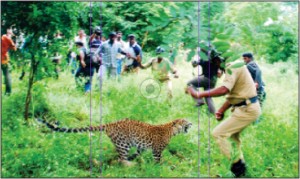
Nagesh Panathale, Senior Photojournalist of Vijaya Karnataka newspaper here in city has won a gold medal in an international photography competition organised by Jodhana Photojournalist Society at Jodhpur in Rajasthan.

Nagesh Panathale has been awarded Gold Medal in Journalism category for his photo titled ‘Leopard Attack’ [see pic. above]. A total number of 8,164 photographers had participated in the competition from 50 countries around the world.

Previously, Nagesh had also won a gold medal in a competition organised by the same organisation in 2011.

source: http://www.starofmysore.com / Star of Mysore / Home> General News / May 13th, 2013

Bhramara trust presents GTN award to Violinist B.K. Raghu

‘Sangeetha Kala Acharya’ Vidushi Neela Ramgopal (second from left) is seen presenting Prof. G.T. Narayana Rao award to young violinist Vid. B.K. Raghu along with Lakshmi Narayana Rao (extreme left), wife of late G.T. Narayana Rao, at a function in city last evening. Others seen are Madhuri Thathachari of Bhramara Trust, Dr. V. Prakash, Hon. Director of Research Innovation and Development, JSS Mahavidyapeetha and B.S. Sridhar Raje Urs, President, Krishna Seva Samithi Charitable Trust, Gokulam.

Mysore :

“Mastering music is a long-drawn process with dedication and strenuous practice with the assistance of a good guru,” opined Dr. V. Prakash, Hon. Director of Research Innovation and Development, JSS Mahavidyapeetha and former CFTRI Director.

He was speaking as chief guest at a programme organised by the Bhramara Trust of Y.T. and Madhuri Thathachari at Alwar Kala Bhavan in Gokulam 3rd stage here yesterday to mark the presentation of Prof. G.T. Narayana Rao (GTN) award to outstanding young instrumentalist in Karnataka in Carnatic music.

Dr. Prakash said that to learn yoga, music, meditation and dance, a teacher was essential and such art should be learnt and rigorously practised for years to excel. Referring to music, he added that it was a culture in itself which should be first understood.

The GTN award was presented to violinist Vid. B.K. Raghu by Sangeetha Kala Acharya Vidu. Neela Ramgopal of Bangalore. The function concluded with a violin recital by the awardee B.K. Raghu accompanied by Vid. P.S. Sridhar on mridanga and Vid. V.S. Ramesh on ghatam.

source: http://www.starofmysore.com / Star of Mysore / Home> General News / May 12th, 2013