The 220-year-old Tipu armoury will be the first structure in the country to be shifted without breaking or altering its structure | EPS
After three years of persistent efforts, the Railways has obtained the Archaeological Survey of India’s (ASI) clearance to shift Tipu Sultan’s armoury at Srirangapatna to lay the second railway line under Bangalore-Mysore Doubling Project.
South Western Railways chief administrative officer Adesh Sharma said, “Now, we have obtained all the clearances required to shift the armoury.”
“As none of such structures have been shifted till now in the country, we may have to search for a company which has partnership with foreign construction companies to shift the structures without breaking them. We may invite tenders to shift the armoury very soon,” he said.
Relocation to Pre-identified Site
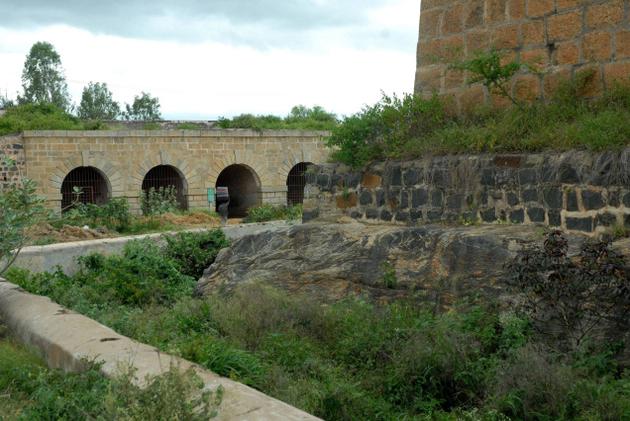
The 800-tonne armoury will be lifted without disturbing its structure using jacks and it will be shifted to an pre-identified site that is around 150 metres away from its present location using some advanced machines.
Tipu’s armoury is a protected monument under The Karnataka Ancient and Historical Monuments and Archaeological Sites and Remains Act 1961.
The state’s Department of Archeology cleared the shifting of the monument nearly three years ago after the Railways found it impossible to change the alignment of the new line.
As it is located within 300 metres of Lord Ranganath Temple at Srirangapatna, a national monument, and is protected under The Ancient Monuments and Archaeological Sites and Remains Act 1958, the Railways had to obtain a clearance for shifting it from the Archaeological Survey of India.
At the behest of the Railways and the state government, the Institution of Engineers had suggested three methods of shifting the monument to retain its originality. They are—demolishing the monument and replicating it with the same material, cutting the monument into huge blocks and replicating it by pasting the blocks with the special glue and shifting the monument as it is.
The Railways and the state government had agreed to shift the monument as it is after obtaining the necessary clearances.
source: http://www.newindianexpress.com / The New Indian Express / Home> Cities> Bangalore / by N R Madhusudhan – Banglaore / May 14th, 2013
The drastic reduction of water quantity in Bhadra backwaters this summer, reveals several interesting historical facts to those who are history enthusiasts. The remains of Lingapura arch bridge, Old Shimoga road, connectivity routes narrate century old stories.
N R Pura which was earlier called as Yedehalli was part of Lakkavalli taluk till 1882.
Yedehalli was sub-taluk till 1897 and it was named as Narasimharajapura from the day Narasimharaja Wodeyar visited Yedehalli in 1915. This area was considered as the centre of paddy cultivation as paddy was grown here in highest quantity in the State prior to the construction of Bhadra dam. With the construction of Bhadra dam submerging the agricultural land in the backwaters, the generation old rich culture, economy and connectivity routes to different towns were destroyed.
But, now the decrease in the quantity of water in backwaters has opened up the remains of the past, narrating the good old stories. Lingapura arch bridge in the backwaters can be viewed if one travels for about five kilo meters from the taluk centre via Old Shimoga road. Though the bridge was submerged in water 60 years ago, the bridge is still intact, showcasing the technological proficiency. The bridge was built using pure Indian technology century ago during the British administration.
Old road
One could reach Shimoga by travelling for about 38.4 kilo meters by travelling on this old road. But now one has to travel for about 55 km in the long route to reach Shimoga. Elders in these villages remember the bus stand that located near the arch bridge from where they used to board the bus to travel to Shimoga.
If one visits this area, one can witness the gravel road that connects Shimoga, reminds people’s existence in Haleda Nivasa, Devale Koppa, Lingapura villages, Koteda Nivasa temple, Ganapathi temple and Venkataramana temple.
Recollecting the good old days, a senior villager L Nagaraj says that his family owned land in Kanakalli village. Everyday three buses belonging to Shankar Company used to ply to Shimoga. But many villagers including him had to lose their land due to dam construction.
The fertile land and the rich heritage of this Malnad region was destroyed with the construction of the dam, that in turn helped to solve drinking water crisis.
source: http://www.deccanherald.com / Deccan Herald / Home> District / N R Pura, DHNS / May 13th, 2013
Socialites Aparna and Keerthana. Kunal and choreographer Sheetal Sharma at the fashion show | EPS
While the city takes in the weather — warm days, cool evenings, fashion conscious Bangaloreans were treated to a fashion show themed on clothing styles fit for the season.
Hosted by a retail brand for clothing for men and women, the event showcased its new summer/spring edition for women.
Top models like Pashmeena Baker and Jackie Shetty sashyed down the ramp in contemporary dresses matched with bags. The show was choreographed by Sheetal Sharma.
Looking for fashion pointers at the show, one came up with a colour palette that comprised essentially black and white, with some shades of peach and blue thrown in.
Sticking to comfortable cuts, the dresses focussed on being suitable for any occasion.“The fits are fantastic, the detailing perfect and the fabric was fabulous – the designers got it spot on,” said Sharma of the range displayed.
“I have been part of many fashion shows but this time I noticed that the garments were perfect for the models and made them look very pretty.
Also, the accessories — the bags and belts — went perfectly with the ensembles.”
Bangalore certainly likes to keep in style for the turn-out included socialites the likes of Aparna Suri, Mariam Baig, Sarah Khan, Sarita Mandoth, Amrita Gokani, Keertana Sundarmurthy, Deepa Masand and Shruta Keerthi.
For those who weren’t too keen on the clothes, DJ Sasha’s kept the party moving with his music.
source: http://www.newindianexpress.com / The New Indian Express / Home> Cities> Bangalore / by Harshitha Ashok – Bangalore / May 13th, 2013
The Bhramara Trust of Y.T. and Madhuri Thathachari, which has instituted Prof. G.T. Narayana Rao Award for young instrumentalist within Karnataka in Carnatic Music, has selected Vidwan B.K. Raghu for this award.
The award presentation ceremony will be held on May 11 at Alwar Kala Bhavan in Gokulam 3rd Stage at 6 pm.
Dr. V. Prakash, Honorary Director of Research Innovation and Development, JSS Mahavidyapeetha, will be the chief guest. Vidushi Neela Ramgopal of Bangalore will be the guest of honour. Prof. K.S. Rangappa, VC, University of Mysore, will preside.
About the award: Guddehithlu Thimmappiah Narayana Rao was born on January 30, 1926 to G.N. Thimmappiah and Venkatalakshmamma of Madikeri, Kodagu. He received his Master’s degree from the University of Madras and was on the faculty of the Madras Christian College, Madras, St. Aloysius’ College, Mangalore, Govt. Colleges in Madikeri, Bellary and Bangalore.
He once remarked “Music is my breath, Literature my body and Science my food.”
He wrote Music Reviews and articles for The Hindu, The Times of India, Indian Express, Deccan Herald, Star of Mysore, Ananya Abhivyakti and other periodicals. Ganabharathi, a well-known cultural body of Mysore (established in 1978) had him as its Honorary Treasurer and Editor of Souvenirs during its formative period, 1980 to 95. It was during his stewardship that the renowned Veene Seshanna Bhavana was built from out of public donation and dedicated (1991) to the cause of fine arts in the city.
He was an organising member of the annual Durbar Hall Dasara Music festival 1981-84. He has supported and encouraged all the music organisations and artistes in Mysore. To live intensely in the present was the basic refrain of his life. Hence, Bhramara Trust has instituted Prof. G.T. Narayana Rao Award for young instrumentalist within Karnataka in Carnatic Music.
About the awardee: Vidwan B.K. Raghu is a young violinist who has enthralled music lovers all over the country and in foreign lands. He was born on 3rd April 1986 in Bangalore to B.R. Krishnamurthy and B.K. Radha.
He started learning violin when he was 8 years old. His gurus are Vidushi D. Sushma Rao, Vidushi D. Suryaprabha, Vidwan B. U. Ganesh Prasad and Vidushi Neela Ramgopal.
Vidwan Raghu has won several awards and honours. To name a few — “Kishora Prathibhe” award from Karnataka Government; Ananaya Pratibha Puraskar from Ananya, Bangalore; Best Solo Performer at the Bangalore Gayana Samaja music concert competition.
He received the scholarship from C.C.R.T. New Delhi (Centre for Cultural Resources and Training). He is an “A” grade artiste in the All India Radio, Bangalore and has accompanied many leading artistes. He has performed during important music festivals at various Indian cities like Bangalore, Mumbai and Chennai and at the Tanzania, Dubai and France Music Festivals.
Vidwan B. K. Raghu has received B.Com degree and is currently working with SAP, India.
The awards function will be followed by a music concert by Vid. Raghu accompanied by Vid. P.S. Sridhar on mridanga and Vid. V.S. Ramesh on ghata.
source: http://www.starofmysore.com / Star of Mysore / Home> General News / May 09th, 2013
A popular retail store launched their latest jewellery inspired saree — Bedazzled Collection which was specially designed by mother-daughter designer duo Chandra Rajendran and Neeta for the auspicious occasion of Akshaya Tritiya.
The collection was launched in the city recently and featured Bangalore’s leading models as they walked the ramp displaying the exquisite creations. The occasion also showcased stunning gold jewellery by Amarapali. The collection is an embodiment of elegance featuring a variety of exclusive, creative and beautiful designs.
For a city that never misses its fashion dose, this one too was attended by connoisseurs of the fashion community.
The exclusive range of designer sarees featured motifs inspired by timeless Indian gold ornaments and bespoke heirloom pieces. The collection captured the nuances and design details of Indian jewellery hand crafted by master-craftsmen into motifs that adorned hand-woven Kanchivaram silk, as hand block printing detailing translated on luxurious pure silks.
These also was recreation of the ornament using kundan embroidery.
For a formal occasion, the collection features handcrafted Kanchivaram silks in brilliant colour tones embellished with pure Resham / silk thread dipped in liquid silver and gold to create exquisite motifs inspired by jhumkas, maangtikas, earrings and malas.
Designers Chandra and Neeta have translated the designs into unique concepts like half ‘n’ half, shoulder design, party pallu, rising and many more transforming the timeless Kanchivaram into contemporary master pieces.
On the other hand, for casual occasions, the collection exhibits an array of light Tussar silk, silk Kota, flowing Chiffon silk sarees in brilliant green, pink, blue, black and off-white. These sarees also featured elegant jewellery inspired motifs that made use of hand block prints.
source: http://www.newindianexpress.com / The New Indian Express / Home> Cities> Bangalore / by Express Features – Bangalore / May 06th, 2013
Prof. Aravind Malagathi is seen addressing at the anniversary function of Kannada Sahitya Parishat in city yesterday as others look on.
Mysore :
“Kannada Sahitya Parishat (KSP) which is nearing its centenary year should expand its literary service deeper into the society,” suggested litterateur Prof. Aravind Malagathi.
He was delivering a lecture on ‘The path tread by KSP’ at a programme organised at District KSP office near Palace here yesterday to mark the 98th anniversary of KSP.
Malagathi pointed out that KSP too should focus its attention on social responsibility to bring awareness among people on pertinent issues instead of depending too much on the litterateurs.
He agreed that KSP was cash-strapped but suggested that a small contribution of Rs. 5 a month by every employee in the State would aggregate into a huge sum to really strengthen the arms of KSP.
District KSP President M. Chandrashekar delivered the keynote address. Litterateur Dr. Malali Vasanthakumar presided. Former President of District KSP Maddikere Gopal and Manasa of Tanu-Manu Prakashana were the chief guests.
Shantha Jagadish rendered the Nadageethe. District KSP Hon. Treasurer Rajashekar Kadamba welcomed. Hon. Secretary Dr. Y.D. Rajanna compered. Convener Mugur Nanjundaswamy, Taluk KSP President Shivamurthy, Litterateurs Kempachar, M.G. Basavanna, Hemalatha and others were present.
source: http://www.starofmysore.com / Star of Mysore / Home> General News / May 07th, 2013
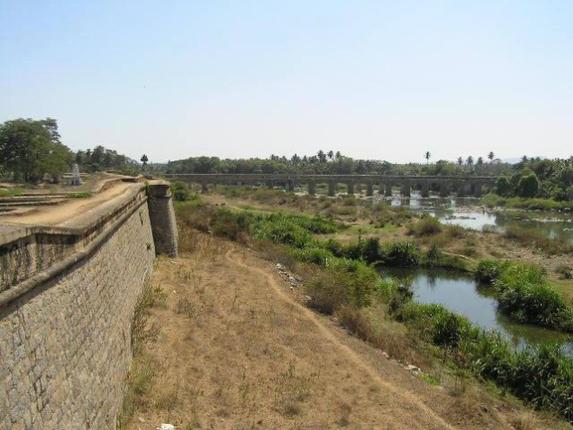
Srirangapatana Fort./ Photo: M.A. Sriram / The Hindu
While the nation quibbles over polarised perspectives of Tipu Sultan, whose death anniversary was on May 4, precious reminders of his reign cry out for attention.
Over two centuries after the fall of Srirangapatna (old Seringapatam), the legend of Tipu Sultan lives on in hitherto undiscovered manuscripts and art works and fresh controversy. Every now and then, some new discovery is made, adding to the mystique that surrounds the Sultan and giving fresh momentum to the debate about how we should perceive him.
While we quibble over our polarised perspectives, a crumbling fort and other precious reminders of this important chapter of our history cry out for attention. The deteriorating paintings on the walls of the Daria Daulat Bagh (Tipu’s magnificent Summer Palace), the encroachments in and around the fort and the sorry state of the Rocket Court are only a few examples of our neglect. The amazing sense of history one gets in Srirangapatna, where tumultuous events once unfolded, is hard to replicate. But do we have the will and the resources to maintain our heritage and showcase it more effectively, both for ourselves and for the world?
Tipu’s fort at Srirangapatna / Special Arrangement / The Hindu
Whatever the answer may be, a series of recent events in different corners of the globe would appear to suggest that interest in Tipu will always be alive. Earlier this year, the Archaeological Survey of India made what officials described as the most “sensational archaeological discoveries” in the history of Srirangapatna. The five interlinked underground tunnels, found very close to Tipu’s Palace, open up new possibilities for research.
A discovery no less exciting was made less than a year ago in the U.K., where a detailed record of the spoils seized by the East India Company after the Fall of Srirangapatna, surfaced for the first time. No one knew where these precious historical records lay or how they landed up in a second-hand bookshop before being bought by the collector who took them into Sotheby’s for evaluation and auction.
Among the treasures described in these papers is the only known sketch of Tipu’s lost throne. The most exquisite ornament of this spectacular gold-covered throne, a bejewelled huma or bird of paradise over the canopy, is part of the royal collection. Of the tiger head finials, now known to have been 10 — and not eight, as previously thought — only four have been seen so far. The whereabouts of three became known only when they were put up for auction; the fourth is exhibited in a castle.
From time to time, Tipu objects — housed in castles, manors, bank vaults and cottages — emerge to go under the hammer at Christie’s, Sotheby’s and Bonham’s. Parallel to this activity is another, an emotional journey, undertaken by the other stake-holders in Srirangapatna’s past, descendants of the British and French — settled in countries like the U.K., Canada and Switzerland, who have visited Srirangapatna and carried out the restoration of their ancestors’ graves. In 2008, Charles Baillie — former Chancellor of Queen’s University and a descendant of Col. William Baillie who was defeated by Hyder Ali and Tipu Sultan in 1780 in the Battle of Pollilur — visited the Colonel’s mausoleum for the first time. The tomb has since been restored by his family with the help of a grant from the British Association for Cemeteries in South Asia.
The Garrison cemetery, once off the tourist itinerary, is seeing more visitors following its renovation by the de Meuron family of Switzerland. The Regiment de Meuron, raised in Switzerland in 1781, served the East India Company in the Mysore Campaign of 1799.
Tipu’s capital has its share of mystery for the French too. Recently, a former French diplomat who visited Srirangapatna in an effort to trace the graves of the French soldiers who’d died there during this period — “for my country” — had to return unsuccessful.
An even deeper mystery shrouds the death of General Lally who fought the British army on Tipu’s side at Pollilur in 1780. Some French scholars have concluded that he could have died in India in 1790, or in 1799, at Srirangapatna at the time of Tipu Sultan’s death. But there is no evidence to support their claims. General Lally figures prominently in the enormous mural, depicting the Battle of Pollilur that decorates both sides of one of the main doorways of the Daria Daulat Bagh. Pollilur has been described as ‘one of the greatest calamities that has ever befallen British arms’. It was also the last time an Indian prince was able to inflict a crushing defeat on an imperial power.
A depiction of the Battle of Pollilur. / Special Arrangement / The Hindu
The figure of Tipu Sultan continues to fascinate the West, where an industry of scholarship has grown around him. In recent years there has been a marked shift from the earlier view, largely shaped by accounts from British sources — the official historians, for example, and soldiers who fought at Srirangapatna, of Tipu as “a monster, pure and simple”. Noted British scholars have, in their different ways, attempted an evaluation of the Sultan that moves away from this one-dimensional appraisal of Tipu as a fanatic. Nor do they flinch when it comes to describing their own excesses during this time. Anne Buddle recognised his patronage of the arts and curated two major exhibitions devoted to Tipu, first in London in 1990, and second, The Tiger and the Thistle Exhibition, at the National Gallery of Scotland, Edinburgh, 1999. Ten years ago, a BBC crew was on location in Srirangapatna, filming forWellesley: The Iron Duke, a lavishly constructed TV series hosted by the late historian Richard Holmes. Contrast their pride in this chapter of our shared history with our own apathy towards it.
Srirangapatna has all the makings of good theatre — the towering figure of the king undone by treachery, a fierce battle and the river that runs through its history like a leitmotif. The area around the Mysore Gate on the ramparts of the Srirangapatna Fort has reportedly been selected for a sound-and-light show focussing on the life and times of Hyder Ali and Tipu Sultan. But the wheels of officialdom grind slowly, so it may be quite some time before this and other projects on the anvil for the fort and this historic city take off.
In the meantime, the enormous potential of the place as a tourist attraction continues to be squandered tragically and there are worrying portents. Witness the slow erosion of Mysore’s legacy as a Maharaja’s capital with high-rise buildings mushrooming next to heritage structures in the heart of the city.
While tourism is unquestionably one of the drivers of our economy, in Srirangapatna, preserving our national heritage is the greater compulsion now. It’s time all discussions on whether Tipu Sultan was a cruel tyrant or a far-sighted ruler were relegated to the academic world, where they belong. Like it or not, he is a part of our history and we owe it to posterity to preserve the historical treasures of Srirangapatna.
source: http://www.thehindu.com / The Hindu / Home> Features> Sunday Magazine / by June Gaur / May 04th, 2013
Renowned danseuse Dr.Vasundhara Doraswamy receiving the “Shreshta Kala Pracharak” award from Kalaimamani Dr.Saroja Vaidyanathan of Ganesha Natyalaya, New Delhi, recently.
Mysore :
The world-renowned danseuse from city Dr. Vasundhara Doreswamy was conferred the coveted Shreshta Kala Pracharak award by Padma Bhushana, Kalaimamani Dr. Saroja Vaidyanathan, founder Director of Sri Ganesha Natyalaya, for her immense contribution to the field of Bharathanatya in a glittering function held at Kamani Auditorium, New Delhi, recently.
Her services in the field of Bharatanatya included her long standing world-renowned performances, scholastic teaching, mind-catching choreography et al, which were lauded by the selectors.
It was a great honour to her and a pride to Mysore, as Vasundhara Doreswamy is the only dancer from Karnataka to be honoured with this award till now.
This national award is given away annually to eminent personalities in different fields of arts.
Apart from Dr. Vasundhara Doreswamy, the awardees this year included veterans Dr.Kapila Vatsayana, Art Historian and Researcher, Chairperson of Indira Gandhi National Research Centre, New Delhi; Dr. Kiran Seth, Chairman, SPIC-MACAY, New Delhi and S. Krishna Murthy, Chairman, Surya Art, Theatre and Film Society, Tiruvananthapuram, Kerala.
The disciples of Vidushi Dr. Saroja Vaidyanathan presented some rare items from Bharatanatya repertory in honour of the award recipients.
source: http://www.starofmysore.com / Star of Mysore / Home> General News / May 05th, 2013
By Prof. A.V. Narasimha Murthy, former Head, Department of Ancient History & Archaeology, University of Mysore
One of the memorable contributions of Kulapati Dr. K.M. Munshi is starting of a fortnightly journal, popularly known as Bhavan’s Journal which has readers all over the world. Dedicated to life, literature and culture, the journal is sought after by common people as well as scholars. This journal’s issue dated 31, March 2013 contained an article written by a senior journalist Dilip Chaware (pages 35-42) and I thought that it would be really interesting to our readers also. Hence inspired by this article I am narrating this journey of Narasimha idol from Multan (Pakistan) to Haridwar (India).
About 200 years ago, there lived a Brahmin Ganeshabhatta Joshi in Sangameshwar and he migrated to Pune to take up a job. His family deity was Lord Narasimha. One day he had a dream in which God Narasimha appeared and told him that he has been lying under a cactus shrub in Kashi and wanted Ganeshabhatta to build a temple for him. Ganeshabhatta and his wife went to Kashi, discovered this image of Narasimha and brought this to Pune and built a small temple for it. After the death of Ganeshabhatta, nine generations have been worshipping this image. How this image reached Kashi is still a mystery. Perhaps to avert a Muslim attack, some well-meaning person may have hidden this image under a cactus shrub.
Recently, Anantharao Joshi, the present descendent of Ganeshabhatta heard a rumour that there was a Narasimha temple at Multan in Pakistan which had some stone idols. Encouraged by this news, Joshi wanted to visit Multan and find out the truth for himself. His sons who were abroad came forward to finance his desire of visiting Multan. Luck also favoured him as a five-day cricket match between India and Pakistan was arranged at Multan in 2004. Joshi got the visa easily to go to Multan under the pretext of witnessing the cricket match.
With the help of his friends, he established contact with a person named Hussain Gardezi, an agriculturist in Multan. Though a Muslim, he had a soft corner for the purpose of Joshi’s visit to Multan and promised all help. Joshi reached Multan in Mar. 2004 and as per the desire of Gardezi, stayed in his house.
Gardezi was very affectionate and provided vegetarian food to Joshi. Thus Joshi was not only comfortable but was also happy by the warmth and affection shown by some of the people of Multan. He also met a local Hindu who had kept two idols, one of sage Vyasa and the other of goddess Lakshmi. Out of fear of the iconoclast neighbours, he had kept them in his bank safe locker. Joshi was very happy to see both the idols stealthily and offered worship.
On enquiring, it was discovered that there was a Hindu temple at a place called Prahladapura and the authorities of Pakistan changed its name as Kilabagh. The Narasimha temple was located at this place. Without giving much publicity, Joshi and friends went to this place where they saw a temple in complete ruins and its materials being used to build a mosque at the same spot. They jumped over the compound of the mosque and entered into the temple. Joshi had a mixed feeling of sorrow and joy at the same time; sorrow because the temple had been destroyed and joy because seeing the ruined parts of the temple of god Narasimha. The stone sanctum (garbhagriha) was 15ft square with a height of 20ft. It also had a pradakshina space. He saw a 15ft. tall stone pillar from which came out Lord Narasimha to kill the demon Hiranyakashipu. However, Joshi was disappointed that he did not see the image of Lord Narasimha.
Then Joshi met a retired Commissioner by name Rana who took the former to the Multan city library. Both searched for relevant books. Finally, they came across a book written by Sayyad Aurlab Ali Gilani titled Muraga-e-Multan (1938). It gave a good description of the temple and referred to the idol of Narasimha which had rubies fixed for his eyes. It was a wealthy temple and was repaired in 1876. After the partition, the temple was destroyed and the saint Mahant Baba Ramananda took the image and kept it in Fatechand Gurudwara for safety, near vegetable market. Later the Gurudwara was also destroyed. Rana requested the Pakistan Government to permit him to rebuild the Gurudwara. But the Government did not grant permission.
Highly disappointed, Joshi returned to Pune. While talking to an elderly person by name Godbole, he got the clue to meet Dr. Shawab Lalit of Shimla. He introduced him to Batra, an active member of the Multan Seva Sangh which is still in existence. Batra informed Joshi that the Narasimha image is safe at a temple in Haridwar and was in daily worship.
What actually happened is equally interesting. There was a saint Narayanadas Baba at Multan who knew about all these things at the temple. When some people destroyed the temple, this Baba packed the Narasimha idol in a wooden crate and was trying to load it into a plane leaving for Delhi. Suddenly an unruly group moved towards the crate and were about to destroy it. Having no other alternative, Baba pulled out his revolver and threatened to kill them. The people vanished and the crate with the Narasimha idol was loaded into plane and safely reached Delhi. As planned earlier, it was taken to Haridwar and was consecrated in Narasimha Dham temple.
The standing marble image of Narasimha is 4 ft. tall; it has a lion face and is holding the demon Hiranyakashipu in his two hands tearing out his stomach. Vishnu, Lakshmi and Prahlada are at the bottom. Though I had been to Haridwar, I did not know that this was the Multani Narasimha and missed seeing him. So, when you go to Haridwar do not forget to pay your respect to this idol of Narasimha. Thus Narasimha has come back to his own country escaping from the clutches of iconoclasts. Thus the Haridwar Narasimha temple is unique and has a saga behind it.
sources: http://www.starofmysore.com / Star of Mysore / Home> Feature Articles / May 04th, 2013
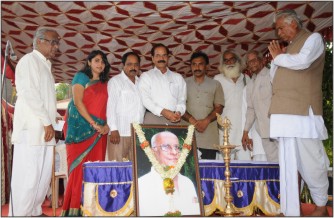
“Vedantha Hemmige, who was a bundle of energy throughout his life for any movement, was a model politician too,” said former MLC D. Madegowda.
He was presiding over a programme organised at the Freedom Fighters Park premises in Subbarayanakere grounds here yesterday to mark the 2nd death anniversary of freedom fighter Vedantha Hemmige.
Madegowda pointed out that Hemmige was an amicable person for every one who had a fighting spirit even in distress situations. He regretted that money was ruling the society now.
Freedom fighter Revanna, speaking on the occasion, recalled that Hemmige was instrumental in holding the Freedom Fighters’ Association members together during a period of dissidence. He added that Hemmige had all the qualities of a true leader who never showed pride even when he was a legislator.
Freedom Fighters’ Association President D.N. Jagadish, working President Dr. M.G. Krishnamurthy, Secretary M.R. Ramasesh, District Kannada Sahitya Parishat President M. Chandrashekar, FPA India President Maddikere Gopal, Bhargavi Hemmige (daughter-in-law of late Hemmige), Prof. P.V. Nanjaraj Urs, former Mayor Purushotham and others were present.
source: http://www.starofmysore.com / Star of Mysore / Home> General News / May 04th, 2013