Category Archives: Arts, Culture & Entertainment

Bangalore: Old township, all dressed up and shipshape

 Straddling the highway to Hyderabad, the birthplace of Kempe Gowda is now among the fastest growing localities in the city.

The brick kiln which was once a famous landmark in Yelahanka, is surrounded by apartments today. The brick tower is retained as a unique landmark.

Thanks to the construction of Bangalore International Airport near Devanahalli and the housing boom along the Bangalore-Hyderabad highway, areas that are part of the Yelahanka constituency are among the favoured destinations for both aspiring home owners and commercial establishments.

Realtor hyperactivity in the area which is part of Bangalore’s history, has pushed up prices of land to crores of rupees an acre. Areas such as Sahakarnagar and Judicial Layout are homes to the middle-to-upper income group.

Buzzing with activity today, Yelahanka was one of the oldest townships in Karnataka and was part of Vijayanagara empire. Legend has it that Kempe Gowda, the founder of Bangalore, was born in Yelahanka and was a feudatory of the area during the reign of Krishna Devaraya of Vijayanagar empire.

Till a decade ago, Yelahanka was primarily home to farmers, but its profile has changed a lot with construction of Bangalore International Airport. It had 2.25 lakh voters in 2008 elections. Now, 16,817 eligible voters have enrolled their names.

Yelahanka has a number of lakes to its advantage, the most prominent being the Yelahanka lake. Yelahanka Satellite Town is considered as the best maintained residential areas in Bangalore. By many accounts, the area has the most number of parks in the city. The major roads connecting Yelahanka with the city are Bellary Road, Doddaballapur Road and Yeshwanthpur Road. It houses major security establishments such as the Air Force and BSF stations, and industrial units such as Rail Wheel Factory, Astra Zeneca Pharmaceuticals, Gogo International, Federal-Mogul Goetze (India) Limited, Ranflex India Pvt. Ltd. and Hobel Flexibles.

Some of the educational institutions such as the Nitte Meenakshi Institute of Technology, Sir M Visvesvaraya Institute of Technology, BMS Institute of Technology, Seshadripuram College, Reva Engineering College, Ryan International School, Delhi Public School, Poorna Prajna School, Srishti School of Art Design and Technology, NMIT and medical colleges Infant Jesus College of Nursing, SB College of Nursing are in this area.

Yelahanka Old Town is a home for thousands of powerloom weavers  from Andhra Pradesh. With more than 18,000 votes, they are expected to play a key role in the election.
As for candidates, SR Vishwanath, the sitting MLA,  is seeking re-election on a BJP ticket. Gopalakrishna is the Congress candidate and Chandrappa is trying his luck on a JD(S) ticket. The constituency has four BBMP wards – Kempe Gowda, Chowdeswari, Atturu and Yelahanka Satellite Town. All these wards are represented by BJP corporators.

Despite corruption allegations, Vishwanath of BJP is confident of winning election. He cites development works taken up during the last five years as the reason for him to be bullish about the success in the election. “I did a lot for this constituency. I want to do more if they elect me in this election again,’’ said Vishwanath.

source: http://www.dnaindia.com / DNA / Home> Bangalore> Report / by Y. Maheswara Reddy / Place:Bangalore, Agency:DNA / Thursday – May 03rd, 2013
Giving back to nature

SankaraBF08may2013

Shankaraa Foundation organised a grand event to showcase the talent and culture of Karnataka at its  premises on Kanakapura Road recently.

This programme was the culmination of the summer workshop, held in association with the Dwaraknath Reddy Institutes for Knowledge Foundation and Association for Voluntary Action and Services.

Shankaraa Foundation worked with 60 gifted children from the slums of the State. This event consisted of different performances by the children that varied from classical to folk forms, and was an exciting conglomeration of dance, music and theatre. It showcased the enthusiastic and undying spirits of these children.

The programme consisted of students performing traditional folk forms, which included pooja kunitha, pattada kunitha, maramma, dollu kunitha and tamte.

A theatrical presentation mixed with dance, ‘The Giving Tree’, choreographed by Rasshme Hegde Gopi, was also staged at the event. This simple, yet moving parable by Shel Silverstein, was adapted in a different style, by mixing dance and music.
The simple message was about nature suffering because of human greed. ‘The Giving Tree’ comprised of children doing various art forms like yakshagana, bharatanatyam and more.

Rasshme Hegde Gopi says, “The concept behind ‘The Giving Tree’ is that children understand the connection with nature, and appreciate nature which nourishes us and shelters us. We also aim to help them understand the need to respect and nurture nature back in return.”

The evening’s performance was followed by an odissi recital by Meera Das and group.
They performed different pieces that left the crowd impressed. Starting with Jagganatha Mangalam, an invocation to Lord Jaganath, the performance moved on to desh pallavi in raga desh; sakhe, a piece about Radha’s conversation with her friend about wanting to meet Krishna again and Dashavatar, a group composition depicting the various avatars of Lord Vishnu.

The performance concluded with Shanti Mantram, a piece about salvation.
Sangeeta Sarita, a Hindustani music recital by Sangeeta Katti and her group followed next, where she performed a lot of classical ragas in film music.

Suvarna, a participant at the workshop, said, “Earlier, folk and classical forms and their names were just words to them. But now, we are able to identify the difference between different forms. Also, it was a learning experience to be able to teach younger children, what we had learnt.”

Ragini another participant, added, “The theatre performance made me realise how selfish we are, and how we should care for nature.”

Arjun S, another participant said, “I had heard of dollu kunitha before, but getting a chance to learn and perform it was a great experience. There was the initial worry about hands hurting but with practice I got used to it.”

source: http://www.deccanherald.com / Deccan Herald / Home> Supplements> Metrolife / DHNS / May 03rd, 2013

Come listen to the golden oldies

Bangalore :

Want to listen to Hindustani classic music of Gauhar Jaan, the first Indian musician to record on the gramophone in 1902 or the first recording of the national anthem by Vishwa Bharati Chorus or the speeches by Mahatma Gandhiji, Subhash Chandra  Bose and HH Aga Khan III.

Head straight to Voices of India, the first audio exhibition of vintage recordings, organized by the Archive of Indian Music (AIM) in association with the Alliance Francaise on the latter’s premises in Vasanthnagar from May 10 to 17.

According to Vikram Sampath, whose brainchild AIM is, the exhibition will be held under seven categories – Hindustani classical music, Carnatic classical music, theatre music, folk music, early cinema, devotional and patriotic music and voices.

The visitors will have the pleasure of listening to Gangubai Hangal, Kesarbai Kerkar, Inayat Khan (sitar), Bundu Khan (sarangi), Kannada theatre of old Mysore (Bidaram Krishnappa and Rachappa), Bangalore Nagarathnamma, one of the earliest south Indian musicians to record on the gramophone in 1904, Bengali folk music, Tamil folk (Kavadi Chindu), K L Saigal from the movie Tansen (1943), Indu Bala from the movie Ankh ka Taara (1932), violin-flute duet by T Chowdaiah and T R Mahalingam, G N Balasubramaniam, Narayan Stuti by Juthika Roy and Kamal Dasgupta, Kaloo Qawwal (qaawaali), Wahidan Bai of Agra singing a naat in praise of Prophet Mohammad, speeches by Gandhiji, Tagore, Kazi Nazrul Islam and Sohrabjee Dhondee of Parsi theatre. It provides a kaleidoscope of the rich musical legacy of our country.

Vikram said there will be an exhibition of all these personalities with their rare photographs and biodata. The visitors can see the exhibits and listen to music and voices of their choice through a cell phone or a computer at the exhibition. The exhibition is open from 10am to 7pm from May 11. The entry is free. It will be inaugurated on May 10 at 6.30 pm.

HIGH TRACK RECORD

Archive of Indian Music (AIM) is a non-profit trust that seeks to digitize and preserve old and rare gramophone records of our country. The primary objective of AIM is to preserve the voices of ancestors and make them easily and electronically available through an online portal for researchers, musicians, students of music and the public at large.

AIM currently has collected close to 10,000 records and a range of gramophone records. TV Mohandas Pai is patron of AIM. The tracks can be listened to free of cost on.

source: http://www.articles.timesofindia.indiatimes.com / The Times of India / Home> City> Bangalore> Indian Music / by S Kumar, TNN / May 04th, 2013

The vintage man

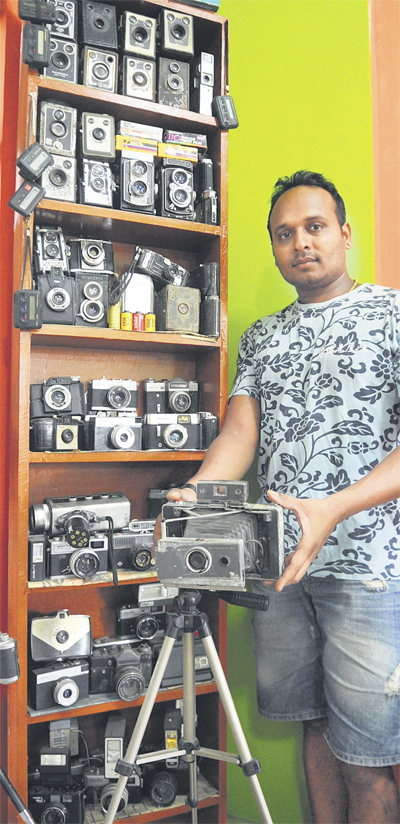
He’s only 30, but he has a penchant for cycles double his age. Sharath S Namburi’s house is a treasure trove of all things ancient and historical.

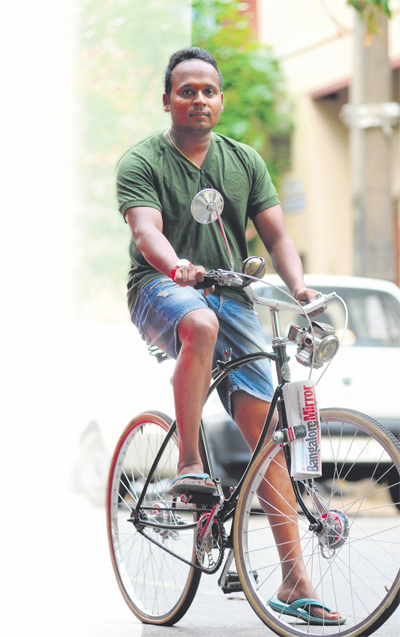
 When Sharath S Namburi came across the skeletal frame of a cycle he didn’t let it pass; it’s not in his nature to go past a bicycle without giving it a second look. When he saw the date of the make on the chassis he realised that he’d hit pay dirt. It was a bicycle used by the British Army in World War II; a cycle that was ridden during Hitler’s regime in 1939; a cycle that had an enviable ‘riding history’. It took Namburi 6 months to restore this 10 kg beauty. This BSA bike now occupies prime position in Namburi’s home in Malleswaram.

Spot Namburi on namma streets, riding this cycle that was ridden during Hitler’s regime in 1939 / Bangalore Mirror
Some people collect coins or stamps, but Namburi, an entrepreneur, collects cycles. He says about his unique habit: “People have all sorts of collections like coins, stamps and stickers, but collecting cycles was rare and I decided to go for it.“ He owns four vintage cycles, apart from five other vintage cars and bikes. Two of the cycles belong to the 40s and another one has a tax card that reads 1968-69, Bangalore City Corporation. Back then cycle owners had to pay road taxto the government.
Recounting the story of how he got hold of the BSA cycle belonging to the Hitler era, Namburi says, he got “the baby” from a 65-year-old cycle dealer, Azeez on Mysore Road for Rs 9000 in early 2012 and spent Rs 40,000 restoring it. All the parts of this restored cycle are original; some are imported from London. The oil lamp (1901) and the double bell are from Joseph Lucas company. The seat is an original dark brown and leather. The newspaper holder on the right side rod of the wheel is of horse brand. There is a cycle pump attached to the rod that sits in a vertical fashion between the legs. The seat is Brooks make. The dust cap is made out of brass. The cycle tires are 25-years old and white-wall tires. A striking feature of the cycle that you cannot miss is the tool kit attached to a rod in the front. The reflector is different as the back of it is made out of tin as opposed to the plastic ones we get today. Mohammed Ismail, a mechanic, did all the painting and gave the finishing touches to this 1939 bike.
And yes, Namburi rides this bike to work in Rajajinagar at least twice a week; he does it with such elan that it would’ve made it’s first owner proud. He says when he is on his bike it is hard for people not to notice him. “It’s the older generation that notices me the most. They are astonished to see someone young on a cycle so ancient.”
But this 30-year-old has always had a penchant for all things vintage. He owns 480 watches, the oldest being a Swiss make from 1895 and is worth Rs 15-20,000 today; 144 cameras and the oldest is an Eastman Kodak from 1901, apart from oil lamps, a 1962 air gun and more. Collecting things has been his passion since the time he was a school boy. He would collect world cup chewing gum cards, trump cards, matchboxes and more. “I still have all of that,” he says. But the ‘collector-bug’ in him was born when his grandfather gave him an HMT watch when he was in class 7. Namburi feels that as a collector it is important to be at the right place at the right time if you want to get your hands on the right vintage.

Namburi’s oldest camera is an Eastman Kodak from 1901 / Bangalore Mirror
Namburi lives by the adage, ‘Junk is old and old is collectible’ to the extent that he even has posters around his house proclaiming this truth. Perhaps to remind his wife so that she doesn’t throw anything during spring cleaning. “There’s something about holding old stuff…it can’t be replaced. You can use old stuff and it will never die out on you,” he says. “I won’t sell anything.”
To pursue his hobby of collecting vintage cycles, watches and other interesting paraphernalia, Namburi feels that he requires only patience, time, money and luck. “If you see something somewhere and like it, you should grab it. It won’t be there the next time,” he says.
Currently, Namburi is restoring two baby cycles for his one-and-a-half year old son,Tejal S Namburi, who he says will continue his legacy; it’s an Indian make that was used in photo studios as a prop in the sixties. And yes, it was a limited edition cycle.

source: http://www.banglaoremirror.com / Bangalore Mirror.com / Home> Bangalore> Home> Sunday Read> Story / Special / by Khushali Madhwani /  Sunday – May 05th, 2013

Mysore varsity renovating Oriental Research Institute

The U.S. Consulate in Chennai is funding the restoration of the Oriental Research Institute in Mysore.— Photo: M.A. Sriram / The Hindu

Conservation principles are being adhered to strictly

The restoration of the Oriental Research Institute (ORI), one of the heritage buildings in the city that adds to its antiquity and is a repository of ancient manuscripts, is under way with funding from the U.S. Consulate in Chennai.

M.R. Veerabhadraswamy, Director of ORI, who also heads the Department of Sanskrit, University of Mysore, told The Hindu that this was one of the biggest funding for restoration that the ORI has ever received and they are making the best use of it.

“The renovation is constantly supervised by the members of the U.S. Consulate, who come down once in a month to see the progress made. There has been a remarkable progress in the work, with one half of the building already fixed and painted to perfection, and work on restoration of the second half of the lime and mortar classical structure, has just about started”, he added.

It was in January 2012 that ORI — which has over 80,000 manuscripts in its collections — was recognised by the U.S. Consulate, Chennai, as one of the cultural heritage sites that needs restoration and preservation and granted $50,000 to the institution following which ORI signed an MoU with the Indian National Trust for Art & Cultural Heritage (INTACH), Bangalore, to undertake the renovation project, which started in September last year.

A significant feature of the restoration work is the adherence to the conservation principles that forbids use of cement and other modern materials that alters the structural profile of the heritage building.

Not the first

N.S. Rangaraju of the Department of Ancient History and Archaeology, University of Mysore, expressed happiness over the work in progress and said he had visited the site a couple of times and there was no violation of the conservation norms.

“The restoration of ORI is the third such exercise undertaken by the varisty– the others being Jayalakshmi Vilas Mansion which was restored with funding from Infosys, Prof. Radhakrishnan’s Bungalow which was funded from M.R. Doreswamy, MLC and founder of the PES Educational Institutions, and the ORI funded by US Consulate. The varsity has become a role model for others to emulate in conservation exercise”, said Prof. Rangaraju.

The intricate designs on the frontal section of the building are being delicately restored and embellished, and once the structure if fully restored, the manuscripts and palm leaves that constitute the country’s ancient cultural heritage, can be preserved better as it would be supported by a better environment, according to scholars at ORI.

A bit of history

Conceived by the then Maharaja Chamaraja Wadiyar, it was constructed in 1887 to commemorate the Golden Jubilee of Queen Victoria’s accession to the British throne, and was known as the Jubilee Hall. The Oriental Library was established here in 1891 and was handed over to the University of Mysore in 1916, and renamed as the ORI in 1943.

It shot into international fame when the only extant copy of Kautilya’s Arthashastra was found here by R. Shamashastry in 1902, and was published in 1909. And, it helped throw light on political and economic statecraft of ancient India.

source: http://www.thehindu.com / The Hindu / Home> National> Karnataka / by Nandita Bhakta / Mysore – May 01st, 2013

Extra innings on the ramp

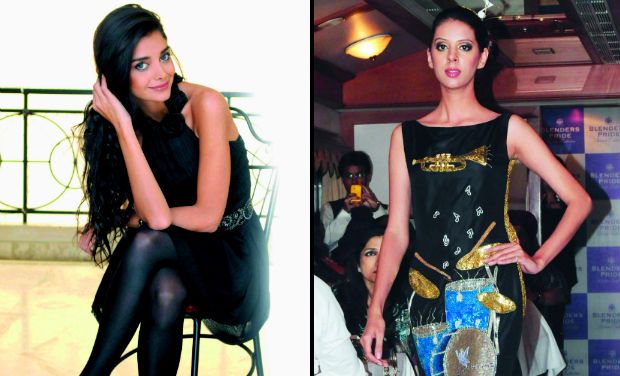
Parto Gohari and Jasleen Benipal.

The heat is on! The excitement is peaking up with every single IPL match. And our very own Bengaluru models are doing an IPL trail and travelling across the country, for the after-party fashion shows.

We speak to a few on the fun times at these soirees.

Creating quite a flutter in the ongoing IPL Season 6 are city models Parto Gohari, Mitali Rannorey, Nina Mo, Jasleen Benipal, Vibhinta Verma, Viraja, Noyonita and others sashaying down the ramp in designer creations by designers like Riyaaz Gangji, Reshma Gangji, Rina Dhaka, Samant Chauhan, Nida Mahmood and others.

Model Parto Gohari, who is doing IPL shows for both Sheetal Sharma and Rahul Dev Shetty, has been on a roll ever since the season began. “The shows are so much fun, but it gets really late each time. We walk with the cricketers on the ramp and then dance with them after the shows. We also get a lot of compliments. Even though I’m not so much into cricket and cricketers, it’s fun to get to mingle with them. Gayle is a very sweet and funny guy. Only thing I wish for is more sleep. Most shows start only by midnight and the following day we start fittings and rehearsals by 2 in the afternoon. Some team owners and VIPs come really late and we have to wait for them for the shows to begin.”

But Bengaluru model Jasleen Benipal is all excited and happy with the buzz. She reveals, “I love my job and the IPL shows are so much fun. I’m used to staying up late nights. Yes, the long waiting hours for the shows to begin, when you’re all dressed with make-up and hair in place sometimes gets too much, but then I just grab a drink and have fun. One of the cricketers came up to me and said he finds Indian girls very pretty and said I was beautiful. Some of them even show attitude, but I love every bit of it.”

Another model who’s living life in the fast lane is Vibhinta Verma. She confesses, “Travelling out of town on shows is always great fun. The best one was when we were all in Goa and after a show all us models and others were chilling and we all got into the pool in our clothes and danced away to the latest Bollywood hits. Even though it’s tiring, as we need to take early morning flights coupled with late night shows, the high during the shows is something we all look forward to. The after-parties in Hyderabad are the most exciting. Most girls usually end up going from the parties straight to the airport to catch the early flights back to Bengaluru. Its funny to see all of us taking a power nap on the flights.”

Even the city choreographers are a busy lot with Sheetal Sharma doing the signature IPL shows and choreographer Rahul Dev Shetty doing the Videocon IPL shows in Pune and Mumbai. Touring with the models he admits to the shows being a fun riot all the way. “It’s been a blast. We are in a new city in a new bed and a new hotel every day and I keep forgetting which side the elevators are. Harbhajan Singh is the funniest of the lot and comes up with such wisecracks all the time.”

source: http://www.deccanchronicle.com / Deccan Chronicle / Home> Lifestyle>  Fashion/Beauty / by Namita Gupta – DC / May 04th, 2013

Magic in every grain of rice

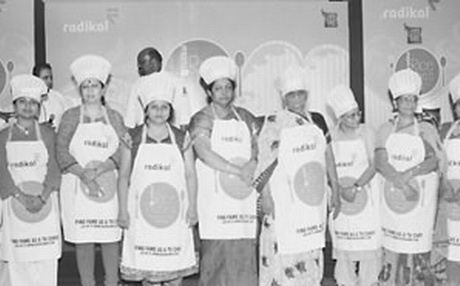
After a tough battle, resulting in many wonderful culinary creations, one winner was selected from each outlet for the state level cooking challenge | EPS


Rice to Riches, a state-level cookery challenge was organised last week for the home chefs of Bangalore. All participants demonstrated their rice cooking skills in the basket cooking round out of which 5 were qualified for the desert making round.

Dishes were selected based on various parameters, such as taste, innovation and presentation skills. The event was organised by Radikal Overseas Pvt. Ltd.

Jameela won the ‘Rice to Riches’ cookery challenge from Bangalore.

The winning meal consisted of a main course of vegetarian coriander rice and dessert of rice mousse.

On sharing her excitement on qualifying for the National Level of the cookery challenge which will be held in Delhi, Jameela said, “I am really excited about competing in Delhi. I never expected to reach this level. It feels like I am on top of the world.”

From across eight metros and mini metros an overwhelming response was received from approximately 2 lakh consumers.

After a tough battle, resulting in many wonderful culinary creations, one winner was selected from each outlet for the state level cooking challenge.

The winners will cook and present their culinary rice delight. Siddharth Chaudhary, Managing Director, Radikal Overseas, said, “We are glad to receive an overwhelming response from Bangalore. The enthusiastic participants created unique and delicious delicacies. Their passion and enthusiasm for the culinary arts is inspiring and we look forward to experience their talent in the national level. Despite stiff competition, the winners truly stood out. The grand finale will have one finalist from each city who will compete to become the celebrity chef.

source: http://www.newindianexpress.com / The New Indian Express / Home> Cities> Bangalore / by Express News Service – Bangalore / April 30th, 2013

Praying before an ancient bow

People generally pray before a deity in most temples but in a 13th century temple that is situated on a hillock called Maradi Gudda (adjacent to Ranganathapura in Sira taluk of Tumkur district), there is a unique custom where people offer their prayers to an ancient huge Dhanush (bow) installed in the temple. Maradi Gudda is a green hill in the middle of the plains and has a beautiful temple that can be seen for miles around and you can drive all the way to the top. It is 135 km from Bangalore and in recent years, it has become popular because of the availability of rare medicinal plants and shrubs in and around the hills.

This temple dedicated to lord Vishnu in the form of Sri Ranganathaswamy, has its own share of myths and legends, and is called the Maradi Ranganathaswamy temple. The most important and perhaps the most sought out in the temple is the huge bow made of Panchaloha generally comprising alloys of  gold , silver, copper, iron and lead.

Legend of the Dhanush: Legend has it that the huge bow and arrow was found at the base of the hill. Several villagers tried to lift it and failed. Their combined effort also did not yield any result. A small boy appeared mysteriously and effortlessly lifted the bow and the arrow. He walked all the way up to the temple on the top of the hill and deposited it near the sanctum sanctorum alongside the idols of Lord Ganesh and Lord Anjaneya.

The road to the hill is through rolling fields and greenery. You will get to the Kamadahalli Ranganathapura village first and then move towards the hillock Maradi Gudda, also called as Pancha Kalasha Gudda. It is easy to spot the hill as it is visible for miles around.

You will see the 40-feet Gopuram of the temple even before you approach it. At the base of the hill is a small lake called Purusharama Kere. You will find a small beautiful Kalyani nearby and the water is used for worshipping the deity.

According to Krishnappa, the priest, the temple is said to be built in the 13th century by Huildore village head Halegowda as per available historical records. “The paintings and the sculpture are recent additions,” he added.

Maradi  Ranganathaswamy temple stands on a three-feet-high jagali (pedestal). Built in the Dravidian style, the temple has a spacious mukhamantapa with intricate carvings of gods and goddesses.

The deity of Ranganathaswamy in a reclining posture is made of black stone and holds the pride of place in the Garbha Gudi. Former Committee Member of the temple, Anantha Raju said, “There is also a saligrama stone kept in a silver bowl which is revered.” The big bow can be seen inside the Sukhanasi housing the idols of Ganesha and Anjaneya near the temple’s sanctum.

The outer walls of the temple have some fine sculpture and colourful mural paintings depicting stories from the Ramayana and Mahabharatha.

When I entered the temple, it was virtually empty and the atmosphere was delightfully serene. Anantha Raju explained, “We get visitors in huge numbers all throughout the day. Youngsters come for trekking and occasionally groups of trekkers camp here. Maradi Ranganathaswamy is the family deity for thousands of people and they come to pray here regularly from everywhere in the country and abroad.”

Dr Chandrappa, a visitor from Cambridge, United Kingdom said he comes here every year, 15 days after Ugadi, for the Kalyanotsava. “Thousands come to witness the marriage ceremony of Lord Ranganathaswamy and Goddess Lakshmi and take part in the annual fair,” he said.

The view from the top of the hill with the lush green landscape is simply amazing. The hill slopes were blanketed by brown and dried grass. Thippeswamy, a local, said, “In the rainy season, the river below fills up and the hills are covered by a layer of lush green grass. All kinds of birds, rabbits, and deer stroll around leisurely. Many youngsters camp here in the hills. Food and accommodation is provided by the temple authorities and our only request to tourists is to refrain from littering on the sacred hills”. By the evening, the sun set a golden glow on the hillock and made way for a spectacular visual. One thing became certain from this visit to this not so popular hill station; Maradi Gudda is the place for anyone looking for some peace and quiet.

source: http://www.newindianexpress.com / The New Indian Express / Home> Cities> Bangalore / by Dr. Mamatha B. R, / May 02nd, 2013

Rahul Pereira: Torchbearer of the land of spices

Rahul Gomes Pereira, a student of the Oberoi Centre of Learning and Development has been selected to represent India in the cooking skills category at the 42nd WorldSkills global competition which will be held in Leipzig, Germany in July 2013. Rahul is the sole Indian representative and he will be the torch-bearer for India’s cooking skills.

Rahul, a kitchen management associate will be accompanied by his trainer and mentor, Chef Parvinder Singh Bali. He will be competing to demonstrate the best of his culinary prowess against chefs from 52 other countries. The preliminary rounds of the competition were held across India. Rahul impressed the jury with his expertise and was selected to represent India at the cooking finals, held on March 30 and 31.

WorldSkills gives young talent between the ages of 17 to 22 the opportunity to demonstrate their excellence in skilled professions. Winners are awarded medals and certificates of achievement recognising their skills and abilities in their respective fields.

On Rahul’s achievement, Mohit Nirula, Dean, The Oberoi Centre of Learning and Development said, “We are  proud that Rahul will be representing  India in the cooking skills competition at the WorldSkillss competition. We wish him success and hope that he will demonstrate the best of his learning and skills.”

About the competition:

WorldSkills is a skills competition, jobs and careers event held in a member country every two years. It is a competition for youth from 17 to 22 years to demonstrate their excellence in skilled professions. The competition is promoted and managed by WorldSkills International, formerly known as the International Vocation Training Organization (IVTO). As of September 2008, WorldSkills International has 50 member countries. The 42nd Worldskills International competition will be held in Leipzig from  July 2 to July 7.

source: http://www.newindianexpress.com / The New Indian Express / Home> Cities> Bangalore / by Express News Service – Bangalore / May 02nd, 2013

Doha: TKQ Tulu Parba showcases rich culture, unity in diversity

Doha :

Tuluvas residing in Qatar witnessed the rich cultural heritage their native land come alive with Tulu Koota hosting ‘Tulu Parba-2013’ on Friday April 19 at Al Ghazal Club in Doha.

Guests of honour Tukaram Poojary, Bhaskar Rai Kukkuvalli, Ravi Shetty were honoured with ‘Panchavadyam’ which showcased the rich traditional culture of Tulu Nadu.

The event was compered by Prarthana Shetty who was introduced on stage by cultural secretary Padmashree Shetty. The green signal for the first part of Tulu Parbha-2013 was given with the traditional dance form of Yakshagana Sthreevesha followed by a welcome dance to escort the guests to light the lamp. A Tulu song to welcome the audience then followed. A beautiful diya dance by young talented team of children lit up the stage.

Later, the audience were entertained with one hour of flawless performance of different dance forms depicting different stages and shades of life, which culminated with ‘Janapada Dibbana’, a traditional Tulu procession which involved 30 different characters such as Shoola, Navilu, Bannada Kode, tribal folk, Yakshagana characters, Bhootha Kola, Bonte, Kambula, Kumbara, Moorthe, Korida Katta, Natti Ponjovu, fishermen, Anarkali and Pili Vesha which symbolised the unity in the diversified culture of Tulu Nadu.

During the stage programme, Tulu Koota president Seethram Shetty welcomed the gathering and emphasized that youth must be initiated to learn more about their culture. Tulu Parba-2013 brochure was released by chief guest Nilanshu Dey, chairman of ICBF Advisory Board along with chief editior Prakash Ajila and team. Mementos were presented to pouplar music director Charan Das and Sathish Venkataramana who came all the way from Dubai in support of Tulu Koota Qatar.

Ravi Shetty, past president and main sponosr of the event in his brief introduction of guest of honour Prof Tukaram Poojary (history head of the department, SVS College, Bantwal) highlighted the contribution of Poojary to Tulu culture, Tulu baduku and appreciated his single-handed effort of now famous Rani Abbakka Adyayana Kendra at Bantwal. Past president Divakar Poojary later introduced guest of honour Vidhya Rathna Prof Bhaskara Rai Kukkuvalli (scholar and multi-talented personality from Tulu Nadu) and highlighted his contribution to Kannada and Tulu literature, culture and art and also media service. President and dignitaries on the dias felicitated Prof Poojary, Prof Kukkuvalli and Ravi Shetty with traditional shawla and presented them with mementos.

Thukaram Poojary and Bhaskar Rai Kukkuvalli spoke about the heritage of Tulu culture and praised Tulu Koota Qatar for the hard work in preserving and promoting our rich Tulu culture in this part of the world and also for imparting these values to the younger generation. President and dignitaries also felicitated chief guest Nilanshu Dey and presented him with a memento. Dey in his address appreciated Tulu Koota Qatar’s consistent contribution to the community not only in culture front but also in meeting special needs.

The entire event was compered by energetic and enthusiastic Prarthana Shetty. Guest of honour Bhaskar Rai Kukkuvalli gave a timely and expert narration in original Tulu ridham. On the whole Tulu Parbha 2013.Cultural secretary Padmashree Shetty proposed vote of thanks

Prarthana handed over the dais to culutural secretary Padmashree Roshan Shetty, who has in turn invited Rajshekar Bappal to brief and introduce various artists of the drama. Bappal was the story writer and Director of “Tulu Drama Julie My Darling”, a 75 minute drama with two songs and a complete entertainment combining comedy, love, emotion and a strong message for the society based on the life in the Gulf, beliefs, and values imparted to children and to the society. Charan Das of the ‘Ashok Charan Nite Fame and Tulu films’ led the music of the play.The play was choreographed by Milan Arun who is also a singer and the creative director of the play. The lyrics of the songs were written and sung by Charan Kumar from the ‘Raagdev’ fame in Mangalore. Milaan Arun.The play was lit up and sounds were provided by Pramod. The play brings out the truth behind the myth and prejudices of caste, money and dowry. The main characters of the play were portrayed as: Kuwait Mary – Milan Arun, Dubai Ram -Ramchandra Shetty, Julie (Daughter of Mary) – Akila Rao, Vijay (son of Ram) – Vijay Rai, Broker Benji – Ajay Raj, Thomasa (brother Mary) – Mohan jeppinamogaru, Saudi Mammuni – Mamouni, Vincy (drama actor)-Vincy Lobo, Qatar Rego – Albert Rego, Rego – Della Rego, Hotel supplier – Alron Rego.

Tulu Koota committee members, volunteers worked hard in presenting this exclusive event which was witnessed by Tulu expatriate community members in large numbers. Choreographers and directors for the event were Veena Rao, Milan Arun, Archana Shetty, Rajshekar Bappal, Roopesh Kumar, Chaitali Shetty, Akshaya Shetty. Overall cordination of the cultural event was done by the cultural secretary Padmashree Shetty. Mementos were presented to all the participants. Tea, snacks and dinner were served to the audience.

source: http://www.daijiworld.com / Daiji World / Home> Top Stories / by Daijiworld Media Network – Doha / Doha, April 21st, 2013