Category Archives: Arts, Culture & Entertainment

Doha: Dr B M Hegde to grace Bunts Qatar first Annual Day event

Doha :

The stage is set for the first-ever Annual Day celebration of Bunts Qatar to be held on Friday April 5 at 4.30 pm at Al Jazeera Academy.

Padma Bhushan Dr B M Hegde will be the chief guest. Guests of honour will be Chidanand Naik, general manager of Pallonji Qatar, Sarvotham Shetty, president UAE Bunts, and K D Shetty, chairman, Bhavani Shipping lines.

BuntsQatarBF11apr2013

Within a short span of time, the association has become known for its charity and social works in Qatar, apart from sports and cultural activities. Former president of Tulu Koota Qatar and managing director of Advanced Technical Services M Ravi Shetty was elected its first president. It aims to extend every possible help to the needy members of the community, with motto of ’unite for a good cause and support the needy’. With this in mind, every year Qatar Bunts will be honouring one personality for his or her service to the community in Qatar.

The event will included dances, songs and skits by the members of the Forum. The first edition of the Association’s souvenir ‘Gari’ will also be released on the occasion.

Those who have contributed to the community will be presented mementos. Also, the Outstanding Community Service Award will be present.

Chief guest Padma Bhushan Dr B M Hegde will be felicitated by the Association, so also the guests of honour.

Orchestra by guest artistes will also add charm to the occasion.

ProfBelleBF11apr2013

About Dr Belle Monappa Hegde

Prof Belle Monappa Hegde is a physician par, excellence, an astute clinician and a teacher in the true Guru tradition. Prof Hegde’s encyclopaedic knowledge, brilliant oratorical skills and natural instinct to teach have endeared him to generations of students and teachers across the globe.

Prof B M Hegde was born on August 18, 1938, to V Shankar Hegde and Chandravathi. After his early education at Hiriadka and Udupi, Prof Hegde proceeded to Madras for his medical education. Through out his tenure as a medical student at Stanley Medical College, Madras, Prof Hegde was a brilliant student and had received a Gold medal and a special prize in surgery from Madras University. He did his MD (Medicine) from Lucknow University with scholarship of Govt. of India. Subsequently, he went to England on Commonwealth Fellowship and had passed the Membership of Royal College of Physicians of UK examination. He then underwent advanced training in Cardiology at Harvard Medical School, Boston under Nobel Laureate Bernard Lown; and at the National Heart and The Middlesex Hospitals in London under Late Walter Somerville and Late Richard Emanuel. He is now the Fellow of all Royal Colleges and the American College of Cardiology.

Prof Hegde started his teaching career as a tutor in 1962 in Manipal. He then served the Kasturba Medical College, Mangalore and Manipal for 45 long years, occupying with distinction the posts of professor of Medicine, director PG studies, principal, dean, pro, and vice-chancellor of Manipal University.

Prof B M Hegde’s academic brilliance has been recognized globally. He is affiliate professor of Human Health (University of Northern Colorado); and former professor of Cardiology (The Middlesex Hospital Medical School, University of London). He is also the chairman, State Health Society’s Expert Committee, Govt of Bihar. He has been the visiting professor to number of universities in India and many countries abroad.

Prof Hegde has been the recipient of numerous National and International Awards. To name a few: Dr B C Roy National Award for being an Eminent Medical Teacher, Dr J C Bose Award for Life Science Research, Pride of India Award from the US, Distinguished Physician of India Award from A P I, Healer of Mankind Award (from Symbiosis University, Pune), Vaidya Ratnakara award, Karnataka Rajyothsava Award among many others. Prof Hegde has been examiner for the MRCP (UK) and MRCPI (Dublin) examinations. Prof Hegde’s monumental contributions to the art of bed, side clinical examination regarding “how to detect early splenic enlargement”, “auscultation for mitral valve prolapse” and “how to assess the second heart sound with the stethoscope correctly” have been published in prestigious medical journals, such as, The Lancet, The German Tribune, The Practioner and the JRCP (London) over the years and two of these have been cited in the American College of Physicians book on Bed side diagnosis.

Prof Hegde is a prolific writer and his articles are frequently published in various magazines and newspapers and his talk shows are sought after in the electronic media. Prof Hegde has penned nearly 35 books and over 3,000 articles in lay press. During the last decade, Prof Hedge along with 15 world renowned scientists, some of them Nobel Laureates, has been publishing a journal titled “Journal of the Science of Healing Outcomes”, of which he is the Founder Editor, in, Chief. Late Prof Rustum Roy, considered to be the father of nanoscience, was Prof Hegde’s mentor and had helped Prof Hegde to start the journal. Professor Hegde’s service to the society through Bharatiya Vidya Bhavan and its activity are legendary.

In 2010, Prof B M Hegde was conferred the prestigious Padma Bhushan Award by the President of India. Professor Hegde’s dear wife, Late Malathi Hegde, was his conscience keeper. They have three children,  two doctor daughters, an engineer son, sons in law, daughter in law and three grand children. They are a close knit family.

In recognition of his outstanding contributions as a dedicated teacher in the true Guru tradition, a physician par excellence, original researcher, a medical philosopher, and an able administrator, the Sri Venkateswara Institute of Medical Sciences (State University) presented Professor B M Hegde the award of the Honorary Degree of Doctor of Philosophy (PhD Honoris Causa) in 2011.

He was the first Bunt and the first medical doctor from Karnataka to be awarded the Padma Bhushan.

source: http://www.daijiworld.com / Home> Top Stories / Media Release / Wednesday, April 03rd,2013

A son’s tribute to Bhakti Gananiratha Sangeetha Vidwan T.R. Srinivasan

T.R. Srinivasan (circled) and other disciples seen with Mysore Vasudevacharya (left) and Piteel Chowdaiah. / Star of Mysore

 By Dr. T.S. Ravishankar, Director of Epigraphy Branch, Mysore

Sri Thyagaraja Sangeetha Sabha Trust has arranged a jugalbandi concert in memory of Bhakti Gananiratha Vid. T.R. Srinivasan on Apr. 6 at 5.30 pm at Veene Seshanna Bhavana in Kuvempunagar. The participants are Vid. H.N. Bhaskar (violin), Pt. Pravin Godkhindi (flute), Anoor Ananthakrishna Sharma (mridanga) and Pt. Udayaraj Karpur (tabla).

I am indebted to Sri Thyagaraja Sangeetha Sabha Trust, Mysore, which has arranged this Memorial Music Concert on April 6. Especially, I am beholden to Prof. Poornaprajna of Kansas University, USA, for having taken the initiative to arrange the concert.

Here I would like to give a brief profile about my father and his contribution to the music world. This concert dedicated to the memory of Bhakti Gananirata Vid. T.R. Srinivasan aptly proves that he had created a niche in the hearts of contemporary musicians, artistes and music-lovers.

He was greatly acclaimed for his booming, resonating, melodious voice and impeccable pronunciation, coupled with great devotion, which formed his strong forte.

His great grandfather, Ganapati Dikshitar, belonged to the lineage of Sadguru Sri Tyagaraja Swamy. His father Tirupattur R. Ramanatha Iyer was the disciple of Ramanathapuram Srinivasa Iyengar and his co-disciple was Sangeeta Kalanidhi Ariyakkudi Ramanuja Iyengar.

Born in 1927, he came under the tutelage of Sangeeta Vidwan T. Puttuswamaiah, brother of Sangeeta Ratna T. Chowdaiah at the age of 12. He subsequently learnt music under Vid. Veena Gopalaraya, Sangeeta Vidwan Ramaratnam, Principal of Music College. He also learnt mridangam from Vid. S.R. Varadachar.

He gave his maiden concert when he was 17 at Bandikeri Prasanna Venkataramanaswamy temple, Mysore. In 1957, he gave a concert before His Highness Jayachamarajendra Wadiyar. Again, in 1959 and 1961 he sang at the Music Academy, Madras, during the Presidentship of Sangeetha Kalanidhi Rajaratnam Pillai and Sangeetha Kalanidhi G.N. Balasubrahmanyam.

Other important concerts were at Bangalore Gayana Samaja, Nada Brahma Sabha, Karnataka Sangha at Bombay and Guntur, Andhra Pradesh and also in the presence of Sringeri Jagadguru and before Sosale Prasanna Theertha Sripadangalavaru and Parakala Swamiji.

He gave concerts right from the year 1947 from All India Radio, to begin with Dharwad and Madras, and subsequently at Mysore. As a very popular music teacher, he was teaching music at Mahila Samaja for many years and other institutions including Ramakrishna School and RIE, Mysore.

Though he got trained under different musicians, he never came under the spell of a particular style of singing and he evolved his own distinct style. Always he used to stress among his students to become creative musicians and follow manodharma sangeeta and emphasise the tonal quality of the voice so that music emerges from the depth of heart and used to cite a phrase from Sri Tyagaraja kirtana — Shobillu sapta swara, which defines the art of articulating the voice.

He has given innumerable concerts in his music career spanning more than five decades and I had the great fortune of accompanying him in many concerts in the ‘70s and ‘80s.

Apart from music, because of his endearing qualities he had earned a large number of admirers and friends. His humbleness, down-to-earth nature won him a lot of friends and he was always generous in his disposition in helping the needy.

Among the virtues to be reckoned with is his nature of nurturing and encouraging young talents. He used to attend many concerts given by young musicians and encourage them. In one of the Bharatanatyam performances given by his daughter-in-law, Bhagyalakshmi, he rendered songs as part of Nattuvangam, and chose songs from DVG’s Antahpura Gitegalu, which was appreciated by the audience.

Thus he left an indelible impression on the connoisseurs of music and led an active life by teaching his disciples and giving concerts till the end. He breathed his last on 25th May 1996.

source: http://www.StarofMysore.com / Home> Feature Articles / April 05th, 2013

Critic Shivaramu Kadanakuppe receives Dr. Ragow Award

CriticBF10apr2013

Mysore :

“Even State and national literary awards are getting contaminated with corruption thus demeaning their quality,” regretted litterateur Dr. Hampa Nagarajaiah.

He was speaking after presenting Dr. Ragow award to critic Dr. Shivaramu Kadanakuppe at a prog. organised by Mandya Karnataka Sangha at Rajendra Bhavan in JSS Hospital premises here on Wednesday.

“Including Jnanpith award almost all Central literary awards are finalised through hectic lobbying and corrupt practices. On the contrary, awards like Ragow or any such instituted in honour of an individual has maintained its sanctity and quality qualified by the stature and calibre of the recipient like Shivaramu Kadanakuppe,” said Dr. Hampana.

Presiding over the event, litterateur H.L. Keshavamurthy regretted that litterateurs too were getting demoralised by getting involved in corrupt activities.

Vidyavardhaka College’s Hindi Professor G. Chandrashekar delivered the felicitation address. KSOU Professor Dr. A Rangaswamy was the chief guest. Dr. Hampana released two books authored by Dr. Shivaramu Kadanakuppe — ‘Samajika nele’ and ‘Vinayaka: Ondu adhyayana.’

Karnataka Sangha President Jayaprakash Gowda, delivering the keynote address, disclosed that the Dr. Ragow award was instituted by the Sangh utilising the funds donated by the students of Dr. Ramegowda who turned 71 on Wednesday.

Addressing the gathering, the honouree Dr. Shivaramu Kadanakuppe reiterated that students should learn English despite studying in Kannada medium. In a philanthropic gesture, he donated the cash component of the award of Rs. 15,000 to Nrupathunga Kannada School in city which was received by the School Secretaries S.R. Sudarshan and Somashekar. Publisher D.N. Lokappa and Dr. Ramegowda were present.

source: http://www.StarofMysore.com / Home> General News / April 05th, 2013

30th National Kannada Sammelana to be held in Delhi on April 6

New Delhi, Apr 2 (ANI):

The 30th National Kannada Sammelana will be held here on April 6 and 7.

Announcing this, M B Samaga, its convenor, said the conference organised by “Dehali Kannadiga”, a Kannada monthly published from Delhi, will be inaugurated by Padmabhushan Dr. D. Veerendra Heggade, Dharmadhikari of Dhrmasthla.

Dr. K. Sudha Rao, ex vice chancellor, Karnataka Open University will preside over. Prof. B.R. Ananthan, vice chancellor, Ranni Channamma University will release the souvenir.

The conference includes a seminar on Kannada language, literature and culture, poets’ meet, women festival, music, dances, drama and other cultural programmes and book exhibition.

“Two thousand delegates from different parts of the country including writers, artists, professors, academics and representatives of the Kannada association are expected to participate, Samaga said. (ANI)

source: http://www.truthdive.com / Home> National> News / by ANI / New Delhi, April 02nd, 2013

‘Peter Colaco was a strong and simple man’

Bangalore :

The absence of Bangalore’s chronicler might leave some of the finest memories of the city rudderless. For, the narrative, in this case, is as much about its creator as it is about the city. The chronicler portrayed what he saw — simple and often funny things taken from the daily affairs of the city, unlike ones found in history books – bringing smiles to his readers’ faces.

Peter Colaco, author of bestseller ‘Bangalore, A Century of Tales From City & Cantonment’, passed away at the age of 67 on Friday, following a cardiac arrest. His work is considered one of the finest accounts of the city’s post-Independence era ground realities.

Peter was a versatile personality. A former professor of advertising at IIM-B, he also donned the caps of documentary filmmaker and musician, besides being successful in his advertising career.

“Above all, Peter was a very nice human being. I remember him dragging me to old age homes where he would just take out his guitar and sing. The aged there loved him,” said Sadiqa Peerbhoy, author, advertising professional and a good friend of Peter.

Many were inspired by the man who was known for his unrelenting quest for precision and perfection. But those who grew up with him, particularly his siblings, perhaps knew him better than most. “Peter spent hours trying to work out  rose grafting, and that’s why, perhaps, can still be either prickly as a thorn or soft as a rose petal,” writes Jacqueline Colaco, one of Peter’s siblings, in her work, ‘Growing Up With Brothers’.

The man himself may be gone, like most of the subjects of his best-selling book. Yet, his readers will find him alive in the reminiscences of the old city.

A few weeks before his death, Peter had pledged his body for research to St John’s Hospital. His end, incidentally, came on Good Friday , a day before he was to turn 68.

He wanted small joys

Peter Colaco was perhaps the most multi-faceted people I’ve known. Peter, as a person, was so powerful and yet so fragile, often torn between the strong mind of sheer genius and the simple mind of the good. There was very little he wanted because there was very little he needed. All he really wanted was the joy of enlightened conversation with good friends  and family.

Paul Fernandes | cartoonist and friend of 35 years

An excerpt from Peter’s book

Grandfather bought Oorgaum House in 1920. It was something of a landmark with a pillared portico and battlemented terrace, an imposing bungalow set far back in a very large compound. It had virtually no neighbour on one side, just a playground of St. Jospeh’s ‘Indian’ High School, and then the expanses of Cubbon Park – excerpted from Peter Colaco’s Bangalore – A Century of Tales From City & Cantonment.

source: http://www.articles.timesofindia.indiatimes.com / Home> City> Bangalore / by Rhik Kundu , TNN / April 02nd, 2013

Mangalore: Compilation of Kodial Khaber editorials ‘Manaa Dakun’ released

Mangalore:

‘Manaa Dakun’, a book of editorial collections that appeared in Konkani fortnightly ‘Kodial Khaber’, written by Mavinakurve Venkatesh Baliga, was released at a programme held at Bhuvanendra Hall, Canara High School, on Sunday April 7.

The book was released by Basti Vaman Shenoy, president, World Konkani Center, while Padma Shenoy, writer, and Ranganath Bhat, secretary, Canara High School, were the guests of honour.

Baliga, in his welcome address, said that the aim of the paper when it was started five years ago, was mainly to spread news as well as to promote Konkani language. He added that the paper now reaches 3,000 families.

Lauding Baliga for all his work, Shenoy said that the editorial in a paper has special standard and importance.

“Here, the editor gives a clear cut idea on the topic of the book before a reader starts reading it. Papers should increase and grow so that people’s knowledge and capacity to understand increases,” he added. He also asked people to always support papers and writers.

Guest of honour Padma Shenoy briefed about the book and lauded the writings of Baliga. M R Ranganath Bhat also spoke on the ocassion.

M R Kamath, member, advisory committee, Naresh R Kini, and Vidya Baliga were among those present.

source: http://www.daijiworld.com / Home> Mangalore / Pics: Brijesh Garodi / Daijiworld Media Network – Mangalore (VM)

Museum of love

AmulyaBF07apr2013

Amulya Shodha’, a museum in Shimoga, was built by a retired history lecturer, Khandobarao, in memory of his wife. The history lecturer now plans to expand the museum and make it the go-to  place for all students of history. Nrupathunga S K reports.

Inscriptions, coins, monuments, manuscripts, all stand as testimony to the many events in history. As we turn over the pages of history, we come across many kings, who took to the battlefield to either retain their kingdom or to expand it.

Speaking of love, though, only one king comes to the memory of most Indians — Mughal emperor Shah Jahan, who built the Taj Mahal in memory of his wife Mumtaz Mahal. This monument has been a source of inspiration for lovers across the globe for several centuries. It’s not surprising then that H Khandobarao, retired history lecturer, better known as ‘Shah Jahan of Shimoga’ was inspired by this emperor.

He has built his ‘Taj Mahal’, a museum named ‘Amulya Shodha’, on a one-acre farm near Lakkinakoppa circle on N R Pura road, 12 km from Shimoga in the fond memory of his wife, Yashodha, who was also history lecturer. She passed away in 2007 due to kidney failure.
‘Amulya Shodha’, as the name itself suggests, is an invaluable search for lost values and culture of the bygone days. It showcases rare paintings of Ravi Varma, coins, inscriptions, manuscripts, weapons, all used by popular kings. The history professor collected these artefacts from various parts of the country.

He wants to create awareness among youth about the significance of lost heritage, culture of the previous era through his museum and thus aspires to make youth more aware of our culture and heritage. Apart from this, it also spreads the fragrance of his deep love for beloved wife Yashodha.

Khandobarao did his schooling and college in Shimoga. Yashodha was his neighbour during his college days. Both of them studied at the Sahyadri College together. Acquaintance turned into friendship, and later, love. They got married in 1972. Khandobarao began his career as high school teacher in 1968.

After serving for nearly five years, he was promoted as a history lecturer for National Pre-University College in Shimoga.

His wife worked as a history lecturer at Kamala Nehru Women’s College. His wife would often say that the Taj Mahal was not only a symbol of true love, but also the soul of true lovers. Inspired by her thought, he made up his mind to build a museum on a one-acre farm after the death of his wife in 2007.

Khandobarao is seeking financial assistance for the development of this museum. He has appealed to people’s representatives, including former chief minister B S Yeddyurappa, in this regard. But, his efforts have failed to produce desired results. Khandobarao feels the museum is turning into a mere godown, owing to the presence of a large number of artefacts. He plans to expand it.

But he is short of funds to execute his plan. He has already submitted a proposal to the Centre along with his plan seeking Rs 3 crore for the development of this museum. He wants this museum to remain a symbol of true love and a school of history for future generations.

source: http://www.DeccanHerald.com / Home> Supplements> Spectrum / April 02nd, 2013

Kannadigas make a mark by displaying their rich tradition

Visakhapatnam :

Their culture and cuisine is very different from that of Vizag and they account for just a small portion of the city’s population. However, the 300-400 Kannadigas, who are mostly concentrated in and around the Gurudwara junction in Vizag, have made the Port City their home.
The Kannadigas are chiefly employed in public sector undertakings such as the steel plant and banks, as well as enterprises such as the Railways and the Navy.

This culturally active community displays its rich traditions and heritage at the Kannada Kala Sangam in the city through programmes such as folk dance and theatre, including Yakshagana and Bhootkala, and also through the celebration of Ganesh Chaturthi and Mosurukudike (Sri Krishna Janmashtami), with the world-famous Carnatic music featuring during festivals. Artistes are also flown in from Karnataka to perform at the Kannada Kala Sangam on special occasions, said Vijaya Kumar, the joint treasurer of the Sangam.

Vishnumurthy Bhat of Udupi in Karnataka, who is in the city for the last seven years and is employed with a nationalised bank, is the secretary of the Kannada Kala Sangam.

“I have extended my stay here by postponing my transfer because my children are studying in the city. Vizag has good schools and hence I’m not in a hurry to rush back to work at my native place,” said Bhat.

The Kannadigas are a floating population here and try to make the most of their stay in the city. “We get everything here except perhaps the Kannada cuisine in restaurants,” he quipped.

That is one of the few things that the Kannadigas, who are in love with the beauty of the city, miss — the cuisine from various parts of Karanataka such as Mangalorian food, Mysore sweets and Bangalore cuisine.

“Each part of Karnataka has its special cuisine, such as the neer dosa (wafer-thin dosa kneaded with water), kori roti (dry rice flakes in chicken gravy), semedaidya and of course the famous Mysore-Pak sweets. There are hardly any authentic Kananda eateries in the city,” lamented Mangalore’s D Deepak, an employee at a corporate house who has been in the city for the last four months.

“The food here is quite different from our part of the country. We use a lot of coconut and banana in our food, including the use of coconut oil. However, overall, I’m enjoying my stay in the city,” he said.

Though the culture and cuisine are vastly different, Kannadiga brother-sister duo B Madhushree and B Srinidhi are all praise for the city and her warm people.

“I could learn Telugu in less than a month because of its affinity with our language and I have many Telugu friends and neighbours who are warm-hearted, soft and polite. I also like the scenic beauty of this tourist place,” said Madhushree, a class eight student of Sri Satya Sai School and a Carnatic classical singer.

For her brother Srinidhi, an intermediate student, it’s the perpetual peace and clam prevailing in the city and non-congested roads that helps Vizag score over other cities. “I’ve been in the city since the fourth standard but have never seen any political unrest or major problems in the city. The city also has good academic institutions. However, the biggest turn-off is the industrial pollution, which is getting worse with each passing year,” said Srinidhi.

source:  http://www.articles.timesofindia.indiatimes.com / Home> City> Visakhapatnam / by Sulogna Mehta, TNN / March 31st, 2013

Book Talk : Sightless, but not Visionless

BookBF06apr2013

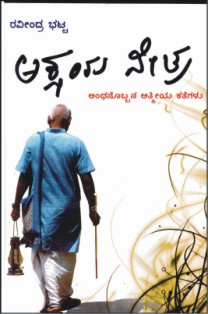
The author of Akshaya Netra, with name and fame in media circles for his lucid presentations about persons and events in which they figure, is in more than one sense the book’s ‘ghost author.’

On his own admission, he embarked upon the task of narrating about an individual who dared his visual impairment (being blind) by leading a life that mocked at the disability, having convinced himself that if he did not record what the central figure of his work, Prof. M.S. Venugopal, went through in life that would amount to a betrayal to the society. The narration in first person makes Venugopal the ‘true author’ of the work, but for his being sightless.

The author has captured the saga of life’s vicissitudes that the subject (Venugopal) of his book faced with aplomb by adopting the anecdotal route as narrated to him from memory. In that sense, the work is a hybrid case of an autobiography not actually written by its own author.

The crisp script presented in 10 concise sections generates a feeling in the reader that Venugopal is himself narrating his travails and ultimate successes in all his pursuits in a one-to-one communication. While his realisation of being sightless is told in a matter-of-fact outlook, his triumphs of achieving his goals in life are told with consummate humility.

The reader is served a sumptuous fare of details of innumerable occasions that Venugopal braved to the extent of visualising those trying occasions as crystal-clear graphics. Once begun, it is well-nigh impossible to put the book away until page 112, its last page.

Prof. Venugopal, now a familiar figure among the literati of Mysore, through the pen of his biographer Ravindra Bhatta, may be inclined to agree with the thought of this reviewer that his message to everyone in society is this: It is a terrible thing to see and have no vision. The world may be full of suffering, but it can also be full of overcoming. Also, avoiding danger is no safer in the long run than outright exposure to that danger (a quote from Helen Keller, the legendary deaf-blind icon). —BRS.

source: http://www.StarofMysore.com / Home> Feature Articles / March 31st, 2013

Holi celebrated with gusto in Gulbarga, Bidar

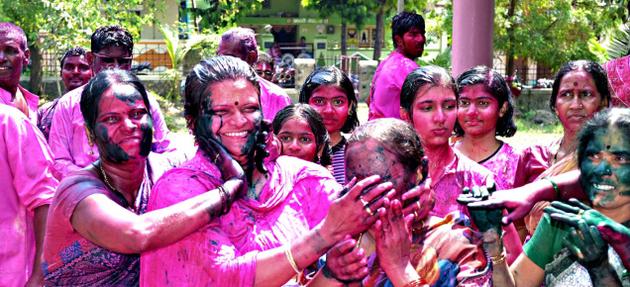
In the thick of it:Members of a youth club participating in a ‘dahi handi’ competition in Bidar (top); women celebrating Holi in Gulbarga on Wednesday.— Photos: Gopichand T. and Arun Kulkarni / The Hindu

The city was awash with colour and life came to a grinding halt as people celebrated Holi on Wednesday.

A festive mood prevailed in the city throughout the day. Shops, business establishments and hotels downed shutters, and public and private vehicles were off the road until evening, as youngsters and revellers took to the streets in the morning itself.

No untoward incident was reported anywhere in the district.

The government had not declared a holiday on Wednesday and attendance at its offices was thin.

Nationalised banks suspended operations for the day.

Competition

Bidar Special Correspondent writes:

Holi was celebrated with joy across the district on Wednesday. Some residents set up temporary shelters to provide drinking water to revellers. Several NGOs distributed buttermilk and lemon juice, while yuvak mandals put up tents and served snacks.

The members of a youth club organised a ‘dahi handi’ competition in the old city.

holi2BF05apr2013

Official reception

Government employees gathered at Durga Darshini, the Deputy Commissioner P.C. Jaffer’s residence, to play Holi.

There, they were met by Dr. Jaffer, Ujjwal Kumar Ghosh, zilla panchayat Chief Executive Officer, and Sunil Panwar, Deputy Conservator of Forests, among others.

Bandeppa Kashempur, MLA, joined a group of Lambani women in their dance in the celebrations organised outside his house. Residents of villages and tandas in the taluk participated in the celebrations there.

Rahim Khan, MLA, played Holi with villagers who visited his house on Ring Road.

source: http://www.TheHindu.com / Home> National> Karnataka / by Special Correspondent / Gulbarga, March 28th, 2013