Category Archives: Arts, Culture & Entertainment

Orange fair at Lalbagh gardens

The Lalbagh Botanical Gardens will host an Orange Mela from January 4 to 6.
The exhibition is being organied to provide a platform for farmers producing oranges to directly interact with their potential buyers.

While farmers will have a better profit for their yield, the orange produced will be cheaply available to the customers, M Jagadeesh, Joint Director of Horticulture (Parks and Gardens), said.

About 20 tonnes of oranges from different parts of the country such as Rajasthan, Maharastra, Punjab, North East, Nagpur, West Bengal, Tamil Nadu and several districts of Karnataka, including Kodagu, Chikmaglur, Hassan will be exhibited at the Mela.

The event will be hosted by the National Horticulture Board, along with the State department.

The regional variety of oranges vary in their production technique, climate, type of irrigation and so on, Dr S V Hittalmani, Additional Director of Horticulture (Fruits) said.

For example, Coorg mandarins are grown like an intercrop in Kodagu. The irrigation is not regular and as a result they are tight-jacketed (peel), whereas the Nagpur oranges, due to proper irrigation have loose jackets,” he added.

Apart from oranges, the exhibition will also have 40 stalls of processed and dehydrated orange products, saffron, capsicum, exotic vegetables, spices and dry fruits, grapes, raisins, flowers, biofertilizers and vegetation tools. The exhibition will not carry any additional fee for the visitor.

Karnataka, with over 5,000 hectares of production area, has a huge potential from such exposition and ultimately the farmers will benefits from such wider network, Jagadeesh said.

source: http://www.DeccanHerald.com / Home> City / Bangalore, DHNS / January 04th, 2013

Bangalore boy gets Grammy nod

Grammy nominee Arun Shenoy has come a long way from his school days in Bangalore. Arun, who is now involved in audio production in  Singapore , released his debut album ‘Rumbadoodle’, which has been nominated for the 55th Annual Grammy Awards in the Best Pop Instrumental Album category. Excerpts from a chat with Arun…

( Arun Shenoy )

How does it feel to have your debut album recognized on a world scale?

I am yet to come to terms with the magnitude of the fact that I am nominated for an award at this pinnacle of excellence in the music business. I am extremely proud of this labour of love, and happy that others believe in it too.

There are two other Indians — the late Pandit Ravi Shankar and  Anoushka Shankar  â€” who have been nominated for the 55th Annual Grammy Awards. What does this say about the impact Indian musicians are making internationally?

Both of them are already legends and globally established stars. I believe there is another Indian gentleman, though, whose name I chanced upon recently, who is nominated as well — Krishna Das, for Best New Age Album. It is interesting to see the growing impact musicians of Indian origin are making on the international music stage.

Why did you decide to bring out a gypsy rumba flamenco album for your debut?

I have always enjoyed fusion music. And as a world music form, gypsy rumba flamenco appeals to me for its raw intensity, with its rapid flourishes and passionate harmonies. I am not a traditional world artist. Rather, I decided to use this as a theme and incorporate other popular music sensibilities from pop, rock, funk and jazz. All of these forms have influenced me deeply and have been a part of my musical journey  and growth. So it was only fitting that I put together a project to pay tribute to them and create my own signature sound that is instantly recognizable.

We heard that you are acquainted with Kannada film star Puneeth Rajkumar.

Puneeth is a great artist and a down-to-earth individual. He is very keen on encouraging local talent and active in promoting Bangalore and India-based artists. He came to know of my work and he was quite enthusiastic about the fact that it’s by a former Bangalore person.

Puneeth speaks:

Arun Shenoy is my friend’s brother-in-law. I’ve heard his music. You feel extremely proud that he’s, first of all, from our city, a Kannadiga, and, above all, an Indian who has achieved so much.

source: http://www.articles.timesofindia.indiatimes.com / Home> Entertainment> Regional> Kannada> Fusion Music / by Anjali Muthanna, TNN / Deember 14th, 2012

Two-Day Beary festival from Dec.30

Mysore :

Karnataka Beary Sahitya Academy will be organising a two-day Beary cultural, traditional and literary fest from Dec. 30 in Mysore. The festival named Beary Sahitya Samskruthika-Sauhardha Mela is being organised in association with Mysore Beary Welfare Association and Bangalore based Hydrose Haji Memorial Charitable Trust.

Addressing the press persons at Pathrakarthara Bhavan, Academy President Rahim Uchchil said that various literary, cultural events will be held on Dec 30 from 9 am to 9 pm at JK Grounds and Milanji and Painting competitions have also been organised between 9 am and 11 am on the same day. The event will be inaugurated by MUDA Chairman L. Nagendra. Later, an interaction on Mysore Beary has been organised in which literary scholars will present their views.

The same day afternoon between 2 pm and 4.30 pm, cultural programmes have been orga-nised. After the cultural progra-mmes, a multi-lingual kavighosti will be held under the Chairmanship of Mohd. Badoor, he said.

The valedictory of the events will be held on the same day in the presence of District In-charge Minister S.A. Ramdas. The Academy will felicitate Beary community achievers B.M. Mumtaz Ali, Maulana V.K. Abdul Khadar, Althaf Hussain Katipalla and Ibrahim on the occasion. Later, a Beary comic play ‘Pokarakogo Pursotille’ will be staged from 6.30 pm at the venue.

On Dec. 31, a procession ‘Halli-Hallig Beary Sandal’ has been organised in Narasimharaja and Chamaraja Assembly constituencies. The youths participating in the rally will sing folk songs of Oppenpat, Kolkali, Taleem, Dhaf and Beary communities. The procession will be inaugurated by MLA Tanveer Sait in front of Dufferin Clock Tower and pass through Bassapaji Circle in Udayagiri, Al-Badra Circle in Rajivnagar, Kyathamaranahalli Circle, Shantinagar, Bannimantap and Mission Hospital Road.

source: http://www.Starof Mysore.com / Home> General News / December 27th, 2012

Tipu’s rocket court in Sr’patna to be converted into museum

Models of missiles and related information will be on display

Chief controller of Defence Research Development Organisation (DRDO) W Selvamurthy said that appropriate measures will be taken to convert the rocket court (Garrison Ball Alley) of Tipu Sultan reign in Srirangapatna, Mandya district into a museum.

Speaking to press persons during his visit to unit, which is said to be world’s first rocket court, he observed that the unit has become dilapidated, while the surrounding area has been encroached. Houses have been built illegally on the way to the monument.

Elaborating on the project, he said that DRDO will acquire the houses and convert the space into road and will be used for other necessary purposes.

He mentioned that the important monument had been subjected to negligence as there has been a confusion between State archaeology department and
Archaeological Survey of India (ASI) about who has to take care of the court.

Noting that a letter of correspondence will be done with both the departments and even chief secretary of Karnataka government, he said, appropriate measures will be taken immediately to conserve the place.

Selvamurthy said, models of all missiles developed in the country will be on display including the original one of Tipu reign.

Information regarding development of missile will also be made available for public.

Many do not know that India was the country which introduced missile to the world. The museum will stress on such facts and which will stress on further researches.
Prior to this, Selvamurthy visited Daria Doulat.

Director of Defence Food Research Laboratory Harsha Vardhan Batra, additional director Radha Krishna, Satish Kumar and others were present.

source: http://www.DeccanHerald.com / Home> District / Srirangapatna (Mandya Dist.), DHNS / December 28th, 2012

Retired Palace artist passes away

Mysore, Dec. 23 :

The scholar of Mysore Traditional Painting M. Ramanarasaiah (91), who retired as a Palace artist, passed away at Vidyaranya Hospital in Chamundipuram here in the wee hours of today after a prolonged illness.

He leaves behind his wife Jayamma, two sons and six daughters. Among his children, Subba Narasimha, Chandrika Padmanabha and State awardee Sudha Venkatesh too have followed the footsteps of their father in Mysore Traditional Painting.

One of Ramanarasaiah’s daughters-in-law Suma Krishna is also an artist of Mysore Traditional Painting. A large number of artists, well-wishers and relatives paid their last respects to the departed soul at his residence in Vijayanagar 2nd Stage today. Last rites were performed at the foot of Chamundi Hill this noon.

A profile

Born in 1922, Ramanarasaiah is the son of Venkatanarasaiah, chamberlain and middle echelon revenue and administrative officer in the erstwhile princely State of Mysore. His mother was a housewife and named him after her father who had been a rich landowner.

Ramanarasaiah completed his SSLC in the then famous English medium high school in Mysore run by a Methodist Mission. At the time his favourite subject was science. Venkatanarasaiah wanted his son to become a doctor or a scientist. But the environment of his upbringing had cast on him a strong spell. While at school, he had kept up his study of painting. So with the conviction that no other pursuit would suit him, he decided to continue his education in a school of painting.

The Chamarajendra Technical Institute in Mysore was also famous as an art institute and was established in 1869 as a part of the Dept. of Handicrafts and Technology. In 1932, owing to the then Prince of Mysore and other distinguished persons of the day, a fine arts school was started as part of this Institute. Liked by his teachers and adored by his friends, Ramanarasaiah was shaped into a fine artist and by deeply ingraining in himself all about the world of art, a highly proficient Ramanarasaiah graduated with a first class in 1947. He then created a 5ft. high oil painting of Jayachamarajendra Wadiyar.

During the days of royal patronage, he completed numerous oil paintings. The Maharaja presented these works to different royal families and notable persons. His paintings of kings and renowned persons are exhibited not only in Jayachamarajendra Art Gallery (28 paintings) but also in Mysore’s elite families and Mutts.

Among his finest creations is the 7’x12′ likeness in oil of the Maharaja’s last Durbar on display at Jaganmohan Art School. It gained a high status as an example of historical art.

He was appointed at the Jayachamarajendra School of Painting and worked hard for the school’s overall development from 1961 to 1978.

Ramanarasaiah’s works have been exhibited in Tirupati, many cities in India and abroad. He has been honoured with many titles like ‘Varna Chitra Kala Chatura’ by Vyasaraja Mutt. He was feted during the 1981 and 1993 Dasara; in 1993 Karnataka Lalithakala Academy honoured him.

He is the recipient of M.T.V. Acharya award for his contribution to art.

He mastered the Mysore & Tanjore traditional styles and trained about a thousand students, in the process becoming a scholar-artist, who dedicated himself for the phenomenal growth of Mysore traditional style.

source: http://www.StarofMysore.com / Home> General News / December 23rd, 2012

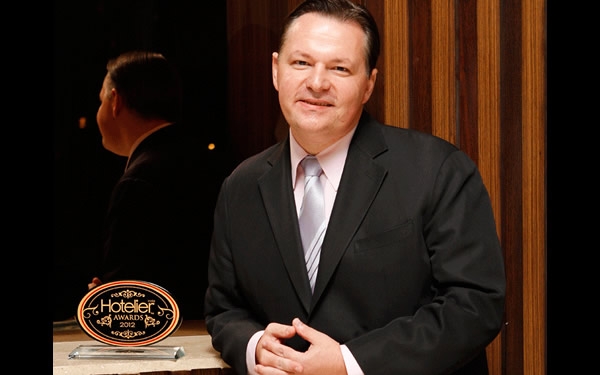
Sheraton Bangalore Hotel GM wins General Manager of the year award by Hotelier India

Martin Wuethrich, GM, Sheraton Bangalore Hotel at Brigade Gateway was awarded as the General Manager of the Year-2012, upscale business hotel category at The Hotelier India Awards in Gurgaon, New Delhi. The Hotelier India Awards is a celebration of excellence; that recognizes individuals who have made a remarkable difference in the field of hospitality.

On receiving the award, Martin Wuethrich, GM, Sheraton Bangalore Hotel at Brigade Gateway said “Winning an award is always a very nice feeling. It is always good to know that your effort has been recognized. Our objective at Sheraton is to delight customers; this award re-iterates that we are working towards our strategic objectives.”

Representatives of 100 + hotels participated in the awards ceremony and the winners were chosen according to their contribution to the Hotels performance above and beyond their call of duty.  The judges reviewed stories of integrity, innovation, customer focus, responsibility, accountability and respect when selecting the winner for each category.

source: http://www.voyagersworld.in / Home / Monday, December 24th, 2012

Unravel secrets about Tipu Sultan in Kere Thonnur


While a lake provides relief from the Mysore heat, temples at  Kere Thonnur  shed new light on Tipu Sultan’s legacy, shares, Arjun Kumar

The inner sanctum of the Narayana temple was cloaked in inky darkness which my eyes could not penetrate. That did not deter the elderly priest from walking swiftly past me, his eyes either better accustomed to the dark or his soul more enlightened to see the Lord where I could not.

A moment after he entered the Lord’s chamber, the darkness was broken by a tiny spot of light. The spot quickly increased in size and intensity in the process dispelling darkness from all but the corners of the inner sanctum. If I sound a shade philosophical, put that down to to the influence of Kere Thonnur. I go into a region mentally preparing myself to find traces of  Tipu Sultan , a man who spent more time at war than at peace, and a man who – as some historians say – was a religious fanatic.

And then I tumble into Kere Thonnur. There is no trace of conflict here, no broken fortifications as there are in nearby Srirangapatnam and no tombs of warriors, old or new.

Instead, I drive past a mix of well-built houses and mud huts, glance quickly at what looks like an old wall on my right and go on to the hill yonder. It is a very short drive up the hill. On the way I pass a group of people happily splashing around under a mini waterfall. I find myself wondering what the source of the cascading water could be.

That question gets answered at the top of the hill for on the other side is a lake, an expanse of clear blue water. The water is clean, something quite remarkable in today’s age. On a weekend, there are a couple of dozen people milling about, enjoying the water and vista.

The cool water invites me to jump in for a swim and as I look around I find half-a-dozen people who accepted similar invitations and taken the plunge.

The water of the lake is deep in parts but there is no one to warn people to be careful. Instead, there is a partially submerged idol of  Nandi  – Shiva’s celestial bull – which looks ready to pray for your soul if you venture too far.

This place is called the Thonnur Lake, also known as the Tirumala Lake. That it is not crowded is because it has not been discovered by the residents of Bangalore and Mysore.

I go back to the village and this time, I drive slowly. And I stop at the place where I saw the old wall, leaving my vehicle to walk up for a closer look. I end up circumambulating the old wall on the track and find a huge gateway looming before me. It stands by itself at a distance from the wall, looking like part of a building block puzzle someone forgot to put in.

On the left is a gap in the wall, which is the doorway to a temple. This is the Krishna Gopal Swamy temple, one of several in Kere Thonnur dedicated to the God  Vishnu  or his incarnations.

Passing through that doorway, I find myself in a large courtyard at the centre of which is the main shrine. On my right is a pillared structure which looks like a shelter for devotees to gather. All around the inside of the old wall – which looms up to about 15 feet in height – runs a pillared corridor with small shrines at the corner. The most interesting feature of this temple is the set of drawings on the walls. These are outline drawings and not full paintings. Gods and goddesses, elephants and birds are all depicted here.

Unfortunately, the flaking of plaster from the walls has severely damaged some drawings while in other places, blurring of the outlines has caused the image to become barely visible.

Across the road from the Gopal Swamy temple is the Narayana temple. Like the former, this temple too has a high wall around it. The most striking feature of this temple is the solid stone pillar in front of it.

About 40 ft in height, the pillar has iconography representing Vishnu on all four sides. Between the pillar and the temple entrance is a small stepped tank, used for cleansing.

Of singular architectural importance in this temple is that the inner sanctum is protected by a wall at the back.

The space between the wall and the shrine thus forms a  parikrama  where devotees can move around the shrine in ceremonial prayer . Within the sanctum, the place comes alive when the priest lights a small lamp. As the flame gradually increases and touches the far corners of the sanctum, I look around in wonder at the idols tucked away into alcoves all around, forming a protective army for the main idol of Vishnu.

source: http://www.timesofindia.indiatimes.com / Home> Life & Style> Travel / by Arjun Kumar, TNN / September 27th, 2012
A 17th century bell that continues to chime

Mysore :

St Bartholomew’s Church , the oldest church in Mysore, is preserving a bit of history that dates back to the 17th century.

Bartholomew’s Church was established in 1830 for Europeans in the region. The single-storey church is known for its history and architectural qualities, but its fascinating association with the past is not quite well known.

A well-kept secret, the place of worship on the ever-busy Bangalore-Nilgiri Road is home to a relic from 17th century. The Church Bell which is still in use was cast in France in mid 17th century for the French Army Base Church  at French Rocks Erode village (now Pandavapur), some 25km from Mysore. After Mysore ruler  Tipu Sultan  was defeated in the war in 1799 and his ally, French Army, left from the area and the capital was moved to Mysore.

About 125 years later, the French Rocks church was broken down when Mysore administrators started building Irwin Canal (now Visvesvaraya canal). The dismantled materials from the church was gifted by the British Army to the then Chaplain Rev G A A Wright of this church. In this way, the majestic bell came to adorn this church, according to a stone plaque at Belfry of St Bartholomew’s church.

Some records claim that the church was reserved for European worshippers for sometime and British VIPs while they were touring the region. It is also said that governor general Lord William Bentinck while on visit to Mysore in 1834 visited this church.

Wilson Dev Prasad, a senior member of Bartholomew’s church, told TOI that before the present Belfry was constructed in front of the church in early 2000, the bell was at the rear end of the church.

According to the commemorative inscription, the foundation stone for the Belfry was laid on October 30th 2002 and was dedicated on December 30th, 2002, by Rev Dr C L Furtado, then Bishop of Church of South India, Karnataka Southern Diocesan. Rev Premkumar Soans was presbyter-in-charge of the church then.

Bartholomew’s Church presbyter-in-charge K P Devkumar says the bell is used every Sunday before the church service commences, during celebrations and marriages. He confirmed that the church bell is over two centuries old.

source: http://www.timesofindia.indiatimes.com / Home> City> Mysore /  by Lawrence Milton & H M Aravind, TNN / December 08th, 2012

His 99th Xmas is coming

So you can understand when he finds the festival ‘stale’. Here he recalls the memorable ones to Khushali P Madhwani

Ashley Homes is an old age home situated on an isolated street in Horamavu. It is here that I met, Allan Arthur Wash, seated in the sunny verandah of the home, with an edition of Bangalore Mirror in hand. He was following the story of the “Chinese making a move on the Japanese” – it must’ve brought back old memories for he spent three years in a Japanese prison as a soldier.

Ramrod straight, an open smile and twinkling eyes match is suave self dressed in clothes as neat and crisp as rice paper. “I was always told to patch up your clothes, polish your shoes and dress your hair,” reminisces this retired army officer. And he’s been following it for the last several decades.
Wash was born in Madras on March 13, 1914. Yes, he has an elephantine memory and can rattle of time, date and year without any difficulty. He lost his father when he was a boy. His mother couldn’t support him and his sister, so he was sent to a “home in Madras called Civil Orphan Asylum” where he could “live and study too. I studied in this school till 1923.” Christmases were mostly spent in the hostel. “On Christmas day we would be served pulao, chicken, sweet, fruit custard and bread pudding.”
At 17, he began working as a telephone operator. “We had to plug the receiver and shout loudly and people would scream loudly to us. I couldn’t do it,” Wash recalls. Two years later, Wash joined the army. Today four medals – Campaign medal, star medal, victory medal and independent medal – keep him company, reminding of the bygone days.
After his stint in Bangalore, he was posted in Malay, Singapore. In 1924, he was captured by the Japanese and remained imprisoned for the next three years. “The Christmas I spent in captivity was a poor Christmas,” says Wash.”I remember eating maize and palm oil.” After three years of incarceration, he returned to India. “I lived in Hyderabad for sometime before moving to Bangalore. “The Bangalore today is not the same as I remember it. As I see it, it is the dirtiest city in the country,” he says. Wash today receives 30,000 as pension, which he passes on to his 62-year-old daughter who cares for him. “At this age what should I buy and what should I spend it on? The Lord has kept me free from wants,” he says.
While in the army, Wash married Pamela in Mysore. He had four girls and four boys. After retiring from the army, Wash worked at Central Food Technological Research Institute (CFTRI) in Mysore. “I didn’t like civil life. Today, the civil officers are highly corrupt,” he says. In 1962, the government gave Wash eight acres of land on which he built a house. His family stayed with him on this farmhouse till 1978. “Some of Pamela’s people, her brothers and sisters joined us in the farm in 1971 for a memorable Christmas. “They made sweets. We had all kinds of meat dishes…” recalls Wash. But, his all-time favourite Christmas meal, he says, will always be the custard and roast chicken prepared by his wife. Oh, yes and he also remembers what she wore on the Christmas of 1968, “She wore a gorgeous red and black checked plaited dress stitched by a good ladies tailor from Goa.” That Christmas, Wash’s eight children and grandchildren joined them in the celebrations. When the kids were little, they would set up a tree at home, decorate it and give their Rugrats gifts. “The girls got dolls and the boys got toy trains,” he says.
In 1975, Wash spent Christmas in Mysore with an Anglo Indian German gentleman and his brother, who threw a grand party for all friends. The hosts were dear friends of Jayachamaraja Wadiyar, who looked after them. “Srikantadatta Wadiyar was a little boy then. I got some novels and something to take home… I think it was a vase,” says Wash. In 1986, Wash and Pamela entered Little Sisters of the Poor in Mysore. After nine days his wife passed away. Like last year, even this year, Wash intends on going to his daughter’s house for Christmas to be with his children and grand children.
“Christmas has become stale because it is the same thing over and over again. It is the same meal, same recipe only the environment and company changes,” says Wash. Celebrating 99 Christmases will get to me too, I guess /
source: http://www.BangaloreMirror.com / Home> Sunday Read> Special> Story / by Khushali P Madhwani / December 23rd, 2012

Kannadigas from America treat theatre buffs

‘Ranga Dhwani’ from LA is staging two plays in city

When the stage at Dhvanyaloka here on Saturday was opened for theatre connoisseurs, it was not just an usual weekend feature, but unveiling of talent of non-resident Indian (NRI) Kannadigas.

Ranga Dhwani, a theatre troupe from Los Angeles, USA, led by Vallish Shastri, is staging plays in the city of palaces. What could endear them to the theatre buffs is, it’s also their maiden performance here.

English novels

‘Tirugetu’, a Kannada adaptation of James Hadley Chase’s ‘There is always a price tag’ and ‘Yamana Call Centre’ are being staged. ‘Tirugetu’ was staged at Dhvanyaloka on Saturday at 7 pm. On Sunday, they will be staging ‘Yamana Call Centre’  at JSS Women’s College, Saraswatipuram at 11 am and  Dhvanyaloka on Bogadi road at 7 pm.
Professionals

Vallish, who was supervising the arrangements for the show, told Deccan  Herald, his six-member troupe was eager to showcase their skills on stage. The artistes here are professionals from different backgrounds, but wedded to the field of art.
Vallish, a native of Hassan, is a software engineer who has his own IT firm ‘V3 Consultants’ in LA.

He had his nursery in acting at Benaka Troupe in Bangalore and for eight years there was no stopping him. In the year 1989, he flew to West Asia and stayed in Saudi Arabia for eight years.

He was also away from his tryst with stage. However, he renewed his ties with stage when he moved to New Jersey. After three years, he shifted to LA, where for the past 12 years he has remained fully active on the stage.

Schedule

Says Vallish; one play in a year has been their schedule and till now have staged 10 plays, including a children’s drama ‘Govina Kathe’ based on ‘Punyakoti’. ‘Jo Kumaraswamy’, ‘Paschaththapa’, ‘Yamana Call Centre’, ‘Hollywoodnalli Yama’, ‘Tirugetu’, ‘Krishna Sandhana’ are among others. ‘Yamana Call Centre’ is a take on the IT-BT life and is loaded with comedy.

“Mysore was on our mind for long, but time was the only hindrance”, explains Vallish. It was due to Srinath Vashishta, an actor on small screen who has his own Kala Vedike Trust, and Mandya Ramesh of Natana, Ranga Dhwani is in the city.

The other members of the troupe; Kannadigas settled in LA are physician Dr Kavita
Kotrappa, Somashekar, chief manager with a finance company dealing with stocks, and Girish Kannalli a software engineer, all hailing from Bangalore, Jagannath, a civil engineer from Hassan, and Vidya, wife of Vallish, having her roots in Shimoga.

source: http://www.DeccanHerald.com / Home> District / Mysore, DHNS / December 22nd, 2012