Category Archives: Arts, Culture & Entertainment

Reminiscences of the intellectual adda

Dharwad:

Manohara Granthamala, a prestigious publishing house in Dharwad, which made a modest beginning in 1933, has now come to occupy a unique position in the literary history of Karnataka and has today become a household name for publishing works of literary excellence in Kannada.

The Granthamala has to its credit more than 450 books. The saga behind the establishment of the publishing house is interesting.

About eighty years ago, winds of nationalism set a new blossoming in some Kannada spirits. Chief among them was poet DR Bendre. He drew some likeminded persons to form “The Friends’ Circle” (Geleyara Gumpu), which provided the base for Kannada activity in an otherwise Marathi infected region.

Even today its associates rank among the foremost Kannada writers. ‘Swadharma’ and ‘Jaya Karnataka’ periodicals were its chief organs. The ‘Nadahabba,’ national festival – owes its revival to “Geleyara Gumpu”. Though as an institution it could not hold together, the idealism it enkindled proved enduring and Manohara Granthamala is the offshoot of the same idealism.

When Jaya Karnataka periodical and the press were in crisis, young members like Prahlad Naregal, Govind Chulaki and Krishnasharma Betgeri tried to revive the publication under SB Joshi’s guidance. Krishnasharma Betgeri (Ananda Kanda)’s first novel ‘Sudarshana’ was their publication brought out on 15th August 1933. The new publication series was named Manohara Granthamala by Krishnasharma Betgeri. GB Joshi, another member of the ‘Geleyara Gumpu’ was their associate and worker. While the paper and other materials were lent to the Granthamala by sympathisers like K R Rayadurg, the books were written free of royalty by  friends  trained in Geleyara Gumpu.

Armed with the band  of literary advisors like DR Bendre, VK  Gokak and RS Mugali, GB Joshi ensured that the trio’s taste and critical vigilance elevated Granthamala to its present status. Keertinath Kurtkoti joined the Granthamala as the adviser just before its silver jubilee volumes.

Granthamala has made several intellectuals take up writing and many of those first published by it have risen to great heights in literary world. Noted among them are Shivaram Karant, DR Bendre, AN Krishna Rao, VK Gokak, RS Mugali, Girish Karnad, UR Ananth Murthy, Na Kasturi and Rao Bahaddur.

New generation of writers are now being introduced by Granthamala and the tradition of organizing informal meetings of writers and literature lovers over the famous “Mirchi, Churmari and Tea’ continues even now. Several writers and literature lovers deem it a privilege to visit the “Atta” (top floor) of MGM.

“Our publication ‘Nadedu Banda Dari’ (Path Traversed), published to mark the Silver Jubilee has been acclaimed as a landmark in Kannada literature,” said Granthamala editor Ramakant Joshi.

Four books released

DHARWAD: Manohar Granthamala, a prestigious publishing house celebrated its 80th birth anniversary by releasing four books on Sunday.

Writer Narahalli Balasubrahmanya released A K Ramanujam’s ‘Ayda Prabandhagalu’, K Satyanarayana’s collection of stories ‘Heggurutu’, Prasanna’s skits ‘Acharya Prahasana Mattu En Huchoori’ and Girish Karnad’s play ‘ Benda Kaalu on toast’ at a function organized at Suvarna cultural complex.

Speaking on the occasion, Narahalli analyzed the books and said all the four books were precious additions to the Kannada literary world.

Hailing A K Ramanujam vision of Indian culture, he said AKR’s works depicted his mastery over both Kannada and English. Narahalli was all praise for K Satyanarayana for his new ways of thinking and depicting the contemporary scenario in his stories.

Author K Satyanarayana said writing stories was a pleasure at a time when the habit of telling and listening stories was waning. Playwright Girish Karnad  said his play was an effort to catch the fast changing Bangalore city and depict its contemporary life.

Critic Giraddi Govindraj presided. Pavanaja spoke on e-library. MGM editor Ramakant Joshi welcomed. H V Kakhandki proposed a vote of thanks.

source: http://www.timesofindia.indiatimes.com  / Home> City> Hubli / by Gururaj  Jamkhandi, TNN / November 26th, 2012
Giving wings to language dreams

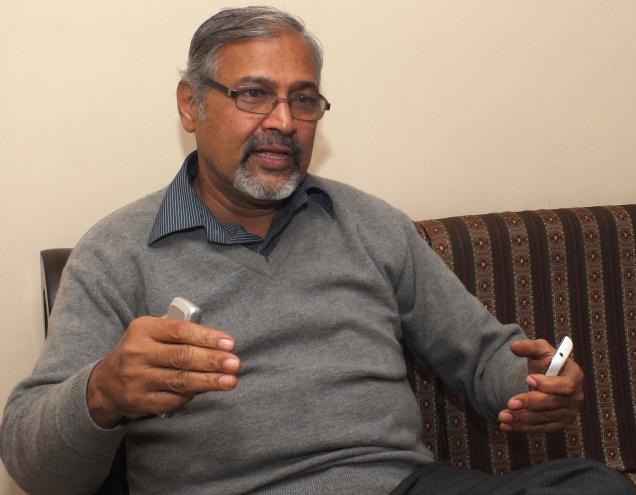
Karnataka Beary Sahitya Academy chairman Rahim  Uchil, writer and film maker, is working towards giving wings to his dreams on making Beary language popular. Rahim, who produced Beary movie ‘Mami Marmol’ and acted in many Beary movies, including ‘Sahana’, ‘Nangala Kutumba’ and ‘Beary’, wants to introduce Beary as an optional language in schools. Another major project,  the academy  has taken up under his guidance is to publish a comprehensive dictionary of Beary – Kannada – Malayalam – English.

Rahim, who assumed charge of the academy on February 6, was assaulted by miscreants at his office at Attavar on March 15. However, the incident did not deter him from going ahead with his dream projects that aims at popularizing the language and literature. Excerpts:

What is the major task before the academy?

Getting land for the construction of a cultural centre for Beary language is the task. We were pursuing the issue and have met district in-charge and  higher education  minister CT Ravi on the issue. A site has been identified at Padil in the city. However, it requires approval from the Mangalore City Corporation council and standing committee there. We will strive to realize the dream of having a cultural centre for Beary language.

Is there any proposal to conduct research on history of Beary language, literature, culture and heritage?

We have urged the government to establish Beary Study Chair at Mangalore University. Research can be carried out on history of Beary language through the Chair. We will also meet university vice-chancellor Prof TC Shivashankara Murthy to discuss about the proposal in detail.

Will academy take initiatives to introduce Beary language in schools?

The academy has plans of introducing Beary language as an optional language. We are in the process of framing a curriculum in Kannada script.

What is the major project on anvil?
The academy will soon publish a Beary – Kannada – Malayalam – English dictionary. We have set up a committee to chalk out plans to prepare the dictionary. The work will commence once the proposal is approved by the government. A meeting of language experts will be convened to discuss about the preparation of the dictionary. We are expecting to complete the work by March next year.

What is your take on the attack on you?

I had undergone a lot of physical and mental pain because of that attack, but the incident did not deter me from returning to office. I do not harbour any grouse nor seek revenge on those who have attacked. It is up to the law of the land and God to decide.

source: http://www.timesofindia.indiatimes.com / Home> City> Mangalore / by Vinobha KT / November 25th, 2012

An enthusiasm for learning new things

Always occupied:  Suryakanth Kanade surprises his family with a new hobby every now and then. /  Photo: Harini Shibaraya / The Hindu

From carpentry to photography, Suryakanth Kanade pursues an array of hobbies to keep himself engaged. A retired BEL employee and a long-time resident of Vidyaranyapura, Suryakanth has been surprising his family with a new hobby every now and then. Today, he might be engrossed in making the door of his cupboard, while tomorrow, he might be engaged in capturing the scenic beauty of Ooty with his camera. Sitting idle is one thing he can’t do.

In his childhood, Suryakanth took a keen interest in carpentry and one of the first things he made was a pen stand. Later, while studying engineering, carpentry was a part of his curriculum. After a hiatus he returned to the hobby, making doors and sections of cupboards at home. “I always had an inclination towards carpentry, and as a child I used to observe and practice. I felt instead of spending money on labour, I could make a few things and use the money saved to buy tools,” he says.

Taken with sewing

Then, he traded in his carpenter’s tools for a needle and thread; he even sewed shirts for his two sons and his father, but after four years, he couldn’t find the time for it. “I consulted books and practiced sewing at home. At BEL we got uniform material, so I used to stitch for myself, but it was very time consuming so I had stopped.” he said. Seeing her husband sewing, Usha Suryakanth couldn’t resist joining in. “I got curious and slowly my interest in sewing developed. Now, I stitch salwaars, saree falls, and a few other things,” she says.

One hobby that has been a constant over the years for Suryakanth is photography. From black and white to colour, his love for the camera has only increased since he began pursuing it. “I used to prepare the required chemicals and develop the pictures at home. I took photos of the 1980 solar eclipse from Hubli, and after retirement, I travel a lot to take pictures of different places such as Kanyakumari and Ooty. I am going to take up wildlife photography in the coming days,” he says. His list of hobbies, like his enthusiasm for learning new things, seems endless. Soon, he plans to make photography his profession.

At present, digital painting has caught Suryakanth’s fancy; he feels it is better than painting on canvas. “Paper and canvas take up a lot of space, and paints have become costlier. Digital painting makes things easier,” says this constant learner.

source: http://www.TheHindu.com / Home> News> Cities> Bangalore / by Aisiri Amin / November 21st, 2012

A language lab for Konkani takes shape at World Konkani Centre

Mangalore:

The digital language lab software that is fuelling English communication skills in educational institutions in the coastal city has aided a move by the World Konkani Centre (WKC) in Shaktinagar here to start a Konkani language laboratory.
WKC under the aegis of Konkani Language and Cultural Foundation has taken up the project under ‘Vision TVM’ propounded by TV Mohandas Pai, chairman, Manipal Global Education.
The Orell Digital Language Lab (ODLL), a professionally engineered, comprehensive, and end-user friendly language learning software tool has been developed by Kochi-based Orell Technosystems (India) Pvt Ltd.
The laboratory with 30 computers using this software saw a trial demonstration on Tuesday for a test of its efficacy with invitees from a cross section of Konkani speaking communities in attendance at WKC.
Gurudath Bantwalkar, assistant director, World Institute of Konkani Language who has taken keen interest in setting up the laboratory told TOI that the software has been dubbed as a super efficient double-edged solution both for the tutor and scholar. “We will now have to leverage the strengths that the software provides and customise it to come up with Konkani language learning modules,” he said admitting that the task in a challenging one.
The centre has planned a workshop featuring Konkani language experts who can help the task of creating corpora of text and speech for the language within next two to three weeks. The challenge also lies in creating corpora for various scripts of Konkani as well as its dialects.
“We intend to make a start by creating corpora for Gowd Saraswath Brahmin and Catholic Christian Konkani dialect and Devanagari and Kannada script as well,” he said.
Aneesh K Murali, area manager, Orell said ODLL serves as platform mainly for teaching English language skills. Text and video files that are professionally recorded can be incorporated to build up teaching modules for any language and the software allows users to customise it to meet their requirements. With plans to dedicate the laboratory for community use shortly, the Centre will hold training sessions for trainers who will teach the trainees in future.

source: http://www.articles.timesofindia.indiatimes.com / Home> Cityu> Mangalore / TNN / November 21st, 2012

He was all of music

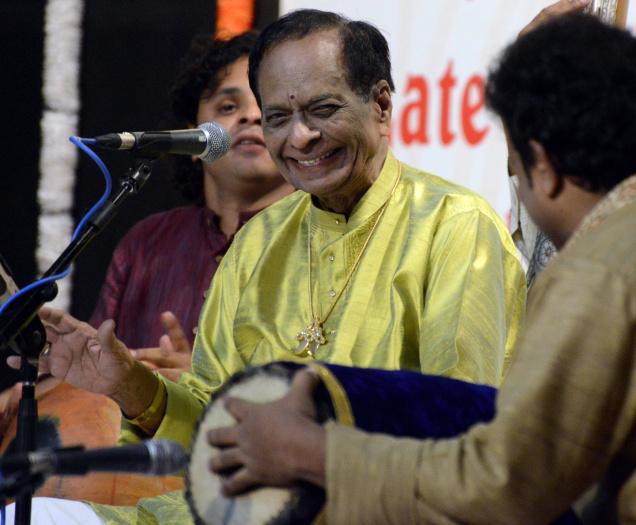
Balamuralikrishna was cheerful, lively, yet mellow. / Photo: V. Sreenivasa Murthy / The Hindu

The endearing Carnatic vocalist Balamuralikrishna continues to have a huge fan following. Listening to the maverick musician at 83, Deepa Ganesh feels that his pursuit of music now is as obsessive as it was during his heyday

Why was I thinking of the late Pandit Bhimsen Joshi as I sat there listening to the Carnatic maestro M. Balamuralikrishna? In many ways, the non-conformist Balamuralikrishna, is similar to Bhimsen Joshi. For him, like the legendary Joshi, the outcome is less important than the journey itself. At 83, Balamurali was bringing everything into his music that he brought in his heyday – he dared the three octaves, sometimes more; he challenged the violinist and the percussionists with his calculations, and brought the most unanticipated moments for listeners and accompanists. The last jugalbandi concert of Balamuralikrishna and Bhimsen Joshi was in Bangalore. Bhimsen Joshi was ill and on a wheelchair. Balamurali stole the initial moments and one actually felt that it was going to be his concert, before the indomitable Bhimsen Joshi let out his characteristic roar and simply took over. That evening, these two maverick musicians, had greatly enjoyed each other’s passion.

At the recent concert organised by Sri Rama Lalitha Kala Mandira, the audience who were drawn from various other cities also, relished the remarkable spirit of this musician with a huge following. Balamuralikrishna was cheerful, lively, yet there was something mellow about his musical demeanour. He was not singing off his hat, merely from the habit of his golden years – he was in a reflective mode. He was constantly discussing with his disciple Veera Raghavan, there were long pauses, silences and it would perhaps be simplistic to attribute all this to his age.

Balamuralikrishna’s journey has been characterised by his free spirit, his defiance towards the power centres of music, alongside his penchant for experimentation that flows from his vast creative abilities. His student Prince Rama Verma, in his essay on his guru Balamuralikrishna, speaks of how he had been kept away from performing at the prestigious Navarathri Mantapam, but in no way had this upset him. One may have disagreements with Balamuralikrishna’s music, but even his bitter critics may have to agree that his music stems from an obsessive pursuit.

The concert opened with a lively Kannada composition in Mohana raga “Paalisemma Muddu Sharade”. Shorn of all embellishments, the piece was simple, and resonated with chaste notes in Balamurali’s voice that showed no signs of ageing. It soared to the upper octave and sunk with ease to the mandra, which is his signature threshold.

For many years now, Balamurali, a vaggeyakara himself, sings mostly his own compositions. With over 400 compositions to his credit, Balamurali is also a creator of many ragas. Even in this concert, he mostly sang his own, but all in well established ragas. Balamurali brought back the mood of the Eighties with his two most popular compositions, “Ee pariya Sobagu” and “Satyavantarigidu Kaalavalla.” His alapane for the raga Hamsanandi was slow, and contemplative – it had the graces of Hindustani style. As Balamurali took the raga through its various contours, one could imagine why the puritans of the Madras music durbar were left shocked by this unusual musician’s unconventional approach. When he ventured into swaraprastara at “Gaganadali…”, there were a bundle of surprises awaiting the accompanists while Balamurali tried various mathematical possibilities.

“Amba Mamava” in Ranjani was a sparkling reminder of the Ranjani ragamalika, “Ranjani Mrudu Pankaja Lochani”. In his Hindola rendition, Balamurali was constantly trying to craft new idioms and work new expressions. The tani for Hindola was a show stealer. Arjun Kumar on the mridanga and Giridhar Udupa on the ghata elevated the concert with their brilliant performance. Balamurali who was enjoying every bit of it (particularly his exchanges with Mysore Manjunath on violin), made encouraging remarks throughout. “If I don’t sing ‘Satyavantarigidu Kalavalla’ then I will be disappointing many,” the affable musician remarked, referring to the hundreds of requests that he had received. The charming tillana in Kuntalavarali was happy and pleasing.

Balamurali is clearly a man of few words. But the smile on his face rarely fades. The endearing musician refuses to sing Mangalam these days. Ask him why, and he says, “I have stopped singing Mangalam because I want to sing a lot more. I want to do more research and propagate Indian music,” says Balamurali, who believes that Indian music is the basis for all music.

Heap praise on him, and Balamurali will make it seem it has nothing to do with his self. “I don’t sing, music sings. If my music is successful, it’s because of listeners,” says the very same Balamurali, who believes that tradition gets renewed with individual talent. Like Nietzche said, ‘One is fruitful only at the cost of being rich in contradictions.’

source: http:///www.TheHindu.com / Home> Arts> Music / by Deepa Ganesh / Bangalore, November 20th, 2012


Vaidya Sahitya Award to Mysore Doctor

Gulbarga, Nov. 16

The book ‘Madhumeha: Dashavyadhigala Mula’ written by well-known Diabetician of Mysore Dr. V. Lakshminarayana and published by Kuvempu Bhasha Bharathi Authority has been selected for the Dr. P.S. Shankara Shreshta Vaidya Sahitya award for the year 2012.

The award carries a cash prize of Rs. 5,000, certificate and a plaque. The award will be presented to Dr. Lakshminarayana at the Dr. P.S. Shankara Pratisthan’s 13th anniversary function to be held at Gulbarga on Jan. 1, 2013.

Dr. Lakshminarayana has the credit of having served Rashtrakavi Kuvempu as his personal doctor for a decade. In his book, Dr. Lakshminarayana has explained in simple language his research experience and about the practical treatment.

source: http://www.StarofMysore.com / General News / November 16th, 2012

No way to maintain our heritage at Halebidu

These are the days where countries with honest and intelligent rulers are quick to capitalise on their God-given and history created tourist destinations. Even small countries like Seychelles, Maldives, Mauritius and Bhutan, so also many in other parts of the world have more per capita income, GDP and foreign exchange reserve considering their small size compared to many bigger countries like India. It is indeed sad that India, with so many wondrous historical ruins, monuments and scenic nature with the very Himalayas standing tall, is very poor in exploiting the ever increasing tourist business.

To come to the point, I am impelled to write on the subject after listening to the laments of an artist, a well known painter, who had just returned from a visit to Belur and Halebidu, a four hours journey from Mysore.

Belur was the capital of the Hoysala empire near Hassan in Karnataka. The Belur Chennakeshava temple complex embellished with sculptures and carvings of female dancers and scenes from epics and puranas was built by Shantaladevi, herself a danseuse par excellence and queen of the king Vishnuvardhana. The work on the temple was started in 1117 BC and completed later on by Vishnuvardhana’s grandson Veeraballala II, taking some 103 years. The renowned sculptor of the period Jakanachari was credited with the carving of most of the sculptures. There are the sculptures of many celestial beauties from puranas, epics and mythology. According to my friend, the upkeep of the temple complex has always been poor and presently it has worsened.

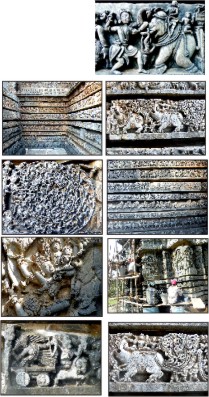
However, the bad news is from Halebidu, which is 16 kms from Belur. Its earlier name was Dwarasamudra and was the capital of the Hoysala empire and the temple complex has Hoysaleshwara as the main deity. The temple dates back to 1121 BC and is astounding for its wealth of sculptural details. The walls of the temple are covered with an endless variety of depiction from Hindu mythology which includes animals, birds, shilabalikas and dancing figures similar to those found in Belur Chennakeshava temple. It appears this temple took 86 years to complete. This temple is now being proposed as UNESCO World Heritage Site.

Unfortunately, such an important historical and cultural centre of great tourist interest is not looked after with care and concern by the Archeological Survey of India which is entrusted with this task. At the Halebidu temple, my friend saw 20 agricultural labourers perched on scaffoldings, busy cleaning up the sculptures of figurines carved on soap stone [see picture]. They were hired by the authorities on the basis of daily wages.

My friend was aghast looking at the way the scaffolding of wooden poles was constructed. The scaffoldings were held in place by tying them up in ropes around the carved figures of animals and mythological characters [see picture No. 4 above] which would definitely damage the sculptures and it was possible some of the carved images would either get chipped or broken. Such irresponsibility even in such a simple matter of providing scaffolding. These days, scaffoldings made of iron pipes or slotted angles are easily available. These iron scaffoldings stand on their own without being tied to the building, as they have done in the present case.

As regards the cleaning of those images, the authorities do not seem to have applied their mind regarding the liquid and the brush used for the purpose. The so called chemical cleaning seems to be just an excuse to justify billing, says my friend. He found ammonium soap oil was being used and he says the soap stone used in the sculpture will tend to melt gradually. Worse was, they were using a toothbrush for the purpose, which was bound to damage the delicate carvings on the wall.

He also noticed the guides touching the images on the wall while describing them to the tourists. Apparently, they were not qualified and trained guides. In the Sun Temple at Konark in Odisha, much care is taken in this regard to avoid the guides and tourists from touching the statues and figurines, forcing them to keep distance. Rope barricades are used.

According to my friend, the three important temples in this region, namely those at Belur, Halebidu and Somanathapura (which is near Mysore) are built using soap stone and therefore, they need to be well protected from vandalism cau-sed in the manner mentioned above by the tourists and the Department of Archaeology.

In these days of privatisation of many public sector units and public works, the government may well consider outsourcing experts to protect and maintain our ancient heritage structures and ruins to save them for posterity. Otherwise, if they are maintained the way they are maintained today, before long, these temples would become just archaeological sites of ruins and find their place only in our history books and coffee table books. The Government of Karnataka must wake up to the dangers these great heritage temples and other structures are facing and take steps to protect them and not allow civil contractors to destroy them in the name of cleaning, maintenance and restoration.

Tailpiece: My friend had travelled all the way to Halebidu temple to take pictures of the mighty behemoth of an elephant belonging to the lineage of the vehicle of Lord Vishnu, the famed Airavata, being ridden by a king Bhagadatta mentioned in Mahabharata and who fought on the side of Kauravas.

e-mail: kbg@starofmysore.com

source: http://www.StarofMysore.com / Home> Feature Articles / by K.B. Ganapathy / November 12th, 2012

The return of roaring Jawa Yezdis

Bangalore:

There could be nothing more exciting than the roar of a motorcycle running full throttle. And if the bike happens to be yesteryear’s Yezdi Jawa variety, it is not only about nostalgia but also a power-packed performance.

Ask Toby Phillippe, an American expat, who restored a rusty 1970 model Jawa bike he took a great liking to three years ago. He has since been riding his favourite motorcycle every day.

Toby is one of the hundreds in the city, who belong to the Jawa Yezdi Motorcycle Club, and rode towards Tumkur on Sunday morning to celebrate the 10th International Jawa Yezdi Day.

Members of this club are passionate bike enthusiasts and owners of the rare Jawa bikes, that lead a pack of rare bikes, whose production was discontinued in India in 1996. “The Jawa Day is celebrated on the second Sunday of July every year. This year we are riding out of the city to have a get-together in Shiva’s Farm near Shivagange,” said John Samuel, a co-founder of Bangalore Jawa Yezdi Motorcylce Club. Samuel owns two Jawa bikes – a 1975 model B and and 1980 classic.

Over 80 rare bikes were present at the event, which started from St Mark’s Road, outside Bowring Institute. “The best part of the bike is its roar. It makes me feel very good to be on the bike,” said Toby.

Shanta Kumar, who works for ITC, has been riding Jawa bikes for more than 20 years now. He said, “Jawa bikes have a better road grip and pollution control than most other bikes. The best thing about the bike is that your back doesn’t ache even if you ride the entire day.”

For Mysoreans, Jawa is more than a bike

About 150 vintage Jawa Yezdi models like the 1945 Czech Jawa model, Jawa Bison, Yezdi 350, Tankswitch Jawa, Roadkings, Oilking, Yezdi ‘B’ type, Pionyr’s, Jet Jawa and Yezdi Colt hit the roads in Mysore to mark the International Jawa Yezdi Day on Sunday.

Jawa Yezdi bikes were made in India at Yadavagiri in Mysore. Today, apartments are coming up on the land where the plant was once situated.

Jawa was coined using the first words of Czech founder Janeek, Frantisek and Wanderer, the German bike he started producing at his plant in Prague. But for Mysoreans, Jawa is also the acronym for its ruler Jayachamarajendra Wadiyar.

Raian Irani, founder Faroukh Irani’s son, said, “Wadiyar was keen on setting up the bike unit in Mysore. Pune was a contender. As governor of the then Mysore state, Wadiyar inaugurated Ideal Jawa (India) Limited in 1961 with the slogan: The forever bike, forever value.

The company closed down in 1990s in face of challenge from the new generation of 100 cc Japanese bikes.

source: http://www.articles.timesofindia.indiatimes.com / Home> City> Bangalore> Mysore / TNN / July 09th, 2012

Canada PM concludes India visit with hockey game in Bangalore

Canadian Prime Minister Stephen Harper wound up his six-day trip to India with a visit to a leading local school, where he played a game of hockey enthralling students on friday. Accompanied by wife Laureen Harper, he visited the Bishop Cotton Boys School where he was received by school captains. Students of Bishop Cotton Girls School were also in attendance to welcome the visiting dignitaries.

The Boys school principal, Prof John P Zachraiah, briefed him about the school, its pupils and their achievements.

At the playground, Harper had a feel of the cricket bat, but chose not to face a single delivery though Prithvi of Class XI was practicing vigorously to bowl.

Harper then joined Cotton Girls Camp led by Nandini S Patil of Class X to play a 10-minute hockey match, while Canadian sports minister Baljit Singh Gosal joined forces with boys’ team led by Yash Gopalka, studying in Class XII.

Boys’ team beat the rival camp which included Harper 2-0.

The Harpers then drove straight to Bengaluru International Airport at Devanahalli and boarded the Manila-bound Royal Canadian Air Force special aircraft.

source: http://www.HindustanTimes.com / Home> Punjab> Canada / by PTI / Bangalore, November 10th, 2012

Mysore Maharaja’s carriage to be auctioned at UK

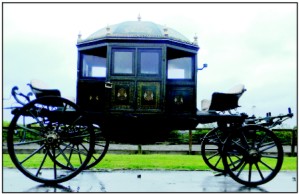
A magnificent 19th century State carriage which belonged to the Mysore Maharajas, is set to be auctioned in the United Kingdom by historics auctioneers.

Used exclusively by the royal family of Mysore and to transport European royalty including the Prince of Wales, the carriage is expected to sell for £70,000 to £100,000. This horse or elephant-drawn State carriage is thought to be of British origin and dates from arou-nd early to mid-19th century.

It features an imposing and ornately finished cruciform body with a vaulted, domed roof situated atop double elliptic springs and iron bound artillery patterned wheels. The basic colour is olive green embellished with delicate meander boarders, floral and heraldic motifs and the family coat of arms. Most of the 16 windows offer drop-down, decorated panels and shutters for privacy.

The interior is upholstered in beige damask and the roof has decorative paintwork, carved border moldings and finials.

The exterior houses two seats perhaps used by servants and courtiers and given the detailing and design throughout, could easily be described as a work of art, as can be seen in a wall painting of it at the Mysore Palace Museum. It is thought to have been last used at the Cha-mundeshwari Festival in 1927.

The Wadiyar dynasty, established by Vijaya, ruled the Kingdom of Mysore from 1399. Vijaya took on the name and ruled Mysore, then a small town, from 1399 CE to 1423 CE. From 1760 to 1799, the rule of the dynasty was essentially nominal, with real power in the hands of successive Dalwai, or Commanders-in-Chief, Hyder Ali and his son Tipu Sultan, who expanded the kingdom aggressively, but clashed with the East India Company.

After Tipu Sultan was killed when the British stormed Seringapatnam in 1799, the Wadiyars were restored to power by the British.

It was offered at auction by an Australian firm, Leonard Joel, on Feb. 22. It is believed to have been offered by a private British collection. It was later exhibited at Sotheby’s Olympia on 1991, and was acquired by historians.

The carriage will be auctioned on Nov. 24, 2012 at the Brooklands Museum in the United Kingdom.

[For more details, contact Dr. Rahul Sharma on email: drrahulsharmaji@yahoo.com.]

source: http://www.StarofMysore.com / Home> Feature Articles / November 07th, 2012