Category Archives: Arts, Culture & Entertainment

A bit of Mysore, abroad

Rooted

Situated in Northwest Switzerland on the River Rhine, scenic Basel is a border town hugging France and Germany. As a confluence of these assimilated cultures by virtue of its location, Basel is a major cultural centre of Europe. Its world famous theatres, museums and art galleries showcase a rich variety of arts and artistes annually, creating a unique meeting ground in itself.

Amid this ambience, Indian classical dance, more particularly the Mysore style of Bharatanatya, has bloomed into a well-recognised form in this distant land today. Kalasri, the school of Bharatanatya and yoga, the first such institution to be established in Switzerland, has brought these ancient Indian forms to that country and popularised them, carving out an identity for the Mysore style on the world dance stage. In Basel’s art calendar too, Kalasri is a visible presence, representing the fluid and graceful Mysore style.

But this carving out a niche for the Mysore style was not by design. For Dasappa Keshava and his Swiss wife, Esther Jenny, Kalasri was a natural fallout of their love for dance and all things Indian. They did not even vehemently announce the pursuit of the Mysore style, their own gentility echoing in the style itself. So all-absorbing has Bharatanatya been to them that their two daughters — Nandini and Sumitra — have taken to it as a full-time profession despite being academically qualified for other vocations.

Seeing is believing

Keshava and Sumitra performed at the Alliance Francaise in Bangalore recently, and this single exposure to their dance spoke of their sincerity and grooming. What constitutes the Mysore style can itself be a debatable issue. But it is no doubt a gentle and graceful style, with the abhinaya complementing it in natural fashion. In Keshava’s words, “It can be called sahaja abhinaya. The pantomime in the sanchari bhavas are shown more clearly. The adavus are done with more flexibility, and appear different, although they are similar to the other banis.”

While these aspects of the Mysore style were visible in the father-daughter duo recital in Bangalore, Keshava’s emphasis on mind and body training is what made him adopt a holistic approach to dance, and the setting up of yoga classes. He is an avid hatha yoga practitioner and trainer. “Dance is an art and not a sport. You have to train the body till it becomes aligned with the mind.”

Why Keshava took to dance makes for a fascinating listen, and a journey into the cultural ethos of the Mysore region. The Mysore style is a part of the ‘Rajanartaki’ form. Keshava is one of the very few dancers trained by Venkatalakshamma, who was the last among the dancers of royal patronage. She was singularly responsible for getting a high visibility to the Mysore style.

Living close to the Mysore palace, Keshava was lucky to watch innumerable recitals of Venkatalakshamma around the palace temples. The fascination for dance took root, although the prejudices attached to boys taking to dance kept him away from learning it.

He found outlet in theatre instead, during his school and college days. But the palace and its rich performing arts activities continued to stir something deep within him, and he could no longer resist walking into Venkatalakshamma’s dance classes.

Far removed from this pursuit was his qualifying as a mechanical draftsman, which he put to use creatively, and not as a career option, by sculpting in wood. The artist in him found yet another outlet, and “I would spend hours working on my carvings.”

His entire learning experience continues as an ongoing journey of the spiritual. His dance has also taken an academic turn with the publishing of his book, Bharatiya Nritya Sampradayagalu, by the University of Mysore, a city which is so close to his heart that he and his family spend at least a few weeks there annually. Perhaps his upbringing in Mysore, with all the paraphernalia of royalty and pageantry in terms of  the famed Dasara festival and public celebrations of festivals all round the year, has much to do with his treating dance as both a heritage and a form of self expression that eventually leads one on to the path of spiritual growth. This humility and faith was more than evident in his recital.

He has brought out two music CDs — Classical South Indian Music and Daiva Stuti — which have propelled him to go deeper into Carnatic music and devotional songs in Kannada.

A remark often heard among dancers is that classical dance has lost its relevance today. Hence the need to venture into new ideas and concepts. Keshava has something else to say. “The art of dance is like a mirror to society. It is educative. Through entertainment, it conveys a great philosophy of life. The good and bad are portrayed on stage, which the audience can easily identify, and learn from it. As for me,  I cleanse my body, mind and soul through practicing dance.” True to this belief, the repertoire of his dance school represents a mini-India, as it incorporates other classical dance forms and folk dances too.

He says he presents Bollywood style dances too as they are popular, but that does not take away from his traditional moorings as those dances are treated as just filmy outings.

source: http://www.DeccanHerald.com / Home> Supplements> Sunday Herald / Home> Arts & Culture / by Jyothi Raghuram / October 06th, 2012
Merc club rolls out in city

Some 60 Benz owners and authorised mechanics have come together to share expertise on the art of Mercedes maintenance 

K Subramani, 65, would always wonder why Benz classic car owners hadn’t got together, like the Yezdi or the Enfield group, despite there being a sizeable population of Merc owners in Bangalore. He need not wonder any more.

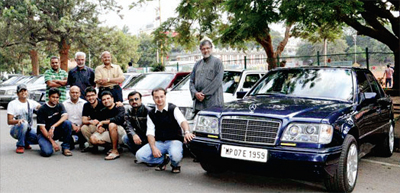
The Mercedes Benz India Group was formed a fortnight back with an initial membership of 60 in Bangalore and 200-odd members all over the country, to bring together passionate auto enthusiasts who want to preserve the classic cars. And Subramani, who has been driving his special edition w140 S500 Merc for 14 years, is one of the seniormost members.

The group, which has also roped in authorised Merc mechanics, has already met once. “We believe in encouraging, sharing, supporting, and enabling newbies and mature auto enthusiasts through the maze of the Indian classic and vintage scene. We have members across all age groups who will meet once a month with their classics. The group’s motto is to empower and equip the average enthusiast to enjoy motoring,” says Pramod Monnappa, committee member.
Apart from planning rallies, the once-a-month meet is aimed at sharing ideas and expertise, tackling problems, high governance standard and all activity related to preservation.
According to Nandish Palrecha, owner of a 1994 S320 w140, who is into retailing and distributing mobile phones, those whose cars are as old as 20 years come under the niche group. There are around 20 varieties ofclassics which are 15-20 years old.
“A Merc is generally the first point of success and is still the most sought-after vehicle. Our group has a healthy mix of people and seniors come with a lot of experience,’’ says Palrecha.
For Subramani, MD of United Exports which exports silk furnishings, his 14-year-old bullet-proof limousine is his second car. “I got to know about the group through Nandish,” he said. “At the first meet, we exchanged views about the problems, and how they can be solved without going to the garage. In fact, the Merc is a simple car and a lot of the problems can be fixed with the help of the internet,’’ he said.
In all these years, not once has Subramani thought of changing his 12-cylinder, petrol-driven car. “My bullet-proof limousine is exceptionally good and I will change it only if S600 is released in India,’’ he signs off.
To know more, contact: nandishpal@gmail or nikhil0673@gmail.

source: http://www.BangaloreMirror.com / Home> News> City> Story / by S. Kushala (kushala.satyanarayana@timesgroup.com / Monday, October 08th, 2012

Art review

It rained ideas

The ample series of performances by mostly young local artists at Gallery Rasa on September 27 was another contribution from the well-guided enthusiasm and organisational skills of Smitha Cariappa, who has by now virtually institutionalised her efforts under the title of Live Art Lab being a part of BAR1 activities.

One has to congratulate her not just for practising performance since a time when it had only a slight presence in the country and none in the city, but also for encouraging and involving others, especially art students and young artists. At the moment as things are still beginning to take shape, one is bound to appreciate the fact that several people from within the circle, even many who otherwise engage with different media, are fascinated by the manifold potential of performance, while understanding that a degree of chaos, chance and mistakes belongs to the process, although some words of caution may not be out of place.

Although it did not start the event, Cariappa’s piece veritably introduced it in a gracefully simple and poetic manner, encapsulating her role as a creative but neutral and open-ended stimulant towards new ideas of the participants by using the metaphor of archaic rain-induction magic.

One could see the work of Deepak D L as complementary here with its humorous-serious combination of objectivity and randomness that admitted uncertainty whether performance has to mean something. Allowed so the freedom of individual interpretation, the present writer would like to stress the spectator’s primary need for sensation pointing to associations that becomes enhanced by its being incorporated in the live person of the performing artist. For this to happen during an actual contact of the viewer with the performer, the artist’s looks, gestures and behaviour along with the significant accessories and background have to be quickly recognisable at least in general terms, even if complexities of thought are to be considered carefully later. Without that, arbitrary or arcane symbolism risks turning into intellectual puzzles which tends to distract the audience from the mood as well as to confuse the reading of intended content. The varied sequence of performances had examples of both extreme options and in-between stages.

Perhaps the best one, anchoring in sheer sensation but thoughtful, which also formed another overture for the day, was by Aishwarya Sultana. Ingeniously using the large window outside and inside the hall, she cleaned it, wrote on it with water, erased it and tried looking within, indeed letting one viscerally yet subtly intuit the perceptual aspirations behind art-making and witnessing art.

Suresh Kumar G was equally inventive and topical in his use of the window in the interior and the noisy traffic on the road considering two, not entirely opposite sides of the observer and observation along with the two sides of screening oneself off and being exposed. The pieces by Dimple Shah, Mangala and Justine Williams dealing with rather diverse issues of anonymity versus fame, identity and truthfulness oscillated between authenticity of concerns or engagement with spectacular visuals and a confusing metaphorical language which troubled in particular with Shah’s effort being partly excellent.

The most layered in his not quite recognisable symbolism was Prakash L. At the other spectrum of message – simplicity and visual or aural primacy – were Anjana Kothamachu, Vasudev and Raghu Wodayar. They knotted fabric of dream by the first kind of illustrating a poem, the second somewhat formalistically tracing link lines between the body, dance and art, the last in a plain yet evocative way, conjuring a noisy crowd of self-centred mobile phone addicts.

Yearly gamut

The ninth annual show with 45 Indian artists 2012 at Galerie Sara Arakkal (August 25 to September 15) was a display very similar to what comes up there as a sort of yearly review of the institution’s steady repertoire while accommodating some slight changes.

The general profile continued with its emphasis on the traditional genres of painting and a few sculptures and a sporadic presence of once innovative photography-based and other complex media. It continued the preference for pleasant and often predictable styles as well, even though on the whole the level improved, thanks to a lesser number of very old-fashioned and amateurish idioms whereas comparatively progressive and ambitious artists could be noticed more often. With some all-India seniors from the always admirable K G Subramanian to Lalitha Lajmi and Achuthan Kudallur, to Yusuf Arakkal and S G Vasudev locally, the gamut included several middling styles together with some interesting contributions by mid-career artists (Rm Palaniappan, C F John) and especially younger ones from around here, like Ravikumar Kashi, Udaya Vir Singh, Manush C J, Gopinath S and Alok Johri.

source: http://www.DeccanHerald.com / Home> Supplements> Art Review / by Marta Jakimowicz / DHNS, October 07th, 2012

A toast to The Lalit Ashok’s chefs

What better way to celebrate an occasion than over food and wine with friends. And so, when it was time to celebrate the achievements of certain chefs in the city, Bangalore’s glitterati headed to The Lalit Ashok to make it an evening of fun and bonhomie.

Everyone raised a toast to Chef Nimish Bhatia, who was recently promoted as the Corporate Executive Chef, and cheered for Chef Subodh Goyal who is the hotel’s new Executive Chef.

The city’s gourmets enjoyed a delectable spread as they reminisced over their favourite memories with Chef Bhatia. We spotted stand up comic Rubi entertaining her friends while Abhay, Alok and Rishad were also seen having a good time with their pals.

source: http://www.articles.indiatimes.com / Home> Life & Style> Parties / TNN, October 07th, 2012

Oscar Fernandes bats for R.K. Narayan Memorial

Mysore, Oct. 8:

Following objections to convert R.K. Narayan’s house at Yadavagiri into a memorial in his name by some Kannada litterateurs, the matter was taken up by the Rajya Sabha member Oscar Fernandes who wrote a letter in this regard to the Union HRD Minister Kapil Sibal urging him to allocate funds to set up the memorial. The full text of the letter written by Oscar Fernandes is produced here below:

Dear Shri Kapil Sibal Ji, 5th October 2012

R.K. Narayan, the celebrated writer who wrote in the English language, was a resident of Mysore. A memorial was conceptualised to honour his memory. The creation of ‘Malgudi’ was his contribution to the literary world, as also his creation of so many loved and memorable characters. A controversy has recently broken out with some Kannada writers aligned to the Right-Wing claiming that R.K. Narayan was not a Kannadiga and therefore opposed the establishment of a memorial for him. Some others like Girish Karnad, U.R. Ananthamurthy and others support his memorial. I am enclosing an article written by Prof. K.C. Belliappa, former Vice- Chancellor, Rajiv Gandhi University, in the Outlook Magazine dated 8th October, 2012 for your kind perusal.

In this light, it may be a step in the right direction if your Ministry may kindly consider making some contribution to erect a memorial for Shri R.K. Narayan, who is indubitably one of India’s finest writers in English. I shall be grateful, if you could kindly consider the request and do the needful.

With kind regards,

Yours sincerely,

(Oscar Fernandes)

source: http://www.StarofMysore.com / Home> General News / October 08th, 2012

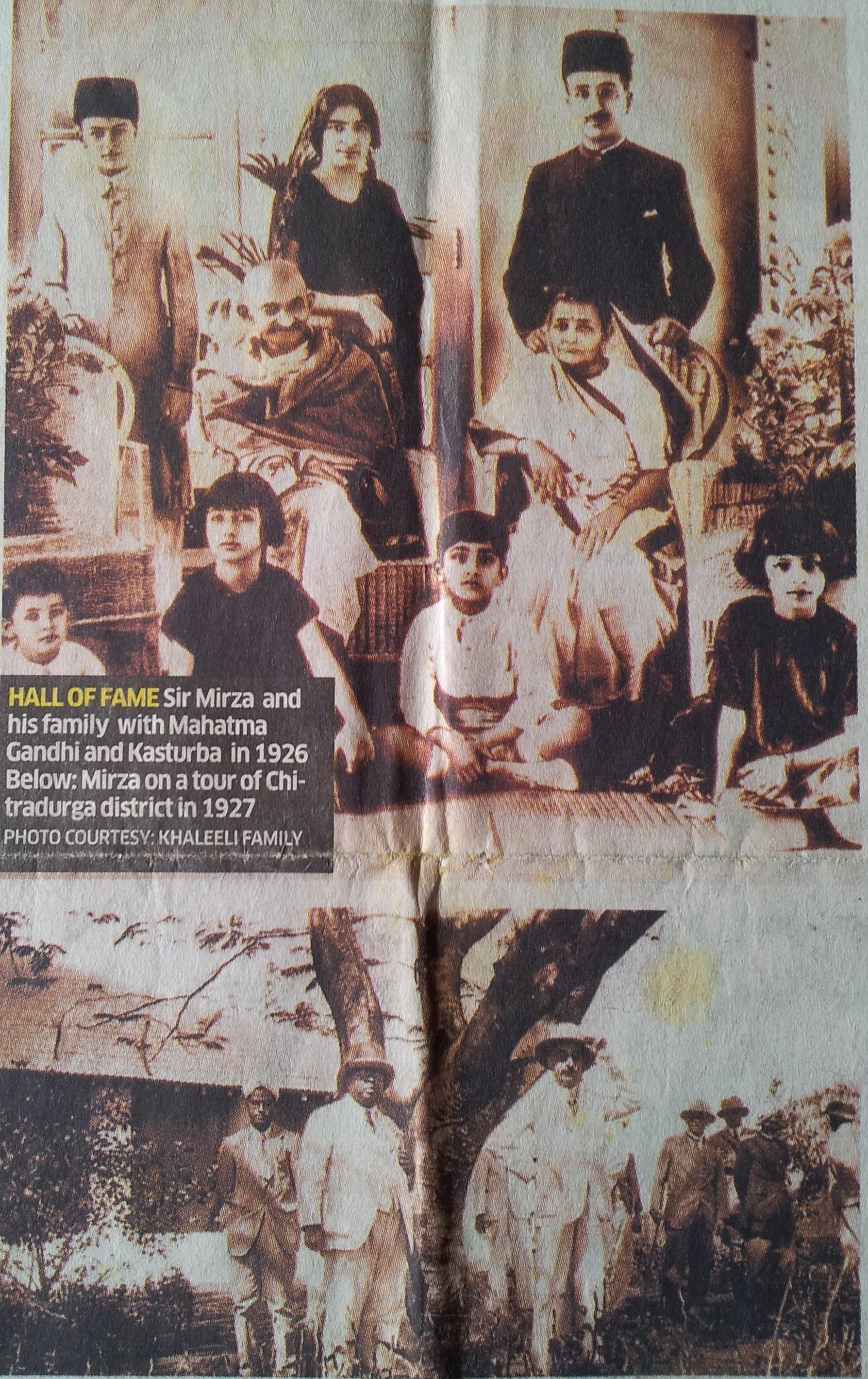
When Gandhi Came To Mysore

The year was 1931, Gandhi on his itinerary stayed back in Mysore to recover from his illness.

When Gandhi was in Mysore, he gave his speech at the Town hall  The place he stayed was Diwan Sheshadri Iyer’s house which today is the commercial tax office of Mysore. He visited the then Holageri which is now the Ashokpuram of Mysore. The KR mills were fortunate to get a visit from this man where he inspired the workers with his presence.

Gandhi was pleased with the administration of the state of affairs here and also the way of life. He called the kingdom – ‘Ramarajya’ . The then king Nalvadi Krishnaraja Wodeyar was called – ‘Rajarshi’ – king amongst the sanyasins. A sanyasin is known for sacrificing his comforts for the well being of people – a title like this to a king, especially from a man like Gandhi stands for itself. Nalvadi’s certainly was the golden reign of Wodeyars for Mysore and Gandhi undoubtedly the golden era of our independence struggle.

Sadly we lost Gandhi on an unfortunate day- 30th Jan 1948. His ashes were immersed close to Mysore and even to this day we see a stone which commemorates it. Any guesses where?

And before we say goodbye.. Happy Gandhi Jayanti!!

source: http://www.royalmysorewalks.com / Home> Blog / by Vinay Nagaraju / October 02nd, 2012

First anniversary of Ognora in Bangalore

It’s been a year since Nayana Jhawar and Prathiksha Hedge realized their dream of working with designers from across the country to offer a one-stop shop solution to fashion-conscious women in Bangalore.

And now the duo is marking the first anniversary of Ognora tonight with a bash at City Bar, UB City.

Top models will showcase designs by Prathiksha, Deepika Arora, Huemn by Pranav Kirti Misra and Shyma Shetty, Deepankshi and Reena, and Chaiti from Confusion Accessories.

Sandalwood stars, including the boutique’s brand ambassador Aindrita Ray, and other celebrities will make an appearance at this do.

source: http://www.timesofindia.indiatimes.com / Home> Life & Style> Parties> Bangalore / TNN / October 06th, 2012

Bombe Mane in city this evening

Mysore, Oct. 3

An expo of exquisite dolls from across India Bombe Mane, organised by Ramson Kala Pratishtana will be inaugurated in Pratima Gallery, 91, First Floor, Above Aamrapali Store Opp. Reliance Fresh, Nazarbad Main Road here today at 5 pm.

Tara Anuradha, MLC and Chairperson of Karnataka Chairperson of Karnataka Chalanachitra Academy will inaugurate. Bombe Mane will be open for public from tomorrow till Oct. 24, everyday from 10 am to 7 pm.

About Bombe Mane: Since past eight years Ramsons Kala Pratishtana has boldly promulgated the doll tradition of old Mysore region through the unique exhibition, Bombe Mane, literally the Doll House of Mysore.

Bringing thousands of dolls from across India and personally choosing the best of doll traditions that India has to offer, the design wing of Pratishtana has put in a lot of field study, research to come up with new dolls to showcase the local culture of the land.

About 2, 000 dolls, among which about 700 have been created since past 10 years by master craftsmen in age-old tradition with no effort and cost being spared to reflect the grandeur and pomp as envisioned by the Maharaja Krishnaraja Wadiyar IV, whose vision made Dasara procession reach its pinnacle in 1939. Once completed, it will be a lasting legacy and heritage of Mysore – Bombe Mane’s humble dedication to the city of Palaces.

Using eco-friendly material like nuwood, miniature model of Jubilee Hall which now houses the Oriental Research Institute is created to commemorate the 125th anniversary of the laying of its foundation stone and models of other Mysore landmarks like Krishnarajendra Circle, Chamarajendra Circle, Lalita Mahal Palace and palace gates are sure to lure everyone with their detailed craftsmanship. Miniature kitchen sets in brass, wood and clay is added attraction of the Bombe Mane along with thousands of dolls from various places across India.

For details, contact Raghu Dharmendra Mob. 9880111625.

source: http://www.StarofMysore.com  / General News / October 03rd, 2012

Spinning a revolution

At a time when affluent foreign investors are knocking on the country’s doorstep, a silent khadi movement involving locals has spread its roots at Melkote in Mandya district.

Spearheading the movement is Janapada Seva Trust, which was started by Gandhian Surendra Koulagi in 1960.

Even though khadi witnessed a decline during the last couple of decades, Surendra Koulagi believes that khadi will continue to play a major part in our lives. Assisting him in the endeavour are his sons Santhosh and Sughosh Koulagi. Janapada Seva Trust, which runs ‘Hosa Jeevana Daari’, has more than 20 women spinning and weaving clothes.

Speaking to Spectrum, Santhosh Koulagi revealed that demand for khadi has been on the rise during the last two years. He believes that change in the mindset of the middle class has led to the revival.

At one time, khadi was shunned as it had limited options and remained unfashionable. Taking on these two factors, the Trust has now sought the assistance of a designer to ensure that khadi changes along with the times. As Surendra Koulagi says, “Now the emphasis is on coordination between the old and the new.”

The emphasis has now been on lending a stylish twist to khadi. The Centre also makes dhotis and quilts. In order to ensure that khadi remains eco-friendly, the Trust is using only natural colours for dyeing the fabric.

Elaborating, Santhosh says, “We are introducing natural dyes made out of roots, barks, leaves, pomegranate, betelnut, arecanut and indigo. At the same time, we are trying to use eucalyptus, which is found in abundance in the area and gives a light blue shade as natural dye.”

Explaining the importance of khadi, he says, the fabric is entirely handspun and hand woven. Gandhi realised that khadi could provide a means of livelihood to millions of people, Koulagi remarks.

At present, Janapada Seva Trust has been able to produce 1,000 metres of khadi fabric each month. Apart from the investment being low, khadi production is also cost-efficient, he says, adding that it can provide employment to a large number of people. With eco-friendly products gaining importance during the recent years, the aim is to revive khadi in each household here, once known for weaving.

Recognising the threat that khadi faces, Santhosh says, “Unless khadi is revived now, there is fear of losing skilled workers. Melkote was once known for its community of weavers and more than 100 families thrived on the trade. But, now many have give up the trade because of insufficient income. Once the skill is lost, it is difficult to master it again.”

Steps to popularise khadi

Noting the steps taken by the Trust to penetrate the retail market, Santhosh mentions that they have sought the assistance of designer Tara Aslam, who runs Nature Alley in Bangalore.

He credits Tara Aslam for providing inputs on the designs for kurtas and shirts, which are made at the Trust. Janapada Seva Trust is also planning to showcase its products at ‘Gandhiji and textile of peace’, a national-level exhibition scheduled to be held between October 2 and 12 at New Delhi.

The Janapada Seva Trust also runs an  adoption placement agency in Mandya district. “Under this programme, any abandoned child found between the ages of one day and five years is sent to the Trust by the Department of Women and Child Welfare. The Trust provides support to the child and also makes efforts to locate biological parents and if not found, the child will be handed over for adoption legally,” says Santhosh.

source: http://www.DeccanHerald.com / Home> Supplements> Spectrum / by Manish / October 01st, 2012

Kalyani Silks Bangalore sojourn

Kalyan Silks, the world’s largest silk sari showroom network, has for the first time stepped out of Kerala to open a 30,000 sq. ft. showroom in Bangalore. The store was inaugurated by the Kerala-based premium silk brand’s two most popular ambassadors – Malayalam movie star Prithviraj and Kannada film actor Shivarajkumar.

The newly unveiled outlet offers a collection of around 0.2 million exclusive bridal saris and a vivid array of exquisite apparels for men, women and children. Moving ahead, the company plans to launch stores in Mangalore, Mysore, Hubli, Belgaum and Mumbai. The company had ventured outside India by opening an outlet in Dubai last year, and it now plans to launch several stores in Sri Lanka, Malaysia and Singapore.

Founded in 1909, Kalyan Silks owns India’s largest wholesale textile showroom and a string of looms in all major silk producing centres across the country. Kalyan Silks prides itself with world-class showrooms in Kochi, Thrissur, Palakkad, Kozhikode, Kannur and Kottayam. Kalyan Silks’ first international showroom was opened in Dubai last December. By end of 2012, the leader in textile retailing will further strengthen its presence by adding many more showrooms to its ever-growing network. The new showrooms will bring international ambience and amenities to Thiruvananthapuram and Thiruvalla. Sri Lanka, Malaysia and Singapore will be Kalyan Silks’ global destinations in the coming years.

source: http://www.fashionunited.in / News / Tuesday, October 02nd, 2012