Category Archives: Arts, Culture & Entertainment

I will work like a soldier for Sahitya Parishat: Pundalika Halambi

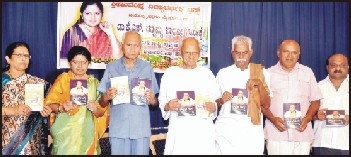
Caption: Pundalika Halambi (third from right), State President, Kannada Sahitya Parishat, is seen releasing two books Gayana Gange and Gana Kala Dasohi at a function held in city yesterday. Others seen are (from left) Yuvaraja College Principal Prof.S.N. Gayatri, authors Dr. Rathnamma & Dr. C.P. Krishnakumar, litterateur Prof. Dejagow, District Sahitya Parishat President M. Chandrashekar and writer Prof. Malali Vasanthkumar.

Mysore, May 10

“I will work like a soldier to uphold the dignity and integrity of Kannada Sahitya Parishat (KSP) and live upto the expectations of those who voted me to the office during the recent Parishat elections,” declared Pundalika Halambi, State President of KSP here yesterday.

He was speaking after inaugurating a seminar, book release and felicitation ceremony organised by Kuvempu Vidyavardhaka Trust at Rajendra Bhavan in JSS Hospital premises.

Sincerely thanking those who voted in a secular manner during the election, Halambi said: “Come what may, I will not compromise with the development of the Parishat and would do whatever required to ensure that the Parishat performed its duties in a transparent and effective manner to uphold the self-respect of Kannadigas.”

Referring to the comments passed on him by several of his detractors that he was ignorant about the basics of Kannada literature, he said that though he was a student of literature, he was not a litterateur and could have made several mistakes in pronouncing several words and regretted for the same. He also said that he would not stick to the post if he could not do justice.

Releasing two books Gayana Gange and Gana Kala Dasohi, biographies of Vidushi Gangu Bai Hanagal and Pandit Puttaraja Gavai, authored by Dr. K.S. Rathnamma and C.P. Krishnakumar respectively, Halambi said that biography was a complex form of writing and should not be limited to creative writing.

Pudalika Halambi, his wife Saroja Halambi and District Sahitya Parishat President M. Chandrashekar were felicitated on the occasion.

source: http://www.StarofMysore.com / General News / May 10th, 2012

Dubai : Bunts UAE Conducts Blood Donation Campaign

Dubai, May 6:
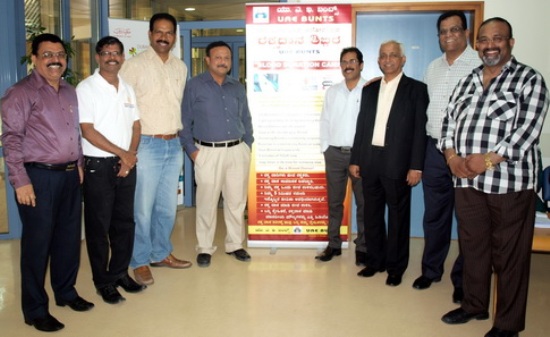
Bunts UAE this year successfully kicked off and concluded ‘Blood Donation’ Campaign at Latifa Hospital, Dubai on the 4th of May, 2012, Friday from 10.00 AM to 2.00 PM with record number of donors participation.

Sudhakar Alva the main man behind this campaign thanked the authorities for being tolerant and supportive in the campaign and promised more contribution to the Blood Bank from all the Indian Communities living in UAE. The Donors poured in great numbers from various parts of UAE into Lathifa Hospital enthusiastically for this great cause. It was also great to see Presidents and Office Bearers of most of the regional Community Associations of Karnataka together in one place for this noble cause. A record was created with more than 100 numbers participation.

As per the Dubai Blood Donation Centre (DBDC), the need for blood is ongoing and must be met every day. The demand for blood is growing faster than the collection rate and DBDC has been requested to have an instant response to the rapid growth in blood demand which is obviously proportionate to the fast growing population of the city along with healthcare facilities. DBDC is the only blood supplier in Dubai. Its services extend to Thalassemia patients (Thalassemia Center at Al Wasl Hospital), road accident and burn victims (Trauma Centre at Rashid Hospital), patients with neonates and maternity health complications (Lathifa Hospital), cases diagnosed with cancer or scheduled for open heart operations (Dubai Hospital) as well as to all private health facilities within Dubai that are entitled for transfusion services.

The Members volunteered along with hospital authorities were busy welcoming donors and filling up the required forms, examining blood samples and getting ready for the extraction of blood all with smiles on their face. They were issued a ‘Donor Card’ exclusively as a proof of their support.
The campaign kicked off with good numbers of Bunt’s voluntarily taking part along with female members and youths. Other patriotic associations who have been willingly doing these types of blood donation campaigns are Karnataka Sangha Sharjah, UAE Amchigele Samaj, Ramarajya Khsatriya Sangha UAE, Padmashali UAE, Kodagu and Dakshina Kannada Gowda Samaja Dubai, UAE Bunts, Billawas Dubai & Northern Emirates, Billawa Balaga Dubai who have already recorded their names in the list of blood donors of India in UAE.

Bunt’s UAE staged a breakfast stall with Snacks, Tea, Coffee, Fruits, Juices etc. at the blood donation campaign was given a boost with the support and participation of prominent community leaders like Sarvotham Shetty of UAE Bunts, Lokesh Puthran, President along with Vice President Yadav Kotian and main co-ordinator of Blood donation campaign in UAE, Bala Salian of Mogaveers UAE, Sudhakar Alva of UAE Bunts, Ravi B. Shettigar, President of Padmashali UAE, Satish Poojary President of Karnataka Sangha Sharjah, Anand Bailoor, Jagannath Bellare, Sudhakar Poojary of Billawas Dubai & Northern Emirates, Sudhakar Thumbe, President of Billawa Balaga Dubai, Representatives of Vishwakarma Seva Sangha & Shodhan Prasad of Nama Tuluveru UAE. Also were Ashok Belman of Gulf Kannadiga and many other prominent members of other well known associations.

The event concluded at around 2 PM
Report: Shodhan Prasad
Photos: Ashok Belman (Gulf Kannadiga)

source: http://www.DaijiWorld.com / Dubai, May 06th, 2012


The village that wove clothes for Tipu Sultan, Indira

Mandya:

Kodiyala village about 12km from Mandya city is famed for its community of weavers who have clothed royalty including the Mysore family and Tipu Sultan. The legacy continues even today.

History has it that about 160 families of the Padmashali community of weavers who migrated from Andhra Pradesh 300 years ago settled down in this village and started their profession. Soon their weaves caught the eye of the royal families around who placed orders for cloth, and thus began a long relationship between the community and the royals.

Some elders of the community said that Tipu Sultan who ruled from Srirangapatna was very fond of cotton cloth manufactured in Kodiyala village. He is said to have helped the Padmashali community by giving concessions in royal taxes and importing raw material from abroad.

Another proud memory for the weavers is of then prime minister Indira Gandhi who visited their weavers’ colony and was impressed with their handlooms and saris. “Leaders like Indira Gandhi former chief ministers Devaraj Urs and SM Krishna were seriously interested in our profession and village” said 80 year-old Narayanappa a weaver. “Impressed that 200 families of our village are running textile manufacturing units SM Krishna had ordered that an exclusive power line be drawn from Tubinakere power station for continuous power supply.” This is perhaps the only weavers’ colony in the state which is so privileged.

Weavers say they are not facing any problem. The market for their products is spread over the entire nation andthereis always a good demand. Neither is there a shortage of raw material and labour. “We are content with our profession. If the erstwhile kings hadn’t supported our ancestors and our profession was not encouraged by the government we may not have been so successful,” said Narayanappa. He claimed their material is of high quality. “We produce rich colourful saris and dhotis, with eye-catching motifs. We have switched to powerlooms and use polycotton thread” he said.

source: http://www.articles.timesofindia.indiatimes.com / Home> City> Bangalore / by M K Madhusoodan and Rajendrakumar K R, TNN / April 26th, 2012

Tracking 400-yr-old family roots in Indian milieu

While tracing one’s genealogical roots is all a rage in the West, it is yet to find traction in India, where tracingone’s ancestral roots is all but impossible. But that did not deter Claudius Pereira, who with help of his six siblings wrote a sprawling saga, Echoes in footprints, that dates all the way back to the 17th century. The book, set to be officially released on May 1, will also be released in the US and London.

The book, which mainly focuses on how Pereira’s father raised seven children as a single parent, starts in 1673, when Pereira’s ancestors were among those who came and settled down in India from France.

“My great great grandfather James Bernard Pereira wanted one of his sons to become a priest in Madras. But my great grandfather was sent back home by Father Superior who saw him play football and figured he should pursue that instead. But James was furious at his son and in his rage chopped his leg off,” said Claudius, who started working on the book in 2006, when he was visiting his siblings, as a way to keep the memory of his father alive.

His great grandfather never became a priest. He instead got married and had four children, one of whom became a priest. In order to trace his family’s at times tragic past, Claudius even went to London, to access the birth and death certificates of his great grandparents. “The British had kept impeccable records, so I found even the marriage certificate signed by my great grandfather,” he beamed. But it was through his grandparents that he got a wealth of information.

“My grandfather’s brother was a priest himself and he set up my grandfather and his wife. He was at that time a railway ticket collector and my father, Clarence Joseph, was one of six children,” added Claudius.

However the book centres on his father, and how his family over several generations merged spirituality with their circumstances. “I was three years old when my mother passed away. My father had to raise seven children by himself. My oldest sister, then 13, had to take up cooking and taking care of us. He had to pawn my grandmother’s jewellery to keep our family going,” he said.
Claudius’ father worked as a telephone operator in a gold mine.

“Due to conditions in the goldmines, he lost his hearing and developed severe asthma and my brother when he got older, joined a gold mine company as well, but by that time the gold mining business started declining,” he adds. The book also chronicles Clarence Joseph’s brief struggle with cancer in the early 90s.

“At that time they didn’t know much about it. Even right now we don’t really know what it was. But his struggle was brief and his death is chronicled in this book by my siblings,” he said. With religious overtones, the booklooks at its historic context and focuses more on familial struggles.

“This is our book about how we came up in life. How we weathered the struggles. Everyone will find some form of inspiration from this book,” he adds. However tracing one’s history in India is close to impossible, says Claudius. “Only few familieshad records. People here can only get pockets of their life history. But my research led me to people who were my cousins, but I didn’t even know existed!” he exclaims.

source: http://www.dnaindia.com / Daily News & Analysis  / Home> Bangalore> Report / Place: Bangalore, Agency: DNA / by Aishhwariya Subramanian / Tuesday, May 01st, 2012


Making space for art

Six years ago, Deepak and Deepika Dorai moved to Bangalore from Chennai, where they had started a unique artistic movement called Bimba. They used to run their art hut out of an old home that was razed to the ground — you can almost hear the pain in his voice when Deepak talks about this. Yet, today, the Dorais have successfully recreated their dream project in Bangalore – a distinctive public space for art and performance that is teeming with activity and enterprise.

One of the most cheering aspects of Bimba the Art Ashram is perhaps the space where it’s run: a 100-year-old building on DVG Road in Basavanagudi that was falling into disrepair before the Dorais lovingly restored it. Belonging to an old Bangalore family that has given the Dorais the run of the place, the house, with its many traditional features, could act as a template for how old structures in the city, facing the threat of demolition, can be revived. “It is a house in which 42 children were born; you can say this is very fertile ground,” says Deepak.

To convert the house from a private residence to a public space, Deepika, whose creative energies have directed all the changes, first began by tearing down the boundary walls to create a more open feel. The original pillared entrance has been retained, and as you enter through it you can feel the temperature drop a few degrees, thanks to old-world construction features such as stone and red-oxide floors, high ceilings and hollow-brick walls.

Deepika uses the rooms within the main house to run her artifacts and furniture gallery, and this is also where she retails her clothing line. Deepika creates some unique hand-crafted furniture, ‘upscaling’ old and discarded tables, chairs and beds into one-of-a-kind items. “This is something people working in newspapers before the computer age would remember,” says Deepak pointing to a large metal tray sectioned into small squares – a linotype used in hot-metal typesetting. These ‘trays’ have been used by Deepika to make cupboards (they act as  the doors) and a coffee table (mounted by glass).

Bimba also hosts live performances every Saturday, and these include shows such as one by a practitioner of the Karnataka rod puppetry tradition, a talk by a musicologist on the Jogis’ folk music or a classical vocal Carnatic performance. Along with these, what draws most people to Bimba on Saturdays is the Rasalok theatre – this is also what the ‘art hut’ has become most famous for in recent years. The Dorais call this ‘still theatre of miniature art’; at its  essence these are vibrant storytelling performances using miniature figures and three-dimensional sets, again hand-crafted by Deepika. Most stories are mythological in nature, and two narrations take place in adjoining rooms done by Deepika and her mother Uma Nagraj. These performances form an essential part of Bimba’s activity calendar especially during Navratri, when day-long sessions are held.

EARTH-SENSITIVE ART

While promoting the ideas of earth-sensitive art, we also like to draw people into our performances and our miniature theatre, through which we tell stories that have their roots in mythology. This story-telling tradition has been in my family for generations; my grandmother MN Susheelamma evolved and finetuned the making of a 3-dimensional still scene on a mini-stage as part of her Navaratri festival offering. The key to the visual magic lay in her sense of aesthetics, period and proportions in the miniature space. This practice was continued and improvised upon by my mother Uma Nagraj, who now composes and narrates a magical moment every year. I’m trying to carry on this great artistic tradition.

Deepika Dorai, Founder, Bimba the Art Ashram

source: http://www.timesofindia.indiatimes.com / Home> City>  Bangalore / by Shrabonti Bagchi , TNN / April 29th, 2012

‘Planning a restaurant in Koramangala? Consider food inflation’

From 176  restaurants in 2006,  Koramangala now boasts 432 restaurants, which showcases this business is a jackpot. But be careful before trying your hand at setting up a restaurant of your own, warns  Sajit Chacko, co-founder of  AST Foods in an interview with ET. He advises aspiring restaurateurs to understand challenges, like food inflation and starting with low investments. Edited excerpts:

How did you start AST Foods and how many restaurants do you own in Koramangala?

We are three of us who started AST Foods. We all are passouts of the Institute of Hotel Management (IHM) and have an experience of 10-15 years. I used to do projects for The Leela and then I thought why don’t we open something on our own and that triggered the idea of AST Foods in 2006. We have three restaurants in Bangalore out of which Umerkot is in Koramangala, which was our first restaurant too.

What was the initial investment?

The three of us contributed Rs 3 lakh each and started Umerkot with a seed capital of Rs 9 lakh. Since, we had less capital we took a bank loan where we got 40 percent of the cost and had to repay it in five years. In order to get the restaurant running and spread its flavours, we availed services from our old contacts and goodwill in the industry.

What challenges did you face in this competitive business?

Umerkot was a challenge due to lack of capital. We took the place in Koramangala as it was cheap at that time. Our cuisine is niche – Akbari Gharana – mughlai but non-spicy food. People were skeptical about our restaurant. It became more challenging in the first six months, as the Shinivagalu Main Road where we are located was not well-constructed so nobody would come to our restaurant. I would say that the first year was challenging but then we took off with our niche fan following of people aged above 30 years.

What kind of growth have you seen since inception?

Apart from having loyal customers, the broken road got constructed which became a common road for many more localities in south Bangalore. This helped us to breakeven in two years, which is very difficult in this business. We paid our five-year bank loan in three years. In 2008, when slowdown shook the economy, we also got affected. Though our business dropped to 40 percent that year, we did not bleed since we have a conservative business model. Our business was at its peak in 2009-2010. In 2009, we saw maximum footfalls. We marked around 10 percent revenue increase per annum. We don’t target crazy profits. As I mentioned earlier, we follow a conservative business model. After 2010, profit has been growing at around 3-5 percent per annum.

What is driving the growth of restaurants in Koramangala?

Koramangala is the centre of attraction for south Bangalore. Just like villagers visit the city to hang out, south Bangalore flocks to Koramangala. This locality is an IT hub having maximum disposable income. These Kormangala techies enjoy fine dining and a relaxed ambience, which is driving the growth of restaurants in this tony locality. Moreover, in 2007-10, real estate in nearby areas had undergone development that attracted lot of people. They all frequent Kormangala restaurants.

What is your future plan?

Our plan is to open a new restaurant in every two years.

Tell us about the business.

Restaurant business is a combination of retail and manufacturing. A manufacturing unit takes 8-9 years to breakeven whereas a retail unit can achieve that in six month to 2.5 years. Sustaining the combination of retail and manufacturing is a tough game.

This business is very dynamic and every city and locality has different restaurant patterns. For instance, Bangalore has seen a complete shift in restaurant patterns, population has doubled since a large number of migrants have settled here and all of them have different tastes. In Koramangala, there were 176 restaurants in 2006 now there are 432. Though the figures denote that restaurant business in Koramangala is a jackpot, one should also consider that every month five restaurants opens and three shut down.

Manufacturing drove the Indian economy and no novice tried entering the food sector. Only Udupi opted for this segment. In 2012, the restaurant business transformed. Novices are entering this business and experimenting. It is tough to say who will click as the trend amongst consumers keeps changing. You can see parents eating in some old restaurant and children trying new food or vice versa. Biggest challenge in this industry is that of food inflation. Nobody talks about it or understands it before venturing into it. Food inflation keeps on fluctuating. If grains are short supplied, chicken prices rise. But one cannot keep changing the price in the menu.

Thus, restaurant business will go flat if these factors are not considered and handled well. Restaurant business is unlike regular retail that pays later on.

Which are the biggest industry opportunities for aspiring entrepreneurs in Koramangala?

I can’t suggest business ideas but can talk about seed opportunities in the area. Koramangala has distinctively two types of people, – one who wants maximum comfort coupled with good services and second – who wants value for money and are less dependent on services. I would suggest enterprising people to keep this in mind and take forward from the segment they want to cater. Business like organic food retailing can click well in the area.

What message you would like to give to budding restaurateurs?

The real trick is to start small, as capital is a big challenge. Go for the business where your strength lies instead of flowing with the trend. For example, if you have Rs 10, then observe the market carefully and go for a business where you can make Rs 10 to Rs 12 faster.

source:  http://www.economictimes.indiatimes.com / The Economic Times / Home> Opinion> Interviews / by Rashi Varshney, ET Bureau / April 29th, 2012
Rural life is my inspiration to write: Hamsalekha

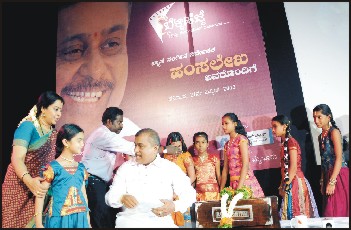
Caption: Hamsalekha interacting with kids during Belli Hejje programme yesterday. Karnataka Chalanachitra Academy Chairperson Tara looks on.

Mysore, Apr. 22

Music director and lyricist Hamsalekha, who composed the famous song Kurak Kukralli Kere for the Kannada film Nenapirali and bagged an award for it, participated in an interaction programme Belli Hejje at Vanaranga of Rangayana on the banks of Kukkarahalli lake last evening.

The programme was organised by Karnataka Chalanachitra Academy. Journalist and music critic Suresh Chandra interacted with Hamsalekha and asked questions based on his life and works on behalf of the audience.

Born as Govindaraju Gangaraju in Kannambadi village near KRS, he got the pen name Hamsalekha after entering the film industry. He has directed music for 300 Kannada films and has scored background music for more than 3000 film.

“I entered the industry as a lyricist with the song Neena Bhagavanta for the film Triveni in 1971. I debuted as a musician with the 1981 film Rahuchandra,” he said.

“My father was a stage artist. I too would accompany him on stage and got attracted by the rural language. This was my inspiration to write songs,” he added.

When asked about the secret of his success, Hamsalekha said, “Those in music field, in addition to their style of composing, should learn to love life. Only then can they succeed. Many who practice classical music hesitate to experiment. But, we do not hesitate. This is also a reason for my success.”

On a suggestion from the audience to write a song on the soldiers who protect our country, Hamsalekha assured to do so.

A documentary on Hamsalekha was screened on the occasion. District In-charge Minister S.A. Ramdas released a booklet on Hamsalekha. Academy Chairperson Tara Anuradha explained the purpose of extending Belli Hejje to other districts instead of just in Bangalore.

source: http://www.StarofMysore.com / General News / April 22nd, 2012

Mysore Dasara to get World Heritage tag soon


Caption: K.R. Ramakrishna, Commissioner, Department of Archaeology, Museums and Heritage.


Mysore, Apr. 20

The historic Mysore Dasara will be included in the list of World Heritage, said the newly-appointed Commissioner of the Department of Archaeology, Museums and Heritage, K.R. Ramakrishna.

Visiting the city for the first time after assuming office, Ramakrishna, in a tete-a-tete with SOM on Wednesday, recalled that though the State government had attempted to get the Mysore Dasara listed under the UNESCO, it had failed to effectively portray the festival as of having heritage value.

“Dasara does not mean the present day Yuva Dasara, Mane Mane Dasara, Rangoli Dasara, Yoga Dasara etc. Accept it or not, it is a legacy of the erstwhile rulers of Mysore kingdom, the traditional grandeur of which has been retained and followed to this day in the form of Dasara celebration. This aspect should have been impressed upon the UNESCO delegation. We have prepared a list of drawbacks and will make attempts to eliminate them. Then we will portray Dasara in its original form before the UNESCO,” said Ramakrishna and expressed confidence that it would be accepted.

Asked if preparations were on for it, Ramakrishna said that the matter had already been discussed with the DC. Though the Republic Day is celebrated on a large scale, it cannot be termed as traditional. It portrays the achievements of the Government and the Defence forces. But Mysore Dasara portrays the royal grandeur of the yore and historical significance.

“We have Police and other security personnel with modern equipment and modern uniform. But at the Palace, we will try to create the ambience of royalty, with security personnel and other staff clad in regalia, giving the Palace a heritage touch,” he said, adding that discussions were held with the Principal Secretary of the State government, who also is the Chairman of the Palace Board.

Regarding the conservation of heritage monuments in Mysore, Ramakrishna said that Mysore has been declared as a Heritage City, along with Srirangapatna, Kittur, Bijapur, Gulbarga and Bidar.

“A total of 269 monuments have been listed as heritage structures in Mysore. They will be conserved as new guide-lines. Some buildings owned by private persons that were erected close to the heritage monuments have been demolished,” he said and added that the Bidaram Krishnappa Rama Mandira on Narayana Shastri road will be conserved as a heritage monument.

source: http://www.StarofMysore.com / General News / April 20th, 2012

Guidelines for conservation of heritage monuments

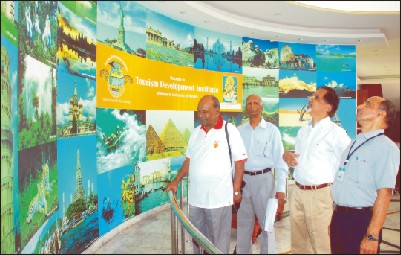
Caption: K.R. Ramakrishna (second from right), Commissioner, Department of Archaeology, Heritage and Museums, looking at the display of heritage monuments at Mahajana Tourism Development Institute in city yesterday as former AIISH Director Dr. N. Rathna, Institute Secretary Srinivas and Director Prof. K.S. Nagapathi look on.

Mysore, Apr. 19

Guidelines for the conservation and protection of heritage monuments in the State will be formulated in three months’ time, said K.R. Ramakrishna, Commissioner, Department of Archaeology, Heritage and Museums.

He was speaking after inaugurating the World Heritage Day celebration held under the aegis of Mahajana Tourism Development Institute in city yesterday.

“There are 769 heritage monuments and buildings in the State and conserving them will be a priority for which guidelines will be formulated,” he said and added that under the 13th Financial Plan, a sum of Rs. 25 crore has been granted for this purpose from the Centre while Rs. 14 crore has been granted under the Department of Archaeology and another Rs. eight crore under the Heritage department.

A programme will be formulated to utilise these grants, he said, adding that conserving the heritage structures of Mysore was considered a priority.

“At present, we are facing shortage of manpower to take up conservation works. Hence, plans are afoot to form Heritage Conservation Clubs, involve local people and use their services for conservation works by paying them wages,” he added.

source: http://www.StarofMysore.com / General News / Thursday, April 19th, 2012


‘Khadri Shamanna Award’ for D. Mahadevappa

Mysore, Apr.15

Senior Journalist D.Mahadevappa, who is actively invol-ved in journalism for over three decades, has been selected for this year’s prestigious Khadri Shamanna Award for journalism.

The award is given by Khadri Shamanna Memorial Trust in the memory of late Khadri Shamanna, well-known for his activities in Kannada journalism.

Mahadevappa is presently working as the Editor-in-Chief of Kannadigara Prajanudi in city and his name was unanimously recommended by a selection committee comprising of S.V. Jayasheela Rao, M.K.Bhaskar Rao and H.R.Srisha at a meeting held at Bangalore recently.

The award will be conferred on Mahadevappa at Bangalore on June 6 during the birth anniversary celebrations of Khadri Shamanna, said Trust Secretary Khadri S. Achyuthan.

source: http://www.StarofMysore.com / General News / April 15th, 2012