Category Archives: Arts, Culture & Entertainment

‘For me Mysore is nostalgia’ says artist S.G. Vasudev

Mysore Art Centre has organised screening of ‘The Open Frame,’ a documentary on Mysore-born artist S.G. Vasudev, by Chetan Shah on Apr. 17 at 6 pm at Nadabrahma Sangeetha Sabha on JLB Road in city. The screening will be followed by an interaction with the artist.
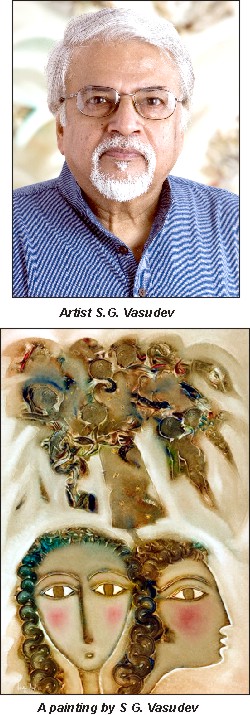

Just like a writer using words to describe his thoughts or a photo-grapher using his frames to express himself, an artist uses his canvas to pour his thoughts, tell the world what he wants to through sketches and colours and most importantly, be himself. An entire life is dedicated looking for new subjects for better creation and inspiration. But when the artist himself becomes a subject for a creation to inspire others, will it not be a tribute to his genius?

“The Open Frame,” a docu-mentary by Chetan Shah is one such tribute to noted artist S.G. Vasudev. Born in 1941 in My-sore, Vasudev graduated from Government College of Arts, Chennai. He works in various mediums like draw-ings, paintings, copper reli-efs and tapestries. His works have been exhibited in India and abroad including at New York, Chicago, London and Munich.

Vasudev has worked as an art director in award-winning Kannada films Samskara and Vamsha Vriksha and has also done cover designs for many important publications. His awards include those instituted by the National Lalithkala Akademi.

Vasudev set up a private trust Arnawaz Vasudev Charities in 1989 in memory of his wife Arna-waz, who died after battling with cancer in 1988. The Trust aims to promote art education and art activities and also provide fina-ncial assistance to young artists.

Star of Mysore had a brief online chat with Vasudev, who now resides in Bangalore, prior to his arrival in city. Excerpts…

Star of Mysore (SOM): What made you choose art as a profession?

S.G.Vasudev (SGV): I don’t think I would have fitted into anything else!

SOM: Your contribution to Cholamandalam Artists’ Village, Chennai.
SGV: Cholamandal Artists’ Village was started in 1965 by a group of artists. The idea is to make living by extending art to craft as it was difficult to make living on art alone. It is a co-operative of artists and has provided spaces for artists to work and also exhibit in the galleries provided; otherwise artists have to build their own houses/studios. I am one of the founder members of the place and even now I go and work there quite often.

SOM: How was it working for films?

SGV: I worked as art director in Samskara and Vamsha Vriksha along with literary giants Girish Karnad and B.V. Karanth. It was a very good experience to work in a different medium. But I preferred to continue my painting and not commercialise.

SOM: Your definition of art.

SGV: Art is what I do. It has no other definition for me.

SOM: What makes your work different and stand out from others… your styles?

SGV: One has to learn grammar, language and skill. If one has got all these things one can evolve a style or a technique of their own. More importantly, you have to work on individuality.

SOM: How will you describe the evolution of your work?

SGV: I have gone through a number of series in my work — Fantasy, Maithuna, Tree of Life, Tree of Life and Death, Human-scapes, He and She, Earth-scapes, Theatre of Life and Rhapsody. This is what I have done in the last 50 years or so. This is my evolution.

SOM: Inspiration for your paintings will be…

SGV: Many sources — poetry, music, theatre, folk stories, Indian miniature paintings, murals and works of a few artists.

SOM: What are the current projects you are working on?

SGV: My show titled ‘Recoll-ections Reconnections’ is going around the country. It was shown in Mumbai, Delhi, Kolkata, Chen-nai and Bangalore since December 2010. After this summer, it will go to Baroda, Ahmedabad, Kochi and Hyderabad.

SOM: Are Indian artists getting due recognition they deserve?

SGV: Artists are being given much more respect today. Peo-ple have realised their contribution in bringing contemporary Indian art to the mainstream.

SOM: Your advice to young artists who have selected painting as a profession.

SGV: Hard work and sincerity is the mantra. Do not get into the rat race as it is happening with galleries. Wait patiently to get the recognition you deserve.

SOM: Lastly, your view on Mysore as a platform for budding artists.

SGV: I am Mysorean by birth. My mother was an amateur artist and she had won gold medal in Mysore Dasara Exhibition when she was in her teens. My grand-father worked for Chamundeshwari Temple for over 40 years. For me Mysore is nostalgia. I love this place. It is also producing very good artists from Chamarajendra Academy of Visual Arts (CAVA) and some of them have become well-known nationally and internationally which is a good development.

— M.S. Apuurva

source: http://www.StarofMysore.com / Feature Articles / Monday, April 16th, 2012
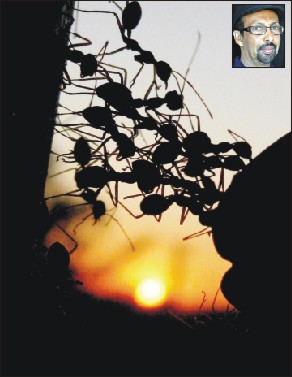
 

Where there is a will, there is an ‘Anty’ bridge !

Caption: A silhouette of the ants’ bridge against the setting sun.

Ants are the most dominant of creatures in the terrestrial ecosystem constituting about 25% of the total animal weight of the tropics. These tiny creatures have been on earth much before the arrival of human race. Ants ori-ginated 145 million years ago and were witness to the extinction of dinosaurs.

Because of their great adaptability, these creatures with about 12,000 known species worldwide, have occupied every possible habitat found on land. Their success in so many environments has been attributed to their social organisation and their ability to modify habitats and to solve complex problems, tap resources and defend themselves. Their complex and variable social structures have made the ants ideal model organisms.

Foraging ants travel distances up to 200 meters from their nest, and scent trails allow them to find their way back even in the dark. In hot and arid regions day-foraging ants face death by desiccation, so they explore the shortest route back to the nest to reduce that risk.

Weaver ants (Oecophylla species) make nests on trees by attaching leaves together. On my balcony, I found a nest on one of my potted bonsai trees. The ants from the nest were found moving up along an iron pillar touching that tree. I pushed the pot a little so as to leave a one-inch gap from the pillar. I just wanted to know how these creatures would solve the problem — whether they take a two-meter long route to reach the pillar, or they would use their inherent talent to bridge the gap. These tiny creatures are awesome indeed. Readers can see from these photos, how they solved the issue.

A few ants clutched onto each other to make a bridge between the plant and the pillar, while other workers used it for their smooth traffic. At times, the bridge was so simple made by only two ants, but more often many ants bundled together to make the bridge stronger. The ants took turns, but the bridge remained all through day and night. I could also make a silhouette of the ants-bridge as its position was in correct angle with the setting sun. I captured these shots in last January. The bridge and the nest remained intact for over two months till the ants themselves abandoned the nest probably because those leaves got dried and the nest was likely to fall. True, these creatures are a unique example of unbinding co-operation and a high degree of unselfishness.

—Dr. A. Mohamed Babu, Scientist, CSR&TI, Mysore [Mob: 9448938253]

source: http://www.StarofMysore.com /  Feature Articles / April 13th, 2012

Beat Guru on a roll

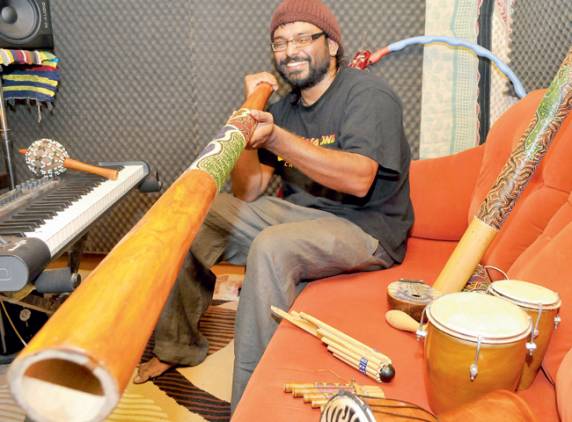
The noise of people at work in a hardware store and a construction site, the whirring of a bus engine, the clanking of doors and the “hollow” sound of a toilet on a moving train have all come together in a track composed by Bengaluru-based DJ and producer Vinayak^A. This experimental music pro has also worked on a remix of the track Allah Jane, for Kamal Hassan’s film Unnai Pol Orruvan.

“I made the club remix for the track. When I was in Chennai studying sound engineering, I met Shruti Haasan through a friend and we jammed together a few times. We then got working on this club remix for the film,” he says.

Vinayak^A’s parents live in Jamshedpur and he was born in Patna. “While playing at a gig, I go by the name Vinayak^A. But, initially my other option was Lambhodar, which is a synonym for Lord Ganesha. I left my house when I finished class six as I didn’t do well,” he says which also prompted his experimental nature. While not producing music, in his free time Vinayak^A is always listening to new music.

“I realised that if I want people to dance, I need to make my music. I like to work with organic sounds and keep my music as organic as possible. The sound of birds chirping is boring. I like loud, undiscovered and different sounds. For example, the silencer of an auto,” says Vinayak^A.
And what about the symbol (circumflex) in his name? It is there because, “It indicates everything going upwards and ahead,” he says.

When you hear a track composed by him, it is hard to identify the object he has recorded. It subtly blends into the music. He says, “Every sound is a musical weapon. I convert the smallest of sounds to the biggest. I like to make the impossible possible.”

Currently, Vinayak^A is working on his first album that is ready for release. “It is titled Lonesome Train. Seventy five per cent of the sounds on the tracks are recorded organically. It took me some time and many train rides, but it eventually paid off,” he says. The only thing he keeps with him while recording is his Sony Cybershot camera. “I have learnt the value of things. I owe my success to my parents and my maternal uncle. They have always been there to support me in my ventures,” he says.

Vinayak^A also attributes his success to social networking websites like facebook and soundcloud. “These are platforms where people heard my tracks and recognised my potential,” he says. He has received tremendous support and recognition from many international artistes like Hernan Cattaneo, Robert Babicz, Jody Wisternoff, Luciano, Cid Inc and Armin Van Burren to name a few.

source: http://www.DeccanChronicle.com / Home> Tabloid> Bengaluru / by Khushali P Madhwan / April 11th, 2012

An inclination for porcelain

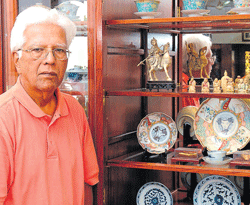
K S Raman, a retired professor, has a passion for antique porcelain items. He has a collection of over 100 items from various countries and each piece is different from the other.


Things made out of Imari, a well-known Japanese porcelain; Nanking Cargo, the blue and white porcelain made in Nanking and Nyonya; colourful porcelain items made in China, Malaysia and Singapore; Cloisonne, a brassware and Netsuke, a miniature Japanese sculpture, form part of his collection Porcelain boxes in various sizes and shapes with colourful and intricate designs, showpieces, pots, tea jars, flower vases, tea mugs, ‘Laughing Buddha’, plates, bowls, antique Chinese chairs and many such things decorate his house. A beautiful flower vase brought from Athens in 1963 was the first item he collected.

Raman had served as a professor at the National University of Singapore from 1984 and relocated to Bangalore when he retired in 2004. “When I was in Malaysia and Singapore, I had the opportunity to travel to China, Japan, US and Europe. It helped me develop a professional, business and personal relationship with the people there and study their culture. I was attracted by their beautifully furnished houses which had decorative pieces made out of porcelain. Impressed by this, I started collecting porcelain items from various countries,” he shares.

Raman says that he used to collect matchbox labels, cigarette packs, and movie notices when he was a high school student in the 1940s. “But, my collection of artistic objects started in 1963 when I spent a few days in Athens. A replica of an ancient Greek vase had caught my attention and I bought it immediately. I bought a replica of an ancient Egyptian vase in Cairo, which is now preserved in a relative’s house. Whenever I visit her house, she shows me the vase and taunts me saying, ‘I can return this to you, but at a hefty price’!’’ he laughs.

Most of the antique items are sourced from the night markets and small shops in Malaysia (from Kuala Lumpur, Malacca, Penang, Kunsan, Kota Bharu), Singapore, Hong Kong, and China (in and around Beijing). “Some of the larger pieces are purchased from reputed art and antique dealers. I bought the Imari bowls and plates from a certified antique dealer in a shopping arcade in Tokyo,” he informs. He says that these have aesthetic value.
When Raman began collecting these items, his family members were not that supportive. “Initially, my wife and children couldn’t understand why I was spending money on such things. As I continued doing so, they accepted it as one of my vices,” he smiles.

It was not easy for him to transfer his collection from Singapore to Bangalore. “We started bringing smaller objects in hand baggage during our several visits to Bangalore for vacation. We engaged a company to ship the whole collection to Bangalore. My wife Indira had taken extra care in packing each item with utmost care. Finally, we were able to transport everything without a scratch,” he informs proudly.  As these objects do not require much care beyond occasional inspection and dusting, the couple doesn’t find maintenance a difficult task. “But, as both of us are old, it takes lot of time for cleaning. In the long run, we hope our son and daughter will look after these. Some others have also shown interest in certain items but we want to make sure that these items are kept safely,” he says.

source: http://www.DeccanHerald.com / Home> Supplements> Metrolife / by Rajani Hegde / DHNS / April 09th, 2012

Over a cup of evening tea: My journey of love & gratitude

By Javeed Nayeem

Guru-Sishya reunion: Author Dr. Javeed Nayeem seen with his revered teacher Dr. VRR at a momentous event in Salem.

Last Sunday I was at Salem in Tamil Nadu with my family. We were there just for a day and it was a journey of only about 270 kilometers each way. But for me it was actually a long voyage back in time, spanning over more than thirty-five years. It was a journey back to the era of my days as a young medical student in distant Gulbarga, then and sometimes even now, considered by all those in government service as the most befitting punishment posting.

The year was 1975 and it was Monday the eighteenth of August, perhaps the best time of the year, after the soothing rains had cooled and greened the place a little, to introduce the unwary and the unini- tiated to the vagaries of a land that is famous for having only two seasons: summer and very hot summer. We were a batch of sixty-seven students who were all seated well in time for our first class of the MBBS course.

It was a bright sunny morning and all of us were at the peak of our happiness and eagerness, as only those who become medical students will perhaps know. At the stroke of eight, a dark, bespectacled man in a long white coat, looking every inch a professor, entered the hall, automatically muting every one of us and sending the hall into pin drop silence. He introduced himself as Dr. Vissa Ramachandra Rao (VRR), the professor and head of the Department of Anatomy and from his language and bearing it was not difficult for me to quickly surmise that he had acquired much of both in Britain. He had served in many medical colleges in Andhra Pradesh and had joined our college after retirement from government service.

He was so impressive that what he said in one hour on that day is still so deeply etched in my mind that I can reproduce it verbatim even today although many things which I learnt much later have faded from my memory. Fortunately for us, we had many very great teachers almost in all subjects who were all able stalwarts in their fields to whom we owe all our learning and professional abilities. But Dr. VRR, as we all affectionately called him, perhaps by being the first one of them to teach us a difficult subject like Anatomy for a full eighteen months, soon became our favourite. Beneath his stern exterior he was a very warm and understanding person who was always very sensitive to our problems which he tried to set right with great concern.

Trip to Ajanta-Ellora

Once, while on a college trip to Ajanta and Ellora we happened to reach Aurangabad early in the morning after an overnight journey. We stopped for breakfast at a hotel where the prowess of the cooks somehow could not match the appetite of a busload of hungry youngsters. I decided to do my bit to ease developing tensions by becoming the self-appointed coordinator between the two groups.

Unnoticed by me, Dr. VRR, who had been accompanied by his wife Smt. Lalitha and his daughter Usha, was watching me closely and after all the students had had their fill he asked me to join them at their table for breakfast. He then asked me where I was from and appreciated my patience and helpful nature. After our return to Gulbarga he recommended my name for nomination to the students’ council as the representative of the pre-clinical batch. With this beginning, my relationship with him became very close and he would always turn to me whenever some responsibility had to be entrusted to someone.

In the darkroom

With my interest in writing and photography he used to be very happy to ask for my help in preparing scientific presentations for seminars and conferences. In those days our college could get this done only by approaching M/s Vaman & Dastur, a firm of photographers on Mouledina Road in Pune which was a rather long and cumbersome process. I used to then process Ekta-chrome slide film along with black and white film in my bathroom which on weekends would do double duty as my darkroom! With the strong and lingering odours of Metol, Hydroquinone and Sodium Thiosulphate overpowering those of my soap and shampoo, all my friends used to say that on Mondays I would always smell very strange!

Unforgiving taskmaster

Dr. VRR although quite friendly with me was always a very unforgiving taskmaster whenever it came to academics and would always keep himself and my parents too updated about my progress as a student. His classes used to be both sessions for the learning of anatomy and also for the inculcation of the essential values required for leading a good life. During my frequent periods of personal interaction with him he used to tell me all about his life including the time he spent in England in the company of some of the most well- known stalwarts of medical science, especially the trio of embryology: Hamilton, Boyd and Mossman. I still have a picture of him standing with them which he gave me.

He was invited by the Royal College when he along with his assistant at the Guntur Medical College, Dr. G. R. K. Hari Rao discovered a new blood vessel in the heart which was later named the Rao & Rao Artery. While working at Kakinada he was the man who dissected and preserved the body of the noted British Geneticist J. B. S. Haldane who donated his body for the advancement of science when he died in the year 1964. He was instrumental in creating and developing anatomy museums in most of the medical colleges where he worked. When I completed my MBBS and it was time for me to leave Gulbarga, Dr. VRR invited me home for lunch which his wife and daughter had very painstakingly prepared taking into consideration my favourite dishes. He then gave me a bundle of manu-scripts which were his most important notes and his trusted German camera saying, “I think I have no use for them now but I know you will value these.” He could not have been more right. I have preserved them among my most treasured thing

s even to this day.

Birthday greetings

We were always in touch over the years after that and I would never fail to send him a birthday card every year on the 21st of March. After he lost his wife he settled down at Salem with his daughter Dr. Usha Sri who has done a commendable job of looking after him through the ups and downs of old age. About five years ago when I had to attend a seminar at Yercaud, the hill station near Salem, I called her up and informed her that I would visit them in a couple of days. It appears he was so eager to meet me that he was constantly asking her exactly when I was expected and had insisted that she should prepare my favourite custard which her mother used to prepare and which I used to relish as an young boy.

I visited him with my family and for both of us it was a very emotional reunion. When we were about to part he smiled and said, “I have taught thousands of students over the years but I cannot expect every one of them to remember me or be in touch with me. But now that one Javeed has come and spoken to me so many years after my retirement, this Ramachandra Rao can die in peace and happiness.”

We visited him a second time a couple of years later with my brother’s family and my mother accompanying us and this time too he was overjoyed. At both these meetings I discovered how much joy a teacher gets when he meets his old students and I think this holds true for every teacher on this earth.

As usual, this year too I called him up on the 21st of March to wish him on his 95th birthday. He felt very happy talking to me but this time it was a one sided conversation because his already bad hearing had deteriorated so much that he could not understand what I was saying. His daughter Usha said she would convey my good wishes to him and said that the Tirupathi Temple authorities in recognition of the contribution of his father Sri. Vissa Appa Rao and his father-in-law Sri. Veturi Prabhakara Shastri to the field of classical music and Telugu literature would be honouring Dr. VRR on the 1st of April at a function in Salem. She said it was his desire that I should be there on that occasion.

His Master’s voice

Three days later there was another phone call and this time the grand old man himself was on the line. He said, “Javeed, I am already 95. I do not know if I will live long enough to see you again. So I want you to be here for this function with your family. It will make me very happy. I cannot hear what you are going to say but I am sure you have heard what I had to say. Thank you.” I had heard him right but I had nothing to say. He was my guru and I was his sishya and this is how the relationship had to be between us.

His wish was my command and so I went. It was a very touching occasion. A few other old students who had come there like me narrated their experiences of his generosity and greatness. A few friends had sent me messages on my cell phone which I read out. The Tirupathi Devasthanam Board had sent two representatives with a citation and a shawl to honour him and much to our surprise he rose to the occasion by making a brief but most impressive speech in reply. Then turning to me, he clasped both my hands in his and said, “Ah, my favourite student from Gulbarga is here. I feel so proud and happy.”

e-mail: kjnmysore@rediffmail.com

source: http://www.StarofMysore.com / Feature Articles / April 06th, 2012

Whipping up a storm

Cooking has never been this fun before.

Thanks to chefs in the city who are holding masterclasses, foodies can now learn the skills from a pro. From Indian to Italian, Asian and more, these weekend workshops are bringing the cool back to cooking.

Chefs Sarabjeet Singh and Faseeulla, started The BBQ Story 11 months ago. The two have been friends since their college days at Christ University and decided to start the classes when they noticed the growing popularity of barbeques in the city. “We started out doing classes for friends and soon it became a mixed crowd including young couples, father-son duos, students, professionals and more,” says Sarabjeet, who runs Popsies and Cafe Grind.

The focus of their classes is on back-to-basics cooking with easy-to-find ingredients, without the use of stoves or electric appliances. Each class or chapter is based on a different theme, he explains.

“So far, we have had eight chapters with cuisines ranging from Thai to Spanish, Jamaican, Italian, Chinese and more. We limit the number to about 20 people so that it’s not like a demo, but a very hands-on experience,” adds Sarabjeet. Classes are fun-oriented and end with a Sunday brunch where the morning’s work is served.

Another theme based masterclass is the Herbs & Spice event organised by three chefs from different culinary backgrounds — Chefs Manjit Singh, Mako Ravindran and Madhu Menon.

Chef-entrepreneur Mako tells us, “The three of us are diverse in our knowledge of food so we have a huge resource among us. So far, we’ve held about 12 masterclasses on different themes like salads, rice, party foods, pasta, baking, etc. It’s not something we do for profit and we keep the numbers low so as to give participants a personal one-on-one workshop with professionals. It’s not only about learning a recipe, but also technique, theory, practical knowledge and application. We taste everyone’s food at the end and try to critique it as constructively as possible. People also get to take home some of the food they’ve made.”

source: http://www.DeccanChronicle.com / Home> Channels> Lifestyle> Dine o Mite / by Tenzin Dechen / DC / Bengaluru, April 03rd, 2012

Chef and owner Manjit of Herbs & Spice adds, “We are keen on restarting the series and organising a class this month.”

For those who want to learn how to host their own barbeques, Starvinmarvin’s Backyard BBQ run by Sarfaraz Soudagar and Sarosh M offers lessons on classic American barbeques.

Sarfaraz, a foodie and self-taught barbeque expert, says, “This is not a professional class but our aim is to teach you how to entertain guests independently. A session involves everything from how to light the barbeque to desserts. We have held four Art of Grilling workshops so far and have many more lined up.”


The World Skills Competition organised

Bangalore:

Brigadier Adolf S Pinto, Deputy General Officer Commanding of Karnataka and Kerala Sub Area inaugurated ‘The World Skills Competition (Southern Region)’ in culinary arts, bakery and food and beverage service at the Army Institute of Hotel Management in the city recently.

Various colleges and institutes affiliated to National Council of Hotel Management and those affiliated to AICTE took part in the event. Monika Sharma and Suraj Pamar of the Army Institute of Hotel Management, Bangalore, won the first prize and second prize respectively in Food and Beverage Service category.

The winners will take part in the national-level competition to be held at New Delhi on June 30 and the finals will be held at Leipzig Trade Fair at Germany from July 2 to 7, the officials said.

Organised by the Amsterdam-based World Skills International, the competition takes place in different countries once in every two years. Gold, silver and bronze medals are presented to winners in the different categories. The competition was held earlier in Japan in 2007, Canada in 2009 and London in 2011.

source: http://www.ibnlive.in.com / South> Southern News> Bangalore / The New Indian Express , Express News Service / April 03rd, 2012


City Artist’s logo selected for ‘Sakala’

Wins Rs. 50,000 prize


<strong>Mysore</strong>, Mar. 31:

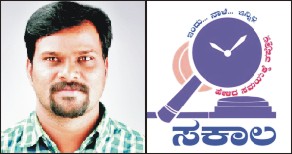
City artist Balaswamy’s logo has been selected for Sakala, the State government’s ambitious initiative aimed at providing timely services to citizens under the Karnataka Guarantee of Services to Citizens Act 2011.
The government had invited entries of logos for the initiative. Over a thousand participants had taken part in the contest, in which Balaswamy’s concept won the government’s approval.
Chief Minister D.V. Sadananda Gowda presented Balaswamy with a cash prize of Rs. 50,000 for creating the logo during the inauguration of Sakala recently.
Speaking to Star of Mysore, Balaswamy said that he had sent three designs of logos and his design based on ‘Time and Law’ (see above) was selected.
Family members of Balaswamy, who came to know about his interest in arts when he was studying PU at St. Philomena’s College in city, brought him an application from Chamarajendra Academy of Visual Arts (CAVA) and enrolled him there after PU.
After completing two years foundation course at CAVA, he took up Bachelor in Fine Arts (BFA) with specialisation in Applied Arts and completed his graduation in 1997 besides working in many advertisement agencies as designer in Bangalore.
He again came back to Mysore and completed his Master in Fine Arts (MFA) in the year 2004 with Sculpture as his specialisation.
He said that he is one among the five artists who created logo for University Grants Commission (UGC) and regretted that he could not go to collect the certificate which was presented by former President Dr. A.P.J.Abdul Kalam in the year 2003 owing to financial constraints despite having been invited. Balaswamy said that the news of his logo being selected was given by Mamatha, Joint Director, Department of Information over phone and added that he was delighted with the news. At present, Balaswamy is working as a freelancer in city.
He may be contacted on Mob:99003-00038.
source: http://www.StarofMysore.com / General News / March 31st, 2012

Respect the Girl Child: Prema Cariappa

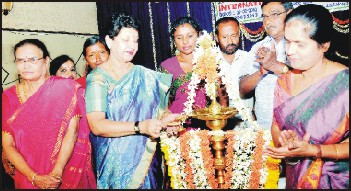
Caption: Prema Cariappa, Chairperson, Central Social Welfare Board, inaugurating the International Women’s Day celebration organised by Karnataka State Social Welfare Board at Rajendra Auditorium in JSS Hospital premises here recently. Others seen are State Board Chairperson Vinoda Nataraj and Karnataka State Women’s Development Corporation Chairperson Sarojini Bhardwaj.

Mysore, Mar. 28

“Members of the Indian society need to shed the ancient notion that only male issues can support us in our old age and that one attains ‘sadgati’ after death only if one is the a parent of a male child,” said Prema Cariappa, Chairperson, Central Social Welfare Advisory Board, New Delhi.

Speaking after inaugurating International Women’s Day celebration held under the aegis of Karnataka State Social Welfare Board at Rajendra Bhavan in city on Monday, she said that women are playing a pivotal role in the development of the nation and the country; but in spite of this, they are being discriminated.

She further said that even today, the birth of a female child is considered shameful. Even though girls excel in education they are being discriminated in the fields of higher education, professional courses and employment.

“The need of the hour is to educate girls. She said that the social evils like dowry etc. have ruined the society. Women are being burnt alive if dowry is not given. Police and judiciary seem to be helpless in stopping these crimes. Govt. is taking appropriate steps for the development of women but it is the duty of the voluntary organizations to come forward to work in the field of social work,” she said and opined that local elected representatives need to work towards eradicating this discrimination.

Board’s chairperson Vinoda Nataraj, State Women’s Development Corporation Chairperson Sarojini Bhardwaj and Women and Child Welfare Department Deputy Director N.R. Vijay were the chief guests.

source: http://www.StarofMysore.com / General News / March 28th, 2012

Tale of two cities

MULTIPLE CITY

Inscribed on the grains of sand, somewhere in the hour-glass of time, is the story of Bangalore, a story that has intrigued many. There are stories within stories of the multiple city that Bangalore is.

SIGHTS OF BANGALORE in the 1900’s. Clockwise from top left: A typical street with turbaned men and women ( Photo courtesy: Jane Smith, England , Missionary Fred Goodwill’s, grand daughter and Jones Ebinesan,  Western Australia).

A common thread that runs through the City’s centuries-old history is that of the constant pete-Cantonment parallel, and the story of the City’s municipal governance occupies a special place in the existence of two separate geographical entities within the map of Bangalore.

Even 150 years after the first municipal board came into existence on March 27, 1862, one can still tell the difference between the old City area and the Cantonment. Today, the cosmopolitan nature of the City, punctuated by people of many communities, occupations and ethnic origins might have masked the difference between the two areas, but not obliterated it. The dichotomy seems to be a constant through Bangalore’s history.

Although the first municipal board was already established in 1862 for old Bangalore, drawing a line of distinction, another board was formed on August 1 of the same year, to govern the Cantonment area.

State within a state

The Cantonment was a state within the state. Its demography was largely decided by the British. Historians point out that the British had, in order to cater to their various needs, brought ‘rich’ communities like the Mudaliars and Naidoos and some Muslims. They had also brought the ‘Harijan’ community to perform menial jobs.

With higher expendable income, larger budgets, special provisions, the Cantonment was elite. But the old City area could not be left out, not even if it were not the bosom of the City in the eyes of historians. Their charms were different. The Cantonment was English; the City area, notwithstanding some resembling architecture, was local.

But they were both vibrant by virtue of enjoying separate business districts, a provision the City planners post-Independence have given little importance to.

According to H S Doreswamy, the oldest (living) freedom fighter of Bangalore, the City’s business district housed all kinds of businesses, from oil producers to potters and silk weavers to bangle makers.

The Cantonment was different. It had bazaars that sold finished products, grocery and was home to a spectrum of entertainment avenues.

In 1871, a new municipal regulation saw the appointment of J H Orr as the fulltime president for the control and direction of the affairs of both the municipal. This was the first attempt at unified governance.

But the differences were not to be wiped out. The total revenue generation of the Bangalore City Municipality was Rs 43,010 while the revenue of the Bangalore Civil and Military Station Municipality (Cantonment) was Rs 92,617.

After the conclusion of the Commissioner’s administration and the beginning of the Mysore rulers’ administration, the Cantonment area was called British Cantonment.
By 1881, the differences in the administration became very apparent and caused discomfort among the locals in the City area. The administration continued, brushing aside these differences that did not last, for Bangaloreans then, like now, 150 years later, didn’t get ruffled too much by these differences.

Home to the British automatically meant more access to many provisions that the City area did not have. The ever-benevolent (British) government’s hand meant funds for development projects.

One such key priority that came the Cantonment’s way was drinking water supply. As early as 1881, Sampangi and three Millers tanks were the chief sources of water for the Civil and Military Stations. The Millers tank, constructed in 1854, was the first step taken to meet the demand for water. For the City, before the commencement of the scheme of protected (filtered) water supply to the City initiated in 1896 by Dewan K Sheshadri Iyer, unfiltered raw water was supplied from a number of tanks like the Dharmambudhi tank, Sampangi, Ulsoor and the Sankey tank.

The British officers deputed in Bangalore during the 1890s were looking for a new source of water supply. Major Grant worked at four sources––Maligal valley, Hebbal, Rachenahalli and Hessaraghatta––and M C Hutchins, the chief engineer of Mysore preferred Hessaraghatta.

More equal than others?

While people residing in the limits of the Bangalore City Municipality were levied three per cent-four per cent water tax, buildings and land used for military purpose were exempted from tax.

In 1892, for the first time, elections were conducted for these boards.
Voting rights were restricted only to male property owners and even among them, only those who have paid property tax, according to provisions of the Central rule of 1883. Both civil and military areas saw 18 members in all.

The differences between the two though, had to continue. Unlike in the City area, only in the Cantonment, women were allowed to vote. It was not until 1923, when the City board submitted a memorandum that women in the City area were allowed to cast their vote.

The differences continued even after Independence, as historians have described.
On December 8, 1949, post-Independence, both the boards were legally merged as one. But the most immediate challenge for the new administrators was to find the much needed co-operation for common administration. For the lines had to be “undrawn.”
The path taken after that needs little recalling. Bangalore has grown, it has a fresh identity. But the two separate identities that the Cantonment and City areas have given to Bangalore will continue to add to the charm of this City in its own way.

source: http://www.DeccanHerald.com / Home> Supplements> Spectrum / by Chethan Kumar / Tuesday, March 27th, 2012