Category Archives: Arts, Culture & Entertainment

VONTIKOPPAL PANCHANGA: Five Generations of expertise in Almanac

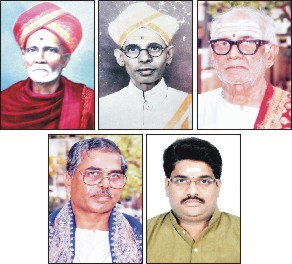
Caption: Siddanthi Tammaiah Shastry, Siddanthi T.V. Krishna Shastry, Siddanthi V. Ramakrishna Shastry, Siddanthi R. Kumar, Siddanthi K. Mohan

By M.S. Apuurva

Most of us will have memories of our childhood with our grandfathers reading from a book full of tables and text in small font, which we could never understand. The ease with which they would decipher the information in the book remained a mystery to us. The book — Panchanga — has been a part of Hindu household since ages and no ritual is held without referring to it.

During Ugadi (tomorrow), which marks the start of a new Hindu year, it is a tradition to read Panchanga (Panchanga Shravanam). The Panchanga reveals the forces that will rule various aspects of life in the coming year. This forecast deals with the transition and effect of constellations on the social life of people. It is a belief that those who read the Panchanga as well as those who listen will be rid of their sins and blessed with a long, prosperous and happy life.

Panchanga’s importance

Dharma plays a very vital role in Indian culture. Sages have allotted a specific time for every work (rituals) and this is defined in Dharma Shastra. Unlike in western traditions wherein for example, Dec. 25 every year is celebrated as Christmas, in Hindu customs, every festival has a fixed start time. Every ritual, be it naming or house-warming ceremony, must compulsorily be carried out within the designated span of time. This calculation of time is done using Panchanga. In simple words, the five attributes of Panchanga (Pancha-Anga) are: Vara – Time from one sunrise to the next sunrise; Tithi – It is the distance between the sun and moon; Nakshatra – It is the movement of the moon; Yoga – It involves the movement of both sun and moon; Karna – It is half of Tithi. The Pancha-nga has two systems — Chandramana and Souramana. The former is calculated based on the moon and the 12 months span from Chaitra to Phalguni, the latter is based on sun with the 12 months where sun travels from Mesha rashi to Kumbha.

Consisting of complex calculations mainly based on spherical trigonometry, Panchanga is propounded with the theories in Surya Siddantha. It is said that demon Maya meditated and Surya appeared before him to grant him a wish. Maya asked Surya to explain all the effects of the movement of Sun. Surya explained them through Sanskrit Shlokas. This was followed by Vakya, Aryabhatiya Siddantha and Dru Ganita (western). Vakya is followed by Tamilians and those who follow Souramana system; Aryabhatiya is used by Vaishnavas; Dru Ganita is mainly followed by people of South Kanara and Surya Siddantha by the remainder of Karnataka.

Vontikoppal Panchanga

One family from city has the pride of writing and printing Pan-changa continuously for the past 126 years. The Vontikoppal Panchanga, as it came to be known, was started by Siddanthi Tammaiah Shastry in 1887-88. Presently, the fifth generation of the family is carrying on the work.

Over the years, Vontikoppal Panchanga has been widely used across Karnataka and even abroad. When asked the reason for this popularity, Siddanthi R. Kumar says, “Ours is the only Panchanga in the world to print information in detail. We print according to all four categories — Surya Siddantha, Aryabhatiya Siddantha, Vakya and Dru Ganita — along with Chandramana and Souramana systems. Presently my son K. Manohar and I are its authors and my father is the verifier. Its printing has not stopped since it was first started by my great great grandfather.”

The Vontikoppal Panchanga has been accepted as the official Panchanga by the Government of Karnataka. The dates for all utsavs under Muzrai Department and govt. holidays are given by the family during June-July and the gazette notification is given during October.

Five generations of expertise

Siddanthi Tammaiah Shastry: This panchanga was started by him. He was born in 1862 at Agara of Yalandur and started learning astrology, literature, philosophy and dharma shastra from the age of eight years. He became the President of Sri Chamarajeshwara Sanskrit Pathashala, Chamarajanagar, in 1914. During 1887-88, he started writing the panchanga and printing it in Madras. In 1925, he was named as the Asthana Vidwan by Nalwadi Krishnaraja Wadiyar. In 1942, Jayachamaraja Wadiyar honoured him with the title Jyotishya Ratna and presented a golden bracelet. For 38 years he published the Panchanga before he passed away in 1944.

Siddanthi T.V. Krishna Shastry: Born in 1892, he learnt medicine, astrology, literature and Veda from his father. In 1932, Nalwadi Krishnaraja Wadiyar appointed him as the Head Master of Vontikoppal Middle School and requested him to compile Vakya Panchanga for the Palace. Since he resided in Vontikoppal, the Panchanga got its name. He passed away in 1946.

Siddanthi V. Ramakrishna Shastry: Born in 1918, he continued the publication for 80 years after the death of his father. He set up a press in city for printing the Panchanga. He was also the Hon. Member of American Astronomical Society. He retired after his son took over the responsibility.

Siddanthi R. Kumar: Born in 1950 at Kanuru, Hassan, he practiced law for a few years. He started learning from his father since the age of 14 years and lent a hand with the Panchanga since 1965. In 1980, he set up Bhagirathi Printers in memory of his mother. He started printing using offset method and recently shifted to web offset.

Siddanthi K. Mohan: Has been learning Sanskrit, astrology and panchanga calculation from his father since childhood and is presently helping his father with the preparation and printing.

When asked why no daughter of the family had continued the tradition, Kumar said, “It is not the question of son or daughter. Learning this knowledge should come in one’s horoscope. I have two brothers and four sisters but only I could continue this.”

American Panchanga

Vontikoppal Panchanga is the first in the world to bring out a Panchanga exclusively for America. “Many Mysoreans living in America would take this Panchanga. But this cannot be used to prepare horoscope there. Hence I started preparing one according to America latitude and longitude in 2001. Since America has 10 zones along with daylight saving, I have prepared this for New York City and have given conversions for other places,” says Kumar.

Publications: Apart from Panchanga, they also print pocket calendars, wall calendars, Ready Reckoner and Muhurtha Manjari. The Ready Reckoner Nitya Kundali Mattu Grahasputa is for professionals who write horoscope, etc. Muhurtha Manjari is an advanced Panchanga. It helps in fixing dates one year in advance. The work usually begins during June-July. Their press is presently located in Hebbal Industrial Area. The printing and sales is completed one month prior to Ugadi. “We need 6 to 7 months to prepare the Panchanga. We don’t use any software or computer and rely only on hand calculation,” says Kumar.

Panchanga can never be repeated

“Some allege that the same Panchanga published some 100 years back is repeated. But this is impossible because the position, speed and distance of stars will keep vary hence changing our calculations. We can never use the same Panchanga and write for another year,” says Kumar.

“If you want to check its accuracy, then the position of the moon or the occurrence of eclipse can be tallied with that mentioned in the Panchanga,” he adds.

Today, Vontikoppal Panchanga has become a household name in Mysore and across the State. Let us hope that the tradition is carried forward by the family for generations to come. [Kumar and Manohar can be contacted on e-mail: manohar13@gmail.com]

SOM was printed here

Remembering the time when Star of Mysore office was in Saraswathipuram, Kumar says, “On two or three occasions, when there was power failure at SOM office just before the paper was printed, it was brought to us for printing. Both had the same Mercedes printing press and it was a time when SOM sister publication Mysooru Mithra was yet to be started.”

source: http://www.StarofMysore.com / Feature Articles / by M. S. Appurva / March 22nd, 2012
A unique father-son duo remembered

DVG’s birthplace salutes litterateur on his 125th birth anniversary

D V Gundappa and B G L Swamy were an unusual father-son pair. Their contributions to Kannada literature were remarkable in their variety and intensity, said Dr Chandrashekhar Kambar

Dr. Chandrashekhar Kambar was felicitated at the Rangavithala Hall at Narashimhatheertha in Mulbagal on Saturday, the 125th birth anniversary of DVG. Justice N Nagamohan Das, Deputy Commissioner Manoj Kumar Meena, P N Srinivasan, K Prahlad Rao, K R Narasimhan and Komul Director Kadenahalli Nagaraj are also seen.  DH Photo.

“Both of them won the Sahitya Akademi Award twice. In many ways, they were like another father-son duo, Kuvempu and Poornachandra Tejaswi.”

Dr Kambar was speaking at the programme commemorating the 125th birth anniversary of DVG, organised at the Rangavithala Hall at Narasimhatheertha on the outskirts of the town on Saturday.

“DVG was a multi-faceted personality. He contributed greatly not just to Kannada literature and culture, but also to Indian journalism,” said Kambar. “The litterateur followed the ideals he presented in his works.”

Justice H N Nagamohan Das inaugurated the programme.

“His lifestyle was simple, as he never used the money he received with the awards for his own needs. Instead he donated the money for the establishment and growth of the Gokhale Institute,” he said.

Speaking about DVG’s works, Justice Das said one can find in the writings several interesting aspects of contemporary town-life in Mulbagal, the birthplace of DVG.
P N Srinivasachari, general secretary of the Department of Small Irrigation, unveiled a picture of DVG. Amaresh, MLA, presided. K R Narasimhan spoke on the life and works of the litterateur.

Dr Shivanna welcomed the gathering. Cultural events were presented by Moodala Nritya Academy. The programme was organised jointly by the Dr D V Gundappa Trust, Department of Kannada and Culture, C Munishami Charitable Trust, Amarajyothi Education Society, Deccan Education Society, Sharada Education Trust and pro-Kannada organisations.

Manjunath Prasad, managing director of KSRTC, Manoj Kumar Meena, Deputy Commissioner, Kadenahalli Nagaraj, chairman of the Amarajyothi Education Society, K Prahlad Rao, chairman of the DVG Trust, K V Jagannath, chairman of the Taluk Primary School Teachers’ Association, Mangamma Muniswamy, Zilla Panchayat member, P Jayamadhava, tahsildar, B N Venkatachalapathi, assistant director of the Department of Kannada and Culture, and others were present.

In Malur

“DVG was a great thinker who visualised the cultural life in the 20th century,” said H S Satyanarayana, professor at the Varthur Pre-university College.

He was speaking at the DVG birth anniversary programme organised at the Agricultural Society Hall in the town by the Chutuku Sahitya Parishat on Saturday.

“Having arrived in Bangalore, tugging along the ‘bullock cart of life’, DVG presented the versatility of his achievements as a litterateur as well as member of the Legislative Assembly,” said the professor.

The book ‘Raktaratri’, by youth poet Na Muniraju, was released by Satyanarayana.

M V Hanumanthaiah, chairman of the Bapuji Education Society inaugurated the programme. Kannada Sahitya Parishat immediate past president A Ashwattha Reddy chaired the programme.

source: http://www.DeccanHerald.com / Home> District / Mulbagal, DHNS / March 17th, 2012

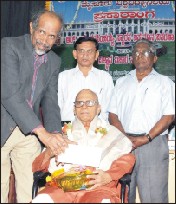
Prof.R.L. Narasimhaiah Award presented


Caption
: Physicist Prof. Roddam Narasimha presenting Prof. R. L. Narasimhaiah award to Dr.B.N. Satyanarayana Rao as Mysore University Registrar Prof. P.S.Nayak and Prasaranga Director Prof. Prabhu Shankar look on.


Mysore, Mar. 15

Mysore University has the distinction of publishing four editions of science literature under the stewardship of K. L. Srimali while he was the Vice-Chancellor, said former Prasaranga Director Prof. Prabhu Shankar here this morning.

He was speaking after inaugurating a function organised by Prasaranga at Rani Bahadur Auditorium in city for presenting Prof. R. L. Narasimhaiah award and a seminar on Science literature in Kannada.

The award was presented to Dr.B.N. Satyanarayana Rao by Physicist Prof. Roddam Narasimha. Science writer Prof. J.R. Lakshman Rao was present.

source: http://www.StarofMysore.com / General News / March 15th, 2012

Unique Shakespeare Expo at St. Philo’s

Mysore:

The Literary Club of St. Philomena’s College, Mysore, presented an astonishing and highly educative literary exhibition during the last weekend.

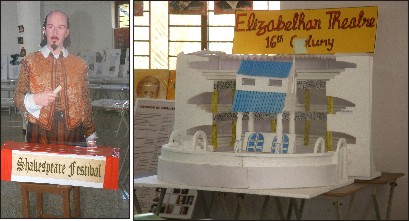
The English Dept. and Functional English Dept. came together under the banner of the Literary Club to present an event that took students, professors and connoisseurs of Mysore down the memory lane with a series of programmes under the title ‘Shakespeare Festival.’

The programme was a package that comprised a colloquium, interaction session on Shakespeare’s plays, a few competitions with cash prizes and a mind-blowing exposition of 37 plays, sonnets and longer poems of Shakespeare apart from a whole section devoted to Strat-ford-upon-Avon and production of Shakespeare plays in different parts of the world.

The expo was an artfully arranged and slick presentation of over 600 display cards, photographs, snapshots, posters of plays and portraits of almost all major British and European writers influenced by the bard, from the private collection of Prof. B.N. Balajee.

The rich colourful presentation of myths and legends of the western world, lovely pictures of Shakespeare’s flowers and birds along with the dramatic contexts in which they appear in his plays were kept for the visitors’ view.

The exhibition had utilised the Fandex card originals published from New York, pictures and plates from various masterpieces of drama capturing scenes of plays from Shakespeare’s plays through the ages along with unique productions of other European and English plays. It was a feast to students of literature, research scholars and lecturers of English.

Students who had only heard about the Globe Theatre, London and RSC Shakespeare Company Stratford could see the photographs of celebrated actors like Michael Redgrave, Richard Burton, Sir John Gielgud and Laure-nce Olivier. One was surprised to see Indian productions of Sha-kespeare, Berkley production of Harvest and Texas production of Nagamandala.

The picture presented the pillars among Indian playwrights who wrote in English that included colourful and impressive pictures of Girish Karnad, Manjula Padmanabhan, B.V. Karanth and K.V.Subbanna.

The picture depicting the life of Shakespeare in Stratford-upon-Avon and fine brochures of RSC, Broadway and Globe Theatres provided informative details about the growth of theatre and the Bard’s contribution to drama.

The exhibition had unique quotes here and there with impressive water co-lour portraits of English poets from Chaucer to Auden and portraits of Arundhati Roy, Salman Rushdie and Vikram Seth and were especially worth seeing.

The expo had a section devoted to over 50 pictures depicting a semiotic interpretation of English literature from 1485 to 2010.

Many visitors were busy taking pictures of rare exhibits and most young visitors wrote down the list of abbreviations used in electronic messaging format. The exhibition also had a thermocol model of Elizabethan Theatre made by PU students.

The exhibition which was part of the Shakespeare Festival on Feb. 25 and 26 for the first time brought for Mysore an extraordinarily visual depiction of Shakespeare’s literary art in particular and world drama in general.

The visitors could write a line about why they admired the plays of the bard and join the competition that offered Rs. 1,000 prize to one lucky visitor.

The exhibition was conceived and directed by Prof. Balajee of the Functional English Dept. with support from Rev. Fr. Leslie Moras, Principal and technical support from Prof. Babu of the Malayalam Dept. — OSR

source: http://www.StarofMysore.com / Feature Articles / March 03rd, 2012


History scrolled in Silver


Mysore:

The beauty of the century-old Mysore Palace is not just in its outer appearance but also in the amount of knowledge it houses about our history, culture, craftsmanship, architecture, etc. A new addition to this knowledge bank is the recently opened chamber which contains scrolls presented to the Wadiyars of Mysore.

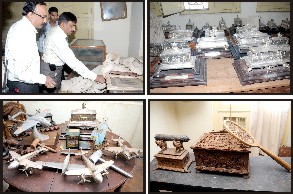
Those were the days when people considered the visit of a king to their land as good fortune. And the king had to be honoured on his arrival to make the occasion memorable. This was done by presenting the king with scrolls kept in cases designed aptly for the occasion. The erstwhile Maharaja of Mysore Jayachamarajendra Wadiyar was presented with 96 such scrolls housed in elegantly designed cases during his visit to functions at various places.

These cases are made of pure silver or sandalwood. The gifts include: A silver model of an aircraft presented to the Maharaja by HAL, Bangalore, in 1948 when he was there in connection with a function; a bridge shaped memento when the King laid the foundation stone for Suvarnavathi River bridge; a sandalwood replica of the Gopuram of Ghati Subramanya Swamy Temple which was presented in 1951; a sandalwood racket which had been presented during a badminton tournament held in Mysore; a silver idol of Goddess Chamundeshwari presented on the occasion of the 16th Akhila Bharatha Lingayatara Sammelana at Basavakalyan; a silver memento presented during the inauguration of general hospital at Davangere; a scroll presented when financial aid was given for the construction of Shimoga and Davangere hospital, etc.

Added to this list are priceless silver and sandalwood mementos given to the Wadiyar to mark his visits to functions at various places like CMC Hospital at Vellore, Shimoga, Bangalore, Kolar, Theerthahalli, Udupi, K.R.Pet, Gokak, Hassan, Yelandur, Belgaum, K.R.Nagar, Gudibande and the gift presented during the diamond jubilee celebration of Madras Ayurveda School.

The cases have carvings depicting scenes from epics like Ramayana, Mahabharata and Gita and pictures depicting the coronation of Wadiyars.

The Mysore Palace Board has now come forward to display these hitherto unseen and unknown 96 precious gifts for public view. These items will be displayed at the rooms adjacent to the Darbar hall on the first floor of the Palace, says Palace Board Deputy Director T.S. Subramanya.

With this, the visitors from various places will have a rare opportunity to view the royal gifts given by their ancestors to the king and the history and occasion behind it. For the convenience of visitors, all these items will soon be showcased in a 360 degree angle view on the Palace website (www.mysorepalace.gov.in) which also offers a virtual tour of the Palace, adds Subramanya.

— By Kiran Kumar

source: http://www.StarofMysore.com / Feature Articles / March 03rd, 2012


A tale of four Palaces


Mysore:

The tale of Yaduvamsha begins with Yaduraya marrying Devajammanni (1399), the daughter of Chamaraja who had died without a direct male heir. Yaduraya inherited the small principality of Mysuru which consisted of 33 villages earning a sum of 3,000 varahas annually.

First Palace: It is a matter of conje-cture as how the Palace of Yaduraya looked like. It must have been an enormous one with many courtyards than a regular house. This first Palace of Wadiyars was struck down by lightning sometime in mid 17th century.

Second Palace: A second Palace was built within a secure fortress during the reign of dynamic king. Ranadheera Kanteerava Narasaraja Wadiyar (1638-59). As per written records, this Palace contained various halls, pavilions, quadrangles and temples. The fort was filled with residences of artists, singers, dancers, musicians, scholars and jesters and an army of soldiers. With the ascension of Tipu, he declared himself Sultan and slowly worked to obliterate the heritage of Wadiyars. He dismantled the Palace and the fort at Mysore, and went about to establish a new town ‘Nazarabad’ just across the Devaraya Sagara. His plans, however, came to nought midway and never materialised.

Tipu died in the IV Anglo Mysore War in 1799. The 4-year-old Krishnaraja Wadiyar III was to ascend the throne after moving the capital to Mysore. Palace records state that the coronation was performed within the premises of Lakshmiramana temple since the Palace was in ruins. Hastily, a new Palace was built (1799-1801) on the foundations of the old Palace which was richer and grander compared to its predecessor.

Third Palace: This Palace was built in 1801 to house the royal family after shifting the capital from Srirangapatna. This east facing edifice was built in typical tradition of the times, had four huge twin wooden columns standing two storeys high. The colonnaded ground floor sported a handsome plinth (jagali). The main entrance to the Palace was a painted pair of elephants flanking the main door. The colonnaded hall on the first floor was the durbar hall where the Maharajah was seated on the golden throne during Navaratri celebrations. The complex had 24 peristyles or colonnaded courtyards (totti) each serving a specific purpose catering to the different administrative wings of the Palace including a reception area, meeting hall, etc.

Three more floors rose above in a pyramidal fashion, the topmost bearing pancha kalasha. Prominently placed was a stucco image of Goddess Gaja Lakshmi. The Palace was a five storey wooden structure of teak, rosewood and sandalwood. Ornamental silver door frames, carved wooden pillars, niches, murals and paintings decorated the halls and corridors of this Palace. The Palace was 245 feet long, 156 feet wide and stood 145 feet tall. The fort (1350 feet x 1400 feet) was also rebuilt at the same time.

The coronation ceremony of Krishnaraja Wadiyar IV in 1895 and the wedding celebrations of Princess Jayalakshmammanni in 1897 were the last two major events hosted in this Palace under the regent Rajamata Vanivilasa Sannidhana before it was gutted in an accidental fire in February 1897.

Fourth Palace: The fourth Palace was rebuilt at the same place under the command of Rajamata Kempa-nanjammanni Vanivilasa, designed by British architect Henry Irwin, built by executive engineer B.P. Raghavulu Naidu at a cost of Rs. 41 lakhs. Amba Vilasa was one of the prominent royal Palaces to be built at the dawn of 20th century and it attracted critical acclaim at the global level during its construction and finishing stages.

Clearing of the Fort: An enormous number of public buildings, houses, mansions and bhajana mandiras were demolished between 1908-10.

In fact, an entire township within the old fort walls was cleared to create the ambience and look as seen today. The perfect unhindered view of the Amba Vilasa in any direction and angle within the ramparts is a mesmerising sight. The Palace construction was completed in 1912.

Construction of the Darbar Hall: In the year 1930, Krishnaraja Wadiyar IV sought for renovation of the front facade of the new Palace. Portico of the main entrance was demolished and a magnificent durbar hall with 9 arches supported by 10 pillars, was built at a cost of Rs. 6,21,000. The capitals of these arches sport the turbaned Mysore soldiers and the famed Mysore Lancers.

The northern and southern twin towers with three domes were the last addition to the new durbar hall in 1932. Proceedings of the Durbar Hall Committee meeting on 11 May 1934 states, “The committee examined 13 designs received for the durbar hall ceiling. The design submitted by K.S. Siddalingaswamy is considered the best among the designs received since the whole design is entirely original and fully oriental in conception and it strictly confirms to the canons of Shilpa Shastra.”

Inside the Palace: The interiors are no exception when it comes to the opulence and beauty. The private durbar hall is definitely the crown jewel of the Palace. The turquoise, gold and red painted pillars with hanging mango brackets and fairies in relief support a majestic stained glass ceiling in the centre.

It was the acclaimed artist K. Venkatappa whose three bas relief sculptures adorn the private durbar hall; he also provided the rich colour scheme to this hall along with several other wings of the new Palace. Rosewood doors inlaid with ivory, doors with silver repousse work, huge chandeliers, enhance the richness of the hall. The octagonal marriage pavilion has 26 paintings of Dasara procession and other celebrations painted by seven well known artists of the time.

An armoury room Ayudhashala within the Palace has about 725 catalogued arms and armoury belonging to different kings of Wadiyar dynasty and also a few arms wielded by Hyder Ali and Tipu Sultan. This armoury was established in 1635 by Chamaraja Wadiyar V. The contents of this room were documented for the first time during the reign of Krishnaraja Wadiyar III and all the arms were inscribed Sri Krishna. The weapons carried by the Ursu noblemen and those worshiped during Ayudha Puja are later deposited here.

Gateways of the Fort: Apart from the five magnificent imposing gates of the Palace, there are two minor gates and one gate on the west which is a relic from the reign of Krishnaraja Wadiyar III. This western gateway to the fort, Bra-hmapuri, opens out on to the road which directly leads to the Jaganmohan Palace — the royal residence between 1897 and 1907.

The south-western gateway is called Karikallu Thotti Dwara. The stucco work in spandrels and on the pillars is of very high craftsmanship. This gate offers a direct access to temples of Khille Venkataramana Swamy, Lakshmiramana Swamy and Prasanna Krishna Swamy which are often visited by citizens.

The eastern rampart of Mysore fort is punctuated by an inspiring, gigantic arched gateway Jaya Martanda Dwara with adjoining corridors. A grand pano-ramic view of the front facade of the Pa-lace which includes the bulbous domes and the gold plated central spire, the massive arches and the side flanks topped with the terracotta coloured domes comes alive as one approaches the Amba Vilasa.

Even after the construction of the main Palace in 1912, several structures were being altered. Archival records state that the ‘T’ shaped corridors adjoining the east fort gate were constructed in 1933.

The southern gate Varaha Dwara of Mysore fort is dedi-cated to the presiding deity of the Shweta Varahaswamy temple. A stucco image of Kaliya Mardana in an arched pediment on this gate has stood silent sentinel to the departed royalty en route to Madhuvana. The towering gopura of the Shweta Varahaswamy temple is decorated with stucco niches and figures. The main temple is a relic from the Hoysala times. Chikka Devaraja Wadiyar (1673-1704) brought the idol of Shweta Varahaswamy from Shrimushnam, Tamilnadu. It was installed in a temple at Srirangapatna which was destroyed in 18th century.

Krishnaraja Wadiyar III, under the supervision of Dewan Poornayya got the idol installed in the present temple. The Ambujavalli shrine dedicated to the consort is a low ceiling pillared structure. Both temples have their interiors painted with Mysore style murals depicting episodes from the Ramayana and Bhagavad Gita.

The twin gates in the northern side Jayarama and Balarama have a temple dedicated to Anjaneya in between them, both the gateways have arched pediment with the royal coat of arms of Wadiyars with the legend Satyamevoddharamyaham. The inner walls of central arch of both gates sport mural paintings of the Bangalore Palace, Jog Falls, Ooty Fernhill Palace and the old Palace by master portraitist Madhugiri Ramoo done in 1951.

Bronze tigers, created by British artist Robert William Colton, are placed two each flanking the north, south and east pathways in front of the Palace. Around 97,000 electric bulbs, when lit, dot the outline of the super structure and allied buildings within the fort presenting an awe inspiring sight.

Archival records state that the formal griha pravesha of the new Palace was performed in 1907; the first major event hosted in the Palace was the upanayana of Yuvaraja Kanthirava Narasaraja Wadiyar in 1910 while the marriage festivals were conducted at the grand hall of Jaganmohan Palace. The major event at the Palace during the reign of Nalwadi was the silver jubilee of his coronation in 1927 and the last spectacular event in the grand hall of Amba Vilasa was the coronation durbar of king Jayachamaraja Wadiyar on Aug. 8, 1940.

Mysore Palace – Celebrating a Century: City-based art foundation Ramsons Kala Pratishtana has published a unique journal Mysore Palace – Celebrating a Century using 82 photographs and paintings depicting various stages of the Palace being built. The journal is made up of two parts — the first part has photographs and texts depicting the making of Mysore Palace while the second part has ruled pages where one can write their experiences and thoughts when they visit the Palace.

The Journal will be released by Palace Board Deputy Director T.S. Subramanya at a function to be held tomorrow at 11 am at Pratima Gallery in front of City Zoo. Historian Prof. P.V. Nanjaraja Urs will be the chief guest. For details about the journal, contact Raghu on Mob. 9880111625.

— R.G. Singh, Secretary, Ramsons /Kala Pratishtana

source: http://www.StarofMysore.com / Feature Articles / March 03rd, 2012


Over a cup of evening Tea: Unnoticed talent in a shy Artist

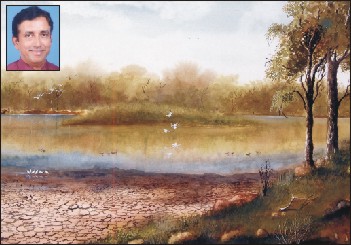
Mysore: Very recently I received an unusual and unexpected gift from one of my patients, Atyeb Ahmed, who is into the construction business. He used to visit me in my clinic now and then seeking a prescription either for his own minor ailments or those of his family members. One day he walked in and handed me a package saying that it was a gift from him. When I opened it, I found that it contained two very pretty landscapes in watercolour, beautifully framed. I was pleasantly surprised when he told me that they were his own work and that painting was his hobby from childhood.

My surprise turned to astonishment when he said that he was a self-taught artist without any formal training, while his work reflected an unusually high level of excellence. It appears he was an introvert as a child, preferring to retreat into the nooks and corners of his house with his crayons, drawing pictures on the backs of the wedding invitation cards his father used to receive.

He was attracted and inspired by characters like Phantom and Mandrake in the comics that his older sisters used to read and he would reproduce them endlessly.He says that his fascination with drawing and painting was so intense that all his notebooks used to have their last few pages full of his art and very often while his friends wrote seriously during their class tests he used to draw and paint on the answer sheets.

Hearing that the world-famous heavyweight boxer Muhamed Ali was likely to visit Srirangapatna, he once painted Ali’s portrait hoping to meet him there and get it auto-graphed. The visit was some-how cancelled at the last moment and a disappointed Atyeb says it would have otherwise become his most prized possession today. It appears he was initially very shy of exhibiting his work but developed confidence in his artistic abilities when he was adjudged the first prize winner in a painting competition organised by the Jaycees and the Traffic Police in the city in the year 1979 and his name appeared in many newspapers including Star of Mysore.

After this, while he was studying at the National College in Bangalore, thanks to the encouragement he received from the Principal, he started participating in painting competitions regularly, winning many awards and prizes. It appears he won awards at the Dasara Exhibition too but seeing the quality of his work the organisers refused to let him participate in the amateur category forcing him to compete with the professionals.

He attributes the excellence of his artistic abilities to the encouragement he received all along from his family members, friends and teachers who, instead of criticising him for his seemingly useless obsession, encouraged him in doing what he liked to do most.

Atyeb may be contacted on Mob: 98454-90808.

source: http://www.StarofMysore.com / Feature Articles / by Dr. K. Javeed Nayeem, MD / March 02nd, 2012

Having a wheel of a time

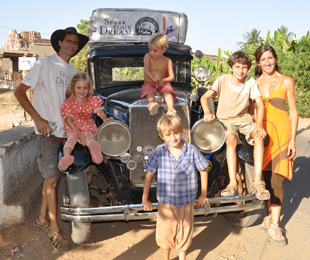
Candellaria and Herman Zapp have been travelling in a vintage car for the past 12 years. They have criss-crossed 37 countries and there have been four births along the way. Right now, they are parked at Hampi

Each of the Zapp children was born in a different country. They’ve never been to school, but life has taught them wonderful lessons

For once, Hampi in itself was not the attraction but a vintage car that trundled in, carrying a family of six. One look and people know that this is no ordinary car and no ordinary family.

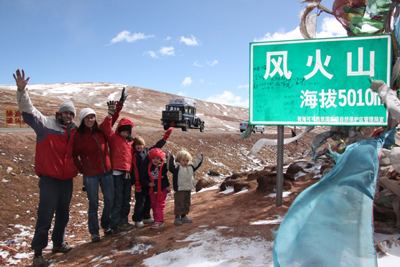
Herman and Candellaria Zapp from Argentina started out 12 years ago in their 1928 Graham-Paige that’s not just a means of transport, but their very home. They’ve criss-crossed 37 countries since, covering almost the distance to the moon, as they put it. What started as a six-month trip from Argentina to Alaska stretched into more than 40 months and the trip is not yet over.
“I hope it will continue for another three-four years. However, we don’t have any plans yet. We will continue as long as we can,” said Herman Zapp, 40.
The Zapps, for whom life is an adventure, is the only known family touring the world in a vintage car. They’ve covered countries as diverse as Sri Lanka, Cambodia, Japan and Peru and are now in Hampi for three days.
A truly global family

During their never-ending journey, the couple has had four kids  and yes, each of them was born in a different country. Pampa, eight, was born in Greensboro, North Carolina, Tehue, five, was born in Argentina, Paloma, three, is a native of Vancouver Island and little Wallaby, two, was born in Australia. The four have never been to school and are taught to look on life as their teacher.
“It’s challenging,” said Zapp. “We don’t stay in any lodges or hotels. This vintage car is everything for us.”
It was given to him by his grandfather and Zapp has to stick to the 40 mile per hour speed  limit that the 84-year old car is restricted to.
“It’s like adventure trekking across the world and we plan to write many more books on our experiences in the days ahead,” said Zapp. They’ve already published a best-seller based on their experiences. Atrapa Tu Sueno was printed during their trip to Alaska. It was later translated into English as Spark your Dream and was the best-selling book at the International Book Fair of Costa Rica. It’s their bread-winner.  The travelogues are well received by readers across the globe, said 35-year-old Candellaria.
The couple is uncertain about what lies ahead but they’ve sparked their dream and there’s no turning back.
Each night,  the six Zapps either sleep in or around a tent set up next to their car, but more often than not they find a friendly local who will put them up for the night.
“This isn’t just a feat by my wife and my young family,” said Herman. “This has a roll call of 12,000 people who have helped my family over the past 11 years.”
And that thought powers them on.
source: http://www.BangaloreMirror.com / Home> News> City> Story / by Chetan R / Monday, March 05th, 2012


Taking the tradition further thro Veena

By S.R. Krishna Murthy

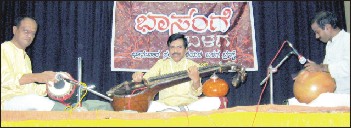
A veena concert by R.K. Padmanabha had been organised by Bhasange Balaga, the youth forum of the city, as part of its monthly programme, on Feb. 19 at Vasudevacharya Bhavana of Nadabrahma Sangeetha Sabha on JLB Road.

Padmanabha plays on his inherited Veena, which is known by the name ‘Kanaka Rajatha Saraswati Veene’, a gift to his father R. S. Keshava Murthy by his Guru Asthana Vidvan Veene Subbanna. This Veene was passed on to Padmanabha, as per the tradition, both by materialistic value and scholastic knowledge. It is a priceless heritage artifact, which I have described in one of my articles. It produces a beautiful Nada (sound), very pleasing to the ear. If it is so much and more on the instrument, the player Padmanabha also inherits the technique of traditional Mysore Bani, which he is carrying on further.

Padmanabha chose to play a dozen krutis in his concert, displaying diversity in section of Raga and Kruti. He flagged off his concert with a Varna Chalamela (Nata Kuranji-Adi-Ranga Swamy Nattuvanar) and proceeded on to Gam Ganapathe (Hamsadhwani-Rupaka-Mu-thaiah Bhagavatar), a briskly played Kruti with a lilting Swara, invoking the blessings of Lord Ganesha. Rama Bhakti Samrajyamu (Shuddha Bangala-Adi-Tyagaraja) was also melodiously played, although appeared to be in a bit of hurry. But the very next Akhilandeshwari (Dwijavanthi-Adi-Muthu Swamy Dikshitar) was treated with the correct perspective pace it deserves. The versatility of the Vainika came to fore in the Madhyama Kala Kruti Manavyalakinchara (Nalina-kanthi-Adi-Tyagaraja), which was rendered in a speedier pace, in which a sparkling Swara was also taken in the same speed.

Padmanabha came to the sub main Raga of the evening by taking up an Alapane in Gowri Manohari, the 23rd Mela Karta Raga. Most of the composers have composed in this raga. But one interesting point is that more compositions are not found composed by them, except Tya-garaja, who has composed a couple of krutis like Guruleka Etuvanti, Pancha Nandeesha Pahimaam etc. The Vainika selected the former in his rendering, set to Khanda Chapu. He also took up the Neraval at Tatva Bodhana Jesi, with many cycles, concluding it with a brilliant Swara — brilliant in spite of pace being accelerated at the Muktaya stage. One of the most popular Hindi Kruti of Swati Tirunal Vishweshwara Darushana Karo, a Kshetra Kruti on deity Vishweshwara of Varanasi (Kashi), was the subsequent one before going to the main item of the evening. A splendid Alapane in Kalyani was replete with Manodharma. The range and emotional contour he displayed went well to the ears. A Veene concert without a Tana is considered as a sumptuous meal without salt. The Tana in Kalyani was excellent, with apposite Laya and in different combinations. Veene is an instrument which can produce almost near human voice, when played with a deft hand. If a listener knows the lyrics of the Kruti played, he can definitely HEAR it. This was the case here when Padmanabha played the Kruti Etavunara of Tyagaraja in Rupaka Tala. After rendering the Kruti in Vilamba Kala, a Neraval at Seetha Gouri Vageeshwari added flavour to the rendering. The Swara was a countersignature for the beauty of the kruti. Though the gradual acceleration was not a necessity, it was played with greater energy level with impromptu improvisations. He could even produce different Swaras by pressing the string from outside the fret board, at the top end, which spoke a lot about the ingenuity of the artiste.

The tail enders were two Devara Nama and a Tillana of Veene Sheshanna in Janjhutti. He concluded his concert on a serene note with Bhagyada Lakshmi Baramma (Madhyamavathi-Adi-Purandara Dasa). On the accompaniment side were G.S.Ramanujan on the Mrudanga and S. Manjunath on the Ghata, contributing immensely for the success of the concert.

It was a day, in which Manodharma favoured the Vainika. An inspired Padmanabha exhibited his virtuoso with his ever smiling facial expressions, which the audience enjoyed.

source: http://www.StarofMysore.com / Feature Articles / February 28th, 2012


Info on Mysore Palace to Tourists through Tablet PCs

Caption:  ZP CEO G. Satyavati inaugurating the training camp for tourist guides being conducted by the Department of Tourism and District Administration at the Tourism Development Institute here yesterday as (from left) Training Camp Liaison Officer Prof. S.S. Kumar, DC P.S. Vastrad, Tourism Development Institute Director Prof. K.S. Nagapati and Liaison Officer Dr. Gopal look on.

Mysore, Feb.28

Tourists visiting the world famous Mysore Palace will in future be provided audio visual information through tablet PCs (mobile computers usually having touch-screen) provided by the Palace Board on rental basis.

Disclosing this yesterday at the inaugural function of Pravasi Margadarshi, a month-long tourist guide training programme for SSLC passed candidates, organised by the Tourism Department at the Tourism Development Institute at Mahajana College in city, Deputy Commissioner P.S. Vastrad said this project would be implemented in the coming two months.

Mysore Palace, which attracts a large number of tourists, has surpassed Taj Mahal in Agra with more tourists visiting the Palace.

In a bid to attract more tourists, the audio kits, which is being used at present, will be replaced with tablet PCs containing the photos of Mysore Palace which can be seen in 360 degrees with audio visual information in multiple languages. The contract has been given to a private firm and the scheme will be launched in two months, he said.

5-Day package tours

“Mysore stands 4th in the world for the number of tourists visiting the place. Till now, those visiting Mysore would see the tourist spots from morning to evening and then visit KRS in the night,” the DC said and added that other places like Srirangapatna, Rang-anthittu Bird Sanctuary and other tourist spots in the surroundings will be included in the package tours (three to five days) for which wide publicity will be given.

Speaking after inaugurating the function, Zilla Panchayat CEO G. Satyavati said that presently, tourism is one of the main revenue earners in which Kerala stood first in the country because of the training in hospitality they have given to drivers of autos, taxis and other vehicles, including the tourist guides, she said and added that such type of training should be given here also as guides play an important role in attracting tourists through their good behaviour.

Prof. K.S. Nagapati, Director, Tourism Development Institute, said that India had failed in marketing the tourism sector and hence 5 and 3 years courses have been started at the college.

Around 40 persons will be trained in the present programme for a period of one-month. For practical training, the trainees will be taken on a tour to North Karnataka. After completion of training, the guides will be provided with identification cards as accredited guides.

Raghavendra of Bannur, who is undergoing training here, said that this training will give him a new lease of life. “I have studied only till SSLC and was worried if I can get a job. After completing this training, I will be able to start work,” he said.

Siddaraju of T.N. Pura said that he will be proud to work as a tourist guide and will learn more languages to provide correct and detailed information to the tourists.

source: http://www.StarofMysore.com / General News / Tuesday, February 28th, 2012