Category Archives: Arts, Culture & Entertainment

These ‘gurls’ love their rides

It’s all about passion for a classic bird, say the biker girls in the city. They take Bhavya Thimmaiah for a spin on their bikes and share with her stories of their obsession

The distinctive thump of a long-stroke, single-cylinder engine reverberates, amid the cacophony of Bangalore traffic. It’s a 1970, Classic 350cc Royal Enfield Bullet weighing 180 kgs plus and measuring 2120 mm (millimeter) length, 780mm width and 1080 mm in height. It’s a beauty. As she thunders down the road on a Sunday afternoon, people awaken not to her beauty, but to the damsel straddling it- Bhavya Srinivasan, 5.4” tall and weighing 65kgs. A speeding car making its way through the traffic slows down a wee bit; the passenger window rolls down and a gentleman gives Bhavya a ‘thumbs up’. “Great job, ma’m. Keep going,” he says. That’s the kind of attention Bhavya gets every time she goes for a ride on her Bullet.

Left to right: Shilpa Thoudam, Bhavya Srinivasan, Bindu Reddy, Vinutha P G and Swathi Reddy (pillion)
Bhavya, an entrepreneur, has been riding a Classic for the last nine years. What began as a curiosity “about bikes during college days” has now turned into passion. She’s now joined hands with HopOnGurls!, the only group in the city to teach women how to ride a Bullet.
HopOnGurls! is the brainchild of 25-year-old Bindu Reddy, a solutions engineer. “I can never forget my first experience on the Bullet; it started off as a bet that became a craving. I took my friend’s Thunderbird and rode away with my friend running behind to catch his birdie,” she says, giggling at the memory. “A memorable day that made me go crazy about this machine.”
Bindu’s friends taught her to ride a Bullet. “I always wondered why isn’t there an instructor to teach girls to ride a Bullet.” Why not start a riding club for girls? She asked herself. As a birthday gift, she asked her college friends – Lionel, Mrudul and Raghunandan – to help start HopOnGurls! in 2011. Bindu’s first students were a mother-daughter duo – Kusum, 56, and Roshini, 25. “The mother was more enthusiastic than the daughter,” recalls Reddy. The mother took about 4 weeks to master the bike. Bindu had another student, Jayanthi Kalyanaraman, a 34-year-old business analyst, who would come from Chennai every weekend to learn to ride the Bullet. “I wanted to learn to ride for a long time but was unable to find a willing teacher in Chennai despite being ready to learn from a male one,” says Jayanthi. She completed the course in 3 weekends. For Jayanthi, it all began with her father challenging her to ride the Bullet in “front of him and then, only then, he said that he’d allow me to buy one,” says Jayanthi, smiling at the memory. Today, there are 60 women Bullet riders in the city and more than 80 associated with HopOnGurls!
Come every Sunday, you will see a bunch of girls learning how to ride a Bullet in a peaceful lane in Koramangala. Spread over 8 sessions, the classes are conducted every Sunday for an hour or so. Apart from teaching to ride, technical sessions are also conducted which include servicing of the bike and knowing your bike better. “We are the only ones to provide bikes to the learners unlike other places where they ask you to bring your vehicle. We also give an opportunity to those girls who have learnt from us to come back and teach others,” says Bindu.
A woman Bullet rider in the city roads always makes heads turn. There have been instances where people have placed bets to know if it is a girl riding a Bullet, encouraged them, challenged them and tested them if they are capable of handling this mean machine.
Bhavya recalls her trip to Chickmagalur in December 2011 where the villagers clad in dhoti and turban stood in a row watching the women ride past them. “There were men calling each other and pointing towards  us,” recalls Bhavya. Interestingly, nobody teases a girl riding a Bullet but they are put to test or challenged. There are some who provoke them to race with them, but “there is a lot of respect shown to the women riders”. When Shilpa went to get her driver’s licence, the RTO officer was impressed when he came to know that she rides a Bullet. “There are times when I’m not charged a parking fee; the attendants take my helmet and say, ‘Ma’m, I will take care of the bike and the helmet’,” says Bhavya. But, not all have the same outlook towards woman riders. “Once a cop asked, ‘Is it necessary that you ride such a vehicle? Can’t you get a smaller size vehicle for yourself?’ When we offered them a ride, they quietly slipped away.” At times, the men on the road also get protective about the women riders. “There have been instances when they’d wave to bus drivers asking them not to overtake us. We have the confidence. Wonder why they get so worried?,” asks Shilpa.
Riding bikes boosts the confidence level. “Mine has shot through the roof since I started riding,” says Shilpa. “I have realised I can handle such a mean machine.” But there are some who are still struggling to convince their parents about letting them ride a bike or even buy one. The girls say they are not feminists. To them, riding a bullet is not about being macho. They enjoy wearing a sari and attending a function as much as they do wearing jeans and riding a Bullet. It’s all about passion for a majestic bird.
source: http://www.BangaloreMirror.com / Home> Sunday Read> Special> Story / by Bhavya Thimmaiah / Sunday, March 04th, 2012

A toast to the French taste

One literally has to crane one’s neck out of the car window to spot the ‘home of Mariannick’ or Chez Mariannick. Located in Siddapura, off Varthur Road, Chez Mariannick is housed in a brick-and-mortar shack with fields on one side, and signs of concretization on the other. This quaint and rustic French creperie-boulangerie, was first started as a bakery by French-born Mariannick Halai and her husband of Indian origin, Shashi, four years ago.

The home of Mariannick started off as a bakery, in a 10- feet-by-10-feet stone structure located in the middle of a field which the couple had rented from a farmer at Rs 1,100 a month.

“I built our first wood-fire oven in that small plot. My wife and I would carry trays with baguettes and croissants for a kilometre from our apartment. After the baguettes and croissants were baked we would then set off on our scooter and sell our produce to whoever wished to buy them,” recalls Shashi, who worked as a carpenter besides dabbling in other artisan works along with Mariannick in London, before shifting to Bangalore.

Today Chez Mariannick has grown to be a 60-seater restaurant that dishes out a lunch and dinner menu six-days a week, with Sundays off. On Fridays and Saturdays the restaurant serves crepes, while on other days wood-fired pizzas are a staple as are baguettes, croissants and few French desserts. Fresh salad and breads are served to diners “just the way it’s done in France,” Shashi says.

And then comes a straightforward admission: “Nothing comes for free. Call it complimentary and put the price up on the food or just say that’s the meal deal, that’s the combo.” Pizzas come for Rs 350-450, bakery products start at Rs 50.

The couple delivers over 100 croissants and close to 80 baguettes a day to the posh residences in an around Whitefield such as Prestige Ozone and Palm Meadows. They also deliver to Bangalore’s Beverly Hills address, Epsilon, and other high-end gated communities such as Adarsh Palm Vista.

On the difficulties in running an authentic French restaurant Shashi says, “I have only been able to train one person who’s been with us for three years. It’s impossible to get someone who’s committed. You get them, they learn and they move on.” He adds, “Our flavours are what you’ll find in a very good French bakery. And that’s because of Mariannick’s hands. One must understand that in India things always change. Each bag of wheat that you’re going to open will be different from the one opened before. That’s just India.”

source: http;//www.articles.timesofindia.indiatimes.com / City> Bangalore / by Anshul Dhamija / TNN/ March 04th, 2012


Big boys don’t want to spend

* Our local hottie has now become one helluva an international one too. Nicole Faria was in Perth to host an exclusive event at Mazzucchelli’s store. This Miss Earth has already been doing so much for the forgotten lakes of Bengaluru and is quite the activist.

Nicole Faria

Now Faria is travelling the world, as the global brand ambassador for Frederique Constant Geneve and was seen pretty busy rubbing shoulders with Perth’s celebrities and the who’s who of Ozzie land. And she looked beautiful, if we say so ourselves. Kudos to Nicole and should we see a Hollywood venture in the offing too? Let’s hope so.
* This popular coffee and quick snack hangout for youngsters on the busy Church Street, Java City allegedly shut shop a few days ago, owing to bad business. Singer and actor Sunil Raoh was often spotted at Java City most evenings with his gang of friends from the Sandalwood industry. Just next door to Java City is a small but always buzzing wine shop that is thronged by many after work every evening and that is doing brisk business. Just opposite is another eatery, Empire Restaurant that continues to rake in the moolah. Does that say something about our city’s changing preferences?

*February was one lucky month for Sandalwood actress Harshika Poonacha. She took part in two game shows and was crowned the winner in both. The people competing against her were Kavitha Lankesh, actor Suriya’s mother and another actress from their upcoming release Crazy Loka. At the other game show, her competitors were the same as the first, except Suriya’s mother was replaced by Nam Anna Don actress Sana. The tasks were simple but the prizes were extravagant. Harshika won lots of goodies, cash prizes and gift vouchers.
*The three city youngsters who were selected to play lead roles in Malayalam film Cinema Company are on cloud nine. The shooting is done and post-production is underway. But the actors Basil, Shruti and Sanjeev are aggressively promoting their film. They are not going big on promotions. Word of mouth publicity, SMSes and social networking sites are the latest promotion tools for this team of youngsters. The May release will be a first of its kind film in Mollywood where the lead actors were chosen through a reality show format.
Who, what,when, where, why
Who is slowly becoming the personal AD guy of the season? From the “Bold Look of Kohli” to the cartoon of a sad Malinga doing the rounds with a larger than life “Melan-KOHLI”, written across, the Royal Challengers Bangalore lad Virat Kohli is the one everyone relies on for excitement and admiration… on and off the field. These recent ads and cartoons doing the rounds on social networking sites are all about the Kohli quotient!
What can Arundhati Nag’s fans look forward to? Her much-awaited film Chaurahen — Crossroads is finally releasing on March 16. The movie which was shelved for nine years has since travelled to 11 film festivals before releasing in India.
When will we see a new nightclub in the sky? Soon… as the newest mall in the City MG Road One is touted to have one helluva party place on its terrace… but we’ll wait till it opens to decide on that!
Where was Nidhi Subbaiah spotted prancing with her boyfriend, actor Sudhanshu Pandey? In Mumbai, where she is shooting for an upcoming Kannada movie. She was seen spending all her free time with him there.
Why is danseause Madhu Natraj a happy lady? She will be receiving the ‘Ustad Bismillah Khan Yuva Puraskar’ from the Sangeet Natak Akademi? Madhu has been chosen for her contribution to the field of creative dance. The award will be conferred on March 7 in New Delhi.
source: http://www.DeccanChronicle.com / TABLOID / Home> Tabloid> Talk of the Town / DC, Bengaluru / March 02nd, 2012

Dance, life interwoven for troupe

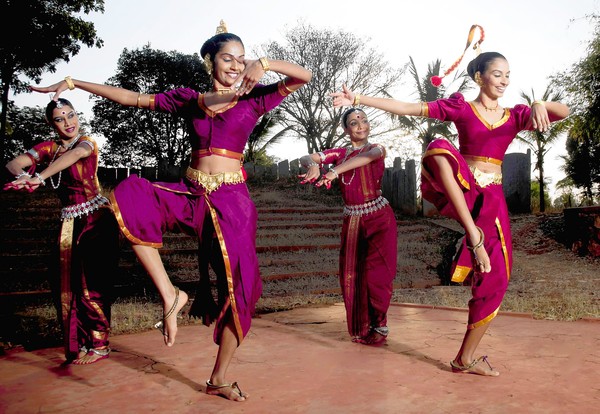
The Indian dance company Nrityagram Dance Ensemble performs Sunday at the University of Notre Dame’s DeBartolo Center for the Performing Arts. (Photo provided / January 3, 2008)

Literally translated, “Nrityagram” means “dance village.”

And what audiences will see from the Nrityagram Dance Ensemble Sunday at the University of Notre Dame’s DeBartolo Center for the Performing Arts is the unified performance of a group of dancers that lives, eats and dances together every day in a live-in dance community in India.
Founded by dancer Protima Gauri in 1990 near Bangalore, India, Nrityagram fosters dancing through community, according to the school’s website. Gauri died in 1998, but her dream lives on through the school.
“I dream of building a community of dancers in a forsaken place amidst nature,” Nrityagram’s website quotes Gauri as saying before the school’s founding. “A place where nothing exists, except dance. A place where you can eat, sleep, dream, talk, imagine — dance.”
Surupa Sen, the current artistic director for the ensemble, has been dancing with Nrityagram for 22 years.
The program for Sunday’s performance is a blend of dances found in India and Sri Lanka, Sen says. Dancers in richly colored and ornate costumes will grace the stage to dance in styles that are inspired by yoga, martial arts and meditation.
A speaker will give a post-performance talk after the show Sunday. The discussion begins immediately after the performance ends.
“My favorite part of the performance is the way the rhythmic beats of the two styles combine to create a new, exciting sound,” she says via e-mail.
Sen was the first soloist of Nrityagram, according to the ensemble’s website. She studied under Guru Kelucharan Mohapatra, as well as Gauri. Sen has performed all over the world with the Nrityagram company.
Nrityagram is in the “Gurukul” tradition, meaning the students take care of the guru, or instructor, as well as the school itself, according to the website. At Nrityagram, students are taught by several gurus and have daily requirements in exercise, prayer and, if they live on campus, chores to take care of the school.
The philosophy of Nrityagram is all-encompassing, impacting every aspect of a dancer’s life, according to the school’s website.
“At Nrityagram, dance is a way of life, a matter of faith and belief, nurtured and enriched by the souls of its own people,” the ensemble’s philosophical statement says on the website. “We believe that being a good dancer is second only to being a good human being.”
Sen says she spent eight months developing the choreography for the upcoming show.
“(Audiences can expect) a joyful collaborative effort and a common resonance between two completely different styles of dance born out of two countries and their respective cultures,” she says. “They will see spectacular costumes and live music played by musicians from India and Sri Lanka.”
The show will be traveling all over America, with 12 scheduled stops, Sen says. The ensemble will have a weeklong run at the Joyce Theater in New York.
“(The best part of performing is) dancing to a new audience and seeing their reactions,” Sen says. “(I enjoy) traveling and learning about the country and its people.”
Onstage
The Nrityagram Dance Ensemble performs at 2 p.m. Sunday at the University of Notre Dame’s DeBartolo Center for the Performing Arts. Tickets are $35-$8. For more information, call 574-631-2800 or visit the website performingarts.nd.edu.
source: http://www.southbendtribune.com / Home> Entertainment> Entertainment, Events from inthebend.com / By AMANDA GRAY ,South Bend Tribune / March 1, 2012

Mangalore: Unique Gurpur Panchayat Festival Fosters Unity

Mangalore, Feb 27:

“For the first time in the state of Karnataka, ‘Panchayat Habba’ a festival of the panchayat including the people of various communities was organized at the panchayat level. The credit goes to the committee of Gurupur Gram Panchayat for coming up with such a unique exposure,” said Ramanath Rai, MLA here at the valedictory programme of the festival on Saturday February 25.

The two-day ‘Grama Habba’ was held at the premises of Vaidyanatheshwar Temple on the theme of ‘Grama Swaraja’ (local governance).

The festival included various competitions for the villagers such as tug-of-war, kabbadi and many more. Cultural programmes by the villagers, depicting village life in the coastal region was part of the festival.

Deputy speaker of state legislative assembly and MLA Yogish Bhat who later spoke, lauded the committee for organizing such a programme. He also appreciated their efforts for bringing up such a festival without government funding and bearing the entire cost with the help of the village’s donors.

Former minister Krishna J Palemar, Rajashekarnand Swamiji and many other dignitaries attended the function.

A rally was held from Gurupur bus stand to Falguni village, where the concourse took place.

U P Ibrahim was the organizing committee chief. Some achievers were felicitated on the occasion.

source: http://www.DaijiWorld.com / Daijiworld Media Network, Mangalore (MN) / Monday, February 27th, 2012


Reality strikes with playback

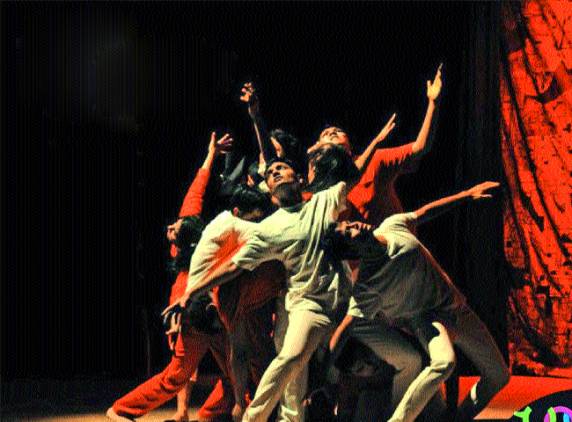
A playback show by Yours Truly Theatre.

Lights, camera, action! Usually, these are cues given by a director. But what if the audience calls the shots? Here’s a chance to take over the director’s mantle and suggest some ideas to a troupe to enact for you, unrehearsed!

Known as playback theatre, this genre is finding many takers in the city, and audiences love it!

What is playback theatre?

Also known as improvisational theatre, this is actor-audience interaction at its best. Barely around for 40 years, it is a rage across the world now. USA is known to have the maximum number of playback troupes in the world and now, other countries are following suit. Walk into any renowned theatre company in Bengaluru and you will find a course offered in this genre.

If you’re a big fan of Whose Line Is It Anyway?, then playback theatre might just be your thing. It is based on impromptu comedy and several stand-up acts and plays are being centred around this style. In Bengaluru, almost every theatre company teaches this form, and even bring down experts from other countries to conduct workshops.

Renowned colleges like NLS, IIM, Christ University, RVCE, NGOs like Spastics Society of Karnataka, National Academy for Blind have regular programmes and workshops with playback actors. Several corporates like Nokia and Puma too have had workshops for team building exercises and interactions. The scope is mostly personal and what makes this form stand out is that it doesn’t lend a tag of exclusivity.

Theatre artiste Namrta Dhar says, “This is one genre I dare not try in front of an audience if I’m not 100 percent sure of what I’m doing. It requires presence of mind, oodles of confidence and sensitivity. It’s certainly a challenging theatrical pursuit.”

The activists

* Nandini Rao: Hailing from the Prabhath family (an old family of fine arts) acting runs in her blood — and she has more than a decade of experience. Having co-established Yours Truly Theatre, she has 300 impromptu shows to her credit, “One must distance oneself from emotions conveyed by an audience. Playback has healed people worldover.”

* Sumit Acharya: “Spontaneity is my middle name,” claims this software engineer who has juggled work and theatre for seven years. Sumit has done over 200 shows (IIT Mumbai, IIT Delhi, SIMC Pune, NLS, National Academy for Blind, etc). “During a festival, someone spoke about how an actor disappeared before the finale. We enacted the same and it was so funny!”

* Ranji David: “In playback theatre, there is no such thing as preparation. You must have immense confidence.” That’s Ranji David, with over 200 shows, with 13 years of experience. He still gets a wave of excitement before a show. His latest project is based on elements like light, costume, etc. “The only answer to perfecting the art is practice, exposure and experience.”

* Ameet Bhuvan: When he walked into an auditorium to watch a play, little did this 28-year-old manager realise his outlook was about to change forever. “My story was enacted on stage and I was awestruck by how the actors effortlessly reproduced myriad emotions so close to my own experience.” He is a common face at many local playback shows in colleges, schools and NGOs.

* Vishal Bhandary: Media consultant Vishal loves storytelling and playback was the answer to his childhood passion. Interactive theatre is used for therapy and community service, and this struck a chord with Vishal. “This is a modern storytelling format which instantly strikes a connection with the people. The best part is we act without a script so each show is varied.”

Beyond borders

The following programmes have been held across the city to promote playback theatre:

Bangaloraholic

A tribute to the essence of a city which has a quaint charm to it. This programme had old Bengalureans, youngsters, expats and immigrants — who narrated various experiences about the city and they were enacted by the actors.

Relive 1947

To mark the 55th Independence Day, theatre artistes invited freedom fighters, participants of the freedom struggle, youngsters and asked each person to give them examples of modern India.

Wake Up India

In association with the Jaago Re campaign, this was an attempt to make the people reflect on how the country has changed in various aspects. Politicians, artists, defence personnel and college students were made to narrate experiences

source: http://www.DeccanChronicle.com / Home> Tabloid> Bengaluru / by Sindhuja Balaji / DC / Bengaluru, February 27th, 2012


3000 million years old Lalbagh rock facing human threat?

Morning walkers fear that it may be damaged by the use of heavy drilling machinery by personnel hired to rejuvenate the lake in the garden

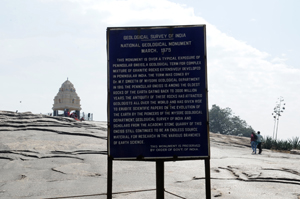
The rock, termed Peninsular Gneiss, is a mixture of granitic rocks

The use of heavy drilling machinery by construction personnel hired to rejuvenate the lake in the renowned Lalbagh botanical gardens has several morning walkers and joggers worried. They fear that work would endanger the 3,000 million years old Peninsular Gneiss, the rock in the centre of the park. The personnel are cutting huge boulders using earth movers, near the Siddapura Gate. Dr Krishna, a morning visitor to the park, told Bangalore Mirror, “I saw these machines near the rock a few days ago. Vigilance officers informed them that they were drilling the earth to cut rocks. None of us had any clue where those rocks were transported.”

But horticulture officials clarified that the rock won’t be damaged. H M Krishnappa, deputy director of Lalbagh, said, “We are not drilling into the rock. 

Special white stone boulders have been brought from Pavagada to construct a bund along the recently rejuvenated Lalbagh lake. They are not only huge but irregular in shape as well. Hence, they have are being cut to fit our requirements. As there was no vast space available within the park to take up the drilling and chiseling work, we chose the empty space near Siddapur Gate, which was sometimes used as a parking lot.”  But when asked whether the drilling work with high level vibrations would damage the texture of the geologically significant rock, Krishnappa clarified, “They have just cleared the soil to keep the boulders intact while drilling and chiseling using heavy machines. We have been vigilant at every step.”

N Chandranna, a retired senior geologist from the mines and geology department, said, “The drilling would not harm the rock as the vibrations would be of negligible level. But using explosives would have a huge impact on the composition of the rock.”
history of the rock
The term Peninsular Gneiss means mixture of granitic rocks, which are largely spread around the southern plateu of India. The term was coined by Dr W F Smeeth of the Mysore Geological Department. It is considered to be one of the oldest rocks of earth. It was declared a national geological monument in 1916.
The antiquity of this rock has attracted geologists from all over the world and has given rise to erudite scientific papers on the evolution of earth by the pioneers of the Mysore Geological Depart-ment, Geological Survey of India and scholars. Stone quarry of this gneiss continues to be source material for research in the various branches of earth science.
source: http://www.BangaloreMirror.com / Bangalore> City / by Niranjan Kaggere / Friday, December 23rd, 2011

A tongue-in-cheek narrative of the Cantonment

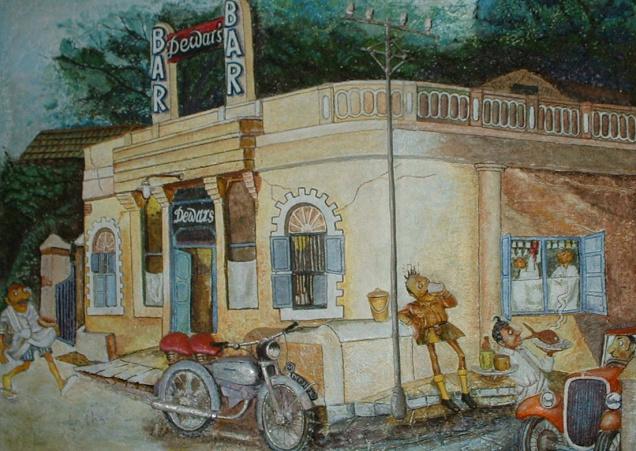
Paul Fernandes’s drawings are a light-hearted portrayal of his memories of Bangalore of the 1970s. Photo: Special Arrangement

Whether you have lived in the particularly endearing cantonment area for some time, or paid a visit to its charming environs, you will surely appreciate what you see at aPaulogy, ‘a gallery of curious illustration’ created by Paul Fernandes.

The 50 drawings on display near the entrance of Richard’s Park in east Bangalore will surely draw a few laughs.

“Around five years ago, I started a light-hearted portrayal of my reminiscences of Bangalore, especially of the 1970s. Most of the sketches are based on my experiences as well as those of my friends and family,” Fernandes shared.

The artist has made a careful yet satirical note of what he has been observing over the decades. Some pictures are of famous landmarks of the Cantonment such as Thoms Cafe and Bakery on Wheeler Road, Everest cinema on Madhavaraya Mudaliar Road (both in Fraser Town), and Ulsoor lake. His drawings depict how several communities despite their cultural, religious and linguistic diversity live in harmony.

There is a picture of a cycle rickshaw puller struggling with his heavily built customer on the now flattened St. John’s Hill. There are also small models of this vehicle at the exhibition. “This was the best mode of transport to negotiate the ups and downs of the terrain,” he said.

Some of his sketches are a humorous take on orchestra conductors, and he describes them as those whose “pride comes before their fall”. While most of the illustrations are watercolour prints, a few are in black and white.

Fernandes’s drawings also highlight the integrity and sincerity of yesteryear policemen. “They were tough with men who were caught in an inebriated condition and would ensure that people who rode bicycles at night had their lamps on,” he said.

A multi-faceted artist, the unassuming Fernandes’s work has been compared to that of the legendary Mario Miranda. Having completed his degree in commercial art from the renowned, M.S. University in Vadodara, he earlier worked in advertising. He has contributed illustrations to books such asMultiple City – Writings on Bangalore by Aditi De, Peter Colaco’s On a High NoteHung by my Family Tree by Ajit Saldanha and a leading Indian travel magazine.

source: http://www.TheHindu.com / News> Cities> Bangalore / December 28th, 2011

The monk who makes cheese

Meet Father K L Michael, administrator of a KR Puram-based monastery. This priest from Kerala, now supplies cheese from Bangalore to various parts of the country

A  variety of Italian cheese. Pic: Theresa Varghese.

He’s the monk who makes the cheese and sells it too! Father K L Michael. Administrator of Gualbert Bhavan, a monastery in KR Puram, is a priest with an alter ego as a cheese maker.

How did a priest from Kerala end up supplying cheese from Bangalore to the best of Italian restaurants and star hotels in the country? As Father Michael himself puts it, with a characteristic little smile tugging at his mouth, “It was a long journey.”

A boy of 15, he was among 11 youngsters in the first batch to join the order when a Vallombrosan Benedictine Congregation was set up in Kottayam (in Kerala) in 1988. Five years later, he was sent to Rome where he learnt Italian and theology and prepared for a Masters in liturgy. As he studied and lived within the order, he began to develop a fondness for Italian food.

“We took turns cooking. At first I just threw ingredients together but soon I was able to make fairly good pasta,” he says with a laugh. He was also able to observe at close quarters the various communities that the order nurtured. The Benedictine order follows the motto of prayer and work. When not meditating, the monks and priests engage in income generating activities that will fund the welfare work they do and also help in sustaining each house. Some of these activities traditionally revolve around food and drink. So while there is a community that manages the sale of religious articles, there are also communities involved in the preparation of wine and liqueur. For those who do not know, Benedictine – the sweet liqueur that goes well with brandy – was created out of herbs and spices by a monk in 1510.

Watching these skilled communities, Father Michael pondered over what kind of work he could undertake when he came back to India. Given his partiality towards spaghetti and its ilk, it was not surprising that his mind veered towards cheese. Father Michael was fortunate on two counts – he belonged to the Benedictine order, and spoke fluent Italian. This translated into easy entry into spaces that would otherwise have been closed. With the encouragement of his superiors, he travelled to cheese-making units and learnt the trade. To Aversa, located in the south of Italy, famous for its Mozzarella cheese made of buffalo milk, and to Naples – the place where pizza is said to have originated.

By the time he got back to India and was ordained as a priest in 1998, Father Michael was a liturgical scholar who also knew how to make varieties of Italian cheese. Two years later, when he was sent to Bangalore to establish a house for young monks, he set up Gualbert Bhavan and began work as a novice master, looking after the needs of the approximately ten to 15 students who arrive here annually. But cheese was not far from his mind. Having obtained used machinery from donors in Italy, he began to look around for good quality buffalo milk. After much research, he decided on milk from a village in Hoskote.
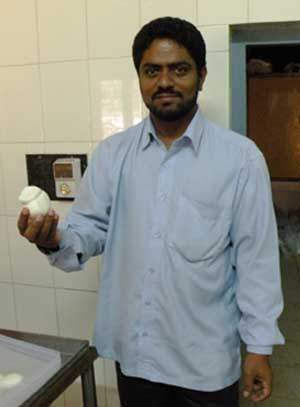
Father K L Michael. Pic: Theresa Varghese.

As he recounts his initial selling experience, Fr Michael is candid about his lack of confidence in his abilities as a cheese maker. “In 2004, I made the first two kilos. Then I looked up the Yellow Pages for Continental restaurants and picked Herbs and Spices in Indiranagar as it was not too far away. I introduced myself to the owner, requested him to try out the cheese and, when he agreed, asked him to let me know what he thought. A week later, he called and told me to get some more.”

It was the beginning of a trajectory. Manjit Singh ofHerbs and Spices, who knew people in the hospitality industry, put out the word. And Father Michael had no reason to look up the Yellow Pages anymore. Within no time he, and his assistant Father Joby, were supplying fresh cheese to five star hotels and Italian restaurants in the city. From there it snowballed to hotels in other cities and from there to Singapore where, according to Father Michael, “For two years we supplied approximately 100 kilos each month to the Pasta Fresca da Salvatore chain of restaurants.”

Vallombrosa cheeses are available at Namdhari’s, Spar, MK Retail, More, Food Zone, Big Market and Tom’s Bakery.

For more information clickhere

Gualbert Bhavan now churns out 45 kilos of cheese each day. Despite the quantity produced, it remains a two-man show, with Father Jinse having replaced Father Joby. The Vallombrosa range, as the brand is known, includes smooth and creamy Mozzarella, small balls of milky Bocconcini, sweet flavoured grainy Ricotta, buttery Burrata, hard and salty Pecorino, tomato paste and olive oil infused Caciotta, rich creamy Mascarpone and, of course, soft stretchy pizza cheese. Except for Mascarpone that utilises fresh cream, all the cheeses are made from buffalo milk, which is creamier and richer than cow’s.

Father Michael recalls how, after his initial success with milk, he found that the supplier was watering down the product. So he cut out the supplier and bought 20 buffaloes, with the aim of ensuring that the source would remain pure. But maintaining the cattle became difficult and when he realised that they were spending more time managing the buffaloes than producing cheese, Father Michael sold off the animals. He then obtained the milk from various buffalo owners in Ramnagaram, an hour’s drive from the city. However, after an initial honeymoon period he found the sceptre of adulteration raising its head again. So it was back to legwork and surveys once again till he finally settled on a farm in Hosur. This is where he currently gets his 170 to 200 litres of milk every day.

Father Michael has recently produced Feta cheese (usually made out of goat milk) from buffalo milk. Though it has been well received, he intends to make Feta the traditional way; the idea being to start a cheese-making unit at the main house in Kottayam where they can also rear goats. The project will be launched by the end of this month.

Did he imagine a mammoth scenario like this when he started out? “Not at all,” replies Father Michael, going on to remark in his mild-mannered way, “It just grew.”

16 Feb 2010

Independent writer and ardent baker who loves all things to do with food.

source: http://www.bangalore.citizenmatters.com / Food> Consumer / by Theresa Varghese / February 16th, 2010


The monk who makes cheese

Father K L Michael laughs when you ask him if he is a foodie. It’s a rich, deep-throated laugh, it answers the question. The 38-year-old from Kottayam, the first Indian to get selected to the religious order of Vallombrosan Benedictine Confederation, has acquired another title, he’s the monk who makes cheese. Father Michael’s brand, Vallombrosa, popular with five-star hotels and fine-dining restaurants across Bangalore, also travels to cities like Mumbai, Chennai and Cochin.

The Benedictine order, which follows the motto of `prayer and work’, not only earns its keep, but also contributes to charitable causes with income generating activities. Father Michael, who lived within the order in Italy (Rome and Florence) for eight years, learning the local language before preparing for a masters degree in liturgy, spent a fair amount of time, racking his brains on what work he would do when he eventually returned to India. During the course of his travels, specifically during a holiday in the southern Italian city of  Naples, the idea of making cheese for a living dawned on him.

After he came back to India in the summer of 2000, the monk experimented with small quantities of cheese. “Even though I spent a lot of time studying the methods when I was in Italy, I hadn’t really experimented with the process. So, when I returned, I started working on it immediately. There are variables like temperature and milk and I tinkered with the process before arriving at a formula that worked for us.”

Father Michael leads a team of six people, who work six to eight hours a day, starting as early as 8 am and winding up past mid-night, with breaks for prayer and rest. They churn out a total 90 kilos of cheese a day. The rates for the Vallombrosa brand that includes Mozzarella, Bocconcini, Burrata, Ricotta, Mascarpone, Caciotta, Pecorino and Feta varies from Rs 500 to 1500 per kilo.

Gualbert Bhavan in Thambuchetty Palya (near K R Puram), where father Michael set up home for young monks, guiding ten to fifteen students who join the fold each year, have cheesy dinners twice a week. Every Tuesdays and Thursdays the house is treated to homemade cheese of their choice, which they have with parotas for dinner.

source: http://www.articles.timesofindia.indiatimes.com / City> Bangalore / Home> Collections> Italy / by Prajwal Hegde / December 24th, 2011