Category Archives: Arts, Culture & Entertainment

Deepika Padukone, the new face of Olympics

Taking charge of her sporty lineage, actor Deepika Padukone will now be seen in a motivational campaign for London Olympics next year. The actor, who recently shot the campaign, says that it “aims to encourage our nation to support all the athletes” for the sporting extravaganza.

Confirming the news, Deepika says, “I finished shooting the promotional campaign for the Olympics. It’s meant to motivate all our athletes—not from  any particular sport.” The actor’s campaign has come through in collaboration with Sports Development Corporation.

Deepika, who is badminton legend Prakash Padukone’s daughter, has played the sport at state level. “I think the media will also help a lot in supporting and motivating Indian athletes. That’s what our sportsmen need right now,” she feels.

Ask the actor if she plans to attend the Olympic events next year, and she says: “I want to go for it. But I haven’t seen the event itinerary yet. So, I don’t know what’s happening when. But I would love to go and watch some of our athletes perform.”

Not many know that Deepika is also a board member of the Olympic Gold Quest (OGQ), an organisation that is dedicated to training Indian athletes for the prestigious competition next year. “A lot of our athletes are training at the moment for the Olympics. The build-up is very exciting as we are nearing the event,” she says.

Talking about sports and athletes, Deepika’s father has openly supported the contentious Sports Bill along with some other sportsmen. Ask the actor what she stands for and she’s quick to support what is best for the country and its sportsmen.

“I don’t know the details of the bill, but people who are a part of it, including my father, have achieved a lot for our country in their respective fields. They are all highly respectable sportsmen, who obviously want the best for Indian sports and our country. So, I would definitely support it,” says the Love Aaj Kal (2009) actor, who is also the face of the Force India F1 Team.

source: http://www.hindustantimes.com / Tabloid / by Prashant Singh / Hindustan Times, Mumbai / December 20th, 2011

Bird-Lovers Throng LINGAMBUDI Lake


Mysore, Nov. 28 :

Braving the incessant drizzle and chilly weather, over a 100 bird- lovers including many children had assembled at 7 am yesterday at Lingambudi Lake in Ramakrishnanagar here for the bird-watching programme organised by Arivu Balaga.

Suprisingly, a few people had arrived from Bangalore and other places to have a glimpse of the exotic migratory birds.

All the bird-lovers lined up on the banks of the lake and stood in hushed silence to listen to the twitter of the birds.

Environmentalists K.B. Sadanand, Mohan Kumar, P. Guruprasad, Ravi Kumar, Rajkumar, Dr. Abhijit and Sahana were present as Resource Persons providing needed information on the birds, their habitats and food habits to the bird-watchers. An interaction was also held on the vagaries of weather at the birds’ habitats and their migratory routes.

Among the migratory birds were also seen local species of birds like cranes, owls, hornbills and bee-eaters.

ACF D

source: http://www.starofmysore.com / General News / November 28th, 2011


Govt. takes over JEHAGIRDAR Bungalow Yelandur


Dewan Poornaiah Memorial Museum to come up

Dewan Poornaiah’s descendant Sukanya Poornaiah and family members are seen handing over the draft lease papers to Archaeology and Museums Department Director Dr. R. Gopal. Picture right shows the majestic bungalow.

Yelandur, Dec.1:

– In the wake of the State Government giving its tentative approval to convert the historical Jehagirdar Bungalow here into Dewan Poornaiah Memorial District Museum, the 8th generation descendant of Poornaiah family, Sukanya Poornaiah, signed the draft copy of the lease document indicating the formal handover of the bungalow to the government for a period of 33 years at the office of the Sub-Registrar here recently.

Accordingly, the neglected bungalow will soon become the long cherished museum.

Background: Recognising the services of Poornaiah, who was the Dewan during the tenure of Hyder Ali, Tipu Sultan and Mysore Maharajas, Mummadi Krishnaraja Wadiyar had in 1807, after obtaining permission from the British, given the taluk of Yelandur to Poornaiah who became the Jehagirdar.

To etch the name of Poornaiah to remain permanent in the annals of history, his descendant P.N. Krishnamurthy got a huge complex constructed with ornate sculptures at Yelandur and Jehagirdar Bungalow was the prominent one.

During the signing-in ceremony, Sukanya Poornaiah’s family members Rajiv, Sanjeev and Madhav, Archaeology and Museums Director Dr. R. Gopal, In-charge Sub-Registrar Rudraiah and others were present.

source: http://www.starofmysore.com / General News / December 01st, 2011


‘The Romance of Indian Coffee’ released

Mysore, Nov. 30-The newly-launched book titled ‘The Romance of Indian Coffee,’ authored by the Bangalore-based senior journalist P.T. Bopanna, offers a 360-degree view of Indian coffee — the fascinating history of coffee, many charming facets of coffee culture, its symbiosis with nature and what makes coffee such a captivating brew.

The book highlights how Indian coffee is unique and stands out in the global market. Unlike the coffee produced in other countries, Indian coffee is totally shade-grown and is much in demand internationally.

The author has chronicled the contribution of Ivor Bull, the British planter from Coorg, who conceived the idea of the ‘pooling system’ to save the coffee industry during the Second World War.

For those interested in the variety of ways in which coffee can be prepared, a separate chapter has been devoted in the book on how to prepare a good cup of coffee, especially South Indian filter coffee. Recipes for other interesting and popular coffee concoctions, including recipes for making coffee liqueur have also been included.

There is an interesting chapter on how the pioneering British coffee planters spent their days in the estates in 1880s. The book also deals with the current issues that threaten planters — deforestation, climate change, fluctuating prices and man-animal conflict.

Brand specialist Harish Bijoor, who has a vast experience in the coffee industry, has written the foreword for the book. Among those who have contributed articles for the book include, agriculture scientists, Dr. Anand Titus Pereira and his wife, Mrs. Geeta Nanaiah Pereira, who have been working diligently on their model coffee farm on sustainable technologies.

The book has been published by Prism Books Pvt Ltd, Bangalore, and is priced at Rs. 270.

Bopanna’s other books include ‘Rise and Fall of the Coorg State,’ published in 2009; ‘Discover Coorg’ published in 2006; ‘Dateline Coorg,’ a compilation of his articles on Coorg in the last two decades and ‘Coorg: Land of Beauty and Valour,’ a coffee table book, published in 2010.

Bopanna runs www.coorg tourisminfo.com, the first news and tourism portal of Coorg. He may be contacted on Mobile: 93424-30141.

source: http://www.starof mysore.com / General News / Wednesday, November 30th, 2011


In regal splendour

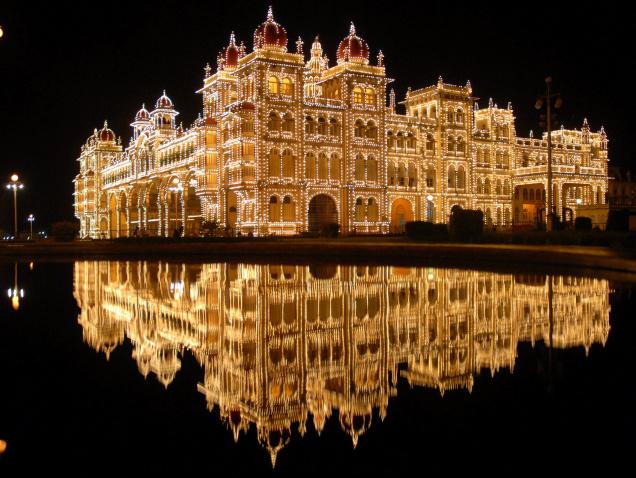
Twilight wonder: The illuminated Mysore Palace. Photo: M.A.Sriram

Magnificent and historical, the Mysore Palace is protected by the Karnataka Archaeology Department. The royal residence would mark a century next year.

Reckoned to be the most popular monument in the country after the Taj Mahal (in terms of the number of visitors), the Mysore Palace draws close to three million tourists every year and the numbers are increasing.

Constructed to house the royal family of Mysore as the earlier wooden palace was ravaged and destroyed in a fire in 1897, the existing palace will complete 100 years in 2012 to mark which the State Archaeology Department plans to have a series of events and have it declared as a protected monument.

There are references to the maharajas of Mysore living in a palace in some of the texts belonging to the Mysore royal family such as Srimanmaharajaravara vamsavalli (annals of the Mysore Royal Family) while a description of the wooden palace has been provided in the Mysore Gazetteer, which notes that it was a constructed in the Hindu style with little or no trace of European influence, according to Dr. M.S. Nagaraja Rao, the former Director General of Archaeological Survey of India, and who has authored a book on the Mysore Palace for the benefit of tourists.

But it is the new palace whose construction started in October 1897 and was completed in 1912 that beckons the tourists and beggars description. It was designed by Henry Irwin who was the consulting architect of the Government of Madras and also went on to design the Viceregal Lodge at Simla.

The palace is an example of the Indo-Saracenic style of architecture and is a three-storeyed structure whose façade comprises nine impressive arches — three on each side flanking the giant central arch that is supported by two smaller arches.

The central portion has a dome that towers to a height of 145 feet and the entire palace facing east, is surrounded by a fort. The main gate of the Fort leading to the palace is Jayamartanda Gate which is massive in proportion and is sublime despite its size.

As one walks into the interiors, the visitors are ushered into the Kalyana Mantapa which is embellished with 26 murals capturing the glory of Mysore Dasara, and further on the visitors enter the durbar hall called the diwan-e-aam which is about 155 feet in length and 42 feet wide.

The Diwan-e-khas is also called Amba Vilas and is lavishly embellished with inlay work, intricately carved designs filled with ivory. The then Maharaja Krishnaraja Wadiyar IV who reigned from 1902 to 1940 entrusted the responsibility of beautifying the Amba Vilas section to the renowned artist K. Venkatappa, according to Nagaraja Rao.

The palace has an impressive collection of objects of art including the model of the original wooden palace but the most famous of the exhibits is the golden throne and the golden howdah. The golden throne is, however, not open to the public throughout the year and is exhibited only during the Dasara. In addition, there is the armoury containing an exhaustive collection of weapons of the ancient and the medieval times but this is not open to the public at present.

In view of its magnificence the palace is a must-see in the tourists’ itinerary and for those who wish to savour its grandeur, the official website www.mysorepalace.tv provides a 360 degree panoramic images to whet the appetite.

The Mysore Palace is illuminated on Saturdays, Sundays and during public holidays and presents a majestic sight like no other. The palace is embedded with 96,000 to 100,000 bulbs for the illumination purpose and was installed in the early 1920s, according to the palace authorities. The cost of illuminating the palace for one hour is about Rs. 25,000 to Rs. 30,000 at the current power tariff.

The throne

The golden throne which is exhibited only during the Dasara, is among the prized possessions of the Palace. Its origins are steeped in mystery and there are beliefs that the golden throne belonged to the Pandavas and it was Vidyaranya — the preceptor of Harihara I, one of the founders of the Vijayanagar empire in the 14th century A.D. — who retrieved it from Penugonda in Andhra Pradesh. It passed on from the rulers of Vijayanagar to the Wadiyars who were the feudatories of the Vijayanagar rulers. There is another theory that it was gifted by the Mughal Emperor Aurangazeb to Chikkadevaraja in 1700 A.D.

Fort gates

Of all the gates to the fort surrounding the palace, the Jayamartanda Gate is architecturally sublime. The central arch is about 60 feet in height and has a width of 45 feet. Made of concrete and granite, it provides a panoramic view of the front portion of the palace. The other gates are named as Balarama, Jayarama, Brahmapuri, Karikal Thoti and Varaha.

source: http://www.thehindu.com / Life & Style> Kids / by R KrishnaKumar / November 28th, 2011


Innovative PHOTO EXPO Opens


Caption: Sculptor and founder of Mysore Art Gallery L. Shivalingappa is seen explaining about the photographs on display at the Gallery yesterday as Heritage Dept. Deputy Director Dr. J.V. Gayatri, Show Organiser S.F. Husseni, Theatrist Narayan Kikkeri and artist Jamuna Rani Mirle look on.

Mysore:

An innovative exhibition of over 5,000 photographs of colour formation of light diffracted off the surface of a waste Compact Disc (CD) titled ‘Amoorth’ opened at Mysore Art Gallery at 12th Cross on Ramanuja Road here yesterday.

Artist and photographer S.F. Husseni has come up with this unique expo which is open from 11 am onwards and concludes on Nov. 15.

Husseni, a native of Mysore intends to organise the unique photo expo in other cities during the coming days to showcase the art.

Journalist Ravindra Bhat pointed out that Husseni had come out with a new concept which triggered the imagination of the viewers.

Heritage Deputy Director Dr. J.V. Gayatri, Theatrist Narayan Kikkeri, Artistes Basavannachar, L.S.N. Achar, Vijayalakshmi, Sundaresh, L. Shivalingappa and others were present.

source: http://www.starofmysore.com / General News /November 12th, 2011


First animated children’s film in Kannada

Bangalore:
It’s November 14 again, but this year’s Children’s Day promises something different for those in the State. ‘Chintu’s Skool,’ the first animated film in Kannada for children, will be screened at the 17th edition of the International Children’s Film Festival which begins in Hyderabad on Monday.

Produced by Kolors n Motion Studios Pvt Ltd, in association with Shree Mahalakshmi Combines, the film tries to bring about social transformation via animation.

Says Sheshagiri Yelameli, a documentary maker and the director of the film: “We have used elements of magic and fantasy with the underlying message that by teaching others, education can be made accessible to all classes of society. Mahatma Gandhi, Swami Vivekananda and even actors Shivarajkumar and Upendra come in their animated forms, showing children that hard work is the key to success.”

Anand Kidambi of Kolors n Motion says the film will be screened for the first time in Karnataka at the JSS Mutt, Suttur, on Monday to around 3,500 children in the Mutt’s state-of-the-art auditorium.

Theatreperson, singer and Rajya Sabha member B Jayashree is the chief guest. This will be followed by shows at Eeshwari and Srinivasa theatres in Bangalore the next day. Made entirely in the studios of Bangalore with more than 30 BFA and DFA holders from Davangere, Gadag and the City working on it, ‘Chintu’s Skool’ has music by V Manohar, lyrics by M N Vyasarao.

Actor Ramesh Arvind and others have lent their voices to the characters.   The producers plan to take the film to schools across the State soon. For more details, contact info@kolorsnmotion.com

source: http://www.deccanherald.com / Home> Entertainment / DHNS / Bangalore /  November 13th, 2011

Rangayana to open ‘SCRIPT BANK’: Dr. Rajaram

This year’s Bahuroopi theatre fest to stage plays by Jnanpith awardees


Mysore:

City’s theatre repertoire Rangayana will create a ‘Script Bank’ in which manuscripts relating to nearly 3,000 dramas would be posted on its website for the convenience of those interested, said Dr. B.V. Rajaram, Director of Rangayana, here this morning.

Participating in an interaction programme organised at Pathrakarthara Bhavan in city by Mysore District Journalists Association (MDJA), Dr. Rajaram said this year’s Bahuroopi National Theatre Festival would be held on the concept ‘Jnanpeetha Rangotsava’ in which dramas scripted by Jnanpith awardees would be staged.

The Rangayana Director also said that a huge collection of scripts and books by B.V. Karanth and his wife Prema Karanth would be preserved at Rangayana and added that the Karanth family had agreed to hand-over the literature treasure in the form of CDs and cassettes.

Dr. Rajaram, who said that this year’s Bahuroopi would be held in a grand manner even if it came to accepting private participation, added that the National School of Drama (NSD) and Rangayana should be incorporated for staging dramas in the State.

Seminar: Stating that Rangayana had plans to conduct a seminar on ‘Media-Rangabhoomi’ during Bahuroopi festival, Dr. Rajaram added that Rangayana’s activities were not limited to the city. He also said that dramas would be organised at taluk and district levels to identify and nurture talent among rural people.

MDJA President C.K. Mahendra, General Secretary K. Deepak, City Unit Secretary M. Subramanya and Rural Secretary Kukke Mahadevaswamy were present.

source: http://www.starofmysore.com / General News / November 03rd, 2011

To the zone and back

They stood facing each other, shuffling from side to side like prize fighters sizing up what lay ahead. The younger man, shorter and of a slighter frame, Olympic gold medallist Abhinav Bindra, sparing with words, and Indian cricket’s stickiest commuter Rahul Dravid, who listened more than he smiled, waited rather than waded, held court on the strikes and strokes that make up the sporting universe.

Bindra, 29, who made history in the 2008 Beijing Olympic Games, recounted his obsessive journey to greatness in a book ‘A Shot At History’, which Dravid launched before a glittering audience that included bowling great Anil Kumble, sprint queen Ashwini Nachappa, basketballers Nandini Basappa and Jayawanthi Shyam and swim star Nisha Millet. Dravid, slow batsman, sharp with words, said of Bindra’s historic effort, “He gave us one of those I-was-there, it-happened-during-my-lifetime moments.”

The evening, an education on the pursuit of sporting excellence, saw the iconic stars attempt to define that moment in time athletes like to call ‘the zone’. A smiling Bindra called it ‘fantasy’. “For me,” he said, “it is all about being in the present. When you are able to sustain that focus over a period of time.”

Dravid said, “Whenever great athletes meet, this (the zone) topic always comes up for discussion, you want to know if the other guy has been there, experienced it, you feed off each other. When Abhinav and I met earlier, we discussed it. Like he said, it is about being in the present, when you don’t have one eye on the score or the pitch or what’s coming at you. I’ve been fortunate to have glimpsed and tasted it in my career.”

For Bindra, whose sport is about attaining a stillness of state and spirit, said that while perfection was the goal, it’s also about what you are able to sum up on an imperfect day. “You have to have a Plan B and then it’s about how you make it work.”

Dravid said, “It’s not about how you do on a good day because you will do well, but how you come through when you are struggling. When things are not going your way and you’re wondering what you’re doing out there embarrassing yourself, but you stick around and make a 100. There’s great satisfaction in that.”

Bindra’s ‘A Shot At History’ is a stirring narration of the journey of an Olympic athlete. The autobiography written with sportswriter Rohit Brijnath, grabs the attention of the reader as much with the voice as with the words that make up the 200-odd pages of the book which takes on the tone of a conversation. It’s as if the champion shooter is narrating his story to you at a neighbourhood cafe. From the moment he wakes up, battling his mind on a winter morning in Chandigarh, to the final pages of the book, where he tells you that he’s ‘learning to suffer again’, readying himself for the 2012 test, you’ve probably downed many mugs of coffee, run through several tissues and finally thumped the table in triumph.

source: http://www.timesofindia.indiatimes.com / by Prajwal Hegde / TNN / Home> City> Bangalore / November 01st, 2011

History in a pastoral set-up

Uttara Kannada’s Balligavi has many temples which stand testimony to its rich past, covering the Chalukya and Hoysala reigns. Apart from the ASI-protected lawn-covered temple complexes, the general scene of present-day Balligavi is like any other small town in the State, with agriculture being the main occupation of people here, observes Poornima Dasharathi
EMBLEM OF A DYNASTY  A Hoysala emblem atop one of the temples in Balligavi.Photos by the authorIt was my first visit to the Uttara Kannada region. Though I am not new to the Western Ghats, I had never ventured beyond Sagar to the smaller towns and villages of Shimoga district. As we raced down the snaky trail from Soraba, the bumpy rides on potholed roads encouraged me to put aside my camera and just enjoy the scenic beauty of the villages.

On either side of the road were huge keres formed by the monsoon and lush paddy crops. Intermittent rain and the monsoon air were accompanied by familiar rural sights and smells. Our destination was Balligavi, a small town in Shikaripura taluk of Shimoga district.

Though Balligavi is a small town today, it was once an important educational, commercial and a cultural hub. “It was a place of such antiquity,” notes B L Rice in the Gazetteer he compiled for the then Mysore government, “that even in the 12th century, as to be styled the mother of cities, the capital of all cities, the anadi rajadhani, the immemorial capital and is said to derive its name from the rakshasa King Bali.” He goes on to say that it was the capital of Banavasi or the “Banavasi-twelve thousand province.”

Considering the Banavasi province once encompassed almost the entire region between the rivers Varada and Tungabhadra, that’s an incredible achievement for a city of those times.

The town, according to the priest at Kedareshwara temple, reached its peak during the reign of Chalukyas (between 10th and 12th century); though its prosperity continued during the Hoysala reign also.

During the Chalukya reign, the city had five mathas (religious centres or monastaries), three puras (extensions) apart from several Brahmapuris (Brahmanas’ settlements). The sculptors of this region were very famous and many travelled down south during the Hoysala rule and were instrumental in creating the marvellous Hoysala temples.

As is common, much of what is left of history are the intricately carved stone temples. Belligavi, Balagami, Ballipura or Balligavi as people now call it, is home to many very old temples – Kedareshwara, Someshwara and Tripurantakeshwara – to name a few. The place is full of inscriptions and temple ruins. The ASI-maintained ones are just a handful, one suspects.

Temple architecture

The Kedareshwara temple is a beautiful structure, slightly below the existing ground level. As we go in, the frontal view is blocked by a huge benevolent nandi; a style that is common across all Shiva temples in Uttara Kannada.

The central shrine is a small linga made of Krishna shila. On either side are shrines to Brahma and Janardana. The ceilings in the mantapa have simple lotus carvings. In the central ceiling is a picture of Shiva as Tandaveshwara flanked on eight sides by ashta dikpalakas – a design that was also seen in Tripurantakeshwara temple. The three shrines have three beautiful gopuras that reflect the Kalyana Chalukya architecture.

On two of these towers is the royal emblem of the Hoysala. A third one that’s incomplete is preserved in front of the museum beside the temple.

The museum is home to several relics and inscriptions collected in the region. Apart from Hindu deities, there are also several Jain statues as the place was an important centre propagating Jina dharma too. The Tripurantakeshwara temple nearby has a colourful history. Built in the 10th century, it was here that the great king Vishnuvardhana met Shantala, explained the local guide. The temple is known for the intricate snake carvings that adorn the window panels of the doorway to the shrine. The intertwined snakes create a mesh-like structure.

Apart from the main linga, there is also a statue of Vishnu. Again, a huge bull sits across the mantapa. The Virabhadra statue carved on the outer walls looks fierce even in ruins. The most amusing and perplexing were the carvings around the temple that are a mix of Panchatantra tales and erotic scenes!

Nearby, in the town centre, is a fierce form of Ganda Berunda, the mythical two-headed bird. Unlike in Keladi or the much gentler Mysore emblem, here the bird is half animal and half human. It’s devouring one human and holding another to devour next!

Apart from these ASI-protected lawn covered temple complexes, the general scene of present-day Balligavi is like any other small town in the State. Agriculture is the main occupation here.

The streets meander across the town with row houses on both sides. Buffaloes take up much of the road and vehicles have a trying time weaving their way through.

The lush green paddy fields, women washing clothes by the river, the occasional mooing of the cows can create an idyllic picture and lull you into a calming frame of mind.

One can almost hear the sound of granite being chipped to create another piece of history

source: http://www.deccanherald.com / DHNS / Home> Supplements> Travel / Tuesday, November 01st, 2011