Category Archives: Arts, Culture & Entertainment

‘Vedic Art Expo’ by foreign artists in city


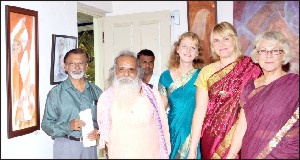
Bharani Art Gallery Chief Convenor N.B. Kaverappa (extreme left) seen with Sri Jamunagiri Swamy of Cave Shiva Temple near Nandi atop Chamundi Hill, artists Linta Vuorikkinen (Finland), Kate Maconachie (Australia) and Pirkko Huttunen-Nieminen (Finland).

Mysore, Oct. 24 (KK&KMC):

People from abroad are being attracted to ancient Vedic art forms of India and are taking up rese-arch works to trace their origin.

One such effort is made by a team of three women artists — two from Finland and one from Australia — who have expressed their understanding of Vedic Art through some 43 paintings that are displayed at the Bharani Art Gallery at Vivekanandanagar (near Circle) in city. The art exhibition tittled ‘Returning to Source’ depicting ancient vedic traditions and mother nature, was inaugurated by Prof. K.C. Belliappa, former Vice-Chancellor of Rajiv Gandhi University yesterday. Chief Convenor of the Art Gallery N.B. Kaverappa was present.

Speaking on the occasion, Prof. Belliappa termed the event as a historic one as the paintings were based on ancient vedic knowledge. “It is an irony that people from abroad are taking interest in our ancient culture and teaching us about it,” he said and opined that one should be self-motivated to appreciate art forms and their values.

Curt Kallman, an artist in Sweden developed and nurtured vedic art painting method for over 30 years. At present, this art is being taught in 12 countries. Since vedic art is not popular in India, all the three foreign artists Pirkko Huttunen-Nieminen, Kate Maconachie and Linta Vuori-kkinen, who have been teaching vedic art, are in the city to educate and propagate the art.

Kaverappa, addressing the gathering, said that the exhibition will be open till Oct. 30 from 11 am to 7 pm. This the artists’ second exhibition in India, after Calicut, he said.

Veteran artist L. Shivalingappa also spoke on the occasion.


Mystic presence of vedic art paintings

Mysore, Oct. 24 (KK&KMC):

The three women artists specialising in Vedic Art are basically art teachers who have been together since the past decade.

One among them, Pirkko Huttunen Nieminen of Finland, aged 65 years, told SOM that she had learnt the art from Curt Kallman of Australia 10 years ago. “It has changed my life itself. The Vedic Art has a mystic presence, deep silence that is pregnant with meaning, which I have tried to give a shape in the form of paintings,” she said.

Artists Kate Maconachie of Australia and Linta Vuorikkinen of Finland are also said to have learnt the art form from Curt Kallman, who is indulged in the art since the past 30 years.

source for both: http://www.starofmysore.com / General News / October 24th, 2011


“KARNATAKA CHOODAMANI” award conferred on LALITHA NAYAK

\


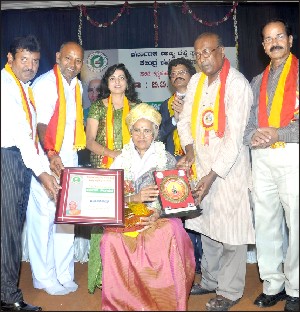
MLC C.H. Vijayashankar presenting Karnataka Choodamani award to former Minister B.T. Lalitha Nayak at a function in city yesterday. Others seen are District Kannada Sahitya Parishat President Maddikere Gopal, poet Jaraganahalli Shivashankar, poetess Latha Rajashekar and KSRTC Divisional Controller M.N. Srinivas.

Mysore, Oct. 24 (MTY&RNN)

Former Minister B.T. Lalitha Nayak was yesterday conferred Karnataka Choodamani award given by Karnataka State Road Transport Corporation’s Central Kannada Working Committee for outstanding services to Kannada land and culture.

Conferring the award at a colourful function organised at Rajendra Bhavan on Ramanuja Road in city, MLC C.H. Vijayashankar lauded the services rendered by Lalitha Nayak, who had overcome shortcomings of being a dalit besides being a woman to render yeomen services to Kannada culture.

Till recently, it was difficult for people of backward community, especially women, to get education, he said and added that Lalitha Nayak had successfully confronted those problems and excelled in contributing to the society which in itself was a great achievement.

Replying to the felicitation, the Karnataka Choodamani Lalitha Nayak said that the difficulties and atrocities faced by tribal women forced her to take to writing and used an incident of a husband harassing his wife as an epicentre for her novel.

Lalitha Nayak said that she was allegedly removed as Minister of Kannada and Culture for not arranging for party funds. She said that she was informed later that her successor collected Rs. 20 lakh from officials for party fund.

She expressed happiness that the incident saved her from being branded as corrupt which could even have resulted in her going to jail.

Earlier, Lalitha Nayak was brought to the venue from Gun House Circle on a decorated vehicle in a grand procession, which was accompanied by various cultural artistes

http://www.starofmysore.com / General News / October 24th, 2011


‘I SALUTE YOU SIR’ book on Pharma Science released


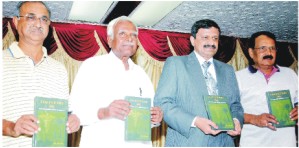
Jayadeva Institute of Cardiology Director Dr. C.N. Manjunath releasing the book ‘I Salute You Sir’ at The Paradise in Yadavagiri on Sunday. Andolana Editor Rajashekar Koti, former Assembly Speaker Krishna and author of the book Dr. Basappa are seen.

Mysore, Oct. 25 (KCU)

– A book on the history of phamaceutical science ‘I Salute You Sir,’ which also throws light on the effort of scientists in discovering medicines, written by Dr. Basappa, Consultant Doctor at Apollo BGS Hospital, was released at The Paradise hotel in Yadavagiri on Sunday by Dr. C.N. Manjunath, Director, Jayadeva Institute of Cardiology, Bangalore.

Speaking on the occasion, Dr. Manjunath lauded Dr. Basappa for throwing light on the invaluable service of scientists to society and pointed out that the book would motivate doctors and medical students to pursue research in medicine.

Andolana Editor Rajashekar Koti, who unveiled a portrait of Louis Pasteur, opined that medical profession was truly dedicated to society and suggested to publish the book in Kannada also.

Presiding over the programme, former Assembly Speaker Kris-hna pointed out that scientists toiled almost their whole lives pursuing research in medicine at the cost of their personal comforts. Contrary to that, a few doctors were more engrossed in making money with no humanity, he regretted.

Dr. Basappa observed that se-veral scientists had entered into deep depression and ended their lives while being deeply engrossed in research work foregoing social life. He pointed out that his book showcased the usage of scientist’s invaluable inventions in society and the struggle and sacrifice behind that.

Dr. Lakshman welcomed. Arun proposed a vote of thanks.

source: http://www.starofmysore.com / General News / October 25th, 2011


Tradition runs in Heredity


Archana presenting a music concert accompanied by M.A. Jyothi on Violin and A. Radhesh on Mrudanga.

Mysore:

L Archana, an upcoming young vocalist, is the daughter of vocalist and Guru Koviladi Kala. She is an accountant by profession, working in Infosys, Bengaluru. Kala hails from a family of musicians from Srirangam, Tamil Nadu. She has migrated to Mysore after her marriage. Since then Kala is a permanent sight in the music circle of Mysore.

Trained under the able hands of a music guru like Kala, Archa-na has blossomed into a fine singer. Added to that, she has developed a cultivated Manodharma through hard work and a keen sense for Sahitya. These two factors contribute a lot in the making of a singer.

Archana was on the dais of Veene Seshanna Bhavana of Ganabharathi during their monthly concerts on Oct. 15. She was accompanied by M.A. Jyothi on Violin and A. Radhesh on the Mrudanga. She began her concert with the popular Shaha-na Varna Karunimpa of Tiruvotriyur Tyagayyar. It was surprisingly suffixed with a Swara, which no one expects from a young singer but nevertheless gave an impetus to her concert. This was followed by another popular Tamil oblation to Ganesha Gajavadana Karuna Sadana (Sriranjini-Adi-Papanasham Shivan).

Immediately she took up a not so brief Alapane of Saveri with one more popular Kruti Shankari Shamkuru Chandramukhi of Shama Shastri set to Adi Tala. Saveri is a prominent Audhava Sampurna raga, derived from 15 Maya Malava Gowla, which evokes Karuna Rasa. Selection of Saveri gave a soothing feeling. The singer took up a Neraval at Shama Krishna Sodari Shya-male Shatodari. Normally this raga is rendered in Vilamba Kala. If the pace becomes any thing slower than the raga permits, it will put the audience to sleep.

Once again there was a not so brief Alapane in Gowri Manohari Raga. Tyagaraja’s Guruleka Etuvanti Guniki was the Madhyama Kala composition chosen. Archana suffixed it with a neat and brief Swara. A rare and interesting raga, Nasika Bhushini, a Prati Madhyama Janaka Raga with number 70, is known as Nasamani in the Dikshitar Sampradaya. It is a minor Mela Kartha Raga with very few compositions. But one has to be very careful while rendering this raga as any minor change in the frequency of Nishadha may tend this Raga into Kosala. Archana chose Sri Rama Saraswati in this raga, by Muthuswamy Dikshitar.

It was time for the Main raga to be taken up. But before that, Archana sang a Purandara Dasa Devara Nama Nanda Tanaya Govindana Bhajipudu in Bhim-palas. Shankarabharana was the main raga of the evening. The Raga image was poignantly projected in the Alapane as the approach had a well rehearsed effort. This was evident when she attempted successfully a Grahabheda (Thodi, the Murchana with Adhara Shadja as Gandhara). It requires certain amount of confidence to do so. The Alapane neatly done, the Kruti Swara Raga Sudha Rasayuta of Tyagaraja was rendered in the traditional Tanjore style with some sangathis evolved by the great Nadaswara Vidvans of that region. The Anu Pallavi line Pramanandamane was taken up for a methodical extrapolation of Neraval, with imaginative Swara Kalpane.

The tail enders after the main raga were Kurai Onru Illai (Raga-malike-Adi-Rajaji), Pannagadhipati (Yamana-Adi-Purandara Dasa) and Elliruve Tande Baaro of Sheshagiri Dasaru in Behag. The first one by Rajaji was on the request of a listener.

Archana was well supported by the accompanists and Radhesh displayed some rare strokes in his Mrudanga in his term of Tani Avartana.

source: http://www.starofmysore.com / Feature Articles/ by S. R. Krishna Murthy


Counting colours at ‘COLORS’ Painting Expo


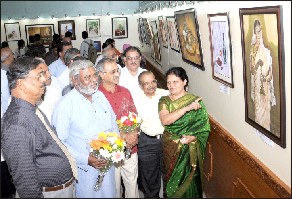
Caption: Dr. R. Chandavar Vidya explaining a painting at her expo to the guests Mysore Varsity ex-VC Prof. S.N. Hegde, Andolana Editor Rajashekar Koti, CAVA faculty D.A. Upadhya and others.

Mysore:

‘Colors,’ a maiden painting exhibition by Dr. R. Chandavar Vidya, was inaugurated by Mysore Varsity former Vice-Chancellor Prof. S.N. Hegde at Suchitra Art Gallery in Kalamandira premises in city yesterday.

Andolana Editor Rajashekar Koti and D.A. Upadhya, member of faculty, Chamarajendra Academy of Visual Arts, were present on the occasion.

A native of Uttara Kannada, Dr. Chandavar has been working at the Zoology Department at Yuvaraja’s College since 1996 and is presently an Associate Professor. She completed her Post Graduation in Zoology from Bangalore University and was awarded the Ph.D degree in Endocrinology from Mysore University.

“I started painting around 25 years ago when a friend of mine forced me to join art classes with her. While my friend discontinued after a few days, my painting journey started from there,” says Dr. Chandavar.

The expo includes oil and acrylic painting. “I like paintings which play with light and shadow. Portraits are my favourite” she adds.

Even with no professional training, her paintings are realistic and takes the viewers to a different world.

The exhibition will be open from 11 am to 7 pm till Oct. 31.

source: http://www.starofmysore.com / General News / October 30th, 2011


‘DEVAGITAM’ CD and WEBSITE released

Mysore:


A twin pack CD containing the compositions of H. Yoga Narasimham and a website about him were released on Oct. 16 at Rotary West audito-rium, in a function presided over by Dr. Padma Murthy who also released the CDs. Dr. Sukanya Prabhakar, who was present, spoke about the CDs and Dr. Mysore M. Manjunath released the website.

Mysore is a true cultural capital even from the days of Maharajas, who gave all-out support to fine arts like music, dance, drama, sculpture, painting etc. This was the main reason for many musicians of repute making this city as their home town. Many of them were composers too, like Veene Sheshanna, Mysore Sadashiva Rao, Mysore Vasudevacharya, Piteelu T. Chowdaiah, Muthaiah Bhagavatar to quote a few. One such composer was H. Yoga Narasimham (1897-1971), who pursued music throughout his life.

Yoga Narasimham was the youngest among the four children born to Narasappa and Lakshmidevamma and grew up in an atmosphere charged with music in the Palace and elsewhere. He was outstanding even in his academics. He had passed his BA exam with a gold medal in all the three subjects Sanskrit, English and Philosophy, in Maharaja’s College. He also completed his MA in Sanskrit from Mysore University.

He joined the Govt. of Mysore as Inspector of Schools under the Department of Schools and became the Principal of Sanskrit Maha Pathashala (Sanskrit College), Mysore. He retired as a District Education Officer, under Nalwadi Krishna Raja Wadiyar’s Royal Mysore Government.

His musical journey began at his home and the navigators were his mother, brothers and sisters. He also learnt a lot by listening to the great masters of the day. He became a disciple of Mysore Vasudevachar and was an ardent student of the legendary musician for seven years from 1928 to 1935. But their association continued for nearly four decades.

This made him a musician, composer, musicologist, critic, an author and editor of repute of musical works. But his composing ability came to the fore at the end of his life. He has composed only about 38 krutis, including Swara Jatis, Varnas, Krutis, Ragamalike, Padas, Javalis and Tillanas.

His compositions are in Sanskrit, Kannada and Telugu. They are a set of refined literary work of impeccable taste, and evolved with high musical acumen. Bharata Ratna M.S. Subbu Lakshmi sang and recorded some of his compositions in a cassette tape in 1986, which made the music fraternity to take notice of his krutis. She used to sing one his krutis in her concerts also and the most popular one was Sada Saranga Nayane in Raga Ranjini.

In spite of all this, the memory of music fraternity is short and his krutis would have gone to oblivion. Therefore, his daughter Neeraja Achuta Rao, a vocalist in her own virtue, her daughter M.A. Jyothi, a vocalist and violinist, brothers and sister of Neeraja took it upon themselves to preserve his krutis for the future and published them in a website www.devagitam.in. They also recorded 18 of krutis in two CDs. The website and CDs have been aptly named as Devagitam, as his Ankita (signature) was ‘Deva.’

The first CD contains ten krutis, Sundara Deva, a varna in Hin-dhola, Ekadantham Upasmahe (Begade-Adi), Kovaa Raago (Valachi-Mishra Jhampe), Sujana Charitam (Mukhari-Adi), Kaapaadade Nepa Hooduvee (Gagana Mohini-Adi), Nada Vara Sushobhitam (Nadavarangini-Khanda Triputa), Chandra Shekhara Guruvaram (Kamavardhini-Adi), More Ittarenu Idadiddarenu (Revathi-Khanda Chapu), Tillana (Abhogi-Khanda Triputa) and a Mangala Narasimhaya Mangalam (Madhyamavathi-Adi).

In the first CD, three krutis are sung by Neeraja and one solo is by Jyothi. The rest are sung by the duo. The two ragas in the above, Gagana Mohini and Nadavarangini are relatively new ones. The first one has a mention in the scripts and this is the only kruti available. The second one is a creation of Narasimham. Gagana Mohini has an Arohana Scale resembling Valachi and Avarohana resembling Amrutha Varshini. It is an Audhava Audhava Raga. The dominance of Kaishiki Nishadha in Arohana and Kakali Nishadha in Avarohana gives the raga its colour, but confuses as to which Janaka Raga it belongs. It can be said 64 Vachaspathi as its Janaka Raga. The other Raga Nadavarangini, a creation of the composer, is a Janya of 22 Kharahara Priya.

The second CD contains eight krutis, namely Kamala Mano Mohana, a Varna in Mohana set to Adi Tala, Shaanti Rupasyatam (Latantapriya-Adi), Sadaa Saaranga Nayane (Ranjini-Adi), Ninnu Minchina (Kolahala-Mishra Chapu), Saphalam Jeevitam (Kuntala Kusumavali-Adi), Hemateera (Kamboji-Khanda Triputa), Tillana (Kalyani-Adi) and Jaya Jaya Bharata (Ragamalike-Adi).

Jyoti has rendered seven krutis and the last one by Sahana Doravari, daughter of Jyoti and Arpita Somayaji, a student of Neeraja. Three Ragas Latantapriya, Kolahala and Kuntala Kusumavali are very rare Ragas. The first one Latantapriya is an Audhava Audhava Raga, a Janya of no. 1 Kanakangi. Most probably this is the only Kruti available in this Raga.

The second one Kolahala is a Vakra Shadhava Sampurna Raga, a Janya of 29 Shankarabharana. There are only three krutis available in this Raga, Madilona Jeevitham of Tyagaraja, Neerajaksha Maam Paahi of C. Rangaiah and the present one. It is heartening to see that the last two composers are from Mysore. The third one Kuntala Kusumavali is another Vakra Audhava Vakra Shadhava raga, a Janya of 65 Kalyani. Once again this may be the only composition available in this raga, as far as my knowledge goes.

The last Kruti is in Ragamalike (Madhyamavathi, Shuddha Dhanyasi, Mohana and Bilahari). It is a patriotic song, in praise of our National Flag and it has been rendered as group song. In both CDs, Charulatha Ramanujan and H.S. Sudheendra have accompanied on the violin and mrudanga respectively.

Most of the krutis are sung to showcase the wisdom of the composer in creating the Sahitya and its adaptation to a Raga. Neeraja Achuta Rao, the elderly lady, has retained the ability to sing. Jyoti is not only a vocalist, but also a violinist. Therefore she has imbibed many styles and has formed her own style of singing. She has rendered the compositions of her grandfather which was already set to tune. But her ability comes to fore when Manodharma can be used, like in Gagana Mohini, Kamavardhini, (both in first CD), Ranjini, Kamboji (both in second CD) where Alapane, Neraval and Swara Prasthara have been rendered.

The CDs have successfully brought out the beauty of the compositions written by Yoga Narasimham, who lived till the later half of the past century and many in my age group have seen and interacted with him. The listener is introduced to many new Ragas and rare ragas as well, in these CDs.

They also give good listening pleasure especially in Kamavardhini, Kamboji etc. Charulatha Ramanujam on violin and H.S. Sudheendra on mrudanga have given able support to the artistes. The digital recording of the CDs is neatly done by Resonators of Mysore. The set of two CDs is priced at Rs. 200.

A vocal concert by M.A. Jyothi, containing the compositions of Yoga Narasimham, had been organised at the end of the stage programme. She was accompanied by Adithi Krishna Prasad (violin), H.L. Shivashankara Swamy (mrudanga and S. Manjunath (ghata). The compositions she sang included five krutis from the CDs and two others.

The varna Kamala Mano Mohana (Mohana-Adi-CD 2), Sujana Charita Avadharaya Chitta (Mukhari-Adi-CD 1) and Kapadade Nepahooduve (Gagana Mohini-Adi-CD 1), were all replicas from the CDs.

Hema Teeradali (Kambodhi-Khanda Triputa-CD 2) was taken up elaborately with an Alapane of Kambodhi, which was followed on the violin neatly by Adithi. She took up a Neraval at the Anu Pallavi line Vamaanga Aalangita Padmalaya Priya Me Kalaya where her Manodharma was in fore, followed by Swara.

The next one was Nijada Nija Neenanate (Bhanu Dhanyasi-Khanda Chapu), a newly created raga, an offshoot of 45 Shubha Pantuvarali, with a limited Nishaadaantya Sanchara (S R G M N D N – D P M G R S N S). It has 5 single line Charanas. All the Charanas are sung the same way as the Pallavi line. Shubha Pantuvarali is a raga which evokes pathos. Therefore the effect is a little weary, as there is no variation and the repetition is also quick.

The concert concluded with a Tillana in Kalyani (CD 2) and a Mangala in Madhyamavathi (CD 1), composed on Lord Narasimha installed on the banks of River Hemavathi near Holenarasipur.

source: http://www.starofmysore.com / Feature articles / by S.R. Krishnamurthy
 

Celebrity Speak….: ‘Journey from nothing to something and something to everything’


Shree Bose, an Indian-origin US-based high school girl, won an award for her research on why a certain drug was resistant to chemotherapy and for finding a solution for it. Remember it was a research done by a high school girl. This was her dedication towards it. When you have dedication, you can go from nothing to something and from something to everything.”

This is how Sahasramukhi Raghavendra Rao (popularly called as Ragi Rao) describes his life. A high school graduate, who worked as a stenographer at the University of Mysore (UoM), went on to become a much-sought-after expressionist in India and abroad. He has been a dramatist, a marriage and party photographer, a percussionist and today, with all his past experience, he is teaching people how to handle stress by altering expressions of past experience.

Ragi Rao is in city on vacation and had a chat with Star of Mysore during which he spoke about his different faces, on and off stage.

It all started with Oliver Hardy Born on Nov. 23, 1937, Ragi Rao worked at University of Mysore (UoM) from 1958 to 1978. His life took a different turn in 1970s. “Apart from my job, I was also a dramatist. But one day while I was shaving, I was twisting my face and at one point it resembled that of Oliver Hardy. With practice and change of expression, I was able to alter that face into Adolf Hitler and Charlie Chaplin. I started entertaining people with this new-found talent and within two years came to limelight. The UoM recognised my talent and granted leave of absence for eight years. I started travelling across the country and earned the title ‘Sahasramukhi’ (Man of thousand faces). You need guts to make faces which will make others laugh,” he says.

Over the years, Ragi Rao has changed his face to resemble national personalities like Indira Gandhi, Swami Vivekananda, Sarvepalli Radhakrishnan, Kuvempu etc., to international figures like Hitler, Hardy, Martin Luther King and Max Muller among others.

Ragi Rao’s first big performance was at the Indian Institute of World Culture in Bangalore. In 1978, Ragi Rao immigrated to the US. “It was difficult for me to get along in the US because of the language and accent. But I didn’t give up,” says Ragi Rao who is today a renowned expressionist in the US.

“You can play the role of Rama and Krishna because no one has seen how they look. But to imitate a non-fictional character is very difficult. A writer writes the character and an actor portrays the character. But an expressionist not only portrays but resembles the character,” he adds.

With his experience as an expressionist, Ragi Rao worked for three years as Counselling Assistant at Mid Columbia Mental Health Centre, where he had to recognise if the patient was psychotic, neurotic or manipulative.

Face behind the lens

“When I was around 13 years old, I got a Kodak box camera. That is when my interest in photography started. Later, my brother got two good cameras for me with which I improved my skills. After I started earning, I got around eight film cameras and made my hobby a profession. With the introduction of digital photography, I sold all my film cameras to buy digital ones. I practiced professional photography for the past 25 years. But now I have stopped as it is difficult for me to carry the weight,” says Ragi Rao.

With this skill, Ragi Rao had organised a photography exhibition on the religious sculptures from India at US to collect money for installing idols at a temple there. The photographs showcased the sculptures from Belur and Halebid temples.

Expressing through drums

“Devotion and intelligence are one and the same. If I get interested in something, I will do it with complete devotion,” says the expressionist who is also a self-trained percussionist. He plays the tabla, mrudanga, ghata, and a host of other percussion instruments along with vocal percussion which, he says, he learnt by seeing and plays by mere knack. He had also given a performance ‘Drums of India’ to raise fund for the victims of 2001 Gujarat earthquake.

And finally…

“Now after portraying so many faces and getting tired of it, I am teaching how to face different faces of life with the appropriate face. This is stress language. It teaches you how to tame and tune your emotions. And unless you know this language, you cannot live with stress,” he says. But what is this stress language? Here is Ragi Rao’s answer…

“You should know 26 alphabets to read, write and understand English. Likewise, the nine emotions — serenity, fury, disgust, pathos, terror, eroticism, heroism, comic and wonder — are like letters. By combining these nine, you can create more emotions. We have heard of anger management and laughter therapy. But I thought why just two expressions? Why not combine all?

“For this you will have to think of a situation that triggers the emotion. Then think of a prefix and suffix relating to good or bad. Good reminds you to do the same to handle such situations. Bad tells you not to repeat the same. For example, in case of anger — think of a situation which made you angry and what you did to tackle it. If the situation was handled well with your expression then do the same in future, or else, alter it for better results. Use the same method for all the nine emotions and you will be taming thousands of other emotions. This will help you control your facial and verbal expressions, thereby helping you overcome tough situations in life.

“With common sense, an individual can make his/her personal tools to express and act with appropriate degree of verbal and facial expression to win situations.

“Physiognomy is not just an art but a science as well. Your facial and verbal expressions should match. If not, what you are telling may be a lie. Hence you should always live with the reality. You should not hide what you are. Ten persons may laugh at you for it but 990 will laugh with you.

“My main motto is not just to make faces to make others laugh and get away with it, but to show with this laughter, how to tame your face and live life better.”

source: http://www.starofmysore.com / Feature Articles / by M.S. Apuurva / October 28th, 2011

He’s Closer to ‘Best Job in the World’

best job Anjaan Hamilton Island Australia Balgalore Island caretaker tourism queensland

India’s Anjaan is another step closer to securing “the best job in the world” in Australia.

The 28-year-old programme manager / radio DJ fromBangalore has again made the cut to remain in the running for the “Island Caretaker” job for Hamilton Islandin sunny Queensland, Australia.

From an initial shortlist of 50 (out of 34,000), Anjaan is now one of 16 people from around the world shortlisted for final interviews on Hamilton Island early May.

The job requires the successful applicant to look after the island (explore and write a daily blog, clean the pool, feed the fish) for a period of six months – all for a staggering $188,000 (A$150,000).

The high publicity campaign is part of Tourism Queensland’s bid to promote the region. Anjaan RJ likes to swim – a lot, which is a useful skill to have as a shortlisted finalist for the Best Job in the World.

Anjaan 28, describes himself as an entertainer, storyteller and beach bum who is also skilled in Bollywood dancing. His love for connecting to people led him to radio more than a decade ago and in his current role, Anjaan sells creative ideas and concepts every day.

“I paint pictures with my words daily on radio, and have transported people to different worlds with my blogs, photographs and articles,” says Anjaan.

If selected as Island Caretaker, Anjaan plans to bring along his motivation and soul-mate – wife Amrita.

“We were impressed with Anjaan’s exuberant and quirky nature which came across in his many media interviews and well established (and well read) blog,” Tourisn Queensland said.

Kim Jagtiani, from Maharashtra, who was also among the shortlisted 50, did not make the top 16 list.

Other candidates are from New Zealand, Australia, Canada, Germany, Malaysia, Singapore, China, Britain, United States, Ireland, Japan, Netherlands, and Taiwan.

The final 16 will be brought to Hamilton Island May 3-6 for more interviews in the final selection process. The successful candidate will be announced on May 6, and the Island Caretaker starts his/her job on July 1.

Stretching the Queensland coastline, the Islands of the Great Barrier Reef offer visitors a unique chance to live among the single largest living thing in the world. The surface of the Coral Sea divides the Great Barrier Reef into two completely different universes – explore the reefs below the water and experience the life above on the stunning islands.

You, the public, can view the final 16 at www.islandreefjob.com

source: http://www.indianweekender.co.nz / by Arvind Kumar / Friday Apr 03rd, 2009

Fiji bids to host Miss India Pageant

Manasvi Mamgai neha hinge nicole faria miss india international world earth. indiansMiss India World Manasvi Mamgai and Miss India International Neha Hinge in Nadi last week.

Three Indian beauty queens graced the shores of Fiji last week as part of Tourism Fiji’s bid to host next year’s Miss India pageant in the South Pacific nation.

The beauty queens included 22-year-old Manasvi Mamgai, a well-known Indian model from Delhi who took out the Miss India World title, software engineer Neha Hinge, 23, who was crowned Miss India International, and Nicole Faria, 20, the Bangalore beauty who won Miss Earth Environmental.

The three winners of the Ms India Pageant 2010 flew Air Pacific from Hong Kong along with a supporting film crew.

They were in Fiji as part of Tourism Fiji’s bid to host Miss India 2011. Their first day was spent at the Shangri-La Fijian Resort and Spa in Sigatoka.

Tourism Fiji chief executive Joe Tuamoto said the industry wanted to showcase Fiji’s products and excursions where arrangements were made with properties in the tourism belt.

The trip was offered as part of their prizes and the group was invited by Air Pacific, Tourism Fiji and Tours Managers. The Miss India pageant has a worldwide television audience.

source: http://www.indianweekender.co.nz / Online / Fiji Times / Sunday, Jun 13th, 2010

All the Raj: Christopher Smith’s Range of Homemade Chutneys

A childhood in India and a book of family recipes lie behind Christopher Smith’s range of homemade chutneys and sauces. Rose Prince watches him whip up a batch of brinjal pickle.

Christopher Smith in his kitchen 

Christopher Smith in his kitchen Photo: CHRIS SCOTT

Christopher Smith spent his 13th birthday on a ship. The boat, which docked at Tilbury, Essex, on December 17 1964, had sailed from India. ‘My mum gave me a pair of long johns,’ Smith remembers. It was his first sight of England. ‘As we came up the Thames, I saw a frost on the ground. It looked like snow.’

Somewhere in the ship’s hold, buried deep in the family’s luggage, was a notebook filled with recipes, belonging to Dolly, Christopher’s mother. The gold words on its cloth cover read: indu indexed diary. compliments of the india united mills. Inside the feint-lined pages are a record of the family’s Anglo-Indian meals, handwritten in pen and ink. Next to the recipes for rock cakes, lemon curd and cheese straws is a recipe for mysoor pak, a crumbly sweet made with sugar, ghee and nutmeg. After the roly-poly, roast beef and cheese soufflé is a recipe for ‘stick curry’. ‘That was a family favourite,’ Smith says. ‘Like a curry with kebabs in it; meat alternating with ginger and onion on the skewers.’

Mulligatawny soup, ginger pop and instructions for ‘Mrs Reddy’s vegetable curry’ hint more clearly at the Smiths’ former life among India’s post-war Anglo-Indian community; a family who, like the characters in a Paul Scott novel, ‘stayed on’ after independence. ‘Mrs Reddy was the mother of one of the boys in the boarding school where my dad was a teacher,’ Smith says. His paternal grandmother and both his father and mother were born in India, but in 1964 his father took the decision to leave, with his wife and four sons. ‘Dad said we should back out, so we left, and came to live in west London.’

Even before putting a foot on the steps of the Smith family home in Ealing, you can smell spices in the street outside. When Christopher Smith opens the front door, the aroma becomes stronger still. On the gas cooker is a huge pan, three-quarters full of brinjal (aubergine) pickle. Smith has been making it all morning. In 2002 he launched a range of Indian condiments named after his parents, St John and Dolly, using recipes from Dolly’s book.

I had contacted Smith, intrigued, having discovered his brinjal pickle in Trinity Stores, a south London deli. Inside the jar was a rich, non-oily mix of spices, hand-cut aubergines and onions, and no stinting on the chilli. I had also found other wonderful sauces: a chilli sauce that was fiery, but which retained the lovely fruity flavour of scotch bonnet chillies; a piquant sweet pickle made from chopped lime zest; and a cinnamon-tinted, hot apple chutney. The colours of each sauce are startling, the textures perfect. Smith’s pickles outclass the competition.

‘My pickle business arose from an odd coincidence,’ Smith says. His mother died in 1993, then his father in 1998. Smith continued to live in the family house, surrounded by their possessions. In 1999, having given up running a photography shop in Ealing, he was visiting a friend in a kitchen shop in Southall. ‘A woman came in, asking for a chattie for making appam,’ Smith says, explaining that appam are breakfast pancakes and chatties the pans you make them in. ‘I called out, “I know appam, I was born in Bangalore,” and the woman said, “So was I.”

‘When I told her my name, she said, “You’re not Dolly Smith’s son, are you?” It turned out she was the daughter-in-law of my mother’s best friend in India, and she then said, “Your mother made wonderful pickles.”’

Smith vaguely remembered the pickles; after their arrival in England his mother would occasionally make a few jars for school sales. Smith went home and dug out the cloth-covered book. He had promised the friend he had met in the shop that he would have a go at making them, so he did. Another friend of his parents tasted the pickles, and reported that they were just as good as Dolly’s originals. Once word got around, orders came in. Two years later Smith started the business properly. He put the name of his parents on the jars, on impulse, with faded photos of their faces. ‘It was a tribute, to the parents I love and to whom I owe so much.

‘All kids should have a childhood like mine,’ Smith says. St John Smith taught at a boarding school in the Nilgiri Hills in Tamil Nadu. Most of the children at the school were from Indian families and Smith recalls one tale of adventure when not in classes. ‘The railway station near the school had horse-drawn carts; you could rent the ponies for a few pence. We rode them through the hills, playing cowboys and Indians,’ he says with an ironic grin. ‘There were people sitting on the side of the road, selling sweets; when we told them we had no pocket money, they gave them to us.’

Along with trapping quails, digging caves and climbing trees, there was mischief: he tells of how his brother Stan, caught stealing fruit from a man’s garden, was held prisoner in his captor’s shed. ‘The man was sitting outside, with a gun. My father had to come and negotiate his release. The next day the man sent a large amount of fruit to the school. That’s how it was – no malice.’

At home his mother had help in the kitchen and rarely cooked. ‘When we were in India I could count the times I saw either of my parents cooking,’ he says. ‘I was weaned on lentils and rice, and we mostly ate curries. I have loved chillies ever since I ate my first.’ Brought up in a poor country, Smith was taught never to waste. ‘When we ate lunch at my school in England, I would ask other boys if I could eat their fat; I also like marrow, and will still crunch on a chicken bone.’

When the family returned to Britain St John sold everything. ‘He arrived here with £300. He went to the local education authority asking for work, but because he obtained his degree in India they would only allow him to teach juniors.’

On the day of my visit Smith had been up before dawn, buying special aubergines for the brinjal pickle from the Western International Market in Southall. ‘I buy chillies from an east London supplier who has a farm in the Dominican Republic. He chooses the reddest ones for me; they make the sauce look good.’

We decide it is time for lunch, and Smith chooses a favourite curry house, the Rajdoot in Ruislip. Smith loves it here, and brings his own pickles to complement the food. ‘The chef, Zak Rahman, never uses ready-made spice mixes or curry pastes, and makes his own chicken stock,’ he says approvingly, as we plough through a fragrant chicken chilli masala and a side dish of sautéed okra, firing it up nicely with a little of Dolly and St John’s chilli pickle, flavoured with tamarind, ginger, garlic and curry leaves. We dip poppadoms into the juicy lime pickle and mop up a spiced dal with hot flatbreads. Smith could be back in the country of his birth. He has not been there since 1998. ‘I tried to find the house in Bangalore where I was brought up, but it had gone,’ he says wistfully. Part of his upbringing is not lost, however. When Dolly Smith packed her cloth-bound notebook in 1964, she was at least taking memories of her kitchen to her new home.

  • St John and Dolly Smith’s pickles: 0797-368 7376; thepickleman.com. Rajdoot, 59 Windmill Hill, Ruislip, west London (01895-634656)


source: http://www.telegraph.co.uk / Food and Drink / by Rose Prince / Apr 15th, 2010