Daily Archives: August 1, 2012

Karnataka government nominates Beary Sahitya Academy members

Mangalore:

The state government has nominated 10-members to the city-based Karnataka Beary Sahitya Academy.  The list of members has given representation to hitherto unrepresented districts and taluks in the state where the language is spoken, Rahim Uchil, president of the Academy said, adding that the government has nominated people with a deep-rooted commitment and passion to develop Beary language, arts and culture.

The academy will shortly convene the meeting of all newly nominated members and chart out the future course of action based on mutual exchange of ideas and strive to implement them successfully, Rahim said. The nominated members are Ahmad Bava and Abdul Ameer Ansari (Mysore), AK Jamaluddin (Mangalore), Ummar J (Sullia), Kasim (Belthangady), Fazal Assaigoli (Assaigoli, DK), Muhammad Kalladka (Bantwal), Khalid KA (Chikmagalur), Yakub Khader Gulvady (Kundapur) and TK Muhmmad Sharief  (Domluru, Bangalore).

source: http://www.timesofindia.indiatimes.com / Home> City> Mangalore / by Jaideep Shenoy, TNN / June 14th, 2012

Writer Sudarshan Desai dead

Dharwad:

Detective novelist Sudarshan Desai(67) breathed his last at a private hospital in Dharwad on Tuesday, after a brief illness. He is survived by wife and three daughters.

Desai was a primary schoolteacher.

Attracted by the Hindi detective literature, he started writing detective novels in Kannada.

A majority of his detective serials were published by leading magazine houses. He has authored 85 detective novels and 35 on social themes.

source: http://www.timesofindia.indiatimes.com / Home> City> Hubli / TNN / August 01st, 2012

Tracking 400-yr-old family roots in Indian milieu

While tracing one’s genealogical roots is all a rage in the West, it is yet to find traction in India, where tracingone’s ancestral roots is all but impossible. But that did not deter Claudius Pereira, who with help of his six siblings wrote a sprawling saga, Echoes in footprints, that dates all the way back to the 17th century. The book, set to be officially released on May 1, will also be released in the US and London.

The book, which mainly focuses on how Pereira’s father raised seven children as a single parent, starts in 1673, when Pereira’s ancestors were among those who came and settled down in India from France.

“My great great grandfather James Bernard Pereira wanted one of his sons to become a priest in Madras. But my great grandfather was sent back home by Father Superior who saw him play football and figured he should pursue that instead. But James was furious at his son and in his rage chopped his leg off,” said Claudius, who started working on the book in 2006, when he was visiting his siblings, as a way to keep the memory of his father alive.

His great grandfather never became a priest. He instead got married and had four children, one of whom became a priest. In order to trace his family’s at times tragic past, Claudius even went to London, to access the birth and death certificates of his great grandparents. “The British had kept impeccable records, so I found even the marriage certificate signed by my great grandfather,” he beamed. But it was through his grandparents that he got a wealth of information.

“My grandfather’s brother was a priest himself and he set up my grandfather and his wife. He was at that time a railway ticket collector and my father, Clarence Joseph, was one of six children,” added Claudius.

However the book centres on his father, and how his family over several generations merged spirituality with their circumstances. “I was three years old when my mother passed away. My father had to raise seven children by himself. My oldest sister, then 13, had to take up cooking and taking care of us. He had to pawn my grandmother’s jewellery to keep our family going,” he said.
Claudius’ father worked as a telephone operator in a gold mine.

“Due to conditions in the goldmines, he lost his hearing and developed severe asthma and my brother when he got older, joined a gold mine company as well, but by that time the gold mining business started declining,” he adds. The book also chronicles Clarence Joseph’s brief struggle with cancer in the early 90s.

“At that time they didn’t know much about it. Even right now we don’t really know what it was. But his struggle was brief and his death is chronicled in this book by my siblings,” he said. With religious overtones, the booklooks at its historic context and focuses more on familial struggles.

“This is our book about how we came up in life. How we weathered the struggles. Everyone will find some form of inspiration from this book,” he adds. However tracing one’s history in India is close to impossible, says Claudius. “Only few familieshad records. People here can only get pockets of their life history. But my research led me to people who were my cousins, but I didn’t even know existed!” he exclaims.

source: http://www.dnaindia.com / Daily News & Analysis  / Home> Bangalore> Report / Place: Bangalore, Agency: DNA / by Aishhwariya Subramanian / Tuesday, May 01st, 2012


Dance, life interwoven for troupe

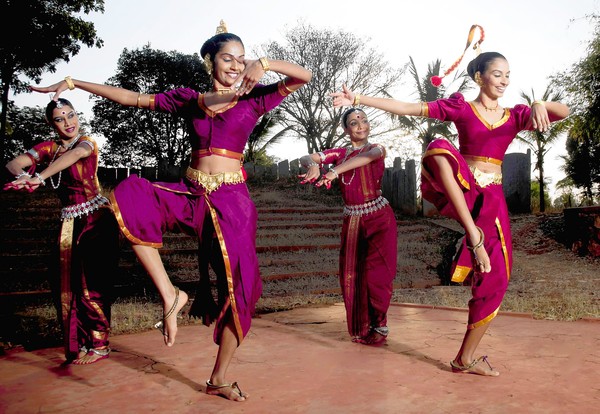
The Indian dance company Nrityagram Dance Ensemble performs Sunday at the University of Notre Dame’s DeBartolo Center for the Performing Arts. (Photo provided / January 3, 2008)

Literally translated, “Nrityagram” means “dance village.”

And what audiences will see from the Nrityagram Dance Ensemble Sunday at the University of Notre Dame’s DeBartolo Center for the Performing Arts is the unified performance of a group of dancers that lives, eats and dances together every day in a live-in dance community in India.
Founded by dancer Protima Gauri in 1990 near Bangalore, India, Nrityagram fosters dancing through community, according to the school’s website. Gauri died in 1998, but her dream lives on through the school.
“I dream of building a community of dancers in a forsaken place amidst nature,” Nrityagram’s website quotes Gauri as saying before the school’s founding. “A place where nothing exists, except dance. A place where you can eat, sleep, dream, talk, imagine — dance.”
Surupa Sen, the current artistic director for the ensemble, has been dancing with Nrityagram for 22 years.
The program for Sunday’s performance is a blend of dances found in India and Sri Lanka, Sen says. Dancers in richly colored and ornate costumes will grace the stage to dance in styles that are inspired by yoga, martial arts and meditation.
A speaker will give a post-performance talk after the show Sunday. The discussion begins immediately after the performance ends.
“My favorite part of the performance is the way the rhythmic beats of the two styles combine to create a new, exciting sound,” she says via e-mail.
Sen was the first soloist of Nrityagram, according to the ensemble’s website. She studied under Guru Kelucharan Mohapatra, as well as Gauri. Sen has performed all over the world with the Nrityagram company.
Nrityagram is in the “Gurukul” tradition, meaning the students take care of the guru, or instructor, as well as the school itself, according to the website. At Nrityagram, students are taught by several gurus and have daily requirements in exercise, prayer and, if they live on campus, chores to take care of the school.
The philosophy of Nrityagram is all-encompassing, impacting every aspect of a dancer’s life, according to the school’s website.
“At Nrityagram, dance is a way of life, a matter of faith and belief, nurtured and enriched by the souls of its own people,” the ensemble’s philosophical statement says on the website. “We believe that being a good dancer is second only to being a good human being.”
Sen says she spent eight months developing the choreography for the upcoming show.
“(Audiences can expect) a joyful collaborative effort and a common resonance between two completely different styles of dance born out of two countries and their respective cultures,” she says. “They will see spectacular costumes and live music played by musicians from India and Sri Lanka.”
The show will be traveling all over America, with 12 scheduled stops, Sen says. The ensemble will have a weeklong run at the Joyce Theater in New York.
“(The best part of performing is) dancing to a new audience and seeing their reactions,” Sen says. “(I enjoy) traveling and learning about the country and its people.”
Onstage
The Nrityagram Dance Ensemble performs at 2 p.m. Sunday at the University of Notre Dame’s DeBartolo Center for the Performing Arts. Tickets are $35-$8. For more information, call 574-631-2800 or visit the website performingarts.nd.edu.
source: http://www.southbendtribune.com / Home> Entertainment> Entertainment, Events from inthebend.com / By AMANDA GRAY ,South Bend Tribune / March 1, 2012

MU flaunts all new science world

Many institutions including ISRO showcase their work at the varsity campus

The exhibition put up by the  ISRO, Bharath Electronics Ltd, MCF, KIOCL, National Centre for Ocean Information Sciences, Hyderabad, MRPL and others at the fourth convention of Karnataka Science and Technology Academy held at Mangalore University attracted large crowd consisting of people from all walks of life.

Students from various colleges visited the programme and availed the advantage of gaining the first hand information about the functioning models and the achievement of various organisations.

The Indian Space Research organisations (ISRO) had highlighted its success story in the last four decades of Indian Space Programmes on charts put up at the exhibition. It also displayed models of Chandrayana, GSAT-8, GSLV MK III, ASTRO SAT. All the charts at the stall gave complete details on how the satellite functions and what are the uses of INSAT, a multi-purpose satellite.

Another interesting stall was by Indian Institute of Astrophysics, Bangalore which explained the stars, the sun and Indian Astronomical Observatories and others.

While explaining the Indian Astronomical Observatory situated at Hanle in Ladakh, an official from Indian Institute of Astrophysics said it is the world’s highest observatory for optical and infra-red astronomy.

As there is no power in Hanle, 90 kilo watt solar energy is produced in the Observatory to support the power supply. The Indian Astronomical Observatory is the high-altitude station of IIA, situated at an altitude of 4,500 mts above the sea level to the north of Western Himalayas. The cloudless skies and low atmospheric water vapour make it one of the best sites in the world for optical, infrared, sub-millimeter, and millimeter wavelengths, he said.

He said a 2-m optical infrared telescope is installed at the observatory. This telescope is remotely operated from CREST, Hosakote, using dedicated satellite links.

The stall put up by KIOCL had a ‘pig iron’ and iron pellets. Various charts by Bharat Electronics Lit, Bangalore exhibited solar power signals, 3 D Radar used in navy and others.

National Centre for Ocean Information Sciences, Hyderabad had displayed an electronic display board, which displays potential fishing zone in the sea. Using the data of potential fishing zone, the fishermen venture into the sea.

The electronic machine also alerts the fishermen during tsunami.

The Mangalore Chemical Fertilisers (MCF) had array of products meant for farming community as well as the precautionary measures used in the MCF to safeguard the employees. Vision Group of State government, Ministry of Earth Sciences, Marine Product Export Development Authority, Jawaharlal Nehru Planetarium, Bangalore, BASF, JSS STEP had also put up their stalls explaining various activities taken up by them.

The mobile exhibition by Vishweshwaraiah Industrial and Technical Museum was another attraction.

source: http://www.DeccanHerald.com / Home> District / Mangalore, January 29th, 2012 / DHNS
‘The Romance of Indian Coffee’ released

Mysore, Nov. 30-The newly-launched book titled ‘The Romance of Indian Coffee,’ authored by the Bangalore-based senior journalist P.T. Bopanna, offers a 360-degree view of Indian coffee — the fascinating history of coffee, many charming facets of coffee culture, its symbiosis with nature and what makes coffee such a captivating brew.

The book highlights how Indian coffee is unique and stands out in the global market. Unlike the coffee produced in other countries, Indian coffee is totally shade-grown and is much in demand internationally.

The author has chronicled the contribution of Ivor Bull, the British planter from Coorg, who conceived the idea of the ‘pooling system’ to save the coffee industry during the Second World War.

For those interested in the variety of ways in which coffee can be prepared, a separate chapter has been devoted in the book on how to prepare a good cup of coffee, especially South Indian filter coffee. Recipes for other interesting and popular coffee concoctions, including recipes for making coffee liqueur have also been included.

There is an interesting chapter on how the pioneering British coffee planters spent their days in the estates in 1880s. The book also deals with the current issues that threaten planters — deforestation, climate change, fluctuating prices and man-animal conflict.

Brand specialist Harish Bijoor, who has a vast experience in the coffee industry, has written the foreword for the book. Among those who have contributed articles for the book include, agriculture scientists, Dr. Anand Titus Pereira and his wife, Mrs. Geeta Nanaiah Pereira, who have been working diligently on their model coffee farm on sustainable technologies.

The book has been published by Prism Books Pvt Ltd, Bangalore, and is priced at Rs. 270.

Bopanna’s other books include ‘Rise and Fall of the Coorg State,’ published in 2009; ‘Discover Coorg’ published in 2006; ‘Dateline Coorg,’ a compilation of his articles on Coorg in the last two decades and ‘Coorg: Land of Beauty and Valour,’ a coffee table book, published in 2010.

Bopanna runs www.coorg tourisminfo.com, the first news and tourism portal of Coorg. He may be contacted on Mobile: 93424-30141.

source: http://www.starof mysore.com / General News / Wednesday, November 30th, 2011


Promote Organic Farming, suggests RAITHA SANGHA President


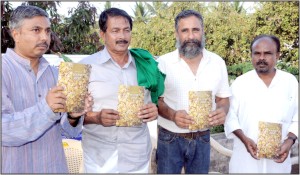
Raitha Sangha President K.S. Puttannaiah, Dr. V. Rajendra and Progressive farmer Vivek Cariappa releasing the book Huruli Parisay at Nisarga Organic Food Products Centre in Kuvempnagar yesterday.

Mysore  Oct. 31:

– Raitha Sangha President K.S. Puttannaiah has urged the government to commence a diploma course in organic farming sans any usage of chemical fertilisers.

He was speaking at an interaction programme with farmers also marking the release of the book Huruli Parisay organised at Nisarga Organic Food Products Centre in Kuvempunagar here yesterday.

“With the increase in use of chemicals in agriculture, deadly diseases like cancer and heart-related ailments have been observed even among children. Accordingly, more medical colleges and nursing homes have been cropping up. Good food should be consumed to maintain good health,” he said.

Huruli or horsegram is one and the only crop cultivated without the use of any chemical fertiliser. If Americans knew about Huruli they would have patented the product long back. The country should evolve a food policy to maintain the health of the citizens which necessitates a well-organised movement,” opined Puttannaiah.

He also suggested marketing of organic food products through mobile vans.

Dr. V. Rajendra of Government Ayurveda College released the book Huruli Parisay.

Progressive farmers Vivek Cariappa, Basavaraj and others were present.

The farmers later had an interaction with the consumers.


source: http://www.starofmysore.com / General News / October 31st, 2011


History in a pastoral set-up

Uttara Kannada’s Balligavi has many temples which stand testimony to its rich past, covering the Chalukya and Hoysala reigns. Apart from the ASI-protected lawn-covered temple complexes, the general scene of present-day Balligavi is like any other small town in the State, with agriculture being the main occupation of people here, observes Poornima Dasharathi
EMBLEM OF A DYNASTY  A Hoysala emblem atop one of the temples in Balligavi.Photos by the authorIt was my first visit to the Uttara Kannada region. Though I am not new to the Western Ghats, I had never ventured beyond Sagar to the smaller towns and villages of Shimoga district. As we raced down the snaky trail from Soraba, the bumpy rides on potholed roads encouraged me to put aside my camera and just enjoy the scenic beauty of the villages.
On either side of the road were huge keres formed by the monsoon and lush paddy crops. Intermittent rain and the monsoon air were accompanied by familiar rural sights and smells. Our destination was Balligavi, a small town in Shikaripura taluk of Shimoga district.

Though Balligavi is a small town today, it was once an important educational, commercial and a cultural hub. “It was a place of such antiquity,” notes B L Rice in the Gazetteer he compiled for the then Mysore government, “that even in the 12th century, as to be styled the mother of cities, the capital of all cities, the anadi rajadhani, the immemorial capital and is said to derive its name from the rakshasa King Bali.” He goes on to say that it was the capital of Banavasi or the “Banavasi-twelve thousand province.”

Considering the Banavasi province once encompassed almost the entire region between the rivers Varada and Tungabhadra, that’s an incredible achievement for a city of those times.

The town, according to the priest at Kedareshwara temple, reached its peak during the reign of Chalukyas (between 10th and 12th century); though its prosperity continued during the Hoysala reign also.

During the Chalukya reign, the city had five mathas (religious centres or monastaries), three puras (extensions) apart from several Brahmapuris (Brahmanas’ settlements). The sculptors of this region were very famous and many travelled down south during the Hoysala rule and were instrumental in creating the marvellous Hoysala temples.

As is common, much of what is left of history are the intricately carved stone temples. Belligavi, Balagami, Ballipura or Balligavi as people now call it, is home to many very old temples – Kedareshwara, Someshwara and Tripurantakeshwara – to name a few. The place is full of inscriptions and temple ruins. The ASI-maintained ones are just a handful, one suspects.

Temple architecture

The Kedareshwara temple is a beautiful structure, slightly below the existing ground level. As we go in, the frontal view is blocked by a huge benevolent nandi; a style that is common across all Shiva temples in Uttara Kannada.

The central shrine is a small linga made of Krishna shila. On either side are shrines to Brahma and Janardana. The ceilings in the mantapa have simple lotus carvings. In the central ceiling is a picture of Shiva as Tandaveshwara flanked on eight sides by ashta dikpalakas – a design that was also seen in Tripurantakeshwara temple. The three shrines have three beautiful gopuras that reflect the Kalyana Chalukya architecture.

On two of these towers is the royal emblem of the Hoysala. A third one that’s incomplete is preserved in front of the museum beside the temple.

The museum is home to several relics and inscriptions collected in the region. Apart from Hindu deities, there are also several Jain statues as the place was an important centre propagating Jina dharma too. The Tripurantakeshwara temple nearby has a colourful history. Built in the 10th century, it was here that the great king Vishnuvardhana met Shantala, explained the local guide. The temple is known for the intricate snake carvings that adorn the window panels of the doorway to the shrine. The intertwined snakes create a mesh-like structure.

Apart from the main linga, there is also a statue of Vishnu. Again, a huge bull sits across the mantapa. The Virabhadra statue carved on the outer walls looks fierce even in ruins. The most amusing and perplexing were the carvings around the temple that are a mix of Panchatantra tales and erotic scenes!

Nearby, in the town centre, is a fierce form of Ganda Berunda, the mythical two-headed bird. Unlike in Keladi or the much gentler Mysore emblem, here the bird is half animal and half human. It’s devouring one human and holding another to devour next!

Apart from these ASI-protected lawn covered temple complexes, the general scene of present-day Balligavi is like any other small town in the State. Agriculture is the main occupation here.

The streets meander across the town with row houses on both sides. Buffaloes take up much of the road and vehicles have a trying time weaving their way through.

The lush green paddy fields, women washing clothes by the river, the occasional mooing of the cows can create an idyllic picture and lull you into a calming frame of mind.

One can almost hear the sound of granite being chipped to create another piece of history

source: http://www.deccanherald.com / DHNS / Home> Supplements> Travel / Tuesday, November 01st, 2011

‘Ekikarana’ movement: A timeline

The regions that make up for today’s Karnataka were under as many as 20 different administrative units with the princely state of Mysore, Nizam’s Hyderabad, the Bombay Presidency, the Madras Presidency and the territory of Kodagu being some of them.


* Under such circumstances, a need was felt among Kannadigas living in these various administrative units to form one state, which would unify all Kannada-speaking people in the various regions. This movement called the Ekikarana movement was led by litterateurs and thinkers.

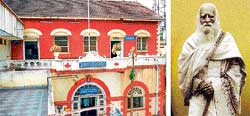
* The Karnataka Vidyavardhaka Sangha was established in Dharwad in 1890. This was an important phase in the history of the unification movement. The Sangha was started by R H Deshpande who strove for the revival of Kannada in a region which was part of the Bombay Presidency where Marathi was the language of administration.

* It was later that the Kannada Sahitya Parishat (Bangalore) was set up (1915), which was another driving force in the unification movement.

* Alur Venkata Rao was the leading light of the unification movement. The publication of his Karnataka Gatha Vaibhava in 1912 gave a huge push in terms of a mass movement. He was known as the Kannada Kula Purohita or the ‘High priest of the Kannada family.’

* The States Reorganisation Commission was constituted by the Central government under the States Reorganisation Act and consisted of Hon. Fazal Ali, Kavalam Madhava Panikkar, and HN Kunzru.

* The recommendations of the Fazal Ali Committee was ratified by the Parliament, which meant that several disparate Kannada-speaking regions would now come under the Mysore State.
n The State was formed on November 1, 1956.

n It was on November 1, 1973, under Devaraj Urs as chief minister that the Mysore State was renamed as Karnataka.

source: http://www.deccanherald.com /by DHNS / Home> Supplements> Spectrum / Tuesday, November 01st, 2011