Daily Archives: April 1, 2018

Genetic diversity can prevent rapid spread of infectious diseases

Choice of pandemic: The models are best suited to study airborne diseases such as H1N1, say Nagasuma Chandra (left) and Narmada Sambataru.

The team studied how susceptibility sub-populations affect the spread of the disease

An infectious disease can spread at different rates in different countries. This phenomenon has been observed in many cases, for instance in the 2009 H1N1 influenza pandemic. An International group of researchers including those at Indian Institute of Science (IISc), Bengaluru, and The Institute of Mathematical Sciences (IMSc), Chennai, looks at genetics as a way to explain this phenomenon. They find that the greater the genetic diversity in immune response, the stronger is the barrier to the spread of the disease. The results have recently been published in PLOS Computational Biology.

Nagasuma Chandra’s team at IISc chose to study H1N1 as modelling it had some advantages.

“There is a lot of work on H1N1 and a lot of data including clinical and epidemiological. These models are also best suited to study airborne diseases. As H1N1 spreads through air, choosing it made a lot of sense,” says Dr. Chandra.

Pandemic H1N1 virus

The pandemic H1N1 2009 influenza A virus was different from other influenza viruses encountered until then. According to the WHO, this is because it originated from animal influenza viruses and is unrelated to the human seasonal H1N1 viruses that have been in circulation among people formany years In fact, this virus is thought to have arisen from a mixture of two viruses: a North American virus that jumped from birds to swine and humans and a Eurasian swine virus that had circulated in pigs for about a decade before entering humans. Clinically also the virus’s effect was very different from that of other flu viruses in that younger people were more severely affected than older ones.

Narmada Sambataru and Sumanta Mukherjee who were at Dr Chandra’s lab, and Martin Lopez-Garcia from the University of Leeds, UK, spent nearly a year building up the model. Their research led them to establish how an individual’s genetic makeup can influence his or her susceptibility to the infection.

The immune system has both innate and adaptive response types to infections, in general. In the case of H1N1 infection, the adaptive immune system can recognise the presence of a virus within the cell and respond to it only if a molecule called the human leukocyte antigen (HLA) binds to some fragment of the viral protein (epitope) and ‘presents’ it to the environment outside the cell. Dr Chandra’s group has described the details of this aspect of H1N1 in an earlier paper published in the journal Clinical and Translational Immunology.

Immune response

“The main take-away from our work is that understanding how the immune response of different individuals leads to a spread of susceptibilities in a population is vital to figuring out how diseases spread,” says Gautam Menon of The Institute of Mathematical Sciences, a co-author of the paper. “This problem, of how to go from what we know about how individuals can vary in their susceptibility to understanding how epidemics spread across entire populations, has been identified recently as one of the major challenges in the study of epidemics.”

Having worked out how the genetic makeup of an individual can affect their susceptibility to the disease, the individuals can be grouped according to their susceptibility. Using a mathematical model called the SIR (Susceptible-Infected-Recovered) model, the researchers study how the presence of susceptibility sub-populations affect the spread of the disease. “In this model, individuals are initially susceptible but not infected.

“When an infection is introduced, individuals become infected at a rate determined by their estimated susceptibility to the pathogen, estimated using genetic information about the host as well as the pathogen. Infected individuals then proceed to recover,” says Dr Chandra.

Trends

The work captures the qualitative features of well-known trends of influenza spread in various parts of the world. “This work uses publicly available information about HLA class-I genes and their prevalence in populations around the world. Unfortunately, there is a significant shortage of this information for Indian populations,” she says.

The group is planning to propose a detailed study of this for Indian populations. “Once this information becomes available, we can do far more to predict disease spread in India. These predictions can be used to inform public policy and make better decisions. This is the real utility of such modeling methods, that we can explore different situations and ask what responses might be most effective in the context of specific diseases,” says Dr Menon.

source: http://www.thehindu.com / The Hindu / Home> Science / by Subashree Desikan / March 31st, 2018

CM inaugurates first phase of Pavagada Solar Park

Chief Minister Siddaramaiah inaugurated the first phase of Pavagada Solar Park at Thirumani in Pavagada taluk of Tumakuru district on Thursday.

Addressing a large gathering, Mr. Siddaramaiah termed the solar park as the “eighth wonder of the world.” He said that “we are thankful to all those farmers who have leased out their land to the government for the project.”

In the first phase, the solar park will produce 600 MW. A total of 2,300 farmers of Pavagada have leased out 13,000 acres of land at Rs.21,000 per acre per annum. This will help to boost the economic activities in the most backward taluk. Before the solar park was established, the land rates were around Rs. 25,000 per acre but now they have risen to Rs. 4-5 lakh.

Energy Minister D.K. Shivakumar said that Karnataka will become self-reliant in the production of power and there will be no need to depend on other States. Pavagada Solar Park will be completed by December 2018 and will generate 2000 MW of power, he added.

District-in-charge Minister T.B. Jayachandra, MP Chandrappa, MLA Thimmarayappa, former Minister Venkataramanappa and others were present.

source: http://www.thehindu.com / The Hindu / Home> News> States> Karnataka / by Staff Reporter / Tumakuru – March 01st, 2018

Around the world in 80 days

Flying high: Captain Audrey Deepika Maben and her daughter Amy Mehta with their aircraft at the Jakkur Aerodrome in Bengaluru on Wednesday.

Woman, daughter to fly 50,000 km to garner support for women’s empowerment

In Jules Verne’s Around the World in Eighty Days, Phileas Fogg and his valet take steamers and trains and even an elephant while in India to win a bet with £20,000 at stake. Flying instructor Captain Audrey Deepika Maben and her 19-year-old daughter Amy Mehta are driven by a different goal as they get ready to fly around the world in 80 days in a motor glider: to spread awareness on women empowerment.

They will cover 21 countries and 50,000 km to garner support for the We! Udaan scholarship for underprivileged girls who want to fly.

K. Moses Chalai, Joint Secretary, Ministry of Women and Child Development, congratulated the mother-daughter duo and also read a message on behalf of Menaka Gandhi. He said the expedition would be a great example of the Beti Bachao, Beti Padhao campaign.

The expedition

Talking about the expedition, Captain Audrey said the it was very dear to her as it would help young girls around the country realise their dreams of flying. “This expedition is only one part of our mission. The larger goal is to encourage women across the country to take up flying,” she said.

She explained that this expedition would be a challenge as they would have to land for washroom breaks and prepare their bodies to accustom to tough conditions during their monthly cycles.

The expedition, in its planning stages now, will be finalised in the next two months. They plan to travel across 21 countries with 70 to 90 landings in between, which may vary depending on prevalent weather conditions and re-fuelling. They will fly eastward towards Japan, Russia, Alaska, North America, Greenland, Europe, Pakistan and back to India. As the motor glider requires fair weather and as Captain Audrey only has a daylight flying licence, they will be flying around 5-6 hours per day.

Training routine

As part of her training routine, Captain Audrey, a mother of three, works out everyday and has regular physical training. She is also following a strict nutrition plan along with yoga and meditation. The initiative is undertaken by an entertainment channel in collaboration with the Ministry of Women and Child Development and Social Access Communications.

source: http://www.thehindu.com / The Hindu / Home> News> Cities> Bengaluru / by Ashwini Raj / Bengaluru – November 30th, 2017

Rajayotsava : The Hows and Whys of Karnataka

RajayotsavaBF01nov2017

Today is Karnataka Rajyotsava, a day celebrating the formation of the state in 1956. ‘One State, Many Worlds’ best describes our story, marked by a unification despite the pulls and pressures of socio-linguistic fragmentation

There is not a day on which Kannada, the state language of Karnataka, comes into popular focus more than every November 1. The day marked as Karnataka Rajyotsava, a public holiday, has been typically accompanied by visual symbols everywhere, of the state’s identity – like buntings of an (unofficial) flag and banners about an (official) language.

Translated literally to ‘State Festival’, Rajyotsava marks the day in 1956 when the erstwhile Mysore State was expanded to re-unify into it, some key Kannada-speaking and geographically connected regions of South India. The change of the State’s official name to Karnataka itself happened close to two decades later, with the passing of the Mysore State (Alteration of Name) Act, 1973.

The early C(K)arnatic

The term ‘re-unification’ of the State needs to be understood with some historical context. The geo-political expansion of the region had been commenced by Chikka Devaraka Wodeyar and continued by Hyder Ali, which towards the end encompassed a surprising area compared to what Karnataka State is today.

This growth of the Mysorean region was of course cut short by two key events: The Treaty of Seringapatam (1792) which ended the Third Anglo-Mysore War, and The Siege of Seringapatam (1799) which ended the Fourth Anglo-Mysore War.

The result of the former was that, about half of the Mysorean territory, was divided by the British and their allies at the time – the Mahratta Peshwa acquired territories up to the Tungabhadra River, and the Nizam of Hyderabad was granted land between the Krishna and Pennar Rivers, and the forts of Cuddapah and Gandikota. The East India Company itself retained a large integral central portion (Mysore and Coorg) and some of the Malabar Coast territories between Travancore and the Kali River, as also Baramahal and Dindigul districts. The result of the latter, which marked the final confrontation between the East India Company and the Kingdom of Mysore, was a further division of the remaining parts of the kingdom – Kanara, Wyanad, Coimbatore, Dharmapuri and Srirangapatna were retained by the British and the Nizam acquired Gooty, a part of Chittoor and Chitradurga districts. The effect on the ground was that large pockets of people were placed outside the core Mysore region, but still retained Kannada as lingua franca because of continued trade and commerce across the borders of a larger core region.

Karnataka in focus

The implication of the States Reorganisation Act of 1956 for the Kannada speaking regions at that time was of course, the re-unification of some zones that had been separated over a hundred years earlier, and the merger of other zones that were inherently Kannada speaking but were part of historical empires that had held on to them over time.

Remarkably, the name indicated by the States Reorganisation Committee for the unified state was “Karnataka”. The committee’s report provides explanatory notes
as to why the state was not proposed to be divided into two (keeping the erstwhile Mysore State separate, as was demanded by a school of thought at that time), and Section 329, which clearly states, “For these reasons, we recommend that one Karnataka State should be formed. This state should, in our opinion, comprise the, following areas…” and lists the areas proposed for unification covering the then existing Mysore State, four Kannada-speaking districts of the southern division of Bombay, namely, Belgaum, Bijapur, Dharwar and North Kanara, two districts from the princely state of Hyderabad namely Raichur and Gulbarga, South Kanara, Kollegal from Madras, and Coorg.

There were some exclusions in the recommendations, such as Bellary and Hospet taluks, as well as Kasargod, and further explanations were provided with a note “The territorial limits of Karnataka, as thus proposed, broadly cover the Kannada-speaking areas, but in the case of one or two small units, linguistic considerations have been subordinated to other compelling reasons”. The report also mentions Kolar district as an inclusion despite having a majority of Telugu speakers, for reasons of historical interest of Mysore in its industry as well as proximity to Bangalore versus Kurnool or Hyderabad. It also provides a list of over a dozen additional justifications for inclusions, exclusions, economic considerations, developmental and industrial issues, natural resources, population and administration. Finally, in Section 351, the report makes a defining statement: “Karnataka with the territorial limits which have been indicated so far will have linguistic and cultural homogeneity and geographical integrity. Barring a few dissentients, all those who have been concerned with the Karnataka problem in some form or (Aber will sooner or later recognise that this is so…”

Despite the recommended name in the SRC Report, the name of the expanded State was retained as Mysore in the SRA of 1956. Two decades later, with the passing of the Mysore State (Alteration of Name) Act, 1973, the erstwhile Mysore State officially adopted the name of Karnataka. This was in itself also due to an identity conflict where residents of northern Karnataka felt the name of Mysore reflected only the erstwhile regime, and did not represent the expanded state. Prior to the unification of Gulbarga, Raichur, Bidar and Koppal districts, the High Court jurisdiction was Hyderabad, only 200 km away, but after the unification it had moved to Bangalore, at four times the distance.

(The author is an IT professional and Bengaluru heritage enthusiast)

source: http://www.bangaloremirror.indiatimes.com / Bangalore Mirror / Home> Bangalore> Others / by Kiran Natarajan / Bangalore Mirror Bureau / November 01st, 2017

Archiving the versatile sari

The aim is to create a cultural documentation of the sari.

The Nivi drape, or the one where the pallu of a sari is worn on the left shoulder, is the most common type of sari drape in the country and the world over. But India has hundreds of such drapes, specific to region and culture, that have been forgotten over the years. To document these drapes and create a digital archive, Border&Fall, a city-based digital platform promoting the garment, textile and craft community of India, is making 80 short films as part of its project ‘The Sari Series: An Anthology of Drape’.

Each film will be two minutes long and will show how to drape a sari in a particular style. The archive, expected to be released this fall, can be accessed online for free .

“This project has been an idea for years, but we began proactively working towards it in early 2016. The aim is to create a cultural documentation of the sari through short films, which will give people access to various drapes, and to showcase the diversity and versatility of sari as a garment,” said Malika Verma Kashyap, founder of Border&Fall.

However, Ms. Kashyap said this was not an attempt to “revive” the garment. “The sari is not a forgotten tradition, it is worn my millions of women every day. But many are unaware of the different ways it can be worn. The Boggli-Possi drape from Andhra Pradesh for example is great to behold,” she said.

Some of the other styles to be documented are the Coorg drape, the Kalna Sari drape from West Bengal, Kuchipudi men’s sari drape from Andhra Pradesh, Yakshagana Kase from Karnataka, Purnia drape from Bihar, Warli drape from Maharashtra, and Ranchi Saiko drape from Jharkhand.

Apart from the 80 films, three independent films directed by Qaushiq Mukherjee, Bon Duke and Pooja Kaul will explore the sari’s past, present and future.

Some of the images of the drapes are part of the #WeWearCulture project by Google Arts & Culture.

source: http://www.thehindu.com / The Hindu / Home> News> Cities> Bengaluru / by Sarumathi K / Bengaluru – July 28th, 2017

StayAbode raises angel funding

StayAbode, a start-up that is building co-living spaces, said that it had raised an undisclosed amount of angel funding from a consortium of investors led by Ishan Manaktala and Angie Mahtaney.

Gaurav Bhalotia (Ex-VP Engineering, Flipkart), Vishal Lulla (CEO, Vishal Exports) and investors from online funding platform LetsVenture also participated in the round. StayAbode said it offers more than 180 beds spread over four properties across Bengaluru. The funding would help it expand to other cities.

Mr. Bhalotia said, “StayAbode is using technology to create living spaces that support the new lifestyle of the young.”

source: http://www.thehindu.com / The Hindu / Home> Business / by Special Correspondent / Bengaluru – February 27th, 2017

‘An award places a greater responsibility on a winner’

Deputy Commissioner N. Jayaram presenting the Karnataka State Jeeva Rakshak Prashasti to Rajesh Gopalrao Khatavkar on the occasion of Republic Day celebrations in Belagavi.

“An award in recognition of social service or contribution to society is not an end in itself. Instead, it implies a greater responsibility on the part of the recipient,” said Karnataka State Jeeva Rakshak Prashati awardee Rajesh Gopalrao Khatavkar. Deputy Commissioner N. Jayaram had presented him with the award during the Republic Day celebrations in Belagavi.

A few months ago, two senior citizens were seriously injured in an accident on Fort Road in the city. They were hit by a reckless motorcycle rider. Mr. Khatavkar, who was passing by then, rushed them to the district government hospital and ensured that they received immediate medical help. He did not wait for the ambulance to arrive. The injured victims survived the accident, which could have been fatal.

What followed, however, were days of unexpected ordeal from the police, who kept calling him in connection with the accident. Finally, his name was recommended to the district administration for the award.

Mr. Khatavkar, an engineer and a social activist, is also the winner of the Godfrey Philips National Bravery Award. He was recently conferred with the CID Gallantary Award that carried a cash prize of ₹1 lakh, a gold medal and a memento. He has received several awards for his acts of bravery, including stopping a bank robbery a few years ago. These were conferred upon him by the President, the Prime Minister and Chief Ministers of Karnataka and Andhra Pradesh.

Speaking to a section of the media here on Tuesday, he appealed to citizens to play a proactive role instead of being mute spectators to various unexpected happenings, or looking at someone else to do or lead.

source: http://www.thehindu.com / The Hindu / Home> News> States> Karnataka / by Special Correspondent / Belagavi – February 01st, 2017

For the love of the game

From the albums

drkrishnamurthybf01dec2016

Karnataka has the rare privilege of playing the first Ranji Trophy match in India in November 1934. That match also turned out to be a good one, with 30 wickets falling in one day and Mysore losing the match to Madras in a single day.

Karnataka has come a long way in Indian cricket and is now acknowledged as one of the most powerful cricket teams, one feared by all opponents. Many have contributed to this transformation — players, administrators, the cricket-loving public and employees of the cricket association.

It has been a long and difficult journey that I am happy to have been a part of, first as a player and then as an administrator.

It started in 1959, when I was chosen to play for a junior match between Mysore and Madras and a brilliant century in that match made it easy for me to get into the Ranji Trophy side and stay there for 10 long years before retiring. After a few years’ break, I entered Karnataka State Cricket Association (KSCA) as an administrator and worked to the best of my ability in various capacities. I retired a few years ago as the vice-president of KSCA.

Today, it is a well-run organisation, with set rules, a beautiful stadium, fabulous clubhouse and more than 3,000 members enjoying the facilities and the game of cricket frequently.

But it was a difficult journey then, with no ground that the association could call its own. The Central College grounds were used as the headquarters and games were also played at various other college and school grounds.

With no money to run cricket matches and expecting everyone to do a good job, the president and the secretary had a hard time running KSCA. S A Srinivasan, M Chinnaswamy, Captain Thimmappiah and C Nagaraj were the stalwarts who built the infrastructure for the present-day KSCA.

The presidents and secretaries sacrificed their personal lives and professions to spend time on the cricket grounds. Even in such difficult situations, KSCA magnanimously contributed to the various causes of the state. This rare photograph was taken on one such occasion for the Chief Minister’s Flood Relief Fund that was organised at the Central College grounds.

The then Ranji Trophy players played in several places like Tumkur, Shimoga and Kolar and raised funds for the cause. Many stalwarts seen in this photograph have left for their heavenly abode while many others have been forgotten. But a few are still active and working for the cause of cricket.

While I was playing for the Ranji Trophy, I was also picked to represent the Mysore University cricket team. Only two universities existed then — Mysore and Karnataka, headquartered in the Hubballi/Dharwad region. Mysore University consisted of all colleges in the old Mysore area.
I was a student of Bangalore Medical College and represented the university for four consecutive years. During the last two, I was the captain. We always had an excellent team and in 1962, we won the All-India Championship for Rohinton Baria Trophy, playing in the biting cold of Kanpur (two degree centigrade).

Almost everyone on those teams went on to play for the Ranji Trophy. I was also fortunate to be selected for the All-India University team against the visiting Australian cricket team, led by late Richi Benaud.
Two of my teammates P R Ashok Anand (present president of KSCA) and Deepak Das Gupta also played in that match.

Deepak Das Gupta was a fine off-spinner and has now settled down in Kolkata. Nearly all the players went on to become highly-qualified professionals in India and abroad and have done well in their respective spheres.

I was also fairly successful in the Ranji Trophy matches, becoming the captain of the Karnataka cricket team and scoring over 1,000 runs which was an achievement in those days.
As the players were not paid in those days, a majority retired early to pursue their chosen professions. I also retired early to take up my medical practice.

Today, university cricket has lost its stature with too many universities and with cricket becoming professionalised. I feel fortunate to have been among the few who savoured the true spirit of the game, surrounded by so many wonderful players.

(The author can be contacted on 9845127495)

source: http://www.deccanherald.com / Deccan Herald / Home> Supplements> Metrolife / by Dr.S. Krishnamurthy / November 21st, 2016

Mysore Rajya: Diverse areas bound by one tongue

slice of history:The cover of the 440-page bookMysore Rajya;

The book, released by Information Department on Nov. 1, 1956, emphasised that Mysore was a State of diverse cultures, but Kannada was the binding factor

When the erstwhile Mysore State, comprising Kannada-speaking territories, came into existence on November 1, 1956, the Information Department of the then Mysore government brought out Mysore Rajya, a 440-page book, to mark the occasion. This six-decade-old volume laid emphasis on the fact that Mysore is a State of diverse cultures, but Kannada is the binding factor.

The book consists of two parts: the first containing articles by eminent people from Kannada-speaking areas, and the second on statistical data about 19 districts that formed the new State of Mysore. According to the preface, the idea behind the government bringing out the book “is to see that it will serve to create a mental and psychological fusion among its several areas”.

In the article Our Culture , R.R. Diwakar, the then Governor of Bihar, explained the difference between individual and social culture and pointed out that Kannada culture is part of Indian culture. Dr. Srikanata Shastry in his article The History of Karnataka dealt with the succession of ings who ruled Karnataka namely the Kadambas, Gangas, Chalukyas and Hoysalas culminating in the establishment of the Vijayanagar Empire. He also made a reference to the Mahratta influence on Mysore and Mohammedan rule under Hyder and Tipu.

B. Shivamurthy Shastry, in his article on Religious Movements in Karnataka, dealt with several religious movements that left their impression on Kannadigas. In his illuminating article on thePolitical Life of Kannadigas , Tirumale Tatacharya Sharma pointed out that the kings of Karnataka have always stood for a Welfare State. Gorur Ramaswamy Iyengar has traced several events that led to the formation of the New Mysore State in his article on The Formation of New Mysore. Writer Jayadevi Taayi Ligade has given a good account of the part played by women in Karnataka. Writing on modern Kannada literature, A.N. Krishna Rao dealt in detail about development in prose, drama, short story, lyric, novel, and literary review, and indicated that the influence of English literature has given a liberal outlook among the Kannada authors.

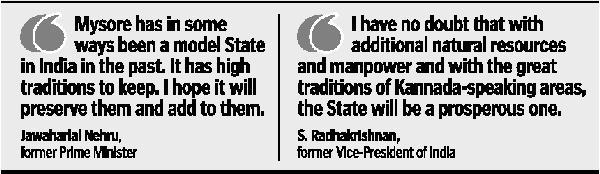
The publication has messages from Prime Minister Jawaharlal Nehru, Sarvepalli Radhakrishnan, first Vice-President of India, Chakravarti Rajagopalachari, the last Governor-General of India, Jayachamaraja Wadiyar, Governor Mysore State, and Chief Minister S. Nijalingappa.

nehrubf01nov2016

Kadidal Manjappa, who was Chief Minister till October 31, 1956, in his introduction stated: “We must not forget that under the scheme of States’ Reorganisation, we are only altering the number and boundaries of the States for administrative purposes and not trying to set up Independent Sovereign States”.

A photo of the Vidhana Soudha in the book.

Interestingly, batting for the need of “multilingual, multinational State”, C. Rajagopalachari dubbed such State as “ideal State in political theory”. He also said: “let us not allow small and narrow interests to take obstinate root and obstruct real progress”.

source: http://www.thehindu.com / The Hindu / Home> News> Cities > Bengaluru / by Muralidhar Khajane / Bengaluru – November 01st, 2016