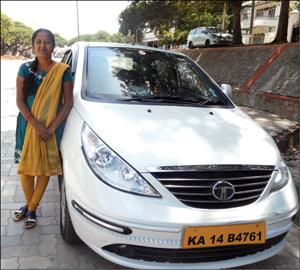
This is the tale of 35-year-old Neetha, a resident of Hebbal in city, who did her Master’s in Sociology from the Open University in 2006, passed Bank services exams and got a job in a Nationalised bank but became a cab driver in the running. She is now working as a cab driver at OlaCabs, a transport company, for the past one year.
Neetha, who says that circumstances forced her to reject the bank job as it was opposed by her family members, is the daughter of retd. KPTCL employee Madaiah and a native of Malavalli in Mandya district, married to one Raju, an employee at KPTCL and a native of Kundapura.
Neetha, who undertakes about 20 trips a day from 6 am to 7 pm in the TATA Vista (KA-14 B-4761) to take tourists to various tourist spots in and around Mysuru like Chamundi Hill, KRS, Nanjangud, Hunsur, K.R. Nagar, Srirangapatna and T. Narasipur, also enjoys her job as the lone woman cab driver in the city.
Speaking to Star of Mysore, Neetha said that she took to cab driving as she felt that it was better to take up a job which helps her earn some money instead of idling at home, which, she claimed, ensured that she was self-sufficient which should serve as a model for other women who waste their time by just sitting at home.
source: http://www.starofmysore.com / Star of Mysore / Home> General News / June 23rd, 2016
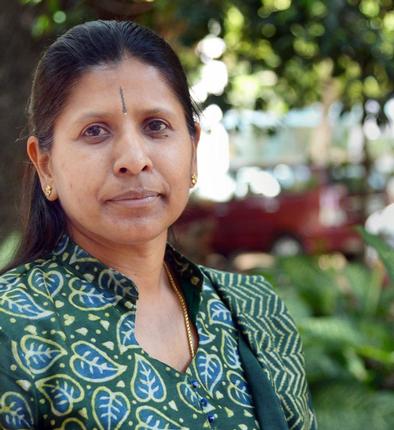
Padhma Priya, research scholar. Photo: K.V. Srinivasan / The Hindu
Padhma Priya, who is researching the art of the region, talks to Lalithaa Krishnan about its distinct features.
Describing herself as an amateur artist who grew increasingly interested in the theory and practice of visual art, Padhma Priya allowed her passion for Mysore painting to lead her towards post-graduate studies in Art History from the Chitrakala Parishad, Bengaluru. Her thesis dealt with the ‘Quality of Art Work’. At present, engaged in an extensive research on Mysore paintings, she shares her insights.
What factors contributed to the creation of this distinct pictorial style?
Rooted in the Vijayanagara art tradition, the pictorial vocabulary of the Mysore style was nourished by the versatile talent of migrant artists who worked in different mediums, their intensive, long-drawn training under their gurus and thorough knowledge of Hindu mythology and religious texts helped them compose amazing themes. So, it appears that a deliberate effort has been made by Mysore artists to stand out and create an individualistic style gradually over a period of time.
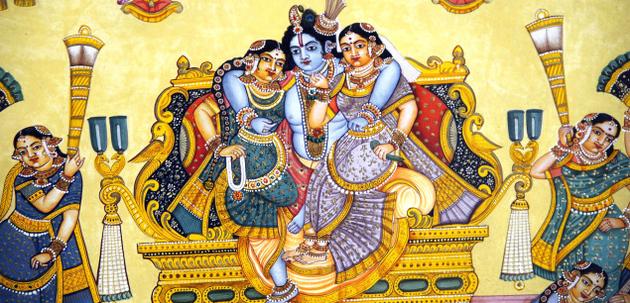
Mysore painting at the C P Art Center. / Photo: K.V. Srinivasan / The Hindu
What are the chief features that distinguish Mysore painting from Thanjavur art?
The differences are evident in terms of methods and materials used. Thanjavur painting is traditionally executed on a jack wood plank with a ground preparation of tamarind seed powder and chalk, while Mysore painting is done on paper. Both schools use jewellery crafted on a flat surface but their techniques differ. Thematically, they share Hindu mythological characters and tales, but my research shows that the Mysore school has a fantastic visual narrative that no other artists of traditional schools have brought forth.
You collaborate with artists, epigraphers and historians. About their valuable inputs…
The foundation for my research is collecting a large, unpublished, unrecorded database across five districts and five taluks of Karnataka. My field work is a rich digital resource database of themes and narratives, artists of Mysore and other arts and crafts of Karnataka. I am grateful to the Karnataka State Archaeology Department, the district administration, Mr. Murari, whose door-to-door survey helped me to locate rare paintings, Mr. Kharbade DG ,NRLC, Lucknow, my art history teachers Dr. R.H. Kulkarni and H.A. Anilkumar of Chitrakala Parishath, Bengaluru, scholars Dr. Jaisree Narasimhan and Dr. Banumathi for deciphering the content of labels and slokas in the paintings, artists K.S. Srihari, Sridhar and R. Sivakumar, who helped document the traditional methods and materials in Mysore paintings.
Which institutions impart formal training in the art? Can artists move beyond creating reproductions and how affordable are Mysore paintings?
The Chitrakala Parishath, Bengaluru, imparts technical training periodically via short-term courses but the need of the hour is to provide long-term training in both theory and technique. Once the artist has a solid grounding in Hindu mythology, iconography and iconology, he can break away from the cliché of mechanical reproduction and create original art works with rare themes. Depending on size, theme and workmanship, prices begin at Rs. 8000 for a 12’’x 15’’ work, to Rs. 200,000 for larger ones.
A note on the conservation of paintings.
I am a quality consultant in fine arts. Through scientific methods, I help buyers check the quality of the art works. Preventive conservation of paintings is my core research. My two-volume publication on the Mysore school is planned for 2017.
Your personal favourites that rank as must-views?
All the paintings in the Mysore palace, Jaganmohan palace and the CKP museum are fantastic collections.
Unusual collection
A connoisseur with a keen eye and memory for detail, art dealer Vitthal Rao brings 40 years of expertise in the field to bear upon the superb collection of Mysore paintings that graces the main gallery, C.P. Arts Centre. Priced between Rs.10,000 and Rs. 40,000, the collation spans myriad deities that include Siva, Vishnu, Kodanda Rama, Krishna, Saraswathi, Lakshmi, Ganesha and Anjaneya and diverse themes such as Pattabhisheka and Rathi-Manmatha. In an unusual portrayal of goddess Tripurasundari, Lord Narayana is shown assuming the form of a bangle seller who fits the ornaments on her hands, as any mere mortal would be burnt by her touch. Varying depictions of a single deity, Chamundeshwari, reflect the vision of different artists. While Yedur Siddhalingeswara, Kalikamba Viswakarma, Tripura Samhara and Dhruva Narayana are rare pieces, the colossal, exquisitely detailed Koteswara Siva and Viswaroopa evoke awe and wonder.
Antique works from royal houses as well as paintings by contemporary artists B.B. Ramakrishna, K.S. Srihari and Dinesh are on display till 18 June. (Timings: 10 am – 8 pm).
source: http://www.thehindu.com / The Hindu / Home> Features> Friday Review> Art / by Lalithaaa Krishnan / June 16th, 2016
We dine with the founder of Earth Loaf and decode what goes into this Indian-grown artisanal chocolate
After a whiskey chocolate dinner and an interview with David Bello, Earth Loaf’s founder, I’m trying to gather my thoughts, but the bar of chocolate is distracting. Wrapped in candy pink bearing a peacock motif, it’s anything but candy. Deep dark chocolate of Kerala origin, made with palmyra sugar and locally-sourced ingredients, 72 per cent is wood fermented in cedar boxes. The chocolate is dark and slightly bitter, has a fruity finish and a woody earthiness that comes from the cedar wood boxes — a first in many ways.
For the socially conscious consumer, Earth Loaf ticks all the right boxes. The cocoa is single origin, sourced from either Karnataka or Kerala — there’ll be one from Tamil Nadu soon — the sweetener used is local palmyra, the farmers are closely involved in the production and it’s all hand-made. From ‘bean to bar’, as David is fond of saying, it’s a local Indian product — but it took a Londoner with Greek roots to make it.
Earth Loaf, originally, was the name of a bakery in London that David started, and after moving to Mysore with his partner Angelika in 2012, he used the name for the small chocolate-making endeavour that took off. What started as 3-4 kg of chocolate made by hand for friends and family became a registered company that works with cocoa farmers in Karnataka, to create a sustainable, Indian chocolate brand. A one-man show today, Earth Loaf is David’s baby, as he calls it, and he does everything from sourcing cocoa beans to web-designing for the site and even creating the lovely packaging that features a peacock motif from the Chittara art of the Malnad region. Today, David calls Mysore home, and having grown up in South Africa, took to Indian climes like a fish to water. “I love the heat! I thrive in it,” he grins.
Artisan, vegan, raw — there are many labels that Earth Loaf identifies with, but that’s not what its selling point is. For David, it’s simply his vision, translated through fine chocolate. Which is why the bars are specific in their flavours; they aren’t trying to cater to a variety of palettes. “There have been people who tried our chocolate, disliked it or found it too bitter. But they came back, to try another flavour. A second, third, even a fourth time. They are willing to experiment and they keep coming back,” he says. Well aware of the Indian sweet tooth, David is just putting out into the market something he enjoys himself — dark chocolate with some unusual pairings. And there’s also the story behind each bar. David knows the farmers personally, he’s even learnt Kannada to converse with them, and he prices his products a bit on the higher side, because he believes that the farmer should get his fair share. The bars are all processed by hand, from the grinding of the beans to the final packing.
His 72-per cent bars of single-origin raw chocolate are paired with unusual ingredients like gondhoraj– a lemon that’s somewhere between the Italian lemons used to make limoncello and an African kaffir lime found only in parts of Bengal and Assam — smoked salt, dried apricots, nuts and more. David’s background as a mixologist is reflected in how he pairs his flavours, often reworking an idea for months at a time, until he gets it right. “Even when I was bartending back in London, I’d work on a single cocktail, like a Martinez, for about six months till I got it right,” he says. And it’s the same with his fruit pairings. Recently, he’s been trying to infuse a jamun-like fruit native to Karnataka into his chocolate, without much success. “The chocolate keeps overpowering it, so I’m trying different things. I’ve been trying to squeeze the essence out of the rind of the fruit, like how you would a bergamot, but it didn’t work, so now I’m trying to dry the rind, powder it and see if that will work better.”
For a country that’s quite a prolific producer of cocoa, India seems to be relatively new when it comes to the bean-to-bar variety of chocolate. “Cocoa was originally brought to India from Indonesia in 1798, by the East India Company,” he explains, “and India has had varieties of cocoa growing, but it wasn’t until the 1950s that Cadbury decided to push cocoa farming in India and that’s when it took off.”
Much like the coffee culture that came from the West to show us the amazing varieties we have in India, there’s a wave of chocolate appreciation that’s slowly gaining ground. A far cry from the sugared candy bars you see at grocery stores, today’s artisanal chocolate is locally sourced, handmade, has tasting notes that range from woody and fruity to acidic, is affected by the terroir, and lends itself to all kinds of pairings from food to wine and whisky. And this chocolate evangelist from Mysore, is more than happy to introduce the country to its own hidden chocolate treasures.
(A menu pairing Earth Loaf chocolates and Jameson whiskey is available at On The Rocks, Crowne Plaza Chennai Adyar Park till June 26. It is priced at Rs. 2,999 per person.)
source: http://www.thehindu.com / The Hindu / Home> Features> Metroplus> Society / by Elizabeth Mathew / Chennai – June 21st, 2016
Renowned Indian-American author and philosopher Raja Rao’s archive that includes a broad range of materials from unpublished works to manuscripts of his well-known novels has been acquired by the University of Texas for advancing the study of arts and humanities.
Rao’s estate donated the archive to the Harry Ransom Center, a humanities research library and museum at the University of Texas in Austin.
According to the centre, “It’s a notable acquisition in part because Rao is widely considered to have been one of India’s most noted authors, having received the Neustadt International Prize for Literature and other honours.”
The Harry Ransom Center specialise in the collection of literary and cultural artefacts from the U.S. and Europe for the purpose of advancing the study of the arts and humanities.
Rao (1908-2006), considered one of India’s earliest and most outstanding English-language novelists, was the author of numerous works of fiction, short stories, poetry, talks, essays and The Great Indian Way: A Life of Mahatma Gandhi (1998), about Gandhi’s time in South Africa.
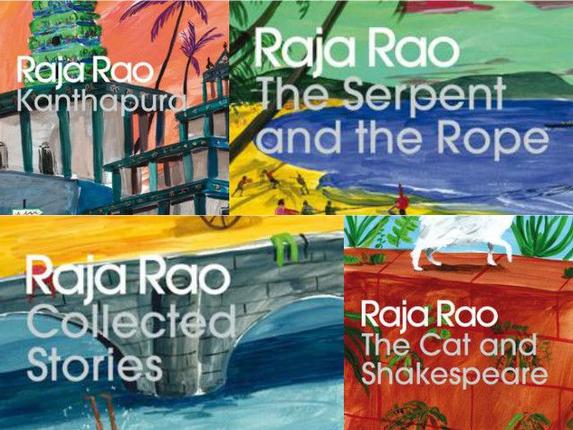
Rao’s archive includes manuscripts of his well-known novels Kanthapura (1938), The Serpent and the Rope (1960) and The Chessmaster and his Moves (1988).
Screenshot of the Harry Ransom Center site shows a photo of renowned writer Raja Rao’s 1969 passport.
“Departing boldly from the European tradition of the novel, Raja Rao has indigenised it in the process of assimilating material from the Indian literary tradition,” said R. Parthasarathy, professor emeritus of English at Skidmore College.
Educated at the Aligarh Muslim University and the University of Madras and other foreign universities, Rao was already an internationally known author when he was recruited by former University of Texas president John Silber to teach Indian philosophy and Buddhism in Austin.
His archive contains materials in several of the languages that Rao spoke, including English, French, Sankskrit and his native Kannada.
Rao won the Sahitya Akademi Award in 1964 for the philosophical novel The Serpent and the Rope. In 1969, he was the recipient of the Padma Bhushan and in 2007 he was posthumously awarded the Padma Vibhushan.
Alongside the archives by Rao at the Ransom Center are manuscript collections of prominent international writers including J.M. Coetzee, Anita Desai, Doris Lessing, Gabriel Garcia Marquez and Amos Tutuola.
source: http://www.thehindu.com / The Hindu / Home> Books> Authors / PTI / Houston – June 16t, 2016
Over the past seven decades, Excelsior bakery has established itself as the place to be for a slice of cakes, puffs and more
In 1926, the bustling Seppings Road was a rather quiet neighbourhood, very different from the bustling marketplace of today. It was in this neighbourhood that baker Sahadevan in a partnership with a British lady, Emery set up Excelsior Bakery.
The bakery has over the years gone on to establish itself as the must go place in the cantonment to head for cakes, milk breads, puffs and much more. The ownership has passed four generations and the bakery is currently being managed by IT professional turned businessman Saipreeth Muralidharan.
He says, “We have a very loyal clientele. In the preparation of the food items in the bakery, we use a lot of secret recipes that have been passed on from one generation to the other. Many of the residents who have moved away from the locality to places like Hebbal and Jayanagar come here regularly to savour our milk breads, Japanese cakes, puffs and spiced breads. I often meet people bringing their children to the bakery and narrating tales about cakes for their birthday parties as children arriving from Excelsior. We have even had instances of people coming from as far as Chennai to sample food from the bakery.” Saipreeth’s father Muralidaran, one of the owners weighs in, “One of our most popular items are the Christmas plum cakes. We add many special spices and essence. We start preparing the plum cakes for Christmas a month and a half in advance. We used to have people knocking the doors of the bakery at six in the morning for a loaf of bread.”
The family takes personal care to ensure the quality of the product. “I check every batch of puffs, breads and sweets that are created at the bakery. We have put systems in place to ensure that only fresh items are served to customers.”
Saipreeth says that over the passage of time, many functions in the bakery have become mechanised. “In the earlier days, we would have to physically knead the dough for the bread. My grandfather used to have army cadets volunteering for the job, in exchange for a loaf of bread. Many of these processes have become mechanised. However, we have still kept some traditional practices alike and most of our baking is done on a firewood oven.”
Once Saipreeth took over operations a few months ago, the bakery underwent changes. “We introduced a new menu with non-vegetarian components such as chicken puffs, rolls and pizzas. We also added sweets to the menu. We try not to use gels and preservatives in our items.”
Talking about the cantonment being a hub for a clutch of family owned bakeries, Saipreeth quips, “I think it was mainly because there was a large British presence in this part of town. They taught us to bake and eat bread.”
source: http://www.thehindu.com / The Hindu / Home> Features> MetroPlus/ Nikhil Varma / Bangalore – June 22nd, 2016
City’s upcoming paddler M.V. Spoorthi taking part in the R.S. Shakuntala Memorial State Ranking Table Tennis Tournament at KGS Club, Bengaluru hogged the limelight by bagging a triple crown on Sunday.
Spoorthi won the women’s singles, youth girls singles and junior girls singles titles. In the women’s singles final, Spoorthi beat Swetha Kumaravel 11-7, 11-9, 7-11, 11-5, 11-6.
In the Youth girls singles final, Spoorthi beat V. Kushi 11-6, 7-11, 11-7, 11-8, 11-7.
Earlier, Spoorthi had won the junior girls singles title and thus completed a fine treble.
In the men’s singles event, Anirban Tarafdar beat city’s Akshay Mahanta 10-12, 14-12, 12-10, 11-7, 11-3 in the quarter-finals while Rakshith beat city’s Vedanth M. Urs 13-11, 11-5, 11-8, 11-5 in another quarter-final.
In the Youth boys singles quarter-final, Nikhil beat Vedanth M. Urs 9-11, 5-11, 11-8, 5-11, 11-8, 11-7, 13-11 to progress further.
source: http://www.starofmysore.com / Star of Mysore / Home> Sports News / June 21st, 2016
Dhruthi T. Venugopal (left) and Kyra Shroff who won the women’s doubles title in the Mary Pierce Indian Ocean Series ITF Women’s Tennis Tournament at Mauritius, seen with the winners’ trophy.
Mauritius :
Mysuru-based Dhruthi T. Venugopal teaming up with Kyra Shroff representing India in the Mary Pierce Indian Ocean Series $10,000 ITF Women’s Tennis Tournament at Mauritius which concluded on Sunday, won the women’s doubles title.
In the final, second seeded Dhruthi and Kyra combined well to score an upset win over top-seeds Chayenne Ewijk and Rosale van Der Hoek of Netherlands 6-1, 6-1 to clinch the title.
source: http://www.starofmysore.com / Star of Mysore / Home> Sports News / June 21st, 2016
A four-year-old girl Brundavani Abbigeri of the Roller Skating Club set a new world record in limbo skating at Kaiga on Sunday. She created the record by limbo skating under a course of 5.5 inches bars. She also created another record by limbo skating for 600 metres.
The Roller Skating Club of Kaiga organised the event on the premises of the Kaiga Township Recreation Club. Brindavani set the new record in front of the representative of the Record Holders Republic (RHR) India. The Kaiga Roller Skating Club office-bearers told reporters that the club will file an application to document the record at the Limca Book of Records and the Asian Book of Records. Representative of the Record Holders’ Republic, Promod Ruiya, documented the new record.
Shubhan Hanbar of the same school had earlier set a record by limbo skating under 5.6 inch bars in 2011.
source: http://www.newindianexpress.com / The New Indian Express / Home> States> Karnataka / by Express News Service / June 20th, 2016
The District Wing of Karnataka State Nurses Association had organised a function at MMC&RI Platinum Jubilee Hall in J.K. Grounds here on Friday to present ‘Florence Nightingale’ award to 12 senior nurses and ‘Sevaratna’ award to six nurses and two nursing students for their sincere service in the nursing profession.
Florence Nightingale awardees are: Nursing Superintendent of PKTB and CD Hospital Shantachandra Leeladarshi; ESI hospital nurse K. Shakuntala; In-Charge Principal of Government Nursing College Firdose Fathima; Senior nurses of K.R. Hospital T.C. Seethamma, Meenakshamma; Cheluvamba Hospital Nursing Superintendent Rathnamma; ED Hospital Nurse Antony Susheelakumari; K.R. Hospital Nurses Jayamani, Manjula Rani, B.B. Bojamma; Nanjangud General Hospital Nurses K.K. Yamuna and Prashanth Kumar Gangolli.
‘Sevaratna’ awardees: PKTB and CD Hospital Nurse Ratna Battur; K.R. Hospital Nurses B.G. Sarala; K.M. Vanaja; Brinda; Ghanajakumari; Sachita; Nursing Students Padma Chandru and P. Jayalakshmi.
On the occasion, Prathibha Puraskar were also presented to N.S. Manasi, H.P. Manoj, A.P. Roopita, K.M. Raksha, H. Pavana, Shelumial Shane, A.J. Deepu Prakash, S. Yashaswini, D. Deepika, K.V. Harshita, B. Tejaswi Nanjappa, H.N. Mahendra, T.V. Krithika, K.P. Roshini, S. Chirag, S. Kiran who excelled in SSLC and Tejas, L. Hemantraj, I.C. Monappa who excelled in PUC and B.P. Kshira who excelled in degree examination.
Ballari District Health Department Superintendent (National Florence Nightingale awardee) Shantabai and Pharmacist Suresh Babu too were felicitated at the function.
Minister for Health and Family Welfare U.T. Khader, MLAs Vasu and M.K. Somashekar distributed scholarships to poor students. MLC Dharmasena presented the ‘Sevaratna’ awards.
MMC&RI Dean and Director Dr. B. Krishnamurthy presented Prathibha Puraskar.
Association District President Shivamma presided. MMC&RI Administrative Officer B.G. Indiramma, Government Employees Association District President H.K. Ramu and others were present.
Senior nurses may soon head PHCs in rural areas: Health Minister
Minister for Health and Family Welfare U.T. Khader speaking at the awards presentation ceremony for nurses at Platinum Jubilee Hall at JK grounds here on Friday said that talks were on with senior doctors to weigh the pros and cons regarding promotion facility for nurses which has been a long pending demand of nurses.
Khader said that days were not too far when Senior nurses would function as doctors at Primary Health Centres (PHCs) in rural areas. He pointed out that at similar Centres in Thailand and UK, senior nurses are the heads. Hence he said that in the context of shortage of doctors, senior nurses would be posted to man the PHCs after thorough discussions and creating a position in that capacity. He added that the wages of contract employees had been increased from Rs. 8,000 to Rs. 11,000-Rs. 13,000 which was a step towards solving the problems of nurses.
source: http://www.starofmysore.com / Star of Mysore / Home> General News / June 19th, 2016
Marimallappa Educational Institutions had organised Sri Gurikar Marimallappa Samsmaranotsava-2016 and Pre-University Award – 2016 and Gold Medal presentation ceremony at its premises in city yesterday.
Defence Food Research Laboratory (DFRL) Director Dr. Rakesh Kumar Sharma and Dept. of PU Education Dy. Director Razina B. Malaki presented the awards and medals.
Gurikar Gold Medal was presented to G. Akhila, who emerged first topper in the district and third topper in the State in II PUC (Science stream) exams. Matrushri Gold Medal for Sangeetha Karanth (Commerce stream) and Bhagyashilpi Gold Medal for Lohit Shekar (Arts stream).
Eeshu, who secured II Rank in the State SSLC exams and evening college student Lakshmi were also felicitated on the occasion.
Institution Hon. Secretary Prof. K.N. Panchaksharaswamy and Marimallappa PU College Principal and Samsmaranotsava Samithi Convenor M.S. Prasannakumar were present during the programme.
source: http://www.starofmysore.com / Star of Mysore / Home> General News / June 19th, 2016