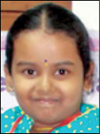
Former National U-7 girls champion, K.G. Anaga (in pic) from Kalale, Nangangud Taluk, is representing India in the Under-8 girls section in the Asian Youth Championships to be held at Mongolia from Apr. 5 to 15.
She is a student at Acharaya Vidyakula School, Kalale, Nangangud Taluk and is the daughter of Gopinath, who is a school teacher and her coach.
source: http://www.starofmysore.com / Star of Mysore / Home> Sports News / April 04th, 2016
All of 13, the young philanthropist, Nikhiya Shamsher from Bengaluru has bagged a gold medal and awarded with the stature of ‘National Honoree’ at the Pramerica Spirit of Community Awards 2016, held at New Delhi. Nikhiya has now been invited to Washington D.C to represent India in the felicitation events to be held on April 30, May 1 and 2.
She will be honoured at the Smithsonian’s National Museum of Natural History in Washington D.C. and will visit U.S Senators on Capitol Hill, share her experiences and ideas with the Spirit Honourees from other countries.
Nikhiya had competed with 4,000 participants in India and would be honoured along with 25 winners from 10 countries and 100 winners from USA.
The Pramerica Spirit of Community Awards is the extension of the Prudential Spirit of Community Awards, the largest youth recognition programme in the United States that identifies and recognizes school students who have made a positive difference in their communities through volunteer community service, across the world.
Nikhiya is a passionate blogger, a national level archer and has been the brain behind her initiative ‘Bags, Books and Blessings’ & ‘Yearn to Learn’. While Bags, Books and Blessings aims to collect re-usable bags, books and school supplies for less privileged school children, Yearn to Learn aims to set up Science and Math Labs in schools and primary colleges that do not have them.
Nikhiya Shamsher, Grade 8 student from Greenwood High International School, said: “I am greatly honoured and humbled to win the gold medal. The cash prize will be utilized towards launching laboratories in more schools. I did not make the journey alone. Many people have supported me on the way. I am grateful to my parents, school principal and teachers for encouraging and mentoring me to achieve my goals. I am also grateful to my donors and volunteers who have made my journey fruitful. Just knowing that we have helped so many students in their educational journey is a wonderful feeling”.
Nikhiya, who had participated in the individual category, has been awarded the Gold Medal, a Certificate of Excellence and a cash prize of Rs. 50,000.
source: http://www.timesofindia.indiatimes.com / The Times of India / News Home> City> Bangalore / by Sreemoyee Chatterjee / TNN / April 06th, 2016
Clockwise from left: There are at least 3,000 objects on display at the Rani Abbakka Tuluva Baduku Adhyayana Kendra; a painting of a war scene made of ‘soote’ or coconut strands
Bantwal :
The coast is not just about beaches, fish curry and shrines. Thanks to historian Tukaram Poojary, this agrarian town houses a museum showcasing Tulu culture and attracting the attention of experts worldwide.
The Rani Abbakka Tuluva Baduku Adhyayana Kendra (Centre for Research on Tuluva Life and Culture) has on display more than 3,000 objects.
Tukaram Poojary, who teaches history at of SVS College here, is our own Indiana Jones. When he is not teaching, he travels to remote places, looking for objects relating to the history of Tulu life and culture.
“It is not just the objects that interest me but also the historical and social conditions that produce it,” he says.
A dowry box at the museum
Ward off Tigers
The museum exhibits a tiger-chasing instrument, perhaps the last in the world. It is meant to drive away tigers, and not to kill them. “It symbolises ahimsa. This region was ruled by Jain chieftains who believed in non-violence,” Poojary says.
The instrument vanished sometime in the 19th century when the British came hunting. They saw tigers as game, and had no qualms about shooting them down.
Another object from the 19th century is a cradle made of five types of wood. “The infant is flanked by two woods, and the head and foot get two other varieties. The bottom, holding the weight of the infant, is made from the wood of the jackfruit tree,” he says.
The wood, interestingly, is used in funeral pyres. Since it is freshly cut, it does not fully burn during the cremation. “Relatives save it to make a cradle,” he explains, hinting at a philosophical cycle of death followed by life.
a painting of a war scene made of ‘soote’ or coconut strands,a painting of Rani Abbakka
Daring Rani
The centre is named after the first Tuluva queen Abbakka. Building an army of fishermen, she destroyed the first Portuguese flotilla that arrived on Indian soil.
She is famous for using the flaming arrow for the first time in this part of the country. History talks about three Abbakkas between 1530 and 1599, but the one who defeated the Portuguese at Ullal lived around 1556.
“I have no doubt Rani Abbakka was the first woman general of the Indian struggle against imperialist forces,” says Poojary, comparing her in greatness to Chand Bibi of the Adil Shah lineage and Razia Sultana of Delhi’s lineage of slave rulers.
Some historians say Abbakka is like William Wallace, the Scottish freedom fighter who led an army against the tyranny of Edward Longshanks, a 13th century English king.
“Though they belonged to different hemispheres, they fought alienation and tyranny. Abbakka’s spirit makes her legacy worthy of a national museum in the land where she lived and fought,” says Poojary.
In 1555, the Portuguese sent Admiral Don Alvaro da Silvereira to fight Abbakka Devi Chowta, queen of Ullal, after she refused to pay them a tribute.
She defied the invaders’ first command. With her army, she set fire to the Portuguese flotilla of galleons with burning arrows.
Arab, Jewish Links
British linguist and historian Elizabeth Lambarn found three objects in the museum sharing their Tulu names with Arabic and Hebrew.
“Petari is a chest for valuables, pataya a place to store grains and spices, and tali a large platter which the Muslims use to eat food together,” historian Tukaram Poojary says.
This shows that the Tuluvas of the Karnataka coast had socio-cultural exchanges with Arabic and Hebrew-speaking countries, he explains.
Poojary’s field trips into the interior parts of the coastal districts are yielding more and more objects. A library of books on Tulu culture, with research papers and anthologies, is also getting bigger.
source: http://www.newindianexpress.com / The News Indian Express / Home> Cities> Bengaluru / by M. Raghuram / April 03rd, 2016
1) Dr. S. Srikanta Sastri [1904-1974] 2) A group photo of B.A. Honours (1936 – 37), Maharaja’s College. Sitting (on chairs): Sathyagirinathan, V. Raghavendra Rao, S. Srikanta Sastri, N. Kasturi, M. H. Krishna, Sri Jayachamarajendra Wadiyar, J. C. Rollo, C. S. Seshadri, H. Muddaraje Urs, A. Sharadamma and Y. Venkamma; Standing (first row): B. Basappa, B. S. Rama Rao, K. S. Venkatanarayana, A. S. Lakshminarayana Rao, S. Mohammed Zakaria, A. S. Jagannath, S. Devaraje Urs, M. S. Bhimasenachar, M. V. Lakshmana Rao and D. L. Narasimha Sastry; Standing (second row): B. K. Raghunatha Murthy, M. L. Krishna Murthy, M. L. Ramaswamy, B. V. Venkannachar, C. V. Venkatesaiah, K. B. Ramaswamy Iyengar, B. Chikke Urs, V. S. Krishna Murthy and B. Puttaraje Urs; Standing (third row): B. V. Keshava Iyengar, D. Chokkanna and K. S. Subba Rao.Dr. S.N. Bhagirath, an avid reader of Star of Mysore, has sent a special article on his grand-father Dr. S. Srikanta Sastri, a renowned historian, to mark the Centenary Year of the University of Mysore. Dr. Srikanta Sastri, who studied BA and MA at Maharaja’s College in the nascent University of Mysore, also served the University as a Lecturer and Professor for thirty-five years.
Dr. Bhagirath, who is presently a Consultant Anaesthesiologist at Rainbow Children’s Hospital, Bangalore, was formerly at JSS Hospital, Mysore. Apart from Medicine, Dr. Bhagirath’s core passion is study of English Literature, writing and reading poetry, collecting information on Indus Valley artifacts and deciphering of Indus Valley Scripts.
Here we publish the special article as a befitting tribute to the polyglot in the Centenary Year of the University. Now read on.—Ed
—–
“It is scholars like Dr. S. Srikanta Sastri who build and make the reputation of a University. A University contributes precious little to build a scholar like S. Srikanta Sastri.”
— Dr. U. R. Ananthamurthy, Jnanpith awardee
——
by Dr. S. N. Bhagirath
During the Centenary Year of the University of Mysore, many of its luminaries, scholars, scientists, technologists and litterateurs of yesteryears are remembered with nostalgia. Among this galaxy of stars, Dr. S. Srikanta Sastri, the historian, stands out as a scholar of international fame on par with Dr. A. Venkatasubbaiah (Berne Univ.). On the advice of this historian, the corrected version of the Asoka pillar now stands in front of Maharaja’s College. The earlier pillar had various animals like the Bull, Lion, Elephant and Horse pushing the Dharma Wheel from the either side and not going anywhere!
He was an extraordinary teacher and research scholar with knowledge of fourteen languages. He took up the first research project of the University of Mysore in 1925 to lay the foundation of Karnataka history by writing “Sources of Karnataka History, Vol I.” In 1926, he published his first research article “The Conquests of Siladitya in the South” in the ‘Journal of Royal Asiatic Society of Great Britain & Ireland.’ Srikanta Sastri happens to be the second person in the University of Mysore to receive a D. Litt degree in 1949 for his contribution to Indology. He preoccupied himself with Karnataka history, when in reality only Princely Mysore State existed. He wrote extensively in English, Kannada, Telugu, Hindi and Sanskrit. He was a personal friend of Prof. M. V. Gopalaswamy, Head of the Department of Psychology and later Principal of Maharaja’s College, Mysore. Srikanta Sastri collaborated with Gopalaswamy in nurturing his pet project of Radio Broadcasting (Akashavani). Later, Prof. Sastri delivered more than twenty lectures in English and Kannada on All India Radio (Akashavani) from Mysore, Bangalore and Dharwad. Through his famous student Gorkha Dakshin Bahu Y. G. Krishnamurti (Nepal), he was keeping in touch with Pt. Jawaharlal Nehru and Subhash Chandra Bose. Nehru sent the first print copy of “Discovery of India” to Prof. Sastri and wanted to know his opinion. Srikanta Sastri later wrote an article titled “Nehru as a historian.” Sastri also contributed an anonymous article to Haripur Congress Souvenir in 1938 with the title “The History of Congress Polity.” This was a historic session where Mahatma Gandhi’s conscience candidate Pattabhi Seetaramaiah lost his election against Subhash Chandra Bose. To this souvenir Netaji Subhash Chandra Bose has sent a special message as President of the Congress party. Sastri’s student Y. G. Krishnamurti is the editor of this souvenir.
Srikanta Sastri’s introduction to Y.G. Krishnamurti’s book “Independent India and a New World Order” in 1943 attracted the attention of Joseph Goebbels – Adolf Hitler’s propaganda chief, who announced Sastri’s name along with that of Dr. S. Radhakrishnan over Berlin Radio one evening. This prompted the British Secret Service to arrest and interrogate Srikanta Sastri about his activities. This German broadcast was heard by several of his students, who began to hero worship him. He also had the courage of conviction to write an article during the time of Nalwadi Krishnaraja Wadiyar with the title “Is the Maharaja of Mysore a True Sovereign?” This article invited the wrath of the then Diwan of Mysore State Sir Mirza Ismail and one must remember Prof. Sastri was still teaching at Maharaja’s College. This firebrand professor also taught Prince Jayachamarajendra Wadiyar — History in the year 1936-37.
In 1943, he wrote a futuristic historical work “Geo-politics of India & Greater India,” which predicted a greater role for the Indian nation after Independence in South East Asia. He also predicted that India had the potential of becoming a world superpower with its large population and rich mineral resources. He heralded the formation of Karnataka State on Nov. 1, 1956 with a series of articles glorifying the history, culture and diversity of our State. His most famous work “Bharathiya Samskruthi” in Kannada has seen five reprints. In all, he authored about 12 books and 224 articles during his lifetime. His collected English works “Srikantayaana – Vol I & Vol II” is being brought forth by Mythic Society, Bangalore in 2016.
When he retired in 1960, the UGC appointed him as the first Emeritus Research Scholar of Mysore University. He was honoured by the University of Mysore during the Vice-Chancellorship of Dr. D. Javaregowda in 1973 with a Festschrift Volume by name “Srikanthika.” This volume contains scholarly articles of very high standard written by T. V. Mahalingam, S. R. Rao, S. Settar, B. R. Gopal, M. Chidanandamurthy, K. V. Ramesh, B. Sheikh Ali, T. V. Venkatachala Sastry, S. S. Raghavachar and A. V. Narasimha Murthy. The then Governor of Karnataka State Mohanlal Sukhadia honoured Prof. Srikanta Sastri during the Diamond Jubilee Celebration of the Mythic Society, Bangalore. The Kannada Sahitya Parishat honoured him during the Annual Sahitya Sammelan in Bangalore in 1970. He was one of the first of the Indian historians to refute the Aryan invasion theory hoisted by the westerners. He wanted Indian history and especially Karnataka history to be written by Indian historians who had an insight into the Indian culture and philosophy. He passed away in 1974. His centenary was celebrated in 2004 by the Mythic Society by conducting a two-day national seminar.
His most famous students are: Former VC Dr. D. Javaregowda, Dr. T. V. Venkatachala Sastry, R. K. Laxman and his brother R. K. Narayan, Sri Jayachamarajendra Wadiyar, H. Y. Sharada Prasad, U. R. Ananthamurthy, T. S. Satyan, S. R. Rao, M. S. Nagaraj Rao and his oldest living student Dr. G. Venkatasubbaiah. Some of his contemporaries were B. M. Sri, Ti Nam Sri, D. L. Narasimhachar, Kuvempu, Rallapalli Anantha Krishna Sharma, Prof. Nikam and M. H. Krishna.
Srikanta Sastri Gold Medal has been instituted by the historian himself to be awarded to a M. A. student who scores highest marks in cultural history of Karnataka in the University of Mysore.
[Dr. S. N. Bhagirath can be contacted on Mob: +91 – 9886803724 or email: bugs2beatles@gmail.com; Visit: www.srikanta-sastri.org]
source: http://www.starofmysore.com / Star of Mysore / Home> Feature Articles / April 03rd, 2016
A device developed by Abbott India Ltd. to monitor blood sugar levels. Photo: By Special Arrangement
Innovation lies in downscaling complicated testing equipment to fit a handheld device
A team from the Indian Institute of Science is developing a handheld medical device, which can measure eight biometric parameters related to blood and urine ( see info box ). It is expected to make testing costs “very affordable” and make monitoring of health statistics more convenient for patients, said the scientists.
This and other developments in the field such as continuous glucose monitoring systems and insulin pumps are changing how doctors and patients are managing diabetes.
“A handheld device to test multiple parameters will definitely help patients as it will reduce the time to obtain results,” said Rakesh Kumar, emergency physician at Apollo Hospitals, Bannerghatta Road.
PathShodh Healthcare Pvt. Ltd., a R&D company incubated at IISc., has developed the device, which is in the prototype stage. The innovation lies in downscaling complicated testing equipment into a handheld device.
Co-founder and Chief Technology Officer Vinay Kumar, who developed the concept as part of his Ph.D. research, told The Hindu , “The motivation behind the product is to transform science for a social mission.”
“Compared to traditional techniques, which are based on optical spectroscopy, we have adopted an electro-chemical technology similar to what is used in glucometers (a device to measure blood sugar levels),” said Navakanta Bhat, professor at IISc., Centre for Nano Science and Engineering, and another founding member of the company.
Apart from glucose, parameters such as HbA1c, haemoglobin and serum albumin cannot be tested by patients at home. The team hopes to change this.
The technology has not been exploited for other medical parameters owing to difficulties in implementation, Prof. Bhat added. “We are trying to make testing very affordable, compared to what is currently available in hospitals,” said Gautam Sharma, vice-president (Business) at PathShodh.
The team expects that the product will become as common as glucometers are today. “We are conducting trials to make sure the accuracy of tests is on par with laboratory tests,” said Mr. Sharma.
Rise in number of diabetics according to the International Diabetes Federation, by 2040, one adult in 10 (642 million) will have diabetes
The federation estimates that India is home to more than 65.1 million people with the disease, compared to 50.8 million in 2010
source: http://www.thehindu.com / The Hindu / Home> News> Cities> Bengaluru / by Staff Reporter / Bengaluru – April 01st, 2016
Senior advocate Prof. Ravi Verma Kumar is seen offering floral tributes to the portrait of Mahatma Gandhi at Senate Bhavan in Manasagangotri this morning as Gandhians Dr. H.S. Doreswamy, Dr. G. Madegowda, Shanthi N. Badriah, Dr. H. Srinivasaiah, Mysore University Gandhi Bhavan Director Prof. S. Shivarajappa and others look on.
Mysuru :
“It is distressing to note that the principles preached and practiced by Gandhiji, who is being praised by renowned personalities across the world, are vanishing in the very country where the Mahatma was born,” rued Prof. Ravi Verma Kumar, Senior advocate of Karnataka High Court here this morning.
He was speaking after inaugurating the Golden Jubilee celebrations of Gandhi Bhavan of the University of Mysore (UoM), said to be one of the oldest Gandhi Bhavans in India (started in 1965), at Nalwadi Krishnaraja Wadiyar Senate Bhavan in Manasagangotri in city.
Regretting that many intelligent students at various Universities across the country, who undertake many progressive activities, were being attacked and branded as anti-nationals for fighting for Freedom of Speech and Expression, the senior advocate said if Gandhiji was alive today, even he (Gandhiji) would have been branded as an anti-national.
Veteran freedom fighter and Gandhian Dr. H.S. Doreswamy, President of Karnataka Gandhi Smaraka Nidhi, Bengaluru, Dr. H. Srinivasaiah, Mandya Gandhi Bhavan Founder-President Dr. G. Madegowda and Gandhian Shanthi N. Badriah were felicitated on the occasion.
Gandhi Bhavan Director Prof. S. Shivarajappa, UoM Registrar Prof. C. Basavaraju and others were present on the occasion.
About UoM’s Gandhi Bhavan: It has a rich history of association with Gandhians and institutions committed to promoting Gandhian philosophy. It also has a collection of books that date back to the pre-independence era and is in the process of establishing a Gandhi Museum to preserve archival materials belonging to Gandhian era and other documents throwing light on Gandhiji’s works.
The foundation stone for the Gandhi Bhavan in city, which was laid on Sept.9, 1960 by the then Chief Minister B.D.Jatti, was inaugurated by former Prime Minister of India Morarji Desai on Jan.31, 1965.
source: http://www.starofmysore.com / Star of Mysore / Home> General News / April 01st, 2016
On Friday, the campus of the Government Polytechnic for Women wa s packed with models showcasing innovative and colourful themes. Themes like straw, peacock, mirror, flowers and Matsya Kanye (fish lady) attracted huge crowds.
However, most audiences were unaware that the designs were prepared by models themselves who are students of the Apparel Design and Fabrication Technology (ADFT). This show was not organised by a corporate company, but hosted by the Government Polytechnic for Women whose students are studying for a diploma in ADFT.
Polytechnic principal GM Goni said the college has girl students from poor or middle class families. “These girls sought permission to host a fashion show and since designing is part of their curriculum, we allowed it for the annual gathering,” he said.
Manjula Kadam, head of the ADFT department, said it’s a three-year course and it has been helpful for girls of middle or lower middle class families. “It’s generally assumed that fashion designing is for students of rich families. However, ADFT has enabled poor girls with a sense of fashion to do the course. Now, students have made us proud by showcasing designs stitched by themselves. It shows they have updated their knowledge on a par with industry requirement,” she said.
Kalyani L, who guided the students, said they used skills like hand embroidery and handicraft to prepare innovative themes. “In all, 23 girl students in the sixth semester prepared designs as part of their project. They started preparing eight days ago. As modeling is not prescribed in their syllabus, they practiced walking on the ramp and other actions required for the show,” she said. Shivaleela Hosamani and MS Bijapur, other faculty members of ADFT, said students were cautious while chosing themes for the show.
Annapurna Mysuru, who presented designs on the Straw theme, shared her friends’ used synthetic material. Krutika Bendigeri, who showcased the Peacock theme, said she wanted to chose a Nature-related theme. Rohini Devadas, who prepared and presented designs on the Mirror theme, said this show has given her confidence to continue in the garment industry.
Innovative designs
The students’ designs were very innovative. They ensured there was not even a hint of obscenity. When beauty is being commercialized, students proved it can be presented without compromising on the modesty of women. Young minds at work educated the audience about fashion, said writer Prajna Mattihalli .
source: http://www.timesofindia.indiatimes.com / The Times of India / News Home> City> Hubli / Sangamesh Menasinakai / March 19th, 2016
Did you know that Carnatic vocalist Bangalore Nagarathnamma was the first ever musician to have paid taxes to the British government in the early 1900s, and was the first Indian woman to have braved her way to perform in Jaffna? She and M.S. Subbulakshmi were among the first women musicians to be accompanied by men on the mridanga and violin when it was considered a societal taboo.
Author N. Jagadish Koppa
An account of rare informationon the two musical greats, who come from a Devadasi lineage, has been recorded in two recently released books in Kannada — Ditta Kalavide Bengaluru Nagarathnamma and Manadolagina Suprabhata M.S. Subbulakshmi, authored by N. Jagadish Koppa and published by Vikasa Prakashana. “It is the first two in a series planned on artistes from the Devadasi community who have contributed to cultural progress,” said Dr. R. Poornima of Vikasa Prakashana.
“While in Tamil Nadu, I chanced upon the Devadasi cult and their poetic and melodic inheritance that contributed immensely to the country’s progress in art and culture. Both were steely women… M.S. was known as the ‘daughter of Shanmukhavadivu,’ and Nagarathnamma as the ‘daughter of Puttalakshamma’,” writes Koppa.
The author goes on to find out on Nagarathnamma that the Oxford University Press in 1991 in the chapter on ‘Women Writers of India’ includes her as the “first woman writer of India” as she had, in 1917, edited the 17th Century Telugu classical poetry Radhika Swantanamu, which got embroiled into controversies for its bold, lyrical features.
Nagarathnamma was born in 1872 at Nanjangud and was brought to Mysuru as a toddler, before she entered Bengaluru and later settled in Tamil Nadu. Her time at Nagarathpet and later at Naraharirayana Gudde, where Judge Narahari Rao built a house for her, are little known facts. “That she sold her house to make money for building a Samadhi of Tyagaraja is common knowledge now,” says Mr. Koppa.
source: http://www.thehindu.com / The Hindu / Home> News> Cities> Bengaluru / by Ranjani Govind / Bengaluru – March 30th, 2016
The students of Okinawa Karate Do Shorin Ryu are Sempai V. Prajwal, Sempai Gangadatta Sharma, Shihan Suji Kumar (Organiser), Shihan Dominic (Chief Referee), Kyoshi S. Sunil Kumar, Sensei Srinath and Somasundari, S. Aishwarya, D.S. Kishan, B.A. Darshan, T. Sumukh, T. Spoorthi, N. Nagesh, Pruthvi Raj, Advaith S. Kumar, Anvesh Naik, K.V. Varshith, Bhoomika, K.R. Vismaya and Vinay S. Gowda.
Shorin Kai Association, India, who participated in the National Invitational Karate Championship-2016 organised by Japanese Goju Ryu Sports Karate Association at M.M.H. Hall, Karaikal, Pondicherry, on Feb. 27 and 28, have bagged the Overall Winner’s Trophy-2016 by winning 16 Gold, eight Silver and two Bronze medals under the guidance of Kyoshi S. Sunil Kumar, Chief Instructor, Examiner & Asian Representative.
source: http://www.starofmysore.com / Star of Mysore / Home> Sports News / March 24th, 2016
Losing one’s voice after an operation is very traumatic, and for patients with throat cancer, it becomes an added burden. India witnesses about 25,000-30,000 throat cancer cases each year, out of which at least 5,000 patients stand to lose their voice box due to the advanced stages of the disease.
Thanks to Dr. Vishal Rao, head and neck surgeon at Bengaluru-based HCG Hospital who has come up with a simple and affordable voice box prosthesis, patients can ‘speak’ again and swallow food.
According to Rao, one of the major disadvantages for throat cancer patients is the loss of their voice box when they undergo laryngectomy, the surgical removal of larynx. This is a hollow muscular organ forming an air passage to the lungs and holds the vocal cords.
Rao, a visiting scholar to the Pittsburgh School of Medicine in the US, says, “The larynx houses the vocal cords through which sound is produced. It also lets air travel from the lungs to the mouth. During laryngectomy, when the trachea (windpipe) and esophagus (food pipe) are separated from each other, an opening is created between them which is called the tracheo-esophageal puncture. The device is placed in this opening. Though the patients can eat through their mouths but they cannot speak due to the absence of the voice box.” Once he saw a villager who couldn’t speak for 16 years because he could not afford the imported device. Rao thought, speech and communication are not only the basic tenet to life force but a right to freedom, peace, dignity and justice. “These poor patients were bereft of this essential means of communication owing to costs only,” he says.
Rao realised there was a need for an improved device with a one-way valve enabling laryngectomy patients to speak. In 2013, he started researching on this problem. He and his industrialist friend Shashank Mahesh came up with a technical plan to develop such a device. After working for two years with engineers, physicists, biomedical and material experts, the voice box was built.
Explaining his innovation, the 37-year-old doctor adds, “Regaining one’s voice is much like a rebirth. We have named the artificial voice box as Aum device, because that sound first resonated across the universe. If air passes through the food pipe into the lungs, it will vibrate and create noise, which can be converted into intelligent speech, with coordination from the brain. As food or water should not fall into the lungs, it is a one-way valve device. It weighs about 25 grams and is 2.5 cm long.”
An imported prosthesis is available for Rs 20,000-45,000 and needs to be changed once in six months. “As 80 per cent of patients belong to the poor socio-economic strata, a majority of them are unable to afford the western prosthesis. Our innovation comes as a boon to them. We have priced it at Rs 50, which is less than a dollar at the moment. Presently, there is a clinical study going on at HCG, after which we will take it to other cities, especially to the regional cancer centres where there is a need for such device,” says Rao.
He has used the device on a few patients. Ramakrishna, a 55-year-old watchman from Bengaluru needed to change his imported prosthesis but could not afford it. “When my voice box was removed, I was given an imported machine, which I used for two years. I had trouble eating as the food leaked through the device. I am doing better after using the Indian device,” says Ramakrishna.
With more than 20 national and international publications to his credit, Rao has also received many global awards.
source: http://www.newindianexpress.com / The New Indian Express / Home> LifeStyle> Health / by Meera Bharadwaj / March 26th, 2016


![1) Dr. S. Srikanta Sastri [1904-1974] 2) A group photo of B.A. Honours (1936 - 37), Maharaja’s College. Sitting (on chairs): Sathyagirinathan, V. Raghavendra Rao, S. Srikanta Sastri, N. Kasturi, M. H. Krishna, Sri Jayachamarajendra Wadiyar, J. C. Rollo, C. S. Seshadri, H. Muddaraje Urs, A. Sharadamma and Y. Venkamma; Standing (first row): B. Basappa, B. S. Rama Rao, K. S. Venkatanarayana, A. S. Lakshminarayana Rao, S. Mohammed Zakaria, A. S. Jagannath, S. Devaraje Urs, M. S. Bhimasenachar, M. V. Lakshmana Rao and D. L. Narasimha Sastry; Standing (second row): B. K. Raghunatha Murthy, M. L. Krishna Murthy, M. L. Ramaswamy, B. V. Venkannachar, C. V. Venkatesaiah, K. B. Ramaswamy Iyengar, B. Chikke Urs, V. S. Krishna Murthy and B. Puttaraje Urs; Standing (third row): B. V. Keshava Iyengar, D. Chokkanna and K. S. Subba Rao.](http://www.bangalorefirst.in/wp-content/uploads/2016/04/ScholarsBF03apr2016.jpg)


