Sitarist’s strings bridge cultures

Bangalore :

Into the sunset of Sunday, arose the strains of a ‘bridge’ across cultures.

Lit candles in the sanctum of St. Andrew’s Church merged with the strings of the sitar, as American musician Paul Livingstone  plunged into the depths of a meditative tune, between the fluidity of bass and treble altitudes.

Internalizing the mellifluousness of raag Jai Jayanti, Livingstone’s soul connected with the heavens in solitary harmony and cascaded into the aura of myriad beating hearts, exploring the communion between heaven and earth.

Keeping the 16-beat pace of the raag, which broke ground and reached sky high, transcending time and space, percussionist Vishwanath Nakod flavoured the range with gentle and powerful finesse.

And into the night’s darkness, candles at the sanctum glowed with acquired intensity, in emotional transcendence with

Livingstone’s alaap swum over the pillars and trusses that have been holding the ancient place of worship steady since the 1860s.

This confluence of music and the magnetic appeal it brought with it reflected the intensity of India’s own music gems — Amiya Dasgupta, Rajeev Taranath and Pandit Ravi Shankar  — under whom Livingstone has trained for over 25 years.

With this Indian connection, Livingstone strummed out of the pages of his own connection to the ‘trinity’ a hymn in raag. “For me, this symbol is about unity and diversity and the love that every person carries for god, no matter what caste or religion,” said Livingstone.

The ‘bridge’ across cultures created a page in the history of spiritual interconnections, as he strummed the strings of the sitar  in an Indian church for the first time ever.

source: http://www.timesofindia.indiatimes.com / Home> City> Bangalore / TNN / January 21st, 2012

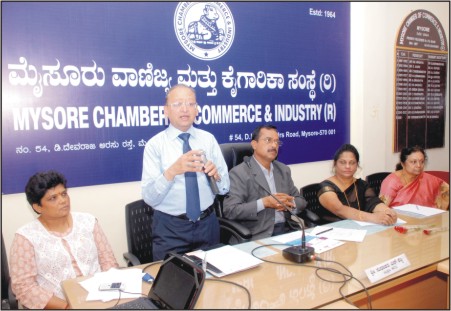
Awareness workshop for Women entrepreneurs

Caption: AIMS Director Ranganath Iyer addressing women entrepreneurs at the MCCI office on Devaraj Urs Road here today as WISE Secretary Rukmini Chandran, MCCI President Sudhakar Shetty, WISE President Gayatri Keshav and Vice-President Vasanthakumari look on. [Pic. by Pragathi Gopalakrishna]

Mysore, Jan. 15

Women in Small Enterprises (WISE), the women’s wing of Mysore Chamber of Commerce and Industry (MCCI), had organised a half-day workshop for women entrepreneurs at MCCI office on Devaraj Urs Road here today.

The workshop was to create an awareness among the women entrepreneurs regarding the ‘10,000 Women Entrepreneurship Development Programme’ to be organised jointly by Iiternationally acclaimed investment bank Goldman Sachs and Business School and the Indian School of Business in association with Acharya Institute of Management and Sciences (AIMS) to be held in Bangalore.

Briefing the gathering of over 50 women entrepreneurs, AIMS Director and Programme Convener Ranganath Iyer said: “The training programme to commence from Feb. 25 will feature 19 days of lectures and interaction with business experts and three months of monitoring by professionals in batches of six days each. The programme will train the women to refine their business modules to face the challenges and complexity in business. To improve communication skills in English, the programme also includes coaching in the language.”

Inaugurating the workshop, MCCI President Sudhakar Shetty pointed out that women entrepreneurs get subsidy up to Rs. 1 crore. He expressed satisfaction that the regional Global Investors Meet held recently in city had evoked good response from women entrepreneurs.

WISE President Gayatri Keshav, Vice-President Vasanthakumari and Secretary Rukmini Chandran were present.

Source: http://www.StarofMysore.com / Home> General News / January 15th, 2013

Dr. Raja Ramanna & Kalpana Chwawla awards for Mysoreans

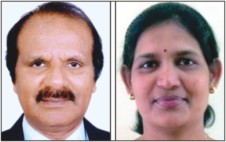
Caption: 1) Prof. Bhyrappa 2) Dr. Shubha

Mysore, Jan. 18

The Karnataka State Council for Science and Research, Indian Institute of Science, Bangalore, has announced the names of the recipients of various prestigious science awards for 2011:

Among the awardees are two Professors of Mysore University — Prof. K.Byrappa and Dr. Shubha Gopal.

Prof. K. Byrappa, international authority in the field of Hydrothermal Technology, senior Professor of M.Tech in Material Science, University of Mysore and Founder Director of the Internal Quality Assurance Cell of Mysore Varsity, will be awarded Dr. Raja Ramanna Award for Science and Technology.

One of his books “Springer Handbook of Crystal Growth” published by Springer-Verlag, Germany, is the second biggest book ever published by Springer-Verlag which runs to about 1,857 pages. He has published over 200 research papers including 30 invited reviews and book chapters on various aspects of ‘Novel Routes of Solution Processing’ and some of his publications are highly cited.

He had earlier served as the Director of UGC Academic Staff College of Mysore Varsity, besides serving as the Chairman of the Department of Earth Science.

At present, he is the co-ordinator of the Rs. 55 crore project in Mysore University, on Material Science and Nano-technology, under the schemes University with Potential for Excellence and Centre with Potential for Excellence in a particular area.

Dr. Shubha Gopal, Chairperson, Dept. of Microbiology, University of Mysore, has been bestowed with the prestigious Dr. Kalpana Chawla Young Woman Scientist Award for 2011-12 by the Karnataka State Council for Science and Technology for her outstanding contribution in scientific research.

Dr. Shubha’s research focuses on the molecular pathogenesis of Listeria monocytogenes, especially the role of thiol-redox and carbohydrate metabolism, its biofilm formation and gene regulation. Besides, she has also worked on bioprospecting of medicinal plants and reported a novel flavanoid from Leucas aspera (Thumbe plant) which has a potential industrial application.

She has published several research articles in peer-reviewed journals, and presented various research papers in national and international conferences.

Other awardees are: Sir M. Visvesvaraya Senior Scientist Awardees: Prof. Raghavendra Gadagkar of IISc., Prof. K.Muniyappa of IISc. and Dr. K. Siddappa, Hon. Director of JSS Foundation for Science & Society and former VC of Bangalore University.

Dr. Raja Ramanna State Scientist Awardees: Dr. G.K. Narayana Reddy, former VC of Karnatak University, Dharwad; Dr. S.M. Shivaprasad of Intl. Centre for Materials Science, Jawaharlal Nehru Centre for Advanced Scientific Research, Bangalore.

Sir C.V. Raman Young Scientist Awardees: Dr. Mohammad Hussain K. Rabinal of Karnatak University; Dr. Michael Rajamathi of St. Joseph’s College, Bangalore; Dr. J. Seetharamappa of Karnatak University; Dr. Y.C. Janardhan Reddy of NIMHANS, Bangalore; Dr. Riaz Mahmood of Kuvempu University, Shimoga.

Prof. Satish Dhawan Young Engineers Awardees: Dr. Subhash C. Yaragal of National Institute of Technology Karnataka, Surathkal; Dr. K. Balakrishna of Manipal Institute of Technology.

Dr. Kalpana Chawla Young Women Scientist Awardees: Dr. Sharada Srinivasan of National Institute of Advanced Studies, IISc.

The award ceremony will take place on Jan.24 at Satish Dhawan Auditorium, Indian Institute of Science, Bangalore.

Minister for Science & Technology Anand Vasant Asnotikar will preside over the function and present the awards. Prof. G. Padmanaban, Emeritus Professor and former Director, IISc., will be the chief guest. Prof. P. Balaram, Director, IISc., will be the guest of honour.

source: http://www.StarofMysore.com / Home> General News / January 18th, 2013

A special show for Indian dogs

The Mysore Kennel Club, which has entered its 82nd year, will host its 100th dog show at Karnataka Veterinary, Animal & Fisheries Sciences campus, on Saturday.

Briefing reporters, Club President P V Yathinder said: “for the first time, Indian dog speciality show scheduled for Saturday will showcase the canine pride of Karnataka — ‘Mudhol Hound’ along with ‘Pashmi’, both native to the State.” ‘Rajapalayam’ and ‘Chippiparai’, native Tamil Nadu dogs and ‘Caravan’, native to Maharashtra will also be vying for pet lovers’ attention.

“There were about 27 native Indian dogs in the country. But, unfortunately, today we have only about seven of them surviving. The Mudhol Hound, also on its way to extinction, has been saved after great efforts,” Yathinder said.

On Sunday, the club will host the All India Championship Dog Show, along with Obedience Trials of Mysore Kennel Club. There will also be a demonstration of agility and skills by dogs on both days.

Best breed

“A total of 48 different breeds of dogs comprising 460 exhibits from all over the country will compete for Best of Breed, Best in Group and Best in Show categories,” he said.

The show will see some rare breeds like ‘African Boer Boal’, ‘Miniature Schnauzer’, ‘Neapolitan Mastiff’, ‘Weimaraner’, ‘Fox Terrier’, ‘Saluki Tzu’  participating. Agus Wardhana from Indonesia, C V Sudarsan (Chennai) and Yashodhara Hemchandra, will be the judges, while Rajendra and Salvi will adjudicate the Obedience Trials.

source: http://www.DeccanHerald.com / Home> City / Bangalore, DHNS / January 16th, 2013

Lalbagh gets ready for annual Republic Day flower show

Floral Eiffel Tower highlight of 11-day show beginning January 18

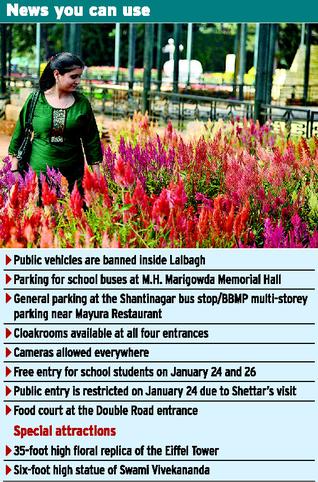
The annual Republic Day flower show, organised by the Department of Horticulture and Mysore Horticultural Society, will open to the public on January 18 and will go on till January 28. Chief Minister Jagadish Shettar is expected to inaugurate the show.

The main attraction at this year’s show will be a 35-foot high floral replica of the Eiffel Tower in Paris. Meant as a floral tribute to Gustave Eiffel, who erected the Eiffel Tower in 1889, the replica will be decorated with more than 2.5 lakh roses and more than 10,000 orchids. It will occupy pride of place at the Glass House. The flower show comprises exhibition of potted plants and cut flowers, Thai art, Jannur, Ikebana, Indian Floral Art, Bonsai and vegetable carving.

Competing teams

The gardening competition will witness teams from the Raj Bhavan, various ministers’ official residences, public sector undertakings, the Indian Institute of Management and gardens on defence properties competing with private sector entities such as Leela Palace, Taj West End, Infosys and Wipro. The organisers have so far received 772 competition entries.

Noted botanical firms such as Florens Flora, Fruit Land and Eden Lora (Bonsai Collections) are also participating.

The dates

While the main show will be inaugurated on January 18, the Ikebana, Indian Floral Art, vegetable carving and Bonsai exhibition will be inaugurated on January 19. Winners of various competitions will be felicitated by Anil Kumble and Javagal Srinath on January 24. The same day has been specially earmarked for school students who have free entry to the exhibition.

Entry fee is Rs.40 for adults and Rs.10 for children.

source: http://www.TheHindu.com / Home> News> Cities> Bangalore / by Staff Reporter / January 16th, 2013

Between the pages!

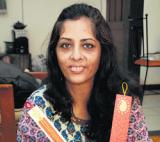
Some are just blessed with a creative streak. And they love exploring and doing something to keep the creative juices flowing. Namrata Navalkar from Sultan Palya, who makes bookmarks out of wedding cards, is one such person.

“With weddings happening all the time, there are always wedding cards lying around. Even if you keep them with you for a month or more, they end up in the waste-bin later on. It was heart-breaking for me to throw these pretty and expensive cards, and that’s how the idea came into being,” says Namrata.

“I’ve always had a creative touch and have been making something or the other from what is considered scrap,” she adds. Namrata, who has learnt the art of paper quilling, and has been using this skill to make bookmarks and other things, says that she started this hobby as she feels the reading habit is still alive in people. “I’m a member of a reading club, and whenever I go for book-reading events, I see a lot of people buying books. Otherwise too, people seem to have got back to reading because of online options.”

She adds with a question, “A pretty bookmark in your book, who wouldn’t want that? It’s much neater than a doggy ear, isn’t it?”

Being a very ‘green person’, Namrata tries to go by the three Rs, which are reduce, reuse and recycle. Explaining further, Namrata says, “I feel I’m reducing the content that goes into the garbage can when I make something out of trash. I am recycling the wedding cards to make these bookmarks.”

From ornate and beautiful bookmarks in different shades of red, blue, black and other colours, each one of them is dear to Namrata. Her collection has now gone up to 100, of which some has been given away to friends and family. Namrata says, “It’s hard for me to part with these, since they’re so dear to me. But I just don’t know what to do with so many of them.”

The raw materials that she uses for these bookmarks include the core materials — the wedding cards, and kundans chosen from either the cards itself, or bought ones. She also uses glitter to add colour, strips from other paper or cards that are leftover, and strings from old rakhis.

“I try my best not to waste even a bit of cut paper in the house. My maid has been strictly ordered to let me know if she sees paper around, before sweeping them off to the bin,” says Namrata.

She adds, “My bookmarks are on an average of 4 cm x 16 cm in size. I first cut the wedding card into the respective size, and colour co-ordinate it. Then I paste them together to make the bookmark, punch the hole in, and string the thread in. With the adding of colours or kundans and the finishing touches, the bookmark is ready. This process also includes feedback from my daughter and husband.”

Namrata’s daughter who is her best critic and inspiration, has talked about her mom’s creativity to her friends, and they love to come home, to pick up some tricks to make bookmarks and more. “I would love to teach this art to anyone who is interested and pass it along. It also helps spread the concept of recycling and being eco-friendly,” Namrata is quick to add.

She often retrieves Ganeshas from these invitations and uses them to make bookmarks. “On a personal note, I believe that remembering Ganesha before doing anything helps a lot. A bookmark with the Ganesha symbol makes the reading of the book more special.”

Namrata, who is an MBA graduate, does counselling for teenagers who are involved in drug addiction and other such issues. She feels that this hobby helps her to unwind. “Since I handle a lot of pressure at work, making these bookmarks helps to relax and bring the stability I need,” she says.

“I started this hobby by chance, and there was no external inspiration behind it, but now it has turned into a passion,” she adds.

source: http://www.DeccanHerald.com / Home> Supplements> Metro Life / by Tini Sara Anien / DHNS, January 07th, 2013

They are adaptable, good at switching roles

He loves playing golf. She hates it; believes it’s a total waste of time. She loves books and music — often borrows heavy metal and hard rock stuff from her sons. He loves Tamil movies; she can’t stand them. He loves to talk at home; she prefers to do things. He loves to cook. She would rather spruce up the interiors of their home.

There’s one thing that they have in common though – the industry they work for. And this husband and wife head big companies, which make them a rare couple. Akila Krishnakumar is the India head of SunGard, a $5-billion US company that provides software to the education, financial services  and public sector organizations. Krishnakumar Natarajan, or KK as he’s fondly known, is the CEO and MD of IT services firm Mindtree .

Managing extremely demanding global jobs – involving constant inter-continental travel — raising two kids, and supporting their extended families has not been easy for the couple. Ask them about the recipe for peace, happiness and success in life and work, Akila says: “We are sensitive to each other. We treat every day as a fresh day. We do not carry old baggage.”

Akila joined  Wipro  in 1982 as a marketing executive after passing out from BITS Pilani. KK was in Wipro then, heading a marketing function. Theirs was not a love marriage. It came as a surprise to them that their parents were seeking an alliance without realizing that their children were working in the same department at Wipro.

KK quit Wipro in 1999 to co-found Mindtree. He was asked to work out   of  North America , and he had to leave Akila and their sons behind in Bangalore. A decade before that, in 1989, Akila too had taken a similar career decision, when she was posted in London and had to leave her little son in the hands of her in-laws. “I was in a dilemma. But KK’s family was fully supportive,” Akila says.

On one occasion, she had to fly from Delhi to Pune to leave her son with her mother there before she could take a flight for Bhopal  for a customer meet.

Akila quit Wipro to float an entrepreneurial venture in 1993. The firm, Exeter Systems, offered IT solutions for universities. In 1999, Exeter was acquired by Sallie Mae Solutions, which in turn was acquired by SCT Corporation. In 2004, SunGard acquired SCT. “So in a way I have been with the same company since 1993. I have seen it in various phases of growth and change.”

KK says it has been extremely challenging for the family. “But we have been adaptable, creative and been consciously finding ways to resolve every hurdle. We are also good at switching roles,” he says.

KK has been a large pillar of support, says Akila fondly. “He totally lived up to anything he was put into…be it looking after the kids, keeping the home clean or cooking for the family.”

KK and Akila are now busy creating an exclusive family hub. They are relocating both their parents and siblings from Chennai and Pune close to their weekend home on the outskirts of Bangalore. “We love our independence. At the same time we also want to be closer to our families when we grow older,” says Akila.

Travel is a common passion for the family. But aligning their calendars to vacation together is tough. “The last long vacation the four of us had was in 2007 in New Zealand. So instead of waiting and planning, we do quick, short and doable trips like the one we did recently to Chikmagalur,” says KK.

source: http://www.articles.timesofindia.indiatimes.com / Home> City> Bangalore / by Mini Joseph Tejaswi, TNN / January 14th, 2013

Those were the days

Bangalore was once famous for its free spirit and culture. A few loyalists are trying to preserve a slice of the city they knew and love

If you happen to be a newcomer to  Bangalore , and get into conversations with some of its older residents, be careful about showering their city with compliments. If you remark that it is green, they will tell you it used to be greener. Talk about the great weather, and they will tell you it used to be much better. Bangalore, they will tell you (wistfully, angrily or with an air of resignation, depending on who you are talking to), is not the place it used to be. And the nostalgia is not unwarranted. Every so often, there will be an article in a newspaper about an old Bangalore joint going out of business because it can’t afford the escalating rent and of customers rushing to have that last cup of tea or sandwich, or just to shoot the breeze, at their old hangout. Some Bangaloreans, though, are trying to do their bit to preserve a slice of the city they knew, in their own way.


“Bangalore used to be the kind of place where people gathered at parks every evening and someone would invariably take out his guitar, where people would dance at clubs till five in the morning, and where the greatest crime was to go around without a cycle lamp!” says Paul Fernandes , artist and former advertising executive, occasionally referred to as the city’s  Mario Miranda . Fernandes has recaptured that era in a series of 60 evocative watercolours, on display at his recently opened gallery, “aPaulogy,” in Richards Town. Each of the watercolours, set in ’70s Bangalore, has a personal memory or association for the artist. But anyone from those days would have an association with the places he has sketched, he adds.


One shows a boy on a cycle riding away with hand outstretched from a constable whose hat is in the air, titled “Potential visitor at Cubbon Park police station? “Oh we all used to do that — slap their hats off and then speed away and if you were caught, you had to spend the night in the lock-up,” Fernandes says with a laugh. Another shows two young bucks doffing their hat to a pretty young lady emerging from her house. Look carefully and you will espy an old gent with a rifle taking aim at the young men. “I have a very pretty sister and young men from all over the city used to come from all over to see her… and my uncle used to use his rifle to threaten them,” says Fernandes, which he later corrects to “seven pretty sisters”. The rifle is also there, next to the watercolour.


Fernandes thought of doing the sketches when he noticed that whenever he and his friends were talking, the conversations would begin with “Do you remember” and it would invariably turn out to be a happy conversation. The push came when his mother’s house, which his father had bought in 1947 when he returned from England, was sold and demolished. “That’s when I started drawing the old buildings,” he says. Fernandes now plans to bring out a book of the watercolours, titled Bangalore Blue — A 1970s Roundabout.

A different attempt to make sense of the rapid changes that took place in Bangalore and the city’s struggles to come to terms with it, while holding on its familiar aspects, is a film by city-based filmmaker  Sushma Veerappa . TitledWhen Shankar Nag Comes Asking, the film tackles these issues by examining what it would take for two auto drivers, Ramanna and Mahadeva, at Shankar Nag Auto Stand to “belong” in Bangalore today. When asked what she made of the changes in Bangalore, and the loss of old “institutions,” Veerappa says, “Of course there is much nostalgia value to something tangible like buildings. But as a documentary filmmaker, I am more concerned with what replaces those buildings — and I don’t mean just the glass façades. How and where does one carry those memories associated with that demolished old building? How do they translate into the everyday?” The changes that have happened, she says, is less about the “loss” and more about the sense of alienation and how insecurities play out. “The making of the documentary helped me understand the many ways of seeing,” she says.


But not all change is unwelcome. “I’m not depressed (about the changes) at all. Life has become better in many ways as well,” says Fernandes. Yet, on being told that Kohinoor Hotel on Brigade Road, a hangout for many Bangaloreans since the late ‘50s, had downed its shutters while he was abroad, Fernandes can’t keep that note of regret out of his voice when he says he will not be able to visit it for one last of glass of its famous suleimani chai with his old friends…


(aPaulogy, located on 15 Clarke Road, near the entrance of Richards Park, is open from 11 am to 7.30 pm Tuesday to Saturday, and 12 to 7.30 pm on Sunday (closed on Mondays); There will be a series of public screenings of When Shankar Nag Comes Asking in February, the details of which will be posted on the director’s Facebook page(sushma.veerappa/facebook))

______________________________________________________

source: http://www.Business-Standard.com / Home> Life & Leisure / by Indulekha Aravind / Bangalore, January 13th, 2013

The master who brought ‘SADARAME’ to life

Y. M. Puttannaiah might be a new name for majority of Mysoreans but not for theatre buffs. He is one among the best Harmonium Masters who has kept the old tradition alive even today.

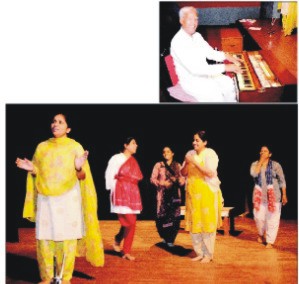
This year’s Bahuroopi theatre festival will feature ‘Sadarama Natakam,’ a play which is being directed by Puttannaiah for the Rangayana artistes.

The play was staged a couple of years back by the artistes during the weekend shows, but was later stopped. Now, it is making a comeback through Bahuroopi.

‘Sadarama Natakam,’ a play which was written by Bellave Narasimha Shastry, was staged by Gubbi Veeranna Company and many other company theatre companies of the yesteryears. The play which used to begin in the night would continue till early morning.

For Rangayana artistes to stage the play, there was a necessity of a person like Puttannaiah, who had the experience of working in Gubbi Company and also teaching theatre songs to the artistes.

Puttannaiah has been presented with many awards among which the prestigious ‘Karnataka Nataka Academy’ (2009) stands tall.

The original script of ‘Sadarama Natakam’ has 108 songs and was staged for over 6 hours, but it has now been reduced to 3 hours and 17 important songs have been retained in the play.

Speaking to Star of Mysore, Puttannaiah shared his theatre journey which he enjoyed for 50 years. Excerpts.

By S.N. Venkatnag Sobers

Star of Mysore (SOM): What attracted you to enter theatre?

Y.M. Puttannaiah: I used to watch my father Rajapart Muddurangappa enacting plays while he was working for Gubbi Company. Since I spent most of my childhood in the Gubbi Company, I had no other option but to enter theatre.

SOM: Which was your first play and when did you learn music?

Puttannaiah: My first play was Mahasathi Anasuya in the year 1962. It was a small role but since then my journey in theatre began and I acted in a lot of plays among which I played the roles of Prahlada and young Krishna in my teens. Later, it was the music which fascinated me; I learnt classical music and also to play instruments. I have worked as a music teacher in many of theatre companies such as Uma Maheshwari Company, Hirannaiah Mitra Mandali etc. It was in 1971 that I started a music institute in Huliyar when the theatre companies closed down.

SOM: Take us on your journey. When did you come to Mysore?

Puttannaiah: After my stint with the music institute, my family decided to shift to Mysore to provide quality education for the children in the year 1978. I was not involved in any theatre activities, but Yoganarasimha Murthy and actor Sundarakrishna Urs got to know I was in Mysore and forced me to work with them for a play called Adige Bhatta. Since then I have been involved in theatre activities in Mysore. I should also thank amateur groups in Mysore such as Amarakala Sangha, Nadaranga, Suruchi Rangamane, Kadamba Ranga Vedike and others for giving me an opportunity to work with them.

SOM: Share with us your experience with Rangayana.

Puttannaiah: Well, what can be said about Rangayana? The theatre repertory which was started by B.V. Karanth has grown up to become one of the best theatre schools in the country. I got involved with Rangayana when they approached me for Sadarama Natakam a couple of years back. Since then I have been visiting this place when ever my services are needed.

SOM: Having worked with amateurs for most of your career, how do you rate Ranga-yana artistes?

Puttannaiah: There is no doubt that the artistes in Rangayana are among the best actors. After being trained under B.V. Karanth, there is nothing that I could teach them. Being professional artistes, they adapted to the change that was required to stage Sadarama Natakam which is enacted in old company style.

When the play was staged for the first time a couple of years back, it was even the first time that these actors sang on stage. Till then, they used to sing from behind the screens. Since this play needs the actors to sing on stage, they executed it well.

SOM: Tell us about Sada-rama Natakam. What is its relevance to the present day scenario?

Puttannaiah: The play has relevance to the present day as it talks about a girl’s fight against injustice during the King’s rule. Today, the same situation is prevailing in the city; except that the rule of the princely state has gone.

SOM: What do you have to say about the present day theatre?

Puttannaiah: Theatre, an ancient art, is definitely seeing a downfall. It is the responsibility of the concerned authorities to chalk out programmes to promote and retain the art for the generations to come.

source: http://www.StarofMysore.com / Home> Feature Articles / by  S.N. Venkatnag Sobers / January 07th, 2013
Cultural archives

Indian music finds new home online
ARCHIVEOFINDIANMUSIC.ORG

The largest online repository of Indian music—from Carnatic greats to Manna Dey

The Archive of Indian Music (AIM) wears its ambition on its record-sleeve. The newest baby of Vikram Sampath, best known for his 2010 biography of Gauhar Jaan, the subcontinent’s first commercial recording artiste, the portal looks to be the largest digitized repository of out-of-copyright recordings by Indian gramophone artistes. With 2,000 recordings (dating currently between 1902 and 1952) already available on the site and up to 20 additions daily, the spread justifies the acronym.
“While researching the life of Gauhar Jaan, I had to look for her music—available in shellac records—in the by-lanes of Kolkata and Mumbai. I got many of her records, but I also picked up many other unknown artistes, paying up to Rs.900 for 3 minutes of music,” says Sampath, 32. “Soon after the publication of My Name Is Gauhar Jaan!, I went on a fellowship to the Institute for Advanced Study, Berlin, where I researched early gramophone recordings of Indian music. In London, Vienna, Berlin, all of which boast of excellent audio-history libraries, I repeatedly faced the question: Doesn’t India have a sound archive?”
On his return to India, Sampath received an invitation to 10, Janpath. “(Congress chief) Sonia Gandhi had read Gauhar Jaanand wanted to meet me. I wondered what we could talk about, and so broached on the subject of a music archive, since the state was a natural stakeholder,” Sampath smiles disarmingly. However, after one year of paper-pushing between Akademis and ministries, the project was still to take off. A chance encounter with then Infosys director T.V. Mohandas Pai in 2011 persuaded Sampath to go private, form his own not-for-profit trust, use Pai’s generous seed fund for sophisticated cleaning and conversion equipment, employ a single audio engineer and, finally, in December, go live at Archiveofindianmusic.org.
Still a work-in-progress, the archives feature a good mix of Carnatic luminaries (M.S. Subbulakshmi, K.B. Sundarambal, Mysore Vasudevachar), alongside some Hindustani artistes (Rasoolan Bai, ustad Imdad Khan), film star-singers (M.K. Thyagaraja Bhagavathar), political leaders (Gandhi), litterateurs (Rabindranath Tagore), the occasional Manna Dey and K.L. Saigal and the Visva-Bharati university chorus (in a 1912 recording of the complete Jana-Gana-Mana).
Many of the pieces have been uploaded from Sampath’s own collection, but the nine AIM trustees—musicians, record-collectors, aficionados—now help him track down old and rare records. Once procured, the records are put through a vacuum-driven master-cleaner, amplified on a high-fidelity player, converted into a digitized format and uploaded to the site.
While the artistes are listed alphabetically, there is little cross-indexing and dating of the material. So, at the moment, navigating the site is a matter of choosing an artiste and selecting a piece to listen to. The uploading of artistes is dictated by popularity—some tracks have received up to 400 plays in the two months the site has been live—but Sampath hopes that apart from the casual listener or history buff, the portal will work as a lively interactive site for researchers and students of music, with user-generated content and talk-through guides.
While the archives are accessible to all at the moment at  Archiveofindianmusic.org , a registration-and-payment process will be introduced soon.
source: http://www.livemint.com / & Wall Street Journal / Home> Lounge / by Sumana Mukherjee / Friday, January 11th, 2013