I will work like a soldier for Sahitya Parishat: Pundalika Halambi

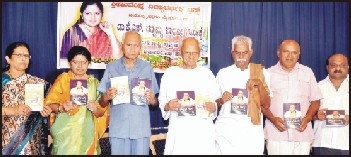
Caption: Pundalika Halambi (third from right), State President, Kannada Sahitya Parishat, is seen releasing two books Gayana Gange and Gana Kala Dasohi at a function held in city yesterday. Others seen are (from left) Yuvaraja College Principal Prof.S.N. Gayatri, authors Dr. Rathnamma & Dr. C.P. Krishnakumar, litterateur Prof. Dejagow, District Sahitya Parishat President M. Chandrashekar and writer Prof. Malali Vasanthkumar.

Mysore, May 10

“I will work like a soldier to uphold the dignity and integrity of Kannada Sahitya Parishat (KSP) and live upto the expectations of those who voted me to the office during the recent Parishat elections,” declared Pundalika Halambi, State President of KSP here yesterday.

He was speaking after inaugurating a seminar, book release and felicitation ceremony organised by Kuvempu Vidyavardhaka Trust at Rajendra Bhavan in JSS Hospital premises.

Sincerely thanking those who voted in a secular manner during the election, Halambi said: “Come what may, I will not compromise with the development of the Parishat and would do whatever required to ensure that the Parishat performed its duties in a transparent and effective manner to uphold the self-respect of Kannadigas.”

Referring to the comments passed on him by several of his detractors that he was ignorant about the basics of Kannada literature, he said that though he was a student of literature, he was not a litterateur and could have made several mistakes in pronouncing several words and regretted for the same. He also said that he would not stick to the post if he could not do justice.

Releasing two books Gayana Gange and Gana Kala Dasohi, biographies of Vidushi Gangu Bai Hanagal and Pandit Puttaraja Gavai, authored by Dr. K.S. Rathnamma and C.P. Krishnakumar respectively, Halambi said that biography was a complex form of writing and should not be limited to creative writing.

Pudalika Halambi, his wife Saroja Halambi and District Sahitya Parishat President M. Chandrashekar were felicitated on the occasion.

source: http://www.StarofMysore.com / General News / May 10th, 2012

Bitten by the B’lore bug

LEGENDARY CONNECTION

It was in Bangalore that Ronald Ross first became interested in mosquitoes. Ross would go on to make the crucial discovery of plasmodium, the malarial parasite, in a mosquito, and win the Nobel too. Bangaloreans can truthfully say that the seeds of that great discovery were sown in our City, writes Meera Iyer

In September 1883, a British doctor named Ronald Ross was appointed the Acting Garrison Surgeon in the Bangalore Civil and Military Station. The doctor initially stayed in a bungalow close to today’s MG Road. He records in his memoirs that this was when he first became interested in mosquitoes. “They devoured me,” he writes, “until I discovered that they were breeding in a tub just outside my window.” Ross got rid of the wee beasties by the simple expedient of tipping the tub. So began a series of experiments and observations on mosquitoes that eventually led to a Nobel Prize for Physiology and Medicine in 1902.

Ronald Ross was born in Almora, Uttarakhand, on May 13, 1857, three days after the Indian Mutiny or the First War of Independence began. He grew up in Almora, Nainital and Benares and was sent to England for his education when he was eight.

The future scientist and Nobel Prize winner displayed no interest whatsoever in science but took wholeheartedly to painting, literature and the arts. He wrote poetry while still at school and at 17, decided he wanted to be a writer. But his father wanted him to join the Indian Medical Service, and so Ross resignedly joined St Bartholomew’s Hospital Medical School in London to study medicine. Ross wrote more poetry and even some short plays while at St Bartholomew’s but remained quite indifferent to medicine. He failed a qualifying exam for the Indian Medical Service, cleared it a year later on his second attempt, and then joined the Service. Ross came to India in 1882, stayed in Madras briefly and then had the first of many stints in Bangalore when he was given medical charge of a unit of the Madras Infantry for a few weeks.

Like many others before and after him, Ross loved Bangalore. He describes how he used to go for long walks every day among “rocky crests of mountains, fir woods, dells with beautiful little trickles of streamlets”. The sun and the breeze, he says, “were those not of earth but of heaven.” In a complaint that sounds all too familiar to us today, Ross says that when he looked for these same places ten years later, he found they had all been swallowed by development.

Over the next few years, Ross returned to Bangalore several times and also served in Quetta, Burma and the Andamans. He churned out more plays, novels and dramas, became very interested in mathematics, played a lot of tennis, whist and golf, but remained a completely ordinary doctor. It was only when he was on leave in England in 1888 that something ignited a spark in him: “I determined now to interest myself much more in my profession,” he writes, and he returned to India with renewed vigour.

Back to Bangalore

Ross was posted in Bangalore once again in 1890, as Staff Surgeon of the Civil and Military Station. Now married, he and his family lived in High Grounds, “in a delightful house facing the golf ground, called Uplands”. (Incidentally, this very house was where Sir M Visvesvaraya stayed for a time after his retirement in 1908). According to his Nobel lecture, it was during this 1890-1893 period in Bangalore that Ross made his first studies of malaria.

He also wrote his first research papers on the disease, including some that rejected the ‘bad air’ theory but speculated (wrongly, of course) that malaria might have an intestinal cause.

In the 1890s, scientists had begun to realise that parasites in blood caused malaria, but no one had any idea how these parasites moved from sick people to healthy people. In 1894, while on leave in England, Ross sought out Patrick Manson, a tropical disease expert who had recently discovered that mosquitoes spread the disease filariasis.

Manson told Ross he believed mosquitoes also spread malaria. This was the beginning of a long association between the two scientists.

Ross returned to India, and plunged into research, determined to prove Manson’s ‘Grand Induction’ as he called it.

Within a few months, Ross became an expert on dissecting mosquitoes, identifying parasites and diagnosing malaria. In his memoirs, Ross states that from April 1895 to February 1899, he wrote 110 letters to Manson about his research, “containing almost exactly 1,000 words each, or about one word to every ten people killed by malaria in India alone every year.”

At West End

But another disease also killed hundreds in India in those days. In 1895, Ross was called to Bangalore on special sanitary duty to contain the frequent cholera outbreaks here, especially in Shivajinagar, Ulsoor and parts of the pete.

Ross took up residence in a tent on the grounds of the (now Taj) West End Hotel. Over the next two years, he organised an overhaul of refuse-cleaning systems, suggested improvements in drainage, mapped the locations of wells and had them disinfected, and posted hospital assistants at stations to detect cases. He also frequently accompanied scavengers in their early morning work. “These experiences are not easily forgotten,” he writes.

Of the scavengers, “the poor men themselves, the last pariahs and outcasts of society, toiling while others slept,” says Ross, “None shall know of your labour, no one shall thank you, you shall die forgotten,” and yet, “the civilisation of the thronged cities was based upon their labour.” Though occupied by his sanitary work, Ross still eked out time for malaria. Until then, both he and Manson had thought that when malarial mosquitoes died, they somehow infected the water they bred in, which when ingested, caused malaria in humans. It was in Bangalore that Ross came up with another hypothesis that later proved correct: In May 1896, he wrote to Manson, “…the belief is growing on me that the disease is communicated by the bite of the mosquito. She always injects a small quantity of fluid with her bite — what if the parasites get into the system in this manner.”

Ross set out to test this hypothesis by the decidedly questionable method of getting mosquitoes to bite volunteers, mostly ‘natives’ of course, including the Assistant Surgeon of the Bowring Civil Hospital.

But as Ross had yet to discover that only the Anopheles mosquito carried the malarial parasite, his results remained negative. It wasn’t until 20 August 1897 (now commemorated as World Mosquito Day), when Ross was posted in Secunderabad, that he made the crucial discovery of a Plasmodium, the malarial parasite, in a mosquito. He came back to Bangalore on short leave a month later, staying at the West End once again (in a room this time, and not a tent!), and wrote up his exciting discovery. The paper, “On some Peculiar Pigmented Cells found in two Mosquitoes fed on Malarial Blood,” appeared in the British Medical Journal in December 1897.

In Secunderabad, the building where Ronald Ross made his landmark discovery is now called the Sir Ronald Ross Institute, and bears a plaque in appreciation of Ross’s work. But Bangaloreans can truthfully say that the seeds of that great discovery were sown in our City.

ROSS, THE POET

* Ronald Ross was known to be a poet, novelist and painter.
* His collection of poems include: ‘psychologies’, ‘Poems’, and ‘Fables and Satires’. He composed this verse about his first impressions of malaria that killed millions:

In this, O Nature, yield I pray to me.I pace and pace, and think and think, and takeThe fever’d hands, and note down all I see,That some dim distant light may haply break.The painful faces ask, can we not cure?We answer, No, not yet; we seek the laws.O God, reveal thro’ all this thing obscureThe unseen, small, but million-murdering cause.

(Courtesy: malariasite.com)

source: http://www.DeccanHerald.com / Home> Supplements> Spectrum / by Meera Iyer / May 07th, 2012
Innovation award for Skanray

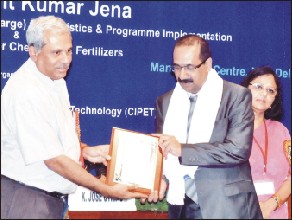
Caption: Balasubramaniam, Director & CTO, Skanray Technologies, receiving the award from K. Jose Cyriac, Secretary, Dept. of Chemicals & Petrochemicals, at New Delhi recently.

Mysore, May 3

Skanray Technologies Pvt. Ltd. won an award for innovation in polymeric products at the 2nd National Awards ceremony for technology innovation in various fields of petrochemical and downstream plastics processing industry held in New Delhi recently. The award is instituted by Ministry of Chemicals & Fertilisers, Govt. of India.

Skanray Technologies won the award for developing ‘Use of Engineering Plastics for Diagnostic X-ray equipment.’

Balasubramanian, Director & CTO, Skanray Technologies, received the award from K. Jose Cyriac, Secretary, Dept. of Chemicals & Petrochemicals.

Skanray was founded in 2007 by a team of reputed engineering and business professionals with decades of experience in industrial and medical devices sectors and having global exposure. Skanray moved into its state-of-the-art manufacturing facility in Hebbal, Mysore and commenced commercial business in 2011.

source: http://www.StarofMysore.com / General News / May 03rd, 2012

Dubai : Bunts UAE Conducts Blood Donation Campaign

Dubai, May 6:
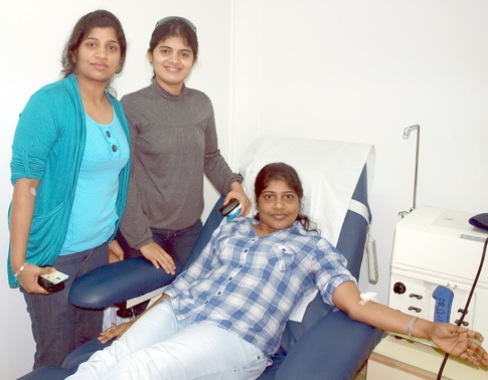
Bunts UAE this year successfully kicked off and concluded ‘Blood Donation’ Campaign at Latifa Hospital, Dubai on the 4th of May, 2012, Friday from 10.00 AM to 2.00 PM with record number of donors participation.

Sudhakar Alva the main man behind this campaign thanked the authorities for being tolerant and supportive in the campaign and promised more contribution to the Blood Bank from all the Indian Communities living in UAE. The Donors poured in great numbers from various parts of UAE into Lathifa Hospital enthusiastically for this great cause. It was also great to see Presidents and Office Bearers of most of the regional Community Associations of Karnataka together in one place for this noble cause. A record was created with more than 100 numbers participation.

As per the Dubai Blood Donation Centre (DBDC), the need for blood is ongoing and must be met every day. The demand for blood is growing faster than the collection rate and DBDC has been requested to have an instant response to the rapid growth in blood demand which is obviously proportionate to the fast growing population of the city along with healthcare facilities. DBDC is the only blood supplier in Dubai. Its services extend to Thalassemia patients (Thalassemia Center at Al Wasl Hospital), road accident and burn victims (Trauma Centre at Rashid Hospital), patients with neonates and maternity health complications (Lathifa Hospital), cases diagnosed with cancer or scheduled for open heart operations (Dubai Hospital) as well as to all private health facilities within Dubai that are entitled for transfusion services.

The Members volunteered along with hospital authorities were busy welcoming donors and filling up the required forms, examining blood samples and getting ready for the extraction of blood all with smiles on their face. They were issued a ‘Donor Card’ exclusively as a proof of their support.
The campaign kicked off with good numbers of Bunt’s voluntarily taking part along with female members and youths. Other patriotic associations who have been willingly doing these types of blood donation campaigns are Karnataka Sangha Sharjah, UAE Amchigele Samaj, Ramarajya Khsatriya Sangha UAE, Padmashali UAE, Kodagu and Dakshina Kannada Gowda Samaja Dubai, UAE Bunts, Billawas Dubai & Northern Emirates, Billawa Balaga Dubai who have already recorded their names in the list of blood donors of India in UAE.

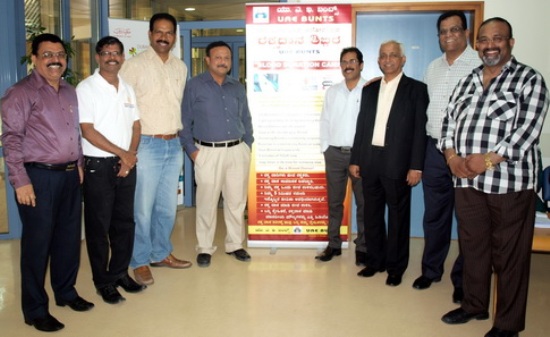
Bunt’s UAE staged a breakfast stall with Snacks, Tea, Coffee, Fruits, Juices etc. at the blood donation campaign was given a boost with the support and participation of prominent community leaders like Sarvotham Shetty of UAE Bunts, Lokesh Puthran, President along with Vice President Yadav Kotian and main co-ordinator of Blood donation campaign in UAE, Bala Salian of Mogaveers UAE, Sudhakar Alva of UAE Bunts, Ravi B. Shettigar, President of Padmashali UAE, Satish Poojary President of Karnataka Sangha Sharjah, Anand Bailoor, Jagannath Bellare, Sudhakar Poojary of Billawas Dubai & Northern Emirates, Sudhakar Thumbe, President of Billawa Balaga Dubai, Representatives of Vishwakarma Seva Sangha & Shodhan Prasad of Nama Tuluveru UAE. Also were Ashok Belman of Gulf Kannadiga and many other prominent members of other well known associations.

The event concluded at around 2 PM
Report: Shodhan Prasad
Photos: Ashok Belman (Gulf Kannadiga)

source: http://www.DaijiWorld.com / Dubai, May 06th, 2012


The village that wove clothes for Tipu Sultan, Indira

Mandya:

Kodiyala village about 12km from Mandya city is famed for its community of weavers who have clothed royalty including the Mysore family and Tipu Sultan. The legacy continues even today.

History has it that about 160 families of the Padmashali community of weavers who migrated from Andhra Pradesh 300 years ago settled down in this village and started their profession. Soon their weaves caught the eye of the royal families around who placed orders for cloth, and thus began a long relationship between the community and the royals.

Some elders of the community said that Tipu Sultan who ruled from Srirangapatna was very fond of cotton cloth manufactured in Kodiyala village. He is said to have helped the Padmashali community by giving concessions in royal taxes and importing raw material from abroad.

Another proud memory for the weavers is of then prime minister Indira Gandhi who visited their weavers’ colony and was impressed with their handlooms and saris. “Leaders like Indira Gandhi former chief ministers Devaraj Urs and SM Krishna were seriously interested in our profession and village” said 80 year-old Narayanappa a weaver. “Impressed that 200 families of our village are running textile manufacturing units SM Krishna had ordered that an exclusive power line be drawn from Tubinakere power station for continuous power supply.” This is perhaps the only weavers’ colony in the state which is so privileged.

Weavers say they are not facing any problem. The market for their products is spread over the entire nation andthereis always a good demand. Neither is there a shortage of raw material and labour. “We are content with our profession. If the erstwhile kings hadn’t supported our ancestors and our profession was not encouraged by the government we may not have been so successful,” said Narayanappa. He claimed their material is of high quality. “We produce rich colourful saris and dhotis, with eye-catching motifs. We have switched to powerlooms and use polycotton thread” he said.

source: http://www.articles.timesofindia.indiatimes.com / Home> City> Bangalore / by M K Madhusoodan and Rajendrakumar K R, TNN / April 26th, 2012

Saviours of native seeds

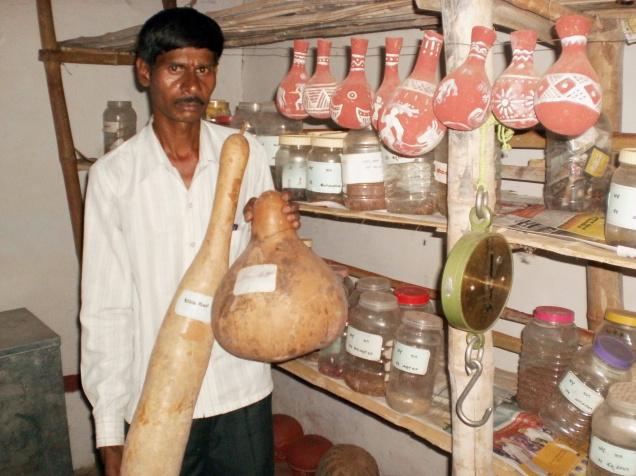
PRESERVING TRADITION: Gurusamy with his collection of native seed varieties. Photo: M.J. Prabu / The Hindu

Farmers like Gurusamy have been reaching out to their community

Inside a dingy and dark room of a house at Odayarpalayam village in Karnataka’s Chamrajnagar district, old earthen pots and worn-out plastic jars are lined up on ramshackle wooden shelves. Inside them are colourful beads and seeds, labelled neatly.

These are native seeds, painstakingly collected and documented by Gurusamy, a traditional seed collector and farmer, who has been in the business for the past 10 years.

P. Rajachar, Programme Officer of the Mysore Resettlement and Development Agency (Myrada), says that thanks to Mr. Gurusamy’s efforts, hundreds of varieties of native seeds have been collected and distributed to farmers. These varieties are now grown on nearly 25 acres.

“I think there are more than 3,000 farmers in Karnataka who grow and maintain such seed varieties. We’ve a good network of suppliers who see to it that our bank balance [read seed bank] doesn’t go down,” adds the self-effacing farmer, who has sustained his efforts creditably.

His suppliers are mainly farmers who want to grow native varieties. “Mostly my suppliers are growers who are eager to preserve native varieties. While supplying seeds, I reach an informal agreement with them to give me back a portion of the seeds after the harvest,” says Mr. Gurusamy.

Seeds, symbols of fertility and vitality, have been a part of Indian culture and heritage for long; to a farmer they personify self-respect. In fact, long before hybrid seed companies set up shop and went commercial, the traditional farmer had saved his own seeds, swapped them with neighbours or exchanged them with others.

Mr. Gurusamy said:

“Sadly, this intimate knowledge of the farmer and his traditional wisdom have been systematically devalued by several scientists, who are keen to promote technologies and seeds that are not suited to a particular area or community.

“High-yielding seed varieties and chemical fertilizers and pesticides that came with the Green Revolution destroyed several indigenous seed varieties. As farmers stopped saving and exchanging seeds, and instead started buying them from the market, their native expertise became irrelevant and crop diversity suffered. In a land that once had several thousand varieties of crops, most of them are no more to be found.

“Farmers used to grow these, swap them with neighbours and preserve them for tough times. These seeds have beaten several odds. In fact, even today we’re able to hold out against the multinational seed companies that are trying to dislodge us and our collection.

“I normally do not charge for the seeds if the farmer desires to grow it in a small area, say, in his backyard. I simply request him to return a small portion of the seeds. But for those growing the crop on four to 10 acres, I charge a nominal amount. It could be anything between Rs. 5 to Rs. 20, depending on the seed one wants.”

There are four persons who help Mr. Gurusamy in his work. They go to various places in Karnataka and Tamil Nadu to source seeds, and update and maintain a database of native growers.

“Like Mr. Gurusamy, C. Rudriah from Kadambur, C. Palaniammal from Bargur, V. Narayanan from Kottamallan, D. Mahesh from Kadatti, N. Alamma from Kottarai and B. Ambamani from Hongalvadi are some of the farmers who preserve and supply native seeds,” says Mr. Rajachar.

These people are simple farmers who cultivate on their meagre holdings. It is their interest in protecting local and native seed varieties that has turned them into seed saviours.

Mr. Gurusamy’s phone number is 09008167819; Mr. Rajachar’s is 09449203217.

source: http://www.TheHindu.com / Home> S&T> Agriculture / by M. J. Prabu / Chamrajnagar, May 02nd, 2012


Tracking 400-yr-old family roots in Indian milieu

While tracing one’s genealogical roots is all a rage in the West, it is yet to find traction in India, where tracingone’s ancestral roots is all but impossible. But that did not deter Claudius Pereira, who with help of his six siblings wrote a sprawling saga, Echoes in footprints, that dates all the way back to the 17th century. The book, set to be officially released on May 1, will also be released in the US and London.

The book, which mainly focuses on how Pereira’s father raised seven children as a single parent, starts in 1673, when Pereira’s ancestors were among those who came and settled down in India from France.

“My great great grandfather James Bernard Pereira wanted one of his sons to become a priest in Madras. But my great grandfather was sent back home by Father Superior who saw him play football and figured he should pursue that instead. But James was furious at his son and in his rage chopped his leg off,” said Claudius, who started working on the book in 2006, when he was visiting his siblings, as a way to keep the memory of his father alive.

His great grandfather never became a priest. He instead got married and had four children, one of whom became a priest. In order to trace his family’s at times tragic past, Claudius even went to London, to access the birth and death certificates of his great grandparents. “The British had kept impeccable records, so I found even the marriage certificate signed by my great grandfather,” he beamed. But it was through his grandparents that he got a wealth of information.

“My grandfather’s brother was a priest himself and he set up my grandfather and his wife. He was at that time a railway ticket collector and my father, Clarence Joseph, was one of six children,” added Claudius.

However the book centres on his father, and how his family over several generations merged spirituality with their circumstances. “I was three years old when my mother passed away. My father had to raise seven children by himself. My oldest sister, then 13, had to take up cooking and taking care of us. He had to pawn my grandmother’s jewellery to keep our family going,” he said.
Claudius’ father worked as a telephone operator in a gold mine.

“Due to conditions in the goldmines, he lost his hearing and developed severe asthma and my brother when he got older, joined a gold mine company as well, but by that time the gold mining business started declining,” he adds. The book also chronicles Clarence Joseph’s brief struggle with cancer in the early 90s.

“At that time they didn’t know much about it. Even right now we don’t really know what it was. But his struggle was brief and his death is chronicled in this book by my siblings,” he said. With religious overtones, the booklooks at its historic context and focuses more on familial struggles.

“This is our book about how we came up in life. How we weathered the struggles. Everyone will find some form of inspiration from this book,” he adds. However tracing one’s history in India is close to impossible, says Claudius. “Only few familieshad records. People here can only get pockets of their life history. But my research led me to people who were my cousins, but I didn’t even know existed!” he exclaims.

source: http://www.dnaindia.com / Daily News & Analysis  / Home> Bangalore> Report / Place: Bangalore, Agency: DNA / by Aishhwariya Subramanian / Tuesday, May 01st, 2012


Making space for art

Six years ago, Deepak and Deepika Dorai moved to Bangalore from Chennai, where they had started a unique artistic movement called Bimba. They used to run their art hut out of an old home that was razed to the ground — you can almost hear the pain in his voice when Deepak talks about this. Yet, today, the Dorais have successfully recreated their dream project in Bangalore – a distinctive public space for art and performance that is teeming with activity and enterprise.

One of the most cheering aspects of Bimba the Art Ashram is perhaps the space where it’s run: a 100-year-old building on DVG Road in Basavanagudi that was falling into disrepair before the Dorais lovingly restored it. Belonging to an old Bangalore family that has given the Dorais the run of the place, the house, with its many traditional features, could act as a template for how old structures in the city, facing the threat of demolition, can be revived. “It is a house in which 42 children were born; you can say this is very fertile ground,” says Deepak.

To convert the house from a private residence to a public space, Deepika, whose creative energies have directed all the changes, first began by tearing down the boundary walls to create a more open feel. The original pillared entrance has been retained, and as you enter through it you can feel the temperature drop a few degrees, thanks to old-world construction features such as stone and red-oxide floors, high ceilings and hollow-brick walls.

Deepika uses the rooms within the main house to run her artifacts and furniture gallery, and this is also where she retails her clothing line. Deepika creates some unique hand-crafted furniture, ‘upscaling’ old and discarded tables, chairs and beds into one-of-a-kind items. “This is something people working in newspapers before the computer age would remember,” says Deepak pointing to a large metal tray sectioned into small squares – a linotype used in hot-metal typesetting. These ‘trays’ have been used by Deepika to make cupboards (they act as  the doors) and a coffee table (mounted by glass).

Bimba also hosts live performances every Saturday, and these include shows such as one by a practitioner of the Karnataka rod puppetry tradition, a talk by a musicologist on the Jogis’ folk music or a classical vocal Carnatic performance. Along with these, what draws most people to Bimba on Saturdays is the Rasalok theatre – this is also what the ‘art hut’ has become most famous for in recent years. The Dorais call this ‘still theatre of miniature art’; at its  essence these are vibrant storytelling performances using miniature figures and three-dimensional sets, again hand-crafted by Deepika. Most stories are mythological in nature, and two narrations take place in adjoining rooms done by Deepika and her mother Uma Nagraj. These performances form an essential part of Bimba’s activity calendar especially during Navratri, when day-long sessions are held.

EARTH-SENSITIVE ART

While promoting the ideas of earth-sensitive art, we also like to draw people into our performances and our miniature theatre, through which we tell stories that have their roots in mythology. This story-telling tradition has been in my family for generations; my grandmother MN Susheelamma evolved and finetuned the making of a 3-dimensional still scene on a mini-stage as part of her Navaratri festival offering. The key to the visual magic lay in her sense of aesthetics, period and proportions in the miniature space. This practice was continued and improvised upon by my mother Uma Nagraj, who now composes and narrates a magical moment every year. I’m trying to carry on this great artistic tradition.

Deepika Dorai, Founder, Bimba the Art Ashram

source: http://www.timesofindia.indiatimes.com / Home> City>  Bangalore / by Shrabonti Bagchi , TNN / April 29th, 2012

‘Planning a restaurant in Koramangala? Consider food inflation’

From 176  restaurants in 2006,  Koramangala now boasts 432 restaurants, which showcases this business is a jackpot. But be careful before trying your hand at setting up a restaurant of your own, warns  Sajit Chacko, co-founder of  AST Foods in an interview with ET. He advises aspiring restaurateurs to understand challenges, like food inflation and starting with low investments. Edited excerpts:

How did you start AST Foods and how many restaurants do you own in Koramangala?

We are three of us who started AST Foods. We all are passouts of the Institute of Hotel Management (IHM) and have an experience of 10-15 years. I used to do projects for The Leela and then I thought why don’t we open something on our own and that triggered the idea of AST Foods in 2006. We have three restaurants in Bangalore out of which Umerkot is in Koramangala, which was our first restaurant too.

What was the initial investment?

The three of us contributed Rs 3 lakh each and started Umerkot with a seed capital of Rs 9 lakh. Since, we had less capital we took a bank loan where we got 40 percent of the cost and had to repay it in five years. In order to get the restaurant running and spread its flavours, we availed services from our old contacts and goodwill in the industry.

What challenges did you face in this competitive business?

Umerkot was a challenge due to lack of capital. We took the place in Koramangala as it was cheap at that time. Our cuisine is niche – Akbari Gharana – mughlai but non-spicy food. People were skeptical about our restaurant. It became more challenging in the first six months, as the Shinivagalu Main Road where we are located was not well-constructed so nobody would come to our restaurant. I would say that the first year was challenging but then we took off with our niche fan following of people aged above 30 years.

What kind of growth have you seen since inception?

Apart from having loyal customers, the broken road got constructed which became a common road for many more localities in south Bangalore. This helped us to breakeven in two years, which is very difficult in this business. We paid our five-year bank loan in three years. In 2008, when slowdown shook the economy, we also got affected. Though our business dropped to 40 percent that year, we did not bleed since we have a conservative business model. Our business was at its peak in 2009-2010. In 2009, we saw maximum footfalls. We marked around 10 percent revenue increase per annum. We don’t target crazy profits. As I mentioned earlier, we follow a conservative business model. After 2010, profit has been growing at around 3-5 percent per annum.

What is driving the growth of restaurants in Koramangala?

Koramangala is the centre of attraction for south Bangalore. Just like villagers visit the city to hang out, south Bangalore flocks to Koramangala. This locality is an IT hub having maximum disposable income. These Kormangala techies enjoy fine dining and a relaxed ambience, which is driving the growth of restaurants in this tony locality. Moreover, in 2007-10, real estate in nearby areas had undergone development that attracted lot of people. They all frequent Kormangala restaurants.

What is your future plan?

Our plan is to open a new restaurant in every two years.

Tell us about the business.

Restaurant business is a combination of retail and manufacturing. A manufacturing unit takes 8-9 years to breakeven whereas a retail unit can achieve that in six month to 2.5 years. Sustaining the combination of retail and manufacturing is a tough game.

This business is very dynamic and every city and locality has different restaurant patterns. For instance, Bangalore has seen a complete shift in restaurant patterns, population has doubled since a large number of migrants have settled here and all of them have different tastes. In Koramangala, there were 176 restaurants in 2006 now there are 432. Though the figures denote that restaurant business in Koramangala is a jackpot, one should also consider that every month five restaurants opens and three shut down.

Manufacturing drove the Indian economy and no novice tried entering the food sector. Only Udupi opted for this segment. In 2012, the restaurant business transformed. Novices are entering this business and experimenting. It is tough to say who will click as the trend amongst consumers keeps changing. You can see parents eating in some old restaurant and children trying new food or vice versa. Biggest challenge in this industry is that of food inflation. Nobody talks about it or understands it before venturing into it. Food inflation keeps on fluctuating. If grains are short supplied, chicken prices rise. But one cannot keep changing the price in the menu.

Thus, restaurant business will go flat if these factors are not considered and handled well. Restaurant business is unlike regular retail that pays later on.

Which are the biggest industry opportunities for aspiring entrepreneurs in Koramangala?

I can’t suggest business ideas but can talk about seed opportunities in the area. Koramangala has distinctively two types of people, – one who wants maximum comfort coupled with good services and second – who wants value for money and are less dependent on services. I would suggest enterprising people to keep this in mind and take forward from the segment they want to cater. Business like organic food retailing can click well in the area.

What message you would like to give to budding restaurateurs?

The real trick is to start small, as capital is a big challenge. Go for the business where your strength lies instead of flowing with the trend. For example, if you have Rs 10, then observe the market carefully and go for a business where you can make Rs 10 to Rs 12 faster.

source:  http://www.economictimes.indiatimes.com / The Economic Times / Home> Opinion> Interviews / by Rashi Varshney, ET Bureau / April 29th, 2012

Sticking with it

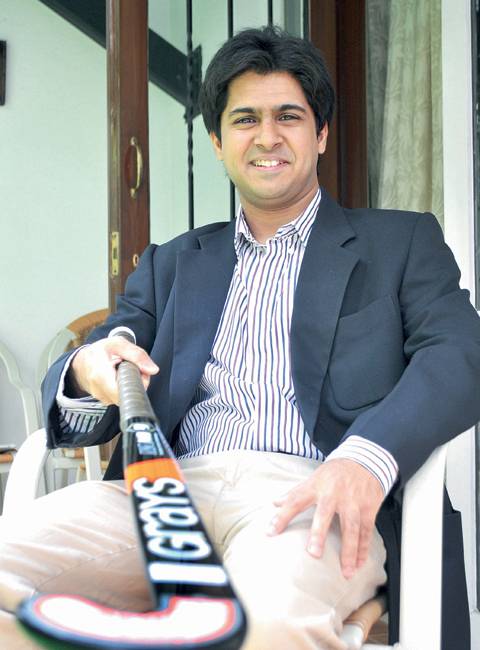
Dhruv Mullick’s only agenda is to bet on sporting talent that is off the beaten track. Inspired by the celluloid story Jerry Maguire, city-based Dhruv has set his sights on the Indian hockey team. A sports entrepreneur, Dhruv is building the brands of two promising hockey players — Raghunath and SK Uthappa just before the Olympics season heats up.

“My idea is to get hockey to a platform where these fantastic players are identified by even school kids. To build brands which can compete with leading cricketers’ brands. But this is just the beginning and we are taking baby steps,” says the entrepreneur. With the London Olympics fast approaching, Dhruv thought this was the right time to build a glamorous image of a much neglected sport. “Raghunath is a typical Kodava lad. His brutal strength as a drag-flicker and commitment to the sport makes him the perfect poster boy of the team. While Uthappa’s talent and the coach’s (Michael Nobb) high ranking, makes him a bankable player. These traits make them brands in themselves,” says Dhruv.

But the going hasn’t been easy. “It is extremely difficult in a cricket-crazy nation to sell non-cricket sports. But the tougher the challenge, the better it gets. The only focus now is to get them as much exposure as possible before the Olympics,” says the shrewd marketing professional. Dhruv who has a BA honours in international business and economics, has trained as a sports brand manager under big names of the Indian sports arena. But his most memorable experience was with cricketing legend Sunil Gavaskar. “The opportunity to work for him and interact with him, is something that I cherish even to this day,” says Dhruv.

Though hockey is his favourite sport, he cannot hide his love for cricket. Not just for school teams, he also managed to play the first cricket season at the university in London. “I played for Regents College during 2004 just for the first season,” he reminisces, adding, “I have a Sunday cricket club with friends. I also play a bit of hockey. But my skills lie off the field,” says Dhruv.

His plan ahead is to ensure that both Raghunath and Uthappa’s brands take off in a big way. The smart entrepreneur concludes by remembering his favourite line from Jerry Maguire, “Show me the money.” And we do hope that hockey as a sport can do that.

source: http://www.DeccanChronicle.com / Home> Tabloid> Bengaluru / by Ayesha Tabassum, DC / April 26th, 2012