Bicycle Alliance launched with vision of one crore cycles

Metallic rings with spokes of a bicycle wheel unique stock photo

To boost the city’s bicycle population, Bicycle Alliance has been launched in Bengaluru with a unique ‘Vision One Crore.’

The big objective is to get Bengalureans own one crore bicycles in the years to come so that cycling becomes second nature to all.

Launched as part of the World Bicycle Day on Wednesday, the vision was propelled by a disturbing piece of statistics: As the city’s first bicycle mayor Sathya Sankaran put it: “India is witnessing very slow growth in bicycle ownership and a decline in the use of bicycles as a form of mobility,” he said citing a report by TERI, 2014.

Between 2001 and 2011, the share of bicycle-owning households has increased by a mere 1%. “The corresponding share in rural areas has increased by 3.4%, whereas in urban areas it has declined by 4.1%. (TERI, 2018).”

Various estimates put the stock of bicycles in Bengaluru to be anywhere between 10 lakh and 30 lakhs. However, as Sankaran informed, most are lying unused. “The bicycling mode share in the city is estimated at 3%.”

The Bicycle Alliance is a collaborative of bicycle retailers, cyclists, corporates, government agencies and the community, spearheaded by the city’s bicycle mayor.

Under the Vision One Crore, the Alliance will aim to provide the people with information on events designed to help them make the switch to owning and riding a bicycle in the city. “We will identify ways to promote bicycling via engagement and technology platforms.”

The retailers will provide feedback that would help measure the success of the campaign. Nine flagship bicycle retailers in Bengaluru have already shown joined this alliance with more on the way, Sankaran informed.

Among the retailers are BumsOnTheSaddle, Track & Trail, CycleWorld, Cadence90, Pedal In Tandem, iCycle, Crankmeister Bicycle Works, Wheelsports and Jayant Probikes.

The Alliance, he said, will support the flagship #ResetWithCycling campaign that brings together government, citizens and businesses to make bicycling a means of recovery in the post-Covid world.

source: http://www.deccanherald.com / Deccan Herald / Home>City> Life in Bengaluru / by Rasheed Kappan / DHNS / June 04th, 2020


Manipal doctors perform complex kidney transplant during lockdown

Representative image/Credit: Reuters Photo

Doctors at Manipal Hospitals have successfully treated a 43-year-old patient from Kolkata suffering from kidney failure.

Noted nephrologist Dr Ravi Jangamani, along with urologists Dr Deepak Dubey, Dr Shivashankar R and Dr Somanna, cardiothoracic vascular surgeon Dr Devananda N S, anaesthesiologist Dr Navneetan and the team carried out the complex kidney transplant recently.

The patient, Jinmay Kundu, had a familial kidney disease called Autosomal Dominant Polycystic Kidney Disease, which resulted in kidney failure. He had multiple complications, urgently needed a kidney transplant and also required blood for the surgery.

His condition had worsened during the lockdown. Kundu also had bad blood vessels with a 90% narrowing of the lower aorta, leading to poor blood supply in the lower part of the body, which made it difficult for the kidney transplant.

The surgery was the first-of-its-kind kidney transplant at Manipal Hospitals. The patient is stable.

“This was one of the most technically challenging kidney transplants one can imagine. Coupled with this challenge was the anxiety related to the Covid 19 infection around us. The patient had diseased blood vessels and the only option was to use a synthetic graft,” Dr Dubey, HoD and Consultant, Surgical Urology, Robotic Surgery and Renal Transplantation Department, said in a statement.

source: http://www.deccanherald.com / Deccan Herald / Home> City / by DHNS, Bengaluru / June 14th, 2020

Hubballi railway platform in Karnataka to be world’s longest

Passengers move to board Hubballi-Jodhpur Shramik Special train, at Hubballi railway station. DH FILE PHOTO

The Hubballi railway station will have the world’s longest platform within one year when the existing 550-metre long Platform No 1 will be extended to 1,400 metres.

Platform No 1 of South Western Railway’s Hubballi railway station which is an inspection carriage line, is being converted into a full platform of 1,400-metre length and 10-metre width. Presently, Gorakhpur in Uttar Pradesh has the longest platform in the world at 1,366 metres.

The Hubballi yard has five platforms, and trains can be dispatched in one direction only at the same time. The Hubballi yard is being remodelled to increase the number of platforms from the existing 5 to 8. This work is being done as part of the Hubballi-Bengaluru line doubling project.

A third entrance is coming up for the station too.

The cost of the works is Rs 90 crore for yard remodelling, signalling, electrical, building work and other works. Work on the project has began and will be completed in the next one year, said SWR chief public relations officer E Vijaya.

source: http://www.deccanherald.com / Deccan Herald / Home> State> Karnataka Districts / by DHNS, Hubballi / June 04th, 2020

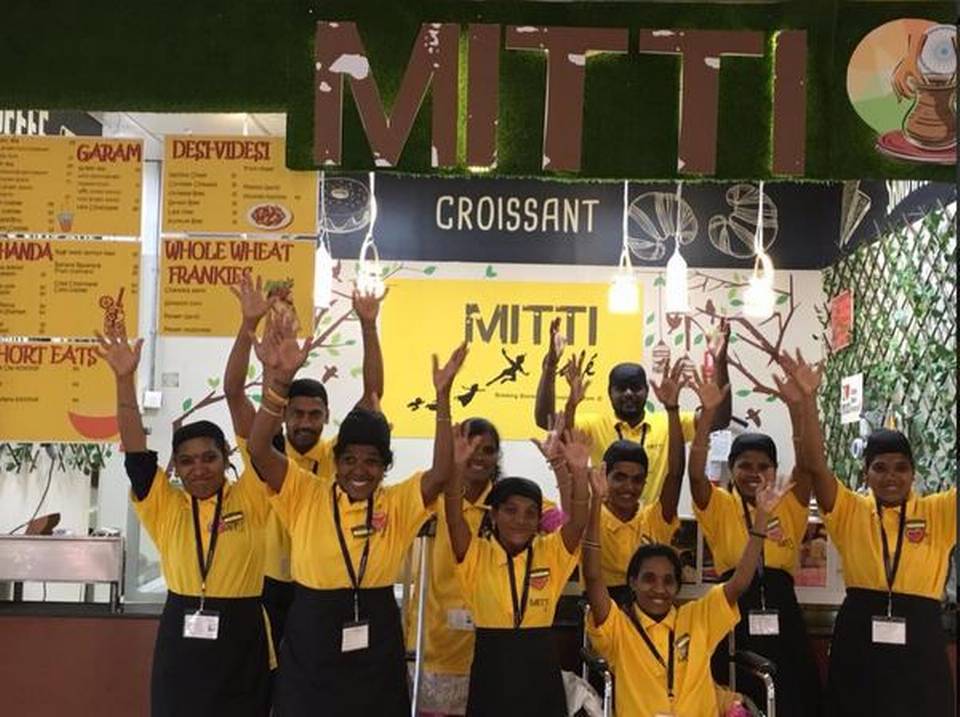
Bengaluru’s Mitti Cafe wins Bumble Grant Program 2020

MittiCafeBF14jun2020

Mitti Cafe founder explains how the grant helped them kickstart their COVID-19 relief work

Mitti Cafe is one of the winners of the Bumble Grant Program launched in March 2020, to support women-led small businesses. The Bengaluru café is run by people with physical and intellectual disabilities, and claims that the grant helped Mitti kick-start its COVID-19 relief work.

“Food is the need of the hour,” says founder Alina Alam, “The grant money is going towards the Mitti Karuna Meals, where our persons with disabilities are serving daily-wage earners and the homeless. We have been able to serve over four-and-a-half lakh meals.”

Social networking site Bumble, which focusses on women-empowerment, has taken initiatives to support 180 local businesses through the Grant Program, launched in March 2020. As a part of the initiative, they offered winners ₹1,00,000 across 11 countries, including India, USA, UK, Russia, Germany, Australia, France, Canada, Mexico, Ireland, and New Zealand.

Of the 20,000 applicants worldwide across sectors like food and service, retail, CSR, technology, fashion and lifestyle, healthcare, education, and more, 2,000 SME applicants were from India. Thirteen of these have received the grant, and eight of these businesses are led by women entrepreneurs.

Director and COO of Mitti, Swati Dokania says, “Bumble’s vision of small businesses working through the community, to make a change, and sustain each other, aligns with ours. That is why we applied for the grant.”

As of now, the 12 Mitti Cafe branches, set up inside various office campuses such as Infosys and Wipro, will remain shut to stay safe from the pandemic. However, the Mitti Karuna Meals initiative is on-going. “Our staff of adults with disabilities came up with this idea, and that’s why we reached out to organisations, including Bumble, to kickstart this,” says Alina.

The 116 staff members at Mitti Cafe are currently helping feed the homeless. However, many of the staff, including assistant manager, Rajasekhar, used to live off the streets as well. “He has an intellectual disability, but today, he trains other people we hire,” says Alina, adding, “Our aim is to help create awareness while at the same time, support them financially.”

Mitti Cafe now has plans of expanding to Chennai, Mumbai and Hyderabad.

source: http://www.thehindu.com / The Hindu / Home> Society / by Sweta Akundi / June 10th, 2020

Microsoft’s venture fund sets up office in Bengaluru

Representative image/Credit: AFP Photo

Microsoft’s venture fund M12 on Wednesday said it has set up an office in Bengaluru that will bolster efforts in pursuing investment opportunities.

The Bengaluru office joins the M12 network that includes San Francisco, Seattle, London, and Tel Aviv.

The local office will pursue investment opportunities across the region, focusing on B2B software startups in the sectors of applied artificial intelligence, business applications, infrastructure, security, and vanguard technologies, a statement said.

M12 seeks to invest in disruptive enterprise software startups in the Series A through C funding stages, targeting both local and cross-border solutions, it added.

“The new office is a step forward in M12’s long-term commitment to the Indian startup ecosystem,” it noted.

M12 has already been remotely investing in India since 2019 and its portfolio includes names like Innovaccer and FarEye.

“Typically, we see the greatest hurdles in a startup’s journey as they scale from local success to global challengers, and then again when they go on to become category leaders,” M12 India Lead Abhi Kumar said.

He added that both inflMicrosoftection points require specific and deep organisational strength, proven talent, GTM partnerships, and global investors.

“M12 is proud to be co-located in the region, and to bring experience and resources that will help startups successfully navigate these inflection points,” he said.

Post-investment, the startups in M12’s portfolio can elect to work with the fund’s Portfolio Development team.

M12’s portfolio companies are actively supported through connections to Microsoft’s go-to-market resources, access to Microsoft technology and internal thought leaders, co-marketing opportunities, and engagement with engineering teams to explore product integrations, the statement said.

Set up in 2016, M12 (formerly known as Microsoft Ventures) has invested in 90 companies.

source: http://www.deccanherald.com / Deccan Herald / Home> City / by PTI / June 10th, 2020

ITC Infotech supports John Hopkins University in COVID-19 Control Study

The project team from Johns Hopkins is working with ITC Infotech’s Digital Experience (DX) team to further enhance the user interface and user experience (UI/UX) of the COVID-19 Control data collection App.

Tracking the spread of the coronavirus is an ongoing challenge. But researchers at Johns Hopkins University are conducting a study that uses an app to collect information that can help localise potential COVID-19, clusters and flare-ups.

COVID-19 Control – a Johns Hopkins Bloomberg School of Public Health approved institutional review board (IRB) study, is a new surveillance tool for COVID-19, based on self-reported body temperatures and, optionally, other symptoms, from users around the country using a user-friendly app.

By using spatial science analytics applied to these data they will identify anomalous increases in body temperatures and generate real-time, pre-clinical, risk estimates of potential COVID-19 outbreaks.

The project team from Johns Hopkins is working with ITC Infotech’s Digital Experience (DX) team to further enhance the user interface and user experience (UI/UX) of the COVID-19 Control data collection App.

ITC Infotech’s DX experts are helping the team from Johns Hopkins fast track UI/UX enhancements to drive higher adoption by introducing more user-friendly features.

“Data from this app will allow us to map and identify hot spots of fevers across the United States, potentially indicating emerging outbreaks of COVID-19 before health care or testing is sought. That information can be key in our efforts to control and mitigate the spread of the virus,” said team member Frank C. Curriero, a professor in the Department of Epidemiology and director of Spatial Science for Public Health Center at the Bloomberg School of Public Health.

“The COVID-19 Control data collection App by Johns Hopkins University is very well-timed, as stay-at-home and shelter-in-place restrictions start getting lifted. We are happy to collaborate with the team from Johns Hopkins University, especially during this unprecedented crisis when industry-academia collaboration is critical,” said Sudip Singh, CEO & Managing Director, ITC Infotech.

This syndromic surveillance tool will allow healthcare systems and government agencies to potentially pre-empt outbreaks and better deploy resources to mitigate consequences. Acquiring data directly from individuals rather than hospitals/laboratories greatly reduces the delay in identifying new outbreaks of the disease and expands basic monitoring of health, he further said.

source: http://www.thehindu.com / The Hindu / Home> Sci-Tech> Health / by Special Correspondent / Bengaluru – June 11th, 2020

Real ‘aatmanirbharta’: Denied job, Karnataka man becomes ‘bitter gourd specialist’

38-year-old Satish Shidagoudar is popular in this region as ‘Bitter Gourd Specialist’ for his amazing skills in growing quality and quantity vegetable in his agricultural field.

He has been cultivating it in his 1.5-acre lands out of five-acres owned by him and is earning in lakhs every month, which he says, no employer could have paid him that much salary, if he had got a job.

Belgavi :

Being a double degree holder he could have easily landed job anywhere. But he wasn’t that lucky as he was denied a job. But it didn’t stop him from doing something else to eke out a living and to his luck he is a successful farmer now, mainly In cultivating ‘ bitter gourd’.

He is Satish Shidagoudar, a 38-year-old farmer from Shirur village of Hukkeri taluk, about 35 km from Belagavi, popular in this region as ‘Bitter Gourd Specialist’ for his amazing skills in growing quality and quantity vegetable in his agricultural field.

He has been cultivating it in his 1.5-acre lands out of five-acres owned by him and is earning in lakhs every month, which he says, no employer could have paid him that much salary, if he had got a job.

He is also a wealthy farmer now, as he owns four vehicles, a piece of land and is also planning to build a bungalow.

Speaking to Express, Satish Shidagoudar said that “I wanted to be a teacher for which I also studied bachelor’s degree in education.

I had also completed BA degree. But I was asked to pay Rs 16 lakh as a bribe for a job with Rs 16,000 salary per month. My father was also planning to arrange money by taking loans as he was desperate to get a job for me. But I refused to and decided to help my father in the field”.

My father Nagappa who is aged 69 and uncles were growing variety of vegetables from the past 15 years in a traditional way.

But the yield and quality were poor due to which they were barely generating any income.

“After joining them in agriculture in 2008, I chose the advanced techniques of growing vegetables by adopting drip irrigation for proper water management, mulching the base to maintain moisture and prevent the growth of weed and providing micronutrients regularly and management of pest.

“I chose to grow bitter gourd by studying its demand in the market. It is bitter by taste, but it is a remedy for diabetes, cancer and many more diseases. People have started consuming it more nowadays. It is also used in making medicines,” said Satush.

“Following this, we started growing the very crop throughout the year by changing the plots in one-and-a half-acres of land. We harvest about 50 tonnes in one season.

“This year, it is being sold at Rs 35,000 per tonne against Rs 48,000 last year. During seasons, I earn about Rs 25,000 to Rs 35,000 per day which I think is far more than the salary earnings of any teacher’ says Satish with a smile on his face”, he added.

“I hardly invest Rs 1.5 Lakh and earnings are several times more than the investment. This is possible only due to hard work and dedication.

“I take care of the plants like a baby due to which I get quality yield. Many people from various districts visit my field to understand the method of cultivation”, he said.

source: http://www.newindianexpress.com / The New Indian Express / Home> Good News / by Sunil Patil / Express News Service / June 10th, 2020

Mum’s the word

She might be known as Sandalwood beauty Sree Leela’s mother now, but Dr Swarnalatha has always been a rockstar in her field of work.

Dr Swarnalatha with her daughter Sree Leela (right) and actor Radhika Pandit

Bengaluru :

She might be known as Sandalwood beauty Sree Leela’s mother now, but Dr Swarnalatha has always been a rockstar in her field of work. One of the most sought-after gynaecologists and fertility specialists in the city, she has helped many Kannada filmstars like Radhika Pandit and Yash welcome their bundles of joy. Swarnalatha is currently working on a book about the most common gynaecological issues. “The book will be like a handbook for women of all ages. It will have details about the changes a woman’s body goes through, right from puberty to menopause,” says the 51-year-old doctor who has been specialising in artificial reproductive methodology for 13 years.

With Sandalwood actors having consulted her for a long time, she says the biggest problem that women in the industry face is stress and erratic lifestyles, which affect their bodies directly. “Stress, constant weight gain or weight loss, etc are part of the job. But it has huge repercussions on your body which may lead to various gynaecological issues, including infertility,” she points out. Working with filmstars might sound like a fun job but she says it also comes with its own set of risks and responsibilities.

“They all come to me with trust. Although I keep all my patients’ cases confidential, stars also bring in a lot of curiosity among people. So I am always intimately involved with a case so that everything comes under my direct supervision,” she explains, adding, “Since their appearance is a critical part of their job, they are also constantly worried about the physical changes that their body goes through, so for any step that we take, we have to keep that into consideration too.”

Swarnalatha is also a hands-on mother, a fact that she says her daughter’s colleagues in the film fraternity can vouch for. “I know her routine by heart. I constantly check with the production team to know if she has had food, etc. I am sure she gets irked by that but later she comes around and says I was right. So that kind of makes up for everything,” says Swarnalatha, revealing that her only concern about her daughter joining the showbiz bandwagon was that Leela should finish her education. “She is currently in the final year of MBBS. Even both my older sons have finished their higher studies, so education is very important in the family,” says Swarnalatha.

Medicine may be her forte but she also nurtures a love for performing on stage, being a trained Bharatnatyam dancer and having performed on stage multiple times. “Even Leela says I should have been the first one in the family to enter the movie industry. I have never planned my life, so you might see me playing the role of a mother in future,” she laughs.

source: http://www.newindianexpress.com / The New Indian Express / Home> Cities> Bengaluru / by Monika Monalisa / Express News Service / June 10th, 2020

Homage To Unwin Of Kannada: Prof. H. M. Shankaranarayana Rao

ShankarnarayanaRaoBF09jun2020

When I was browsing through some literature on Prof. H. M. Shankaranarayana Rao, a write-up in Kannada with the title ‘Unwin of Kannada’ written by M. Satyanarayana Rao of Geetha Book House-fame, attracted my attention. A great Publisher can understand and appreciate another equally great Publisher more intimately.

For the benefit of those who are not familiar with Unwin, I may add that Sir Stanley Unwin of England was one of the Publishers known all over the world for publishing books of everlasting value written by distinguished authors. For want of a better title, I simply copied that title to pay homage to Prof.  H. M. Shankaranarayana Rao, the architect of Sharada Mandira, a Kannada Publishing House which has made Mysuru City proud.

Though he was elder to me by two decades, I had the privilege of knowing him fairly intimately. Placing Prof. Shankaranarayana Rao on the same pedestal occupied by Unwin is perhaps the best tribute to Prof. Rao.

Prof. Shankaranarayana Rao (1913-1997) was born at Harihara, a place of great antiquity sanctified by Harihareswara temple built by the Hoysalas eight hundred years ago. Shankaranarayana is another name for Harihara, a composite deity which establishes the identity of Siva and Vishnu, a wonderful concept. Instead of continuing as the priest of this temple, Shankaranarayana Rao chose to get modern College education. Any other person would not have even dreamt of College education when poverty was staring at him. But the young Rao had a dream of his own.

Weekly meals

In those days, the concept of weekly meals was very popular among poor students. Weekly meals did not mean taking food once in a week but eating each day at a different house in turn with the consent of the owner of the house. In fact most of the distinguished persons have grown under this umbrella of weekly meals.

Shankaranarayana Rao had arranged for weekly meals for all the seven days of the week. He joined the Maharaja’s College and automatically got 50% exemption from the payment of the tuition fee. But Rao could not afford to pay the remaining 50%. He met Principal Prof. J.C. Rollo (Englishman) and told him that he is poor and surviving on weekly meals.

Prof. Rollo understood this as eating once a week and asked the College Manager if this is true and the latter replied ‘Yes, Sir.’ And Prof. Rollo granted Rao exemption from the payment of the remaining 50% of the College fee. This enabled Shankaranarayana Rao to prosecute his College education. This incident sounds like a fairy tale to the students of the present generation.

H. M. Shankaranarayana Rao had the good fortune of getting a Master’s degree in Kannada literature under the luminaries like B.M.Sri, Ti.Nam.Sri, T. S. Venkannaiah, A. R. Krishnasastry, DLN, M. H. Krishna, Srikantha Sastri, Rallapalli, M. Hiriyanna  and others. His friends like Paramesvara Bhatta and K. Venkataramappa gave him good company. After some initial struggle, Shankaranarayana Rao joined the Sarada Vilas College as a lecturer in Kannada, became a Professor and finally emerged as the Principal of that College.

During his leadership, Sarada Vilas College attained name and fame as a great centre of education and became popular. H. M. Shankaranarayana Rao paid great tribute to the management of this College by saying: ‘This is perhaps the only College where the Principal and the staff are allowed to work without any interference from the Management.’

Man of innovations

Prof. Shankaranarayana Rao was a man of innovations. His creative mind always aspired for new things to help the society. Once he wrote a long essay in Kannada and wanted to get it published. Instead of going and waiting at the doors of the Publishers, he thought of starting a Publishing House of his own and serve Kannada.

At the suggestion of Ti.Nam.Sri, it came to be called ‘Sharada Mandira’ (House of Goddess Sharada, the presiding deity of Knowledge). From that day onwards neither Sharada Mandira nor Shankaranarayana Rao looked back and Rao became a Kannada Publisher.

In the beginning, he published his own books and began approaching other authors who came in search of Shankaranarayana Rao with a request to publish their books. Rao has published over four hundred titles of great authors including A.R. Krishna Sastry, Veesi, Gorur, Ti.Nam.Sri, DLN, K. Venkataramappa, Pu.Thi.Na, Murthy Rao, Krishnamurthy, Ashwattha, Tarasu etc. Thus practically all illustrious writers of that period have found a place in Sharada Mandira. This is not a mean achievement.

Scholarly monograph on  Harihareswara temple 

Prof. Shankaranarayana Rao enriched Kannada literature by publishing his own 25 books. As a student of History and Epigraphy, I have always admired his scholarly monograph on Harihareswara temple at Harihara. I had suggested to him to get it translated into English so that non-Kannadigas would be benefitted by it.

Another virtue which has endeared Prof. Rao to the Authors and Publishers is the way he respected the authors. He believed that an author is the focal point of the literary world and hence he should be respected and rewarded properly. He started the practice of giving royalty to authors in a single lumpsum. In addition he has helped many authors by giving financial help in times of needs such as marriage, buying a site or completing a house etc. This showed his concern for the authors who were the backbone of the Publishing industry.

In this connection I may quote what Prof. Rao told me once. ‘I very much desire to give you royalty; please give me a manuscript.’ Unfortunately, I could not do it and the loss is mine.

Prof. H. M. Shankaranarayana Rao was not merely a great Publisher but a great scholar in Kannada. He has written more than 25books in Kannada including independent works and edited old classics. Fortunately, many of his works became text books and the students were the real beneficiaries. His beautiful Kannada handwriting has been admired by his contemporary scholars. Some twenty years ago, I received a beautifully written post card from him.

It seems he was reading Ranna and at one place, he saw a phrase ‘posa-pon’ meaning new gold and it did not suit the context. In my book on coins of Karnataka, I had indicated that ‘pon’ is a gold coin and this meaning suited his context, as newly minted gold coins. He congratulated me for this interpretation.

I used to meet Rao occasionally in the evenings at the first floor of the famous Geetha Book House at K. R. Circle. Though it was a small place surrounded by books on all sides, it was made a pleasant place by the brothers Satyanarayana Rao, Gururaja Rao and Gopalakrishna. Prof. Rao, Venkataramappa, HSK, H. M. Nayak used to be there with pleasant conversation on literature, men and matters laced with generous comments without malice to anybody. Light eatables were always there. I was the youngest of the lot and the horizon of my knowledge was broadened greatly. Alas! Such meetings are not held nowadays either in Colleges or in homes or when friends meet. Now it has passed into the pages of history.

In the meantime, it is our duty to salute and pay homage to Shankaranarayana Rao who has made Mysuru city proud by his Publishing House Sharada Mandira.

source: http://www.starofmysore.com / Star of Mysore / Home> Columns / by Prof. A.V. Narashima Murthy / June 07th, 2020

Colourful Yakshagana saris now for anyone’s wardrobe

George Amanna weaving a Kase sari in Udupi. | Photo Credit: Special Arrangement

Efforts are on to make and market Kase saris — which have colourful bold checks and are traditionally worn by Yakshagana (Badagathittu) artistes — to suit any woman’s wardrobe.

The Karkala-based Kadike Trust, which has been working to popularise the Udupi sari, which enjoys the Geographical Indication (GI) tag, is now doing the same with Kase sari, which come in bright shades of yellow, red and black checks.

“Some decades ago, the late Kamaladevi Chattopadhyaya, founder of the Crafts Council of India, who was attracted to the Kase sari, visited Manjunath Shettigar of Brahmavar, a master weaver, and collected some samples,” said Mamatha Rai, trustee of Kadike Trust.

A couple of years back, the Crafts Council of India sought a couple of saris for exhibition at a national conference in Manipal. It was then that the trust decided to encourage weavers to weave Kase sari, which is being marketed as “Yaksha Udupi Sari”. “The marketing of this sari is fetching better returns for weavers and we are sharing profits with them,” Ms. Rai said.

At present, about five weavers from three primary weavers’ cooperative societies (at Brahmavar, Shivally, and Talipady) weave these saris. “The Kase sari worn by Yakshagana artistes is 8.25 metres long. But we are getting it weaved for 5.5 metres with a pallu. We presently have orders for weaving 50 saris,” Ms. Rai said.

Use of social media

The trust has been using social media to popularise these special saris. It is also encouraging weavers’ societies in Udupi district to take up weaving of this sari and is facilitating its marketing.

George Amanna, 68, a weaver, said the initiative to popularise Kase sari was laudable at a time when the demand for handloom saris was low. “I hope the trend of wearing Kase sari catches on,” he said.

Shashikanth Kotiyan, secretary, Shivally Primary Weavers Service Cooperative Society, Udupi, said the society had weaved about 70 Kase saris (of 5.5 metres length) and supplied them to the trust for marketing so far.

source: http://www.thehindu.com / The Hindu / Home> News> States> Karnataka / by Ganesh Prabhu / Udupi – June 08th, 2020