From Turkey to Bengaluru

Zuhair Fiyaz, who is in his mid-20s, discovered this ice cream parlour and fell in love with it.
TurkishIceCreamBF10nov2018

Bengaluru :

I scream, you scream, we all scream for ice cream! Meet your sweettooth cravings here at The Maras, south India’s first Turkish ice cream parlour that opened recently on the busy Jyoti Nivas College Road in Koramangala.

MarasicecreamBF10nov2018

There are a variety of flavours that one can try here. A Turkish flavour, Saada, originated from the Turkish word Saadee, is also available here. Other flavours include the popularly-sold almond honey, chocolate brownie, kiwi (they claim to use the kiwi fruit for its rich flavour), pistachio, caramel and strawberry-banana, that tastes like a bubble gum.

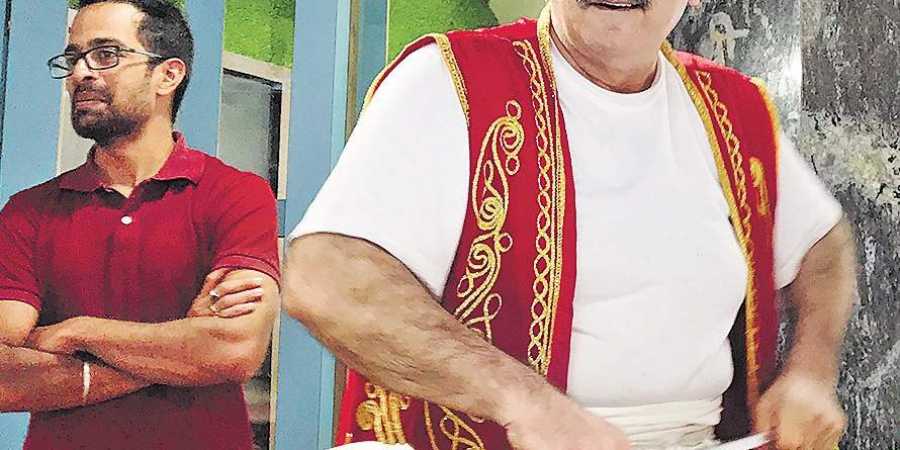
It’s a joint venture by Nikita Agarwal, her husband, Vinay Agarwal and brothers in-law Manish and Nikhil Agarwal. They say they wanted to start something unique and hence, came up with this idea. “Our tagline – Serving cones with happiness – is in par with the way we serve Turkish ice creams to people. Our happiness ‘delivery man’, Mustafa, is from Turkey and the way he plays with the ice cream before handing it over is unique and exciting to watch. People, especially children, queue up in front of the shop and watch him prepare the ice cream for two minutes. It’s fun to watch him serve scoops of ice cream on the cone,” says Nikita.

But, why the name Maras? “Dondurma, the Turkish ice cream, as is originally called, is believed to have been found in the city of Maras in Turkey. Hence, we decided to just name it The Maras (pronounced Marash),” says Manish.

Apart from ice creams, they also sell Turkish sweets such as baklava and bulbul, and their sale shot up during the festive season. “We are open on all days, from 12.30 pm to 12 am. We were a hit during Diwali as people were looking for unique sweets for gifting purposes,” says Nikita. “We recently added the Matcha flavour, originally from Japan, which tastes similar to green tea, for diet-conscious people,” she adds.

Zuhair Fiyaz, who is in his mid-20s, discovered this ice cream parlour and fell in love with it. He says, “I have visited this ice cream parlour thrice and my aim is to try out all their flavours one by one. Mustafa is a delight to watch every time I buy an ice cream from him. They gave me a loyalty card which offers my 10th ice cream for free.” Approx. cost for two: Rs 150
Customers say watching Mustafa make the ice creams is a delight.

source:http://www.newindianexpress.com / The New Indian Express / Home> Cities> Bengaluru / by Sudeshna Dutta / Express News Service / November 10th, 2018

Omprakash Kanagali passes away

The former Minister Omprakash Kanagali died in Belagavi on Tuesday. He was 68. He served as Irrigation Minister in the S.M. Krishna Cabinet.

He is survived by wife, a son and a daughter.

The final rites were held in his native village of Kanagala in Belagavi district on Wednesday. Kanagali was the son of B. Shankaranand, former Union Minister. Kanagali, who was an advocate, organised the Kannada Dalit writers’ meet in Belagavi in 1992, according to family sources.

source: http://www.thehindu.com / The Hindu / Home> News> States> Karnataka / by Special Correspondent / Belagavi – November 09th, 2018

‘Work on Krumbiegel memorial to start in two months’

The Krumbiegel hall before it was razed.

Archaeology Department says the tender process is on

A year ago, Krumbiegel Lecture Hall inside Lalbagh Botanical Garden was razed after a portion of the 100-year-old building collapsed following heavy rains. Facing criticism from all sides for failing to restore an important piece of the city’s heritage, the Horticulture Department, which is entrusted with maintaining the garden, decided to erect a memorial for Gustav Hermann Krumbiegel, the man who gave the city its green cover. However, a year later, the land where Krumbiegel hall once stood still remains vacant.

In his time, Krumbiegel used the lecture hall to practise his speeches. Over the decades, however, it fell to disuse and conservationists despaired over its neglect. Now the city and Krumbiegel’s family in U.K. are waiting for the memorial to come up.

The State Archaeology Department was roped in, and a plan and an estimate prepared. Officials in the Horticulture Department said that all necessary approvals for rebuilding the memorial are in place and that the Archaeology Department has initiated the tender process. “The tender process is taking long. Once finalised, the work can be completed in six months,” said M.R. Chandrashekar, Deputy Director, Lalbagh.

The Department of Archaeology, Museums and Heritage said it had presented an estimate of the project, which has been approved. “The tender process is on and is likely to take over a month. Meanwhile, we are getting technical approval for the project. The work is likely to start in two months,” said Venkatesh T., Commissioner, Archaeology Department.

Cost estimated at ₹98 lakh

As per the plan, a structure similar to the old Krumbiegel hall is to come up at an estimated cost of ₹98 lakh. “The Archaeology Department will keep the old design in mind to create the new space. The new hall will serve as a space to learn about the history and horticultural richness of Lalbagh. There will be audio-visual aids for tourists. Short films on the Botanical Garden will be played in both Kannada and English,” Mr. Chandrashekar added.

Alyia Phelps-Gardiner Krumbiegel, the great granddaughter of Krumbiegel, said she was eagerly waiting for the memorial to come up. “I’m so pleased to hear that at long last the new Krumbiegel hall is coming to realisation. Karnataka still owns the legacy of my great grandfather. He designed and landscaped his way from Baroda, Ooty, Bombay, Coochbehar, Jamshedpur, Delhi, Hyderabad, Trivandrum,Madras, Mysore and above all Bangalore. He found his home in Bangalore. He and the other four heavyweight superintendents of Lalbagh – William New, John Cameron, Rao Bahadur H.C. Javaraya and M.H. Marigowda – all deserve their own special monuments for their contribution.”

source: http://www.thehindu.com / The Hindu / Home> News> Cities> Bengaluru / by Sarumathi K / November 08th, 2018

Bengaluru student to get USD 400,000 prize for self, teacher, school

Breakthrough Junior Challenge is a global science video competition designed to inspire creative thinking about fundamental concepts in the life sciences, physics, and mathematics.

Bengaluru :

Sixteen-year old Samay Godika, a city school student, will receive USD 400,000 in educational prizes for himself, his teacher and his school, as he emerged the winner in the fourth annual “Breakthrough Junior Challenge”, a global science video competition.

The US-based Breakthrough Prize announced Godika, a junior at the National Public School-Koramangala here, as the winner of this year’s ‘Breakthrough Junior Challenge’ for his video submitted in the life sciences category on circadian rhythms, which are physical, mental, and behavioural changes that follow a daily cycle.

Breakthrough Junior Challenge is a global science video competition designed to inspire creative thinking about fundamental concepts in the life sciences, physics, and mathematics.

“As the winner, Samay will receive USD 400,000 (approx Rs 2.92 crore) in educational prizes for himself, his teacher and his school,” Breakthrough Prize said in a release posted on its website Sunday.

Samay will receive a USD 250,000 college scholarship while his ninth and tenth grade science teacher Pramila Menon will get USD 50,000 prize.

Additionally, his school will receive a state-of-the-art science lab valued at USD 100,000.

Menon had encouraged his interest in life sciences and tutored him after school to encourage his curiosity about scientific ideas.

Recognising him as a Boston native who now lives in India, Breakthrough said, Samay’s video, submitted in the life sciences category, focused on circadian rhythms, the 24-hour biological processes that can affect simple daily experiences such as waking up for school or jet lag.

Because he has family members who suffer from Parkinson’s and other neurological diseases, Samay is particularly interested in the correlation between circadian rhythms and the effectiveness of medical treatments, it added.

“Participating in and now winning the BreakthroughJunior Challenge is life-changing, thrilling and such an honour. I’m so grateful for this opportunity to be recognised alongside so many of the world’s top scientists and tech industry leaders,” Samay said.

Breakthrough Junior Challenge is a global initiative to develop and demonstrate young people’s knowledge of science and scientific principles, generate excitement in these fields and engage the imagination and interest of the public-at-large in key concepts of fundamental science, it said.

www.newindianexpress.com/ The New Indian Express / Home> Cities> Bengaluru / by PTI / November 05th, 2018

Tulsi herbal drinking water creator wins Young Scientist Award

Harishchandra S. Bidnoorkar with his students in the laboratory at Sharnbasva University in Kalaburagi.

Harishchandra S. Bidnoorkar received the award in Goa recently

Harishchandra S. Bidnoorkar, a young scientist who works as an associate professor at the Faculty of Business Studies at Sharnbasva University, Kalaburagi, is a man with multiple talents. In recognition of his recent contributions in science and research– developing Tulsi Herbal Drinking Water and a Healthcare App – he has been honoured with Young Scientist Award – 2018 by the International Association of Research and Development Organisation (IARDO).

The award was presented at the International Award Conference on Multidisciplinary Research and Latest Innovation – 2018, at the International Centre, organised in Dona Paula, Panjim, Goa, recently.

Tulsi Herbal Drinking Water, developed in 2017, is a simple and multipurpose drinking water concentrated basil (Tulsi) content. Mr. Bidnoorkar obtained a patent for the process of the preparation of the herbal drinking water.

“This Tulsi water formula comprises an active amount of an extract and/or at least one bioactive fraction from Ocimum Tenuiflorum [basil/Tulsi]. That makes this non-toxic drinking water special as it has rich medicinal qualities. There are absolutely no side-effects. This special water with added Tulsi has been tested in the laboratory and has proved to be active in addressing or treating 15 common diseases,” Dr. Bidnoorkar told The Hindu.

Now, Bidnoorkar is getting offers from businessmen and establishments who want to use his patented formula to produce packed drinking water for commercial purposes.

He has, however, turned down the offers to establish his own packed drinking water production plant and sell the product to the people of Hyderabad Karnataka region.

“If I sell my patented formula to any business firm, it will produce packed drinking water bottles in a big scale using my formula and sell it at not less than ₹100 a litre. My invention will then serve only the rich and remain inaccessible to large sections of the poor. My plan is to establish my own plant with financial assistance from the government and to sell this water at the cheapest possible price, even cheaper than normally packed drinking water presently available in the market so that large sections of the poor can benefit,” he said.

He is now planning to cultivate Tulsi plants on a massive scale in Kalaburagi and Bidar districts and produce the packed water in plants he will establish in the same region.

The problem is the capital. He had approached the Union government for funds under Prime Minister’s Employment Generation Programme scheme. It sanctioned ₹25 lakh as the non-refundable amount. “But, I am yet to receive the money that is in Corporation Bank’s zonal branch in Belagavi. I hope the bank authorities fasten the process and release the money soon. I can start producing Tulsi drinking water on a small scale with this amount,” he said.

A writer

Mr. Bidnoorkar had published as many as 78 articles on management studies, business development and the modern education system. He has presented as many as 32 papers in various international conferences held in the country.

He is also the author of four books, including The Massive Successful Modern Education System, an ISBN certified book that caught the attention of former President of India Pranab Mukherjee who wrote to him in appreciation of his concerns on modern education.

source: http://www.thehindu.com / The Hindu / Home> News> States> Karnataka / by Kumar Buradikatti / Kalaburagi – November 06th, 2018

This Karnataka artist makes art ‘come out of its shell’

BhatBF05nov2018

Udupi :

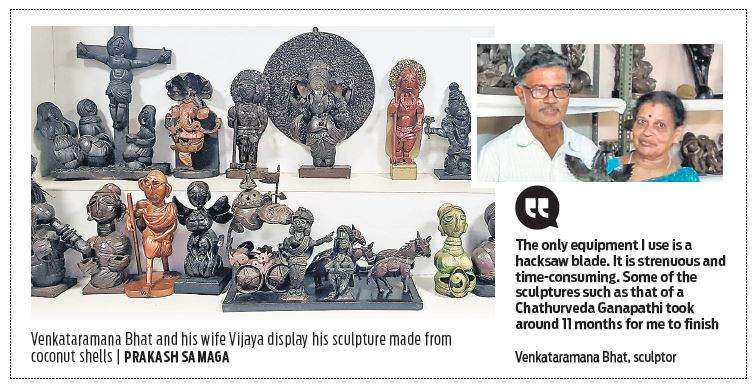
His story in a nutshell: He creates art pieces from coconuts. The ones carved by Venkataramana Bhat are beautiful enough to make a collector’s item. The discovery of art in coconut shells has helped Bhat, who stammered for the first two decades of his life, overcome his struggle with speech.

Bhat has been creating intricate works of art such as Ganesha, Krishna, Jesus Christ, Shakuntala, and Geethopadesha using coconut shells for 45 years now. Today, the house of the 72-year-old artist at Padu Alevoor in Udupi showcases over 140 items made from a material that most people discard as waste. Many of the exhibits are a result of backbreaking work.

‘The only equipment I use is a hacksaw blade. It is strenuous and time-consuming. Some of the sculptures such as that of a Chathurveda Ganapathi took around 11 months for me to finish,” he says. “I would have tried my skills in other materials, but coconut shells made me think about why this material could not be put to good use instead of ending up as waste. I then started experimenting with various methods to make art pieces from coconut shells.”

Bhat found his calling when he wanted to explore some media to express his ideas. In a bid to overcome stammering, he thought of bringing his ideas to people through the sculptures. His complete devotion to the craft paid off. He does not stammer now.

Bhat learnt the art himself. Initially, he didn’t know how to tame the hard shells, and used to soak them in water for some days. “But soon I realized that they do not soften that way. I then started using a hacksaw blade to cut the shells in the precise shape,” says Bhat, a BSc graduate who used to run a small shop in Davangere.

The detailed work in the artefacts does not make it easy for most people to guess the material that has been used to create them. Some even touch the sculptures and ask him if he is indeed telling the truth. Bhat uses good quality adhesive to glue the pieces together, and spends hours on each piece to get the desired finish. He has even taken as much as eight months to create one sculpture. One of the creations that he is especially proud of is a ‘Vyasa Ganapathi’ that he created 40 years back.

Among the several fans of Bhat’s work is Dr B G Acharya, a general practitioner at Mitra Hospital in Udupi who purchased a sculpture from him three years back. ‘‘I got a chance to visit his house and was fascinated by the creations,” he says. “Then I chose ‘Kadegolu Krishna,’ which is one-and-a-half-foot high. We have decorated our house with many other decorative items, but our guests particularly enquire about the coconut shell sculpture.”

Acharya, who bought the statuette for `4,000, purchased another ‘Kadegolu Krishna’ that shows him emerging from a lotus, some months back. “I gave the two-foot-high idol to my son-in-law. He placed it in the pooja room,” he says. “Bhat does not have any motive to make profit, and feels happy if his work is recognised,” Acharya adds.

Bhat procures the coconut shells from people nearby who store them and sell it to him at a reasonable price. He first conceives the sculptures in his mind and then devotes his complete attention to give it the desired contours. Various themes such as animals, scenes from Indian mythology, and the famous Gandhi’s monkeys come alive in the sculptures. Some of them also portray the emotions that he deciphers from works of popular poets of Karnataka, such as Kuvempu.

Bhat’s wife and their four daughters have always supported his skill even though it does not contribute much to the family income. In fact, when Bhat’s ideas do not seem to take off sometimes, and all the pieces fall apart, his wife Vijaya steps in to motivate him.

Giving shape to a sculpture takes a lot of patience. The process starts with selecting the right-sized coconut shell. For instance, large shells are required for making a belly. Bhat matches two big shells and glues them together to get a belly-like form. He carves out the two eyes by using his instruments, and sticks small pieces of shells in the background to make it look as if the eyeballs are real. He then moves on to creating more intricate designs.

Bhat’s creations have been displayed at various art events. Koti Prasad Alva, proprietor of Prasad Art Gallery in Mangaluru, has invited him several times to the art gallery and organised training sessions for children under his mentorship. Alva said that Bhat does not do it for earning money alone. He loves the art and is passionate about his creative talent.

SHOWCASING HIS SKILLS

Bhat has been invited by the department of architecture at Manipal Institute of Technology where he demonstrates his art. He has also showcased his skills at a national sculpture’s camp in Alva’s College, Moodbidri; at Rajangana in Sri Krishna Mutt premises, and at Coconut Development Board in Kochi.

source: http://www.newindianexpress.com / The New Indian Express / Home> States> Karnataka / by Prakash Samaga / Express News Service / November 04th, 2018

Once migrants, they now call themselves Kannadigas

Students of the government school at Indiragrama include children of migrant sculptors and masons, in Madhugiri taluk of Tumakuru district. | Photo Credit: The Hindu

Sculptors, masons who came from T.N. to Karnataka in the 50s have made Tumakuru their home

In the 1950s, around 40 families of sculptors and stonemasons migrated from a village in Karikudi taluk of Sivaganga district in Tamil Nadu to build the Vidhana Soudha in Bengaluru.

Today, the families have embraced Kannada culture as their own, while calling Indiragrama in Madhugiri taluk of Tumakuru district their home.

After the construction of the Vidhana Soudha, they got the job of building the Kannika Parameshwari temple in Badavanahalli in Madhugiri taluk. So, the Karnataka government allotted Ashraya houses to them and gave them land.

For Rangapura Gram Panchayat member Muthanna, it is indeed home. “My father Mahalingappa came to Bengaluru to help build the Vidhana Soudha. I was born and brought up in the State and now my age is 57,” he said. “We have become Kannadigas.”

Though their mother tongue is Tamil, they are fluent in Kannada. Their children participated in the Rajyotsava celebrations along with their friends in school.

“We sang ‘Naada Geethe’ and other songs on Kannada and Karnataka today,” said P .Pooja, a class 4 student from one of the families.

Pitching in

Teachers at the government school have also done their bit to help the children learn the local language. Headmistress D. Hemalatha, told The Hindu, “We teachers have learnt a little Tamil so that we can communicate better with students from lower classes, and help them learn Kannada properly.”

source: http://www.thehindu.com / The Hindu / Home> News> States> Karnataka / by S. Bhuvaneshwari / Tumakuru – November 02nd, 2018

Mphasis ties up with IIMB’s incubation centre

Mphasis, an IT services and solutions provider, has partnered with NSRCEL, the start-up incubation centre at Indian Institute of Management Bangalore to support early-stage social venture.

The programme aims to incubate and support ‘for profit’ social ventures and startups that have been in operation for one to three years, said a press release.

Over 550 applications were received for this programme and 16 of them were shortlisted for the three-month pre-incubation. They were then given an opportunity to pitch before an advisory council for selection to the programme which will be for 12-18 months, the release said.

TAXSHE Services Pvt. Ltd., ECONUT Coconut Producer Company Ltd., Blink Research and Services Pvt. Ltd., ThinkZone, and Rural Caravan Pvt. Ltd. are the selected ventures. They will receive an entrepreneurial grant and will be supported through a series of events and workshops aimed at addressing specific challenges.

source: http://www.thehindu.com / The Hindu / Home> News> Cities> Bengaluru / by Staff Reporter / Bengaluru – November 01st, 2018

Wrongly accused in ISRO spy case, SK Sharma dies of cancer in Bengaluru

SK Sharma was in palliative care being treated for stage-4 oesophagus cancer.

SK Sharma had been trying for compensation for the last 20 years. (Photo: Facebook Screengrab/ S K Sharma)

Bengaluru: 

Sudhir Kumar Sharma, one of the men falsely accused in the Indian Space Research Organisation (ISRO) ‘spy’ case of 1994, has died early on Thursday.

SK Sharma was in palliative care being treated for stage-4 oesophagus cancer.

Sharma was 62-year-old. He is survived by wife and three daughters.

Sharma was hoping to be compensated for the allegations after former ISRO scientist, Nambi Narayanan, was cleared of espionage charges and awarded Rs 50 lakh compensation for “unnecessary harassment” by the Kerala Police.

Labour contractor from Bengaluru, SK Sharma, who was tortured and harassed by the Kerala Police, was also cleared of all charges, but only after a difficult time in custody.

Socially ostracised and labelled as a traitor even when he fought to clear his name, it was a long battle for Sharma, who kept fighting tooth and nail as he wanted his reputation to be restored.

Sharma was trying for compensation for the last 20 years.

Sharma was just 34-year-old when he was first illegally detained for two days – November 21 and 22 in 1994 – from a DRDO lab in Bengaluru.

Sharma was good friend of Chandrashekhar, another person who was falsely accused in the case, who recently passed away.

In early 1994, Chandrashekhar had contacted Sharma seeking his help to get daughter of one of the two Maldivian women he had met at the Thiruvananthapuram airport admitted to a school.

Sharma was unaware that months later he would be detained, his family put under surveillance, or that he would be associated to what at the time was country’s biggest scandal.

In custody, Sharma was physically tortured. ‘They hit me. Slapped and kicked. Then with cane. After half an hour, this person would vanish. Another person would come. They said, ‘you passed ISRO and defence information to Pakistan’. I cried and cried but they were unrelenting. They didn’t let me sit on the ground for three days,” Sharma told NDTV earlier.

His reputation was damaged. And it hurt not just him but his family too.

Sharma had told NDTV, “My daughters were thrown out from the school. My daughters were humiliated. They were told, ‘You people are agents, deshdrohis (anti-nationals). The teachers also said hurtful things.”

His social life was affected as well and people who were close to him started avoiding him.

source: http://www.deccanchronicle.com / Deccan Chronicle / Home> Nation> Current Affairs / by Deccan Chronicle / November 01st, 2018