‘Tree Man’ of Channapatna spent earnings to create urban forest

Bhoohalli Puttaswamy

“How many saplings you have planted so far to build a green tomorrow? If you have planted any, it is commendable. If not even a single, plant at least one and nurture it. There is only one earth and we all should strive to preserve it for the future generations as well as our better tomorrows.” – This is the advice of Bhoohalli Puttaswamy to whoever he meets.

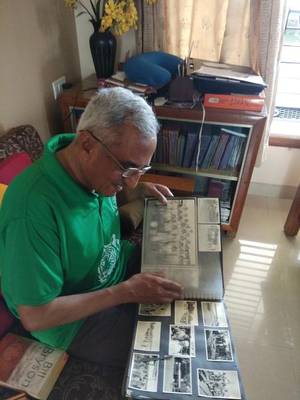
The 63-year-old retired history lecturer from Bhoohalli of Channapatna taluk is popularly called the ‘Tree Man of Channapatna’. In a little over 11 years, he has single-handedly planted around 4,000 saplings on barren lands, roadsides and government land. He has also involved students in planting over 500 saplings in and around Channapatna.

One of the tree parks created by environmentalist Bhoohalli Puttaswamy in Channapatna. He has planted over 4,000 saplings at different parts Channapatna taluk in Ramanagaram district since 2007.

Tree parks

The sexagenarian has converted 3.5 acres of barren land at Bhoohalli into an urban forest by planting nearly 500 saplings of varieties of native species. He created ‘Jeeveshwara Vana’ with 500 saplings next to Mahadeshwara Temple on Channapatna-Sathanur Main Road, and ‘Vidyarthi Vana’, next to Jeeveshwara Vana, with the involvement of students of various colleges. While he created ‘Kavi Vana’ near Bhoohalli with around 1,000 saplings, he increased the green cover with varieties of saplings at Kempegowda Layout in Channapatna.

It all started with an effort to prevent encroachment of a government land at Bhoohalli, he said.

Speaking to The Hindu on Monday, Mr. Puttaswamy stated that some influential elements eyed the government land at Bhoohalli years ago and began exercises to grab it. Upon learning of this, Mr. Puttaswamy rushed to the village and trying to save the land, alerted the villagers about the incident and later planted saplings. “Nearly 800 grown trees are there now,” he said.

IRs. 18 lakh

Environmentalist Bhoohalli Puttaswamy working at Jeeveshwara Vane at Channapatna of Ramanagaram district.

Mr. Puttaswamy claimed that he had spent nearly ₹18 lakh to plant saplings, and has been spending ₹15,000 a month to nurture them. “I hire tankers for watering the saplings during summer,” he said.

According to Rudreshwar, a folk enthusiast from Ramanagaram, the Tree man has spent most of his retirement benefits and earnings on planting saplings. “Mr. Puttaswamy mobilises students and volunteers, digs pits himself, plants saplings and nurtures them,” Mr. Rudreshwar, who is also a close aide of Mr. Puttaswamy, said.

Retired principal

Mr. Puttaswamy retired a few ago back as the Principal of the Government First Grade College of Channapatna, after serving for 32 years. He has penned 12 books on various issues.

source: http://www.thehindu.com / The Hindu / Home> News> States> Karnataka / by M. T. Shiva Kumar / June 05th, 2018
Little Kumaraswamy, ‘the government’s baby’

LittleKumaraswamyBF05jun2018

Abandoned baby gets a new lease of life as woman police constable tends to his needs

From being abandoned by his parents to becoming a representative of sorts for the new government — little Kumaraswamy, named after the new Chief Minister, is too young to comprehend the long journey he has already taken in such a short time.

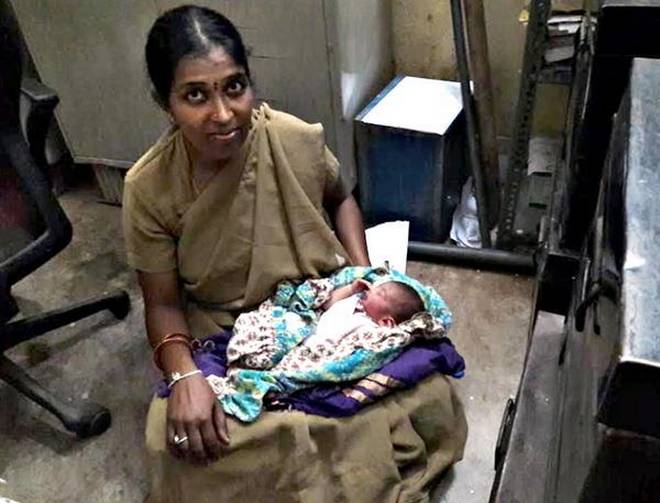
The newborn was rescued by the Electronics City police, and found the warmth of a mother in a woman police constable, who breastfed him and saved him from starvation.

It was on Friday morning that a rag picker noticed a newborn child stuffed in a plastic bag under a bush near a house under construction in Celebrity Layout, Doddathoguru.

He alerted the shopkeeper nearby, who in turn informed the police control room. Assistant Sub-Inspector Nagesh R. arrived at the scene and rescued the baby. By then, a large crowd had gathered at the spot.

“The baby was in bad shape. He was covered in blood and the umbilical chord was wrapped around his neck,” recalled Mr. Nagesh, who took the baby to a nearby hospital, where doctors treated him free of cost.

Soon after, Mr. Nagesh brought the baby to the station, and handed him over to police constable Archana, mother of a three-month-old boy herself. As the baby was weak and was motionless, Ms. Archana’s heart went out to him. She picked up the baby and breastfed him. In a few seconds, the baby gave a gusty cry.

There was jubilation in the station. Mr. Nagesh ran out to buy clothes for the baby, who was then named Kumaraswamy. “It is the government’s baby now, and we decided to name him Kumaraswamy as it would be under the care of the government,” Mr. Nagesh told The Hindu.

The baby was handed over to the Shishu Mandir on Hosur Road.

source: http://www.thehindu.com / The Hindu / Home> News> Cities> Bengaluru / by Special Correspondent / Bengaluru – June 05th, 2018

Bengaluru: Hearing impaired woman covers 8,300km on bike

DRIVEN BY PASSION: Archana Timmaraju embarked on the tour to motivate the hearing impaired

______________________________

HIGHLIGHTS

  • Hearing impaired Archana Timmaraju is back in Bengaluru after completing a 8,300km bike ride to Ladakh.
  • Born with 40% hearing ability, Archana has been facing difficulties and disabilities in her speech.

_________________________________

Bengaluru :

She may be hearing impaired but that hasn’t stopped her from being adventurous. Archana Timmaraju, 33, is back in the city after completing a 8,300km bike ride to Ladakh .

Hailing from Andhra Pradesh, Archana studied in St John’s School, Bengaluru, and later did her masters in metal sculpting from Karnataka Chitrakala Parishath. Other than sculpting, Archana also teaches art at Mallya Aditi International School.

“I started riding at 21 and haven’t looked back since. The aim of this tour — Journey to Inspire — was to motivate the hearing impaired and encourage more women to ride bikes,” she said.

Archana was accompanied by her friend and colleague Daniel Sundaram, a geography teacher, on the journey that began on April 29 and culminated at Freedom Park on May 29. She rode a Royal Enfield, while Daniel was on a KTM bike.

When asked about Archana’s feat, her mother Sita Mahalakshmi said: “We were not scared at all.Archana made video calls to us every day and shared her location live so we knew where she was. I am extremely proud of her.”

Born with 40% hearing ability, Archana has been facing difficulties and disabilities in her speech. She can hear to a certain extent with help of an aid. Archana, with Daniel, has also founded a community, Silent Expedition, for bikers,with special emphasis on those with disabilities.

source: http://www.timesofindia.indiatimes.com / The Times of India / Home> News> City> Bangalore / TNN / June 02nd, 2018

Nature lessons from a school principal in quiet Chikmagalur

Homework in the forest

A teacher who wanted his students to listen to the sounds of nature. | Photo Credit: Vaishali Rawat

We’ve all gone through school with teachers nagging us to stay quiet, but when M.N. Shadakshari, principal of Model English High School in Karnataka’s Chikmagalur, asks his students to be silent, the reasons are different. He wants them to listen to the sounds of nature — “the dry leaves of autumn trees rustling in the breeze, the melody of birds’ evening tweets, chirping grasshoppers and crickets, frogs and toads croaking into the night.”

Shadakshari makes for an unusual school principal. He isn’t a strict authority figure, but more a warm, passionate teacher whose guidance is always available for students. And as much as worrying about math and history, Shadakshari is dead keen his wards learn about nature. “Growing up, children are so much more receptive, curious and inquisitive as they learn to ask questions and perceive the world around them. It is crucial that teachers recognise this and ensure that an intuitive connection to the environment is nurtured,” says the 70-year-old.

Long before it became fashionable to do so, Shadakshari was teaching his students about the natural world and climate change. He would take his students on nature walks that would be interspersed with conversations about how forests, rivers, lakes and grasslands feed into the larger ecosystem, and about the birds and animals they encountered on the paths. Inspired by ‘Shadakshari sir’, many students have taken up full-time careers in conservation.

Extra mile outdoors

Chikmagalur borders the Bhadra Wildlife Sanctuary, and it is famous for the vast Shola forests that carpet its hills, and its prominent peaks like the Mullayanagiri, Kemmangundi, Baba Budan Giri and Kudremukh. And it was to these slopes, forests and lakes that Shadakshari took his students.

D.V. Girish, a wildlife conservationist based in Chikmagalur, says it was in the 80s, in Class VI, that Shadakshari first taught him. “He would often come to school early and stay late, so he could spend time answering our questions. He invited botanists, zoologists and ecologists to come and interact with us. He encouraged us to document nature, stay curious, ask questions, and always went that extra mile.”


Shadakshri02BF02jun2018

Shadakshari’s way of making treks interesting was to incentivise the students. “I would send them on patrol and instruct them to observe the forest, write down their observations, and report back to me. Marks were allotted for every bird feather, shell, or bark they identified. It gave me the opportunity to teach more — why a certain plant they collected was poisonous, or why a xerophyte grew in regions of low rainfall, or why the leaf structure of a particular tree was unique.”

While most of his lessons were imparted outdoors, Shadakshari’s classroom lectures were far from drab, his students say. Anything interesting they picked up from their surroundings — an insect, a leaf, a lizard — was taken to ‘Shadakshari sir’ for identification, stored in formaldehyde, and discussed in detail. “While teaching biology and chemistry, there were always so many opportunities to weave in the importance of nature and our dependence on it,” Shadakshari says.

Former student Sharath Indavara, who has recently completed a degree in Science, is an ardent birder and a guide around the lakes and forests of Chikmagalur. “It was Shadakshari sir’s camps and quizzes that encouraged my passion,” he says. “I began observing and documenting birds and wildlife from that time.”

Shadakshari’s advocacy has not been limited to the classroom: as a member of several local conservation groups like WildCAT-C and Nature Conservation Guild, he has been involved in nature conservation.

As our conversation slowly winds down, he tells me about one nature trek where he saw the students’ unbridled joy as they splashed about in a river after a long walk. “I remember thinking how lucky I was to see the true nature of my students — free and unrestrained, not bottled-up like they sometimes are in classrooms.”

There might be valuable lessons for educators from humble Chikmagalur.

The writer is with Wildlife Conservation Society India.

source: http://www.thehindu.com / The Hindu / Home> Profile> Society / by Vaishali Rawat / June 02nd, 2018

He played guitar as Bengaluru doctors fixed his brain circuits

Taski Ali's brain surgery lasted for two hours, according to doctors
Taski Ali’s brain surgery lasted for two hours, according to doctors

Bengaluru :

A 31-year-old Bangladeshi computer science engineer, who was operated for a rare neurological disorder in a city hospital two weeks ago, was strumming his guitar during the procedure.

Taskin Ali was suffering from guitarist’s dystonia, which rendered his left hand numb. The two-hour brain circuit surgery to tackle the disorder was performed in Bhagawan Mahaveer Jain Hospital on May 17.

Ali first noticed the problem in 2013 when he was playing guitar for no less than 10 hours a day. He worked in a company that developed video games and his job was to provide background music for the games.

“I used to find it difficult to move my left hand fingers while playing the guitar but that was my bread and butter. I thought I should practise more and increased it to 14 hours a day. But my condition only worsened. I was not able to play guitar at all,” Ali told TOI. Soon, his condition was diagnosed as Guitarist’s Dystonia in Dhaka but he was told that there was no treatment for the same.

In 2017, Ali read a Times of India report about a surgery conducted in Bengaluru on a guitarist suffering from the same disorder. He got in touch with Dr Sharan Srinivasan, consultant neurosurgeon at Jain hospital who had conducted the surgery. He also got in touch with the guitarist, Abhishek Prasad, who had undergone surgery.

Ali sold one of his guitars and other music equipment to raise money for the surgery that cost him Rs 2.25 lakh. Ali didn’t inform his parents too and landed in Bengaluru with his uncle on May 14.

Guitarist’s dystonia occurs due to abnormal and involuntary flexion of muscles because of rigorous use. “We usually do not extensively use the last two fingers of the hand, especially left. But that’s quintessential for the guitarists. No CT scan or MRI scan can show the problem,” says Dr Sharan.

Ali was put on local anaesthesia during the surgery. He played the guitar, Dr Sharan and and Dr Sanjiv CC, a movement disorder neurologist, operated on him.

“Through a 14 mm insertion to the brain, we burnt 9.3 cm of the ‘problematic’, ‘misbehaving’ circuit the brain. We made eight burns for 40 seconds each and parallelly checked the movement of the fingers in his left hand as he played the guitar. These extremely challenging surgeries improve the quality of life. Throughout the surgery a special MRI scanning was done and we used a software for precision,” Dr Sharan explained.

The disorder is said to affect one percent of musicians, especially guitarists. “For musicians suffering from this problem, fingers do not coordinate with each other. The problem is resistant to medical drugs and surgery is the only option,” said Dr Sanjiv.

Ali said he was conscious of his finger movements throughout the surgery. “I was unable to even hold a cup of coffee in my left hand or flip a coin. Now, I have to retrain my left hand fingers for my regular work,” he said.

Ali’s parents landed in Bengaluru on Wednesday. They were shocked to learn that their son had to undergo a brain surgery to fix the problem in his hand.

source: http://www.timesofindia.indiatimes.com / The Times of India / Home> News> City News> Bangalore News / by Sunitha Rao R / TNN / June 01st, 2018

India’s First Aston Martin V12 Vantage AMR Delivered In Bangalore — Limited To 100 Units Globally

India’s first Aston Martin V12 Vantage AMR has been delivered in Bangalore. The car has been finished in Zaffre Blue with Speed Red Graphics paint scheme

AstonMartinBF31may2018

The new Aston Martin V12 Vantage shares garage space with a number of other supercars. This includes the country’s first Lamborghini Aventador SV and the Mercedes-Benz AMG GT-R.

Other supercars in the garage: Lamborghini Huracan, the Huracan Performante, Porsche 911 Turbo S, 911 GT3, Boxster S, Cayenne Turbo and the Range Rover SVR.

The Aston Martin Vantage AMR is limited to a production number of just 300 units. With 100 units of the V12 and 200 units of the V8 engine. The Vantage AMR in Bangalore is the 11th of the 100 units, with the V12 engine available in the world.

The new Aston Martin Vantage AMR comes with a 6.0-litre V12 engine producing 595bhp. The engine is mated to an automatic manual paddle-shift gearbox as standard. With a 0 – 100km/h time of just 3.6 seconds, the V12 AMR is said to be the most powerful road-going Vantage yet.

The new Vantage features the AMR Aero kit. This kit includes carbon fibre inserts, along with a front splitter, dive planes, plus side sills and a fixed rear spoiler. The car also features the optional forged aluminium wheels and the AMR’s Titanium Exhaust.

The Vantage AMR was first launched at the 2017 Geneva Motor Show. It is the first series production car from Aston Martin’s performance range. The car takes direct inspiration from the Aston Martin Racing’s participation in the FIA World Endurance Championship. The Aston Martin Vantage AMR series is available in both coupe and roadster versions for the V8 and V12 options.

Thoughts On India’s First Aston Martin V12 Vantage AMR

The new V12 Vantage AMR shares garage with other exclusive supercar collection in the country. This Vantage AMR recently delivered is the first in the country, while its exclusivity is maintained to just 100 units worldwide.

Source: SupercarsInBangalore

source: http://www.drivespark.com / DriveSpark / Home> Four Wheelers / by Rahul Nagraj / May 23rd, 2018

This 11-year-old CEO heads an initiative that organises drum circles

SB Sharan
SB Sharan

With Drum Circle, the age barrier is lifted and everyone comes together to make music, says SB Sharan

When SB Sharan hands his business card, he does it with the confidence of someone who has done it before. Still, he is not your regular CEO: firstly, he is a grade IV-level drummer at the Trinity School of Music, and secondly, he is all of 11. In January, Sharan started his company Drums Circle, an initiative to build community harmony through percussion.

Sharan heads drum circles at corporate team building sessions and other events and parties; he plays — and teaches others how to play — djembes, bongos and shakers. “Playing drums in sync builds a feeling of togetherness and also helps relieve stress and anxiety,” says Sharan.

What does he know about stress and anxiety? “Not much,” he laughs but adds, “Playing drums has helped me develop better concentration and listening.” Most of all, he credits drums with breaking barriers and spreading happiness. “Take any gathering, you’ll see that there are children, elders— all busy among themselves. But with Drum Circle, the age barrier is lifted and everyone comes together to make music.”

DrumCircleBF31may2018

It’s surprising that drums became Sharan’s passion, given how scary his introduction to them was. “The memory of my first private drums class still horrifies me. I was just five. My teacher had long curly hair and I used to think he was a ghost,” he sheepishly admits. He quit soon after, only to join another class when he was eight. This talent for drumming translated into a business through Kidspreneur, a school for helping children run companies. His first event was with 15-20 children his age and his first corporate event was for OptiSol Business Solutions.

“The first time, I felt very shy. Nobody listened to me,” reveals Sharan. “The problem was that everyone was busy playing on their own.” Getting people to drum in sync is a skill that he has mastered over several events. He recalls the latest one he performed at, “I was heading a drum circle in an orphanage in Kolathur. The people there told me that two of those kids would rarely laugh. But while playing the djembes, they did.”

Sharan is serious about his business: with the name of his company already printed on half his clothes. “We are in talks with drummer Sivamani to act as Sharan’s mentor in Mumbai,” says Mohana Lakshmi, founder of Kidspreneur. Sharan started out with buying 10 bongos via crowd-funding. Today, after seven events, his collection has increased to 70 djembes and eight shakers; costing a sum of over ₹2 lakh. Four of those events were ticketed at ₹650 per head.

The invisible hand behind all of this is Sharan’s father, who helped him with the financial aspect when crowd-funding was not enough; Sharan promises to repay him. Sharan’s father has actively gotten contacts and promoted his son on social media because of his work in the event management field. “He is with me every step of the way,” says Sharan, “He’s my best friend and more.”

For details and bookings, log on to www.drumscircle.in or call 9790701816.

source: http://www.thehindu.com / The Hindu / Home> Entertainment> Music / by Sweta Akundi / May 30th, 2018

‘Museums promote cultural heritage’

Students of History Department at Government College and employees of Government Museum, Kalaburagi, and others took part in a function to celebrate International Museum Day, here on Friday.

“Museums collect, preserve, archive and display elements of our past and have a story to tell. The collection displayed at the museums could do with more attention,” observed Manjula Chincholli, Department of Post Graduate Studies and Research in History, Gulbarga University.

Emphasising the need to involve students in museum and archaeology studies, Dr. Chincholli added that visiting museums should be a part of the curriculum for history students. The task to draw in more people is not managed by increasing the number of objects or artifacts, but by a regular communication between people and scholars and the museum, she added.

Sarvodaya Shivaputra, head of History Department, Government College Kalaburagi, said that museums must promote exhibitions that are topical and challenging.

“They must broaden their scope and not restrict themselves solely to objects and materials in their collections. Museums must show leadership in the promotion of the heritage of the nation.”

Later, S.S. Wani, convener for INTACH, took the students around the museum and explained the significance of the artefacts.

source: http://www.thehindu.com / The Hindu / Home> National> Karnataka / by Staff Reporter / Kalaburagi – May 19th, 2018

Wealth from waste! This loom in Bengaluru can turn paper, rubber strips into green products

Bengaluru :

Raahul Khadaliya, 36, founder, Studio ABCD, started the dialogue around reusing waste in 2011. That was when sustainability had yet not become a buzzword. “Clients didn’t want to pay extra for sustainable practices,” says Khadaliya, a NIFT Bengaluru graduate, whose design firm helped businesses with branding and visual communication with a focus on sustainability.

With an idea to launch a project that was sustainable from a social, innovation and environmental impact, Khadaliya, started The Second Life Project in 2012 that was upcycling newspapers using traditional block printing technique to turn discarded paper into gift wrapping paper.

 “Block printers are losing their livelihood to machine printed products. The idea was to think of an alternative livelihood for these craftsmen. It had three purposes — waste management, sustainable livelihoods and to raise consumer awareness on reusing waste,” he adds.

Over time, Khadaliya realised that a large amount of paper was also wasted in printing presses. “There is 5-8% of wastage when brochures and other such things are printed. On a large scale that amounts to a lot. These end up in landfills or waste because there’s no place to store them,” he says.

 It was then that the idea of weaving handloom from waste paper began to take shape. After eight months of research, Khadaliya built a paper weave loom, a redesigned version of the handloom. Made from waste wood, it can weave flat substances into raw material to be used further. “While our current focus is on paper, in future, we have identified waste materials like rubber tube strips and flex banners, which are a great nuisance, to be turned into woven handloom. The loom works completely on renewable human energy and the entire process is green,” he adds.

 While making garment is not possible from this woven handloom, it can be used for panelling in interiors, making removable partitions, linings, wall art, gift wrapping. “We are currently looking at funds to scale this up. In future, we will collaborate with nonprofits to increase production. The final aim is to build a cooperative like the Lijjat Papad and provide meaningful and sustainable livelihoods to artisans and people,” Khadaliya says

According to Sunitha Jayaram, product lead, Saahas Zero Waste, a socio-environmental enterprise that believes in a circular economy, an innovation like this can help raise awareness about not only waste produced by different industries but also how to put that to good use. “Using the waste of one industry as a raw material for another is what circular economy is. Once people see products that come out of waste, it can also help behavioural change towards reduce, reuse and recycle,” Jayaram adds.

source: http://www.economictimes.indiatimes.com / The Economic Times / ET Home> Magazine> Panache / by Ipsita Basu, ET Bureau / May 24th, 2018

Bewitched by Bengaluru

PriyankaUpendraBF30may2018

Actress Priyanka Upendra talks about what she loves and hates about this city

I moved to Bengaluru after my marriage in 2003 and have been living in Banashankari ever since. We never moved from here. The one thing I remember about Bengaluru is that it was very green when I first came here and there was hardly any traffic. It was a lot easier to get around and the weather was cooler. Sadly, over the years, the city has changed so much. Traffic has increased, trees have been cut down in the name of development and the population has increased drastically. I see an influx of people in every part of this city. There are people everywhere and I find the city is getting crowded everyday. No matter where you go, you will see people and more people everywhere – be it at parks, lakes or restaurants.

Our residential area had so many empty sites when I first moved there. Now all I see is huge commercial complexes. Those days we could hear birds chirp in our garden and our home was also visited by monkeys. Now all we see is concrete buildings and hear traffic snarls. The main road in front of my home is now going to house the metro. So, more trees are being cut down to make the new flyover. It is good to have the metro as it connects places and cuts down on traffic. What’s heart breaking is the number of trees that have been cut down to accomplish this project.

There are also many ups in namma Bengaluru. One is the numerous Bengali associations that have come up. When I moved here, there were hardly any Bengali associations or Durga pujas. Now you are treated to so many Durga pujas happening in and around our city. We also have so many options of the festive food. Initially, I would travel all the way to the Ulsoor Bengali Association. Now I go to the one on Bannerghatta Road as it is closer home. I have always loved Bengaluru and the various festivals that are celebrated here.

I love the food we get here. The typical uppittu, the Bengaluru breakfast places like MTR, Kamat and Halli Thindi. I specially love the Davangere benne dose. I love the people of this city. I find it to be a nice cosmopolitan crowd, which is calm and friendly.

We have people living in harmony – be it a software engineer from outside, the typical Bengalurean or the expat – they all blend in well, each with his/her own culture and lifestyle.

The city has many options when it comes to entertainment. You can take off to Koramangala, Sadashivanagar or Basavanagudi, and you sure will find something unique to that particular area when it comes to food, culture and people. If you go to Whitefield you will get that ex-pat experience, at Gandhinagar, you get the old Bengaluru charm, and so on.

The only thing that bugs me about this city is the traffic situation. I hope it improves and that we plant more trees so that we can enjoy the city as it was. I wish we could take off on long walks amidst the lush greenery that this city was once known for.

(As told to Shilpa Sebastian R)

This column features the city through the eyes of a prominent Bengalurean

source: http://www.thehindu.com / The Hindu / Home> Entertainment> Movies / by Shilpa Sebastian R / May 24th, 2018